Feeds:
Posts
Comments

(Updated July 6, 2024)

In the 1964 World Series, Phil Linz was in and out of tune against the Cardinals.
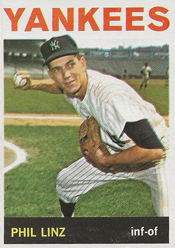
A utility player during the regular season, Linz started all seven games of the Series for the Yankees as their shortstop and leadoff batter.

Linz was in the Yankees’ starting lineup against the 1964 Cardinals because shortstop Tony Kubek had a severely sprained wrist and couldn’t play.

A right-handed batter, Linz had seven hits, including two home runs, and scored five times in that Series. He also made two errors, including a Game 7 miscue that enabled the Cardinals to take the lead, and was involved in a costly misplay in Game 4.

Music man

Linz was 22 when he debuted with the Yankees in 1962. Because he played all four infield positions and the outfield, Linz became a valuable backup.

After the 1962 season, the Cardinals, seeking a shortstop, wanted Linz. According to the St. Louis Globe-Democrat, Linz was “a No. 1 target” of general manager Bing Devine, but a deal couldn’t be worked out. (The Cardinals got Dick Groat from the Pirates instead.)

In 1964, Linz made 50 starts at shortstop, 38 at third base and three at second base for an injury-plagued Yankees team trying to stay in contention with the White Sox and Orioles for the American League pennant.

After the Yankees were swept by the White Sox in a four-game series at Chicago in August, dropping them 4.5 games out of first place, they boarded a bus for the airport. In his book “The Mick,” Yankees slugger Mickey Mantle said, “I had sneaked a couple of beers on the bus. Probably a few other guys did the same.”

Linz, seated near the back, took out a new harmonica he was learning to play and began an amateurish rendition of “Mary Had a Little Lamb.”

From the front of the bus, manager Yogi Berra hollered out for Linz to stop playing. Unsure what Berra said, Linz asked Mantle what he heard. In his book, Mantle, a prankster, said he replied, “Play it fast.”

As Linz tooted the tune, Berra confronted him and they argued. In the heat of the moment, Linz flipped the harmonica to Berra, who slapped at the instrument, The Sporting News reported. The harmonica struck teammate Joe Pepitone on the knee, fell to the floor and broke apart.

Linz apologized to Berra the next day and was fined $200, according to The Sporting News. Later, a harmonica company gave Linz $10,000 to endorse its product, the New York Times reported. Not a bad return for Linz on his investment in the $2.50 harmonica.

Though some initially thought the incident was an indication the Yankees were cracking under pennant pressure, the opposite occurred.

The Yankees played the incident for laughs, relaxed and surged, winning 22 of 28 games in September and finishing a game ahead of the second-place White Sox.

Borrowed bat

Linz helped the Yankees beat Bob Gibson and the Cardinals in Game 2 of the 1964 World Series. Using a bat borrowed from Mantle, Linz had three hits, a walk, a RBI and scored two runs in the Yankees’ 8-3 victory at St. Louis.

“He could play regularly on a lot of ballclubs,” Cardinals third baseman Ken Boyer told the St. Louis Post-Dispatch.

With the Yankees ahead, 2-1, Linz led off the seventh inning with a single against Gibson and advanced from first to third on a wild pitch. Bobby Richardson followed with a single, scoring Linz.

In the ninth, Barney Schultz, who allowed one home run in 30 appearances during the season, relieved Gibson and gave up a homer to the first batter he faced, Linz.

Linz fouled off several pitches before connecting for the home run on a fastball from the knuckleball specialist. “I guess he wasn’t afraid of me,” Linz told the Post-Dispatch. Boxscore

Botched chance

The Yankees won two of the first three games of the Series and were leading, 3-0, in the sixth inning of Game 4 when the Cardinals put runners on first and second with one out.

Dick Groat hit a grounder that had the makings of an inning-ending double play. Second baseman Bobby Richardson went to his right, gloved the ball and intended to toss it to Linz, who was moving toward the bag at second, but the ball stuck in the webbing of Richardson’s glove.

After a moment of hesitation, Richardson managed to flip the ball with his glove hand to Linz, but their timing was off.

As the ball reached Linz, baserunner Curt Flood slid into him hard and the ball fell to the ground. “On any other Sunday, Flood would have been penalized 15 yards for clipping,” Linz said to the Post-Dispatch.

All runners were safe, loading the bases, and Richardson was charged with an error. The next batter, Ken Boyer, hit a grand slam against Al Downing, erasing the Yankees’ lead and propelling the Cardinals to victory. Boxscore

“It was entirely my fault,” Richardson told The Sporting News. “Phil couldn’t possibly have handled (the throw).”

Linz said to the Post-Dispatch, “It was just as much my fault. I was a little late getting to the bag. I was on the bag, but I had to reach back for the ball. That’s when Flood hit me.”

Flood told the New York Daily News, “I was sure they had me when I saw Richardson get the ball. All I wanted to do was break up the double play. So I slid into Linz’s right leg to knock him off balance.”

Turning point

In the winner-take-all Game 7, Linz was involved in the play that turned the momentum in the Cardinals’ favor.

The game was scoreless in the fourth inning when the Cardinals put runners on first and second with no outs. Tim McCarver hit a grounder sharply to first baseman Joe Pepitone. The Yankees were expecting to turn a double play.

Pepitone threw to Linz, covering second, for the forceout, but the return throw from Linz to pitcher Mel Stottlemyre, covering first, was wild. The ball sailed wide of first base and bounced to the bunting draping the stands. Ken Boyer scored from second, giving the Cardinals a 1-0 lead.

“A good throw and we got him,” Yogi Berra told the Post-Dispatch.

Instead of two outs, none in and a runner on third, the Cardinals had one out, one in and a runner on first because of the Linz error.

Berra called Linz’s wild throw “the key play” in the game. The Cardinals went on to score three runs, including a McCarver steal of home, in the inning.

The Cardinals took a 7-3 lead into the ninth. Gibson struck out Tom Tresh before Clete Boyer hit a home run, making the score 7-4. Johnny Blanchard struck out for the second out.

Up next was Linz. He hit a Gibson fastball deep to left. Lou Brock raced back to the wall and leaped, but the ball went into the stands, where it was caught by a fan, for a home run.

Linz’s homer made the score 7-5. Cardinals manager Johnny Keane, saying he was committed to Gibson’s heart, left him in the game to face Bobby Richardson, who hat 13 hits in the Series. If Richardson reached base, slugger Roger Maris was up next, representing the potential tying run, and Keane told The Sporting News, “I would have had to get Gibson out.”

Instead, Gibson got Richardson to pop out to second baseman Dal Maxvill, and the Cardinals won the championship. Boxscore
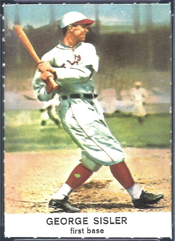
 

George Sisler, an elite hitter who spent his prime years with the St. Louis Browns, chose to wind down his playing career in the Cardinals’ organization.

On Dec. 13, 1930, Sisler signed with the Rochester Red Wings, a Cardinals farm club, to be their first baseman after 15 seasons in the majors with the Browns, Senators and Braves.
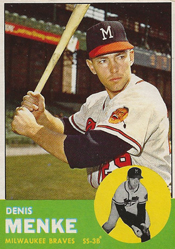
Though Sisler, 37, had hoped to continue in the majors in 1931 rather than go to the minors, the move proved beneficial because it gave him the chance to play for a championship club for the only time in his Hall of Fame career.

.400 hitter

Sisler’s baseball career soared when he enrolled at the University of Michigan. Branch Rickey was head baseball coach when Sisler arrived there. Rickey left Michigan to join the Browns after Sisler’s sophomore season. Two years later, in 1915, Sisler, 22, signed with the Browns, who were managed by Rickey, and pitched and played outfield and first base his rookie season.

Settled in at first base in 1916, Sisler went on to become a special player. “At his peak, Sisler was a striking figure _ supple, rhythmic and graceful in action,” Joe Williams wrote in the New York World-Telegram. “The hits flew off his bat with a whistling hum _ sharp, clean and powerful.”

A left-handed batter, Sisler hit .344 in 12 seasons with the Browns. He led the American League in batting in 1920 (.407) and 1922 (.420), joining Ty Cobb as the only American League players to twice hit .400 in a season. Sisler had 2,295 hits for the Browns in 1,647 games.

“For 12 years, he was the baseball idol of St. Louis boydom as no other player has been,” the St. Louis Post-Dispatch declared.

Sisler received the American League Most Valuable Player Award in 1922, but he sat out the 1923 season because a sinus infection impaired his vision. He returned in 1924 as player-manager and served in that role for three years. The 1927 season, when he played but didn’t manage, was Sisler’s last with the Browns. In December 1927, they sold his contract to the Senators. Five months later, the Senators sent him to the Braves.

Free agent

In three seasons (1928-30) with the Braves, Sisler hit .326. In 1930, Sisler batted .309, had 133 hits in 116 games, and was second on the club in RBI (67), but after the season the Braves informed him he wasn’t in their plans for 1931.

“Sisler’s main difficulty last season was his legs,” the Post-Dispatch reported. “He slowed down badly. His fielding was not as good as in previous campaigns.”

The Braves told Sisler he could stay with them as a coach, but Sisler wanted to keep playing, the Boston Globe reported.

In response, the Braves gave Sisler “permission to make the best arrangements possible for his service,” the Associated Press reported. In effect, The Sporting News noted, Sisler “was made a free agent.”

According to the Boston Globe, “The club has promised not to stand in his way. There’s only one sure thing about Sisler, and that is he won’t drop back into the minors.”

Limited options

Sisler attended the baseball winter meetings at New York in December 1930, looking to convince a big-league team to sign him as a first baseman. In 15 seasons in the majors, Sisler batted .340 and had 2,812 hits and 1,178 RBI, but he never played with a championship club.

The American League Tigers and National League Dodgers showed interest. So did the International League Rochester Red Wings, a Cardinals farm club. Branch Rickey was running the Cardinals’ front office, and Rochester club president Warren Giles knew Rickey endorsed bringing Sisler into the organization.

Rochester needed a first baseman to replace Rip Collins, whose contract was purchased by the Cardinals after he batted .376 and hit 40 home runs for the Red Wings in 1930. The Cardinals, defending National League champions, would have future Hall of Famer Jim Bottomley and Collins at first base in 1931. 

Giles told the Rochester Democrat-Chronicle, “George still feels he can play in the major leagues, but assured me if he decided to play in the minors that he would give Rochester first consideration.”

Sisler never had played in the minors, but when the Tigers and Dodgers failed to make offers, he agreed to sign with Rochester.

Sisler told the St. Louis Star-Times he was “sound and fit,” and could play for another five years.

“There are a number of clubs in the majors that could have used me,” Sisler said. “I’m still a good first baseman and can hit and field probably better than a number of the players who will be seen playing regularly in the American and National leagues next summer.”

Regarding going to the minors, Sisler said, “Baseball is baseball no matter where you play it. I probably will be just as happy over at Rochester as I might have been at Boston or some other places in the big leagues.”

Top of the heap

Sisler, 38, batted .303 for Rochester and was second on the club in hits (186) and doubles (37). Best of all, he got to play for a championship club. Rochester won the International League pennant for the fourth consecutive season.

In an editorial, the Post-Dispatch declared, “That such a pleasure has at last come to him as a member of the Rochester Red Wings will gladden the heart of many a St. Louis baseball fan who knew the work of the Browns’ former first baseman and held it in the highest esteem.”

Sisler “had a great deal to do” with the Red Wings winning the pennant, the Rochester Democrat-Chronicle reported. The Sporting News added Sisler “was a prominent factor” and “a good influence on the players.”

Limited mobility, however, hampered his fielding. His lack of range resulted in “a slower brand of baseball” at first base, the Rochester Democrat-Chronicle observed.

The Sporting News reported, “He was slow, and many plays, completed with ease and grace when he was in his prime, entailed extra effort.”

End of the line

As International League champions, Rochester advanced to play the American Association pennant-winning St. Paul Saints in the 1931 Junior World Series. In Game 1, Sisler singled in his first at-bat, but left because of a groin injury. He sat out the rest of the series, though Rochester prevailed.

Afterward, on Oct. 14, 1931, Sisler requested and got his unconditional release after he learned the club was planning to develop a younger player at first base for 1932, The Sporting News reported.

“I had an understanding at Rochester that if I wanted my release I could have it,” Sisler said to the Post-Dispatch.

In March 1932, Sisler became player-manager of the Shreveport team in the Texas League. He hit .287 in 70 games, and, at 39, was done as a player.

(Updated Nov. 25, 2024)

Denis Menke was a menace to Bob Gibson.

Menke was an infielder who played 13 seasons with the Braves (1962-67), Astros (1968-71, 1974) and Reds (1972-73). He also coached in the majors for 20 years.
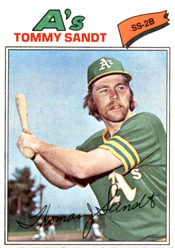
Though he batted .184 against Gibson in his career, Menke delivered multiple game-winning hits to beat the Cardinals’ ace. The highlights:

_ A three-run home run against Gibson in a 6-3 Braves win in 1963.

_ Two home runs against Gibson to drive in all the runs in a 4-0 Braves win in 1966.

_ A two-run single against Gibson in a 3-2 Astros win in 1968.

In the book “Stranger to the Game,” Gibson’s friend and teammate Joe Torre said, “Denis Menke was one who hit Bob a little better than he should have.”

Menke told Joe Schuster of Cardinals Yearbook in 2018, “Any success I had against him (Gibson) might have involved more than just a little luck.”

Power provider

Born in Bancroft, Iowa, Menke developed into an amateur baseball standout and was signed by the Braves for $125,000 in May 1958. He made his debut in the majors with them in 1962.

Menke played all four infield positions, though his primary spot was shortstop.

In 1963, Braves manager Bobby Bragan put him at third base and moved the future Hall of Famer, Eddie Mathews, from third to left field.

On Aug. 9, 1963, in a Friday night game against the Cardinals at Milwaukee, the Braves featured a lineup with Hank Aaron, Mathews, Torre and Menke in the third through sixth spots in the batting order against Gibson.

In the second inning, Menke doubled and scored. In the third, he hit a three-run home run, giving the Braves a 6-0 lead. Menke’s homer provided them the margin of victory in a 6-3 win. Boxscore

Adjustments at-bat

Three years later, in 1966, the Braves relocated from Milwaukee to Atlanta. Menke had two big performances against the Cardinals that season.

The first was on June 5, a Sunday in Atlanta. Batting in the leadoff spot, Menke produced five hits and five RBI in the Braves’ 14-4 victory. He had a pair of singles against starter Al Jackson, a RBI-single versus Don Dennis, a three-run home run against Art Mahaffey and another RBI-single versus Hal Woodeshick. Boxscore

Two months later, the Braves fired Bobby Bragan and replaced him with Billy Hitchcock, who returned Menke to shortstop.

On Sept. 21, 1966, a Wednesday night in Atlanta, Gibson was seeking his 21st win of the season when he started for the Cardinals against the Braves.

Before the game, Hitchcock asked Menke to come to the ballpark early and review film of himself at the plate. “He could hardly believe what he saw,” Hitchcock told the Atlanta Constitution.

A right-handed batter, Menke was “pulling his left foot on almost every pitch. Bailing out, as the players say,” The Sporting News reported.

Hitchcock said, “The only pitch he could handle was the one in on him. Anything from the middle to the outside part of the plate, he just couldn’t reach.”

During batting practice that evening, Menke “concentrated on keeping his left foot in place, then stepping toward, or into, the pitch,” The Sporting News noted.

Gibson held the Braves hitless until, with two outs in the fifth, Menke lined a pitch to left. According to the St. Louis Post-Dispatch, the ball was “fair by inches” as it cleared the fence for a home run, giving the Braves a 1-0 lead. Cardinals manager Red Schoendienst said Menke was fooled by the pitch “and was stepping out when he hit it.”

In the seventh, Menke batted with runners on first and second, one out, and drove a Gibson pitch over the fence in left-center for a three-run home run and a 4-0 Braves lead. “He just hit a good pitch,” Schoendienst said.

Gibson limited the Braves to four hits in the game, but Menke’s two home runs supported the shutout pitching of Dick Kelley and gave the Braves the win. Boxscore

“Gibson pitched one heck of a game,” said Schoendienst. “He didn’t make any mistakes, really. That kid (Menke) just hit the ball. That’s all.”

Special delivery

Menke was dealt to the Astros after the 1967 season and became the second baseman in 1968 when Joe Morgan was sidelined because of a knee injury.

The 1968 season is when Gibson posted a 1.12 ERA and was the recipient of the National League Most Valuable Player Award and Cy Young Award, but Menke cost him a win that season.

On May 12, 1968, a Sunday in St. Louis, the Cardinals led the Astros, 2-1, when Menke faced Gibson in the seventh inning with the bases loaded and two outs.

Gibson’s first pitch to Menke was called a ball by plate umpire Bob Engel. Gibson told the Post-Dispatch, “The guy behind the plate was calling balls on pitches that were waist high. That’s what happened on Menke. The first pitch was a ball and I know it was a strike.”

The second pitch clearly was outside the strike zone, but instead of the count being 1-and-1, it was 2-and-0.

With the bases loaded, “I’m just trying to get the ball over” on the third pitch, Gibson said.

Menke hit it for a two-run single, giving the Astros a 3-2 lead.

Starter Larry Dierker held the Cardinals scoreless over the last three innings to seal the win for the Astros. Boxscore

Moving on

Menke was the Astros’ shortstop in 1969 and 1970, and was named to the National League all-star team both years.

Learning from Astros manager Harry Walker, the former Cardinal, how to hit to all fields, Menke led the club in hits (149) and RBI (90) in 1969, and in hits (171) and RBI (92) in 1970.

Traded with Morgan and others to the Reds in November 1971, Menke was their third baseman when they won consecutive division titles in 1972 and 1973. In the 1972 World Series versus the Athletics, Menke batted a mere .083, but he hit a home run against Catfish Hunter and fielded 29 chances flawlessly at third.

For his career, Menke produced 1,270 hits.

After three seasons as a minor-league manager, Menke was a coach in the majors with the Blue Jays (1980-81), Astros (1983-88), Phillies (1989-96) and Reds (1997-2000).

During his time in the Cardinals’ organization, Tommy Sandt won a labor grievance, played in the same infield with Tony La Russa and Jim Riggleman, and got traded for a pitcher who became a World Series hero.

Though he never played in the majors for the Cardinals, Sandt was in their farm system after being acquired from the Athletics.
It was an unconventional adventure.

Hanging in there

Sandt was chosen by the Athletics in the second round of the 1969 amateur baseball draft. He said he almost quit in 1973 when he was demoted from Class AA Birmingham to Class A Burlington, but Burlington manager Rene Lachemann convinced him to keep trying. “He saved my career,” Sandt told the Pittsburgh Post-Gazette.

Sandt hit .301 for Burlington and began to advance again. In 1975, his seventh season in the minors, Sandt was called up to the Athletics in June, made his debut in the majors as a defensive replacement at second base in a game against the Angels, and was sent back down. He hit .309 for Class AAA Tucson in 1975.

At spring training in 1976, Sandt was considered a longshot to earn a spot with the Athletics until he caught the attention of manager Chuck Tanner during a baserunning drill.

“The A’s wore white shoes then and I didn’t have any, so someone loaned me some new white shoes,” Sandt told the Pittsburgh Press. “I wore them to run the bases and came up with blisters. They started bleeding and Chuck told me to go in and change my shoes. I told him I’d gut it out. I didn’t know it, but Chuck told me later I made the club right there.”

Tanner confirmed to the Honolulu Star-Bulletin, “Tommy made my club that day. I figured if a guy will do that, he must want it bad.”

Sandt spent the 1976 season with the Athletics as a backup to second baseman Phil Garner and shortstop Bert Campaneris, played in 41 games and hit .209.

Instead of it being the start to a playing career in the majors, it turned out to be the end.

Money matters

Though Jack McKeon had become Athletics manager after cash-strapped club owner Charlie Finley traded Tanner to the Pirates, Sandt figured to be back with the team in 1977.

At spring training, Sandt got into a contract squabble with Finley. Rather than negotiate, Finley invoked a clause to renew Sandt’s contract and cut his salary by more than 20 percent. Under baseball’s labor agreement with the players’ union, Finley had the right to renew Sandt’s contract but the maximum he could cut a salary was 20 percent.

Sandt filed a grievance. Finley retaliated by selling Sandt’s contract to the Cardinals on March 26, 1977.

Off and on

The Cardinals assigned Sandt, 26, to their Class AAA New Orleans farm club. New Orleans opened its season with a double-play combination of Tony La Russa at second and Sandt at shortstop. In a game against Iowa, Sandt and La Russa each hit a home run.

La Russa, in his final season as a player before embarking on a Hall of Fame managing career, also was serving as a coach for New Orleans manager Lance Nichols. Ken Oberkfell eventually took over at second base. La Russa managed New Orleans for five games while Nichols was treated for lymphoma.

In the book, “Tony La Russa: Man on a Mission,” Oberkfell recalled a lesson he learned from La Russa and Sandt after Oklahoma City baserunner Lonnie Smith upended him on a slide into second.

“I guess it was kind of a cheap shot, but I didn’t really know any better and I didn’t think anything about it,” Oberkfell said. “I got to the bench after the inning and Tony and Tommy Sandt came up to me and said, ‘Don’t worry, we’ll get him for you.’ I was like, ‘Get who for what?’ That was a part of the game I really didn’t know much about.”

On May 28, 1977, an arbitrator who reviewed Sandt’s grievance against Finley ruled in favor of Sandt, declared the contract invalid and made him a free agent.

Sandt left the New Orleans club and went home, hoping to field offers. The Cardinals showed the most interest, and on June 18, 1977, they signed Sandt and sent him back to New Orleans.

The Cardinals also promoted Jim Riggleman from Class AA to be the New Orleans third baseman. Riggleman, a future Cardinals coach and big-league manager, and Sandt provided pop in the lineup. Four times, they combined to hit home runs in the same game.

Sandt was called up by the Cardinals when rosters expanded in September 1977, but never played in a game for them.

Moving ahead

The Cardinals were loaded with infielders at the major-league and Class AAA levels in 1978, so they loaned Sandt to the Blue Jays. Sandt was assigned to Class AAA Syracuse, a club managed by Vern Benson, a former Cardinals player and coach. Sandt played second base next to the shortstop, basketball’s Danny Ainge.

With his path to the Cardinals blocked by better prospects, Sandt was traded to the Pirates on Jan. 25, 1979, for a minor-league pitcher, John Stuper.

Stuper got called up to the Cardinals in 1982, became a member of the starting rotation and earned a complete-game win in Game 6 of the World Series, positioning them to clinch the championship the next night.

After three more seasons as a player in the Pirates’ farm system, Sandt became a minor-league manager for them in 1982. He managed for five seasons, including at Hawaii, where he was named manager of the year in the Pacific Coast League and helped a promising prospect, Barry Bonds.

In 1987, Sandt became a coach on the staff of Pirates manager Jim Leyland. Sandt was a Pirates coach for Leyland from 1987-96. Leyland kept Sandt on his coaching staff when he managed the Marlins (1997-98) and Rockies (1999). Sandt also was a Pirates coach for managers Gene Lamont (2000) and Lloyd McClendon (2001-02).

On Twitter, Pirates broadcaster Greg Brown called Sandt “a brilliant baseball man and as humble as they come.”

Asked by the Pittsburgh Post-Gazette what three words described him best, Sandt replied, “Fun-loving, emotional, dedicated.”

As a coach, Sandt developed a reputation for being a master at using the fungo stick to hit balls to players during fielding drills.

Another coach, Rich Donnelly, told the Miami Herald, “There’s no one better with a fungo. If the fungo was a sand wedge, Tommy Sandt would be Tiger Woods.”

The emergence of Albert Pujols as a big-league prospect enabled the Cardinals to swap third baseman Fernando Tatis for the left-handed reliever they needed.

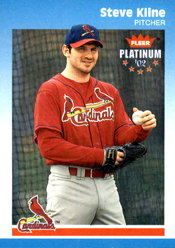
On Dec. 14, 2000, the Cardinals acquired pitchers Steve Kline and Dustin Hermanson from the Expos for Tatis and pitcher Britt Reames.
Hermanson was projected as a starter to join a Cardinals rotation with Darryl Kile, Matt Morris and Andy Benes, “but the player they really want is Kline,” the St. Louis Post-Dispatch reported

A reliever who led National League pitchers in appearances in 1999 (82) and 2000 (83), Kline was a durable, effective left-hander.

A lack of reliable left-handed relief limited the late-inning maneuvering Cardinals manager Tony La Russa could do in 2000. Jesse Orosco and Scott Radinsky both had health issues and hardly played. Their replacements were Jason Christiansen (5.40 ERA), Mike Mohler (9.00) and Mike Matthews (11.57).

“Kline is the left-handed reliever the Cardinals have been seeking for years,” columnist Bernie Miklasz wrote in the Post-Dispatch.

Stock drop

To get Kline, the Cardinals had to give up Tatis, a right-handed power hitter, but they were confident they had a replacement in Pujols. Though he had one season of experience as a professional, Pujols, 20, looked to the Cardinals to be on the cusp of reaching the majors.

Tatis, acquired by the Cardinals from the Rangers in July 1998, had a breakout season in 1999 when he became the first player to hit two grand slams in an inning. Tatis hit .298 in 1999 and had an on-base percentage of .404. He scored 104 runs, drove in 107, slugged 34 home runs and had 21 stolen bases.

He appeared headed for another big season in 2000 when he hit .375 in April and drove in 28 runs in 21 games, but on April 29 he suffered a tear of his left groin and was sidelined for two months.

When he returned on June 30, Cardinals management noticed Tatis wasn’t applying himself to conditioning and workouts.

“Tatis had issues a lot of guys face after having big years,” La Russa said to the Post-Dispatch. “They forget how hard they worked. I didn’t think he prepared himself as well.”

Tatis hit .183 in August and .186 in September. La Russa benched him in the National League Division Series versus the Braves.

After the season, the Post-Dispatch reported, “There apparently is some indecision in the organization whether to trade Tatis, but on the horizon is Albert Pujols.”

Playing primarily third base, Pujols hit .314 with 41 doubles and 96 RBI in the Cardinals’ farm system in 2000.

“Fast-rising Albert Pujols is not figured to be far away” from being ready for the majors, the Post-Dispatch reported.

Assessing value

After deciding to trade Tatis, Cardinals general manager Walt Jocketty tried to convince the Expos to take a player other than Reames in the deal. Reames debuted with the Cardinals in August 2000 and was 2-1 with a 2.88 ERA. He also got the win in the decisive Game 3 of the NL Division Series.

The Expos wouldn’t make the trade without Reames included.

“I know Walt tried as hard as he could to get him out of the deal,” La Russa said. “He even offered three or four players instead of Britt.”

When the trade was announced, Bernie Miklasz noted, “Some fans are freaking out” about the departure of Tatis.

“That’s understandable,” Miklasz wrote. “Baseball has become a homer-crazy game and we’ve developed a homer-crazy mentality.

“Jocketty was absolutely correct to go out and reinforce his pitching staff, even if it meant sacrificing Tatis,” Miklasz concluded. “Jocketty wouldn’t have made the deal unless the organization was confident Albert Pujols is the real deal. Pujols could be a Cardinal next year.”

Tatis told Miklasz, “I was surprised to be traded. I was disappointed. If I didn’t get hurt last season, with the numbers I would have put up, they wouldn’t have traded me.

“I thought I’d be in St. Louis for a long time.”

Loopy lefty

Jack Todd of the Montreal Gazette offered, “If there is a part of this deal that causes real pain in Montreal, it’s the loss of Kline.”

Kline had a reputation for being a free spirit. “He’s a lefty, and all lefties are crazy,” Hermanson told the Post-Dispatch. “You want those guys in the bullpen, not scared to do anything.”

Born in rural Sunbury, Pa., about 55 miles north of the state capital of Harrisburg, Kline said, “I’m weird. I am a goofy left-hander. They called me a groundhog when I was a kid. Nothing but dirt.

“My brothers were electrocuting me when I was a kid. I was ratting everyone out to my mom, so they tied me up to a fence and they shocked me to teach me a lesson. I learned quick.”

Kline said he threw sinkers to right-handed batters and sliders to left-handers, and he enjoyed pitching as often as possible.

“I get paid to pitch,” he said. “I’m not getting paid to sit there.”

One-sided deal

The deal worked out well for the Cardinals.

Kline established a Cardinals franchise record for most games pitched in a season, making a league-leading 89 appearances in 2001. The only others to pitch in 80 or more games in a season for the Cardinals are Ray King (86 in 2004) and Kevin Siegrist (81 in 2015).

Left-handed batters hit .150 versus Kline in 2001 and none hit a home run against him.

Hermanson was 14-13 in 33 starts for the 2001 Cardinals.

Pujols opened the 2001 season as the Cardinals’ left fielder. He also made starts at third base, first base and right field. He won the National League Rookie of the Year Award, hitting .329, scoring 112 runs and driving in 130.

In four seasons (2001-2004) with the Cardinals, Kline was 12-11 with 21 saves and a 2.69 ERA. In 13 postseason games for St. Louis, Kline was 0-1 with two saves and an 0.96 ERA. He became a free agent after the 2004 season and signed with the Orioles.

Hermanson was traded to the Red Sox for prospects after the 2001 season. He rejoined the Cardinals in 2003 and got released in June. Two years later, he had 34 saves as the closer for the World Series champion White Sox.

In three years with the Expos, Tatis hit .225. He never again approached the kind of success he had with the Cardinals.

Reames also played three seasons with the Expos and was 5-12 with a 5.53 ERA.

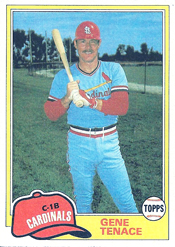
Gene Tenace brought to the Cardinals a winning pedigree, leadership and a consistent ability to get on base. Willing to accept a reserve role as a catcher and first baseman, Tenace was a good fit for a franchise looking to change its culture and transform from underachievers to champions.

On Dec. 8, 1980, the Cardinals got Tenace, pitchers Rollie Fingers and Bob Shirley, and a player to be named, catcher Bob Geren, from the Padres for catchers Terry Kennedy and Steve Swisher, infielder Mike Phillips and pitchers John Littlefield, John Urrea, Kim Seaman and Al Olmsted.

Fingers, a closer and future Hall of Famer, was the player who got the attention for the Cardinals when the deal was made, but Tenace was the one who contributed the most.

Four days after acquiring Fingers, Whitey Herzog, who had the dual roles of Cardinals manager and general manager, dealt him and another future Hall of Famer, catcher Ted Simmons, to the Brewers. Tenace remained with the Cardinals for two years, fulfilled the role Herzog envisioned for him, and helped them become World Series champions in 1982.

Finding his way

Tenace was born Fiore Gino Tennaci in Russelton, Pa. He grew up in Lucasville, Ohio, and his name was changed to Fury Gene Tenace because the family wanted it to be more American than Italian.

He was 18 and a shortstop when the Athletics selected him in the 20th round of baseball’s first amateur draft in 1965. Tenace was an outfielder and third baseman in the Athletics’ farm system before he was converted to catcher in 1968.

A right-handed batter, Tenace generated tremendous bat speed. “I play to hit,” Tenace told The Sporting News. “I love to hit.”

A turning point in Tenace’s career came in 1969 when he was assigned to Birmingham, a Class AA club managed by Gus Niarhos. A former big-league catcher who started for the 1948 Yankees before being replaced by future Hall of Famer Yogi Berra, Niarhos taught Tenace how to play the position.

Tenace, 22, was called up to the Athletics in May 1969. After he went 0-for-4 in his debut against Denny McLain, Tenace got a single the next day versus Luis Tiant for his first hit in the majors.

Though the Athletics liked Tenace’s hitting, the catcher they liked best was Dave Duncan, the future Cardinals pitching coach. Duncan was the Athletics’ starting catcher in 1971, when they won the first of five consecutive division titles.

Duncan was the starter again in 1972 before he went into a hitting slump. “He wasn’t doing it with the bat and it was beginning to affect his catching,” Athletics manager Dick Williams said.

Tenace replaced Duncan for the last two months of the 1972 season, and he was the starter when the Athletics went into the World Series against the Reds.

Valuable player

Tenace took center stage in the 1972 World Series. In Game 1, he became the first player to hit home runs in his first two World Series at-bats. The homers versus Gary Nolan produced all the runs for the Athletics in a 3-2 victory. Boxscore

Tenace hit .348 with four home runs and nine RBI against the Reds and was named most valuable player of the 1972 World Series. Video

Moved to first base in 1973, he had 24 home runs and a .387 on-base percentage. In the World Series against the Mets, Tenace had 11 walks and three hits.

In 1974, when the Athletics won a third consecutive World Series title, Tenace again played first base and hit 26 home runs. He returned to catcher in 1975 and had 29 home runs and an on-base percentage of .395.

Regarding his ability to get on base often, Tenace told the St. Louis Post-Dispatch, “I’ve always used discipline at the plate. I know my limitations. I’ve been in the game long enough to know I can handle only certain pitches.”

Herr almost dealt

Tenace became a free agent after the 1976 season and signed with the Padres. He was tough versus the Cardinals. In 1978, he had 11 RBI in 12 games against them and his on-base percentage was .467.

In 1980, Tenace and Fingers clashed with manager Jerry Coleman and asked to be traded. According to The Sporting News, the Padres tried to trade Tenace to the Cubs in July 1980, but it didn’t work out.

Herzog was interested in both Fingers and Tenace. The Padres wanted a young catcher, and the Cardinals’ Terry Kennedy and the Pirates’ Tony Pena were the two who appealed to them most.

In his book, “White Rat: A Life in Baseball,” Herzog said Kennedy approached him near the end of the 1980 season and asked to be traded to a team needing a starting catcher.

Herzog and Padres general manager Jack McKeon met during the 1980 World Series and agreed to a trade of Kennedy, second baseman Tommy Herr and others for Fingers, Tenace and Bob Shirley. “I can make that deal now,” Herzog told the Post-Dispatch.

Herr said, “I don’t know if I’d like it or not. I want to play with a contender.”

The trade “was close” to being made, The Sporting News reported, but it got held up because of a snag over Fingers’ contract.

Herzog and McKeon resumed their talks at the baseball winter meetings in December. In his book, Herzog said he almost traded Kennedy to the Reds for reliever Tom Hume, but when the Padres agreed to take other players instead of Herr, Herzog closed the deal with them.

Good as advertised

Herzog said Fingers was “the great relief pitcher I needed, but not the one I really wanted. The guy I was really after was Bruce Sutter.”

Fingers was insurance in case Herzog couldn’t make a deal for Sutter.

On Dec. 9, 1980, the day after the trade with the Padres, the Cardinals acquired Sutter from the Cubs. With catcher Darrell Porter joining the Cardinals earlier in the week as a free agent and Sutter filling the closer role, Herzog decided to package Fingers and Ted Simmons in a trade to the Brewers.

Tenace was projected to back up Porter at catcher and Keith Hernandez at first base. Unfazed about a reserve role, Tenace said, “I’ve been adjusting all my life.”

Tenace delivered what was expected of him. He had on-base percentages for the Cardinals of .416 in 1981 and .436 in 1982.

A leader in the clubhouse, he made sure the reserves were as ready as he was to play. Outfielder Tito Landrum said, “If I start having a letdown, he comes over and kicks my rear end. Literally. He pulls no punches. He lets you know.”

After the Cardinals won Game 7 of the 1982 World Series versus the Brewers, Porter, like Tenace in 1972, was named the Series’ most valuable player, meaning the Cardinals had two catchers on the same team who had received the honor.

Tenace became a free agent after the 1982 World Series. Herzog said the Cardinals wanted to keep him, but on a one-year contract. When the Pirates gave Tenace a three-year deal, he accepted.

After one season with the Pirates, Tenace was through playing. He went on to coach, manage and instruct, including a stint with the Cardinals as minor league hitting coordinator from 2002-07.