Feeds:
Posts
Comments

The Cardinals intended for Chris Sabo to replace Todd Zeile as their first baseman, but the plan fizzled when Sabo’s back gave out.
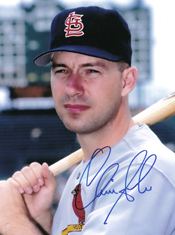
On June 8, 1995, the Cardinals signed Sabo after he was released by the White Sox. A third baseman, Sabo was sent to the Cardinals’ Louisville farm club to learn to play first base so he could be brought back to the majors and fill multiple roles.

About a week later, on June 16, 1995, Sabo was called up to the Cardinals amid a massive shakeup. On the day he arrived, manager Joe Torre was fired and Zeile was traded to the Cubs.

Interim manager Mike Jorgensen put Sabo into the lineup at first base, but his time with the Cardinals lasted only a few games.

Cincinnati kid

Sabo won the National League Rookie of the Year Award in 1988 when he produced 40 doubles and 46 stolen bases as third baseman for the Reds.

A son of a plumber from Detroit, Sabo became a Cincinnati favorite. Nicknamed “Spuds” for a resemblance to the dog Spuds McKenzie in beer commercials, Sabo wore goggles, a buzz cut and a K-mart wardrobe, and drove a well-used 1982 Ford Escort.

In 1990, Sabo had 38 doubles, 25 home runs and 25 steals for the champion Reds. In the Reds’ World Series sweep of manager Tony La Russa’s favored Athletics, Sabo hit .563 with two home runs and fielded flawlessly at third.

After the 1993 season, Sabo became a free agent, rejected an offer from the Mets and signed a one-year contract for $2 million with the Orioles because he viewed them as a contender.

The Orioles opened the 1994 season with a left side of the infield featuring Cal Ripken Jr. at shortstop and Sabo at third, but it didn’t last. Sabo hit .228 in April and went on the disabled list in May because of a bad back. His replacement, Leo Gomez, hit .325 in May and held the job.

Used primarily in the outfield and as designated hitter, Sabo played in 68 games for the Orioles, hit .256 and departed for free agency after the season.

New role

The Cardinals considered signing Sabo to be their third baseman, the St. Louis Post-Dispatch reported, but traded for Scott Cooper of the Red Sox instead. When no other teams showed interest, Sabo, 33, thought about returning to the University of Michigan to finish the work he started on a degree 14 years earlier, the Chicago Tribune reported.

Sabo’s plans changed on April 10, 1995, when the White Sox gave him a one-year contract at $550,000 to be their designated hitter. John Kruk was the first choice of White Sox general manager Ron Schueler to be designated hitter, the Tribune reported, but when Kruk, a free agent, opted to retire, Schueler selected Sabo.

Sabo plays with “intensity and has fire in his eyes,” Schueler said.

Said Sabo: “I’ve never been very level-headed. I have quite a temper. It’s the only way I’ve been able to get where I have. I get fiery. I don’t have a world of talent. So I fire up to help myself.”

Sabo preferred to play third base, but the White Sox had a Gold Glove winner, Robin Ventura, there.

What a Kruk

The White Sox opened the 1995 season with Sabo batting in the cleanup spot between slugger Frank Thomas and Ventura. In May, Kruk changed his mind about retirement and signed with the White Sox, who intended to make him the designated hitter.

Miffed, Sabo told The Cincinnati Post he’d return to the Reds “for a song.”

“I plan on being with the Reds again before I’m done, one way or the other,” Sabo told The Post.

Kruk, 34, joined the White Sox on May 24, 1995. The Tribune’s Paul Sullivan described him as having “the physique of Babe Ruth, the batting eye of Tony Gwynn and the sarcastic wit of David Letterman. He chain-smoked cigarettes, didn’t watch his weight and proudly wore the same T-shirt day after day.”

The White Sox released Sabo on June 5. In 20 games for them, he hit .254 with one home run.

Team in turmoil

Three days later, on June 8, 1995, the Cardinals signed Sabo and indicated he would be used as a utility player for them after he went to Louisville and learned to play first base.

“We know he can play third and the outfield,” said Cardinals manager Joe Torre. “If he can play first, it will add to his versatility. If he’s healthy, he’s a threat with the bat. He can hit the homer and he pulls the ball. He plays well defensively.”

Sabo hit .393 in nine games as Louisville’s first baseman.

Promoted to the Cardinals, he never got to play for Torre. With the Cardinals’ record at 20-27, general manager Walt Jocketty fired Torre on the morning of June 16 before trading Zeile. Though Zeile hit .291 with 22 RBI in 34 games, he was dealt after accusing management of reneging on a contract agreement.

With Zeile gone, Sabo became the first baseman and was assigned uniform No. 18, the same previously worn by Mike Shannon and Andy Van Slyke. In his Cardinals debut on June 16 against the Giants at St. Louis, Sabo batted fifth in the order between Ray Lankford and Scott Cooper. He made a fielding error in the second inning, leading to a run, but had a run-scoring single in the fifth. Boxscore

Sabo played in four more games for the Cardinals, making another start at first, one at third and two pinch-hit appearances. He had a two-run double versus Dodgers rookie Hideo Nomo on June 19. Boxscore

During batting practice one day, Sabo developed back spasms. He went on the disabled list on June 29, 1995, and remained sidelined for six weeks. “I don’t think there’s a lot of fuel left in the tank,” Cardinals coach Gaylen Pitts told Larry Harnly of The State Journal-Register of Springfield, Ill.

In August 1995, the Cardinals sent Sabo to their St. Petersburg farm club in the Florida State League to get in condition for a possible return to the majors in September. Instead, after Sabo hit .231 in 14 games for St. Petersburg, the Cardinals released him because “he didn’t dominate that league like you’d think he would,” Jocketty said.

In 13 at-bats for St. Louis, Sabo had two hits and three RBI.

As he predicted, Sabo returned to the Reds and played his final major-league season with them in 1996.

In 2018, Sabo was named head baseball coach at the University of Akron.

(Updated Dec. 8, 2024)

When Whitey Herzog became Cardinals manager, he replaced a friend who had been his roommate and teammate with the Mets.

On June 8, 1980, the Cardinals fired manager Ken Boyer and hired Herzog to succeed him.

Boyer, an all-star and Gold Glove Award winner as Cardinals third baseman in the 1950s and 1960s, was their manager since April 1978. Herzog managed the Royals to three consecutive division titles before being fired after the 1979 season.

In 1966, the Mets had Boyer as their third baseman and Herzog as a coach. In his book, “White Rat: A Life in Baseball,” Herzog said he and Ken Boyer shared a New York apartment with Yankees players Roger Maris and Clete Boyer, Ken’s brother.

“When the Mets were on the road, Clete and Roger had the place, and when the Yankees were on the road, Kenny and I took it over,” Herzog said.

After Boyer was fired by the Cardinals, he told a St. Louis Post-Dispatch reporter, “Wish Whitey Herzog good luck. I hope they can turn it around.”

The comment was relayed to Herzog, who said, “I appreciate that. We are very good friends.”

Time for a change

After Herzog left the Royals, Cardinals general manager John Claiborne called him occasionally to seek his opinions on players. Claiborne and Herzog had worked together for Bing Devine with the Mets.

At one point in their conversations, Herzog said, Claiborne asked whether he’d want to become a paid consultant to the Cardinals. “I told him I didn’t want to get tied up with something like that, but I’d be happy to give him my opinions when he asked for them,” Herzog said.

The 1980 Cardinals hit the skids early and Claiborne and club owner Gussie Busch determined Boyer needed to go.

On Saturday, June 7, 1980, Herzog said he got a call from Busch’s attorney, Lou Susman, who asked him to meet Busch in St. Louis the next morning. Meanwhile, Claiborne headed to Montreal, where the Cardinals were playing, to inform Boyer he was fired. Claiborne intended to get to Montreal on Saturday night and meet with Boyer the next morning, but a rainstorm canceled the connecting flight and Claiborne had to spend the night in Chicago.

On the morning of June 8, 1980, Herzog went to Busch’s estate at Grant’s Farm and Claiborne took a flight from Chicago to Montreal, where the Cardinals and Expos were to play a Sunday afternoon doubleheader.

Herzog met with Busch and Susman, and was offered a one-year, $100,000 contract to manage the Cardinals. When Herzog objected to the length of the contract, Busch countered with a three-year deal through the 1982 season. Herzog accepted and Busch made plans to announce the hiring in a news conference late in the afternoon.

(In a 2016 interview with Cardinals Yearbook, Herzog said he was headed out the front door after learning the contract offer was for one year. According to Herzog, Busch then said, “Come back here. You’re right. The ballplayers have long-term contracts; you should have one, too.”)

At Montreal, the Cardinals lost Game 1 of the doubleheader, dropping their record to 18-33 and giving them 21 losses in their last 26 games.

Boyer was in the clubhouse, making out the lineup card for Game 2, when he looked up and was surprised to see Claiborne enter. “I thought for certain he had come here to discuss possible trades,” Boyer told the Montreal Gazette.

Instead, Claiborne told Boyer he was fired. “This is something you want to talk about to a man face to face, not over the telephone,” Claiborne said.

Claiborne offered Boyer another job within the organization, but Boyer said he wanted time to think it over.

“Boyer was on his way to St. Louis by the second inning of the second game,” the Gazette reported.

Coach Jack Krol filled in as manager for Game 2, and the Cardinals lost again.

Mourning in Montreal

In the locker room, after getting swept in the doubleheader, most Cardinals said they were sorry Boyer was gone and exonerated him of blame for the team’s record. Boyer was 166-191 as Cardinals manager.

In comments to the Post-Dispatch, first baseman Keith Hernandez said the 1980 Cardinals were “the worst team I’ve been on since I’ve been in the major leagues. The worst. We are bad. The manager is only as good as his horses and we don’t have the horses. I’m going to miss Ken Boyer.”

Second baseman Tommy Herr said, “There’s a lack of professionalism among certain players as far as guys running groundballs out, 100 percent all-out effort.”

Cardinals catcher Ted Simmons and pitcher Bob Forsch were two of the players most upset by Boyer’s firing, according to the Post-Dispatch. “Old Cardinals die hard,” Simmons said.

Pitcher John Fugham told The Sporting News, “Unfortunately, there were not 25 people on this team as intense as Kenny Boyer was. Therein lies the problem.”

Vern Rapp, who two years earlier was fired while the Cardinals were in Montreal and replaced as manager by Boyer, was a coach with the 1980 Expos. Asked his reaction to Boyer’s firing, Rapp told the Post-Dispatch, “I feel sorry for anybody it happened to. I know how it feels. It’s not a good feeling.”

Oh, brother

At the news conference at Grant’s Farm introducing him as Cardinals manager, Herzog said, “I’m going to take this dang team and run it like I think it should be run. I don’t think I’ve ever had trouble with players hustling. I understand that’s been a problem here. I think you’ll see the Cardinals running out groundballs.”

Asked whether the Cardinals needed a leader to emerge from within the team, Herzog said, “I don’t need a team leader. I’m the leader.”

Said Busch: “My type of manager, without any argument.”

Born and raised in New Athens, Ill., Herzog described himself as a “very opinionated, hardheaded Dutchman.”

At birth, he was named Dorrell Norman Elvert Herzog. His mother said she intended to name him Darrell, but the name got misspelled. In New Athens, where he excelled at basketball as well as baseball, everyone called him Relly. In the New Athens High School yearbook, it was noted, “He likes girls even more than basketball.” As a professional ballplayer, he got nicknamed Whitey because of his light blonde hair.

Herzog had two brothers _ Therron, who everyone called Herman, and Codell, who everyone called Butzy.

When Herzog was named Cardinals manager, Butzy, who “never played baseball in his life,” told Whitey what lineup he should use to help the Cardinals improve.

“I may play his lineup,” Whitey said.

“He better,” Butzy told the Post-Dispatch, “or we’ll have a fight.”

Whether or not it was with Butzy’s help, the Cardinals went on to win three National League pennants and a World Series championship during Whitey’s 11 years as their manager.

Asked about the style of baseball that became known as Whiteyball, Herzog told Cardinals Magazine, “Whiteyball was nothing more than using speed and playing good, sound, fundamental baseball. And your players have to buy in to it.”

Herzog told Cardinals Yearbook, “We changed the way the Cardinals played baseball. We went back to the old Gashouse Gang philosophy.”

Author Mike Mitchell has written a book, “Mr. Rickey’s Redbirds,” and it’s a compelling blend of baseball and American history.

I read it and found it to be thought-provoking and informative.
The book can be ordered on Amazon or at the author’s website, rickeysredbirds.com.

I interviewed Mitchell via email in May 2020. The interview is presented here in an edited, condensed form.

Q: Congratulations on writing the book. What inspired you to do it?

A: “I wrote a book many years ago and appreciated the process. I enjoy researching and writing, but needed time and a new idea. Both emerged around 2015. I had moved back to St. Louis just a few years before, having wound down some previous business commitments. I was fortunate to have the freedom to pursue a new venture. What started as a curious peek into the team’s first World Series championship squad in 1926 eventually became the book that is out today.”

Q: How does this book differ from others about the Cardinals and baseball?

A: “A lot of baseball books focus on a particular person or a particular season. At the other end of the spectrum are books that present a comprehensive history. This book is somewhere in between. It’s largely about Branch Rickey, but also the eras in which he played, managed or ran a front office. It covers a lot of ground because Rickey covered a lot of ground.

“At times, it’s also a book that delves into the broader sweep of history. Prohibition, the Black Sox scandal, the Great Depression, and segregation are all topics Rickey and the Cardinals face during his time in St. Louis.”

Q: From inception to completion, how long did the project take and what was the most time-consuming aspect?

A: “It started around 2015 when I began researching the 1926 team, but as I continued to dig into the material, I quickly realized it was a much bigger story. By 2017, I had the outline for what the book became and by the summer of 2018, I was probably 75 percent complete and expected to have a book done by Christmas of that year. But my father passed away in January of 2019, and from about six months before that until six months afterward, I lost my appetite for the project. I picked it up again in the second half of last year.”

Q: What was the biggest obstacle or challenge you had to overcome and how did you do it?

A: “With the Internet and digitalization of many newspapers, magazines and books, access to information isn’t an issue. Deciding what to include among the fire hose of facts, figures and data available is. One of the ways I handle this is to include all sorts of supplemental information in the end notes of every chapter.”

Q: The book is honest and accurate, and doesn’t sugarcoat or sensationalize. How were you able to strike the right balance?

A: “I can’t say it was some grand strategy, but I can say I started with a blank slate and a curious mind. Whether the information was positive or negative, my main interest was telling a captivating story in a compelling fashion. One thing I notice is that once a book is in print, certain ideas, stories, and quotes get injected into the bloodstream of history. Good stories tend to get told again. I’m sure I’ve fallen for it myself, but I try to be skeptical anytime I see a quote that gets endlessly repeated without attribution. Skepticism, combined with curiosity, goes a long way.”

Q: Do you think anyone in baseball today has qualities similar to Branch Rickey?

A: “If Bill James is the father of SABR metrics, Branch Rickey is the grandfather. As manager of the Browns in 1914, he had a sportswriter named Travis Hoke charting pitches and counting bases, not hits. Later with the Dodgers, he hired a statistician, Allan Roth. The two developed a formula for wins based on things like on-base and slugging percentage.

“If I had to name one person that fits the Rickey mold, Bill DeWitt Jr. comes to mind. His father had a long history with Rickey, worked for him for years. It was Rickey who brokered the deal that saw DeWitt Sr. and Don Barnes take control of the Browns. As a general manager, DeWitt Sr. became the first executive to win pennants in both leagues (1944 Browns, 1961 Reds). Bill Veeck said in the early 1960s, that outside of Rickey, there’s no smarter man in baseball than DeWitt. This is the environment in which DeWitt Jr. grew up.”

Q: What are your personal remembrances of Cardinals baseball and what was its impact on you?

A: “When I think of Cardinals baseball, I think of my family and summertime. My earliest memories aren’t of watching games, but listening to them on the radio with my father, either in the car or on our patio. While I live in St. Louis now, I didn’t grow up here. The only time we saw the Cardinals on television was Sunday road games, or the rare occasion the team would be on the Game of the Week. We made the trip to St. Louis to watch games only a handful of times a year.

“My father got his love for Cardinals baseball from his father, my grandfather, who was born in 1893. I like to think that between the three of us, we’ve had memories of nearly every Cardinals team.

“The weekend Ozzie Smith was inducted into the Hall of Fame, my father and I were there for his speech. That’s the only time I’ve been to Cooperstown, and it’s a memory I’ll always cherish.

“My mother merely tolerated baseball for many years. She’d watch the games because the males in the house would be watching them. That all changed in the summer of 1998. She became a fan that season because of Mark McGwire and the chase to break the record set by Roger Maris. She’s 88 now, still a fan, and like all of us, can’t wait for baseball to return.”

Q: Can you share with us a favorite personal baseball anecdote?

A: “Hands down, Game 6 of the 2011 World Series is my favorite baseball moment. I got lucky. It was the only game of the Series I attended. I remember the knot in my stomach in the bottom of the ninth inning as a group of Rangers fans in front of me stood up to cheer what seemed to be inevitable. Then the David Freese triple happened. Then Josh Hamilton homered and back to despair.  Somehow the Cardinals clawed back to tie it again. The roller coaster ride ended with the Freese home run to center. A friend said I began shouting, ”David Freese!” I don’t remember that, but I do remember the feeling. Pure joy.

“I’d never experienced a moment quite like that as a fan, and doubt I will again.”

Q: Anything else about the book?

A: “I hope readers can think about two questions after reading the book: 1. Why isn’t scout Charley Barrett in the Cardinals Hall of Fame? It may surprise people to realize how influential and well-known Barrett was in St. Louis. 2. Why isn’t Rickey’s image on the left-field wall at Busch Stadium along with other greats of the franchise? He didn’t play for the Cardinals, but neither did Jack Buck nor Gussie Busch. If a franchise can honor a broadcaster and an owner, why not a general manager?”

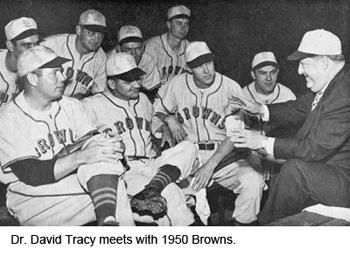
With or without a hypnotist, the 1950 Browns played like they were in a trance.

Two months into the 1950 season, the Browns fired Dr. David F. Tracy, a psychologist and hypnotist who they’d hoped would help turn the American League club from losers to winners.

The 1950 Browns slumbered to an 8-25 record before cutting ties with Tracy. They stayed in a stupor, finishing 58-96.
In the 21st century, professional sports teams commonly invest in helping athletes with the mental side as well as the physical. For instance, Bob Tewksbury, who pitched for the Cardinals in the 1990s and earned a master’s degree in sports psychology and counseling from Boston University, became a mental skills coach for the Red Sox and mental performance coach for the Giants.

Not so in 1950.

Brothers Bill DeWitt Sr. and Charles DeWitt, the Browns’ owners, were among the first to hire a psychologist to work with a big-league club. Looking back, their decision might be lauded as bold and innovative, but at the time many viewed it as desperate and gimmicky. The Browns needed better pitching, hitting and fielding, but Tracy offered hypnosis, psychology and metaphysics.

A self-promoter, who often seemed more P.T. Barnum than Sigmund Freud, Tracy generated skepticism as well as curiosity.

Mind games

Tracy grew up in Gloucester, Mass. He attended Tufts College for two years and became intrigued by the use of hypnosis to treat battle shock during World War I. Tracy transferred to the University of Southern California and earned a degree in psychology, he told The Sporting News.

While in Los Angeles, Tracy said, he became an ordained minister in the Divine Church of Metaphysics.

He moved to New York, married his wife, an associate editor of a medical journal, became a lecturer and founded the American School of Modern Hypnotism. In 1937, Tracy became a practitioner in New York and charged $20 an hour for his sessions, according to The Sporting News. He wrote a book, “How to Sleep Without Pills,” hired a press agent and charged admission for demonstrations.

The St. Louis Globe-Democrat described him as “a one-man medicine show.”

Tracy was a sports fan, and in December 1949, when the baseball winter meetings were held in New York, he met the DeWitt brothers and convinced them to hire him to help the Browns, who suffered 101 losses that year.

Deep breaths

Browns fans who hoped the DeWitts would return from the winter meetings with upgrades to the roster might have suspected hocus-pocus when they learned the major acquisition was a 50-year-old hypnotist.

“This is no gag,” Charles DeWitt said. “We have several fellows on our club who have an inferiority complex. We feel sure the doctor will instill in them a winning spirit, the same type of spirit that has made the Yankees famous.”

Tracy, described by The Sporting News as “a registered doctor of metaphysics, a hypnotist and a consulting psychologist,” said, “After I teach the players emotional stability, they will automatically climb higher in the league race. With my treatment, the club should finish fifth and maybe even climb to fourth.”

Regarding hypnosis, Tracy said he would teach the players to “talk themselves into a state of confidence.”

“I will teach the Browns players to talk to their arms, so they will feel more limber and strong, and to talk to their legs, so they will feel more speedy and supple,” Tracy said. “When I have a player under hypnosis, I will tell him the next time he feels nervous he should take two deep breaths, allow his shoulders to slump and he then will feel relaxed. I’ve noticed a certain tenseness among the Browns.”

In an interview with the St. Louis Post-Dispatch, Tracy said, “Don’t laugh about hypnotism. I’ll use it only in individual cases, but I’ll teach the players to hypnotize one another.”

The Browns hired Tracy to work for them until April 1, 1950, with the understanding an assessment would be made then on whether to continue. The agreement called for him to be paid more than $200 a week, The Sporting News reported, with the possibility of a bonus. The St. Louis Star-Times reported the Browns would pay Tracy $1,000 a month.

Join the club

Tracy accompanied the Browns to spring training in Burbank, Calif.

“Dr. Tracy will work with the boys during the hours they are not in uniform,” Browns manager Zack Taylor said.

Player meetings with Tracy were held at a hotel and attendance was voluntary.

“I don’t interfere with Dr. Tracy and he doesn’t interfere with me,” Taylor said. “Our players don’t have to go to him, but he already has helped some, I believe.”

Said Tracy: “I’ve been encouraged by the players’ interest and application.”

Browns players referred to Tracy as “The Eye,” the Star-Times reported, because of the way he peered at them during sessions.

When he wasn’t working with the players, Tracy was giving media interviews, making speaking engagements and, at every opportunity, urging people to buy tickets to Browns games.

Near the end of spring training, the DeWitts said Tracy would be retained indefinitely, “probably throughout the 1950 American League season.”

“We’re satisfied Dr. Tracy has been received favorably by most of our players and that he already has helped some of them,” Bill DeWitt Sr. said. “We’re fully aware of the publicity value that has resulted.

“If he can help us sell tickets as well as relax our kids and make them more confident, that’s what we want.”

Costly experiment

The Browns opened the 1950 season with wins in their first two games at Chicago against the White Sox.

Tracy “drew more newsmen and broadcasters to his corner of the bench before the season opener in Chicago than the entire Brownie team attracted,” The Sporting News reported.

Tracy “wasn’t a bit bashful about taking some of the credit for the fast getaway,” according to The Sporting News.

The good vibes faded quickly. Positive suggestion couldn’t overcome bad baseball, and the Browns lost 13 of 15.

On May 29, with their record at 8-23, the Browns informed Tracy his contract would be terminated May 31. “This experiment was an expensive proposition,” said Charles DeWitt, “and it is our feeling we can’t continue to enjoy these luxuries unless we draw bigger crowds.”

The Browns were 3-5 in April and 5-20 in May, but Charles DeWitt noted, “The Browns feel Dr. Tracy has helped several of our players. He has taught them a lot about relaxation.”

DeWitt concluded, “This experiment has convinced us there is a definite place for a psychologist in sport.”

Pointing fingers

Tracy put the blame for his dismissal on Zack Taylor, claiming the Browns’ manager didn’t fully embrace his ideas.

“From the start, he displayed no interest in my work,” Tracy said. “He neither helped nor hindered me. Had he stepped in and gone along with me, I think I could have helped him win some games.

“When I joined the Browns, I had an idea I’d have the status of a coach, with authority to call the players together, possibly once a week for meetings,” Tracy said. “Also, I thought I’d be given the privilege of talking to certain players just before they took the field for a game, so I could cement in their minds the theories transmitted to them earlier, but the Browns didn’t approve of my plan.”

In a parting shot, Tracy added, “The Browns got a million dollars worth of publicity, but they failed to get the benefits of my work.”

Asked to analyze the Browns’ problems, Taylor, who had been in the big leagues since joining the Dodgers as a catcher in 1920, said, “This team has possibilities, but it’s awfully green. Every day, somebody makes a vital mistake and that generally costs us the game.”

(Updated Dec. 28, 2024)

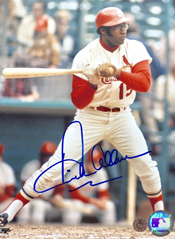
Dick Allen capped one of his best performances for the Cardinals by hitting a grand slam against the pitcher who got traded with him to St. Louis.

On June 2, 1970, Allen had seven RBI for the Cardinals in their 12-1 victory over the Giants at St. Louis.

Allen had a run-scoring single and a two-run home run versus Giants starter Gaylord Perry. The grand slam came against Jerry Johnson, who was traded with Allen and Cookie Rojas by the Phillies to the Cardinals in October 1969 for Curt Flood, Tim McCarver, Joe Hoerner and Byron Browne.

On May 19, 1970, the Cardinals dealt Johnson to the Giants for pitcher Frank Linzy. Johnson was making his fifth appearance for the Giants when he faced Allen for the first time.

New look

Looking to shake up the Cardinals, who lost six of their last seven, manager Red Schoendienst changed the batting order for the series opener versus the Giants at Busch Memorial Stadium.

Schoendienst had been featuring a top five of Jose Cardenal, Julian Javier, Lou Brock, Dick Allen and Joe Torre. Against Perry and the Giants, Schoendienst went back to the batting order he used to open the season, with Brock in the leadoff spot, followed by Cardenal, Allen and Torre. Joe Hague batted fifth, and Javier dropped to the seventh spot, behind Ted Simmons.

“The big reason for the change is getting Allen back up there to No. 3 where he can hurt people even more,” Schoendienst told the Associated Press.

To the St. Louis Post-Dispatch, Schoendienst explained, “I like to bat Cardenal second, especially against right-handers, because he has good bat control and can hit that outside pitch to right. and I want to be sure Allen gets to bat in the first inning.”

Played on a damp Tuesday night, the game attracted a crowd of 11,111, a number the Post-Dispatch described as “a poker player’s dream.”

Eight future Hall of Famers were in the lineups: Willie Mays, Willie McCovey and Gaylord Perry for the Giants, and Lou Brock, Joe Torre, Ted Simmons, Steve Carlton and Allen for the Cardinals. On the bench were three more: Schoendienst and pitchers Juan Marichal of the Giants and Bob Gibson of the Cardinals.

Carlton pitched a four-hitter and would have had a shutout if not for McCovey’s home run, a 420-foot drive into the bleachers in right-center. “I told myself to throw him a really nasty slider, but I hung it,” Carlton told the Post-Dispatch.

Carlton also contributed three singles. “That was just a little cream topping,” Carlton said.

Power source

Allen was in top form from the start.

In the first inning, Allen’s single versus Perry scored Cardenal from second.

In the fifth, Allen, a right-handed batter, sliced a Perry slider over the wall in right for a two-run homer. The ball “landed in the runway behind the right-field fence,” according to the Post-Dispatch. Impressed by Allen’s ability to drive the ball the opposite way, Cardinals coach George Kissell told the Post-Dispatch, “He hits them to right like a left-handed golfer.”

Allen had astonishing power, even though his right hand was weakened three years earlier when pieces of glass from a broken headlight on a car he was pushing severed nerves in his palm.

“I worked hard to get that hand so that I could use it again,” Allen told Dick Young of the New York Daily News. “I got a job as a bricklayer’s helper. For nothing. A friend of mine gave me the job. He wanted to pay me. He kept throwing money at me and I kept throwing it back. I wanted to work for nothing. It made me keep thinking of why I was doing it. I asked him for a slow bricklayer, though.”

Run producer

Allen and Perry faced one another frequently. Allen would finish his career with 30 hits and 31 strikeouts versus the spitball specialist.

Jerry Johnson was a different story. He was Allen’s teammate with the Phillies in 1968 and 1969, and for a brief time with the 1970 Cardinals. Johnson began the 1970 season in the minors, got called up to the Cardinals on May 1 and was 2-0 with one save in seven relief appearances for them before he was traded.

In the seventh inning, Johnson relieved Perry and deprived Allen of another RBI, striking him out on a slider with a runner on third and none out.

An inning later, Allen came up against Johnson with the bases loaded and hit a fastball into the seats in left-center for his fifth grand slam in the big leagues. He’d hit three more grand slams before his career was done. Boxscore

The home run would be the only base hit Allen would get in 12 career at-bats versus Johnson.

Allen had one other game with seven RBI. It occurred Sept. 29, 1968, for the Phillies against the Mets at Shea Stadium in New York. Allen hit a two-run home run versus Tom Seaver, a solo shot off Cal Koonce and a grand slam against Ron Taylor, the former Cardinal.

The 1970 Cardinals found the closer they needed, but, following a familiar pattern, gave up on him too soon.

On May 29, 1970, St. Louis got Ted Abernathy from the Cubs for infielder Phil Gagliano.

A right-hander, Abernathy, 37, threw underhanded with a delivery described as submarine style.

At 6 feet 4, he was a formidable presence when he whipped his right arm down low to the ground and sent the ball zipping toward the plate.

The Cardinals needed quality relief and Abernathy provided it. He made 11 appearances for them and was 1-0 with a save and 2.95 ERA.

Inexplicably, a month after the Cardinals acquired Abernathy, general manager Bing Devine dealt him to the Royals for pitcher Chris Zachary, who was assigned to the minors.

Abernathy went on to pitch in 36 games for the 1970 Royals and was 9-3 with 12 saves and a 2.59 ERA for them. He joined Wayne Granger (Reds), Dave Giusti (Pirates), Joe Hoerner (Phillies) and Mudcat Grant (Athletics and Pirates) as premier relievers dealt by Devine during his second stint with the Cardinals.

In 1970, when the Cardinals ranked last in the league in saves (20) and their team leader was Chuck Taylor (eight), Granger, Giusti, Hoerner and Grant had a combined record of 32-16 with 94 saves.

Adapt and adjust

Abernathy threw overhand until he injured his right shoulder as a high school freshman and switched to a sidearm delivery.

After signing with the Senators in 1952, Abernathy made his major-league debut with them in 1955.

Near the end of the 1956 season, Abernathy hurt his right elbow. Trying to compensate for the pain, he put pressure on his shoulder and damaged it again. Weakened, Abernathy was 2-10 with a 6.78 ERA for the Senators in 1957.

Except for two appearances for the Senators in 1960, Abernathy spent the next five seasons (1958-62) in the minors. After undergoing shoulder surgery in 1959, he adopted the submarine delivery.

In 1963, Abernathy, 30, made it back to the majors with the Indians and experienced a career rebirth. With his arm strength restored and his submarine delivery perfected, Abernathy became a durable, effective big-league reliever.

“His delivery was sweeping so low it swept him to the top as a relief pitcher,” the St. Louis Post-Dispatch noted.

Late bloomer

Abernathy was the National League leader in saves twice (31 for 1965 Cubs and 28 for 1967 Reds). He also led the league in games pitched three times (84 for 1965 Cubs, 70 for 1967 Reds and 78 for 1968 Reds).

Relying on a sinking fastball, curve and knuckleball he used as a changeup, Abernathy thrived on work. The more often he pitched, the better the results.

“If I don’t have to work more than a couple of innings, I can go for seven or eight days in a row, take a rest, and do it again,’ Abernathy told The Sporting News.

In 1970, during his second stint with the Cubs, Abernathy began the season as the setup reliever to closer Phil Regan.

On May 16, 1970, Abernathy relieved Cubs starter Ken Holtzman in the ninth inning of a game at St. Louis. With the Cubs ahead, 3-1, Abernathy was brought in to face slugger Dick Allen with the bases loaded and two outs.

With the count at 2-and-1, Abernathy needed to throw a strike, but his pitch sailed toward Allen. Though he tried to turn away, the ball struck Allen in the back of the head.

“I was surprised Allen didn’t get out of the way,” Abernathy told the Post-Dispatch. “I yelled to him, but I guess he didn’t hear me.”

Allen’s advancement to first allowed the runner from third to score, carrying the Cardinals to within a run at 3-2, but Regan came in and got Joe Torre to line out to center, ending the game. Boxscore

Come and gone

Two weeks later, the Cubs traded Abernathy to the Cardinals. Though Abernathy had a 2.00 ERA and a save in 11 games for the 1970 Cubs, manager Leo Durocher had lost confidence in him.

“The Cardinals were the only team who wanted Abernathy,” Durocher told the Chicago Tribune. “They needed relief pitching and were willing to take the chance. Maybe he’ll help them. I don’t know. All I know is that every time I put him in a game this year he was getting bombed.”

Before the Cardinals acquired Abernathy, five pitchers, Chuck Taylor, Tom Hilgendorf, Jerry Johnson, Sal Campisi and Billy McCool, earned saves for them in 1970. A week before Abernathy arrived, the Cardinals got another closer candidate, Frank Linzy, from the Giants.

“What they’re doing, of course, is indulging in a bit of wishful thinking when they claim anything in sight with a toeplate,” Bob Broeg wrote in the Post-Dispatch.

On May 30, 1970, Abernathy made his Cardinals debut at St. Louis against the Dodgers and pitched 3.1 innings in relief of starter Santiago Guzman. Boxscore

Abernathy got a save a week later in a game Bob Gibson won against the Padres at St. Louis. Boxscore

On June 27, 1970, in his last Cardinals appearance, Abernathy worked out of a bases-loaded jam he inherited and got the win versus the Phillies at St. Louis. Boxscore

Four days later, he was traded to the Royals.

Royal gift

“I was pitching well for the Cardinals,” Abernathy said. “At least I thought I was pitching pretty well. I asked Bing Devine (about the trade) and he told me, ‘That’s baseball. You move around.’ ”

When Abernathy reported to the Royals, he said to manager Bob Lemon, “I need work.” Lemon replied, “You came to the right place.”

Abernathy pitched five times in his first six days with the Royals and was 3-0 with a save and 0.96 ERA. In his first 9.1 innings, he allowed a run and struck out 13.

Lemon, an ace for the Indians when Abernathy debuted in the American League 15 years earlier, knew how to utilize his reliever. Abernathy was 5-3 with four saves in July, 2-0 with four saves in August and 2-0 with four saves in September. Right-handed batters hit .202 against him.

Abernathy was the second productive player the Royals got from the Cardinals in 1970. A month earlier, they obtained second baseman Cookie Rojas.

“We appreciate the Cardinals,” Royals general manager Cedric Tallis said to the Post-Dispatch. “They treated us as equals, not as just another expansion club, the way everybody else did.”

Abernathy’s combined 1970 record with the Cubs, Cardinals and Royals was 10-3 with 14 saves and a 2.60 ERA.

Abernathy pitched for the Royals again in 1971 and 1972, ending his 14 years in the majors with a 63-69 record and 149 saves.