(Updated Sept. 12, 2025)
Opening the way to a pipeline of talent, second baseman Julian Javier was the first player from the Dominican Republic to play for the Cardinals.
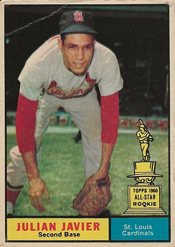 On May 27, 1960, the Cardinals acquired a pair of Pirates prospects, Javier and reliever Ed Bauta, for starting pitcher Vinegar Bend Mizell and infielder Dick Gray.
Making the leap from the minor leagues to the Cardinals’ lineup, Javier became the third player born in the Dominican Republic to play in the major leagues. Before him were Ozzie Virgil of the 1956 Giants and Felipe Alou of the 1958 Giants.
Javier was the Cardinals’ second baseman for 12 years and contributed to three National League pennants and two World Series titles. Dominican Republic natives who followed him to the Cardinals included Albert Pujols, Joaquin Andujar, Pedro Guerrero and Tony Pena.
Opportunity knocks
Javier was born and raised in San Francisco de Macoris, Dominican Republic. Located in the northeast section of the Caribbean island country, his hometown is one of the world’s largest producers of cocoa beans. A son of a truck driver, Javier had seven siblings.
In 1956, when he was 19, Javier attended a Pirates tryout camp in the Dominican Republic and was offered a contract by scout Howie Haak. Javier signed for $500, The Sporting News reported.
“We didn’t know about bonuses then,” Javier said in 1967. “Today, I would ask for $50,000.”
Javier began the 1960 season, his fifth in the Pirates’ farm system, with their Columbus, Ohio, club. The Pirates had a future Hall of Famer, Bill Mazeroski, as their second baseman and were planning to convert Javier to shortstop, the St. Louis Post-Dispatch reported.
When the 1960 Pirates got off to a fast start, winning 12 of their first 15 games, general manager Joe Brown began looking for ways to keep the team in contention. To bolster the starting pitching, he made Javier available for trade.
Infield shift
In 1960, Alex Grammas, 34, moved from shortstop to second base for the Cardinals to make room for Daryl Spencer, who was acquired from the Giants. Shortstop was Spencer’s preferred position, but Grammas “did not adjust too well to second base,” The Sporting News reported.
“I think Grammas is more at home at shortstop,” Cardinals manager Solly Hemus told the St. Louis Globe-Democrat.
On May 9, 1960, Hemus said Grammas would go back to shortstop and Spencer would shift to second “to tighten our defense.”
The switch “caught Cardinals brass by surprise” and Spencer “felt he was being made a scapegoat,” according to The Sporting News.
Cardinals general manager Bing Devine sought a better solution. He wanted to acquire a young middle infielder, either a second baseman or a shortstop, who would provide long-term stability.
According to Bob Broeg of the Post-Dispatch, the Cardinals pursued Reds shortstop prospect Leo Cardenas, “the tall, skinny kid who looks as though he might be another Marty Marion.” Rejected, the Cardinals’ focus turned to Javier.
Help wanted
Cardinals director of player procurement Eddie Stanky, a former second baseman, scouted Javier and recommended him. Stanky said Javier was “one of the best prospects in the minors” and “his speed was second only to that of Vada Pinson of the Reds,” The Sporting News reported.
“He’s one of the fastest right-handed batters I’ve ever seen,” Stanky said to the Post-Dispatch.
The Cardinals weren’t the only club interested. The Phillies wanted a second baseman, too, and were talking to the Pirates about a swap of pitcher Don Cardwell for Javier. According to the Pittsburgh Post-Gazette, the Phillies scouted Javier for 10 days, but “the scout reported back to the front office that Javier struck out too often and had a tendency to become injured.”
After the Phillies dealt Cardwell to the Cubs for second baseman Tony Taylor, the Cardinals offered Vinegar Bend Mizell to the Pirates for Javier. Pirates general manager Joe Brown viewed Mizell, 29, as a good fit to join a rotation with Bob Friend, Vern Law and Harvey Haddix. Mizell was 1-3 for the Cardinals in 1960, but he had five seasons of double-digit win totals in his previous six with them.
“We are sacrificing a future for the present because in Mizell we have a known quantity,” Brown said.
The Pittsburgh Press noted, “Javier wouldn’t have made it with the Pirates for two or three years, but the team needed pitching help now.”
Javier, 23, hit .288 for Columbus in 1960 and Devine called him “an outstanding glove man as well as an improving hitter,” the Globe-Democrat reported.
“We consider this a major addition to the Cardinals’ regular lineup now and for the future,” said Devine.
Bob Broeg of the Post-Dispatch concluded, “It took courage to give up a player of some reputation for one with none at the major-league level.”
Hot start
On May 28, 1960, Javier made his debut in the majors at second base for the Cardinals against the Giants at St. Louis. He had six putouts, three assists and helped turn a double play. Batting eighth, Javier singled twice versus Billy O’Dell. Boxscore
Hemus used Javier’s arrival to make other moves. Spencer shifted back to shortstop and Grammas was benched. Bill White went from center field to first base, replacing Stan Musial, and Curt Flood took over in center.
With White and Javier solidifying the right side of the infield, and Flood in center, the Cardinals improved. On the day they got Javier, the Cardinals were 15-20. After the trade and the moves to upgrade the defense, they were 71-48.
“Javier knows how to make the tough double play,” Hemus told the Post-Dispatch. “He makes the club solid. Not many balls are falling in with him and Curt Flood out there. Those two have helped make our pitching better.”
In the book “Few and Chosen,” Cardinals catcher Tim McCarver said Javier’s skill at turning double plays earned him the nickname “Phantom.”
“Runners never got to his legs,” McCarver said. “Javier was rarely on the bag. His timing was perfect and his hands and feet were so quick, you often couldn’t even see the exchange (of the ball).”
In addition to showing good range in the field on grounders and pop-ups, Javier hit safely in 10 of his first 11 games. In his third game, on May 30 at Los Angeles, he hit his first big-league home run, leading off the fourth versus Clem Labine of the Dodgers. Boxscore
On June 3, Javier hit two triples versus the Giants’ Mike McCormick at San Francisco, “amazing everybody with his breathtaking speed,” The Sporting News observed. Boxscore
Four days later, on June 7, Javier’s wife came from the Dominican Republic to St. Louis and saw her husband play in the majors for the first time. Javier raked the Phillies for three singles. Boxscore
Stellar career
The 1960 Cardinals finished at 86-68, nine games behind the champion Pirates, who were 95-59. Mizell, in his last good season, was 13-5 for the 1960 Pirates.
Javier hit .237 with eight triples and 19 stolen bases for the 1960 Cardinals. His 15 sacrifice bunts led the league. Though he also made the most errors among National League second basemen, Javier was named to the Topps all-rookie team.
In 12 seasons with St. Louis, Javier batted .258 with 1,450 hits, twice led National League second basemen in putouts and twice was named an all-star, including 1963 when he was part of a Cardinals starting infield with Bill White, Dick Groat and Ken Boyer.
In Game 7 of the 1967 World Series, Javier’s three-run home run versus Jim Lonborg of the Red Sox was a key blow in the Cardinals’ championship clincher.
Javier was traded to the Reds for pitcher Tony Cloninger in March 1972. As a utility player, he helped the Reds win the pennant in his last season in the majors.
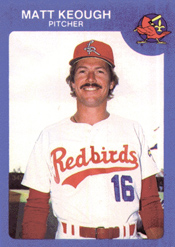 A right-hander who pitched in the majors for nine years, Keough endured an epic losing streak and survived being struck in the temple by a foul ball.
 Hacker managed teams in the St. Louis farm system for four years and was a big-league coach on Herzog’s staff for five seasons, including 1987 when the Cardinals were National League champions. Hacker also was a coach for the Blue Jays when they won consecutive World Series titles in 1992 and 1993.
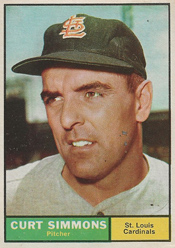 On May 19, 1960, the Cardinals signed Simmons on his 31st birthday. A left-handed pitcher, Simmons was released a week earlier by the Phillies after he played in 13 seasons for them and won 115 games.
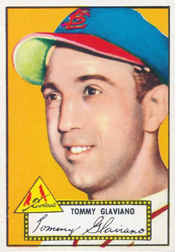 On May 18, 1950, Glaviano made four errors, including three in a row in the ninth inning, in a game against the Dodgers at Ebbets Field in Brooklyn. The Cardinals, who led 8-0 entering the eighth inning, lost 9-8.
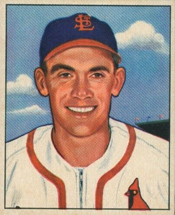 Johnny Lindell faced the Cardinals in a World Series as a Yankees outfielder and in a regular season as a pitcher for the Pirates and Phillies. He also played for the Cardinals for a couple of months when they sought power for their lineup.
 RetroSimba