Feeds:
Posts
Comments

(Updated March 17, 2020)

Larry Walker, who completed his career with the Cardinals, had one of his greatest games as their opponent.

On April 28, 1999, Walker hit three home runs for the Rockies in their 9-7 victory over the Cardinals at Busch Memorial Stadium in St. Louis.

Walker was the first opposing player to hit three homers in a game at St. Louis since the Expos’ Larry Parrish did it 22 years earlier in 1977.

It was the second of three times Walker hit three home runs in a game for the Rockies. He also did it against his former club, the Expos, at Montreal in April 1997 and against the Indians at Cleveland in June 2004, two months before he was traded to the Cardinals.

On Jan. 21, 2020, Walker was elected to the Baseball Hall of Fame in balloting by the Baseball Writers Association of America.

An outfielder who batted left-handed, Walker began his career with the Expos and spent his prime seasons with the Rockies before finishing with the Cardinals.

In 144 regular-season games for the Cardinals, Walker batted .286 with 26 home runs and 79 RBI. He also hit six home runs in 15 postseason games for the 2004 Cardinals. In 150 regular-season games against the Cardinals, Walker hit .300 with 28 home runs and 110 RBI.

Canadian club

Born in Maple Ridge, British Columbia, Walker wanted to be a professional hockey player. When a junior-level hockey team coach told him he’d be their third-string goalie, Walker, 17, switched to baseball, according to the Associated Press.

Signed by the Expos in 1984, Walker became a prized prospect in their farm system when he hit 33 home runs in 1986 and 26 in 1987.

On Jan. 16, 1988, while playing winter baseball in Mexico, Walker tore ligaments in a knee when he slipped while crossing home plate. He sat out the 1988 season and “there were times I didn’t think I’d make it” to the majors, Walker told the Montreal Gazette.

“I wondered, ‘What am I going to do now? Be a garbageman?’ ” Walker said.

Walker was with Class AAA Indianapolis when he got called up to the Expos in August 1989. He became the fifth Canadian to play for the Expos, following Claude Raymond, Larry Landreth, Bill Atkinson and Doug Frobel.

Though he grew up 2,300 miles from Montreal, Walker said, “This is one big country. We’re one big family.”

In his debut game against the Giants at Montreal, Walker had a single and three walks in four plate appearances. Boxscore

“What I liked about him is he had an idea about what he wanted to do every time he went to the plate,” Expos manager Buck Rodgers said.

According to the Montreal Gazette, when Walker reached base for the fourth time in the game, Giants first baseman Will Clark turned to him and said, “Geez, three walks. Not bad. They’re pitching you like a 10-year veteran.”

At spring training in 1990, Walker impressed the Expos with his dedication. In a four-day stretch, he took 500 swings per day in the batting cage. “I can’t believe how hard he works,” said Expos hitting coach Hal McRae.

Walker won the Expos’ right field job and never looked back. He hit .281 in six seasons (1989-1994) with the Expos before becoming a free agent and signing with the Rockies.

Powering up

Walker won the first of his three National League batting titles in 1998, but a rib injury sidelined him for the Rockies’ first seven games of the 1999 season.

When he returned to the lineup, he went homerless in his first eight games before he busted out against the Cardinals on a Wednesday night in St. Louis.

Walker had four hits, including the three home runs, and a career-best eight RBI in the game. Boxscore

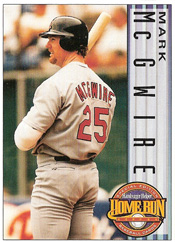
The performance drew comparisons to Mark McGwire, the Cardinals’ first baseman, who witnessed it, but Walker dismissed such talk.

“My name is Larry, not Mark,” Walker told the Associated Press. “I don’t have Popeye arms. I’ve just got little tiny ones.”

In the opening inning, after the first two Rockies batters singled, Walker hit a three-run homer on a 1-and-2 pitch from right-hander Jose Jimenez.

With the Rockies ahead, 4-3, in the second, Walker batted with runners on first and third, two outs, and hit the first pitch from Jimenez for another three-run home run.

Walker had three hits, all home runs, in four career at-bats versus Jimenez. The last also was in a three-homer game for Walker in 2004 when Jimenez was with the Indians. Walker and Jimenez were Rockies teammates from 2000-2003.

Walker’s third home run of the game at St. Louis came in the seventh. Facing Scott Radinsky with a runner on first and one out, Walker hit a 1-and-2 pitch from the left-hander for a two-run homer, giving the Rockies a 9-6 lead.

All three home runs were hit over the right-field wall.

In 17 seasons in the majors, Walker batted .313 with 2,160 hits, 383 home runs, 1,311 RBI and a .400 on-base percentage. He won the Gold Glove Award for his outfield play seven times.

In an interview with the Baseball Hall of Fame magazine, “Memories and Dreams,” Jim Leyland, who managed the Rockies in 1999, said, “Barry Bonds is the best player I ever managed, but Larry Walker was the best five-tool player I ever saw. There was nobody more impactful in a game than Larry Walker. He beat you all five ways _ defense, his throwing, his base running, his hitting and his power.”

The Cardinals gave Ed Sprague a chance to become a professional ballplayer and make a connection with Sparky Anderson.

A right-hander, Sprague pitched for eight seasons in the major leagues with the Athletics, Reds, Cardinals and Brewers.

It took a series of career turns before Sprague pitched in a big-league game for the Cardinals in his second stint with them.

Good advice

Sprague was born in Boston and went to high school in Hayward, Calif., about 15 miles south of Oakland. He didn’t play prep sports because he had a job after school at a furniture store.

In March 1964, Sprague, 18, enlisted in the Army. While stationed in Mainz, Germany, as a paratrooper, he joined the military base fast-pitch softball team as a catcher. Sprague had a strong arm and an Army colleague, former minor-leaguer Dick Holland, encouraged him to pursue a baseball career, The Sporting News reported.

After his discharge from the Army in March 1966, Sprague, 20, enrolled at a baseball school in West Palm Beach, Fla., run by big-league infielder Dick Howser.

Four days later, the school held a tryout camp attended by big-league scouts. “About 100 kids tried out that day,” Spague told the St. Louis Post-Dispatch.

Cardinals scout Tommy Thomas made an offer and Sprague signed. “I didn’t get a bonus,” he told The Sporting News.

Fast learner

Relyng exclusively on a fastball, Sprague pitched in 13 games for two farm clubs in 1966 and posted a 2.66 ERA.

In 1967, Sprague, 21, was assigned to Modesto, a California League team managed by Sparky Anderson.

“He was so raw and inexperienced then that he didn’t even know how to stand correctly on the pitching rubber,” Anderson told The Sporting News. “You almost had to lead him to the mound.”

Throwing with a sidearm delivery, Sprague learned quickly and had an 11-7 record and 3.12 ERA for league champion Modesto.

After the season, Anderson joined the Reds as a minor-league manager and Sprague reported to the Cardinals’ 1967 fall Florida Instructional League team. Playing for manager George Kissell, Sprague had a 1.74 ERA in 11 starts.

Left off the Cardinals’ 40-man winter roster, Sprague was selected by the Athletics with the first pick in the Nov. 28, 1967, minor-league draft. Athletics executive vice president Joe DiMaggio made the announcement at the baseball winter meetings in Mexico City.

Finding his footing

Sprague pitched well at spring training in 1968 and earned a spot on the Athletics’ Opening Day roster. The Athletics moved from Kansas City to Oakland after the 1967 season, meaning Sprague would begin his big-league career with a team located a 15-minute drive from where he went to high school.

“He throws a sidearm pitch with considerable speed,” The Sporting News noted. “It sinks.”

On April 16, 1968, in his second major-league appearance, Sprague got the win with three scoreless innings in relief of starter Catfish Hunter at Yankee Stadium.

The outing started ominously when Sprague lost his balance on the second pitch he threw and fell off the mound.

“I don’t know what happened,” Sprague told The Sporting News. “All of a sudden, there I was flat on my face and everyone was laughing at me.”

Sprague regained his composure and finished the inning by getting Mickey Mantle to fly out to left.

In the ninth, the Yankees had a runner at second with two outs when Sprague sealed the win by getting his baseball school operator, Dick Howser, to ground out. Boxscore

Come and go

Sprague pitched for the Athletics in 1968 and 1969, but spent the 1970 season in the minors. The Reds, who won the National League pennant in 1970 in Sparky Anderson’s first season as manager, acquired him after the World Series.

In 1971, Sprague was assigned to the Reds’ top farm club at Indianapolis. The manager, Vern Rapp, had been in the Cardinals’ system when Sprague was there. Rapp taught Sprague how to throw a changeup and the pitch helped him achieve nine wins and five saves for Indianapolis.

The Reds called up Sprague for the last month of the 1971 season and he allowed no earned runs in 11 innings. “It’s pretty well known there are some among the Reds brass who think highly of Ed Sprague,” The Sporting News reported.

In 1972, when the Reds won the pennant, Sprague was 3-3 in 33 games. The Reds played the Athletics in the World Series, but Sprague didn’t pitch.

The next year, he was 1-3 with a 5.12 ERA when the Reds traded him to the Cardinals on July 27, 1973, for infielder Ed Crosby and catcher Gene Dusan. The Cardinals also got a player to be named, first baseman Roe Skidmore.

“My arm is fine,” Sprague told the Post-Dispatch. “My trouble has been lack of work.”

In his first appearance for the Cardinals, on July 29, 1973, in the second game of a doubleheader against the Cubs at Chicago, Sprague relieved starter Rich Folkers with the bases loaded and two outs in the seventh.

Jose Cardenal hit Sprague’s first pitch on the ground. “It looked like an easy out,” the Post-Dispatch reported.

The ball took a high hop and bounced over the head of third baseman Ken Reitz for a fluke single, tying the score at 4-4. The Cubs won, 5-4. Boxscore

“I did what I set out to do, make him hit the ball on the ground,” Sprague said.

Sprague made eight appearances for the Cardinals and was 0-0 with a 2.25 ERA when they sent him to the minor leagues, preferring to go with a left-hander, John Andrews, as a reliever.

In the genes

After three appearances with Class AAA Tulsa, Sprague’s contract was sold by the Cardinals to the Brewers on Sept. 4, 1973.

Sprague had his best big-league season in 1974 with the Brewers. He was 7-2 with a 2.55 ERA in 10 starts and 0-0 with a 2.10 ERA in 10 relief appearances.

Sprague pitched eight seasons in the majors and was 17-23 with nine saves and a 3.84 ERA.

His son Ed Sprague Jr., was a big-league third baseman for 11 seasons, mostly with the Blue Jays, and played in two World Series with Toronto.

Larry Walker hit two home runs in a game five times for the Cardinals, including once in the postseason.

A three-time National League batting champion who spent most of his career with the Expos and Rockies, Walker was elected to the National Baseball Hall of Fame on Jan. 21, 2020, by the Baseball Writers Association of America.

A left-handed batter and outfielder, Walker played his last two seasons for the Cardinals after being acquired from the Rockies on Aug. 6, 2004.

In 17 seasons (1989-2005) in the majors, Walker hit for average (.313) and power (383 homers).

With the Cardinals, Walker hit 26 home runs in the regular season and six in the postseason.

Here are Walker’s two-homer games with St. Louis:

Solving Nomo

On Sept. 12, 2004, at Los Angeles, Walker was 4-for-5 with two home runs, three RBI and three runs scored in the Cardinals’ 7-6 win over the Dodgers. Boxscore

Walker produced two homers and a double against Dodgers starter Hideo Nomo.

“I never think about hitting home runs,” Walker told the St. Louis Post-Dispatch. “I only think about hitting the ball hard.”

In the sixth inning, with the score tied at 6-6, Walker’s single against Edwin Jackson moved Tony Womack from first to third with none out. Womack scored the winning run when Albert Pujols grounded into a double play.

Mr. October

In the first game of the National League Division Series against the Dodgers at St. Louis on Oct. 5, 2004, Walker had two solo home runs in an 8-3 Cardinals victory.

Walker’s first home run, against starter Odalis Perez, sparked the Cardinals to a five-run third inning. His other was against Giovanni Carrara in the seventh. Boxscore and Video

“My heart was pounding the whole game,” Walker said. “It was a lot of fun.”

Walker became the third Cardinals player to hit two home runs in a postseason game, joining Willie McGee (Game 3, 1982 World Series) and Ron Gant (Game 3, 1996 NL Championship Series).

Walker was playing in the postseason for the second time in his career. The first time was nine years earlier for the Rockies in the 1995 NL Division Series versus the Braves.

“Normally, I’m up in my cabin in British Columbia with my brother and some fishing buddies for some salmon that are running up the rivers,” Walker said. “I’d much rather be here.”

Native son

A Canadian, Walker took pride in hitting two home runs at Toronto in a 7-0 Cardinals triumph over the Blue Jays on June 14, 2005.

Walker’s pair of two-run homers against Chad Gaudin provided support for Cardinals starter Chris Carpenter, a former Blue Jay, who pitched a one-hitterBoxscore

The home runs were Walker’s first in Canada since he hit one for the Rockies against the Expos’ Carl Pavano at Montreal on May 8, 2002. Boxscore

Walker was hitless in 10 career at-bats in Toronto before hitting the home runs.

“I feel good about it,” Walker told the Canadian Press. “I’ve had two-homer games before, but this one felt a lot better.”

Walker said he worked with hitting coach Hal McRae before the game and made “a couple of tweaks” in his stance.

“I moved my front foot to try and get a different wave on the bat, a different plant on my foot,” Walker said.

Pain in the neck

On June 29, 2005, Walker hit a pair of two-run homers against Reds starter Ramon Ortiz in an 11-3 Cardinals victory at St. Louis. Boxscore

“Don’t expect this every day,” Walker said.

Walker, 38, said he got a cortisone shot before the game to relieve discomfort from a herniated disc in his neck.

Hit man

The last two-homer game of Walker’s career came on Oct. 1, 2005, in a 9-6 Cardinals win against the Reds at St. Louis. Ortiz again was the pitcher. The home runs were the last of Walker’s career. Boxscore and Video

Walker was 6-for-13 versus Ortiz in his career. All six hits were for extra bases (four home runs and two doubles).

In two seasons with St. Louis, Walker batted .286 and had an on-base percentage of .387.

For his big-league career, Walker had 2,160 hits in 1,988 regular-season games and an on-base percentage of .400.

He won NL batting titles in 1998 (.363), 1999 (.379) and 2001 (.350). In 1997, he was the recipient of the NL Most Valuable Player Award. He had 208 hits, 143 runs scored, 130 RBI, 49 home runs and 33 stolen bases for the 1997 Rockies.

Walker also was the recipient of seven Gold Glove awards for his outfield play.

(Updated Jan. 21, 2020)

Ozzie Smith welcomed Derek Jeter as a peer among baseball’s best shortstops.

In 2014, when Jeter came to St. Louis with the Yankees for the last time as a player, he was embraced by Smith in a pre-game ceremony near home plate at Busch Stadium.

Smith, who won 13 Gold Glove awards, including 11 with the Cardinals, was elected to the Baseball Hall of Fame in 2002 in his first year on the ballot. Smith got 91.7 percent of the votes from the Baseball Writers Association of America.

On Jan. 21, 2020, Jeter was elected to the Hall of Fame in his first year on the ballot. Jeter got 99.7 percent of the votes from the baseball writers.

Parting gifts

After Jeter, 39, said 2014 would be his final season as Yankees shortstop, he was honored at each stop on the schedule.

The Yankees came to St. Louis for a three game series May 26-28 in 2014.

Jeter had played against the Cardinals in 2003 at Yankee Stadium and in 2005 at Busch Memorial Stadium in St. Louis. The 2014 visit was at the downtown ballpark that opened in 2006.

Before the Memorial Day series opener in 2014, the Cardinals presented Jeter with cuff links bearing the likeness of franchise icon Stan Musial. The Cardinals also gave Jeter a $10,000 donation to his Turn 2 Foundation. According to its Web site, the foundation “strives to create outlets that promote and reward academic excellence, leadership development and positive behavior” for young people.

Among those representing the Cardinals at the ceremony were Red Schoendienst, the Hall of Fame second baseman who wore the same uniform number (No. 2) as Jeter did, and Smith, the acrobatic fielder nicknamed The Wizard. Video

Special bond

Smith “put out his arms and embraced” Jeter, MLB.com reported.

Smith’s last two seasons in the majors (1995-96) were Jeter’s first two.

“He’s always treated me good, especially when I was a younger player,” Jeter said. “He’s a guy that I admire. I admire his career. When you’re a young player, you remember how guys treat you. Ozzie always treated me well.”

Smith told the New York Post, “He’s probably been the perfect example of what a baseball player should be. Great ambassador for the game. He’s done it the right way.”

Cardinals reliever Randy Choate, Jeter’s teammate from 2000-2003 with the Yankees, said to MLB.com, “He leads by example. When you play with him, you want to play like him.”

Showing respect

In his first at-bat after the ceremony, Jeter singled and received a standing ovation. Boxscore

Jeter “was feted at every opportunity” during the three-game series, the St. Louis Post-Dispatch reported.

Jeter started the first two games but sat out the third when the Yankees went with his backup, former Cardinal Brendan Ryan. In the seventh inning, Jeter got a standing ovation when the scoreboard camera showed him in the dugout. He responded by going to the top step and doffing his cap. Boxscore

“It’s much appreciated,” Jeter said. “It’s not something that’s expected.”

Hall of Fame stats

Jeter’s best performances against the Cardinals were in 2005 when he had five hits in 13 at-bats. His career batting mark versus St. Louis was .265 (9-for-34).

In 20 seasons (1995-2014) with the Yankees, Jeter won five Gold Glove awards and was named an American League all-star 14 times. One of his all-star appearances was the 2009 game in St. Louis.

Jeter produced a career batting mark of .310 and an on-base percentage of .377. He had 3,465 hits, including 544 doubles, with 1,311 RBI and 358 stolen bases.

Jeter has the most career hits of any shortstop.

According to MLB.com, the top six players all-time in career hits are Pete Rose (4,256), Ty Cobb (4,191), Hank Aaron (3,771), Stan Musial (3,630), Tris Speaker (3,515) and Jeter (3,465). Aaron is the only right-handed batter with more career hits than Jeter.

Jeter played in seven World Series and the Yankees won five of those. He had a World Series batting average of .321, with 50 hits in 38 games, and an on-base percentage of .384.

The Cardinals continue to span the globe for talent.

In January 2020, the Cardinals’ 40-man winter roster had players who were natives of nine countries or territories. In alphabetical order, those are Canada, Cuba, Dominican Republic, Mexico, Panama, Puerto Rico, South Korea, United States and Venezuela.

One of the Cardinals’ key acquisitions for the 2020 season was left-handed pitcher Kwang-Hyun Kim, a South Korean.

Cardinals president of baseball operations John Mozeliak is leading the franchise’s efforts to grow its global reach. In January 2020, Mozeliak answered questions from bloggers by e-mail. The opportunity to ask questions of Mozeliak came about through the efforts of Daniel Shoptaw, founder of United Cardinal Bloggers.

Mozeliak thoughtfully answered my two questions regarding the Cardinals’ international approach. Here are those questions and his answers:

Q.: What will be the long-term impact of the Cardinals’ Dominican Republic Academy on the major-league organization?

John Mozeliak: “Great question. We continue to invest in Latin America, specifically in the Dominican Republic. We’re currently operating two Dominican Summer League teams, and part of the reason for that is trying to create opportunity for finding more talent.

“I think, as you look at overall operating costs and what we’re also trying to manage through on the minor-league side, at some point I hope we get back to one team down there, but the impact we’re hoping for from the Latin America program is very real. These are measurable. Are you getting contribution from that program that’s contributing to the major-league side, or helping you with trades?

“Right now, we feel that our international operations has done a very good job of finding us talent and we continue to hope to enrich that by making investments and educating our staff to help them grow.”

Q.: How important will the Pacific Rim become as a talent source and how will the Cardinals be a player in that region?

John Mozeliak: “Well, clearly, we are a player in the region. I think you’re going to see more and more players have interest in coming here.

“A couple of things have changed over the last 10 years. I think the posting system (created to allow Asian teams to get compensation for players who want to go to the U.S. majors leagues) is much more fair. It’s more fair for everybody involved, not only domestic teams, but also teams in Korea and Japan.

“Players are able to see the game more, too. If you think about why New York, Boston or Los Angeles were the teams that seemed most attractive, I think part of that was because those were the teams that were on television in Asia. But now, with the ability to stream, players can see all the games, so their interest in other
baseball teams has become very real. You saw that with the Kwang-Hyun Kim signing.

“(Seung-Hwan) Oh (who pitched for the 2016-17 Cardinals) certainly didn’t hurt in that, being from Korea and speaking positively of the Cardinals, but also it was a team that he could see. I think how people watch the game of baseball now has helped our game grow.”

As a rookie with the 1951 Cardinals, Dick Bokelmann took over the role of closer.

A right-handed reliever, Bokelmann’s career in the majors consisted of spending parts of three seasons (1951-53) with the Cardinals.

He experienced his most success after his promotion from the minors in August 1951.

Handy man

Bokelmann, 20, was pitching for Northwestern University when he got an offer from the Cardinals and signed with them in 1947.

His breakout season came in 1951, his fifth year in the Cardinals’ farm system, when he posted a 10-2 record and 0.74 ERA as the closer for Houston of the Texas League.

“Dick began learning to place his sinking fastball and splendid curve where he wanted it,” The Sporting News reported.

Bokelmann, 24, was called up to the Cardinals and made his debut with them on Aug. 3, 1951, earning a save in relief of starter Harry Brecheen against the Giants at St. Louis. Boxscore

In his first three appearances for the Cardinals, all against the Giants, Bokelmann faced a total of 10 batters and retired all of them.

“A kid like Bokelmann comes in handy,” Brecheen told the St. Louis Post-Dispatch.

In the groove

Bokelmann’s emergence prompted Cardinals manager Marty Marion to move closer Al Brazle into the starting rotation, where he thrived, posting a 2.83 ERA in eight starts.

“If we had a relief pitcher like Dick Bokelmann all season, we could have started Brazle more often,” Marion said.

After a couple of shaky outings against the Dodgers and Braves in late August, Bokelmann experienced a hot streak. In four appearances from Aug. 26 to Sept. 9, Bokelmann yielded no runs over 16 innings, earning two wins and a save.

The save came on Sept. 6 when Bokelmann worked four scoreless innings in relief of starter Cliff Chambers against the Cubs at Chicago. Boxscore

The next night, Sept. 7, the Cardinals were at Pittsburgh and Bokelmann got his first big-league win, yielding one hit and no runs over five innings in relief of starter Tom Poholsky. Boxscore

On Sept. 9, at Pittsburgh, Bokelmann, the Cardinals’ third pitcher of the game, entered with one out in the fourth, held the Pirates to one hit over 5.2 innings and got the win. Boxscore

Changing careers

Bokelmann finished the season with a 3-3 record and three saves in 20 appearances for the 1951 Cardinals.

He opened the 1952 season with the Cardinals, gave up runs in seven of his 11 appearances and was sent back to the minors.

Bokelmann ended his big-league career with three appearances for the 1953 Cardinals. His overall record for them: 3-4, three saves and a 4.90 ERA in 34 games.

After his baseball career, Bokelmann worked for Prudential Insurance in Illinois for 30 years.