Sometimes in baseball a weak swing at a bad pitch can produce a good result. It happened that way for Randy Moffitt, a reliever for the Giants during the 1970s.
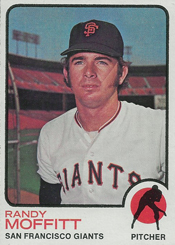 On July 8, 1974, at Jarry Park in Montreal, Moffitt pitched 3.1 scoreless innings against the Expos and was credited with a win.
His pitching, though, was only part of the reason the Giants prevailed. Moffitt’s bat was a factor, too. Actually, it wasn’t his bat. It belonged to teammate Bobby Bonds. Moffitt just happened to swing it. Well, actually, he didn’t swing. Moffitt simply moved the bat in the general direction of the pitch. Physics did the rest.
Here’s what happened:
With the score tied in the 10th inning, the Giants had a runner on first and none out. Moffitt was up next. Expecting the bunt sign, he reached for the heaviest bat he could find and grabbed one belonging to Bonds, the Giants’ home run leader that season.
“I could never swing that thing around deliberately,” Moffitt told the Montreal Gazette. “I had the fat bat because it was easier for me to bunt with that.”
Pitching was starter Steve Rogers, who hadn’t allowed a hit since the third inning.
The Expos, too, were expecting Moffitt to bunt. He had just two big-league hits and never had driven in a run. The corner infielders, first baseman Mike Jorgensen and third baseman Ron Hunt, moved way in, positioning themselves about 15 feet from the plate.
“Those two guys were sitting right in his lap,” Giants manager Wes Westrum told the San Francisco Examiner. “There was no way he could have sacrificed.”
Moffitt got the sign to swing away. Now he had to try to get that heavy bat around to meet the pitch.
Rogers delivered. “A fastball right down the middle,” Moffitt said to the Gazette.
No, said Rogers to the Montreal Star. “I didn’t throw him a fastball. It was a slider, high, and it was over the middle of the plate.”
A right-handed batter, Moffitt was hoping he could chop a grounder past Hunt. “I didn’t take a cut at the ball,” Moffitt told the Gazette, but somehow the bat connected solidly with the pitch.
Moffitt said to the Associated Press, “The ball hit the bat more than I hit the ball.”
It lifted into the air and carried _ way out to left-center. Playing in, left fielder Bob Bailey and center fielder Willie Davis turned and chased the ball but it landed past them and rolled toward the fence.
Mike Phillips scored from first with the go-ahead run and Moffitt hustled around the base paths. He thought he had a chance for an inside-the-park home run, but instead stopped at third with a stand-up triple because, “I decided I needed my strength for the finish,” he told the Associated Press.
Moffitt retired the Expos in the bottom half of the inning, sealing the 5-4 win. Boxscore
A sinkerball specialist, Moffitt was a better pitcher than hitter. In 12 seasons in the majors with the Giants (1972-81), Astros (1982) and Blue Jays (1983), he had 43 wins and 96 saves. Moffitt was 76 when he died on Aug. 28, 2025.
All in the family
Randy Moffitt was the younger brother of Billie Jean King, the tennis champion. Their parents, Billy and Betty Moffitt, raised Billie Jean and Randy in Long Beach, Calif. Billy was a fireman who later became a baseball scout for the Brewers.
“When Billie Jean was 10 years old, she was the star shortstop in the North Long Beach Girls’ Softball League,” Billy Moffitt said to Allen Abel of the Toronto Globe and Mail. “Her speed was her best asset. She could outrun all the other girls. She loved to play ball, but one day I told her, ‘There’s no future in this for a girl.’ I tried to get her into something that she could continue to do as she got older. I suggested swimming, but she said she didn’t like to swim. I sent her out to play golf, but she thought it was too slow. When she was 11, I gave her a racquet. She came back after the first day and said, ‘This is it. I’ll never give this up.’ ”
Randy Moffitt was five years younger than his sister. As Billy Moffitt recalled to the Globe and Mail, “He had to tag along to the tennis courts every day with his big sister. He won his share of tournaments, too, but his heart just wasn’t in it. Having to follow his sister everywhere made him sour on tennis. It wasn’t easy for him, being in the background all those years. He was always a quiet kid.”
At 14, Randy Moffitt quit playing competitive tennis. He said he turned to baseball because there weren’t enough boys his age to challenge him in tennis, according to the Globe and Mail.
Asked if he’d played tennis against his sister, Moffitt told Newsday, “When she’s serious, I couldn’t take a point off her, but she gets to laughing.”
Sink or swim
A pitcher and shortstop for Long Beach Polytechnic High School, Moffitt advanced to Long Beach State. The Giants picked him in the first round of the January 1970 amateur draft. Two years later, he was in the majors, joining a Giants bullpen with the likes of ex-Cardinal Jerry Johnson and 42-year-old Don McMahon.
Moffitt’s first save came against the Cardinals when he pitched two scoreless innings in relief of Sam McDowell. Boxscore
Moffitt led the Giants in saves in 1974 (15), 1975 (11) and 1976 (14).
In 1979, Moffitt began experiencing daily bouts with nausea. He passed blood, lost weight. “You can’t imagine how it feels to be nauseous every minute of every day,” Moffitt told the Houston Chronicle.
He eventually was diagnosed with having cryptosporidiosis, a disease caused by a parasite in the gastrointestinal tract.
It wasn’t until 1981 that doctors found a treatment to rid him of the illness. That year, during the players’ strike, the Giants released Moffitt. At 33, he was faced with having to rebuild his playing career.
The Astros signed him to a minor-league contract in 1982. Moffitt began the season at Tucson, but got brought up to the Astros in late April. He pitched in 30 games for them and posted a 3.02 ERA.
Granted free agency, Moffitt went to the Blue Jays in 1983. “He’s got a nasty sinker,” Blue Jays manager Bobby Cox told Peter Gammons of the Boston Globe. “He’s tough on right-handers. He’s unbelievably competitive.”
Moffitt had six wins and a team-leading 10 saves for the 1983 Blue Jays, but it turned out to be his last season in the majors. A free agent, Moffitt got a look from the Brewers, who agreed to send him to their Vancouver farm team. He signed in June 1984, was activated in July and released in August.

 RetroSimba
So many things to love in this post. For starters, it’s another great piece of yours about a player not in the limelight which hammers home the idea that everyone has a story to tell. Your hard work on the research is very appreciated. Now, I can’t say that I’ve ever heard of a mlb player who grew up playing tennis. The Milwaukee connections hit home, from fireman to Brewers scout – amazing. I’d love to hear dad’s full story and then Billy Jean King! This post kept getting more and more interesting as you unpacked Moffitt’s story. I keep having to check how to spell his last name, double f’s and double t’s.
Thanks, Steve! I, too, had to continually cross-check to make sure I was spelling Moffitt correctly. The 1950s Cardinals had a relief pitcher named Billy Muffett and it was tricky for me to keep Randy Moffitt and Billy Muffett from being one and the same.
In a 1983 interview with the Toronto Globe and Mail, Billie Jean King said that until she took up tennis, “I had this dream of being a baseball player. I was a good leadoff hitter (in softball), with a good eye. I was always like Pete Rose, always motivated. Pete Rose. Ha, ha. I wish.”
Billie Jean King didn’t get to play pro baseball, but she did get to become involved in pro baseball. She is part of the Los Angeles Dodgers ownership group.
That connection of Billy Jean King to baseball is very intriguing. I’m gonna look and see if there is a book out there about her.
I can’t even begin to imagine what it would be like to live three years of your life dealing with an illness that not even your doctor can explain. That bacteria basically took away three years of Randy Moffitt’s career. Still though he ranks among the top ten in all-time relief appearances and saves for the Giants. I would have loved to see that check swing triple. The Expos outfielders probably felt like fools having to turn around and chase the ball.
Good points, Phillip. Thanks for the info on Randy Moffitt being among the Giants’ career leaders in saves and appearances. I was surprised to see that Moffitt (459) pitched in more games for the Giants than Juan Marichal (458) did.
For Moffitt’s career, right-handed batters hit .238 against him. Left-handed batters did better: .285. Ken Reitz batted .091 (2-for-22) versus Moffitt. Lou Brock batted .571 (8-for-14) against him.
Moffitt was 1-5 with seven saves versus St. Louis. On Aug. 17, 1974, the Cardinals’ Reggie Smith slugged a walkoff home run to beat Moffitt: https://www.retrosheet.org/boxesetc/1974/B08170SLN1974.htm
Great Story.
I loved my cardinals but had other teams peak my interest back in the 70’s and the Giants were one.
McCovey, D Evans, Matthews, Bonds, Lavelle, The Count Montefusco, Reitz for a year and a young Jack Clark
Some of the guys played for an affiliate team in my hometown that folded in 74 or 75.
Thanks for taking the time to read and to comment.
There sure were some big trades between the Cardinals and Giants, including Rogers Hornsby for Frankie Frisch and then the Johnny Mize, Orlando Cepeda and Jack Clark deals.
And during the 1970s it seemed the Cardinals and Giants made a trade nearly every year. There was Jerry Johnson for Frank Linzy, Ken Reitz for Pete Falcone, Lynn McGlothen to reacquire Reitz, Marc Hill for Elias Sosa and Ken Rudolph, Larry Herndon for Ron Bryant, John Curtis, Willie Crawford, Vic Harris for Mike Caldwell, John D’Acquisto and Dave Rader, to name just a few.
Hi Mark, nice to be here again. I remember Randy to be sure, but had forgetten until now he was Billie Jean’s brother. I also enjoyed seeing “Jarry Park” in writing once more. One of my favorite all-time parks as the Expos at one time were my “other NL team” besides the Phils. It was quaint and quirky.
Hi, Bruce. Welcome back. You’ve been missed. I look forward to getting the chance to read your posts again.
I agree with you about Jarry Park. I hope Montreal gets a team again someday and, if it does, that the owners will model a new ballpark along the lines of Jarry Park.