On a typical sweltering July afternoon in St. Louis, baseball fans soothed themselves with refreshing thoughts of a possible October World Series between the Browns and the Cardinals.
 On July 22, 1922, St. Louis teams simultaneously were atop the standings of the American League and National League for the first time.
The Browns (53-37) had a .589 winning percentage in the American League and the Cardinals (57-35) had a .620 winning percentage in the National League. Their closest pursuers were New York clubs _ Yankees (.559) in the American; Giants (.612) in the National.
Though the title hopes evaporated and New York teams prevailed, St. Louis experienced a baseball euphoria in 1922. As the St. Louis Post-Dispatch noted, “With two teams in first place, we feel safe in saying there are more baseball followers in St. Louis than there are Democrats in Georgia.”
Tale of two teams
The 1922 Browns and Cardinals were dissimilar teams.
The Browns were managed by Lee Fohl, a former catcher with a fourth-grade education. The Cardinals’ manager was Branch Rickey, a former catcher with a law degree from the University of Michigan.
The Browns had good pitching (a league-leading 3.38 ERA) and the Cardinals didn’t (a 4.44 ERA that was the second-highest in the league).
Browns fielders ranked in the top half of their league in fewest errors committed (199); the Cardinals made the most errors in their league (240).
Their commonality was hitting. The Browns led their league in runs (868), hits (1,684), triples (94), RBI (785), batting average (.310) and slugging (.453). The Cardinals were league leaders in doubles (280), RBI (787) and slugging (.444).
Each had a .400 hitter _ Browns, George Sisler; Cardinals, Rogers Hornsby.
As Peter Golenbock noted in his book “The Spirit of St. Louis,” “Arguments arose in bars all over St. Louis as to who was the better hitter: Sisler or Hornsby.”
(Hornsby and Sisler respected one another. In his book “My War With Baseball,” Hornsby selected Sisler on his all-time team and said, “He is the greatest fielding first baseman I ever saw … He could hit hard to all fields and was an exceptionally good base runner.” In 1928, Sisler was the Boston Braves first baseman when Hornsby was their player-manager. According to the Post-Dispatch, Hornsby said he was one of Sisler’s “strongest admirers.”)
Sisler in 1922 led the American League in runs (134), hits (246), triples (18), stolen bases (51), batting average (.420) and produced a 41-game hitting streak.
Hornsby achieved the Triple Crown in 1922, leading the National League in batting (.401), home runs (42) and RBI (152). He also was the league leader in runs (141), hits (250), doubles (46), on-base percentage (.459), slugging (.722) and had a 33-game hitting streak. His dominance was reflected by his 450 total bases _ 136 more than the runner-up, Irish Meusel of the Giants at 314. Only Babe Ruth (457 with the 1921 Yankees) has had more total bases in a season than Hornsby.
Besides Sisler, the 1922 Browns featured Ken Williams, who swung a 48-ounce bat and led the league in total bases (367), home runs (39) and RBI (155). Williams had more homers than strikeouts (31) that season. He also swiped 37 bases. Two other 1922 Browns hitters of note: Marty McManus (.312, 34 doubles, 109 RBI) and Baby Doll Jacobson (.317, 16 triples, 102 RBI).
Joining Hornsby in the Cardinals’ attack were Milt Stock (.305, 33 doubles), Specs Toporcer (.324) and a couple of rookie .300 hitters called up in August, Jim Bottomley and Ray Blades.
Turning taunts to cheers
On June 26, 1922, the Browns (40-28) held first place in the American League, while the Cardinals (34-29) were in second behind the Giants (39-23) in the National. Then the Cardinals won 23 of their next 29, averaging six runs per game. The last win in that stretch was the one that moved them into first place in the National while the Browns remained atop the American.
The Cardinals did it with a stirring rally against the Braves.
In the third inning, the scoreboard at Sportsman’s Park showed the final from Cincinnati: Reds, 3, Giants 2. That meant the Cardinals could climb past the Giants and into first if they won.
The Braves, though, had other ideas. They scored three runs in the fourth, stretching their lead to 5-1. Many among the crowd of 15,000 reacted by “heaving taunts” at the Cardinals, the St. Louis Globe-Democrat reported.
The mood in the stands remained grim when the Cardinals batted in the eighth, trailing 8-3. Facing Frank Miller, a reliever working his sixth inning, Milt Stock led off with a single and Harry McCurdy walked, but Spec Toporcer’s deep liner to right-center was snared by Walton Cruise, a former Cardinal, for the first out.
Joe Schultz, batting for pitcher Jeff Pfeffer, was next. Schultz was a marvel for the 1922 Cardinals. He hit .384 at home and .363 overall with runners in scoring position. As he had all season, Schultz delivered, booming the ball over the head of left fielder Al Nixon for a two-run double, cutting the Boston lead to 8-5.
The next batter, Max Flack, popped up to second baseman Hod Ford for the second out. Then the Cardinals got a big break. Jack Smith bounced a grounder to Ford for what should have been the inning-ending out, but Ford made a wild throw and Smith was safe at first on the error, with Schultz scooting to third.
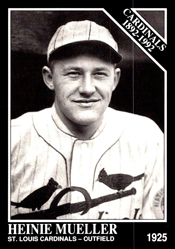
The mistake extended the inning and allowed Rogers Hornsby to bat. Hornsby lashed a double, driving in Schultz and making the score 8-6. Smith moved to third. Up next was Heinie Mueller, a St. Louisan who had driven in a mere five runs all season. After getting ahead in the count 2-and-0, Mueller looked for a cripple pitch and got it. He singled to center, sending Smith and Hornsby home and tying the score at 8-8. “Upon this, pandemonium broke loose” in the stands, the Globe-Democrat reported.
Braves manager Fred Mitchell lifted Frank Miller, who faced 26 batters in his relief stint, and brought in a rookie, Tim McNamara. Les Mann ran for Mueller. Del Gainer, the first batter to face McNamara, tapped a ball toward third for an infield hit. Then Milt Stock stroked his second single of the inning through the right side, scoring Mann and giving St. Louis a 9-8 lead.
“Bedlam and pandemonium and all its kindred companions broke out in earnest,” the Post-Dispatch reported.
According to the Globe-Democrat, “frenzied fans smashed straw hats, hurled scorecards onto the field and all but tore the stands into pieces.”
Bill Sherdel, who pitched 10 innings in a win two days earlier, was brought in to work the ninth for St. Louis. He held the Braves scoreless, saving the win that put the Cardinals into first place. Boxscore
That afternoon, in Philadelphia, the Browns stomped the Athletics, 10-1, and boosted their lead over the Yankees to 2.5 games. Boxscore
“For the first time in 21 years, since the American League was organized in 1901, the two St. Louis teams simultaneously occupy first place in the major leagues,” the Globe-Democrat noted.
New York, New York
Soon after, the Giants and Yankees were helped by trades made with the Boston clubs. On July 23, the Red Sox dealt third baseman Joe Dugan to the Yankees for four players and $50,000. Dugan hit .286 for the 1922 Yankees and .385 with runners in scoring position. On July 30, the Braves sent pitcher Hugh McQuillan to the Giants for three players and $100,000. McQuillan earned six wins, including one against the Cardinals, for the 1922 Giants.
Meanwhile, the Cardinals went into a tailspin, losing five in a row, including four to the Giants, after the comeback win against the Braves. The Cardinals were 8-14 in August, including 4-11 at home. Their record after July 22 was 28-34.
The Giants (93-61) were National League champions. The Reds (86-68) placed second and the Cardinals (85-69) and Pirates (85-69) shared third.
The Yankees (94-60) prevailed in the American League, one win better than St. Louis (93-61). The Browns lost 14 of 22 against the Yankees during the season.
The World Series was all Giants, who swept to the title.



this is a great discovery Mark…..i’ve often wondered about the “tendencies” of those that loved the Browns more than the Cardinals and vice versa and same with the Red Sox and Braves and other two team cities and i say tendencies because it’s hard to generalize about fans. Did a rival exist between cardinal and browns fans?
Thanks, Steve. According to the St. Louis Browns Historical Society and Fan Club, beginning in the mid to late 1920s, St. Louis shifted from strong Browns loyalty to Cardinals loyalty, with the Cardinals in the World Series four times within a six-year period (1926-31). When the Browns and Cardinals played in the 1944 World Series, the town was rooting for the underdog Browns. (The Browns were in their first and only World Series; the Cardinals were in the World Series for the third year in a row.) Even Stan Musial said how weird it felt having the fans root against the Cardinals. In his autobiography, Musial recalled his wife, Lil, saying after the 1944 World Series opener, “This is a Brownie town.”
the potential for a rivalry that could draw people into soft core gang activity as opposed to murders is maybe the lure of sports. i like the potential in two team cities like in new york it seems pretty clear – to be a yankee or mets fan….same with chicago. geez, back in the 80’s white sox fans would come to milwaukee or brewers fans would go to chicago and serious brawls would break out.
I appreciate you Mark making this post. I’ve always been fascinated with the 1922 St.Louis Browns. I also have always wondered if things would have gone differently had they been able to win the pennant. It really is insane to look at the head to head comparisons and discover that the only team to give the Browns any trouble were the New York Yankees. But it’s enough to drive a manager crazy that of the 14 losses they suffered against New York 8 were by one run with four of those being extra inning games. It’s interesting also that you mention the trade the Yankees made for Joe Dugan. He hit safely in 9 out of 10 games against the Browns scoring 8 runs. Two of those runs proved to be the winning run. The city of St.Louis would have to wait another 22 years before both the Cardinals and Browns sat a top the respective leagues. Once again thanks Mark.
Your factual insights about the razor-thin margin of most of the Browns’ losses to the Yankees in 1922, as well as the damage Joe Dugan did to the Browns after going to the Yankees that season, adds well to this post, Phillip.
One more note on Joe Dugan: He would play in five World Series for the Yankees, including 1926, when he hit .333 versus the Cardinals. Like he was against the Browns, Dugan was a thorn against the Cardinals, with two hits versus Grover Cleveland Alexander in Game 6 and two more versus Jesse Haines in Game 7.
They shared the same ballpark, right? Wonder if it has ever happened that two teams sharing the same home field met in the World Series. (And nobody’s going to use that Democrats in Georgia comparison anymore.)
World Series clubs that shared the same home field were:
_ 1921, Giants vs. Yankees at the Polo Grounds
_ 1922, Giants vs. Yankees at the Polo Grounds
_ 1944, Browns vs. Cardinals at Sportsman’s Park
The Yankees moved into Yankee Stadium in April 1923.
Thanks. Didn’t know that the Yankees once played in the Polo Grounds. Before my time, haha.
In 1913, the Giants invited the Yankees to leave Hilltop Park and become tenants at the Polo Grounds, with the Yankees paying rent. The Giants were happy with the arrangement until 1920, when Babe Ruth joined the Yankees. He became baseball’s top gate attraction. By 1921 and 1922, the Yankees were routinely drawing larger crowds to the Polo Grounds than the Giants, even though the Giants were winning National League pennants. Humiliated and furious that a tenant team was stealing their spotlight in their ballpark, manager John McGraw and Giants management gave the Yankees notice to vacate. This forced the Yankees to purchase land across the Harlem River in the Bronx and build the original Yankee Stadium.
Most New York landlords would have just jacked the rent astronomically.
The relationship of the two St. Loo teams back then has fascinated me. I can’t fathom what that must have been like back in the day to have two major league teams in the same city. Wonder how many people attended both teams games in Sportsman’s Park, and why even pick one over the other? Musial called it a Browns town, but I am wondering if that was just because of their underdog status. Very interesting post, Mark.
Thanks, Bruce. I feel likewise about the relationship of the two Philadelphia teams. Wish the Philadelphia A’s and Philadelphia Phillies had faced off in a World Series. I think the closest it came to happening was 1913 when the A’s were American League champions and the Phillies finished second in the National.
At least Philadelphia had the annual City Series exhibition games between the A’s and Phillies. According to MLB.com, Philadelphia sports reporter Allen Lewis said, “The teams took it very seriously. One year (1912) Pete Alexander had won 19 games going into the last week of the season, but the Phillies didn’t pitch him all week because they were saving him for the City Series.” Alexander made his pitching debut in Philadelphia in a 1911 City Series game, pitching five hitless innings against the A’s.
Good post, Mark. That George Sisler was some kind of hitter. After hitting .420 in 1922, Sisler’s career batting average was a cool .361. He missed the 1923 season with eye problems, and came back and hit “only” .320 over the rest of his career, leaving his lifetime batting average at.340. Makes you wonder what he might have done if he hadn’t contracted that eye ailment.
I appreciate your appreciation of George Sisler, Hugh. His career batting averages against some of the game’s top pitchers are remarkable: .395 vs. Waite Hoyt, .369 vs. Stan Coveleski, .347 vs. Herb Pennock, .337 vs. Walter Johnson.
And George Sisler could pitch with the best, too: https://retrosimba.com/2025/09/26/american-idol-george-sisler-versus-walter-johnson/
Is that the same Joe Schultz who was a Cardinal coach in the 60’s and then manager of the Seattle Pilots in 1969? He must have been pretty old when he managed the Pilots (and Jim Bouton).
Thanks for asking. That player for the 1922 Cardinals was Joe Schultz Sr., who was born in 1893. His son, Joe Schultz Jr., is the one who coached for the 1960s Cardinals and managed the 1969 Pilots. Joe Schultz Jr. was 50 when he managed Seattle: https://retrosimba.com/2024/11/29/joe-schultz-from-cardinals-coach-to-literary-protagonist/
A right-handed batter, Joe Schultz Sr. played 11 seasons in the majors and hit .285. A left-handed batter, Joe Schultz Jr. played nine seasons in the majors and hit .259.