Closers get the glory, but catchers get the most valuable saves.
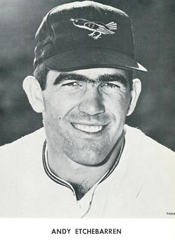
Within an eight-month period, August 1966 to March 1967, catchers Andy Etchebarren (Orioles) and Dave Duncan (Athletics) saved people from drowning.
Etchebarren rescued his teammate, Frank Robinson, who sank to the bottom of a swimming pool. Duncan saved a girl who tumbled into the Gulf of Mexico.
Deep end
The 1966 Orioles made themselves hard to catch in the American League pennant race, winning 12 of their first 13 games and then 25 of 33 in June.
 A key to their success was Frank Robinson. Acquired from the Reds in December 1965 _ Bill DeWitt Sr. made the decision to trade him _ Robinson would have a spectacular 1966 season, achieving the Triple Crown as the league leader in home runs (49), RBI (122) and batting average (.316). He also was tops in total bases (367), runs scored (122), on-base percentage (.410) and slugging (.637).
“Frank Robinson was the catalyst who transformed a good Baltimore team into one that could be the strength of the American League for several years,” Steve Jacobson of Newsday noted.
On a day off, Monday, Aug. 22, the Orioles (80-43) awoke with a 12.5-game lead over their closest pursuers (Detroit). To reward his hometown heroes, Baltimore mortician Leonard Ruck gave them a private party at his estate that evening.
Many of the guests gathered around or in the swimming pool. Boog Powell, the massive first baseman, slipped and fell trying to throw teammate Moe Drabowsky into the pool. Powell suffered a cut above his right eye and had to go to the hospital for stitches, the Baltimore Sun reported.
Frank Robinson said other players threatened to toss him in fully clothed, even though he told them he couldn’t swim, the Associated Press reported. He said he changed into swim trunks (which he apparently had brought for lounging on the pool deck) and eased into the shallow end to prevent an expected dunking.
“I was jumping up and down (in the water) when I slipped off into the deep end,” Robinson told reporter Gordon Beard. “I went down a couple of times and kept yelling for help every time I surfaced. My wife thought I was kidding, and I guess everybody else did, too.”
Orioles outfielder Paul Blair recalled to the Associated Press, “The way Frank was jumping up and down, it looked like he knew how to swim. We were trying to catch (teammate) Charley Lau to throw him in at the time, so we weren’t paying too much attention (to Robinson) anyway.”
Sensing Robinson, 30, was in trouble, rookie Andy Etchebarren, 23, jumped in. “I thought he was kidding at first,” Etchebarren said to Gordon Beard, “but then I decided it was time to do something. When I reached Frank, he was just off the bottom and couldn’t move up.”
Etchebarren grabbed Robinson, then let go and returned to the surface for air. “I didn’t take a deep breath when I jumped in because I wasn’t really sure if Frank was kidding,” said Etchebarren. “When I realized he wasn’t, I pushed him a few yards and then resurfaced.”
Robinson told the Associated Press, “I remembered that a person in this kind of trouble is not supposed to struggle, so I kept as calm as I could. After giving me a couple shoves, Andy lost contact with me for a few seconds. I could see the headlines: ‘Robinson drowns at team party.’ Finally, Andy grabbed me again and shoved me to the side of the pool.”
No resuscitation effort was needed. “We let him lie by the side of the pool for about five minutes and then he got up,” Etchebarren said to Gordon Beard.
The next day, Etchebarren learned he had a cracked bone in his hand. Five weeks earlier, when he was struck on the hand by a Dennis Higgins pitch, X-rays showed no fracture. Pain persisted, and when another exam was done the day after the pool rescue, the fracture was discovered.
Etchebarren was back in the lineup a week later. In the Orioles’ World Series sweep of the Dodgers, he was the starting catcher in all four games. He fielded flawlessly, with no errors in 36 innings, and handled a pitching staff that limited the Dodgers to two total runs.
Frank Robinson’s home run against Don Drysdale lifted Baltimore to a 1-0 victory in the decisive Game 4. He received both the World Series Most Valuable Player Award and the American League MVP honor. Boxscore
Taking the plunge
After clouting 46 home runs for minor-league Modesto in 1966, Dave Duncan, 21, went to the Kansas City Athletics’ 1967 spring training camp at Bradenton, Fla.
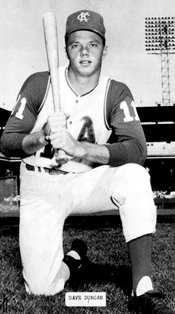 On March 24, 1967, the day after Duncan walloped a 400-foot homer to break a tie and propel the A’s to an exhibition game win against the White Sox, he was fishing from Rod and Reel Pier in Anna Maria, Fla. A family from Benton Harbor, Mich., 11-year-old Vickie Peet and her parents, were fishing there too.
Vickie lost her balance, fell into the sea and sank in about 12 feet, the Tampa Bay Times reported.
Duncan, fully clothed, leaped in after her and “brought the struggling girl to safety,” according to the Bradenton Herald.
“She was backing up (on the pier) and it looked like she stumbled,” Duncan told The Sporting News. “She was struggling around in the water and no one was doing anything, so I jumped in and got her.”
According to the Bradenton newspaper, the girl’s parents, Nick and Patricia Peet, “were eternally grateful.”
Duncan began the 1967 season at Birmingham, Ala., and was brought to the A’s for stints in June and September. He started in 27 games for Kansas City.
In February 1975, Duncan was traded by Cleveland to Baltimore for Boog Powell and Don Hood. With Duncan and Elrod Hendricks sharing the catching spot, the Orioles no longer needed Etchebarren, who was sent to the Angels in June 1975.
Duncan, who played in two World Series for Oakland, became a pitching coach, primarily on teams managed by Tony La Russa. As a coach, Duncan helped Oakland to three American League pennants and a World Series title and St. Louis to three National League pennants and two World Series championships.

 RetroSimba
what an amazing story…stories of courage and bravery and thank goodness both Robinson and the young girl survived. I enjoyed the title of this post and the section headings.
It pleases me that you noted and appreciated the headline and section headers, Steve. I try to put some effort into those in each post and it gives me a lift when that is appreciated.
Yes, your titles and headings are very much part of your posts.
1966. That was a two team American League pennant race for a few weeks…in Springtime. Indians and Orioles.
Yes, indeed, Managed by Birdie Tebbetts, the 1966 Cleveland Indians won their first 10 games and 14 of their first 15. Cleveland featured a starting pitching staff with Sam McDowell, Luis Tiant, Sonny Siebert, Gary Bell and Steve Hargan, and had a lineup with sluggers Rocky Colavito and ex-Cardinals Leon Wagner and Fred Whitfield. Cleveland faded in the second half, including an 11-19 record in July, and Tebbetts was replaced in August. After that marvelous start, Cleveland finished 81-81 in 1966.
Grateful to learn about these two catchers’ heroic efforts saving Frank and Vickie. Incidents that I had never heard of before. Thank you.
Thanks for reading and for commenting, Tom. I didn’t know about either of these rescues until I read a mention of the Andy Etchebarren heroics this month in a book about the 1966 World Series. In researching that, I came across the Dave Duncan rescue of the girl in newspaper archives.
It’s good to know that both of these incidents have happy endings. I can’t help but laugh a bit that the host of the party was a mortician. It’s a good thing that Frank Robinson remembered to remain calm. A truly heroic gesture from Andy Etchebarren. You have to wonder if the Orioles team doctors would have ever discovered that fracture if not for that 2nd X-ray. Dave Duncan’s coaching legacy is basically based upon is gift of saving struggling pitchers and getting them back on the right track. He proved to be a hero in the real world as well.
I appreciate your keen eye for detail, Phillip, and that you picked up on the fact a mortician hosted the Orioles party. Yep, he came close to getting an unwanted customer.
Good point about Andy Etchebarren’s fracture possibly going undetected if not for the second X-ray. Difficult enough to make that rescue with healthy hands, let alone a fractured one.
I like your line about Dave Duncan’s coaching career being known for saving struggling pitchers. Indeed, he threw life lines, so to speak, to a lot of ballplayers.
Good catches indeed, Mark. Two guys who I think I had more multiples of their trading cards than any other major league players lol. I was not aware of their real-life, life-saving exploits, so this was a very cool addendum for me to their career memories. Dunc of course was part of those A’s championships, and with the A’s being my AL team of choice as a kid I was more familar with him. He really did have a great second career once his playing days ended.
So, I wasn’t the only kid who kept getting Andy Etchebarren and Dave Duncan cards in his wax packs! Yep, there must have been 15 Etchebarren and 15 Duncan cards inserted for every one Johnny Bench or Thurman Munson.
Like Dave Duncan, Andy Etchebarren also had a long second career in baseball. Etchebarren was a minor-league manager for 17 seasons and a big-league coach for 10 seasons. He coached the Angels (1977), Brewers (1985-91) and Orioles (1996-97). He was the bench coach for Tom Trebelhorn in Milwaukee and for Davey Johnson in Baltimore.
Among the minor-league players Etchebarren managed were Jayson Werth, Brian Roberts, Pete Rose Jr. and Tim Raines Jr. Though he mostly managed in the Orioles’ system, Etchebarren spent his final four seasons as a manager (2009-12) near your neck of the woods, Bruce, with the York (Pa.) Revolution.
I had forgotten Andy managed that York Revolution squad, which apparently was partly owned by Brooks Robinson…which I think I missed entirely. It was nice Andy got to win a couple of titles as a manager before retiring.
You are correct about Brooks Robinson having been part of the ownership group of the York Revolution of the independent Atlantic League. Thanks for noting it, Bruce.
Robinson was 18 when he began his professional baseball career with the York White Roses in 1955. He played second base (54 games) as well as third base (40 games) that season and hit .331 before being called up to Baltimore in September.
In 2008, the York Revolution unveiled a statue of Robinson. It shows him standing between two kids and signing autographs. The statue is located on Brooks Robinson Plaza outside the ballpark, which is located on 5 Brooks Robinson Way in York.
At the statue unveiling, Robinson told the York Daily Record, “York Pennsylvania has always been special to me. No one was as happy as I was to be a part of bringing baseball back to York.”
What a great story. Can’t get over hearing that Etchebarren saved Frank Robinson’s life at a team pool party. I’d vote him into the Hall of Fame for that one.
Alas, Andy Etchebarren hasn’t even been inducted into the Baltimore Orioles Hall of Fame, an oversight considering his lifesaving rescue.
According to the New York Times, Etchebarren said he and Robinson didn’t talk much about the incident, although occasionally throughout the years Robinson would greet Etchebarren or introduce him to others by saying, “This is the guy who saved my life.”
(In his Baseball Hall of Fame induction speech, Robinson didn’t mention Etchebarren.)
Another note from the Times: Etchebarren said the swimming pool at that team party didn’t have a gradual dropoff. “Went from like two feet to four feet and then straight down to 12.”
This pool party sounds like one our baseball team had in high school where a few players were trying to throw other players into the pool, resulting in a couple of injuries–but we were teenagers. Even then, however, I thought it was stupid. Anyway, maybe the most amazing item in this post is that Frank Robinson was just 30 years old in 1966. What were the Reds thinking when they traded him away?
In 1961, Frank Robinson got into an argument with a short-order cook at a Cincinnati diner, pulled out a pistol and threatened the cook. Two police officers witnessed the incident from across the street and arrested Robinson. At the police station, Robinson called Bill DeWitt, who ran the Reds. According to Dick Young of the New York Daily News, Robinson thought DeWitt was slow to help. Robinson spent the night in jail. “The feelings between Bill DeWitt and Frank Robinson never were the same after that,” Dick Young reported.
DeWitt said he thought Robinson was injury-prone. When he traded Robinson to Baltimore, DeWitt said, “He is an old 30.”
That remark upset Robinson _ “That’s like calling Sophia Loren an old bag,” Young wrote in 1966 _ and Robinson was determined to show that DeWitt was wrong.