Stan Musial wanted out. The Cardinals wanted to give away an out. The ninth inning at Brooklyn’s Ebbets Field on Sept. 18, 1948, was, in a word, outlandish.
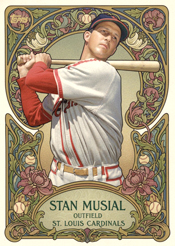 Musial, who hit .522 (24 for 46) at Ebbets Field in 1948, set the stage an inning earlier when he slammed a Paul Minner pitch out of the ballpark for his 36th home run of the season, tying the score at 2-2 in the eighth.
Stan comes clean
The score remained even when the Dodgers came to bat in the ninth against the Cardinals’ best reliever, Ted Wilks.
Pee Wee Reese led off and hit a pop fly into shallow left. Shortstop Ralph LaPointe chased after it and called off left fielder Enos Slaughter.
(LaPointe had entered the game in the fourth for Marty Marion, whose back ached. Marion committed two errors in the first, leading to a Brooklyn run.)
With the wind twisting the ball away from him, LaPointe changed direction at the last moment. He got his hands on the ball, then dropped it. Reese was safe at second with what was ruled a double.
Then Musial, playing center field, called a timeout, trotted toward the dugout and conferred with manager Eddie Dyer.
To the surprise of all in the ballpark, Musial took a seat on the bench and Erv Dusak went out to center field to replace him.
A day earlier, as it turned out, when Musial made a somersaulting catch of Tommy Brown’s short fly to center with two on in the eighth, he strained his left arm.
Musial kept quiet about the ailment because he didn’t want to remove his bat from the lineup. However, now that the Dodgers had the potential winning run in scoring position, Musial confessed to Dyer that he didn’t think he could make a strong throw from the outfield to the plate if Reese tried to score on a single to center, the St. Louis Post-Dispatch reported.
According to the Irv Goodman book “Stan The Man Musial,” Musial knew he was due to bat second in the 10th inning and “this, too, had kept him quiet when he went out to the field at the bottom of the ninth.”
Now that Brooklyn had a scoring chance, “My turn at bat wouldn’t mean anything if there wasn’t going to be a 10th inning,” Musial told reporter Bob Broeg.
So he huddled with Dyer, who said, “thanks,” according to the Irv Goodman book.
Decisions, decisions
Next up for Brooklyn was Carl Furillo. He fouled off a bunt attempt, then tried again and the ball “glanced straight down off the bat and wound up in fair territory on the left side,” the New York Daily News reported.
According to reporter Dick Young, “Furillo stood still at the plate for the longest moment and then decided to run.”
Wilks fielded the ball and fired to first for the out, with Reese advancing to third.
Rather than accept the out, Eddie Dyer and Cardinals catcher Del Rice insisted to plate umpire George Barr that the ball struck Furillo’s foot and thus was foul. After conferring with fellow umpires Lee Ballanfant and Al Barlick, Barr reversed his call, declaring Furillo’s bunt try was a foul, and ordered Reese to go back to second.
Instead of one out and a runner on third, the Dodgers still had none out and a runner on second.
With two strikes on Furillo, a third bunt try was impractical. So Dodgers manager Burt Shotton sent a left-handed batter, Pete Reiser, to replace Furillo and swing away against the right-handed pitcher.
A St. Louisan, Reiser drilled Wilks’ first pitch into the alley between Erv Dusak in center and Ron Northey in right. Reese raced home with the winning run. Reiser was credited with a single, though he easily could have reached second or third.
The victory, in the final 1948 matchup between the Cardinals and Dodgers, gave Brooklyn 12 wins in 22 games versus St. Louis. It was the first time the Dodgers won a season series against the Cardinals since 1932. Boxscore



The last line of this post totally surprised me. The Dodgers hadn’t won a series from the Cardinals in 16 years!
Yep, surprised me, too, when I came across that.
The Cardinals won the season series against the National League champion Dodgers again in 1949, then didn’t win another season series from them until 1960.
Man, this is a captivating read. What a way to start it. “Stan Musial wanted out.” Just brilliant right there. So if i got this right, the strange bunt or not to bunt incident resulted in a pinch hitter? That has to be one of the most bizarre at bats.
Thanks, Steve. Yep, quite a bold move by Dodgers manager Burt Shotton to lift Carl Furillo for Pete Reiser during an at-bat once the bunt wasn’t going to be attempted. Furillo was a quality hitter, batting .297 in 1948 and .305 with runners in scoring position. By comparison, Reiser batted .236 in 1948 and .257 with runners in scoring position. However, Shotton knew his personnel. He preferred a left-handed batter to swing away against Ted Wilks, plus Reiser hit .444 versus St. Louis in 1948 and .313 for his career versus Wilks.
It turned out to be a winning move.
I like the move. Keeping players on their toes, not knowing when it’s their time.
A lot of interesting things took place in the 9th inning. Some of which in today’s analytical game would have never happened. You have to admire Stan Musial taking himself out of the game. Especially considering the phenomenal year that he had in 1948. Besides his regular numbers he batted .391 with risp. You mention Mark the catch that he made the previous day. In looking at the boxscore the Dodgers had runners on 1st and 2nd when he made that difficult catch. I was wondering Mark, if maybe it would have played out better for Del Rice to put the tag on Carl Furillo and at the same time keep his eye on Reese and try to hold him at 2nd. One things for sure is that the Cardinals that year suffered some heart breaking losses against the Dodgers. On August 30 they blew a 5-2 lead giving up 4 runs in the 9th.
Thanks for all the insights you provided, Phillip, and for the additional research.
Yes, I agree that Stan Musial did the right thing by removing himself from the game for all the right reasons. By the way, the next day, the Cardinals had a doubleheader against the Giants and Musial played the entire way in both games. In the opener, he went 2-for-3 with a walk and scored a run. He made three putouts in center field. In the nightcap, Musial hit a two-run home run. He started in center, shifted to right and made five putouts. The Cardinals won both games.
Yes, based on the description of where the ball ended up on Carl Furillo’s second bunt try, Del Rice, rather than Ted Wilks, probably should have made the play. However, I got the impression that Rice didn’t attempt to field the ball because he believed it was a foul ball and wasn’t in play, while Wilks didn’t know that and thus fielded the ball.
I guess the Cardinals preferred Reese at second with no outs as opposed to being at third with one out. It’s difficult to imagine why they would take an out off the board. It’s also hard to believe that Shotton had enough confidence in Reiser to send him to the plate with two strikes on Furillo. I wonder how great Reiser would have been if he hadn’t had a penchant for crashing head first into the outfield wall. I wonder how many of today’s superstars would take themselves out of the lineup in the same situation. Stan Musial truly was The Man. Great post, Mark.
Enjoyed your comments, Hugh.
If the Cardinals had accepted the out, putting Pee Wee Reese at third with one out, the next batter was Tommy Brown, who hit .230 against right-handers that year. I’m guessing Burt Shotton would have sent Pete Reiser to bat for Brown. (Another left-handed hitter available on the Dodgers’ bench was Duke Snider.) Regardless, it is, as you note, telling how much confidence Shotton had in Reiser at the plate with the game on the line.