Willie Mays was having an unhappy 25th birthday the afternoon of May 6, 1956, at St. Louis.
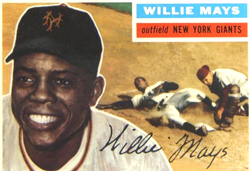 Batting cleanup for the Giants in a doubleheader against the Cardinals, Mays went hitless in the opener and stranded five base runners as St. Louis prevailed, 5-4.
Willie’s birthday blues extended into the second game. In the first inning, he retrieved Red Schoendienst’s double and unleashed a wild throw that sailed past third baseman Foster Castleman and landed in the seats on one hop. Schoendienst scooted to home plate on the error, giving the Cardinals a 1-0 lead.
Mays was such an exceptional ballplayer, though, that even when his hitting and fielding were askew, he could find another way to beat a team. In this instance, it was his base running that sparked the Giants to a Game 2 victory and gave Mays a birthday treat to celebrate. Mays swiped four bases in a game for the first time.
On the run
In his first three seasons with the Giants, Mays rarely attempted to steal bases, but manager Leo Durocher gave him the green light in 1955 and “I found out I could steal,” Mays told the Jersey Journal.
Mays swiped 24 bases in 28 attempts in 1955.
Durocher was Willie’s mentor and protector. When Bill Rigney took over as Giants manager in 1956, Mays had trouble adapting to the change. Rigney didn’t coddle Mays as Durocher had and tension developed between player and manager.
Mays hit .200 and made no steal attempts in the Giants’ first 13 games of 1956. A breakout came on May 4 at Milwaukee when Mays hit a home run and stole a base against Lew Burdette.
Then the Giants went to St. Louis for the Sunday twin bill on Willie’s birthday.
Coming up empty
In the opener, Mays went 0-for-5 against three Cardinals pitchers _ Harvey Haddix, Larry Jackson and Ellis Kinder.
He had hard luck against Haddix in the third. Batting with two on, two outs, Mays sent a drive to deep left. It looked to be a double or triple, but Rip Repulski made a leaping catch against the concrete wall.
Two innings later, Mays again batted with two on, but Larry Jackson got him to foul out to first baseman Wally Moon.
After Stan Musial put the Cardinals ahead, 5-4, with a home run versus Al Worthington in the eighth, Mays batted with one on in the ninth, but Ellis Kinder, the 41-year-old closer facing Mays for the first time, got him to fly out. Boxscore
Finding a weakness
Eager to atone for the error that gave St. Louis the lead in the first inning of Game 2, Mays led off the second with a single against Vinegar Bend Mizell. Back with the Cardinals after two years in the Army, Mizell was a left-hander who threw with a “slow, exaggerated delivery,” according to the St. Louis Post-Dispatch.
Mays was seeing Mizell for the first time. Willie was in the Army when Mizell had his first two seasons with St. Louis (1952-53).
As Mays took his lead off first, he “did not get a good read on Mizell’s move,” according to James S. Hirsch, author of the authorized biography “Willie Mays: The Life, The Legend.”
Willie’s hesitancy cost the Giants. Daryl Spencer followed with a grounder that the Cardinals converted into a double play _ Ken Boyer to Schoendienst to Moon.
If he reached base again, and Mays had no doubt he would, he was determined to take advantage of Mizell’s slow-motion windup. As biographer Hirsch noted, “Mays studied the pitcher from the bench. Left-handers were tougher to decipher, but he thought they all had one vulnerability: their eyes signaled their intentions. He also found a tip-off in Mizell’s delivery. With a speedy runner on first base, Mizell assumed, like most pitchers, that his fastball would give his catcher a better chance on an attempted steal, but Mays saw that Mizell kicked his right leg higher on a fastball, making that the ideal pitch on which to run.”
Next time up, in the fourth, Mays walked, got a running jump and stole second. Then he swiped third. He was stranded there, but Mays now knew he could run at will on Mizell and there was little that catcher Bill Sarni could do to stop him.
In the sixth, Mays walked again, stole second and “could feel the angry, frustrated stares of both Mizell and Sarni,” biographer Hirsch noted.
Sarni, who began his pro career at 15 with Los Angeles of the Pacific Coast League in 1943, had a strong arm and took pride in his ability to thwart stolen base attempts. He nailed 48 percent (70 of 146) of those trying to steal against him during his big-league career. After Mays ran wild against the Cardinals, Sarni told the Post-Dispatch, “I guess 26,000 people (at the game) will think I can’t throw.”
Applying pressure
With St. Louis ahead, 4-3, in the ninth, Mays led off against Mizell and singled. According to Hirsch, “Mizell tried to hold him with several throws, but Mays ran on the first pitch and beat the peg _ four steals in one game. He considered stealing third, though with none out, the attempt would have carried undue risk.”
“I could have taken third base easy,” Mays said.
Instead, Mays dashed home from second with the tying run on Daryl Spencer’s double against a rattled Mizell. After Ellis Kinder relieved, Foster Castleman bunted Spencer to third and Dusty Rhodes drove him in with a single, giving the Giants a 5-4 lead.
The Cardinals put two on with one out in their half of the ninth, but Hoyt Wilhelm came in and retired Bill Virdon and Walker Cooper on pop-outs to the catcher, preserving the win. Boxscore
NL’s first 30-30 player
A month after the base stealing show by Mays in St. Louis, Bill Sarni was sent with Red Schoendienst and others to the Giants in the trade that brought Alvin Dark to the Cardinals.
(Sarni threw out 15 of the 26 runners who tried to steal against him with the 1956 Giants. Impressed, the Giants projected him as their catcher in 1957, but on the first day of spring training Sarni, 29, suffered a heart attack. He survived but never played again.)
Willie Mays went on to steal 40 bases in 50 attempts and belt 36 home runs for the 1956 Giants, becoming the first National League player with at least 30 homers and 30 steals in a season.
(The first to do it in the American League was Ken Williams, with 39 homers and 37 steals for the 1922 St. Louis Browns. No AL player achieved the feat again until Tommy Harper, 31 homers; 38 steals, with the 1970 Milwaukee Brewers.)
Mays repeated the achievement in 1957, with 35 homers and 38 steals.
(In the long and prominent history of the Cardinals, none has achieved 30 steals and 30 homers in a season.)
Mays in 1956 became the first National League player to swipe 40 bases since Kiki Cuyler totaled 43 for the 1929 Cubs.
Mays led the NL in steals for four consecutive seasons: 1956 (40), 1957 (38), 1958 (31) and 1959 (27).
He had 338 steals in his big-league career, according to retrosheet.org, and he was successful on most of his attempts. For instance, Mays had 27 steals in 31 tries in 1959 and 18 in 20 attempts in 1962. At age 40 in 1971, Mays was caught just three times in 26 attempts.
Mays swiped four bases in a game just once after his thefts at St. Louis. That came against the Reds in 1957, the year the Cardinals tried to acquire Mays with a $750,000 cash offer to the Giants. Boxscore
As for Vinegar Bend Mizell, Mays remained his menace throughout his career. Mays hit .392 (40 for 102) versus Mizell, with six doubles, five triples, five home runs and a .488 on-base percentage.



This adds to the legend of Willie Mays and Leo Durocher who my grandpa used to refer to as Lippy. amazing that Mays didn’t steal bases during the beginning of his career, not until Durocher gave him the green light!! And then that he was such a successful base stealer too, unlike today’s game which limits pitcher pick offs. that’s a rule change i don’t think i’ll ever adjust to. makes stolen bases a joke or not a joke. i could never steal a base, but it seems so much easier now. i’m not sure where i first saw footage of Mays playing stickball with kids on city streets, but he sure seemed like a happy dude and is it fair to say that he is a little overlooked? Mays that is because he was (as far as I know) not too vocal about civil rights like Aaron and Flood. strange twist to think that bigotry might have propelled various careers to new heights because of the racism….that rage, the inspiration to stick it to the whities.
Tom Meany, a sportswriter, watched Willie Mays play stickball with the neighborhood kids in Harlem. Meany filed this report for Collier’s magazine in September 1954:
Stickball is a variation of baseball, with a broom handle serving as the bat and the pitcher throwing a rubber ball on one bounce. Home plate is a manhole cover on St. Nicholas Place and West 155th Street, where Willie and his youthful pals play their games nearly every evening when the Giants are at home. Second base also is a manhole cover but first and third are fenders of parked cars. One strike, or one foul, is out. Willie boards nearby with Mrs. James Goosby, who watches the games and calls him when dinner is ready.
Don’t get me started on Willie Mays. Growing up a Giants fan, I thought he was the best thing that ever happened to baseball. As an elementary school student in the late 50’s I was involved in many a schoolyard argument about who was the best centerfielder, Mays, Mantle or Snyder. (There’s only one correct answer.)
In January 1979, at a press conference in New York after he was elected to the Baseball Hall of Fame, Willie Mays was asked, “Who was the best ballplayer you ever saw?”
According to the New York Times, Mays replied, “I think I was the best ballplayer I’ve ever seen. I feel nobody in the world could do what I could do on a baseball field.”
The next question was: “Aside from yourself, who was best?”
Mays said, “The next one would be Roberto Clemente.”
Mark, I’m left speechless how quickly Willie Mays had figured out Mizell. Basically one at bat plus a couple of innings analyzing his windup from the bench. Talk about being a student of the game. But I guess that’s why he was the say hey kid. Didn’t know about Bill Sarni having a heartache at only 29. Glad to know that he recovered even if it meant the end of his playing career.
In 1979, more than 20 years after his four-steal game against Vinegar Bend Mizell and the Cardinals, Willie Mays still was being asked how he did it. Mays explained to the New York Times, “He reared back and lifted his leg and dropped his arm. In two pitches, I’d steal second and third.”
Mays indeed was a genuine student of the game. He was especially observant of where batters usually hit the ball and he used his insights to position himself in the outfield. For example, Mays told columnist Dave Anderson how he played when Richie Ashburn batted: “He was a line drive hitter. I used to play him shallow over in left-center and catch most of his line drives. He used to yell at me, ‘Hey, give me a chance.’ I think he hit one ball over my head his whole career.”
Bill Sarni suffered what was described as a “moderate” heart attack on the first day of 1957 spring training. At the time, Sarni was close to qualifying for the major league pension. So Giants owner Horace Stoneham kindly made him an official member of the 1957 Giants coaching staff, even though Sarni needed to go home to St. Louis to recuperate. In August 1957, Sarni was cleared to join the Giants as a coach, but because of Stoneham’s kindness, he was given credit for being a Giants coach the entire season.
Eerily, Hal Smith, the catcher who took over for the Cardinals after Sarni was traded to the Giants, also had his playing career cut short because of a heart ailment: https://retrosimba.com/2014/04/20/hal-smith-cardinals-all-star-catcher-made-pitchers-better/
Mark, I liked your comment quoting Willie when asked about the best baseball player, and not just because he named himself. He also mentioned Roberto Clemente. Mays and Clemente are both definitely in the upper level of any list I would compile if I were asked that question.
Roberto Clemente and Willie Mays are the only players to achieve career batting averages of at least .300 and win at least 12 Gold Glove awards.
(Ivan Rodriguez came close to joining them, with 13 Gold Glove awards and a career batting average of .296.)
I’m always so fascinated by how professional baseball approach things. The attention to the tiniest detail like a leg kick that’s slightly higher on a fastball than on an offspeed pitch. It’s what makes players like Willie so great, and something we could definitely all learn from. I’ve got a meeting with my digital marketing team this week, and I’m definitely going to bring up Willie Mays to express the importance of attention to detail. Thanks for sharing.
Thanks for reading and for commenting.
Lots of interesting stuff here, Mark. Even the great Willie Mays could have a bad day.
Foster Castleman grew up here in Nashville. His first cousin, once removed worked with me as manager of our food protection program. The Giants sold Castleman to the Orioles, and his cousin said that Foster joked that it took Brooks Robinson to replace him at third base.
Thanks for sharing those insights about Foster Castleman, Hugh. Indeed, with Brooks Robinson taking over at third, Castleman made 64 starts at shortstop for manager Paul Richards’ 1958 Orioles.