It was easy to see why, for some, Fort Lauderdale in February 1963 was like paradise. Sunshine and scents of citrus blossoms carried by gentle sea breezes were abundant in the Florida coastal town.
 Bolstered by the hit 1960 film “Where the Boys Are,” thousands of college students frolicked in the Atlantic Ocean surf and in hangouts like the Elbo Room.
The Yankees, reigning World Series champions, were headquartered for spring training in the oceanfront Yankee Clipper Hotel. Designed to model a luxury ocean liner, the hotel featured The Wreck Bar, where patrons could sip rum runners while seated along portholes that gave enticing views of mermaid shows being performed in the swimming pool. Mickey Mantle, Roger Maris, Whitey Ford, Yogi Berra or even the Yankee Clipper himself, Joe DiMaggio, then a spring training batting instructor, might show up to see their favorite mermaids.
A significant benefit of staying at the Yankee Clipper Hotel in 1963 was that it didn’t discriminate against people because of skin color. Before 1962, the Yankees (like the Cardinals) trained in St. Petersburg, and their hotel headquarters, The Soreno, refused to admit blacks.
Fort Lauderdale, too, was resistant to ending segregation. A 1927 ordinance restricted black residents and businesses to the northwest sector of the city. Fort Lauderdale’s beaches weren’t desegregated until 1962. Segregation wasn’t fully dissolved in the town until the federal Civil Rights Act of 1964 became law.
A prominent social spot for blacks in Fort Lauderdale was a two-story building patrons called “The Elks Rest,” formally known as the Pride of Fort Lauderdale Elks Lodge No. 652. (Newspapers referred to it as the Negro Elks Club.)
“Back in the day, especially during the 1950s, ’60s, ’70s, anybody black and of high regard and considered ‘classy’ would most likely visit the Elks during their visit to Fort Lauderdale,” James Dallas II, son of a civic leader, recalled to Fort Lauderdale Magazine. “It was not just for these out-of-town visitors but also for everyday people looking for a cozy watering hole where they could have a few drinks and some good conversation.”
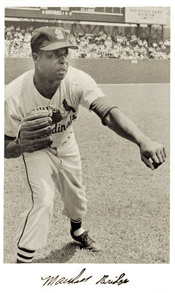
One of those finding his way there one night in February 1963 was Marshall Bridges. A left-handed pitcher, Bridges reached the majors with the 1959 Cardinals and was the top reliever for the 1962 champion Yankees.
Bridges was having a drink at the bar when he tried to strike up a conversation with a woman. She wasn’t interested, but Bridges persisted. So she reached into her purse, pulled out a gun and shot him.
Building bridges
Marshall Bridges was from Jackson, Mississippi. He quit school in ninth grade and at 14 got a job as a porter, or custodian, at the state capitol building in 1945, according to the Jackson Clarion-Ledger.
(Throughout the 1950s and into the early 1960s, Bridges worked as a porter at the state capitol building during the fall and winter after baseball season. With salary and tips, he earned $50 a week, United Press International reported in 1961. “This is not a bad job as temporary jobs go,” Bridges told the wire service.)
In 1947, Jackson had a minor league team, an affiliate of the Boston Braves. Bridges, 16, became a groundskeeper’s assistant and then a clubhouse attendant. He was paid $28 a week, according to the St. Louis Post-Dispatch.
“I used to throw during my lunch hour and every other chance I got when I was the clubhouse boy and the bat boy,” Bridges recalled to reporter Neal Russo. “I used to run errands and do all kinds of things for the ballplayers. They got to like me and gave me all the bats, balls and gloves I could use _ new ones, too.”
The Jackson manager, Willis Hudlin, totaled 157 wins as a Cleveland Indians pitcher. When he noticed Bridges tossing balls, he gave the youngster advice on how to pitch. Bridges joined a local semipro team in 1948 and played on weekends. He had talent and “was one of the players developed through the Delta Baseball School,” the Memphis Commercial Appeal reported.
The school was operated by Homer “Goose” Curry, manager of the Memphis Red Sox of the Negro American League. Curry brought Bridges to Memphis in 1950 to pitch and play outfield.
After the 1952 season, Bridges was part of a Negro American League all-star squad that played against a barnstorming team of major leaguers led by Dodgers catcher Roy Campanella. “As a result of his brilliant work in that series,” Bridges’ contract was purchased for $10,000 by the New York Giants, who outbid Brooklyn and Cleveland, the Memphis Commercial Appeal reported.
Baseball odyssey
At the Giants’ 1953 minor-league spring training camp, Bridges impressed more with the bat than with his pitching. Giants officials deemed him a first baseman and assigned him to the Sioux City (Iowa) Soos. “His fielding at the start of the season was, to say the least, on the crude side,” the Sioux City Journal noted.
Bridges made errors, didn’t hit enough and was back with the Negro American League Memphis club as a pitcher in June 1954. Given the chance to start regularly, he regained his form.
Bridges pitched mostly for unaffiliated teams in the minors for the next four seasons and did well as a starter, including 15-1 with Amarillo in 1955.
Developing a curve to mix with a fastball, Bridges won 16 and struck out 205 with Sacramento of the Pacific Coast League in 1958. Scout Joe Mathes recommended Bridges to the Cardinals, who purchased his contract in October 1958.
After opening the 1959 season with Rochester, Bridges, 28, got the call he’d dreamed about. The former minor-league clubhouse attendant was going to the big leagues to pitch for the Cardinals.
Badge of honor
Bridges was assigned to room on the road with first baseman George Crowe. According to John Stamm of the Jackson Clarion-Ledger, when Bridges introduced himself by his first name, Marshall, Crowe immediately thought of a deputy marshal, like Wyatt Earp, from an old Western. Crowe nicknamed him “Sheriff” and soon all the Cardinals were calling Bridges that.
Cardinals manager Solly Hemus viewed Bridges as a reliever. “He fits into our pattern of need; that is, he can throw exceptionally hard in a jam,” Hemus told the St. Louis Globe-Democrat.
In his big-league debut, Bridges pitched 5.1 innings in relief of Larry Jackson and got the win against the Phillies. Boxscore
Two weeks later, Hemus gave Bridges a start versus the Reds at Cincinnati. In the first inning, Bridges clouted a two-run home run against Orlando Pena. Boxscore
(Though he never homered again in the majors and batted .119 overall, Bridges fancied himself a hitter. In 1965, after Bridges stroked a two-run triple against Dean Chance, the 1964 Cy Young Award winner, he told Steve Jacobson of Newsday, “Three greatest hitters _ Williams, Bridges, Musial.”)
In his second Cardinals start, the Sheriff prevailed in a duel with Sandy Koufax, striking out nine Dodgers and earning the win. With St. Louis, Bridges totaled three wins versus the Dodgers and Koufax was the starter in each game. Boxscore
Bridges was one of six pitchers who made their big-league debuts with the 1959 Cardinals and started games for them. The others: Gary Blaylock, Ernie Broglio, Bob Gibson, Tom Hughes and Dick Ricketts.
(In recalling the 1959 season in his book “Stranger to the Game,” Gibson said Solly Hemus “kept calling me Bridges, confusing me with Marshall Bridges, who was several years older than me, skinnier and pitched left-handed. But he was black. Solly got that much right.”)
Used primarily as a reliever the rest of the season, Bridges was 6-3 with a save in 27 appearances for the 1959 Cardinals, striking out 76 in 76 innings.
With the 1960 Cardinals, Bridges was 2-2 with a save and a 3.45 ERA in 20 games, but he landed in Hemus’ doghouse. “Hemus complained that Bridges’ performance was erratic,” the Globe-Democrat reported.
Bridges told Joe Trimble of the New York Daily News, “The manager (Hemus) decided I wasn’t good enough to be a starter or thought he had better men. Anyway, I was put in the bullpen. I told him I wanted to start.”
Selected off waivers by the Reds on Aug. 2, 1960, Bridges was 4-0 with two saves (including one against St. Louis) and a 1.07 ERA for Cincinnati that season.
That’s all, folks
Bridges was popular with teammates because of his infectious humor and entertaining tall tales. As catcher Elston Howard told the Jersey Journal, “He’ll try to get you to believe everything. We talk about table tennis, he says he was the national champion. Talk about fishing, you can bet he caught a 300-pounder.”
Many of his yarns were about rabbit hunting. He told Newsday he saw a rabbit run so fast that it turned blue. In the bullpen one night, Bridges said to pitcher Jim Brosnan, “One time I borrowed an old shotgun. It’s a mess. Wires held it together. So I spy a rabbit. The rabbit sees me. He stops. I shoot. Bam! The barrel goes one way. The handle goes the other way. But the rabbit drops. So I walk over, pick him up. Not a mark on him. Now believe me, that rabbit had a heart attack!”
Though Bridges’ nickname remained Sheriff, Brosnan called him Fox apparently because of Bridges’ boasts about his popularity with so-called foxy ladies. In his book “Pennant Race,” Brosnan quotes Bridges telling teammates, “So I says to this cute lil ol’ fox _ this is before I was married, you understand _ I says, ‘Honey, let’s me and you make a little happiness.’ She just smiles.”
With the 1961 Reds, Bridges entered a game against the Cardinals with Cincinnati ahead, 3-2, in the eighth. Stan Musial walked and Ray Sadecki ran for him. Daryl Spencer walked, moving Sadecki to second. Then Sadecki was picked off. Joe Cunningham lined a hanging curve to center, but Vada Pinson caught it and doubled Spencer off first to retire the side. According to Brosnan, Bridges strolled into the dugout and said, “When you’re wild, you got to use them trick plays.” Boxscore
Reds manager Fred Hutchinson wasn’t amused. He wasn’t laughing either when Bridges’ ERA ballooned to 7.84.
The Reds demoted him to Jersey City in June. After the Reds won the National League pennant, they brought Bridges back to pitch batting practice during the 1961 World Series against the Yankees.
Pride of the Yankees
Yankees scouts had seen Bridges strike out 15 for Jersey City in a game against their Richmond farm team and figured he might help them.
On Dec. 14, 1961, the Yankees traded catcher Jesse Gonder to the Reds for Bridges. It was a brilliant move. The Yankees’ closer, another former Cardinals left-hander, Luis Arroyo, developed an arm ailment in 1962 and Bridges replaced him. Bridges, 31, was 8-4 with 18 saves for the 1962 Yankees, who won the American League pennant.
Danger zone
On Feb. 13, 1963, Bridges participated in a Yankees spring training workout. That evening he went to the Elks Lodge and took a seat at the bar. Another customer, Carrie Lee Raysor, 21, arrived and sat next to Bridges.
Raysor said Bridges asked several times whether he could take her home. She said she told him no several times, United Press International reported.
According to the Fort Lauderdale News, Raysor told police Bridges “put his arm around me and pulled me over, and I didn’t like this kind of mugging.”
Bartender Cora Davis told police Bridges “was trying to kiss the woman.”
Bridges, married with three children, said to the Jackson Clarion-Ledger, “I’ve been a happily married man for 11 years and I don’t have any girlfriends. I just went into this place to eat and I started talking to this woman … Suddenly, for no reason at all, she pulled a gun and shot me.”
The bullet, fired from a .25-caliber automatic revolver, entered Bridges’ left leg just below the knee and remained lodged in his calf, the New York Times reported.
Another bar patron, Erskine Hepburn, said to the Associated Press, “I heard a shot, looked around and saw Bridges fall to the floor. I helped him to my car and drove him to the hospital.”
Examination at Broward General Hospital disclosed a fractured fibula and torn muscle. The bullet burrowed deep and it was decided to leave the slug in his leg.
Raysor, a Fort Lauderdale resident, was taken to the city jail and charged with aggravated assault.
The next day, Bridges’ wife came to Fort Lauderdale. As George Vecsey of Newsday noted, “Being shot was hardly the worst part of Bridges’ experience. The lowest time of all was having to explain the incident to his wife.”
Hard times
After recuperating at home, Bridges returned to the Yankees in late March 1963. According to Newsday, when he entered the clubhouse, Mickey Mantle burst out of a side room, carrying a toy pistol. “Bang, bang, bang,” Mantle shouted. “It scared the stuffing out of me,” Bridges told George Vecsey.
Bridges pitched in 23 games for the 1963 Yankees and was 2-0 with a save. After the season he told the Jackson Clarion-Ledger, “The leg bothered me up until about a month ago. That’s the one I push off the rubber with.”
Though Bridges had been reluctant to press charges against Carrie Lee Raysor, prosecutors were insistent she stand trial. After several delays, all charges against Raysor were dropped in May 1964 when Bridges didn’t appear in court to testify. An assistant county solicitor determined that without Bridges’ testimony the state couldn’t prosecute, the Fort Lauderdale News reported.
The Yankees sold Bridges’ contract to the Washington Senators and he pitched his last big-league game for them in 1965.
Life after baseball was difficult for Bridges. A business venture went bad. His wife left him. He tried carpentry, but a power saw sliced off the little, ring and middle fingers of his left hand. “Only three stumps remained on what had been his pitching hand,” Butch John reported in the Jackson newspaper.
He thought drinking could solve his problems. “I’d go get two or three fifths a day and lock myself in the house,” Bridges told the Clarion-Ledger.
Ralph Houk, Bridges’ manager with the Yankees, asked the club to invite Bridges to the annual Old-Timers’ Day at Yankee Stadium. According to the Jackson newspaper, when Dizzy Dean, the former Cardinals ace, heard about it, he contributed money for a suit of clothes for Bridges to wear at the event.



what a treat…a sunday post! I totally enjoyed your descriptions of the Yankee Clipper Hotel, the details had me right there. What a shock to read about the woman who shot him! And what a legend….the entire story, how he got his nickname “like Wyatt Earp” and the endless struggles Bridges faced. It’s not often I hear about players being moved from pitcher to position player and then back to pitcher.
I guess he played with Jim Brosnan then, with the Cardinals in 1959? I wonder if Brosnan mentions Bridges in his books? A nice ending to know that Dizzy Dean lent a hand to him and too bad fans couldn’t read this post before attending that old timers game.
He certainly was an interesting character. I can’t help but have the feeling that he could have had a better career. I also have the feeling that there are some things regarding the shooting incident that Marshall Bridges never disclosed. He had an excellent year in 1963. Up until the start of August he was 6-0 with 15 saves and an era of 2.00. I noticed though Mark that he struggled those last two months. Was it some nagging injury or fatigue?
I meant to say 1962.