Feeds:
Posts
Comments

Archive for the ‘Executives’ Category

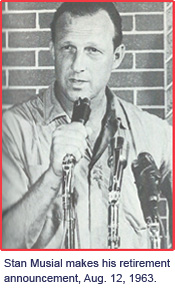
A timely talk with the Cardinals’ general manager helped Stan Musial determine how to inform his teammates and fans he would end his major-league playing career after the 1963 season.

stan_musial27On Aug. 12, 1963, Musial surprised many with a tearful announcement of his retirement plans at a Cardinals team picnic.

Privately, the Cardinals’ all-time greatest player had reached his decision on July 25 at Milwaukee. That day, Musial, 42, had driven in the winning run for the Cardinals with a single against another 42-year-old, Braves pitcher Warren Spahn. Boxscore

Though Musial wasn’t hitting at the level he had when he won seven National League batting championships, he still was effective, ranking among the top five on the club in RBI. But his fading fielding skills in the outfield convinced him it was time to quit playing.

In his book “Stan Musial: The Man’s Own Story,” Musial said, “I noticed that I really had difficulty untracking to get started after a fly ball.”

From Milwaukee, the Cardinals went to Chicago for a series against the Cubs. General manager Bing Devine joined the team there and invited Musial to breakfast in his hotel suite. Musial suspected Devine wanted to know his plans for 1964.

“The words came hard because it’s not easy to quit,” Musial said in his book.

Musial said to Devine, “After this year, Bing, I’ll have had it.”

“Devine seemed relieved, as relieved as I was when I got the words out,” Musial said.

Musial told Devine he wanted to make the announcement in St. Louis and he wanted his teammates to hear it first. Devine suggested Musial use the team picnic on Aug. 12 as the venue and Musial agreed.

The picnic, on a rainy Monday, was at Grant’s Farm, the estate of Cardinals owner Gussie Busch. Players, their families, team officials and a small group of reporters attended. Busch was out of town for a family wedding.

Only Musial, his family and Devine knew what he planned to say at the gathering. Many anticipated Musial would wait until after the season to reveal his plans.

Musial was “choked with emotion,” the Associated Press reported, as he stood before a battery of microphones and said 1963 would be the last of his 22 seasons as a player.

“Baseball has been my life,” Musial said. “I have loved St. Louis and this ballclub and I have had fun all these years.

“I’ve had the best job in the world. The thrill of putting on a major-league uniform, hitting, fielding and playing ball is greater than any other job I could ever have.”

Musial acknowledged he would become a grandfather for the first time in September 1963. His son, Dick, and daughter-in-law Sharon were expecting their first child.

In an effort to lighten the mood after the emotional retirement announcement, The Sporting News reported, Musial turned to his wife, Lil, and said, “I don’t think you want to kiss an old, retired ballplayer.”

Replied Lil: “I don’t think you want to kiss an old grandmother.”

Read Full Post »

In 1968, the Cardinals, and all major league teams, were faced with a decision of whether to play games on the day of slain Sen. Robert F. Kennedy’s burial and on the national day of mourning declared in his honor.
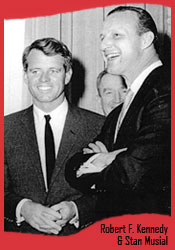
stan_rfkCardinals players said publicly they didn’t want to play on either day, but, facing the prospect of forfeiting if the Reds didn’t join them in sitting out, the Cardinals played three games in less than 24 hours over both days.

Other teams and players acted more defiantly, displaying the leadership and clarity baseball commissioner William Eckert lacked.

Kennedy, the New York senator and candidate for the 1968 Democratic presidential nomination, was shot in the predawn morning of June 5, hours after he won the California primary. He died on June 6 at age 42.

The funeral for Kennedy was scheduled for Saturday, June 8, at St. Patrick’s Cathedral in New York. Burial was planned for about 5 p.m. at Arlington National Cemetery near Washington. A train would transport Kennedy’s body from New York to Washington.

President Lyndon Johnson declared Sunday, June 9, a national day of mourning in tribute to Kennedy.

Eckert ordered no big-league game on June 8 would start until after the burial.

The Yankees, Senators and Cubs called off their afternoon home games scheduled for June 8. The Astros called off one of their doubleheader games against the Pirates and said the other game would be held after the burial.

At San Francisco, Mets players refused to play the Giants that Saturday. Mets management supported the players’ decision. The Giants front office, expecting a large crowd at Candlestick Park, was miffed, but agreed to call off the game when Mets officials refused to change their stance.

Other afternoon games, including Cardinals at Reds, were moved to night starts. The Cardinals-Reds game was rescheduled for 7 p.m.

However, when the train carrying Kennedy’s body was delayed by large crowds along the route from New York to Washington, the burial was pushed back several hours.

Cardinals and Reds players held separate pre-game meetings, took the field for warmups, and returned to the clubhouses again when they learned the burial wouldn’t be held before the 7 p.m. game time, the Associated Press reported.

Cardinals players wanted to call off the game, The Sporting News reported, but because they were the visitors they left the decision to the Reds.

Reds manager Dave Bristol urged his team to play. Pitcher Milt Pappas, the Reds’ player representative, disagreed. Pappas told Bristol most Reds players preferred not to play the game, the Associated Press reported. Bristol responded that if he could find nine players to take the field the Reds would play.

“If we go out (on the field to play), we all go out,” Pappas replied. “If we do go out, find yourself a new player representative.”

Pappas took a vote of Reds players on whether to play. The outcome was 12-12, with one abstaining, The Sporting News reported. A second vote was held and the result was 13-12 in favor of playing.

“Pappas lost a power struggle within the club when several players heeded the urgings of manager Dave Bristol to play the game,” The Sporting News reported.

Pappas, telling the Associated Press his “days with the club are numbered,” resigned as player representative.

The June 8 game began at 7:45 p.m. and the Cardinals won, 7-2, before 13,368. Boxscore

“Our position was that we had scheduled this game in good faith at a time about an hour and a half after the burial was scheduled,” Reds general manager Bob Howsam said. “We would have waited if the delay had been a short one.”

Pappas and catcher Tim McCarver, the Cardinals’ player representative, said both clubs voted not to play the doubleheader scheduled for Sunday, June 9, the national day of mourning for Kennedy.

Eckert declared that management of each home club would decide whether to play games that Sunday.

(Two months earlier, Eckert had called off all big-league spring training exhibition games on April 7, the national day of mourning for slain civil rights leader Dr. Martin Luther King Jr. Also, in respect for King’s funeral on April 9, all of the major-league regular-season openers scheduled for April 8 and April 9 were moved to April 10.)

The Orioles called off their June 9 doubleheader with the Athletics and the Red Sox called off their game with the White Sox. All other home teams, including the Reds, decided to play that Sunday.

The Reds scheduled a memorial service for Kennedy before the first game of the doubleheader. The Cardinals won the opener, 10-8, on Lou Brock’s three-run home run. Boxscore The Reds won the second game, 7-6, on shortstop Leo Cardenas’ RBI-double in the 12th off reliever Steve Carlton, the Game 1 starter. Boxscore Attendance was 28,141.

Pappas pitched in relief in both games, yielding a run in eight total innings, and was booed by fans. (Two days later, Pappas was traded to the Braves.)

At Houston that Sunday, Astros third baseman Bob Aspromonte and first baseman Rusty Staub, and Pirates third baseman Maury Wills, refused to play, protesting the decision to hold the game on the national day of mourning. All were fined by their teams.

Pirates outfielder Roberto Clemente decided to join Wills in sitting out the game, but changed his mind after a meeting with manager Larry Shepard, The Sporting News reported. “I preferred not to play,” Clemente said. “The disturbing thing to me was the indifferent attitudes of some of our players.”

Frank Mankiewicz, press secretary for Robert Kennedy, sent telegrams to Pappas, Aspromonte, Staub, Wills and Mets manager Gil Hodges (on behalf of the entire team), thanking them for the stances they took. “Please accept my personal admiration for your actions,” Mankiewicz wrote in the telegrams.

He said Kennedy’s widow, Ethel, would write personal letters to those who received telegrams, the Associated Press reported.

Wrote Bob August of the Cleveland Press, “Baseball’s observance of Senator Kennedy’s death was disorganized, illogical and thoroughly shabby.”

Under the headline, “The Aftermath _ Baseball Takes A Beating,” The Sporting News reported, “Baseball wallowed in a morass of confusion and acrimony in trying to decide what to do about paying respect to Sen. Robert F. Kennedy … For the most part, there was no concrete plan on how mourning for (Kennedy) would be handled.”

Previously: Bob Gibson put aside grief to pitch while mourning MLK

Read Full Post »
(Updated June 11, 2024)

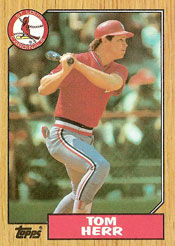
Desperate for a power-hitting right fielder and feeling the sting of the defection of free-agent Jack Clark, the Cardinals stunned nearly everyone when they traded second baseman Tommy Herr, a stalwart of their three pennant-winning teams of the 1980s, to the defending World Series champion Twins in 1988.

tom_herrAs he departed, Herr said he hoped to return to the Cardinals as their manager.

When he arrived in Minnesota, Herr told the Minneapolis Star-Tribune, “I tried to take the trade like a man, but when the plane left St. Louis I cried like a baby for a half hour.”

Surprise move

On April 22, 1988, Herr was dealt to Minnesota for outfielder Tom Brunansky. The trade was announced after the Mets beat St. Louis, 4-0, dropping the Cardinals’ record to 4-11.

Joe Durso of the New York Times wrote, “It stunned Herr and his teammates as they came into the locker room. Herr was asked to step into manager Whitey Herzog’s office, where he received the news from Herzog and Dal Maxvill, the Cardinals’ general manager.”

Said Herr: “Sure, I’m shocked. I’ve loved my years as a Cardinal and it’s hard to say goodbye.”

Acknowledging it was difficult to inform Herr of the trade, Herzog told the St. Louis Post-Dispatch, “Tommy always knew he was my type of player from day one. It was tough.”

Herr played 10 seasons (1979-88) with the Cardinals, batting .274 with 1,021 hits in 1,029 games. He was the starting second baseman on the pennant-winning clubs of 1982, 1985 and 1987. He was an all-star in 1985 when he placed third in the National League in both RBI (110) and doubles (38). Herr ranked among the top three second basemen in the league in fielding percentage six times.

“It’s not an easy thing trading a great ballplayer and a fine gentleman,” Maxvill said to the Associated Press.

Mets third baseman Howard Johnson told the Post-Dispatch, “I think the Cardinals have dealt themselves a blow. A guy like Tommy Herr is a pretty valuable part of your ballclub.”

Three factors prompted the trade:

Factor No. 1

The Cardinals’ top run producer, Clark, signed with the Yankees after the 1987 season. Jim Lindeman, the 1988 Opening Day right fielder, was headed to the disabled list because of back spasms. The Cardinals were averaging 2.8 runs per game. Brunansky, who hit 20 or more home runs in six consecutive seasons (1982-87) for the Twins, provided a much-needed power source.

“The deciding factor was our (poor) run production,” Maxvill said to the Associated Press. “Brunansky can help.”

Cardinals pitcher John Tudor told the Post-Dispatch, “It was kind of pleasant to see that they’re trading to win instead of sitting on their attendance.”

Factor No. 2

The Cardinals feared Herr would depart for free agency. Herr was in the final season of a four-year contract. After losing reliever Bruce Sutter and Clark to free agency, the Cardinals were determined to get value in return for Herr before he could depart.

Herzog told the Minneapolis Star-Tribune, “We just can’t keep losing players like that. It was something we felt had to be done right now.”

“I could see the writing on the wall,” Herr said to the Post-Dispatch, “but I didn’t think it would happen this soon.”

Said Mets first baseman Keith Hernandez, who played with Herr on the 1982 World Series champion Cardinals: “If they had Clark, Tommy Herr’s on the team.”

Herzog told the Post-Dispatch, “If they’d tell me they were going to re-sign him, then who knows what we’d do?”

Regarding whether the Cardinals ever did have interest in re-signing him before he became eligible for free agency, Herr said, “I knew I’d find out sooner or later what the thinking was here. It was sooner rather than later.”

Factor No. 3

The Cardinals had a replacement for Herr. Luis Alicea, a first-round selection of the Cardinals in the 1986 draft, was promoted from Class AAA Louisville to replace Herr at second base.

“We think we have a fine young man who is ready to be an everyday player here in Alicea,” Maxvill said to United Press International.

Timely chat

Twins general manager Andy MacPhail told the Minneapolis Star-Tribune he made a social phone call to Maxvill on April 21. “At the time, I didn’t think there was any chance of a trade,” MacPhail said.

As the conversation evolved, MacPhail mentioned the Twins needed a left-handed batter for the top of their order.

“He made it clear he couldn’t trade Willie McGee or Vince Coleman,” MacPhail said.

Herr, a switch-hitter, fit the need.

MacPhail said Maxvill asked about third baseman Gary Gaetti and outfielder Kirby Puckett.

“I told him I wouldn’t trade Gaetti and that my house would be burned to the ground if I traded Puckett,” MacPhail said.

Familiar foe

The Twins had defeated the Cardinals in a seven-game World Series in October 1987. Six months later, they were swapping position starters.

“I will miss Tom Brunansky,” Gaetti said. “It’s like a cold shower and a slap in the face at the same time.”

Minneapolis Star-Tribune columnist Sid Hartman reported, “Twins officials maintain Brunansky’s speed is down from last year, that he hasn’t covered the ground in right field as well and that his arm is not as strong.”

Herzog told the Post-Dispatch, “To tell you the truth, the only time I’ve ever seen Brunansky play in person was in the World Series, but over the last 10 years he’s always had pretty good bat potential and he’s had good power statistics. He’s always been a good outfielder with a good throwing arm.”

Minneapolis Star-Tribune columnist Dan Barreiro wrote, “Brunansky had his limitations, we all know how streaky he could be, but he still was a hitter with power numbers.”

For Brunansky, the trade was the chance for a new adventure. “It’s going to be exciting,” he said.

For Herr, the trade took him away from his professional roots and a place he had hoped to grow his career. “I’m proud of the accomplishments I’ve had here,” Herr said before leaving. “I wanted to play my whole career here. That dream has gone. It’s been a good time. Maybe I’ll be back and manage this ballclub.”

Years later, when asked about Herzog, Herr told Cardinals Magazine, “Whitey had a profound effect on me. He was the guy who gave me my shot as a regular … The confidence he showed in me really put me over the top.”


Read Full Post »

(Updated March 15, 2023)

In March 1988, the NFL approved the move of the St. Louis football Cardinals to Arizona, leaving the St. Louis baseball Cardinals as the sole tenant of Busch Memorial Stadium for the first time since it opened in 1966.

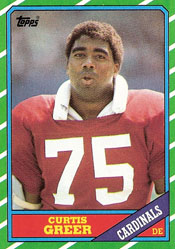
curtis_greerThe departure of the football Cardinals ended 28 years of NFL existence in St. Louis, but it was a boon to the baseball Cardinals, who benefitted from improvements to Busch Memorial Stadium.

In April 1988, when the defending National League champion Cardinals opened their baseball season a month after the football Cardinals left St. Louis, 1,000 seats and 10 luxury suites were added to Busch Memorial Stadium, increasing seating capacity for baseball to 54,224.

A year later, among the upgrades made to the stadium for the 1989 Cardinals baseball season were a 65,000-watt sound system, seven new concession areas and remodeling of 11 others.

In 1992, the baseball Cardinals installed a spongier and darker artificial playing surface. Four years later, they went to a natural grass surface at Busch Memorial Stadium for the first time since 1969.

Bill Bidwill, owner of the football Cardinals, asked the NFL on Jan. 15, 1988, for permission to move to Phoenix because he believed Busch Memorial Stadium limited his revenue opportunities and he didn’t have hope a football stadium would be built in St. Louis. The NFL wanted Bidwill to relocate the team to Baltimore because it intended to place an expansion franchise in Phoenix.

Bidwill preferred Arizona. Sun Devil Stadium in Phoenix offered 73,000 seats (20,000 more than Busch Memorial Stadium did for football). Bidwill stood to gain $2.5 million from luxury suite seats. He also was optimistic of having a domed stadium built in downtown Phoenix.

On March 15, 1988, NFL owners voted 26-0, with two abstentions, to approve the move. Abstaining were Raiders owner Al Davis and Dolphins owner Joe Robbie.

(Davis, in a legal battle with the league, told the New York Times, “It’s all a sham. They vote any way they want and allow anyone they want to move.” Robbie told the St. Louis Post-Dispatch he abstained out of loyalty to his friend Joe Foss, who headed a group seeking an expansion franchise in Phoenix. “A man who forgets his friends doesn’t deserve friends,” Robbie said.)

Cardinals defensive lineman Curtis Greer said Bidwill had given St. Louis the chance to build a stadium and keep the team.

”I would think that you’ve got to appreciate Mr. Bidwill’s patience in trying to give the city of St. Louis time to get a new stadium,” Greer said to the Post-Dispatch. ”I think it was about 3 1/2 years since he first talked of moving. He took the route of being courteous and following the guidelines of the league. I think you’ve got to admire a guy like that.”

St. Louis mayor Vincent Schoemehl ripped the NFL for permitting the move. Schoemehl told the Post-Dispatch that “communities have a right to be treated better” by the NFL.

“This is a reflection on them (the NFL) and not us,” Schoemehl said. “I think our code of conduct in this city is frankly superior to theirs.”

Regarding the NFL commissioner, Schoemehl added, “I find it hard to hold Pete Rozelle in high regard.”

Seven years later, St. Louis regained a NFL franchise when the Rams moved there from Los Angeles. The Rams played their first four home games of the 1995 season at Busch Memorial Stadium before relocating to a domed stadium built for the franchise in downtown St. Louis.

After the 2015 season, the Rams returned to Los Angeles.

Previously: Football Cardinals finally got it right with Don Coryell

Read Full Post »

In 1943, the defending World Series champion Cardinals shifted their spring training site from Florida to Illinois. Compared with where other big-league clubs had to go, the Cardinals considered themselves fortunate.

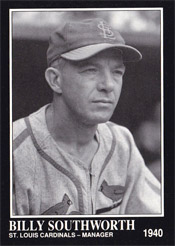
billy_southworth2With the United States pouring resources into its fight against Germany and Japan in World War II, big-league baseball offered to help conserve by placing travel restrictions on where clubs could train in the spring.

Clubs were ordered to choose sites north of the Potomac and Ohio rivers and east of the Mississippi River.

The Browns of the American League selected Cape Girardeau, Mo., located 135 miles south of St. Louis. (Because Cape Girardeau is on the west bank of the Mississippi, the Browns technically were in violation of the rules, but baseball officials allowed it.)

The Cardinals picked Cairo, Ill., the southernmost spring training site of all 16 major league clubs. Cairo, then a town of 14,000, is located where the Ohio River flows into the Mississippi. It is 40 miles south of Cape Girardeau.

“We’re going farther south than any other big-league training outfit,” Cardinals owner Sam Breadon said to The Sporting News. “We’ll be only a short distance from Tennessee and the weather down there is always from 12 to 15 degrees warmer than it is in St. Louis.”

Here is where the big-league teams trained in 1943:

NATIONAL LEAGUE

CLUB……………1943 TRAINING SITE……………1942 TRAINING SITE

Braves…………..Wallingford, Conn……………………..Sanford, Fla.

Cardinals……….Cairo, Ill……………………………………St. Petersburg, Fla.

Cubs………………French Lick, Ind……………………….Catalina Island, Calif.

Dodgers…………Bear Mountain, N.Y…………………..Havana, Cuba

Giants……………Lakewood, N.J………………………….Miami, Fla.

Phillies…………..Swarthmore, Pa……………………….Miami Beach, Fla.

Pirates……………Muncie, Ind…………………………….San Bernardino, Calif.

Reds………………Bloomington, Ind…………………….Tampa, Fla.

AMERICAN LEAGUE

CLUB……………1943 TRAINING SITE……………1942 TRAINING SITE

Athletics…………Wilmington, Del………………………..Anaheim, Calif.

Browns…………..Cape Girardeau, Mo…………………..DeLand, Fla.

Indians…………..West Lafayette, Ind……………………Clearwater, Fla.

Red Sox………….Medford, Mass………………………….Sarasota, Fla.

Senators…………College Park, Md………………………Orlando, Fla.

Tigers……………..Evansville, Ind…………………………Lakeland, Fla.

White Sox………..French Lick, Ind………………………Pasadena, Calif.

Yankees……………Asbury Park, N.J…………………….St. Petersburg, Fla.

The Cardinals didn’t report to Cairo, Ill., until mid-March, at least two weeks later than they usually went to St. Petersburg. They trained outdoors on a large field and indoors in a high school gym.

According to The Sporting News, the field drained well, “usable the day after a heavy rainfall,” and the gym was like “a steam room” because the Cardinals kept the temperature above 80.

Cardinals manager Billy Southworth projected a positive attitude, telling The Sporting News after the first week of workouts, “Let us have three days outdoors out of every five and we’ll be in thoroughly satisfactory condition for the pennant race. And let us have warm weather through most of the last two weeks and we’ll be in as good condition as we could attain anywhere in the country.”

The Cardinals’ Cairo spring didn’t hurt. They repeated as National League champions in 1943. They trained again in Cairo in 1944 and 1945 (winning a World Series title in 1944) before returning to St. Petersburg in 1946.

Previously: How Mort Cooper pitched 2 straight 1-hitters for Cardinals

Read Full Post »

(Updated July 4, 2020)

The St. Louis Cardinals and Milwaukee Brewers are rivals in the National League Central Division now, but in 1953 Milwaukee appeared to be a rival in trying to lure the Cardinals from St. Louis.

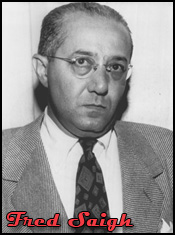
fred_saighHow close the Cardinals came to moving to Milwaukee in February 1953 is unclear, but Anheuser-Busch wasn’t willing to take any chances. The St. Louis-based brewery stepped forward and bought the Cardinals from Fred Saigh when it appeared Saigh was willing to sell to a Milwaukee syndicate.

Tax cheat

On Jan. 28, 1953, Saigh, who had owned the Cardinals since 1947, was sentenced to 15 months in prison and fined $15,000 for federal income tax evasion.

“This means, of course, I will have to dispose of the Cardinals,” Saigh said in addressing the court. “There is no way I can stay in baseball.”

Saigh, an attorney who invested in commercial real estate, had entered a plea of no contest to two counts of evading $19,299 in taxes.

Addressing Judge Roy Harper in court after the sentence was announced, Saigh said, “I think you’ve been too tough with me.”

Replied Harper: “You plead that you are guilty to those essential elements, and if you were not guilty, you should have stood upon a plea of not guilty. Don’t come in and plead before me and then ask me to say you are wrong.”

Buy and sell

Saigh and Postmaster General Robert Hannegan purchased the Cardinals from Sam Breadon in 1947 for about $4 million, but, the Associated Press reported, “by what Saigh termed a ‘gimmick’ in the tax law, he and Hannegan were able to buy the club and its widespread minor-league holdings for a cash outlay of only $60,800.”

Because of failing health, Hannegan sold his stake in the Cardinals to Saigh in January 1949.

Four years later, facing jail time, Saigh put a price tag of $4.5 million on the Cardinals, according to the Associated Press. Several media outlets reported Bill Walsingham, a Cardinals executive and nephew of Sam Breadon, was the leading candidate to buy the club. Joe Reichler of the Associated Press wrote: “Bill Walsingham Jr. probably will be the new owner of the St. Louis Cardinals.”

By Feb. 1, 1953, The Sporting News reported, Saigh had received 30 to 40 bids for the franchise. Quietly, Anheuser-Busch indicated to Saigh it might be interested in buying the Cardinals.

Out-of-town shoppers

Saigh claimed the best offer he received was in excess of $4 million from a Milwaukee group that planned to move the Cardinals to Wisconsin.

“When it became apparent that an out-of-town group was ready to purchase the Cardinals at a price which I felt was a fair value for the club, I informed Mr. (August) Busch and his associates of the impending sale,” Saigh said in a statement.

The Sporting News reported the Milwaukee businessmen had the “inside track” to buy the Cardinals. Saigh was “about to close a deal with a Milwaukee group,” according to the Associated Press.

In his book, “Stan Musial: The Man’s Own Story,” the Cardinals outfielder said Saigh, after being approached by the Milwaukee group, “prepared to go to New York to get commissioner Ford Frick’s approval for sale of the Cardinals.” Before Saigh departed, Musial said, a group consisting of Anheuser-Busch executives and St. Louis bankers convinced him to delay until they had a chance to prepare a bid.

Local discount

On Feb. 20, 1953, Saigh announced he was selling the Cardinals to Anheuser-Busch for $3.75 million, less than what he could have gotten from the Milwaukee buyers, he claimed.

The Associated Press wrote, “The St. Louis Cardinals, close to being transferred to Milwaukee a week ago, counted themselves as one of the money clubs today with solid financial backing in the old hometown. Anheuser-Busch Inc. bought the club for the announced purpose of keeping the Cardinals in St. Louis.”

Anheuser-Busch representatives told reporters Saigh had “made several important concessions to keep (the Cardinals) here and deserves sincere appreciation.”

R.G. Lynch of the Milwaukee Journal reported a different version. In a piece picked up by The Sporting News, Lynch wrote Saigh had hyped the notion of a Milwaukee offer in order to drive up the purchase price from Anheuser-Busch.

“There’s a big chuckle in the St. Louis baseball deal,” Lynch wrote. “It involves the Milwaukee offer, which Fred Saigh says he turned down in order to keep the Cardinals in St. Louis. There was no Milwaukee offer. All Saigh ever had was an inquiry from Fred Miller, Milwaukee brewer, as to how much he wanted for the property. The answer was $4 million-plus, and that was the end of it.

“Saigh was forced to sell and every potential buyer knew it. So he grasped at this straw and built it into a scarecrow.

“Whether or not this maneuver helped Saigh to get a better price, no one will ever know, except the Anheuser-Busch people, and they won’t tell.”

Fearing he couldn’t compete with the financial resources of Anheuser-Busch, Bill Veeck, owner of the St. Louis Browns, tried moving his club to Milwaukee but the American League blocked the deal. In March, Milwaukee got its team when the Braves moved there from Boston just before the start of the 1953 season.

Saigh died at 94 in December 1999. In an obituary, the New York Times reported: “Saigh was released from prison in November 1953 after serving six months and soon began buying shares in Anheuser-Busch. He was said to have become the largest single owner of the brewery’s stock outside the Busch family, at one point with holdings worth about $60 million.”


Read Full Post »

« Newer Posts - Older Posts »