Feeds:
Posts
Comments

Archive for the ‘Executives’ Category

As Cardinals manager, Branch Rickey either was ahead of his time or hopelessly out of step with the times. Take your pick. Either way, Cardinals owner and president Sam Breadon decided Rickey no longer should be manager.

One hundred years ago, on May 30, 1925, Breadon changed managers, replacing Rickey with Rogers Hornsby. Rickey remained with the club in a front-office role.

The shakeup turned out to be good for the Cardinals. Player-manager Hornsby led them to their first National League pennant and World Series championship in 1926. Focused on baseball operations, vice president Rickey built the Cardinals into a perennial contender.

On shaky ground

After managing the St. Louis Browns (1913-15), Rickey joined the Cardinals and became their manager in 1919. In his first six years, he piloted the club to three winning seasons: 1921 (87-66), 1922 (85-69) and 1923 (79-74). Then the Cardinals took a big step backwards, finishing 65-89 in 1924 and drawing a mere 272,885 at its home games.

Knowing Breadon was considering a change, Rickey offered to resign during 1925 spring training but reconsidered, according to St. Louis Post-Dispatch columnist John Wray. “I look at this team I have put together and I can visualize it winning the flag,” Rickey told Breadon. “I have the stuff here and I want another chance. I think I deserve it because I assembled all this talent.”

Breadon wasn’t convinced. In his autobiography, “My War With Baseball,” Hornsby said Rickey sought his help with Breadon. “I went to Breadon and said that Rickey was the smartest man in baseball,” Hornsby recalled. “Breadon suggested I take the job as manager, but I wasn’t interested.”

Before spring training ended, Breadon formerly offered Hornsby the job, but he declined. “I recommended that Breadon keep Rickey,” Hornsby said in his autobiography. “I also told Breadon that if the Good Lord himself were to … manage this club, he couldn’t do any better. It was a lousy team.”

Decision time

The 1925 Cardinals won five of their first eight, then nosedived, losing seven in a row at home before mostly small crowds.

When the Cardinals were in Pittsburgh for a series with the Pirates, Breadon showed up. On Friday, May 29, Hornsby was having breakfast at the Hotel Schenley when traveling secretary Clarence Lloyd approached him and said Breadon wanted to meet. In his autobiography, Hornsby recalled that as he passed by the table of Rickey and coach Burt Shotton, Rickey said to him, “Breadon wants you to manage the team.”

Hornsby replied, “I don’t want to manage. He knows that.”

“Then will you ask Breadon to give me another chance?” Rickey said to Hornsby. “If he won’t, see if you can get him to let Shotton here be the manager.”

Hornsby said, “OK.”

(In addition to coaching, Shotton managed the Cardinals on Sundays, because Rickey promised his mother before signing his first professional contract that he would abstain from baseball activities on Sundays.)

Hornsby met in Breadon’s room and was offered the job. Hornsby said no.

According to the book “Branch Rickey: A Biography” by Murray Polner, Breadon barked back, “I won’t have any goddamned Sunday school teacher running my team. You’re going to run it.”

In his autobiography, Hornsby said he and Breadon had the following exchange:

Hornsby: “You mean, Rickey’s through?”

Breadon: “That’s exactly right _ as manager.”

Hornsby: “What about Shotton as manager?”

Breadon: “I don’t want any Rickey man either.”

It was agreed Hornsby should think over the proposal and inform Breadon of the decision the next day. “I went back down and told Rickey what Breadon had said,” Hornsby recalled in his autobiography. “Rickey didn’t cuss or anything, but he got pretty mad and said he would sell all his stock in the Cardinals.”

According to the Rickey biography, Rickey said to Hornsby, “Judas priest, the man (Breadon) is stabbing me in the back.”

At the ballpark that day, Hornsby slugged a two-run home run, but the Cardinals lost, dropping their record to 13-23. It turned out to be the last game Rickey would manage. Boxscore

Making the switch

According to his autobiography, Hornsby went to Breadon on Saturday, May 30, and told him “the only way I would be interested in becoming manager would be if I could buy Rickey’s stock … Then baseball could be my business for life.” Breadon assured him that would be arranged. The two agreed Hornsby would become player-manager, effective Sunday, May 31. “I expect him to put new fight into the Cardinals,” Breadon told the Associated Press.

In reporting on the managerial switch, James M. Gould of the St. Louis Star-Times wrote, “The pupil succeeds the master.”

Hornsby, 29, became the youngest manager in the National League. He was a few months older than player-manager Bucky Harris, 28, of the American League’s Washington Senators. Other player-managers in the majors in 1925 included Dave Bancroft of the Braves, Ty Cobb of the Tigers, Eddie Collins of the White Sox, George Sisler of the Browns and Tris Speaker of the Indians.

“I feel that with Rickey as vice president and business manager, and Hornsby as playing manager, we have one of the greatest combinations in baseball,” Breadon told the Post-Dispatch.

He also said to the Associated Press, “Rickey is a valuable man and we want to utilize his knowledge of baseball and his great judgment of players. He is a great organizer and a builder, and that is his sphere.”

Breadon’s words, though, didn’t appease Rickey, who resented being ousted as manager. According to Rickey’s biography, he described Breadon’s action as “clumsily brutal.”

According to author Murray Polner, Rickey felt betrayed and considered leaving the Cardinals to become athletic director at Northwestern University, but his wife Jane talked him out of it.

In his book “Mr. Rickey’s Redbirds,” author Mike Mitchell wrote that Rickey later said, “My fault as a manager … was due to my apparent zeal. I discussed the game every day … as if the game coming up was the game of the year.”

With Rickey out and Hornsby taking over effective May 31, coach Shotton was tasked with managing the Cardinals in the May 30 Saturday doubleheader at Pittsburgh, according to “Mr. Rickey’s Redbirds.” The Pirates won both, totaling eight triples in Game 2. Boxscore

Rickey’s reviews

Reaction to the managerial move mostly was favorable:

_ J. Roy Stockton, Post-Dispatch: “The Cardinals should do well under Hornsby. He will not overmanage the team. If there was any just criticism of Branch Rickey’s regime, it was that he burdened the team with too much management. He tried to pitch for the pitchers and to catch for the catchers … He lacked poise when directing his men … He decided on a plan of action and then … he hesitated, pondered over the danger and changed the plan.”

_ Tommy Holmes, Brooklyn Eagle: “Some attribute the failure of the team to Rickey’s attempt to mastermind the Cardinals. He wanted to do all the thinking that was to be done on the team … Branch exercised his managerial authority by requiring the batter to keep in constant touch with his wagging from the bench. A hitter up there with the bases full, to bust it and nothing else, had to strain his neck getting the signal on every ball pitched.”

_ Henry Farrell, United Press: “Rickey had a lot of trick ideas about handling of a ballclub that made some of the older athletes feel like they were being treated like children. He not only had blackboard talks on baseball but he extended his skull practice to include arithmetic and the grammar school arts and sciences.”

_ John B. Foster, Dayton Daily News: “The greatest weakness of (Rickey) was … his lack of playing instinct. He usually managed to change pitchers at the wrong time … Almost every manager in the National League figured upon his doing the wrong thing at the wrong time … Opposing managers figured they would get away with games if they forced Rickey to change pitchers.”

_ The Sporting News: “The elevation of Hornsby to the management was the most popular choice that could have been made for the fans.”

Different approach

Indeed, fans gave Hornsby a big reception when he was led to the plate by St. Louis mayor Victor Miller and presented with several floral pieces before the start of his managerial debut on Sunday, May 31. During the game, the Post-Dispatch noted “a new spirit exhibited by the players” and “a dash that had been missing for some time.” Hornsby contributed two hits, two walks, two runs scored and a RBI in a 5-2 Cardinals victory over the Reds. Boxscore

The next day, Hornsby started Jesse Haines against the Reds. In four starts for Rickey in 1925, Haines was yanked from the games and lost all four. In his first start for Hornsby, he pitched a complete game and won. Boxscore

A week later, Hornsby bought 1,167 shares of Rickey’s Cardinals stock at $43 a share, a total investment of $50,181, the St. Louis Globe-Democrat reported. As author Mike Mitchell noted, “Upset about being removed as manager, Rickey made an emotional and short-sighted decision.”

Meanwhile, Hornsby canceled the daily team meetings and daily morning workouts that had been the norm when Rickey managed. “You can’t drill for two hours and then get out in the afternoon with all your pep and play some more,” Hornsby explained to the Star-Times.

The Cardinals won 15 of their first 19 games with Hornsby as manager and finished at 77-76. Hornsby’s hitting helped, too. In 1925, he was named recipient of the National League Most Valuable Player Award and led the league in batting average, on-base percentage and slugging percentage for the sixth year in a row.

Read Full Post »

In a race to determine the slowest runner in the National League, the loser was the commissioner of baseball, and he didn’t even run.

A pair of catchers, Del Rice of the Cardinals and Rube Walker of the Dodgers, were the contestants in what Bob Broeg of the St. Louis Post-Dispatch described as “a snail versus tortoise match race.”

When some of the Cardinals made small, friendly wagers with their Dodgers counterparts on which of the two leadfoots would win, heavy-handed baseball commissioner Ford Frick initiated a gambling investigation.

Frick backed down quickly after baseball writers mocked him in their newspaper stories for being unable to see the difference between harmless fun and scandal.

Slow going

Signed by Cardinals scout Frank Rickey, brother of general manager Branch Rickey, Del Rice was 18 when he began his pro baseball career in the minors in 1941. Rice reached the majors with the Cardinals four years later.

Listed as 6-foot-2, Rice also played one season (1945-46) of pro basketball with the Rochester Royals. His teammates included Red Holzman (the future head coach of the St. Louis Hawks and New York Knicks), Otto Graham (better known as quarterback of the Cleveland Browns) and Chuck Connors (the big-league first baseman who became TV’s “The Rifleman”). Rochester won the National Basketball League (NBL) championship that season. (In 1949, the NBL merged with the Basketball Association of America and became the National Basketball Association, or NBA.)

Like Rice, Rube Walker also was 18 when he became a pro baseball player, signing with the Cubs in 1944 and advancing to the majors with them four years later. Joe Donnelly of Newsday described him as “a large man with a twinkle in his eye and a heart that reached out to people.”

Rice and Walker were good defensive catchers who didn’t hit much. In 17 seasons in the majors, mostly with the Cardinals and Braves, Rice batted .237. Walker hit .227 in his 11 seasons with the Cubs and Dodgers.

Both also were notorious plodders on the base paths. “Neither could outrun me,” Dodgers owner Walter O’Malley, who chain-smoked cigars, said to Dan Daniel of The Sporting News. (Rice managed to steal bases twice in the majors; Walker did it three times.) A good case could be made for either being the slowpoke of the league. Their teammates decided to settle the matter with a footrace.

Amazing race

During warmups before their game on May 17, 1955, at St. Louis, the Cardinals and Dodgers got into some good-natured bantering about who was the slowest man in the league. Rice and Walker were coaxed into having a 50-yard race across the outfield.

(Walker was not the type to back down from a test. According to the New York Times, “he once challenged manager Walter Alston to a billiards match after Alston had taken 130 shots without missing.”)

Members of the teams lined up in two rows _ Cardinals on one side; Dodgers on the other _ forming a lane for Rice and Walker to rumble through, the New York Times reported.

Cardinals manager Eddie Stanky joined some of his players in making bets with Dodgers on who would win, according to the Post-Dispatch. Most of the wagers were for $5. “All told, it was guessed that $45 rested on the outcome,” the St. Louis Globe-Democrat reported.

(Dick Young of the New York Daily News noted that the wagers on the Rice-Walker footrace were pocket change compared with what went on in earlier times. When speedy outfielder Ben Chapman was with the Yankees in the 1930s, he’d routinely race all challengers and usually won. According to Young, “Babe Ruth used to bet hundreds of dollars on every race.” Chapman’s teammate, Dixie Walker, told Young, “The first time, Babe bet against Chapman and lost. After that, Babe always bet on Chapman, and cleaned up.”)

In the St. Louis contest, Rube Walker trudged out to a lead but Rice steamed ahead at the finish and won by a yard. One of the observers, 19-year-old Dodgers rookie Sandy Koufax, recalled to the New York Times years later, “They didn’t go fast enough for a photo finish. It was a study in slow motion.”

Little big man

Walker took his loss in good spirit. “I once was a gazelle,” he told the New York Times. However, baseball commissioner Ford Frick was not amused when he learned wagering was involved. He decided to investigate. According to the Daily News, the wires Frick sent to managers Stanky and Alston read: “You are ordered to submit names and amounts bet by the ballplayers.”

While Frick awaited the reports from the managers, the newspapers ridiculed him for overreacting.

_ Dan Parker, syndicated columnist: “Ford Frick is a man of fine character, but a sense of humor forms no part of it.”

_ Morris McLemore, Miami News: “It would appear Ford Frick might have more to do than worry about the footrace between Del Rice and Rube Walker.”

_ Whitney Martin, Associated Press: “Frick probably feels that from such molehills mountains grow, and that the first thing you know the boys will be … gambling that when they put a penny in a (vending) machine a stick of gum will come out.”

_ Dick Young, New York Daily News: “Frick may have been watching too many ‘Dragnet’ shows.”

Soon after, Frick dropped the investigation, the Jersey Journal reported.

Changes afoot

Stanky, Rice and Walker made headlines for a variety of other reasons in the days following the slowest man contest.

On May 27, 1955, the Cardinals fired Stanky. A week later, they traded Rice to the Braves. (The footrace had nothing to do with either move.)

On June 30, 1955, Walker was carted off the field and sent to a hospital for treatment of a gashed shoulder after Willie Mays ran over him while trying to score. “Walker went down flat on his back, clutching the ball grittily,” the Daily News reported.

(Four years later, in June 1959, Rice suffered a broken left leg in a collision with Mays near home plate. Mays slid hard into Rice, who was straddling the line while awaiting a throw. “It wasn’t his fault,” Rice told the Associated Press. “He had to slide _ that’s baseball _ but he certainly slides hard.”)

After his playing days, Walker coached in the majors for 21 seasons. He was the pitching coach for the 1969 World Series champion Mets. He later was a scout for the Cardinals when Whitey Herzog was their manager.

Rice ended his playing career with the 1961 Angels. He was the first player signed by the American League expansion franchise and was the starting catcher in their first regular-season game. Boxscore

According to the Los Angeles Times, during his stint as an Angels coach in the 1960s, Rice “etched his name into the club’s lore by organizing and winning a golf tournament played in the halls of the team’s Boston hotel (Rice wore golf spikes, glove, hat and pajamas), with the players putting into cocktail glasses.”

After four seasons managing in the minors, Rice was the Angels’ manager in 1972, Nolan Ryan’s first season with the club after being coached by Rube Walker with the Mets.

Read Full Post »

Looking for a good time in St. Louis when their team came to play the Cardinals, Reds fans rolled out the barrels and got busted.

One hundred years ago, in April 1925, Reds owner Garry Herrmann and seven others associated with the Reds Rooters fan club were arrested at the Hotel Statler for possessing real beer.
Home to breweries such as Anheuser-Busch and Falstaff, St. Louis was synonymous with suds, but not during the Prohibition era in the U.S.

Herrmann and the Reds Rooters found out the hard way when federal agents raided their roost before a game.

Dry land

Influenced by repressive religious groups, particularly Christian denominations, and temperance organizations, federal lawmakers approved an amendment to the Constitution that prohibited the production, importation, transportation and sale of alcoholic beverages. The Prohibition era lasted from 1920 to 1933 and prompted gangsters to fill the void with violent bootlegging businesses.

In his book “Mr. Rickey’s Redbirds,” author Mike Mitchell noted, “The battle over Prohibition pitted rural versus urban, Protestant versus Catholic, native-born Americans versus newly arrived immigrants … War gave a final push toward a national prohibition. Those who wanted to ban alcohol often made no distinction between America’s enemies in World War I and brewers in the United States with European heritage.”

St. Louis breweries Anheuser-Busch and Falstaff survived Prohibition by producing near beer, a malt beverage which typically had an alcohol content of less than 0.5 percent, and other products, such as soda pop. (The Anheuser-Busch near beer was called Bevo.) Most other St. Louis beer producers, including Lemp, a major lager brewer, went out of business.

Prohibition didn’t stop the Reds Rooters from carrying on a tradition of traveling to the city where the team played its first road series of the season. About 110 of them went by train from Cincinnati to St. Louis for the four-game set between the Reds and Cardinals April 22-25, 1925.

Beer and bratwurst

The Reds Rooters booked rooms at the elegant Hotel Statler at the corner of Washington Avenue and Ninth Street in downtown St. Louis. Built in 1917, Hotel Statler was the first air-conditioned hotel in the United States.

Another feature of the grand hotel was its 17th floor, which was designated for sample rooms used by traveling salesmen to display products. The Reds Rooters reserved the entire floor and converted it into a party clubhouse for their stay.

According to the St. Louis Post-Dispatch, the Reds Rooters brought with them “several kegs of sauerkraut, barrels of pickles and great quantities of sausages, pretzels and cheeses.”

That’s not all. To quench their thirst, the Cincinnatians also brought 25 half barrels of beer. Real beer.

An informant tipped off John Dyott, special assistant attorney general in charge of federal Prohibition cases, that the Reds Rooters were guzzling illegal brew. Dyott contacted federal law enforcement agents and ordered them to investigate.

At 1:30 p.m. on April 24, 1925, four agents arrived on the 17th floor, where they found 40 Reds Rooters about to leave for the ballpark, the Post-Dispatch reported. The Cincinnati group included Reds owner Garry Herrmann.

Down the drain

Orphaned at age 11, August Herrmann had worked as an errand boy filling salt stacks and then as a printer’s apprentice, where he got the nickname Garibaldi (shortened to Garry), according to the National Baseball Hall of Fame. He went into politics, becoming a Cincinnati city administrator, and rose to prominence with his creation of a modern waterworks system.

Herrmann was the life of any party. According to the Cincinnati Enquirer, “He was considered the greatest host in Cincinnati and he entertained his friends lavishly.”

In the raid on the Reds Rooters, agents found two half kegs of beer on tap and 11 more half kegs in an ice box waiting to be tapped, the Post-Dispatch reported. After taking samples for analysis, the agents poured all the brew down the drain.

Tests showed the beer had a 3.94 percent alcohol by volume (ABV) and qualified as illegal real beer, the St. Louis Star-Times reported. (Before Prohibition, a typical ABV for beer was 4.5 percent to 6 percent. In the early 1930s, a weaker, 3.2 percent beer gained prominence as a legal alternative in states that repealed dry laws before federal Prohibition ended.)

“We were under the impression that the stuff was near beer,” Herrmann told the Star-Times. “It was just an unfortunate mistake.”

Herrmann, five members of the Reds Rooters who were in charge of the arrangements, and two employees of the group were arrested on federal warrants charging possession of intoxicating alcohol. Herrmann posted a bond of $500 immediately after the warrant was served on him. A hearing in federal court in St. Louis was set back to the fall.

Costly pitchers

In October 1925, Herrmann led a contingent of Cincinnatians to Pittsburgh for the World Series between the Senators and Pirates. According to columnist Westbrook Pegler, when Herrmann arrived at Hotel Schenley, friends approached and asked, “Where are the kegs?” Herrmann replied, “Ever since that time they took the kegs away from the Cincinnati boys in St. Louis, I go without kegs.”

Later that month, Herrmann and the other defendants appeared for their hearing in the St. Louis courtroom of U.S. district judge Charles Breckenridge Faris, a former prosecutor who was appointed by President Woodrow Wilson in 1919.

Charges against Herrmann and the five members of the Reds Rooters were dismissed on the grounds that they were not in physical possession of beer when the agents raided the clubroom.

The two Reds Rooters employees, John Rosskopf and Leonard Schwab, who were in their shirt sleeves and wearing the aprons of bartenders when the agents came, pleaded guilty to charges of possession of alcohol. Each was fined $390.

According to testimony reported in the St. Louis newspapers, agents said they saw Rosskopf at a tapped keg with a foaming pitcher of beer in his hand and Schwab also had a pitcher filled with suds.

After the hearing, Herrmann told the Post-Dispatch, “We feel no malice toward St. Louis for our difficulties in this case. You can tell the world the Reds Rooters are still loyal. They’ll be back in the spring.”

Read Full Post »

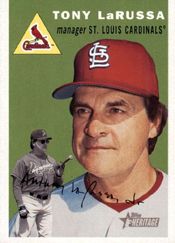
When he was ready to leave the Athletics, Tony La Russa was intending to manage the 1995 Red Sox.

“At the end of nine years, the A’s had given me permission to interview with the Red Sox, and I was going to Boston,” La Russa recalled to Cardinals Yearbook in 2014. “We even had a discussion about free agents … The one free agent we wanted was Larry Walker.”

If La Russa had gone through with the move, he likely never would have joined the Cardinals, the club he managed to three National League pennants, two World Series championships and a franchise-record 1,408 wins.

A lunch conversation with Athletics owner Walter Haas prompted La Russa to change his plans.

The times they are a-changin’

From 1988-90, La Russa led the Athletics to three consecutive American League pennants and a World Series title, but they finished 68-94 in 1993 and 51-63 in strike-shortened 1994. Though the 1994 Athletics had players such as Dennis Eckersley, Rickey Henderson and Mark McGwire, the club had a dismal 19-43 record until winning 19 of its next 22.

La Russa’s two-year contract with the Athletics expired at the end of 1994 and he was thinking it might be time to leave Oakland. “I came to realize that once you start amassing time _ eight or 10 years in one place _ there becomes a very real perception that the scene needs a change, more for the people around you than for yourself,” La Russa recalled to Cardinals Yearbook. “Fans get tired of reading your same quotes. The media starts to know what you’re going to say before you even say it. Players grow tired of you.”

Also, the Athletics were for sale and the uncertainty that created gave La Russa another reason to consider departing. “If the Haas’ (family) were still in Oakland, I’d still be there,” La Russa told Cardinals Yearbook in 2014.

After the players’ strike halted the season in August 1994, La Russa took his family on an extended vacation to England a month later “amid growing speculation that he could become Boston’s next manager,” the Sacramento Bee reported. “La Russa did nothing to downplay the speculation, acknowledging there are some ‘attractive situations’ out there. He sounded absolutely unsure if he will return to the A’s or seek grander challenges elsewhere.”

The Red Sox were seeking a replacement for Butch Hobson, who never produced a winning record in three seasons as their manager.

“I don’t think that Hobson’s firing will have any impact on our negotiations (with La Russa),” Athletics general manager Sandy Alderson told the Oakland Tribune.

Alderson also said to the Sacramento Bee, “Most of the Boston speculation is just that _ speculation.”

Please come to Boston

Actually, La Russa was the first choice of Red Sox general manager Dan Duquette, who viewed him as the person to lead the franchise to its first World Series crown since Babe Ruth played there in 1918. “The Red Sox are dying to hire La Russa and are willing to pay him a record-setting salary,” Baltimore Sun columnist Tom Keegan noted.

In explaining why La Russa would consider joining the Red Sox, Sacramento Bee columnist Mark Kreidler wrote, “Win it all in Boston, and La Russa’s fame is set for eternity, perhaps even the Hall of Fame … La Russa is not a man without ego. He would go into baseball-rabid Boston and he would own it within a year; and he would be paid millions; and he would work for a franchise that has the money and is willing to spend it in service of a diamond-encrusted ring. Heady stuff.”

Though it went unreported at the time, La Russa made up his mind to accept Boston’s offer. Before sealing the deal, he accepted an invitation to lunch with Walter Haas, the club owner who hired him to manage the Athletics in 1986 after La Russa was fired by the White Sox.

“(Haas) had always treated Elaine (La Russa’s wife) and me like family,” La Russa recalled to Cardinals Yearbook. “At this point, he was having serious health problems. He said he had one more year and he wanted me to manage the team. Going home, I told Elaine what Walter had said. At the time, I didn’t really know if he was talking about his health, selling the franchise, or both.”

Regardless, La Russa decided to honor Haas’ request. “I called Boston and declined the job,” he told Cardinals Yearbook.

Haas gave La Russa a three-year contract with a protective clause that enabled the manager to depart if there was an ownership change, the San Francisco Examiner reported.

As columnist Mark Kreidler noted, “You don’t have to make Tony La Russa a prince for accepting $1.25 million (per year) to continue managing the A’s, but know this: Finances and all, La Russa still made a decision of loyalty and personal feeling not to jump to the waiting Boston Red Sox.”

On the same day the Athletics signed La Russa, the Red Sox named Kevin Kennedy, formerly of the Rangers, as their manager.

“The specter of La Russa haunts Kennedy as Kennedy takes over the fabled Boston franchise,” wrote Boston Globe columnist Dan Shaughnessy. “It is well known that the Red Sox coveted the A’s manager above all others.”

Twists and turns

About the time he decided to stay with the Athletics, La Russa, a vegetarian and animal rights activist, caused a stir when he hammed it up in a national TV commercial for Wendy’s and its new chicken, bacon and Swiss cheese sandwich. “It was stupid on my part,” he told the Associated Press. “I screwed up.”

La Russa claimed he was misled, saying he thought the commercial was for a salad bar and baked potatoes, but Wendy’s spokesman Denny Lynch said Tony was full of baloney. “He knew that it was a chicken sandwich commercial,” Lynch told the Associated Press.

During the 1995 season, the Haas family completed the sale of the Athletics to Ken Hofman and Steve Schott. On Sept. 20, Walter Haas, 79, died. After that, the Athletics lost their last nine games and finished at 67-77, La Russa’s third consecutive losing season. “It wasn’t like the guys weren’t trying; they were grieving,” La Russa recalled to Cardinals Yearbook.

Meanwhile, Kevin Kennedy’s Red Sox, with a roster that included ex-Athletics slugger Jose Canseco as the designated hitter and former Cardinals such as second baseman Luis Alicea, pitcher Rheal Cormier and outfielder Willie McGee, were 1995 East Division champions at 86-58.

La Russa left Oakland after the season and became Cardinals manager. His first World Series appearance with them was in 2004. Their opponent was the Red Sox. Managed by Terry Francona, Boston swept, becoming World Series champions for the first time in 86 years.

Eventually, La Russa worked for the Red Sox, joining them in November 2017 as special assistant to president of baseball operations Dave Dombrowski. The Red Sox then won the 2018 World Series championship.

Read Full Post »

Immediately after the Cardinals beat the Dodgers in the playoff game that decided the 1946 National League pennant, Dodgers general manager Branch Rickey and his assistant, Arthur Mann, hustled into the home team clubhouse at Ebbets Field.

Rickey wanted to talk with Dodgers manager Leo Durocher, but the door to Durocher’s office was closed and locked. Rickey and Mann plopped down on a trunk filled with uniforms and waited.

Finally, when the door swung open, Rickey rose and started in, but was brushed aside by a small, brusque man.

“Just a minute, Pop,” the man said to Rickey. “Stand back.”

Startled, Rickey obeyed.

As the man pressed ahead, another followed close behind. As the second man passed, he said, “Hello, Branch.”

According to Mann in a piece published in the Newark Star-Ledger, the following exchange took place:

Rickey: “Who was that?”

Mann: “The little fellow in the front was Killer Gray, the bodyguard.”

Rickey: “And what body was he guarding?”

Mann: “George Raft, the movie actor.”

As Mann noted, “Rickey was nettled, but not because Raft got there first. He was distressed that Raft had got there at all.”

Described by the New York Times as “the cool tough guy who specialized in gangster roles,” Raft earned millions in his film career, but as he told Lloyd Shearer of Parade magazine, “Part of the loot went for gambling, part for horses and part for women. The rest I spent foolishly.”

A passionate baseball fan, Raft became a friend of Durocher, going back to Leo’s playing days, including his time as shortstop for the Gashouse Gang Cardinals. They spent lots of time together until baseball’s commissioner put a stop to it.

Street hustler

Raft (the original name was Ranft) grew up in the tough Hell’s Kitchen section of New York City at 41st Street and 10th Avenue. “You had to fight for your life everyday,” Raft said to the Saturday Evening Post. In recalling how he survived, Raft told the Los Angeles Times, “I could run good, and I carried a rock in the toe of an old sock.”

After quitting school in the seventh grade, he sold newspapers on street corners, was a bat boy for the New York Highlanders (who became the Yankees), delivered groceries and had a stint as an electrician’s apprentice.

Eventually, Raft tried boxing. In 14 pro fights as Dutch Rauft, he had nine wins, three defeats and two draws, according to Ring magazine. In 1911, Raft turned to baseball. He had a two-day tryout with the minor-league Springfield (Mass.) Ponies but didn’t make the team, according to the Springfield Republican.

Raft found success in his next undertaking as a dancer. Fast on his feet, he was adept at dancing the Charleston and tango. Working in New York City dance halls and nightclubs as a paid partner, or gigolo, Raft “charmed well-to-do women for money and favors,” according to the New York Times.

It was during this time that Raft began associating with gangsters. As Florabel Muir of the New York Daily News noted, “He was fascinated by them _ the lavish way they lived, the mysterious and underhanded way they did business, by their power and the perilous hold they had on life.”

One of Raft’s pals, mobster Benjamin “Bugsy” Siegel, got his nickname because he was “crazy as a bedbug,” according to PBS. “He hated to be called Bugsy,” Raft told Dean Jennings of the Saturday Evening Post, “and nobody in the mob dared use that word.”

Asked if he ever picked pockets or rolled a drunk, Raft replied to Dean Jennings, “Yes, I’m sorry to say. During Prohibition, we thought all the customers in the speakeasies were fair game.”

Raft also said he delivered bootleg booze for mobster Dutch Schultz and drove a bulletproof sedan for Owney Madden, a gang leader and bootlegger who operated the Cotton Club in Harlem. “I had a gun in my pocket and I was cocky because I was working for the gang boss of New York,” Raft recalled to the Saturday Evening Post. “I was as good as any driver in the mob, and I could have steered Owney’s car on the subway tracks without getting a scratch on the enameled armor plate.”

Leo Durocher was early in his playing career with the Yankees at this time. According to the book “Leo Durocher: Baseball’s Prodigal Son” by Paul Dickson, “Raft and Durocher first met in a poolroom on 48th Street and liked each other instantly … Raft was naturally drawn to the young ballplayer, who seemed every bit as brash as he was.”

Raft’s dancing got him parts in Broadway shows and his association with Owney Madden helped get him his start in Hollywood films. “The underworld put up money so I could try my luck in Hollywood,” Raft told the Saturday Evening Post.

Going Hollywood

The role that brought Raft stardom was his portrayal of playboy gangster Guino “Little Boy” Rinaldo, performed with coin-flipping menace, in the 1932 film “Scarface.” Other strong performances came in “Bolero” (1934), “Each Dawn I Die” (1939), “Invisible Stripes” (1939) and “They Drive by Night” (1940).

In a 2018 retrospective of Raft, Josh Sims of The Rake magazine wrote, “Other men of his era _ James Cagney, Spencer Tracy, Humphrey Bogart, Cary Grant, Gary Cooper _ entered the annals of cool, but the much-less-famous Raft embodied it. They played tough; he was tough.”

Unwittingly, Raft played a part in helping Bogart become a Hollywood legend. Raft turned down the lead roles in “High Sierra” and “The Maltese Falcon.” According to the Los Angeles Times, studio boss Jack Warner considered Raft for the lead in “Casablanca.” All of those parts went to Bogart.

Raft’s acting style might best be described as deadpan. Or, as Josh Sims wrote, “Raft made self-effacement an art form.” At a Friar’s Club event, comedian George Burns cracked, “Raft once played a scene in front of a cigar store, and it looked like the wooden Indian was overacting.”

“I don’t try to act,” Raft told the Detroit Free Press. “I try to get what the fellow in the story means, but I certainly can’t act.”

On set, he took punches at fellow actors Edward G. Robinson, Wallace Beery and Peter Lorre “because I thought they were needling me about my background,” Raft told the Saturday Evening Post.

He appeared in more than 100 movies. According to Josh Sims, Raft said, “I was killed 85 times. How unlucky can you go, right? I did pretty well with the girls, but, in the pictures, always got killed.”

Though married for 47 years, Raft and his wife separated early on. Among the actresses he romanced were Marlene Dietrich, Betty Grable, Carole Lombard, Norma Shearer and Mae West.

In West’s first film, “Night After Night,” starring Raft, she wrote some, or most, of her dialogue. When West enters a joint run by Raft, the checkroom clerk, dazzled by the jewelry, says, “Goodness, what beautiful diamonds.” West replies, “Goodness had nothing to do with it, dearie.”

Buddy system

Raft and Durocher stayed in contact as both grew their careers. When Durocher played for the Cardinals in the 1934 World Series, Raft attended games in St. Louis and Detroit, signing autographs for fans in the stands.

According to the New York Daily News, Raft “will gamble on anything, but he especially likes the horses … He likes to bet on baseball and football games, too. He will bet at the drop of a hat on either side of any known chance.”

In 1939, when Durocher became Dodgers manager, he and Raft hung out often. As author Paul Dickson noted, “The friendship was such that Durocher began parting his hair, dressing and talking like Raft. Durocher visited with Raft when he was in California, and Raft stayed with Leo in New York. Durocher had a duplicate Dodgers uniform _ complete with his number 2 _ made for Raft.”

When the Dodgers reached the World Series in 1941, Durocher gave his four tickets behind the dugout to Raft. Baseball commissioner Kenesaw Mountain Landis objected because of Raft’s gambling. Raft was put in different seats. After the World Series, Durocher, without his wife, moved into Raft’s 14-room house in the Coldwater Canyon section of Beverly Hills.

“Durocher’s infatuation with Hollywood in general and George Raft in particular seemed to intensify,” wrote author Paul Dickson. “Durocher was now dressing exactly like Raft, copying all of his details … Raft’s own tailor now made Leo’s clothes as well.”

Bad for business

Raft made headlines in 1944 for two gambling incidents.

In March, while Durocher was with the Dodgers at spring training, Raft was staying at Leo’s place on East 64th Street in Manhattan. Paul Dickson described it as “a plushy terrace apartment with a built-in bar whose stools were made of catchers mitts mounted on baseball bat tripods.” After the New York premiere of his movie “Follow the Boys,” Raft gave a party at the apartment.

One of the guests, Martin Shurin Jr., an aircraft parts manufacturing executive, filed a complaint with the New York district attorney, claiming he lost $18,500 that night to Raft in a crooked dice game. Raft said the amount was $10,000 and that the dice weren’t loaded. No formal action was taken against Raft, but Durocher now was linked publicly to high-stakes gambling.

Two months later, in June 1944, police raided a Hollywood apartment and arrested Bugsy Siegel for bookmaking. Raft was in the apartment, too. At the trial, Raft testified for the defense. “I’m ready to swear on all the St. Christopher medals I wear and everything else holy that there was no bookmaking being done,” Raft said on the witness stand.

Siegel pleaded guilty to a lesser charge, a misdemeanor, and received a small fine, the New York Daily News reported.

Durocher continued to reside in Raft’s house during baseball off-seasons. They also attended the 1946 World Series between the Red Sox and Cardinals. Newspapers published photos of Durocher, Raft, saloonkeeper Toots Shor and Joe DiMaggio seated together at a game in Boston.

The Cardinals’ 20-year-old catcher, Joe Garagiola, told syndicated columnist Jimmy Cannon, “I read in the newspapers that movie stars are here watching me play. I want to get a look at them. I want to see how they look in person. I saw Chico Marx the other night and I was looking for George Raft all day.”

Breaking up

In a series of columns he wrote for Hearst newspapers, Westbrook Pegler said the relationship between Durocher and Raft was bad for baseball and would lead to a gambling scandal similar to the one that tainted the 1919 World Series.

Happy Chandler, who succeeded Kenesaw Mountain Landis as baseball commissioner, met with Durocher in November 1946 and told him to move out of Raft’s house and end all contact with him. Durocher had stayed with Raft for nine winters in a row.

Following Chandler’s orders, Durocher returned to Raft’s house to remove his belongings. According to Paul Dickson’s book, when Durocher began to explain to his friend what Chandler commanded, Raft interrupted and said, “I know what he says. You’ll hurt your career chances hanging around with me. I don’t want that to happen. You better move out.”

Durocher replied, “Yeah, I better.”

According to Paul Dickson, Durocher “packed his bags that night and moved out the next morning. The two men never were seen alone together again.”

“Twenty years of friendship out the window,” Raft lamented to Parade magazine.

In January 1947, Raft met with Chandler, hoping to get the commissioner to change his mind about his directive to Durocher, but was unsuccessful. In his autobiography, Chandler recalled Raft said to him, “I got a bum rap.” Chandler replied, “I didn’t give it to you.”

Rough stuff

Under pressure to take action for Durocher’s perceived continued involvement with underworld figures, Chandler in April 1947 suspended Durocher for one year for conduct “detrimental to baseball.”

Two months later, in June 1947, Bugsy Siegel was killed in a hail of bullets while he sat on a couch reading a newspaper near a window inside the Beverly Hills home of an acquaintance, Virginia Hill. Shortly before midnight, the killer (never identified) rested a .30-caliber carbine rifle “on a white rose trellis in the driveway of the house next door and pumped nine bullets through a window,” the New York Daily News reported.

“Half of the mobster’s face was torn away and his right eye was found 15 feet across the room on the tiled floor. He … never knew what hit him,” Florabel Muir of the New York Daily News reported from the scene.

Dr. Fredrick Newbarr, who performed the autopsy on Siegel, called it a “typical gangland slaying,” the Los Angeles Daily News reported.

Beverly Hills police chief C.H. Anderson told the Los Angeles newspaper he wanted to question Raft for information about Siegel. Bodyguard Killer Gray, speaking for the actor, said Raft didn’t know what the shooting was all about.

(During a 1940 murder trial, a $3,200 check written by Siegel and endorsed by Raft was uncovered. At the time of Siegel’s murder, speculation was Siegel may have owed Raft $100,000, the Los Angeles Times reported. Raft denied it.)

In her gossip column, noting that Hollywood producers were considering a movie about Siegel, Hedda Hopper suggested Raft “would be a natural” for the lead role.

Read Full Post »

Gabby Street knew well the highs and lows of managing professional baseball clubs in St. Louis.

In 1931, Street piloted the St. Louis Cardinals to their second consecutive National League pennant and a World Series title. Seven years later, as manager of the 1938 St. Louis Browns, his American League team had a 53-90 record before he was fired with 10 games left in the season.

That wasn’t the low point, though.

In November 1939, Street managed the St. Louis Pandas of the fledgling National Professional Indoor Baseball League.

The eight-team circuit, which had Baseball Hall of Famer Tris Speaker as its president, sought to provide fans an indoor version of professional baseball from November to March. Instead, the league folded after a month.

Winter wonder

In August 1939, the St. Louis Star-Times reported that “promoters, elated over the success of softball as an outdoor attraction during the summer, plan an indoor organization that has all the trimmings of major league baseballers.”

The National Professional Indoor Baseball League, slated to begin play in November 1939, proposed to operate franchises in eight markets: Boston, Brooklyn, New York and Philadelphia in the Eastern Division, and Chicago, Cincinnati, Cleveland and St. Louis in the Western Division.

Tris Speaker “is exuberantly enthusiastic about the venture which he confidently predicts will be a major sport during the comparatively dull, dead winter months,” International News Service reported.

Each club was scheduled to play 102 games in the season. The division champions would compete in a World Series in March for the league title.

Though the league marketed itself as a brand of professional baseball, the indoor game in 1939 was more a hybrid of softball and baseball to fit the dimensions of the arenas, fieldhouses and armories that served as game sites.

The baseball used for the indoor game was 14 inches in circumference (it’s nine inches for regulation baseball) and “quickly gets squishy,” The Sporting News noted. Also for indoor baseball:

_ The distance between the bases was 60 feet rather than 90.

_ The pitcher stood 41 feet from the plate rather than 60 feet, six inches.

_ Pitchers were required to use an underhand delivery.

_ Most of the players came from outdoor softball leagues.

St. Louis showman

The owner of the St. Louis franchise was Earl Reflow, a sports promoter who had been a professional boxer and vaudeville actor. As a youth, he stowed away on a freighter to fulfill a desire to see Australia and New Zealand. In St. Louis, he promoted ice shows, midget auto racing, boxing and rodeo, according to the St. Louis Post-Dispatch.

From 1929-32, Reflow also was secretary-treasurer of the St. Louis Flyers of the American Hockey Association. The Flyers played their home games at St. Louis Arena. Reflow’s connections to the operators of that facility enabled him to get his indoor baseball team booked there for its home games.

Like other indoor baseball franchise owners, Reflow sought someone with experience in the big leagues to manage the team. Gabby Street, 57, was a good hire for him. 

A former catcher in the majors, Street was quite familiar to St. Louis sports fans. He was a Cardinals coach in 1929 and then their manager from 1930-33 before being replaced by Frankie Frisch. Street coached the Browns in 1937 and was their manager in 1938, beating out Babe Ruth for the job.

(Street went on to broadcast Browns and Cardinals games. He was Harry Caray’s first partner on Cardinals broadcasts, starting in 1945.)

Other indoor league managers included former Indians second baseman Bill Wambsganss (who turned an unassisted triple play in the 1920 World Series) at Cleveland, former Reds catcher Bubbles Hargrave at Cincinnati, former Dodgers catcher Otto Miller at Brooklyn, former Giants outfielder Moose McCormick at New York and former Athletics first baseman Harry Davis at Philadelphia.

As a favor to Davis, A’s owner Connie Mack allowed one of his big-league players, rookie infielder Al Brancato, to play for the Philadelphia indoor team, The Sporting News reported. Brancato apparently was the only big-league player to appear in a National Professional Indoor Baseball League game.

Name of the game

In a contest to name the St. Louis franchise, the winning entry, Pandas, was submitted by W.R. “Pick” Messmer, a sign painter, who was inspired by two giant pandas brought to the Saint Louis Zoo from China. After being informed he’d won two Pandas season tickets, Messmer told the St. Louis Globe-Democrat, “I am going out to the zoo today to see a panda for the first time.”

The Pandas settled on a roster recruited primarily from neighborhood fast-pitch softball teams:

_ Pitchers: Dave McDowell, Santo Catanzaro (the oldest player at 28), Les Lees and Freddie Geldmacher.

_ Catcher: Ray Stroot.

_ Infielders: First baseman John Moynihan, second baseman Bill Hoffman, shortstop Joe Spica, third baseman Rich Egan.

_ Outfielders: Joe Herman, Joe Dennis, Barney Wallerstein.

_ Utility players: Eddie Moran, Bill Clifford.

“We hope the league will develop into a proving ground for big-time ballplayers,” Tris Speaker said to the Associated Press.

Shaky start

The Pandas were supposed to open their season with home games against Chicago on Nov. 21 and Nov. 23, but the league granted Earl Reflow’s request for a postponement because St. Louis Arena was not ready for play.

As the Globe-Democrat explained, “The rules insist that games be played on a tightly spread canvas infield. Large nets have not as yet been placed in front of the boxes and seats for the protection of fans.”

Playing their inaugural game on the road Nov. 24 against Cincinnati at Xavier University’s fieldhouse, the Pandas lost, 17-4, before 947 paid spectators. “Before the seventh inning, more than half of those who saw the start of the game had gone,” the Globe-Democrat reported. The Pandas made seven errors and struck out 17 times in the nine-inning game.

After two more losses at Cincinnati (and postponement of a game at unprepared Chicago), the Pandas returned to St. Louis for their Nov. 28 home opener. Tickets were priced at 40 cents, 75 cents and a $1.10.

The Pandas also signed Milford Wildenhauer, a second baseman in the Yankees’ farm system.

Facing Cincinnati again, the Pandas drew 2,200 for their home debut, but lost, dropping their record to 0-4.

Two nights later, in the opener of a doubleheader before 750 spectators at St. Louis Arena, the Pandas got their first win, beating Cincinnati, 7-1.

Going bust

The Pandas were scheduled to play Dec. 2 at Cleveland, but didn’t show. Skeptical of the game drawing enough people to make the trip worthwhile, the Pandas asked the league to guarantee expenses would be covered. When the league refused to do so, the Pandas stayed home.

“Cleveland is too far away to make one-night stands profitable,” Earl Reflow told the Globe-Democrat.

(The Cincinnati club filled in for the missing Pandas and played before 137 Cleveland spectators.)

With the Chicago club still unprepared to play and the St. Louis club reluctant to travel, Tris Speaker suspended the league schedule on Dec. 3.

“More and more it becomes evident that the league was not solidly organized before the schedule was started,” The Sporting News observed.

Unable to work out the problems, especially in finding suitable buildings for the dates games were scheduled, the National Professional Indoor Baseball League was dissolved on Dec. 22.

The St. Louis Pandas finished with a record of 1-5.

Read Full Post »

« Newer Posts - Older Posts »