Feeds:
Posts
Comments

Archive for the ‘Games’ Category

(Updated July 29, 2018)

Trevor Hoffman’s first loss in the big leagues was to the Cardinals.

Hoffman, who retired Jan. 12, 2011, with 601 saves and was elected to the National Baseball Hall of Fame in 2018, had his share of success against the Cardinals (six wins, 25 saves), but he had some spectacular setbacks, too.
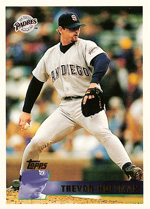
Against teams whom he faced at least 10 times in his career, Hoffman’s ERA was highest vs. St. Louis (4.09 in 51 regular-season games).

Though he lost to the Cardinals three times in the regular season, none of those defeats occurred during his time with the Padres, whom he pitched for in 16 of his 18 big-league seasons.

Two of his losses to St. Louis came while with the Brewers (2009-10).

The other occurred in 1993 when he broke into the majors with the expansion Marlins.

On May 16, 1993, at St. Louis, Hoffman was brought in by manager Rene Lachemann to face the Cardinals in the bottom of the ninth of a scoreless game. With one out, Gregg Jefferies singled to center, stole second base and advanced to third on catcher Steve Decker’s errant throw. Hoffman issued intentional walks to Ray Lankford and Mark Whiten, loading the bases.

With Stan Royer, hitless in the game, due up next, manager Joe Torre called on Todd Zeile to bat. Zeile’s single to center scored Jefferies, giving St. Louis a 1-0 victory and handing Hoffman his first career loss. Boxscore

It would be 16 years before Hoffman lost to the Cardinals again in the regular season. On Sept. 8, 2009, at Milwaukee, Matt Holliday’s two-run, ninth-inning home run against Hoffman carried St. Louis to a 4-3 victory. Boxscore

The next year, on April 9 at Milwaukee, pinch-hitter Nick Stavinoha’s two-run home run against Hoffman in the ninth lifted the Cardinals to a 5-4 victory. Boxscore

Two other Cardinals home runs against Hoffman are noteworthy:

_ In Game 3 of the 1996 National League Division Series at San Diego, Hoffman entered in the ninth with the score at 5-5. Brian Jordan’s two-run home run gave St. Louis a 7-5 victory and a sweep of the best-of-five series. Boxscore

_ A year later, June 10, 1997, at San Diego, a matchup of two top relievers, Hoffman and Dennis Eckersley, became a debacle for both.

With the Padres leading 3-1 in the ninth, Hoffman entered and yielded four runs _ the last two on Delino DeShields’ two-out, two-run home run _ to put St. Louis ahead, 5-3.

Eckersley attempted a save, but Tony Gwynn’s two-out, two-run double tied the score at 5-5. San Diego won, 6-5, with a run in the 12th. Boxscore

Read Full Post »

(Updated on Jan. 15, 2025)

The Hall of Famer who hit the most career home runs against Cardinals ace Bob Gibson was Billy Williams, with 10.

Of the 257 regular-season home runs Gibson yielded in his career, 67 were hit by fellow Hall of Famers.

Williams, an outfielder for the Cubs from 1959-74, slugged more home runs (10) and drew more walks (24) against Gibson than any other player, Hall of Famer or otherwise. Williams batted .259 (45-for-174) versus Gibson.

In the book “Sixty Feet, Six Inches,” Gibson said, “Billy Williams probably hit me better than anybody, but even so, and despite the fact that he was left-handed, I went ahead and pitched to him because he had Ron Santo and Ernie Banks behind him and I didn’t want either of them hitting two-run homers. If Williams had batted cleanup, I’d have probably pitched around him more.”

Even in the two seasons in which Gibson won the Cy Young Award _ 1968, when he posted a 1.12 ERA, and 1970, when he recorded a career-best 23 wins _ Williams hit two home runs against him in each year.

Entering the Cardinals’ game against the Cubs on Aug. 4, 1968, Gibson had given up three runs in 101 innings before the Cubs scored five times on two home runs, including one by Williams. Boxscore

One of Williams’ most memorable home runs decided a showdown between Gibson and Ferguson Jenkins: In the 1971 season opener between the Cardinals and Cubs at Wrigley Field, Williams hit a home run off a Gibson fastball in the 10th inning for a 2-1 Chicago victory. Boxscore and Video

“Gibson and Williams were good friends and formed a mutual admiration society except when they faced each other in a game,” Bob Burnes of the St. Louis Globe-Democrat wrote in the 1986 Baseball Digest.

Hall of Famer and ex-Cardinal Rogers Hornsby was a hitting instructor with the Cubs when Williams was a prospect. In the book “We Would Have Played For Nothing,” Williams recalled, “One thing he said that always stuck is that when you get two strikes on you, you got to be like a goalie. You got to protect the outside. You got to protect the inside. You got to protect everything. So that’s what you did. You shortened your swing and you wanted to make contact. You didn’t swing for the fences. If you get your pitch on the first pitch, you swing for the home run, and that’s what I did.”

The Hall of Famers who hit home runs against Gibson in the regular season (listed in order of number of homers hit):

_ Billy Williams, 10

_ Hank Aaron, 8

_ Willie McCovey, 7

_ Willie Stargell, 5

_ Roberto Clemente, 4

_ Eddie Mathews, 4

_ Frank Robinson, 4

_ Ernie Banks, 3

_ Johnny Bench, 3

_ Orlando Cepeda, 3

_ Willie Mays, 3

_ Joe Morgan, 3

_ Ron Santo, 3

_ Duke Snider, 3

_ Bill Mazeroski, 1

_ Tony Perez, 1

_ Mike Schmidt, 1

_ Dave Winfield, 1

NOTE: In nine World Series games, Gibson yielded one home run to a Hall of Famer _ Mickey Mantle of the Yankees in 1964.

Read Full Post »

(Updated June 20, 2024)

Ryne Duren played a key role in nearly derailing the Cardinals’ National League pennant bid in 1964.

Duren was a hard-throwing, hard-drinking pitcher with the Yankees from 1958-61. In 1964, he was 35 and a middle-innings reliever with the Reds.
On Sunday morning, Sept. 20, 1964, the Cardinals were in second place, 5.5 games behind the Phillies and a game ahead of the Reds. Most figured St. Louis needed a win that afternoon in Cincinnati to keep alive its hopes of catching the Phillies and prevent the Reds from moving into a tie for second.

Ken Boyer’s two-run triple, solo home runs from Lou Brock and Dick Groat and a successful squeeze bunt by Bill White put St. Louis ahead 5-0 after three innings. When Mike Shannon led off the fourth with a home run, Reds starter Joe Nuxhall was replaced by Duren.

With St. Louis ahead 6-0, the Reds appeared beaten.

“I looked around the dugout and everyone was really down,” Duren told author Doug Wilson in the book “Fred Hutchinson and the 1964 Cincinnati Reds.”

“I got mad and said to everyone on the bench, ‘If you don’t want to compete, let’s just go home, but if you’re out here, let’s have a little life.’ ”

Duren backed his words with action, on the mound and at the plate, and his efforts changed the momentum.

He pitched four scoreless innings and held the Cardinals to three hits.

In the fifth, with the score 6-1, Duren batted with Leo Cardenas on first and two outs. An .061 career hitter who wore thick lenses on his glasses because of poor sight in both eyes, Duren was “a terrible hitter,” his former Yankees manager, Ralph Houk, said in the book “Season of Glory.” According to Houk, Duren “choked way up on the bat and it was like he was using a hammer to hit a nail. He swung at the ball like that.”

Nonetheless, Duren was challenged by his Reds teammates to get on base.

“I made up my mind I would take one for the team, which I did,” Duren said.

Duren leaned across the plate as Cardinals starter Gordon Richardson delivered his pitch. The ball struck Duren on the upper thigh and he was awarded first base. The Cardinals protested vehemently to no avail.

“He didn’t even try to get out of the way,” Reds pitcher Sammy Ellis said. “And there’s no way he would have gotten a hit. He couldn’t even see.”

Inspired, the Reds rallied against the flustered Richardson. Pete Rose singled, scoring Cardenas. Duren and Rose scored on Vada Pinson’s single. When Duren got to the dugout, all the Reds were on their feet to greet him.

Cincinnati tied the score in the sixth. Ellis relieved Duren in the eighth and, in the bottom half of the inning, Cincinnati scored three runs against closer Barney Schultz and won 9-6.  Boxscore

“Frank Robinson (Reds outfielder) always gave me credit for waking the club up,” Duren said.

The Phillies beat the Dodgers that day and went into the final two weeks of the season with a 6.5-game lead over the Cardinals and Reds with 12 to play.

After that, the Phillies lost the next 10 in a row, Cincinnati won nine in a row and the Cardinals won 10 of their final 13. When the Phillies beat the Reds in the final two games, St. Louis won the title on the last day of the season.

Duren never pitched another game for the Reds after his performance against the Cardinals. He was released in April 1965 and pitched for the Phillies and Senators that season, the last of his big-league career.

Read Full Post »

(Updated Oct. 6, 2019)

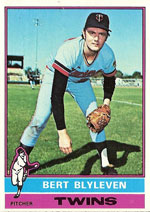
Bert Blyleven usually pitched impressively against the Cardinals, but that didn’t always translate into wins for him.

Blyleven, elected to the National Baseball Hall of Fame on Jan. 5, 2011, was 4-2 with a 2.84 ERA against the Cardinals while he was with the Pirates from 1978-80.

He also started twice for the Twins against the Cardinals in the 1987 World Series, winning Game 2 and losing Game 5.

In a 2019 edition of the Baseball Hall of Fame magazine, “Memories and Dreams,” Blyleven credited former Cardinals reliever Marv Grissom with helping him become a better pitcher. Grissom was pitching coach of the Twins in 1970 when Blyleven was a rookie.

“I threw across my body really bad,” Blyleven said. “(Grissom) actually put a folding chair down and I had to step to the left of that folding chair. That really changed my delivery to where my body went toward home plate rather than recoiling.

“I did ask him at one time, ‘What if I land on that folding chair with my left foot?’ He said, ‘Well, you’ll break your neck, won’t you?’ So that was the way for him to get me to open up and utilize the lower part of my body and my pitching delivery.”

Blyleven twice beat the Cardinals on complete-game five-hitters for the Pirates _ a 7-1 win at Pittsburgh on Sept. 13, 1978, Boxscore and a 2-1 win at St. Louis on Sept. 11, 1980. Boxscore

Blyleven also lost twice to the Cardinals in April 1980 despite pitching well. That stretch also contributed to one of the most controversial incidents of his career.

On Opening Day, April 10, 1980, at Busch Stadium, Blyleven started and held the Cardinals to a run (a George Hendrick RBI-double) and two hits in five innings. Cardinals starter Pete Vuckovich was better, pitching a complete-game three-hit shutout for a 1-0 win. In the ninth, Pittsburgh had runners on second and third with no outs, but Vuckovich finished with a flair, striking out Tim Foli, Dave Parker and Willie Stargell. Boxscore

Nine days later, at Pittsburgh, Blyleven faced the Cardinals again and struck out 12 in seven innings before being lifted for a pinch hitter with the score 1-1. In the eighth, the Cardinals scored (a Hendrick RBI-single) off reliever Dave Roberts and won, 2-1. Though Blyleven didn’t get the loss, he was deprived of a win despite a dominant performance. Boxscore

Blyleven then faced Montreal twice without a decision. After five starts, including the two against St. Louis, Blyleven was 0-2 with no complete games for the defending World Series champions.

On April 30, 1980, he quit the team, went home to California and demanded a trade, complaining that manager Chuck Tanner was lifting him from games too quickly.

In an article by Charley Feeney in the May 17, 1980, edition of The Sporting News, Blyleven said he told Pirates executive Pete Peterson he would retire if the Pirates didn’t trade him. Blyleven said Tanner “took a lot of competitiveness away from me” and blamed the manager for “non-support and lack of confidence.”

“I felt I had to speak up,” Blyleven said. “If I didn’t, maybe 20 years from now I’d be wishing that I had spoken up. Maybe 20 years from now I’ll wish I hadn’t spoken up.”

Said Pirates third baseman Bill Madlock: “I can understand a lot of things about ballplayers, but going home … I don’t know why he did that.”

The Yankees reportedly offered to trade pitcher Ed Figueroa for Blyleven but the Pirates declined. Blyleven was placed on the disqualified list.

Bill Conlin, a columnist for The Sporting News, wrote, “Blyleven’s incredible sulk is sending shock waves through National League front offices.” Conlin quoted an unnamed big-league general manager as saying, “I don’t think I’d want a player who so obviously places individual goals over team goals.”

On May 11, 1980, Blyleven offered to return and the Pirates reactivated him. Two days later, Blyleven started against the Giants, pitched a complete game _ and lost, 5-0. Boxscore

In the 1987 World Series, Blyleven had a solid start in Game 2, striking out eight, holding St. Louis to two runs in seven innings and earning the win in an 8-4 Twins victory. Boxscore In the fifth, Cardinals manager Whitey Herzog complained to umpires that Blyleven was balking by not coming to a full stop in his motion. Blyleven said Herzog was “trying to get something in my mind.”

In Game 5 at St. Louis, Blyleven held St. Louis scoreless through five innings. In the sixth, the Cardinals scored three runs off Blyleven (two on Curt Ford’s two-out bases-loaded single) and won, 4-2. Boxscore


Read Full Post »

Second baseman Roberto Alomar, who was elected to the National Baseball Hall of Fame, enjoyed some of the hottest hitting of his career over a two-game stretch against the Cardinals.

Playing for the Padres, Alomar went 7-for-8 with two walks, two runs scored and two RBI in two games, May 9-10, 1990, at St. Louis. Five of those seven hits were doubles.
Overall against the Cardinals in his career, Alomar batted .294 (53-for-180) with a .352 on-base percentage.

St. Louis had lost five in a row and had slumped to 10-16 when the Padres came to Busch Stadium for a two-game midweek series.

In the opener on Wednesday night, May 9, the Cardinals won, 11-5, behind 3.2 innings of scoreless relief from Rick Horton and the hitting of leadoff batter Vince Coleman, who had three singles, a walk, two RBI and two runs scored.

Alomar was a one-man wrecking crew for the Padres, going 3-for-4 with a walk, a RBI and a run scored. He laced three doubles _ one apiece against John Tudor, Horton and Tom Niedenfuer _ and reached Scott Terry for a walk.  Boxscore

The next day, Thursday afternoon, May 10, San Diego routed the Cardinals, 9-1, behind Alomar, who went 4-for-4 with a walk, a run and a RBI.

Alomar had two doubles and a single off Cardinals starter Joe Magrane. He also singled against Niedenfuer and drew a walk from Frank DiPino.  Boxscore

Overall in 1990, Alomar batted .364 (16-for-44) against the Cardinals.

After the 2004 season, the National League champion Cardinals strongly pursued Alomar as a free agent to replace second baseman Tony Womack, who had departed St. Louis for the Yankees.

In December 2004, Newsday reported Alomar had signed with the Cardinals, but the report was inaccurate. Alomar instead signed with Tampa Bay in January 2005, but retired during spring training.

The Cardinals replaced Womack with free-agent Mark Grudzielanek.

Read Full Post »

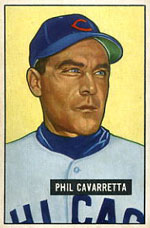
Phil Cavarretta hit one of the most important home runs in the long rivalry between the Cubs and Cardinals.

Cavarretta, who died Dec. 18, 2010, at 94, was a 19-year-old first baseman for the Cubs in 1935.

On Sept. 25, the first-place Cubs brought an 18-game winning streak to St. Louis to begin a season-ending, make-or-break five-game series with the Cardinals.

Chicago (97-52) had a three-game lead over St. Louis (94-55).

The series opener paired Chicago’s Lon Warneke against Paul Dean, brother of Dizzy Dean. Paul Dean had beaten the Cubs five times in six decisions that season. Warneke had lost four of six against the Cardinals.

Paul Dean struck out four of the first five Cubs. That brought Cavarretta to the plate with two outs in the second inning.

Dean hung a one-strike curve and Cavarretta belted it over the right-field pavilion. It was the hit that lifted the Cubs into the World Series.

Warneke shut out the Cardinals on two hits and the Cubs won, 1-0, clinching a tie for the pennant. Boxscore

After a rainout the next day, the Cubs beat Dizzy Dean and the demoralized Cardinals, 6-2, in the opener of a doubleheader, eliminating St. Louis from contention.

Playing for the Cubs from 1934-52, Cavarretta batted .291 (260-for-893) against the Cardinals, with 12 home runs, 110 RBI and a .370 on-base percentage.

In 1944, Cavarretta and Stan Musial of the Cardinals were the National League co-leaders in hits (197).

Musial trailed Cavarretta by six hits as the Cardinals went into a doubleheader against the Giants at New York on the final day of the season.

Musial went 6-for-9 (4 hits in the opener and 2 in the second game).

His final hit, the one that tied Cavarretta, came on his last at-bat _ a two-run home run off Ken Brondell.  Boxscore

Read Full Post »

« Newer Posts - Older Posts »