Feeds:
Posts
Comments

Archive for the ‘Hitters’ Category

(Updated June 12, 2024)

In a deal that triggered their transformation into champions, the 1985 Cardinals got a sleeping giant to wake up their offense.
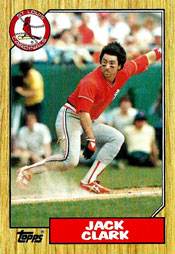
jack_clark4On Feb. 1, 1985, the Cardinals acquired Jack Clark from the Giants for Dave LaPoint, David Green, Jose Uribe and Gary Rajsich.

Cardinals manager Whitey Herzog saw Clark as the answer for an offense that lacked consistent power. “I’m getting a sleeping giant who immediately fits right into our picture a lot better,” Herzog said to The Sporting News.

Clark, 29, was a proven run producer, but he missed three months of the 1984 season because of right knee surgery. He also developed a reputation as a malcontent.

Asked about his image, Clark told the St. Louis Post-Dispatch, “I give my best effort on and off the field. I don’t act crazy. I’m a real straight shooter. Some people like that and some people don’t.”

Green, 24, was a prized prospect, but personal problems led to him being admitted to a treatment center in 1984.

“You’re really gambling on his potential,” Herzog said. “Of all the players I’ve had the opportunity to manage, David Green has more ability than anyone as far as hitting, hitting with power, speed and throwing arm. (Garry) Templeton and George Brett are in that category, but Green has more power than either, he runs better than either and he throws better than George (Brett).”

Prime target

After the Cardinals traded their top run producer, George Hendrick, to the Pirates in a December 1984 deal that brought them pitcher John Tudor, Herzog sought a replacement for the heart of the batting order. Clark was a prime target.

“It all happened rather quickly,” Giants general manager Tom Haller said. “The Cardinals instigated talks about Clark and we threw some names at him.”

In his book “The White Rat: A Life in Baseball,” Herzog said, “I’d always wondered what it would be like to write his name down on my lineup card. We went after Jack Clark hammer and tong in the winter of 1984-85.

“With Hendrick gone, we stepped up the campaign for Clark, the same kind of hitter George had been, only better. We knew he was unhappy in San Francisco, playing in that disgraceful ballpark of theirs (Candlestick Park). The Giants were down on him because he was unhappy there.”

Let’s make a deal

The trade initially called for the Cardinals to receive Clark and minor-league pitcher Colin Ward. Talks hit a snag when it was discovered Clark had several financial incentives in his contract, including a clause stating Clark would be given a $250,000 payment if he joined another team in 1987.

When Giants owner Bob Lurie agreed to compensate the Cardinals with $125,000, Ward was dropped from the deal and the transaction was completed.

“I’ll be playing somewhere I can be more productive and it will be more fun coming to the park every day,” Clark said to columnist Stan Isle. “You don’t develop good work habits at Candlestick Park. You can’t always do what you want to do out there, like trying to hit Nolan Ryan with dust blowing in your eyes.”

Said Herzog to the Associated Press: “Jack Clark puts us in the situation of definite contenders again. Here’s a guy who can win a ballgame with one swing of the bat. He’s the only player in the league besides (Mike) Schmidt who could hit 20 homers a year playing in our park.”

Said Lurie to columnist Art Spander, “Nobody in the organization was anxious to trade Jack Clark … but we need players; we need starting pitchers. We’re supposed to be getting some top prospects.”

Upper hand

The deal was lopsided in favor of the Cardinals.

The Giants, who had finished in last place in the National League West at 66-96 in 1984, did even worse after the trade, finishing last again at 62-100 in 1985.

Green, primarily playing first base, hit .248 with 20 RBI in 106 games in 1985.

Uribe, who had played for the 1984 Cardinals under the name Jose Gonzalez, was the everyday shortstop for the 1985 Giants. He hit .237 and committed 26 errors.

Rajsich hit .165 as a utility player. LaPoint was 7-17 with a 3.57 ERA in 31 starts.

Clark connects

The Cardinals, who had finished in third place in the NL East at 84-78 in 1984, won the division title at 101-61 in 1985. Sparked by the additions of Clark and rookie left fielder Vince Coleman, the Cardinals, who scored 652 runs in 1984, scored a league-leading 747 runs in 1985.

Clark, primarily playing first base, had a .393 on-base percentage and .502 slugging percentage for the 1985 Cardinals. He had 26 doubles, 22 home runs, 83 walks and 87 RBI. Clark hit the game-winning home run that clinched the pennant for St. Louis in Game 6 of the NL Championship Series versus the Dodgers.

In the book “You’re Missin’ a Great Game,” Herzog said, “Jack Clark could pull a bullet … I could be blindfolded and tell when Jack was taking (batting practice). He was the only guy I had who didn’t sound like he was hitting underwater … The man’s power scared people, kept the defenses honest and kept our jackrabbits circling the bases.”

In three seasons with the Cardinals, Clark had a .413 on-base percentage and a .522 slugging percentage, powering St. Louis to two pennants.

Herzog “was the best manager I ever played for, and he was the best manager I ever played against,” Clark told Cardinals Magazine. “Whitey was the X factor that gave his team an opportunity, or the right matchup, and put his players in position to succeed.”

Read Full Post »

(Updated April 28, 2025)

Whether facing a journeyman such as Barney Schultz or future Hall of Famer Steve Carlton, Cubs icon Ernie Banks produced some of his best performances against Cardinals pitching.

ernie_banksBanks began his pro career with the Negro League Kansas City Monarchs, who signed him on the recommendation of St. Louis resident and former standout player Cool Papa Bell. The Cubs acquired Banks in September 1953.

In a 19-year playing career with the Cubs, Banks had 512 home runs, 1,636 RBI and 2,583 hits. Against the Cardinals, Banks totaled 326 hits in 324 games, including 64 home runs.

“One thing fans never really knew about Ernie is he talked all the time,” teammate George Altman said in his autobiography. “He talked to opposing hitters when they reached first base. He talked to our infielders. He talked to us on the bench.”

All of that talking became too much for Cardinals ace Bob Gibson.

“Ernie Banks was a good example of a guy whom I probably would have enjoyed quite a bit if he had been on my side _ I don’t doubt that he was as nice a guy as everybody said _ but as it was he talked too damn much,” Gibson said in his book “Stranger to the Game.”

“He was always jabbering at me a day or two before I pitched against the Cubs, trying to get me off my game. One day … he came by during batting practice and said, ‘Hoot, you pitching tomorrow? We’re going to beat you. We’re going to beat your ass tomorrow.’ I said, ‘Ernie, you’d better leave me alone.’ It wasn’t in his nature to do that, though, and the next day I answered him.”

Gibson drilled Banks in the ribs with a pitch. “He didn’t have much to say to me after that,” Gibson said.

That day, July 18, 1962, Gibson struck out Banks three times and held the Cubs to three hits in a 2-1 Cardinals victory. Boxscore

Banks had a career batting mark of .229 (24-for-105) against Gibson with three home runs and 13 RBI.

Some of Banks’ most memorable games versus the Cardinals:

Communication breakdown

Banks hit two home runs on April 16, 1955, but the Cardinals won, 12-11, in 14 innings at St. Louis.

In the second inning, Randy Jackson, Banks and Dee Fondy hit consecutive home runs off Tom Poholsky.

With the score at 9-9 in the 12th, Banks and Fondy connected for back-to-back homers off Schultz. The Cardinals tied the score in the bottom half of the inning on Wally Moon’s two-run homer with two outs off Bubba Church.

A misplay involving Banks ignited the winning rally in the 14th. Bill Sarni lifted a fly to short left. Banks, the shortstop, and left fielder Hank Sauer miscommunicated and the ball dropped in for a double. Moon followed with a single, scoring Sarni. Boxscore

Slugging shortstop

Three months later, on July 8, 1955, Banks again homered twice against the Cardinals, and the Cubs won, 6-4, in 11 innings.

Banks hit a solo home run off Floyd Wooldridge in the first. In the 11th, Banks broke a 4-4 tie with a two-run homer off Gordon Jones. Boxscore

The home runs gave Banks a season total of 23, most for a shortstop in one year since Glenn Wright slugged 22 for the 1930 Dodgers.

In a five-game stretch against St. Louis in July 1955, Banks hit .550 (10-for-18).

Perfect at plate

Banks produced five hits in a game for the only time in his major-league career on Sept. 29, 1957, against the Cardinals. He was 5-for-5 with a career-best three doubles and two singles in an 8-3 Cubs victory in the season finale. Boxscore

Lucky seven

Banks tied a career high with seven RBI against the Cardinals at St. Louis on May 1, 1963. Banks hit a pair of three-run home runs _ in the first inning off Ray Sadecki and in the seventh off Harry Fanok _ and added an RBI-single in the eighth. The Cubs won, 13-8. Boxscore

Fit to be tied

Ten years after his 12th-inning home run off Schultz, Banks hit another dramatic shot against the Cardinals knuckleball pitcher.

On April 12, 1965, in the season opener at Chicago, the Cardinals carried a 9-6 lead into the bottom of the ninth. With two outs and none on, Tracy Stallard walked Ron Santo and Altman followed with a single.

Red Schoendienst, in his debut as manager, replaced Stallard with Schultz. Banks powered a three-run homer “into the teeth of a 20 mph wind,” according to the Associated Press, tying the score at 9-9.

After each team scored in the 11th, the game was ended because of darkness and declared a tie, with all statistics counting. Boxscore

“Stallard pitched like a son of a gun,” said Schoendienst, “but when Altman got that good, solid hit I … decided to take him out. Why not? Schultz was warmed up and nobody has touched him for anything in the spring games.”

Last hurrah

At 39, Banks hit a pair of two-run home runs off Carlton _ the first giving the Cubs a 4-3 lead in the sixth and the second snapping a 4-4 tie in the eighth _ but the Cardinals rallied and won, 8-6, at St. Louis on June 29, 1970.

The home runs were the 506th and 507th of Banks’ career and were the last he would hit against Cardinals pitching. Boxscore

Composer Burt Bacharach, Banks’ self-described No. 1 fan, was in St. Louis for a concert and was greeted by Banks outside the clubhouse after the game.

“You were making beautiful music out there,” Bacharach said to Banks.

Banks played against the Cardinals for the final time on Sept. 10, 1971, when he grounded out as a pinch-hitter against Don Shaw at Wrigley Field. Boxscore


Read Full Post »

Joining the Navy helped Stan Musial boost his baseball career with the Cardinals.

On Jan. 22, 1945, seven months after passing his Navy physical, Musial, 24, was inducted and sent to the United States Naval Training Center at Bainbridge, Md.

stan_musial_navy“I was really relieved to go into service when my draft board finally called in January 1945,” Musial said in his book “Stan Musial: The Man’s Own Story.”

Musial had helped the Cardinals win three consecutive National League pennants and two World Series championships during the World War II years 1942 through 1944.

In a January 1945 edition, The Sporting News wrote of Musial, “The Cardinals consider themselves lucky that the young clouter was permitted to remain with the club through three war seasons. Sam Breadon (owner of the Cardinals) was reconciled to losing Musial last winter.”

While receiving his naval training at the Bainbridge facility near the banks of the Susquehanna River, Musial also played for its baseball team.

Though he was a two-time National League all-star, a NL batting champion (.357 in 1943) and a NL Most Valuable Player Award winner (1943), Musial learned two important baseball skills at Bainbridge.

Serious about first

Musial had played all three outfield positions for the Cardinals. At Bainbridge, the athletic officer, Lt. Jerry O’Brien, instructed Musial to play first base.

“I was amused,” said Musial. “O’Brien was not.”

Said O’Brien to Musial: “You’re terrible.”

Stung by the criticism, Musial worked on becoming an adept first baseman. The effort paid off for him and the Cardinals. Musial would play 1,016 games at first base for St. Louis, extending his career and helping the club.

Pull with power

The other skill Musial learned at Bainbridge was how to pull pitches with power.

“Service personnel wanted to see the home run,” said Musial. “So to pull more often, to hit the long ball, I altered my batting stance a bit. I moved up closer to the plate. This proved to be an important step in my evolution as a hitter.”

Before joining the Navy, Musial’s single-season high in home runs for the Cardinals was 13 in 1943. In 1948, he hit a career-high 39 home runs, starting a streak of slugging 20 or more for 10 consecutive seasons.

Popular with the other Navy recruits at Bainbridge, Musial “autographed the inside of the white sailor caps of many of his fellow boots, by insistent request,” The Sporting News reported.

No Musial, no title

Musial was one of three regulars from the 1944 World Series championship team who went into military service in 1945. Musial and outfielder Danny Litwhiler missed the entire 1945 season. Catcher Walker Cooper missed all but four games.

Johnny Hopp, the Cardinals’ center fielder in 1944, moved to right field to replace Musial in 1945. The Cardinals reacquired Buster Adams from the Phillies to take over for Hopp in center. Rookie Red Schoendienst, a natural infielder, replaced Litwhiler as left fielder. Backup Ken O’Dea took over the catching for Cooper.

“I still think the Cards have enough pitching to finish first,” Musial said in April 1945. “That’s the big thing that will win it, the pitching _ and that great boy (Marty) Marion at short.”

Pie Traynor, a Pittsburgh radio commentator after a Hall of Fame playing career for the Pirates, predicted the 1945 Cardinals wouldn’t overcome the loss of Musial. “Few realize the real greatness of Stan,” Traynor said. “He is a natural hustler, he is on the bases continually and he is one of the best base runners in the game.”

The 1945 Cardinals earned 95 wins, but finished in second place, three games behind the Cubs, who won eight of their last 10.

Repair work

Musial completed his training at Bainbridge on April 9, 1945, and was assigned to the ship repair unit at Pearl Harbor in Hawaii.

“I never did learn how to repair ships,” Musial said.

In the fall of 1945, Musial requested a leave to visit his ailing father in Pennsylvania. The request eventually was granted and he got there after Christmas. At the end of his leave, in January 1946, Musial was assigned to the Philadelphia Navy Yard.

“I was listed among ship repairmen assigned to dismantle a British destroyer,” Musial said. “The day before I was scheduled to work, I walked over to watch men already at work, wearing goggles and heavy gloves and carrying blow torches. I realized a green pea like me could wind up maiming himself or someone else.”

Musial asked an officer, “Sir, I’m a ship repairman who never has repaired a ship. For my sake and the Navy’s, can’t you please have my orders changed?”

The officer agreed. Two months later, in March 1946, Musial was discharged at Bainbridge. After taking a train to Philadelphia, Musial and two colleagues hitchhiked together to their homes in Pennsylvania. After a week at home in Donora, Musial reported to Cardinals spring training camp and played the entire 1946 season, helping them to their third World Series crown in five years.

Previously: How a B-17 nearly clipped Cardinals in World Series

Read Full Post »

For Cardinals pinch-hitter Gerald Perry, a controversial feat against a future ace salvaged an afternoon that began with a gaffe.

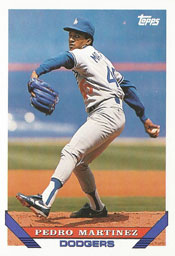
pedro_martinezOn April 13, 1993, Perry hit the first big-league home run yielded by Pedro Martinez, then a Dodgers rookie.

Twenty-two years later, on Jan. 6, 2015, Martinez was elected to the National Baseball Hall of Fame in his first year on the ballot. In 18 seasons with the Dodgers, Expos, Red Sox, Mets and Phillies, Martinez produced a 219-100 record and 2.93 ERA with 3,154 strikeouts.

In 1993, Martinez was 21, a relief pitcher in his first full big-league season with the Dodgers.

Perry, 32, was an 11-year big-league veteran, an established professional, but he made a rookie mistake.

Room service, please

Perry thought the Cardinals and Dodgers were playing a night game at Los Angeles. Instead, it was a rare weekday afternoon starting time because the game was the Dodgers’ home opener.

According to Rick Hummel of the St. Louis Post-Dispatch, Perry “was resting at the Century Plaza Hotel, having room service and watching a movie (“The Bodyguard”) on television” when he got a call from Cardinals equipment manager Buddy Bates, informing him he was about 90 minutes late.

Perry took a cab to Dodger Stadium and arrived in the clubhouse about 45 minutes before the start of the game. “I was very embarrassed walking in,” Perry said.

The Dodgers led, 7-5, after six innings. Martinez, the Dodgers’ third pitcher of the game, had held St. Louis scoreless in the fifth and sixth. The right-hander was making his second appearance of the season and his fourth overall in the big leagues.

In the seventh, the Cardinals had two runners on base with two outs when manager Joe Torre called on Perry, a left-handed batter, to pinch-hit for reliever Les Lancaster.

Tommy Lasorda, the Dodgers’ manager, stuck with Martinez.

Trouble if it’s fair

Perry swung at a high changeup and lined a deep drive down the right-field line.

As the ball carried toward the foul pole, Darryl Strawberry, the 6-foot-6 right fielder, “leaned over the waist-high wall” and reached for the ball, Hummel reported.

On KMOX radio, Cardinals broadcaster Mike Shannon told his audience, “Swing and a long one down the right-field line. It’s trouble if it stays fair … Well, we can’t tell.”

A fan with a glove caught the ball.

It landed just inside the foul line _ a three-run home run, giving the Cardinals an 8-7 lead.

Strawberry claimed the fan interfered.

“I would have had it,” said Strawberry. “I had it all the way. He just took it away.”

An inning after the home run, ushers escorted the fan from his seat. “Perhaps for his own safety,” Hummel wrote.

Cardinals catcher Hector Villanueva, who was in the bullpen, witnessed the fan being harassed by fellow spectators. “They were throwing stuff at him,” Villanueva said.

After viewing a video replay of Perry’s home run, Cardinals catcher Tom Pagnozzi opined, “There’s no way Strawberry would have caught that ball because the ball was already by him. What’s he whining about?”

Said Perry to the Orange County Register: “I was hoping and praying (Strawberry) wouldn’t catch it. Thanks to the fan, too.”

Martinez was lifted after completing the seventh. In the ninth, Pagnozzi hit a solo home run off Ricky Trlicek, extending the St. Louis lead to 9-7, and Lee Smith shut down the Dodgers in their half of the inning, earning his 358th save, then a major league record. Boxscore

When Perry got back to the clubhouse, he found a sign, created by his teammates, taped over his locker that informed him of the next Cardinals-Dodgers game. It read: “Night game, Rookie.”

Redbirds vs. Pedro

Martinez took the loss. Against the Cardinals in his career, he would finish 4-4 with a 3.62 ERA in 16 regular-season appearances, including 11 starts. He also earned a win against them with seven shutout innings in Game 3 of the 2004 World Series. Boxscore

Martinez gave up 10 career home runs versus the Cardinals. Six of those 10 occurred in three games.

_ John Mabry and Gary Gaetti connected for home runs against Martinez on July 28, 1996, in a 6-4 Cardinals victory over the Expos at St. Louis. Boxscore

_ Mark Grudzielanek and Abraham Nunez homered for the Cardinals against Martinez in a 7-6 St. Louis victory over the Mets on May 14, 2005, at New York. Boxscore

_ Troy Glaus and Rick Ankiel hit home runs off Martinez in an 8-7 Cardinals triumph over the Mets at St. Louis on July 2, 2008. Boxscore

Previously: How Joe Girardi became a member of Cardinals’ family

Read Full Post »

After considering Roberto Alomar and Alex Cora, the Cardinals chose Mark Grudzielanek to be their second baseman in 2005.

mark_grudzielanekOn Jan. 6, 2005, Grudzielank, a free agent, signed a one-year, $1 million contract with the Cardinals. He replaced Tony Womack, who became a free agent and signed with the Yankees after hitting .307 with 26 stolen bases for the 2004 Cardinals.

Grudzielanek, 34, hit .307 in 81 games for the 2004 Cubs after missing the first two months of the season because of an Achilles’ tendon injury.

In the St. Louis Post-Dispatch, columnist Bernie Miklasz wrote, “I like the Cardinals’ signing of Mark Grudzielanek to play second base … Grudzielanek won’t steal bases or run as well as Womack did. But his on-base percentage is about the same, and he will hit for more power and drive in more runs.”

Cora, 29, hit .264 with 10 home runs for the 2004 Dodgers. The Cardinals lost interest when the free agent demanded a multiyear contract. (Two weeks after the Cardinals got Grudzielanek, Cora signed with the Indians. He hit .205 for them and was traded to the Red Sox in July 2005.)

Alomar, 36, was nearing the end of a Hall of Fame career. A free agent, he had played for the Diamondbacks and White Sox in 2004. A final season with a contender such as the Cardinals was appealing. Instead, after the Cardinals passed, Alomar signed with the Rays but retired before the 2005 season started.

Tough, competitive

Grudzielanek began his big-league career with the 1995 Expos. He hit .281 in four years with the Expos, .284 in five years with the Dodgers and .312 in two years with the Cubs before joining the Cardinals.

“We’re getting a guy who will fit in with our club for a lot of reasons,” Walt Jocketty, Cardinals general manager, told the Post-Dispatch.

Said Cardinals manager Tony La Russa: “Grudzielanek is a tough player. He looks the same every day. He’s very competitive. That’s the No. 1 thing we like in him.”

The Cardinals got what they expected. In 2005, Grudzielanek led National League second basemen in fielding percentage (.990) and double plays turned (108). He batted .294 (155 hits in 137 games) with 30 doubles and 59 RBI.

Prime producer

Only Albert Pujols (38) and Jim Edmonds (37) had more doubles for the 2005 Cardinals than Grudzielanek. He also ranked third on the club in hits, trailing Pujols (195) and David Eckstein (185).

Grudzielanek became the first Cardinals second baseman to have as many as 30 doubles and 59 RBI in a season since Tommy Herr (30 doubles, 61 RBI) in 1986.

On April 27, 2005, Grudzielanek hit for the cycle against the Brewers at St. Louis. No other Cardinals hitter has achieved that feat since. Boxscore

With Grudzielanek at second base, the Cardinals won their second consecutive NL Central title and achieved 100 regular-season wins for the second year in a row. In the 2005 postseason, Grudzielanek fielded flawlessly, committing no errors in nine games for the Cardinals.

He became a free agent on Oct. 27, 2005, and signed a multiyear contract with the Royals two months later. The Cardinals opened the 2006 season with Aaron Miles as their second baseman.

Previously: Roberto Alomar: double trouble for Cardinals

Previously: Spring fling: How Tony Womack sparked 2004 Cardinals

Read Full Post »

(Updated April 6, 2026)

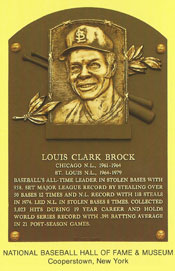
Recognition for being a player of multiple skills was as important to Lou Brock as being elected to the National Baseball Hall of Fame.

lou_brock11On Jan. 7, 1985, Brock got elected his initial time on the Baseball Writers Association of America Hall of Fame ballot.

Though base stealing was his signature talent, attributes such as smarts, work ethic, teamwork, being a catalyst and ability to intimidate foes helped make Brock a Hall of Famer.

Aside from the inaugural Hall of Fame class of Ty Cobb, Babe Ruth, Honus Wagner, Christy Mathewson and Walter Johnson, the 14 players who preceded Brock in being elected their first time on the ballot were Ted Williams, Stan Musial, Bob Feller, Jackie Robinson, Sandy Koufax, Ernie Banks, Willie Mays, Warren Spahn, Mickey Mantle, Al Kaline, Bob Gibson, Hank Aaron, Frank Robinson and Brooks Robinson.

“I think my greatest gift was the ability to be a force on the field, to beat you many ways,” Brock said to United Press International. “I was an unpredictable guy who could beat you in the clutch.”

Red Schoendienst, Brock’s manager from 1965-76, said to Super Sports magazine in 1969, “What’s there he can’t do? He’s a streak on the bases. He can hit and he also can hit with power. He can turn singles into doubles and doubles into triples. He can cover the outfield with the best around … He has to be the most exciting player in the game.”

Brock was named on 315 of 395 ballots (79.5 percent). A candidate needed to be named on 75 percent of the ballots to get elected.

Also elected that year was Hoyt Wilhelm. A knuckleball specialist, Wilhelm was the first relief pitcher elected. He played for nine teams, including the 1957 Cardinals.

Food for thought

Growing up in rural Louisiana, Brock didn’t pay attention much to baseball early in his boyhood until a teacher assigned him to research the lives of players, such as Jackie Robinson and Stan Musial, and present a report to the class.

In the book “Redbirds Revisited,” Brock recalled to authors David Craft and Tom Owens, “In stumbling through what I’d read about these ballplayers, I guess there was this one paragraph that stated these guys got something like $8 to $10 a day meal money. This was an economically poor rural community, remember, and one thing school kids identified with was lunch. Eating. A meal. I had trouble getting a quarter for meal money, and these guys were getting maybe 40 quarters a day. I thought, ‘Wow. Can you believe that?’ That stayed with me, and I wanted to learn more about baseball.”

Brock began playing sandlot baseball, went to Southern University, excelled in the sport there, and signed with the Cubs.

Offensive force

Brock played 16 years (1964-79) with the Cardinals after four seasons (1961-64) with the Cubs. His most impressive career statistics: 938 stolen bases (the National League record) and 3,023 hits in 2,616 games.

With the Cardinals, Brock had 888 steals, 1,427 runs and 2,713 hits in 2,289 games. Primarily a left fielder, Brock ranks second to Stan Musial all-time among Cardinals in hits, runs and games.

(With 1,469 strikeouts as a Cardinal, 20 more than Ray Lankford, Brock is the club’s franchise leader in that category, too. “I’m the type of hitter who leaves the bench swinging and that’s why I don’t really possess the qualifications for a leadoff man,” Brock told Super Sports magazine. “I don’t look for walks, the way a leadoff hitter should … I just look for the baseball. I don’t care if it’s not in the strike zone. I see it, I hit it.”

Brock also ranks second all-time among big leaguers in steals (Rickey Henderson has 1,406). He led the National League in steals eight times, including 1974, when he had a career-high 118 at age 35.

“His speed meant so much that he had a greater effect and worried more pitchers than any home run hitter did,” Ted Sizemore, the Cardinals infielder who often batted second in the order behind Brock in 1974, told The Sporting News.

Said Brock: “I was a force that had to be reckoned with.”

In a 2014 interview with Cardinals Magazine, Brock said, “The stolen base artist has a passion. He is always seeking to occupy a piece of territory behind the enemy line, and there is something distasteful to the opposition about getting out there and taking that territory.

“If you hit a double, you actually land at second base, but if you walk, there’s something arrogant about looking at second base and saying, ‘I want to go over there and stand, and I’m going to do it between pitches.’ ”

Asked to describe his legacy, Brock said it was an “ability to light the fuse to enthusiasm, to cause teams and myself to play to the limit of their ability. You become a chemist, which makes a team tick. I think I had that ability.”

Will to win

Acquired along with pitchers Paul Toth and Jack Spring from the Cubs for pitchers Ernie Broglio and Bobby Shantz and outfielder Doug Clemens on June 15, 1964, Brock sparked the Cardinals to two World Series titles (1964 and 1967) and three National League pennants.

“He was a hard worker,” Bing Devine, the Cardinals general manager who made the trade, said to the Associated Press. “He worked very hard to become the expert base stealer he was. The base stealing is the dramatic thing about him, but he was an all-around ballplayer.”

Brock told Cardinals Magazine, “Being a base stealer was a double whammy. You had to be in shape, along with the rest of your teammates, but you also had to be in base-stealing shape, or you weren’t going to be successful. That was a special challenge, all by itself, that you had to prepare for.”

Brock excelled in the spotlight. He batted .391 (34-for-87) with 16 runs, 14 steals and 13 RBI in 21 World Series games for the Cardinals.

“He was as good as I’ve ever seen rising to the occasion,” Devine said.

United Press International columnist Milton Richmond described Brock as “the thinking man’s ballplayer. He knew almost as much about gravity and motion as Sir Isaac Newton.”

Ted Sizemore, a Dodgers second baseman before joining the Cardinals, had the perspective of observing Brock as an opponent as well as a teammate. Sizemore told Cardinals Magazine, “He slid very late and a lot of times the guys on the club wondered how he didn’t break his ankle sliding so late. Being on the other end of that, I hated tagging him because his knee was always up so high when he came in. You could break your hand putting it in there.”

Keith Hernandez, who joined the Cardinals as a 20-year-old first baseman in 1974, recalled Brock as a Hall of Fame person.

“He helped me more than anybody in my career,” Hernandez said. “He’s one of the guys in my career that if they weren’t around at a certain stage I might not have made it … He was such a giving person.”

Read Full Post »

« Newer Posts - Older Posts »