Feeds:
Posts
Comments

Archive for the ‘Hitters’ Category

(Updated March 13, 2023)

While facing the Cardinals at St. Louis in 2008, Mark Reynolds of the Diamondbacks became the first big-league player to strike out 200 times in a season.
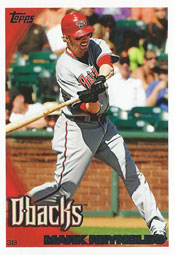
mark_reynoldsSix years later, Reynolds joined the Cardinals as a role player.

A free agent who played for the 2014 Brewers, Reynolds signed a one-year, $2 million contract with the Cardinals on Dec. 11, 2014. The Cardinals hoped he would provide right-handed power. They knew, though, he also would strike out a lot.

Starting in 2006, total strikeouts in the majors increased regularly, according to The Sporting News. Reynolds was the model for that trend.

Poor plate discipline

On Sept. 25, 2008, Reynolds struck out in the second inning against Cardinals starter Joel Pineiro. It was Reynolds’ 200th strikeout that season. He struck out again in the seventh. Boxscore

After the game, Reynolds told Rick Hummel of the St. Louis Post-Dispatch, “It’s obviously something I have to work on for next year. It’s not the greatest of records to have. It’s a matter of pitch recognition and being more patient and more selective. I can’t tell you how many times I’ve gotten to 3-and-2 and swung at ball four.”

Reynolds finished the 2008 season with 204 strikeouts, breaking the big-league record of 195 set by Adam Dunn of the 2004 Reds. The record had been 189 strikeouts by Bobby Bonds of the 1970 Giants until Dunn topped the mark 34 years later.

“Records are made to be broken. Maybe somebody will come along and break my record,” Reynolds told Hummel.

Instead, Reynolds broke his own record the next season.

Whiffs pile up

In 2009, Reynolds struck out 223 times. That remains the big-league record.

“Deep down inside, I’m sure it bothers him more than he likes to portray,” said 2009 Diamondbacks manager A.J. Hinch.

Reynolds reached 200 strikeouts in a season three times: 204 in 2008, 223 in 2009 and 211 in 2010. He was with the Diamondbacks all three seasons.

Tyler O’Neill holds the Cardinals club record for striking out the most times in a season. O’Neill fanned 168 times in 2021, breaking the franchise mark of 167 set by Jim Edmonds in 2000.

Power potential

The reason Reynolds remained in the majors was he hit home runs. In 2009, when he established the strikeout record of 223, Reynolds produced 44 home runs and 102 RBI for the Diamondbacks. Reynolds hit 22 home runs in 378 at-bats for the 2014 Brewers.

“When that production is coming with the strikeouts,” Hinch said, “it (the record) is almost a moot point.”

Paul Molitor, who produced 3,319 hits and never struck out 100 times in a season, told The Sporting News in 2014, “Guys that are good hitters and hit for a high average should probably be striking out 10 percent of the time.”

Reynolds hit 13 home runs and struck out 121 times in 382 at-bats for the 2015 Cardinals. He became a free agent after the season and went to the Rockies.

In 13 seasons in the majors, Reynolds had 1,283 hits (298 for home runs) and 1,927 strikeouts.

“I don’t know if it’s the mentality of the players,” said Molitor, “but they’re definitely not concerned about it.”

Read Full Post »

david_ecksteinIn December 2004, the Angels did the Cardinals a favor, opting not to re-sign their shortstop, David Eckstein, making him a free agent.

The Cardinals, needing to replace shortstop Edgar Renteria, a free agent who signed with the Red Sox, hardly could believe their good fortune.

Eckstein filled two needs. He replaced Renteria at shortstop and he also batted leadoff. Like Renteria, Tony Womack, who batted leadoff for the 2004 Cardinals, became a free agent. Womack signed with the Yankees.

Pouncing on the opportunity to acquire a player described by general manager Walt Jocketty as “a perfect fit,” the Cardinals signed Eckstein on Dec. 23, 2004, two days after he became available.

It was a move that felt right from the moment it occurred.

Eckstein ignited the Cardinals with his hustle, heart and smarts, leading them to two postseason appearances and a 2006 World Series championship.

Shortstop roulette

Though Eckstein had sparked the Angels to their only World Series title in 2002 and had led American League shortstops in fielding percentage in 2004, the Angels sought an upgrade, citing Eckstein’s lack of arm strength as a liability.

Meanwhile, Renteria, a three-time all-star with the Cardinals, had bolted to the Red Sox, who gave him a four-year, $40 million contract.

With Renteria joining Boston, Orlando Cabrera, the shortstop who helped the Red Sox sweep the Cardinals in the 2004 World Series, declared for free agency. The Angels pursued him, offering a four-year, $32 million deal. When Cabrera accepted, Eckstein became expendable.

According to the Associated Press, the Cardinals, unable to find a suitable replacement for Renteria, were considering signing shortstop Barry Larkin, 40, who had become a free agent after 19 seasons with the Reds. When Eckstein became available, the Cardinals called with a three-year, $10.2 million offer.

Eckstein, 29, accepted and it was a bargain for the Cardinals.

“They were very aggressive,” Eckstein said to the St. Louis Post-Dispatch. “They were pretty much the first team to call … It was clear that this was a good fit. The best fit.”

John Mozeliak, the Cardinals’ assistant general manager, said, “David was the player we focused on right away after Cabrera signed.”

Said Jocketty: “We felt this was the guy, the perfect fit for our club for a lot of reasons. For his personality, for the way he goes about playing the game. He’s a gamer through and through. He’s the kind of player St. Louis will embrace. I think he will become a cult hero with our fans. He’s a hustler.”

Disappointed with the decision to discard a player popular with the team based near Disneyland, San Bernardino Sun columnist Paul Oberjuerge wrote, “The Angels just shot Bambi.”

Size doesn’t matter

Eckstein, 5 feet 6, 170 pounds, had 156 hits in 142 games for the 2004 Angels. He seldom struck out (49 times in 637 plate appearances) and fielded effectively (six errors).

In the 2002 World Series against the Giants, Eckstein batted .310 with nine hits, three walks and six runs scored for the Angels.

Post-Dispatch columnist Bernie Miklasz wrote, “Eckstein is the kind of old-school player who commands such great respect and appreciation in St. Louis, a traditional baseball town.”

Rex Hudler, an Angels broadcaster who had been a hustling utilityman for the Cardinals from 1990-92, told Miklasz he’d named his son, David, in honor of Eckstein.

“He’s going to be revered as the new Huckleberry Finn of St. Louis and Missouri,” Hudler said of Eckstein.

Hudler said his 8-year-old daughter cried when she learned Eckstein was leaving the Angels. “Kids are his biggest fans,” Hudler said. “The children look up to him and relate to him because he’s so small … He inspires all of those kids who have been told they aren’t good enough.”

Asked about Eckstein’s subpar arm, Hudler replied, “He’s so smart. Extremely intelligent. He studies the hitters. He positions himself perfectly. He’s always in the right place. The ball comes right to him. I’ve never seen him make a mental mistake.”

Said Eckstein: “I don’t really look like your typical pro athlete. It means I always have to prove myself … I don’t want to lose that edge.”

St. Louis sparkplug

Cardinals manager Tony La Russa was delighted by the acquisition, calling Eckstein “a winning player.”

After speaking with La Russa, Eckstein told the Associated Press, “Mr. La Russa just said to play my game, be a pest at the plate and play solid defense.”

That’s exactly what Eckstein did for the Cardinals.

In three seasons (2005-07) as the St. Louis shortstop, Eckstein twice was named an all-star. He batted .297 with 465 hits in 398 career games for the Cardinals. He had a .357 on-base percentage with them. In 2005, Eckstein ranked second among National League shortstops in both assists (517) and double plays turned (123).

His crowning achievement came in 2006 when he was named winner of the World Series Most Valuable Player Award. Eckstein hit .364 in the five-game series versus the Tigers, with four RBI and three runs scored.

“He’s the heart and soul of this ball club,” Cardinals second baseman Aaron Miles said to Sports Illustrated.


Read Full Post »

Before Johnny Mize played a game for the Cardinals, they gave up on him and gave him away to the Reds.

Fortunately for the Cardinals, the Reds gave him back.

johnny_mize5During six seasons as the Cardinals’ first baseman, Mize won a National League batting title (.349 in 1939), a RBI crown (137 in 1940) and twice led the league in home runs (28 in 1939 and 43 in 1940).

In three consecutive years (1938-40) with the Cardinals, Mize led the NL in slugging percentage and total bases. Nicknamed “The Big Cat,” Mize was a four-time all-star with St. Louis. He was elected to the National Baseball Hall of Fame.

The story of how Mize transformed into one of the Cardinals’ all-time sluggers is filled with a dizzying array of twists and turns.

Rich Reds

In 1934, Mize, 21, was with the Cardinals’ minor-league Rochester (N.Y.) affiliate. His season was cut short because of a groin injury. In 90 games, Mize hit .339 with 17 home runs.

Larry MacPhail, the Reds’ brash general manager, needed sluggers for a team that ranked last in the major leagues in runs scored (590) in 1934. MacPhail saw Mize as a cornerstone for that rebuilding project.

Jim Bottomley was the Reds’ first baseman. Bottomley, who would be elected to the Hall of Fame, had been a standout for the Cardinals, helping them win two World Series titles (1926 and 1931) and four pennants. The Cardinals traded him to the Reds in December 1932.

Though he hit .284 with 31 doubles for the 1934 Reds, Bottomley, 34, had peaked as a run producer.

Powel Crosley, the Cincinnati radio manufacturer and broadcasting titan, had purchased the Reds in 1934 and was willing to spend money to revive a franchise that had finished in last place in the NL that year. In December 1934, MacPhail approached the Cardinals and offered $55,000 for Mize.

It was an astonishing sum at a time when the nation still was staggered by the economic hardships of the Great Depression. MacPhail’s offer topped the $50,000 the Yankees had paid the San Francisco Seals a month earlier for their highly touted prospect, outfielder Joe DiMaggio.

The Cardinals, who had won the 1934 World Series championship, were quite willing to accept such a large sum for a hobbled player who never had appeared in the big leagues.

On Dec. 13, 1934, the Cardinals sent Mize to the Reds.

String attached

“Whatever happens to the Reds (in 1935), it cannot be said (they) have not put plenty of cash and industry into their efforts,” The Sporting News reported. “The substantial sum of $55,000 was turned over to the Cards for (Mize) … There is ample reason for believing that Mize will prove well worth the expenditure. He is a strapping youngster … who puts a great deal of power into his swing.”

The deal came with one important condition. Wrote The Sporting News: “As for the injury, so confident are the Cardinals that it will not prove a hardship that they have guaranteed the first sacker will be sound for 1935, which means that if the injury still handicaps the player, the Reds need not keep him but instead may return him and get back the money paid for his services.”

As spring training started in February 1935, Mize told reporters he was “entirely recovered” from the groin injury. The Sporting News speculated Bottomley would be traded to the Cubs or Giants.

After watching Mize perform, though, it became evident something was wrong with him. It later was determined spurs had developed on his pelvic bone, restricting his movement and causing pain.

Return to sender

On April 15, 1935, the Reds voided the deal, returning Mize to the Cardinals the day before the start of the season.

Assigned to Rochester, Mize played in 65 games and hit .317 with 12 home runs until the pain became too intense to continue. With his career in jeopardy, Mize agreed to surgery after the season.

In December 1935, The Sporting News reported, “Mize recently underwent an operation to correct a condition that interfered with the free action of his legs … The surgery (Mize) submitted to was for the removal of a growth on the pelvic arch and it has been pronounced a success.”

The report was accurate. Mize opened the 1936 season with the Cardinals and soon after took over from Rip Collins as the first baseman. The rookie hit .329 with a team-leading 19 home runs and 93 RBI for the 1936 Cardinals.

In six seasons with St. Louis (1936-41), Mize batted .336 with 1,048 hits in 854 games. His .600 slugging percentage with the Cardinals ranks third all-time in franchise history and first among left-handed batters. The only players with higher career slugging percentages as Cardinals are Mark McGwire (.683) and Albert Pujols (.617).

On Dec. 11, 1941, seven years after they sent him to the Reds, the Cardinals traded Mize to the Giants for catcher Ken O’Dea, first baseman Johnny McCarthy, pitcher Bill Lohrman and $50,000.


Read Full Post »

(Updated Jan. 8, 2025)

In losing their closer and top run producer within a six-day stretch in December 1984, the Cardinals appeared to be a franchise in danger of decline.

george_hendrick2Instead, they became champions.

With Bruce Sutter (45 saves, 1.54 ERA) and George Hendrick (28 doubles and 69 RBI), the 1984 Cardinals achieved 84 wins and finished 12.5 games behind the champion Cubs in the National League East.

Without Sutter and Hendrick, the 1985 Cardinals achieved 101 wins and clinched the National League pennant.

On Dec. 7, 1984, Sutter, a free agent, signed with the Braves. Five days later, on Dec. 12, 1984, the Cardinals dealt Hendrick and minor-league third baseman Steve Barnard to the Pirates for pitcher John Tudor and utility player Brian Harper.

Distraught by the trade of a player who had led the Cardinals in RBI for five consecutive years and in home runs for four seasons in a row, second baseman Tommy Herr told the St. Louis Globe-Democrat, “It’s hard to understand. I think we’ve taken some serious steps backward. … I don’t know why they would trade George, especially to a team in our division. I don’t see how our lineup can withstand the loss of a guy like George.”

Strengthen rotation

Sutter’s departure had created an urgency for the Cardinals to find a pitcher to join Joaquin Andujar as starters who could go deep into games. Without Sutter, the Cardinals are “going to have to have our starters go like hell and get us to the eighth inning,” manager Whitey Herzog told The Sporting News.

Hendrick, 35, was deemed expendable because the Cardinals believed they had candidates to replace him.

Cardinals general manager Joe McDonald told United Press International, “We are sorry to give up George Hendrick and wish him well, but young outfielders like Andy Van Slyke and, a little further into the future, Vince Coleman are deserving of their chances and I’m sure they’ll respond in a way St. Louis fans like.”

In his book “You’re Missin’ a Great Game,” Herzog said Hendrick “became one of the most respected players on my team. When I traded him to the Pirates, it was only out of baseball necessity.”

Herzog told Cardinals Magazine he considered Hendrick “a Gold Glove in right field … Never made mental mistakes, played good team baseball and really grew up to be a heck of a man.”

Cardinals outfielder Willie McGee recalled how he and Hendrick would drive home from the ballpark together during the 1984 season. “George helped me a great deal,” McGee recalled to Rick Hummel of the St. Louis Post-Dispatch. “It was like he thought more about another person than himself. I’d leave the park and I’d be down, but by the time we got home, I’d be laughing and looking forward to the next day.”

Tudor, 30, had a 12-11 record for the 1984 Pirates. McDonald noted, though, that the left-hander had yielded fewer hits (200) than innings pitched (217) and had 117 strikeouts compared with 56 walks. “What I like about him is his ratio of bases on balls to strikeouts,” said McDonald.

Positive Pirates

The Pirates, who had finished in last place in the six-team National League East in 1984, were confident Hendrick would produce runs and excite the fan base. “It was a deal that general manager Pete Peterson needed to convince Pittsburgh fans that there is a desire to improve the club,” The Sporting News reported.

Said Peterson: “Hendrick can hit 20 home runs and drive in 80 runs … I rate him as one of the best clutch hitters in the game.”

Eight days later, on Dec. 20, 1984, the Pirates acquired another run-producing outfielder, Steve Kemp, from the Yankees.

The deals, however, were busts for the Pirates and a boon for the Cardinals.

Terrific Tudor

Tudor was both the winner and the workhorse McDonald and Herzog had hoped he would be for the 1985 Cardinals. After losing seven of his first eight decisions, Tudor won 20 of his last 21. He and Andujar each had 21 wins for the 1985 Cardinals. In 36 starts, Tudor pitched 275 innings and recorded 10 shutouts. His ERA was 1.93.

In his book, Herzog said Tudor “never threw a ball over 85 mph in his life” and credited a “now-you-see-it changeup” for Tudor’s turnaround.

“John Tudor was the most amazing pitcher I ever saw,” Herzog said.

Van Slyke, 24, adequately replaced Hendrick in right field. Van Slyke had 25 doubles and his 13 home runs ranked second on the club.

Coleman, 23, was promoted from the minors in mid-April and became the everyday left fielder, igniting the offense with 170 hits and 110 steals.

First baseman Jack Clark, acquired from the Giants two months after Hendrick was traded, delivered 22 home runs and 87 RBI.

Herzog deftly handled a closer committee of Jeff Lahti, Ken Dayley, Bill Campbell and Neil Allen until rookie Todd Worrell became the stopper in September.

Danny Cox (18 wins) joined Andujar and Tudor in creating a formidable rotation that also included Kurt Kepshire (10 wins) and Bob Forsch (nine wins).

Meanwhile, the Pirates regressed. They were 57-104, finishing 43.5 games behind the 1985 Cardinals. Hendrick hit .230 with two home runs and 25 RBI in 69 games. Kemp hit .250 with two home runs and 21 RBI in 92 games.


Read Full Post »

(Updated Nov. 13, 2025)

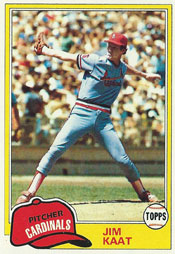
Jim Kaat was 41 when he stole a base and hit a home run in separate games for the 1980 Cardinals.

jim_kaat4At an age when most players are retired, Kaat remained a complete ballplayer.

Speed demon

On June 23, 1980, two months after he was acquired from the Yankees, Kaat earned the win and pitched a complete game for the Cardinals in their 6-1 victory over the Pirates at St. Louis. Kaat didn’t allow a walk or an extra-base hit. He held the Pirates scoreless over the last seven innings and earned his 266th career win, tying Hall of Famer Bob Feller.

In the seventh, he stole a base.

Bobby Bonds was at the plate when Kaat, noticing first baseman Bill Robinson wasn’t holding him on, dashed for second. Bonds took a pitch from Enrique Romo. Catcher Steve Nicosia gunned a throw to Phil Garner, covering second, and Kaat beat the peg.

“Kitty figured as long as somebody wants to give you something, you might as well take it,” Cardinals manager Whitey Herzog said to the St. Louis Post-Dispatch.

Fans at Busch Stadium rewarded Kaat with a standing ovation. “I guess they thought Lou Brock was back,” Kaat said.

In its account of the game, the Associated Press wrote, “It was the aging hurler’s speed that brought the customers to their feet … The accomplishment nearly overshadowed his hurling.”

Said Kaat: “It was the element of surprise. I had a good lead. It was worth it.” Boxscore

The steal was Kaat’s first in nine years. He was 32 when he swiped a base for the Twins against Yankees pitcher Stan Bahnsen and catcher Thurman Munson on July 30, 1971.

His stolen base for the Cardinals was Kaat’s fifth and last in a 25-year career (1959-83) in the majors.

Described by the Post-Dispatch as a “left-handed Methuselah,” Kaat needed only 82 pitches to complete the game. He threw a strike on the first pitch to 25 of 32 Pirates batters.

“He may be 41, but he has the body of a 28-year-old,” said Pirates manager Chuck Tanner.

Sultan of swat

Two months after his steal for the Cardinals, Kaat hit a home run for them.

On Aug. 26, 1980, Kaat homered off the Astros’ Joe Niekro at St. Louis.

“He hit a knuckleball up,” Niekro said to the Associated Press. “He’s a pretty good hitter. I’ve got a brother (Phil) who is 41 and he hits home runs. It’s not the first time I gave up one to a pitcher and it probably won’t be the last.” Boxscore

The home run was the last of 16 hit by Kaat. He slugged his first 18 years earlier on June 19, 1962, off Dom Zanni of the White Sox.

(The oldest player to hit a big-league home run was Mets first baseman Julio Franco, 48, against Randy Johnson of the Diamondbacks on May 4, 2007. Franco was three months shy of his 49th birthday.)

Going strong

Exactly one year after his home run, Kaat, 42, got his last big-league hit, a single for the Cardinals against 25-year-old Giants rookie Bob Tufts on Aug. 26, 1981. Boxscore

The next year, Kaat, 43, appeared in 62 regular-season games for the Cardinals (earning five wins and two saves) and pitched in four games of the 1982 World Series against the Brewers.

He pitched his last game at 44, tossing 1.1 scoreless innings in relief of Joaquin Andujar for the Cardinals against the Pirates on July 1, 1983, at Pittsburgh. Boxscore

Kaat was 19-16 with 10 saves in four seasons (1980-83) with the Cardinals.

Elected to the Baseball Hall of Fame, Kaat totaled 283 career wins and received 16 Gold Glove awards for fielding.


Read Full Post »

(Updated Nov. 24, 2017)

In 1964, Ken Boyer showed the qualities one would expect in a Hall of Fame player. The Cardinals third baseman consistently excelled with the glove and with the bat. He was a champion and a leader. He achieved feats that ranked him among the elite at his position all-time.

ken_boyer8Boyer hasn’t been elected to the National Baseball Hall of Fame at Cooperstown, N.Y. The only other third basemen of the 1958-64 era who fielded and hit at the same level as Boyer were Brooks Robinson of the Orioles, Eddie Mathews of the Braves and Ron Santo of the Cubs. All three have been elected to the Hall of Fame.

Special player

Though one outstanding year doesn’t qualify anyone for the Hall of Fame, Boyer’s 1964 season is important because it caps a seven-year stretch of consistently high quality and puts into context how Boyer elevated himself into a special category of third basemen.

Boyer, 33, played in all 162 Cardinals regular-season games in 1964. He led the majors in RBI with 119. Boyer also ranked in the top five in the National League in triples (10) and walks (70). He hit .295 with 185 hits, 30 doubles and 24 home runs. He scored 100 runs. His on-base percentage was .365.

Among NL third basemen in 1964, Boyer ranked second in both assists and double plays turned.

Calm and steady

His immense value to the Cardinals was proven with these statistics: Boyer hit .335 with 91 RBI in the Cardinals’ 93 wins in 1964; .238 with 28 RBI in the Cardinals’ 69 losses.

Remarkably consistent, Boyer in 1964 hit .296 against right-handed pitching; .291 versus left-handers.

Boyer was at his best against the Cardinals’ closest competitors, the Phillies and the Reds. Each finished a game behind the pennant-winning Cardinals. Boyer hit .351 with 17 RBI in 18 games against the 1964 Phillies; .309 with 13 RBI in 18 games versus the 1964 Reds.

In a profile of the Cardinals team captain in the Nov. 14, 1964, edition of The Sporting News, Ed Wilks wrote that Boyer “does everything well, but in the calm, steady, unspectacular fashion of a professional.”

Said Boyer: “The (1964) season couldn’t have been more satisfying. I think I did just about everything I had hoped to do.”

Rewarding year

Among the feats Boyer achieved in 1964:

_ He was named recipient of the NL Most Valuable Player Award on Nov. 24. Boyer became only the second NL third baseman and just the fourth in the big leagues to win a MVP Award. The others were Bob Elliott of the 1947 Braves in the NL and Al Rosen of the 1953 Indians and Brooks Robinson of the 1964 Orioles in the American League.

Top five in balloting for 1964 NL MVP were Boyer, Johnny Callison of the Phillies, Bill White of the Cardinals, Frank Robinson of the Reds and Joe Torre of the Braves. Boyer received 14 of 20 first-place votes. “That’s a lot when there are only 20 votes altogether and you have all that strong competition,” Boyer said. “Fourteen must be my lucky number. That’s my uniform number.”

_ The Sporting News named Boyer its Major League Player of the Year. He became the third Cardinals player to earn the honor, joining Marty Marion (1944) and Stan Musial (1946 and 1951).

_ For exemplifying the qualities of Lou Gehrig on and off the field, Boyer was presented the Lou Gehrig Memorial Award by the late Yankees first baseman’s Phi Delta Theta fraternity at Columbia University. He joined Musial (1957) as the second Cardinals player to receive the honor.

Run producer supreme

_ He became the first third baseman to lead the NL in RBI since Heinie Zimmerman (102) of the 1917 Giants. Boyer also was the first Cardinals player to lead the major leagues in RBI since Enos Slaughter (130) in 1946 and the first Cardinals player to lead the NL in RBI since Musial (109) in 1956.

_ Named to the all-star team for the seventh and last time, Boyer started at third base in the 1964 Midsummer Classic at Shea Stadium in New York and went 2-for-4, with a home run off Athletics reliever John Wyatt, in a 7-4 NL victory. Boxscore

_ Despite a hamstring injury, Boyer played in all seven games of the 1964 World Series against the Yankees. He hit a grand slam off Al Downing for all the Cardinals’ runs in a 4-3 Game 4 triumph Boxscore and produced three hits, including a solo home run against Steve Hamilton, in the Cardinals’ championship-clinching 7-5 victory in Game 7. Boxscore

_ The 1964 season was the last of seven in a row in which Boyer hit 23 or more home runs and produced 90 or more RBI.

Previously: If Ron Santo goes into Hall, Ken Boyer should, too

Previously: Ken and Clete Boyer: 1st brothers to each hit 25 HRs

Read Full Post »

« Newer Posts - Older Posts »