Feeds:
Posts
Comments

Archive for the ‘Hitters’ Category

Cardinals third baseman Scott Rolen followed the most consistently excellent regular-season performance of his career with a postseason effort that was extraordinarily erratic.
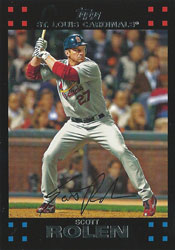
scott_rolen2In 2004, the Cardinals won three of four games against the Dodgers in the National League Division Series, even though Rolen went hitless.

Super season

In the 2004 regular season, Rolen achieved career highs in home runs (34), RBI (124), batting average (.314), on-base percentage (.409) and slugging percentage (.598). His RBI total was second only to the 131 of the Rockies’ Vinny Castilla in the National League.

Rolen also was named a National League all-star in 2004, won a Gold Glove Award and finished fourth in the league’s Most Valuable Player Award balloting, behind Barry Bonds of the Giants, Adrian Beltre of the Dodgers and teammate Albert Pujols.

However, Rolen missed 16 games from Sept. 11 through Sept. 27 because of a calf strain. He still was experiencing soreness in the calf when the Cardinals opened the Division Series versus the Dodgers on Oct. 5, but he told the St. Louis Post-Dispatch he was “close to being close” to 100 percent.

Like 0-for-a-zillion

What happened next was unexpected. Rolen played in all four game of the Division Series and was hitless in 12 at-bats. He did walk six times, so along with a .000 batting average for the series Rolen had a .333 on-base percentage.

Batting in the cleanup spot, Rolen drew three walks in Game 4, a 6-2 Cardinals victory that eliminated the Dodgers and advanced St. Louis to the National League Championship Series versus the Astros. Boxscore

Said Rolen, who had sat out most of the 2002 postseason because of a shoulder injury: “I’m standing here after going 0-for-a-zillion and this feels so much better (than 2002). We’ve put ourselves in a position to do something special and I’m just glad to be part of it.”

Asked by Derrick Goold of the Post-Dispatch how he planned to end his slump before facing the Astros, Rolen replied, “I’m going to assess, approach, focus … Oh, that sounded pretty corny. A LaRussaism. He’s getting it in my head. That’s what Tony would say.”

Actually, what Cardinals manager Tony La Russa told Goold was: “Sometimes you have to go beyond the stats. (Rolen) was not a hitless hitter in the Dodgers series. You watch his at-bats, he had tough bases on balls.”

Timing is key

Cardinals hitting coach Mitchell Page said he told Rolen that six walks are as good as six singles.

“What six walks tells you is that they were pitching him careful,” Page said. “They weren’t just going to put something down the middle for him to hit.”

Rolen, though, acknowledged he had fouled off pitches he should have stroked for hits.

“My timing might have been here and there,” said Rolen. “I’m pulling some balls foul that I don’t normally pull foul.”

Rolen recovered, hitting .310 (9-for-29) with three home runs and six RBI in the League Championship Series. He produced the key hit, a two-run home run off Roger Clemens that snapped a 2-2 tie in the sixth inning of Game 7 and lifted St. Louis to a 5-2 pennant-clinching victory. Boxscore

Then, in the World Series versus the Red Sox, Rolen slumped again, going hitless in 15 at-bats.
Read Full Post »

George “Shotgun” Shuba wasn’t an all-star, but he played like one against the Cardinals.

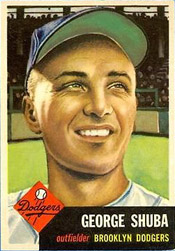
george_shubaIn seven seasons (1948-50, 1952-55) as a Dodgers outfielder, Shuba hit .259.

His career batting average against the Cardinals: .337 (33-for-98).

As a rookie in 1948, Shuba hit .267 in 63 games for the Dodgers.

Against the Cardinals that season, Shuba hit .385 (10-for-26), including .471 (8-for-17) at St. Louis’ Sportsman’s Park.

In his 1971 book “The Boys of Summer,” Roger Kahn wrote of Shuba, “His abiding love was hitting. All the rest was work. But touching a bat, blunt George became The Shotgun, spraying line drives with a swing so compact and so fluid that it appeared as natural as a smile.”

Two of the best performances of Shuba’s career came versus the Cardinals as a rookie.

Double trouble

On July 18, 1948, in the second game of a doubleheader at St. Louis, Shuba, a left-handed batter, was a prominent part of a Dodgers onslaught.

Brooklyn scored 13 runs in the first two innings. Each of the first 17 Dodgers batters reached base safely. Each of the three outs in the five-run Dodgers first was recorded on the base paths. The 17 reached base on four doubles, five singles, six walks and two force outs.

In the first, after Pee Wee Reese doubled and Jackie Robinson walked, Jim Hearn’s first two pitches to Gene Hermanski missed the plate.

Cardinals manager Eddie Dyer lifted Hearn and replaced him with Al Brazle. Hermanski drew a walk, loading the bases.

Shuba then ripped a two-run double.

In the second, with Gerry Staley pitching, Shuba doubled again, scoring Robinson, who had singled.

Shuba finished 3-for-5 with 3 RBI and 2 runs scored, sparking the Dodgers to a 13-4 triumph. Boxscore

Cardinals nemesis

The next month, Aug. 30, 1948, Shuba led the Dodgers to an improbable comeback victory versus the Cardinals in the first game of a doubleheader at St. Louis.

Cardinals starter Murry Dickson carried a 5-2 lead into the ninth. Hermanski led off with a single and Shuba followed with a double, advancing Hermanski to third. Pete Reiser doubled, driving in Hermanski and Shuba and cutting the Cardinals’ lead to 5-4.

Ted Wilks relieved Dickson. After the Dodgers tied the score at 5-5, Shuba came to the plate with Arky Vaughan on third and Bruce Edwards on first, one out.

Shuba singled to right, scoring Vaughan with the run that completed a four-run ninth and brought the Dodgers a 6-5 victory. Boxscore

Of all the Cardinals pitchers Shuba raked during his career, Wilks was his favorite. Shuba hit . 833 (5-for-6) with 4 RBI vs. Wilks.

Shuba had two other noteworthy games against the Cardinals.

He drove in three runs, including a two-run, two-out home run off Joe Presko, in a 10-4 Dodgers victory over the Cardinals on Aug. 24, 1952, at St. Louis. Boxscore

A year later, Aug. 1, 1953, Shuba was 3-for-4 with two runs scored in the Dodgers’ 11-4 win against the Cardinals at St. Louis. Boxscore

Previously: How Andy Pafko gave Cardinals inside-the-glove home run

Previously: Duke Snider, Stan Musial put on big show

Read Full Post »

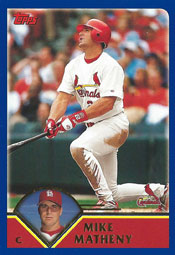
mike_matheny8Catcher Mike Matheny played a big role for the Cardinals in the 2004 National League Division Series versus the Dodgers.

On Oct. 5, 2004, Matheny contributed a solo home run against reliever Elmer Dessens in the Cardinals’ 8-3 victory in Game 1 of the best-of-five series at St. Louis.

Cardinals fans rewarded him with an ovation and urged a curtain call. A hesitant Matheny went to the top step of the dugout and acknowledged the sustained applause.

“It’s a huge honor,” Matheny, 34, said to the St. Louis Post-Dispatch. “It’s taken me five years (with the Cardinals) and this is the first year I’ve had one. I didn’t know how to get out there.” Boxscore

Hot hitter

Two days later, on Oct. 7, 2004, the Cardinals entered Game 2, knowing a victory would give them control of the series.

In the fifth inning, with the Cardinals ahead, 4-3, Matheny batted against starter Jeff Weaver with the bases loaded, two outs, and stroked a two-run single to center, giving the Cardinals a 6-3 lead and knocking Weaver out of the game.

“He gets fired up,” Cardinals manager Tony La Russa said.

Dan Haren, who followed starter Jason Marquis and Cal Eldred, held the Dodgers scoreless in the fifth and sixth, stabilizing the game for St. Louis. It was an impressive effort for a pitcher making his first postseason appearance.

A grateful La Russa called Haren, 24, “a cool dude” and “tough as nails” and said Haren’s shutdown of the Dodgers “turned the momentum.”

Said Matheny: “He came into a tough situation and made pitches right away.”

RBI record

In the seventh, the Cardinals, looking to stretch their three-run lead, had Reggie Sanders on second and Edgar Renteria on third, with two outs. Though first base was open and pitcher Ray King was on deck, the Dodgers decided to pitch to Matheny and he singled to left off a first-pitch curve from Giovanni Carrera, scoring both runners. The Cardinals won by the same score as the opener, 8-3. Boxscore

“The hit (Matheny) got off Weaver, he hit a good pitch,” said Dodgers manager Jim Tracy. “It was a breaking ball down and away and he got it. In the seventh, that wasn’t a good pitch.”

Wrote Post-Dispatch columnist Bernie Miklasz: “The Dodgers probably wonder how it is that Matheny became Johnny Bench.”

Matheny became the first Cardinals hitter to produce four RBI in a Division Series game.

“I know that I haven’t put up huge (regular-season) numbers offensively, but I also know what my purpose is on this team,” Matheny said. “First of all, it’s behind the plate _ and I put a whole lot more pressure and expectations on myself back there.”

The Cardinals eliminated the Dodgers with a Game 4 triumph, advancing to the National League Championship Series against the Astros. The Cardinals beat the Astros in four of seven games, winning their first pennant in 17 years and progressing to the World Series against the Red Sox.

Previously: Why Mike Matheny ended his playing career as a Giant

Previously: Pitcher for 1964 Cardinals was mentor to Mike Matheny

Read Full Post »

Grant Dunlap possessed a variety skills. He was a winning coach in multiple sports, an accomplished author and a pinch-hitter deluxe for the Cardinals.

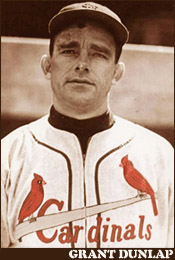
grant_dunlapDunlap played his lone big-league season with the 1953 Cardinals.

A Stockton, Calif., native, Dunlap, 17, was signed by the Reds in 1941. He was given an $870 bonus and used the money to pay for surgery for his mother. A year later, he joined the Marines, became an officer and served in the South Pacific and China during World War II.

In 1952, Dunlap was the Texas League batting champion, hitting .333 for Shreveport. The first baseman, a right-handed hitter, was purchased by the Cardinals in December 1952 and placed on the big-league roster. The Cardinals said Dunlap would compete with Steve Bilko and Dick Sisler for the everyday first base role.

Ready to hit

A 29-year-old rookie, Dunlap made a favorable impression when he joined the Cardinals at their spring training camp at St. Petersburg, Fla., in February 1953.

In its March 11 edition, The Sporting News reported, “Perhaps the outstanding ‘sleeper’ in camp is Grant Dunlap … In the early batting drills, he attracted attention and in the first squad game he swung at the first pitch and whacked the ball far over the left field wall into Tampa Bay. Dunlap looks like a hitter. He poises his bat and is ready for every pitch.”

Said Cardinals manager Eddie Stanky: “Dunlap looks pretty shifty around first base, too.”

Two weeks later, The Sporting News wrote, “Grant Dunlap is another substantial hitter on the Cardinals squad and may remain because of his prowess with the war club.”

Wounded warrior

Late in spring training, during an exhibition game against the Braves, Dunlap suffered an injury that derailed his chances of winning the first base job. After stroking a single, Dunlap was on first when Hal Rice hit a grounder to second baseman Jack Dittmer. Dunlap braked to avoid a tag and Dittmer threw out Rice at first.

First baseman Joe Adcock then pursued Dunlap, who got trapped in a rundown. In the frenzy, Adcock accidently stepped on Dunlap’s left foot. Dunlap suffered “a five-suture spike wound” near the instep and was “carried off the field on a stretcher to minimize bleeding,” The Sporting News reported.

Bilko opened the season as the Cardinals’ starting first baseman. Stanky kept Dunlap on the roster as a pinch-hitter.

St. Louis slugger

Dunlap’s first two big-league hits were significant.

In his third big-league at-bat, Dunlap got his first hit _ a pinch-hit home run off Ken Raffensberger in a 5-2 Reds victory at Cincinnati on May 10, 1953. Boxscore

A month later, Dunlap got his second hit and it produced a Cardinals victory.

On June 12, 1953, at New York’s Polo Grounds, the Giants led the Cardinals, 1-0. In the seventh, with Cardinals runners on first and second, one out, Dunlap drove a pinch-hit triple off the right field wall against Dave Koslo. Ray Jablonski and Rip Repulski scored, giving the Cardinals a 2-1 lead. Pitcher Harvey Haddix ran for Dunlap and scored on Solly Hemus’ sacrifice fly. The Cardinals won, 3-1. Boxscore

Used primarily as a pinch-hitter, Dunlap batted .353 (6-for-17) for the Cardinals, but couldn’t displace Bilko at first base and wasn’t getting at-bats. In August, the Cardinals sent Dunlap to their minor-league affiliate at Houston. Stanky predicted Dunlap would be “a terrific man” for Houston given the chance to play regularly.

On Aug. 11, 1953, Dunlap went 5-for-5 for Houston in a game against Dallas. He hit .277 in 35 games for Houston.

Life after baseball

After the season, the Cardinals sold Dunlap’s contract to their Rochester affiliate. In December 1953, Rochester traded Dunlap to another Class AAA club, Minneapolis, for pitcher Bill Connelly.

Dunlap spent the 1954 and 1955 seasons in the minor leagues. Then he began a successful second career.

An all-conference baseball and basketball player at Occidental College, Dunlap returned to the Los Angeles school in 1955 and coached both sports teams.

In 30 years as Occidental baseball coach, Dunlap had a 510-316 record and won nine conference titles. He was 205-156 with five league championships in 16 years as Occidental basketball coach. Dunlap also was the Occidental athletic director from 1971-76. He retired in 1984.

Dunlap wrote an acclaimed mystery novel “Kill the Umpire” that was published in 1998. Dunlap was praised for his vivid, lively prose, drawing on his minor-league experience to recreate the feel of the Texas League towns of the 1940s and what it was like to be a ballplayer in that time. The book is available on Amazon.

Previously: Like Polish Falcons, 2013 Cardinals soar with doubles

Previously: The story of how Tom Alston integrated Cardinals

Read Full Post »

(Updated Feb. 3, 2019)

No National League night game has gone more innings than the one played by the Cardinals and Mets on Sept. 11-12, 1974.

bake_mcbride2Beginning at 8:08 p.m. on Sept. 11 and ending at 3:15 a.m. on Sept, 12, the Cardinals beat the Mets, 4-3, in 25 innings at New York’s Shea Stadium. Started before a crowd of 13,460, it ended before about 1,000 spectators, including baseball commissioner Bowie Kuhn.

The Cardinals-Mets marathon remains the longest National League night game in innings played.

In the longest major-league game by innings, the Dodgers and Braves played to a 1-1 tie in 26 innings on May 1, 1920. That National League game was played on a Saturday afternoon at Braves Field in Boston. Boxscore

Only one 25-inning game has been played in the major leagues since the Cardinals-Mets classic in 1974. In an American League game, the White Sox, managed by Tony La Russa, beat the Brewers, 7-6, in 25 innings at Chicago’s Comiskey Park. That night game began on May 8, 1984, was suspended after 17 innings with the score tied at 3-3 and completed on May 9. Boxscore

With no National League curfew, the Cardinals and Mets played their 25-inning game without a stop in play.

When it ended, Cardinals outfielder Reggie Smith told his teammates, “There’s no way that your wives are going to believe you guys were out playing baseball all night.”

Reitz to the rescue

The Cardinals trailed, 3-1, entering the ninth. After Joe Torre struck out, Ted Simmons singled and was replaced by pinch-runner Larry Herndon. Herndon went to second on a wild pitch by starter Jerry Koosman, but Bake McBride struck out.

With the Mets an out away from victory, the Cardinals’ last hope, Ken Reitz, hit a two-run home run, tying the score at 3-3.

“I was looking for a fastball, a strike, and I got it,” Reitz said to the St. Louis Post-Dispatch.

Cardinals reliever Claude Osteen, who had a clear view of the home run from his perch in the bullpen, held his hands less than a foot apart when he told United Press International the ball “went out by about that much.”

Scoreless relief

For the next 15 innings, Cardinals and Mets relievers threw shutouts.

Al Hrabosky, Rich Folkers, Ray Bare, Osteen and Sonny Siebert were the Cardinals relievers who stopped the Mets in extra innings. Osteen pitched 9.1 innings _ the equivalent of a complete-game shutout.

A pair of former Cardinals, Harry Parker and Bob Miller, joined Bob Apodaca and Jerry Cram as the Mets relievers who stopped the Cardinals. Cram pitched eight innings.

They escaped several jams.

_ Torre was out at the plate trying to score on a single by McBride in the 13th.

_ In the 20th, the Cardinals had runners on first and second, no outs, but Smith was picked off at second and the threat fizzled.

_ In the 23rd, the Mets loaded the bases with two outs before Cleon Jones flied out.

_ Both teams loaded the bases with two outs in the 24th but failed to score.

Bake was cooking

Hank Webb relieved Cram in the 25th inning. McBride led off with an infield single and Reitz was up next.

Cardinals manager Red Schoendienst gave the hit-and-run sign. Webb made a pickoff throw, but it sailed over first baseman John Milner and rolled into foul territory in right field.

“I figured I could get to third,” McBride told the Associated Press. “Then, when I turned second, I said to myself, ‘I’m going all the way.’ ”

McBride raced around third without looking toward coach Vern Benson, who was showing the stop sign. “I didn’t see any sense in sending him home with nobody out,” Benson said.

Milner retrieved the ball and fired a throw to catcher Ron Hodges. McBride and the ball arrived at the plate about the same time. Hodges dropped the ball before he could attempt a tag.

“I don’t think he would have had me, even if he had held the ball,” McBride said. “He was out in front of the plate and I was past him.”

Benson saw it differently. “It was a good throw by Milner, and Hodges probably would have got McBride if he hadn’t taken his eyes off the ball,” Benson said.

The Cardinals led, 4-3, but the Mets still had their turn to bat.

Happy ending

Siebert retired the first two batters, Ken Boswell and Felix Millan, on fly outs.

Brock Pemberton, appearing in his second big-league game, batted for Webb and singled, prolonging the drama with his first big-league hit. When the ball was removed from the game so Pemberton would have a keepsake, Mets pitcher Tom Seaver quipped from the dugout, “Don’t give it to him. It’s the last ball we’ve got left.” (Fifteen dozen balls were used in the game, The Sporting News reported.)

Milner, the Mets’ top home run hitter, batted next.

Siebert struck him out, ending the game at 7 hours, 4 minutes. Boxscore

Dizzying stats

The Cardinals used 26 players and the Mets, 24. The Cardinals stranded 20 base runners and the Mets, 25.

Nine players played the entire game. They were McBride, Reitz, Smith, Torre and Ted Sizemore for the Cardinals; Millan, Milner, Wayne Garrett and Dave Schneck for the Mets.

“Ordinarily, I get two hits and it’s a decent night, but 2-for-11?” Schneck said to the New York Daily News.

McBride, Reitz and Millan each had four hits in 10 at-bats. Garrett was 0-for-10 with four strikeouts. Lou Brock, the Cardinals’ future Hall of Famer, was 1-for-9 and was caught stealing in his lone attempt.

The home plate umpire, Ed Sudol, also had worked the plate in a 23-inning game between the Mets and Giants in 1964 and a 24-inning game between the Mets and Astros in 1968.

“My legs feel like a couple of lead posts,” Sudol said.

Asked to sum up the long night, Mets pitcher Tug McGraw said, “The only thing I regret now is that all the eating places are closed. I’ll have to go home and make myself a baloney sandwich.”

Previously: Reggie Smith and the Cardinals’ after-hours club

Read Full Post »

(Updated Jan. 25, 2024)

On the night he broke the record for stolen bases in a season, Lou Brock triggered a wide range of emotions. Cool Papa Bell was delighted. Maury Wills was melancholy. Bob Boone was bitter.

lou_brock10Brock was relieved.

“I’m glad to get it behind me,” Brock said to the Associated Press.

On Sept. 10, 1974, in an 8-2 Phillies victory over the Cardinals at St. Louis, Brock got his 104th and 105th stolen bases of the season, surpassing the mark of 104 established by Maury Wills of the 1962 Dodgers. The steals were the 739th and 740th of Brock’s career and made him the all-time National League leader, surpassing Max Carey, who swiped 738 for the Pirates and Dodgers from 1910-29.

In achieving the single-season record, Brock stole second base 100 times and third base five times.

Sorry, Maury

Brock, 35, got his 105 steals in 134 games. Wills got his 104 steals in 165 games. (The Dodgers and Giants had a three-game playoff after ending the 162-game schedule in a tie for first place.)

“I never thought anyone would approach the record this soon, probably not in my lifetime,” Wills said. “I just feel that was my record. I was very proud of it … I don’t think anyone looks forward to seeing his own record broken.”

Asked by The Sporting News to compare his skills with Brock’s, Wills replied, “I had more finesse and got a better lead, but I guess Brock has more speed.”

In his book “On the Run,” Wills said, “I wasn’t at the game when Brock stole his 105th base. I was at an NBC studio, waiting to comment on it. When it happened, they asked me how I felt about it. ‘I don’t like it at all,’ I said honestly. ‘I wasn’t pulling for him.’ ”

Hometown hero

The game against the Phillies on Sept. 10 was the Cardinals’ last at home before embarking on a trip to New York, Philadelphia and Pittsburgh. Brock was motivated to break the record at St. Louis.

“The only pressure was that which I’d put on myself by saying I wanted to do this at home,” Brock said.

In the first inning, before 27,285 at Busch Stadium, Brock led off with a single against Dick Ruthven. On the second pitch to the next batter, Ron Hunt, Brock broke for second and beat Boone’s throw, which bounced into center field. Brock was credited with a steal of second and advanced to third on the error.

Brock led off the seventh with a single. On Ruthven’s second pitch to Hunt, Brock took off and beat a wide throw from Boone to shortstop Larry Bowa for the record-breaking 105th steal. Video at 2-minute mark

“On 105, I felt my legs swaying just before I reached the base,” Brock said. “I didn’t even have enough energy to pop up with my slide. I guess I was pretty well spent.”

Salute to Lou

As Cardinals fans chanted “Lou, Lou, Lou,” the game was halted and Brock was honored in an on-field ceremony. Second-base umpire John McSherry shook hands with Brock. Bowa did, too.

Bell, a Negro League speedster who had been inducted into the National Baseball Hall of Fame, presented Brock with the second-base bag. “We decided to give him his 105th base because if we didn’t he was going to steal it anyway,” Bell said.

Addressing the crowd, Brock thanked Ted Sizemore _ “My partner in crime.” _ who had batted behind him for most of the season and patiently took pitches in order to provide Brock with the chances to attempt steals.

Brock also thanked teammates Bake McBride and Reggie Smith “for helping me clock the pitcher’s delivery” and trainer Gene Gieselmann because he “pumps my legs up every day.”

Said Brock of the record: “The key to it all was getting on base enough and staying healthy.”

Sour grapes

Two innings later, with the Cardinals trailing by six, Brock led off the ninth and reached first on Bowa’s error. He tried to swipe second, but was caught by Boone.

Boone criticized Brock for running into an out with the Cardinals so far behind.

“I thought it was brutal,” Boone said. “When anybody tries to steal with his club six runs behind, he better darn sure make it. I lost a lot of respect for the man when he tried that … You just can’t get thrown out in that situation.

“My dad played with a guy named Jungle Jim Rivera and he was paid by the number of bases he stole. Maybe Brock’s got something like that in his contract, too. I don’t know why he did it. It wasn’t good baseball.”

Said Phillies third baseman Mike Schmidt: “What the hell’s he stealing for in the ninth inning?”

Replied Brock: “Sometimes you can make things happen by the unexpected.”

Green means go

Several Phillies defended Brock.

“Everybody knows he’s going to run and he still does and makes it most of the time,” Bowa said.

Said Phillies second baseman Dave Cash: “When a man steals 104 or 105 bases, you don’t put the red light on.”

Phillies pitcher Steve Carlton, Brock’s former Cardinals teammate, said, “These people came to see him run.” Boxscore

Brock finished the 1974 season with 118 steals. It was the only time in 19 seasons in the majors he swiped more than 74.

In 1979, Brock told writer Roger Angell, “That record meant the most, because it was the only one where I challenged. All the other records I just caught up with, because of time. They were milestones.”

Brock’s record of 118 steals in a season didn’t last long. In 1982, Rickey Henderson swiped 130 for the Athletics. Henderson is the big-league career leader in steals at 1,406. Brock is second at 938.

Read Full Post »

« Newer Posts - Older Posts »