Feeds:
Posts
Comments

Archive for the ‘Hitters’ Category

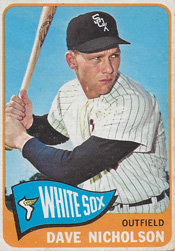
Born and raised in St. Louis, Dave Nicholson was one of baseball’s all-time best power-hitting prospects, but the Cardinals were unwilling to pay the price it took to sign the hometown slugger.

In January 1958, Nicholson was 18 when he signed with the Orioles for more than $100,000, a shocking sum for an amateur at that time.
A right-handed batter, he was “probably the hottest prospect in the country,” the Cleveland Plain Dealer reported.

Though he went on to hit some mighty home runs in the majors, the records Nicholson set were for striking out. As Frank Hyland of the Atlanta Constitution noted, Nicholson “turned around the can’t-miss label. He could miss, and did almost every opportunity.”

An outfielder, Nicholson played seven seasons in the majors with the Orioles, White Sox, Astros and Braves.

Special talent

At 6-foot-3, 215 pounds, strong and swift, Nicholson attracted pro scouts to St. Louis to see him play in amateur leagues and for Southwest High School. “He has power, physique, the arm and speed,” White Sox farm director Glen Miller told the Chicago Tribune. “His hands are as big as hams.”

The Cardinals scouted Nicholson for two years, The Sporting News reported.

In the summer of 1957. when Nicholson was playing in the amateur Ban Johnson League after his junior season in high school, Orioles scout and former Cardinals catcher Del Wilber tracked him. “Best prospect I’ve ever seen,” Wilber told the St. Louis Globe-Democrat.

The Orioles sent seven scouts at various times to St. Louis to verify Wilber’s glowing reports on Nicholson. All liked what they saw. Paul Richards, who had the dual role of general manager and manager of the Orioles, and his pitching coach Harry Brecheen, the former Cardinal, showed up, too. They put Nicholson through a special workout, with Brecheen pitching to him. Nicholson passed the test, according to the Globe-Democrat. 

By the end of the summer, scouts from every big-league team had come to see the teen who crushed baseballs with the power of a hulk.

Your bid

In the fall of 1957, Nicholson, a senior, dropped out of high school and took a job with a St. Louis printer for $60 a week, the Baltimore Sun reported. According to the Chicago Tribune, Nicholson withdrew from school because of a disagreement with a coach who wanted him to play football. The Sporting News reported he left because of “weakness in the classroom.”

The pro scouts didn’t care. Every big-league team, except the Tigers, made Nicholson an offer, the Associated Press reported. It put the teen and his parents in a strong negotiating position. They let the clubs drive up the bidding in visits to the family’s Arthur Avenue home.

The Cardinals dropped out when the price reached $60,000, the Globe-Democrat reported. The Yankees didn’t stick around long either. Their scout, Lou Maguolo, who signed the likes of Tony Kubek, Norm Siebern and Lee Thomas, told The Sporting News, “Nicholson struck out seven times in 10 trips when I saw him, and I can’t recommend anybody like that.”

When the bidding reached six figures, three teams were left in the running: Cubs, Orioles, White Sox. According to The Sporting News, the Cubs and White Sox made the highest offers, but Nicholson said he chose the Orioles because, “I like Paul Richards, and I honestly think the quickest road to the majors is through the Orioles’ farm system.”

In addition to the bonus of more than $100,000 (published estimates of the amount ranged from $107,000 to $150,000), the deal included two new Pontiacs _ one for Dave and one for his father, Larry, The Sporting News reported. Larry Nicholson also was given a part-time scouting job with the Orioles.

According to the Globe-Democrat, the only other baseball amateurs to get signing bonuses of $100,000 or more were Paul Pettit (Pirates, 1950), St. Louisan Frank Baumann (Red Sox, 1952) and Hawk Taylor (Braves, 1957). Nicholson “is worth every penny,” White Sox scout Pat Monahan told the Globe-Democrat.

Learning curve

A month after signing, Nicholson was at the Orioles’ spring training camp in Scottsdale, Ariz. Watching him in batting practice, Richards told The Sporting News, “He has as much bat speed as I have seen in a youngster.”

The quick bat didn’t result too often in contact, especially against breaking pitches. Nicholson struck out in seven of his first eight at-bats in spring training games, The Sporting News reported. His only hit in 11 at-bats in exhibition games was a home run against the Giants’ Curt Barclay.

“The kid’s stance is too wide,” Cubs hitting coach Rogers Hornsby told The Sporting News. “He has to do it all with his arms, and the breaking stuff will give him a fit.”

Richards planned to have Nicholson start his pro career at the Class D level of the minors, but changed his mind and sent him to Class A Knoxville. After 25 games, he was dropped to Class B Wilson, N.C. He struggled there, too, and was demoted to Class D Dublin, Ga. 

The Dublin club was managed by a St. Louisan who spent six years playing in the Cardinals’ farm system, Earl Weaver. His task was to restore Nicholson’s sagging confidence. “He has the tools to make the majors,” Weaver told The Sporting News. “He just has to get the experience to catch up with the other boys.”

Nicholson’s combined numbers for the 1958 season were 98 hits (15 for home runs) and 158 strikeouts.

The Orioles assigned Nicholson, 19, to Class AA Amarillo in 1959, and again it was a mistake. Overmatched, he was dispatched to the Class C Aberdeen (S.D.) Pheasants and put under the care of their manager, Earl Weaver.

Weaver got Nicholson to relax and play loose. Nicholson responded, producing 35 home runs and 119 RBI for Aberdeen. When injuries depleted the Pheasants’ pitching staff, Weaver had Nicholson take some turns on the mound. In nine pitching appearances, including two starts, Nicholson was 3-1 with a 2.91 ERA. He struck out 43 batters in 34 innings.

Swishing sound

Nicholson, 20, began the 1960 season with Class AAA Miami, then was called up to the Orioles in May. He batted .186 and struck out 48 percent of the time (55 whiffs in 113 at-bats) in his first big-league season.

After another year in the minors in 1961, Nicholson was with the Orioles in 1962. He batted .173 and struck out 44 percent of the time (76 whiffs in 173 at-bats).

The Orioles dealt Nicholson, Ron Hansen, Pete Ward and Hoyt Wilhelm to the White Sox for Luis Aparicio and Al Smith in January 1963. The White Sox made Nicholson their left fielder. He hit 22 home runs for them in 1963, but struck out 175 times, a major-league record.

Just six years earlier, the batter who fanned the most times in the American League in 1957 was the Senators’ Jim Lemon, with 94. As The Sporting News noted, “It wasn’t too long ago when the total of 100 strikeouts in any one season was considered staggering … but those days are gone, perhaps never to return.”

(Today, the major-league record for striking out the most times in a season is held by Mark Reynolds, 223 whiffs with the 2009 Diamondbacks. At least Reynolds hit 44 home runs that year. In 2011, Drew Stubbs of the Reds struck out 205 times and hit 15 homers. According to baseball-reference.com, the career big-league salaries paid to those players: $30 million to Reynolds and $15 million to Stubbs.)

Playing hardball

On May 6, 1964, in the first game of a doubleheader at Comiskey Park in Chicago, Athletics starter Moe Drabowsky threw a slider to Nicholson on a 2-and-1 count. Nicholson launched a towering shot that disappeared over the roof covering the upper deck in left and landed in nearby Armour Square Park. White Sox officials estimated the ball carried 573 feet, the Chicago Tribune reported.

The ball was retrieved by 10-year-old Michael Murillo Jr., who was listening to the game on his radio while his father was at softball practice in the park, the Tribune reported. In exchange for the home run ball, Nicholson gave Michael an autographed baseball and one of his bats.

Some witnesses in the upper deck said the ball cleared the roof on a fly; others said it hit atop the roof, then skidded out of the ballpark. Regardless, Nicholson joined Jimmie Foxx, Mickey Mantle and Eddie Robinson as the only players to propel a home run out of Comiskey Park, the Tribune reported.

Nicholson’s prodigious homer was the first of three he hit that day. He had another against Drabowsky an inning later, and hit one in the second game against Aurelio Monteagudo. Boxscore and Boxscore

Two months later at Kansas City, in his first plate appearance against Drabowsky since hitting the home runs against him, Nicholson was struck in the forehead, just above the left eye, by a fastball. He fell to the ground, bleeding. Teammates carried him off the field on a stretcher. Nicholson was taken to a hospital and needed stitches to close the wound.

“The beaning was clearly an accident,” the Kansas City Times reported. “It appeared Nicholson was hit by a fastball that took off. Drabowsky was not warned by the plate umpire, Joe Paparella, and there was nothing said to him by the White Sox players.”

Paparella told The Sporting News, “It was an inside pitch that sailed.” Boxscore

Hit or miss

As Nicholson’s strikeout rate increased, his playing time decreased with the White Sox in 1964 and again in 1965. His totals in three seasons with them: 176 hits (37 for home runs) and 341 whiffs.

One person who didn’t lose faith in Nicholson was Paul Richards, who had become general manager of the Astros. He traded for Nicholson in December 1965.

Going to a National League team meant Nicholson would get to play in his hometown for the first time as a big-leaguer. On May 30, 1966, in his first at-bat in his first game in St. Louis, Nicholson singled against Bob Gibson. Boxscore 

On July 5, 1966, Nicholson hit two home runs against the Braves’ Denny Lemaster. One of the shots reached the purple seats in the fourth level of the Astrodome, 512 feet from home plate. Boxscore A month later, Nicholson belted a home run against Sandy Koufax. Boxscore

The long balls were thrilling; the strikeouts, not so much. Nicholson had the most strikeouts among Astros batters in 1966. After the season, he went to the Florida Instructional League, tried converting into a pitcher and “showed some promise,” The Sporting News reported.

Then, Paul Richards came back into his life. Richards, who left the Astros to become general manager of the Braves, acquired Nicholson in the trade that sent Eddie Mathews to Houston in December 1966.

Richards had hopes Nicholson, 27, still could be a consistent hitter, but he wanted him to begin the 1967 season in the minors at Class AAA Richmond, where he could play every day. The Braves sent hitting instructor Dixie Walker to Richmond to work with Nicholson, but the plan unraveled.

Nicholson struck out 100 times in 254 at-bats and was demoted in July 1967 to Class AA Austin (managed by Hub Kittle).

In September, Richards did Nicholson a favor and brought him to the Braves. He played his last 10 games in the majors that month. His last hit, a single, came against Bob Gibson in Atlanta. Boxscore

Nicholson’s last big-league game was Oct. 1, 1967, against the Cardinals. Naturally, his last at-bat, against Nelson Briles, resulted in a strikeout. Boxscore

Read Full Post »

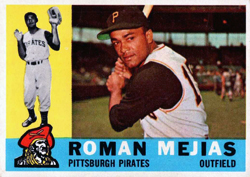
Prevented by racism from playing in the minors in 1955, Roman Mejias opened the big-league season as the Pittsburgh Pirates’ starting right fielder ahead of another rookie, Roberto Clemente.

That year, Mejias (of Cuba), Clemente (Puerto Rico) and Felipe Montemayor (Mexico) formed the first all-Latino starting outfield in the majors.

Though Mejias didn’t play often for the Pirates as a rookie, he had some of his best games versus the Cardinals. For the rest of his career, Mejias hit well against them.

A right-handed batter and outfielder, Mejias played nine seasons in the majors with the Pirates, Houston Colt .45s and Boston Red Sox.

Bayou bigotry

Mejias was born in Abreus, Cuba. Most sources list the date of his birth as Aug. 9, 1930. Others list it as 1925. Pirates scout Howie Haak said Mejias was 32 when he signed him for $100 before the 1953 season. Pirates general manager Branch Rickey agreed to list Mejias’ age as eight years younger, Haak told Peter Gammons of the Boston Globe in 1985.

(According to the Waco Herald-Tribune, George Sisler was scouting for the Pirates in Cuba, spotted Mejias in a game, “liked the way he snapped those wrists and signed him on the spot.”)

In 1953, Mejias’ first season in the Pirates’ system, he hit .322 for Class D Batavia, N.Y. The next year, he batted .354 with 141 RBI for Class B Waco, Texas, and had a 55-game hitting streak.

At spring training in 1955, the Pirates assigned him to the Class AA New Orleans Pelicans, but that club “refused his contract because of color,” The Pittsburgh Press reported. According to the Pittsburgh Post-Gazette, “The Pelicans owners decided they wouldn’t take his contract because he is a Cuban Negro.”

Because Mejias hit well in spring training, the Pirates put him on their Opening Day roster, hoping he could make the leap from Class B to the majors.

Latino talent

Mejias and Clemente were assigned to be road roommates with the 1955 Pirates, according to The Pittsburgh Press. Clemente was drafted from the Dodgers’ system during the winter, but when the Pirates opened the 1955 season at Brooklyn their starting right fielder was Mejias. Frank Thomas started in left and Tom Saffell in center. Boxscore

The next day, for the Pirates’ home opener against the Phillies, Mejias again started in right and Clemente was on the bench. Mejias hit a home run against Herm Wehmeier but also made an error, leading to a pair of Phillies runs. Boxscore

After a third consecutive start in right, Mejias was benched by manager Fred Haney and replaced by Clemente.

On April 24, 1955, at Philadelphia, when Haney started an outfield of Mejias in left, Felipe Montemayor in center and Clemente in right, “the Pirates were told they are making history with the first all-Latin American outfield,” The Pittsburgh Press reported. Boxscore

A week later, on May 2, the Pirates started the same outfield combination against the Cardinals in Pittsburgh. Boxscore

Put me in, coach

On June 12, 1955, in a game against the Braves at Pittsburgh, Mejias snapped a 3-3 tie with a two-run home run against Warren Spahn, lifting the Pirates to a 5-3 victory. Boxscore

As the summer wore on, though, Mejias got less playing time. He had three hits in July and four in August. When the Cardinals came to Pittsburgh at the end of August, Mejias was batting .197 for the season.

In the series opener on Aug. 30, Mejias got the start in right, smacked a two-run triple against Harvey Haddix and scored a run in the Pirates’ 3-1 victory. Boxscore

Starting again in the series finale on Sept. 1, Mejias had four RBI, including a three-run double versus Luis Arroyo, in a 7-6 Pirates triumph. Boxscore

Mejias hit .355 (11-for-31) against the Cardinals in 1955 _ far better than his season batting mark of .216 in 176 plate appearances.

“It didn’t do him good to be on a big-league roster (in 1955),” Jack Hernon of the Pittsburgh Post-Gazette wrote. “He wasted away a season when he could have been developing. It was because the club didn’t have a farm team which would accept him. The player suffered and perhaps the Pirates killed off a fine prospect.”

Ups and downs

After playing for minor-league Hollywood (Calif.) in 1956, Mejias was the Pirates’ Opening Day right fielder in 1957 when Clemente was sidelined because of a bad back. Boxscore When Clemente recovered, he joined an outfield with Bill Virdon in center and Bob Skinner in left. Mejias was sent back to the minors.

In 1958 and 1959, Mejias was a reserve outfielder with the Pirates. A highlight came on May 4, 1958, in a start against the Giants, when he slammed three home runs in the game at San Francisco’s Seals Stadium. Two of the homers were hit against Johnny Antonelli and the other off Marv Grissom. All were pulled to left. Mejias was the first Pirate to hit three homers in a game since Ralph Kiner.

“I hit line drives, try to get base hits,” Mejias told the San Francisco Examiner. “I’m not a home run hitter really.” Boxscore

In 1959, when he hit .236 for the season, Mejias batted .377 (20-for-53) against the Cardinals.

Mejias spent most of the next two seasons (1960 and 1961) in the minors and wasn’t on the roster when the Pirates prevailed against the Yankees in the 1960 World Series.

Houston calling

In October 1961, the Houston Colt .45s selected Mejias in the National League expansion draft, and he finally got a chance to play every day.

Mejias, the starting right fielder, hit a pair of three-run home runs in Houston’s Opening Day win at home against the Cubs. Boxscore

As usual, he battered the Cardinals, hitting .290 against them. On April 26, 1962, Bob Gibson held Houston hitless until Mejias hit a home run in the eighth. Boxscore Mejias hit another home run against Gibson in August. Boxscore (Mejias batted .300, 6-for-20, versus Gibson in his career.)

Mejias went on to lead the expansion team in runs scored (82), hits (162), home runs (24), RBI (76), stolen bases (12), batting average (.286) and total bases (252) in 1962. According to his listed birth date, Mejias turned 32 that season. “He was 40,” Howie Haak insisted to the Boston Globe.

“He’s a wonderful person, and he’s a very fine ballplayer,” Houston manager Harry Craft told the Globe. “I know of at least 10 games we never would have won without Mejias. He has a tremendous throwing arm. He’ll never embarrass you.”

Fenway follies

Envisioning Mejias launching home runs over the Green Monster wall in left at Boston’s Fenway Park, the Red Sox traded two-time American League batting champion Pete Runnels to Houston for him in November 1962.

When Red Sox officials learned Mejias’ family was unable to get permission from the Fidel Castro regime to leave Cuba, they worked with the Red Cross to make it happen. Mejias’ wife, two children (ages 12 and 10) and two sisters joined him in the United States in March 1963. “Best day of my life,” he told the Globe.

The Red Sox opened the 1963 season with Mejias in center, but he got off to a dreadful start, hitting .117 in April and .189 in May.

He started to press and tried too often to hit home runs over the Green Monster. “I’m playing like a bush-leaguer,” Mejias said to the Globe.

Red Sox executive Mike Higgins told him, “Forget about the fence. Don’t even look at it when you’re batting,” the Globe reported.

“You’ve got fence-poisoning,” Higgins said. “You’re spoiling your swing and your timing because you’re trying to hit the fence. Just try to hit the ball anywhere.”

Mejias had a good June _ batting .304 for the month and hitting three home runs in a doubleheader against the Orioles Boxscore and Boxscore. September was good, too. He hit .310 for the month and had seven RBI in a game against the Twins. Boxscore

Overall, though, he hit .227 with 11 home runs. The Red Sox thought he was 33, but if Howie Haak was correct, Mejias was 41.

The next year, Tony Conigliaro, 19, started in center for the Red Sox and Mejias was on the bench. Mejias batted .238 in 1964, his last season in the majors.

A career .254 hitter, Mejias batted .316 versus the Cardinals.

Of Mejias’ 54 career home runs, 12 came against pitchers who got elected to the Baseball Hall of Fame _ Warren Spahn (4), Sandy Koufax (2), Bob Gibson (2), and Jim Bunning, Robin Roberts, Don Drysdale and Juan Marichal (1 each).

Read Full Post »

About the same time that fans of Milwaukee baseball learned the Braves planned to abandon them, the club’s most prominent pitcher, Warren Spahn, got cast aside, too.

So, when Spahn returned to Milwaukee for the first time as a member of the Mets, the fans there came out to cheer for him and against the Braves.

The drama didn’t end there. Spahn was matched that night against his protege and former road roommate, Wade Blasingame. Both were destined to wind up with a Cardinals farm team.

Mr. Brave

A left-hander who developed into a consistently big winner, Spahn began his major-league career with the 1942 Boston Braves (managed by Casey Stengel), served in combat during World War II, and moved with the club to Milwaukee in 1953. He was revered in Milwaukee for being the staff ace and for helping the Braves win two National League pennants (1957 and 1958) and a World Series title (1957).

“No individual made a greater contribution to the fabulous Milwaukee baseball story,” The Sporting News reported on Spahn. “He was truly Mr. Brave.”

Spahn won 20 or more 13 times, including six years in a row (1956-61). He was 42 when he won 23 for the 1963 Braves.

Trouble developed for both Spahn and the Milwaukee fan base in 1964. Spahn quit winning, and was shifted to the bullpen against his wishes by manager Bobby Bragan. Spahn finished the season at 6-13 with a 5.29 ERA.

“He was dead on his feet,” Bragan told The Sporting News. “His legs were gone. He couldn’t get off the mound, and they were bunting him silly.

“If any other pitcher had been shelled the way he was,” Bragan said, “he would have been shipped to (minor-league) Denver.”

The Braves wanted Spahn to stop pitching and offered him several jobs in the organization, including a radio broadcasting gig, The Sporting News reported. Spahn wanted to play instead.

Then the Braves delivered a double salvo of damaging decisions to the fans of Milwaukee baseball:

_ In October 1964, the Braves’ board of directors voted to approve a move of the franchise to Atlanta. The Braves were ready to go, but the National League ordered them to play one more season in Milwaukee in 1965, putting them in a lame-duck position with a furious fan base.

_ A month later, the Braves sold Spahn’s contract to the Mets, a move the scorned fans viewed as thankless.

“They got rid of me because of the money, my salary,” Spahn told The Sporting News. According to the New York Daily News, Spahn was paid $85,000 in 1964.

Double duty

The Mets’ manager, Casey Stengel, gave him the dual role of pitcher and pitching coach. “Pitching is first, then coaching,” Spahn told The Sporting News. He said to Dick Young of the Daily News, “I think I’m still a 20-game winner.”

Whitey Ford, who attempted to be both pitcher and pitching coach for manager Yogi Berra’s 1964 Yankees and found it daunting, delivered a message to Spahn through The Sporting News: “You’ll be sorry.”

(Berra, who was fired by the Yankees after the club was defeated by the Cardinals in the 1964 World Series, joined Spahn as a coach on Stengel’s 1965 Mets staff. Berra played in four May games for the 1965 Mets, then stuck solely to coaching.)

Spahn, 44, won his first two decisions with the 1965 Mets. Both were complete games _ one against the Dodgers Boxscore and the other versus the Giants. Boxscore

(In his first start versus the Cardinals as a Met, Spahn was matched against Bob Gibson. Lou Brock hit a two-run home run and the Cardinals won, 4-3. Boxscore and radio broadcast)

Out for revenge

Spahn was 3-3 with a 3.51 ERA heading into his return to Milwaukee to oppose the Braves. The fans there were showing their contempt about the impending move to Atlanta by staying away from County Stadium. 

After a paid crowd of 33,874 attended the 1965 home opener, subsequent April and May Braves home games drew an average paid attendance of 3,000. Paid attendance figures for the Cardinals’ three-game series at Milwaukee April 27-29 were 1,677, 1,324 and 2,182.

The turnout for the Thursday night game with the Mets on May 20, 1965, was a lot bigger _ 19,140 total (17,433 at full price, 1,707 youngsters admitted for 50 cents each) _ and most were there to pay tribute to Spahn.

“They made no secret of the fact they were rooting not for the Braves but for Spahn,” The Sporting News reported. “They cheered when his name was announced, when he took the mound and when he threw so much as a strike. They gave him a standing ovation when he went to bat.”

Dick Young of the Daily News observed, “He was to be their instrument of revenge. They came just for him, hoping, praying, he would beat the Braves.”

Several brought homemade banners and placards, including one with the message, “Down the Lousy Saboteurs. C’mon, Spahn, Mow Down the Betrayers,” the Daily News reported.

The Braves’ lineup that night featured Hank Aaron, Eddie Mathews, Joe Torre, Felipe Alou and 21-year-old starting pitcher Wade Blasingame. A left-hander, Blasingame got called up to the Braves in June 1964 and roomed on the road with Spahn, who became a mentor. Blasingame was 9-5 (including a shutout of the pennant-bound Cardinals Boxscore) for the 1964 Braves.

“There is a growing feeling (Blasingame) is about to become the new Spahn,” The Sporting News reported.

Spahn “taught me more in a year than I ever knew before,” Blasingame told United Press International.

All business

Blasingame and Spahn waged a scoreless duel for four innings. Then, in the fifth, Spahn became unglued. The Braves scored twice, then loaded the bases for Eddie Mathews, the left-handed slugger who was, according to George Vecsey of Newsday, “one of Spahn’s closest friends.”

When the count got to 1-and-1, “I couldn’t afford to get behind,” Spahn explained to United Press International. “He had been looking bad on the slider all night, but I second-guessed myself and threw him a fastball. Trouble was, I was indecisive about whether to throw it down and in, or down and away. So I came right over the plate.”

Mathews clobbered it _ “a mile past the bleachers in right,” the Daily News reported _ for a grand slam, giving the Braves a 6-0 lead.

“Spahn kicked the top of the mound to dust, and picked up the resin bag and slammed it down,” Dick Young noted.

Mathews said to Newsday, “If I felt something special about hitting a home run against Spahn, I’d tell you. I didn’t. He’s just another pitcher.”

In his book, “Eddie Mathews and the National Pastime,” Mathews said, “Spahnie and I went out and drank together after the ballgame, but there was no sentiment while he was on the mound.”

Hank Aaron followed with a single, stole second and eventually scored on Rico Carty’s second double of the inning, capping the seven-run outburst.

Spahn completed the inning, then was lifted for a pinch-hitter.

Blasingame held the Mets hitless until the seventh when, with two outs, Ron Swoboda singled, scoring Billy Cowan, who had walked and moved to second on a wild pitch.

Blasingame, who finished with a one-hitter, told George Vecsey he felt bad for Spahn: “I know he wanted to beat us very much _ maybe more than I wanted to beat them.” Boxscore

Tulsa time

Four days after his loss at Milwaukee, Spahn pitched a complete game, beating Jim Bunning and the Phillies. Boxscore Then he lost eight in a row, and the Mets placed him on waivers. In 20 games with the Mets, Spahn was 4-12.

The Giants claimed him and he finished the 1965 season, his last, with them, going 3-4. Spahn’s 363 career wins are the most by a left-handed pitcher. 

“I never did retire from pitching,” Spahn told writer Roger Kahn. “It was baseball that retired me.”

Wade Blasingame was 16-10 for the 1965 Braves, but never achieved another double-digit win season. In 10 years with the Braves, Astros and Yankees, he was 46-51.

(Blasingame and Jim Bouton were Astros teammates in 1969. In his book, “Ball Four,” Bouton wrote, “Today, Blasingame was wearing a blue bellbottom suit, blue shirt, a blue scarf at his throat and was smoking a long thin cigar, brown. Teammate Fred Gladding said, ‘Little boy blue, come blow my horn.’ Everybody on the bus went ‘Oooooh.’ Blasingame feigned indifference.”)

In 1967, Cardinals general manager Stan Musial hired Spahn to be manager of the Tulsa farm club. Spahn held the job for five years, but was gone by March 1973, when the Cardinals acquired Blasingame from the Yankees and assigned him to Tulsa.

Blasingame was 1-0 with an 0.90 ERA in two months with Tulsa before being traded to the Cubs’ Wichita farm team for another left-hander, Dan McGinn.

Read Full Post »

Manager Whitey Herzog had a major influence on Jamie Quirk. Even on his honeymoon, Quirk had Herzog on his mind.

In February 1983, Quirk reported to spring training with the Cardinals after eight seasons in the American League, mostly with the Royals. The Cardinals signed the free agent to be a backup to catcher Darrell Porter, a former Royal.

It was Herzog who convinced Quirk, when both were with the Royals, that he’d help his playing career by becoming a catcher, and it was Herzog who wanted Quirk to come to the Cardinals.

Quirk, who got married in January 1983, was on his honeymoon in Hawaii when he reached agreement on a contract with the Cardinals.

He was the second former Royals catcher Herzog landed for the Cardinals during a honeymoon bliss. In December 1980, Darrell Porter was on a honeymoon cruise when the free agent agreed to move from the Royals to St. Louis.

Calling an audible

Quirk, 6-foot-4, was a standout athlete at St. Paul High School in Santa Fe Springs, Calif., the alma mater of two other future Cardinals, pitcher Andy Rincon and infielder Mike Gallego.

University of Notre Dame football coach Ara Parseghian ranked Quirk, a quarterback, No. 1 on the school’s recruiting list and got him to sign a national letter-of-intent to play for the Fighting Irish, the Kansas City Star reported.

The Royals wanted him, too. A left-handed batter, Quirk was a shortstop in high school, and the Royals sent assistant scouting director Herk Robinson (later their general manager) to California to convince Quirk to play for them.

“I was not optimistic,” Robinson told the Star. “He just didn’t ask enough questions about baseball and the Royals.”

Undeterred, the Royals chose Quirk in the first round of the 1972 amateur draft, then brought him to Kansas City for a red carpet tour. After Quirk, 17, signed with them, Royals director of scouting Lou Gorman told the Star, “He perhaps is the most sought-after high school athlete in the last decade and has a chance to be a star. He’s the kind of player you can build a championship team around.”

As it turned out, Quirk didn’t have the range of Royals shortstop Fred Patek, and his next-best position, third base, was claimed by a better prospect, George Brett.

(Quirk became Brett’s best friend on the Royals _ “He knows me best,” Brett told the Kansas City Times _ and Brett was best man at Quirk’s wedding.)

Able to play multiple infield positions and the outfield, Quirk became a utilityman.

On-the-job training

In December 1976, Quirk was sent to the Brewers in the trade that brought Darrell Porter to Kansas City. After an unsatisfying season in Milwaukee (.217 batting average and almost as many strikeouts, 47, as hits, 48), Quirk was returned to the Royals.

Late in the 1978 season, Royals manager Whitey Herzog suggested to Quirk he should try catching _ the former quarterback had the strong arm for the job _ but Quirk disliked the idea. “I was hardheaded,” he told the St. Louis Post-Dispatch. “I thought, ‘I’m a good infielder.’ “

Herzog eventually convinced Quirk that becoming a catcher would help his chances of staying in the majors. “I don’t want to be a superstar,” Quirk said to the Star. “I’ve never wanted to be one. I just want to stay in the majors a long time and contribute any way I can.”

Quirk went to the Royals’ Florida Instructional League camp after the 1978 season and developed into a capable catcher. “It’s the best thing that’s happened to me,” Quirk told the Post-Dispatch.

At Royals spring training in 1979, Herzog named him a backup to Darrell Porter.

“Jamie has made great progress as a catcher,” Herzog told the Star. “He has good instincts and pitchers like to throw to him. I believe he can eventually become a first-string catcher in the majors.”

Looking good

Herzog was fired after the 1979 season, but became Cardinals manager in June 1980, replacing Ken Boyer. One of his first moves was to acquire Darrell Porter.

Two years later, Herzog managed the Cardinals to a World Series championship and Porter was named World Series Most Valuable Player. Afterward, Porter’s backup, Gene Tenace, became a free agent and signed with the Pirates.

The Cardinals contacted Quirk about replacing Tenace. After Quirk got married in Kansas City, he and his bride were honeymooning in Hawaii when he agreed to a two-year contract offer from Herzog and the Cardinals, the Star reported.

Quirk said the Cubs and Mets were interested in him, too, but he chose the Cardinals because, “Whitey is the only guy who has expressed confidence in me by putting me in (during) tough situations,” he told the Post-Dispatch.

Herzog said to the Star, “I’ve always liked having Jamie around because he’s always ready to play, he plays hard, and he can play almost anyplace. Besides, he looks good in a uniform.”

The reigning World Series champions opened the 1983 season with three catchers _ Porter, Quirk and Glenn Brummer _ and it soon became evident Quirk wouldn’t get much playing time. He sat for two weeks before he appeared in his first Cardinals game and he didn’t make his first start at catcher until May 1. 

Idle time

Quirk’s highlight as a Cardinal came on May 29, 1983, when he produced four RBI, including a three-run home run, against the Astros’ Mike Scott. “I finally got a chance to pull my weight and get some respect from my teammates,” Quirk told the Post-Dispatch. Boxscore

As the season wore on, Quirk played less and less. In a stretch of nearly two months (July 28-Sept. 21), he made two starts. In August, he had a mere 11 plate appearances. “This is not what I expected when I came here,” Quirk told the Post-Dispatch. “I was playing more than that in Kansas City.”

To break up the boredom, Quirk pretended to pursue Roger Maris’ record, setting a goal of trying to hit more than 61 batting practice home runs before the season ended. “The other Cardinals have gotten so caught up in it that the regulars occasionally have given up their time in the cage so Quirk can get more swings,” the Post-Dispatch reported.

The Cardinals finished with a losing record (79-83) and Quirk hit .208 overall and .059 (1-for-17) as a pinch-hitter. He caught in 22 games, including 16 as a starter, and threw out 26 percent (8-of-31) of runners who attempted to steal.

Breaking up

Because he had signed a two-year contract in February 1983, Quirk went to spring training in 1984 expecting to have a spot with the Cardinals, so he was stunned when in late March he was told he wasn’t in their plans. Given a choice of being released or getting assigned to the minors, Quirk chose to be released, hoping he could catch on with another big-league team.

“Hindsight is always 20-20,” Quirk told the Post-Dispatch, “but I probably never should have left Kansas City.”

Herzog told the newspaper, “If we hadn’t made a catcher out of him, he probably wouldn’t have been in the big leagues the last five years.”

When no offer came Quirk’s way, Herzog invited him to rejoin the Cardinals as their bullpen coach. The Cardinals were obligated to pay Quirk the second year on his contract, and this way they could continue to get a return on the investment.

Quirk, 29, was with the Cardinals as a coach until late May, when he signed a player’s contract with the White Sox, who sent him to their Denver farm club.

The honeymoon, at least with Herzog and the Cardinals, was over.

Moving on

Except for a brief call-up to the White Sox in July, when he made three plate appearances, Quirk spent most of the summer of 1984 with Denver. On Sept. 24, he was picked up by the Cleveland Indians. In his only plate appearance for them, he hit a game-winning home run against the Twins. “After I hit the ball,” Quirk told United Press International, “I really was in shock for a moment.” Boxscore

Quirk’s baseball odyssey continued with a return to the Royals in 1985. He didn’t appear in the World Series that year against the Cardinals, but he did play in the 1990 World Series for manager Tony La Russa’s Athletics.

Because of his ability to catch, Quirk played 18 years in the majors with the Royals, Brewers, Cardinals, White Sox, Indians, Yankees, Athletics and Orioles.

He spent another 19 seasons in the majors as a coach with the Royals, Rangers, Rockies, Astros and Cubs.

Read Full Post »

In their quest for an elusive World Series title, the Cardinals created a pipeline to the 2002 champion Angels. The first player they tapped was Orlando Palmeiro.

In February 2003, the Cardinals signed Palmeiro, a free agent, to fill the same role he’d performed so well for the Angels. A left-handed contact hitter, Palmeiro was a reliable reserve outfielder whose team-oriented approach contributed to the Angels in 2002 becoming World Series champions for the first and only time since the franchise started in 1961.

The Cardinals, who hadn’t won a World Series title since 1982, liked the style of winning baseball played by the 2002 Angels. Eventually, the Cardinals would acquire the entire starting infield from those champion Angels _ first baseman Scott Spiezio, second baseman Adam Kennedy, shortstop David Eckstein and third baseman Troy Glaus _ as well as their closer (Troy Percival) and a starting pitcher (John Lackey). The Angels’ catcher, Bengie Molina, became a Cardinals coach.

Eckstein and Spiezio helped the Cardinals become World Series winners in 2006, and Molina was a hitting coach for the 2013 National League champion Cardinals.

Palmeiro didn’t experience a championship with the 2003 Cardinals, but they were pleased with the job he did for them.

Fully charged

Born in Hoboken, N.J. (site of the first organized baseball game played in June 1846 between the Knickerbocker Club and New York Nine), Palmeiro grew up in Miami.

Although the 2003 Cardinals media guide and several other baseball sources list him as a cousin to another big-league player, Cuban-born Rafael Palmeiro, the two aren’t related, Orlando Palmeiro told the St. Louis Post-Dispatch. “I don’t have any relation to him that I know of,” Orlando Palmeiro said to the Associated Press.

(Rafael and Orlando Palmeiro share a last name, but were dissimilar as ballplayers. Rafael hit 569 home runs in the majors. Orlando hit 12.)

Playing for University of Miami in 1990, Orlando Palmeiro hit .365 and was “the embodiment of Hurricanes baseball with his slap-and-scrap style,” Dan Le Batard reported in the Miami Herald.

Described as “Miami’s ultra-hyper center fielder,” Palmeiro “has more energy than any of us,” Hurricanes teammate Jorge Fabregas (who also teamed with Palmeiro on the Angels) told the Herald. “He’s like a rechargeable battery.”

Or, as Miami coach Ron Fraser said to the newspaper, “Orlando is our catalyst.”

Though he wasn’t chosen by the Angels until the 33rd round of the 1991 baseball draft, Palmeiro became a prominent prospect, hitting better than .300 in five consecutive seasons in the minors. His hitting coach with the Vancouver Canadians, former Cardinals outfielder John Morris, said to the Vancouver Sun, “The thing that impresses me about Orlando is he’s not afraid to go deep into the count. He’s not afraid to take a strike or two waiting for his pitch. He’s extremely disciplined at the plate.”

Promoted to the Angels in July 1995, Palmeiro made his debut at Oakland against manager Tony La Russa’s Athletics. Batting in the ninth for third baseman Carlos Martinez (father of future Cardinals player Jose Martinez), Palmeiro singled to center in his first big-league plate appearance. Boxscore

Angel in the outfield

Palmeiro wasn’t going to displace any of the Angels’ starting outfielders (Garret Anderson, Jim Edmonds, Tim Salmon, or later, Darin Erstad), so he worked to become the best role player he could be. 

Los Angeles Times columnist Diane Pucin observed, “You notice the weaknesses first with Palmeiro. The speed of his bat just doesn’t seem big league. Looks like a batter with too much Judy, not enough Punch, (but) Palmeiro grows on you … He is what good baseball teams need. A man who will do what is asked and not complain when not much is asked.”

Angels pitcher Jarrod Washburn told the Los Angeles Times, “He’s really underrated. I bet he averages more pitches per at-bat than anybody in the big leagues. He gets two strikes and fouls off about five pitches. I would never be able to throw enough strikes to him.”

In 2002, when he filled in for Erstad and Salmon when they were injured, Palmeiro hit .300 overall and .329 with runners in scoring position, helping the Angels stay in the title chase.

After the Angels became World Series champions, Palmeiro became a free agent. In eight seasons with them, he hit .281 and had an on-base percentage of .361.

Man in motion

After right fielder J.D. Drew had knee surgery in October 2002, the Cardinals went into 2003 looking for experienced role players who could fill in for Drew and back up Albert Pujols in left and Jim Edmonds in center.

In February 2003, the Cardinals signed two outfield free agents who played for the 2002 Angels _ Palmeiro and Alex Ochoa. (Two weeks later, Ochoa was released so that he could accept a more lucrative deal with Japan’s Chunichi Dragons.)

Paid $1 million by the 2002 Angels, Palmeiro, 34, got a one-year contract from the Cardinals for a guaranteed $700,000, with another $200,000 possible if he achieved incentives, the Post-Dispatch reported.

Columnist Bernie Miklasz hailed Palmeiro’s arrival as a “terrific signing,” and Cardinals assistant general manager John Mozeliak told the Post-Dispatch that Palmeiro was a player “we didn’t really think we’d have a shot at landing a couple months ago.”

Describing Palmeiro as “master of a short, quick swing,” the Post-Dispatch’s Joe Strauss noted, “Palmeiro’s appeal is his bat control, his ability to play all outfield positions despite an underwhelming arm and willingness to accept a support role.”

On Opening Day against the Brewers in 2003, Cardinals manager Tony La Russa started an outfield of Pujols, Edmonds and converted catcher Eli Marrero. In the eighth inning, with the Brewers ahead, 7-5, Marrero on first and one out, Palmeiro made his Cardinals debut. Batting for reliever Russ Springer, Palmeiro tripled against Luis Vizcaino, driving in Marrero, and scored the tying run on Fernando Vina’s double. The Cardinals prevailed, 11-9. Boxscore

Later that week, Palmeiro made his first Cardinals start. La Russa batted him third in the order, just ahead of Pujols and Scott Rolen. “He’s proven to me that he does a lot of things you want a No. 3 hitter to do,” La Russa said to the Post-Dispatch. “He’s got a good eye. He uses the whole field.”

Palmeiro responded with two hits, a walk and scored a run in the Cardinals’ 6-4 triumph over the Brewers. Boxscore

“The Cardinals are built on power,” Joe Strauss wrote in the Post-Dispatch, “but Palmeiro allows them to put the game in motion.”

Job well done

Another highlight for Palmeiro came on July 27, 2003, when he entered in the seventh inning, drove in three runs and scored the game-winner, igniting a Cardinals comeback from a 3-0 deficit against the Pirates. Boxscore

Asked about his role, Palmeiro told the Associated Press in 2003, “I understand there are guys like Albert Pujols and Jim Edmonds, and I don’t have that type of talent. I’m aware those guys are horses and I might be a little pony. The asset I bring is I can help the team in a lot of situations without being noticed. To me, that’s the best way.”

Palmeiro was involved in two noteworthy plays late in the 2003 season. In August, he was one of the base runners when Braves shortstop Rafael Furcal turned an unassisted triple play. In September, at Wrigley Field in Chicago, he leaped into the ivy at the wall in left to rob Ramon Martinez of a bases-loaded hit with two outs in the ninth. Boxscore

With the 2003 Cardinals, Palmeiro established single-season career highs in games played (141), RBI (33) and total bases (110). He even hit three home runs, matching in one year with the Cardinals what he totaled in eight seasons with the Angels.

Palmeiro played in 112 games in the outfield for the Cardinals, including 36 starts in right field, 19 starts in left and 10 starts in center. He fielded flawlessly, making no errors in 171 chances.

The 2003 Cardinals (85-77) failed to qualify for the playoffs. Palmeiro became a free agent after the season and signed with the Astros, helping them to a National League pennant in 2005.

Read Full Post »

(Updated Sept. 12, 2024)

Frank Thomas, a slugging outfielder for the 1950s Pirates, came close to being acquired by the Cardinals, but it would have come at a hefty price.

In 1957, Cardinals general manager Frank Lane was ready to deal Ken Boyer to the Pirates for Thomas and third baseman Gene Freese. When the deal got put on hold by Cardinals hierarchy, Lane quit and became general manager of the Cleveland Indians.

A right-handed batter, Thomas played for seven teams during 16 seasons in the majors, belting 286 home runs. He hit 30 or more home runs in a season three times, twice topped 100 RBI and never struck out as many as 100 times.

Different uniform

Born and raised in Pittsburgh, Thomas developed a passion for baseball at an early age. In the book “We Played the Game,” Thomas recalled, “My mother said I never went to bed without a bat or ball in my hand. I first used my dad’s pick hammer for a bat.”

Thomas said he attended the games of the Pirates and the Negro League Homestead Grays at Pittsburgh’s Forbes Field. “I got my first baseball from (Negro League catcher) Josh Gibson. He gave me two,” Thomas told author Danny Peary.

When Thomas was 12, he was sent by his parents to a Catholic seminary in Niagara Falls, Ontario, to study for the priesthood. He quit the seminary when he was 17, returned to Pittsburgh and played sandlot baseball. Six months later, after he turned 18, the Pirates signed him in July 1947. “It was like a miracle,” Thomas said in “We Played the Game.”

In his first professional season, playing for a 1948 minor-league Tallahassee team managed by former Cardinals outfielder Jack Rothrock, Thomas produced 132 RBI. Three years later, he made his debut in the majors with the 1951 Pirates.

Possessing power and a strong throwing arm, Thomas was a good player on mostly bad Pirates teams. In 1954, when he earned the first of three all-star honors, Thomas batted .298 with 32 doubles, 23 homers and 94 RBI.

Shopping list

During the 1957 season, the Cardinals shifted Ken Boyer from third base to center field. Boyer led National League center fielders in fielding percentage but his hitting declined. He batted .265 with 19 home runs and 62 RBI in 1957 after putting up better numbers (.290, 23 homers and 89 RBI) the year before.

At the 1957 World Series between the Braves and Yankees, Cardinals general manager Frank Lane met in New York with his Pirates counterpart, Joe Brown, and discussed a trade of Ken Boyer for Frank Thomas, The Pittsburgh Press reported. A pull hitter who stood close to the plate, Thomas hit .290 with 23 home runs and 89 RBI for the Pirates in 1957.

Lane said he and Cardinals manager Fred Hutchinson had two four-hour talks with Brown and Pirates manager Danny Murtaugh about the proposed trade, according to The Sporting News. The talks continued into the fall.

In the book “Ken Boyer: All-Star, MVP, Captain,” biographer Kevin D. McCann noted, “Lane had been Boyer’s biggest supporter and harshest critic. He expected much from him and felt he should be as good as _ or even better than _ Yankees slugger Mickey Mantle. He wasn’t timid about publicly chastising what he perceived to be Ken’s lack of competitive hustle and aggressiveness.”

On Oct. 23, 1957, the Pittsburgh Post-Gazette reported that Lane was willing to trade Ken Boyer and pitcher Willard Schmidt to the Pirates for Frank Thomas and Gene Freese.

“Boyer is reported to have told friends in St. Louis that he had been alerted by the Cardinals not to be surprised if he were traded,” The Sporting News reported. “He was expecting to come to Pittsburgh.”

Boyer told the St. Louis Globe-Democrat, “After the season I had, I had made up my mind that I was going to be traded by Lane.”

Too many chiefs

Lane said he and Joe Brown talked trade until the first week of November 1957 “and, for his part, was ready to make the deal,” The Sporting News reported, but there was a hang-up.

In 1956, after swapping Red Schoendienst to the Giants and trying to deal Stan Musial to the Phillies for pitcher Robin Roberts, Lane was told any trades he wanted to make must be approved by club owner Gussie Busch and team executive vice president Dick Meyer. “Lane was unhappy with the handcuffs on him,” The Sporting News reported.

Lane told The Pittsburgh Press that Busch “has too many advisers to suit me. If I’m the general manager, I want to stand or fall on my own decisions. Before I’d make a deal, I’d always tell Busch. Then his vice-presidents would call a meeting and in three or four days I’d get an answer.”

According to the Sporting News, when Lane sought permission to make the trade of Boyer and another player (possibly Schmidt) for Thomas and Freese, “the okay wasn’t forthcoming.”

“The Cardinals’ brass shuddered every time I’d mention Boyer in a trade,” Lane told The Pittsburgh Press, “but they should have known if I traded him I’d get somebody good in return.”

Though he had a year remaining on his Cardinals contract, a frustrated Lane quit in November 1957 and accepted an offer to be general manager of the Cleveland Indians, who agreed not to restrict his ability to make trades. Lane’s assistant, Bing Devine, replaced him as Cardinals general manager.

Just say no

Devine had no interest in pursuing the trade Lane had put together with the Pirates. “Stan Musial is the only player not tradeable, but Boyer comes close to it,” Devine said to The Sporting News.

Cardinals manager Fred Hutchinson had other ideas. Asked by the Post-Dispatch whether he would have made the deal with the Pirates that Lane had proposed, Hutchinson said, “I’d still be inclined to give it a considerable amount of attention. Boyer has potential, all right, but I don’t know whether he’s determined enough to achieve that potential.”

In December 1957, the Phillies offered outfielder Richie Ashburn and pitcher Harvey Haddix (a former Cardinal traded by Lane) for Boyer, but Devine declined, the Globe-Democrat reported.

Boyer said to the Post-Dispatch, “I told my wife that if I’d have been the Cardinals, I’d have made that trade.”

(In his autobiography, “The Memoirs of Bing Devine,” Devine said Lane had initiated talks with the Phillies about Ashburn for Boyer before departing St. Louis.)

Bob Broeg of the Post-Dispatch also revealed that the Pirates approached Devine with an offer of outfielder Bill Virdon (another former Cardinal traded by Lane) and Freese for Boyer, but that was rejected, too.

Returned to third base in 1958, Boyer hit .307 with 23 home runs and 90 RBI, and won the first of five Gold Glove awards. He remained a force for the Cardinals, powering them to a World Series title in 1964 and winning the National League Most Valuable Player Award.

Thomas had a big year in 1958 for the Pirates, batting .281 with 35 home runs and 109 RBI, but was traded to the Reds after the season.

Breaks of the game

After stints with the Cubs and Braves, Thomas was a Met when he hit a walkoff home run to beat the Cardinals’ Curt Simmons on July 9, 1964. Pinch-hitting with one on, two outs and the Cardinals ahead, 3-2, in the bottom of the ninth, Thomas pulled a changeup over the wall at Shea Stadium in his first at-bat since developing a glandular infection May 31. Boxscore

Nicknamed “Big Donkey,” Thomas “bet guys $100 he could catch their hardest throw barehanded at 100 feet,” Mets first baseman Ed Kranepool recalled to the New York Times. “He did it with a two-handed swinging motion to take the sting out of it. He even bet Willie Mays when Willie was at his best. Willie let one go, but the Big Donkey caught it.”

In August 1964, Thomas was traded to the first-place Phillies, who wanted him as their first baseman for the pennant stretch. Thomas provided a spark, hitting .294 with seven home runs and 26 RBI in 143 at-bats before fracturing his right thumb on Sept. 8.

The Phillies, who held a six-game lead at the time Thomas was injured, went into a slide soon after, allowing the Cardinals to overtake them and win the pennant.

Read Full Post »

« Newer Posts - Older Posts »