(Updated June 12, 2022)
Facing Ernie Broglio for the first time since they were traded for one another, Lou Brock ignited a rally with a bunt.
 On July 28, 1964, Broglio started for the Cubs against the Cardinals at Wrigley Field in Chicago. It was the first time the Cardinals and Cubs played one another since the June 15 deal of Brock and pitchers Jack Spring and Paul Toth to the Cardinals for Broglio, pitcher Bobby Shantz and outfielder Doug Clemens.
Broglio, who was 3-5 with a 3.50 ERA for the 1964 Cardinals, entered the series with a 1-4 record and 5.70 ERA for the Cubs. Pitching with an aching right elbow, he lost his first four decisions with the Cubs before beating the Mets with a 10-hit complete game.
Brock, who batted .251 for the 1964 Cubs, entered the series with a .338 batting average and 11 stolen bases for the Cardinals. Brock’s speed, base running and hitting drew comparison’s with former Cardinals standout Enos Slaughter.
“He’s about as close to Slaughter as you can get,” Cardinals manager Johnny Keane told the Associated Press, “and he’s faster. His running has made a great difference to this ballclub.”
Brock said, “Stealing bases is like hitting. It’s timing and rhythm. I don’t study pitchers much. When you have the timing and rhythm, a pitcher can do anything and you can still steal the base.”
Lighting a spark
The Tuesday afternoon game was played before 16,052 spectators on a day when the Chicago temperature exceeded 90 degrees.
Brock grounded out and struck out in his first two plate appearances against Broglio.
In the sixth, with the Cubs ahead, 4-1, Brock gave the Cardinals a chance to climb back. With one out and none one, he pushed a bunt toward the mound. Broglio fielded the ball, but Brock streaked to first with a single. Ken Boyer drove him in with a triple, and Bill White followed with a home run, tying the score at 4-4.
Though the Cubs regained the lead in the bottom of the sixth against an ineffective Bob Gibson, Broglio couldn’t protect it and the Cardinals knocked him out with two runs in the seventh. Broglio and Gibson each gave up six runs.
The game was delayed for five minutes before the start of the ninth because of excessive heat and humidity. Plate umpire Doug Harvey was overcome by exhaustion and was replaced by Lee Weyer.
The Cardinals prevailed, 12-7, in 10 innings, with another of their former pitchers, Larry Jackson, taking the loss. Boxscore
Chicago blues
Brock faced Broglio twice more in 1964, going 0-for-2 with a walk on Sept. 6 and 2-for-4 (two singles) on Sept. 11.
In the Sept. 6 game, Broglio pitched 6.1 innings and allowed one earned run, but he told The Sporting News, “I felt as if I had pulled everything inside the elbow.” Boxscore
The last match between them was on June 27, 1965, when Brock drove in a run with a groundout. Boxscore
As a Cardinal, Brock was 3-for-10 versus Broglio. As a Cub, he was 7-for-31, with two home runs. His home run on July 19, 1962, ended a streak of 11.1 scoreless innings for Broglio. Boxscore
Overall, Brock hit .244 versus Broglio with five RBI.
Brock excelled against the Cubs throughout his Cardinals career. His .334 batting mark versus the Cubs was his best against any opponent. Brock also had career highs in hits (342) and doubles (64) against the Cubs.
In four starts against the Cardinals, Broglio was 0-2 with a 5.32 ERA. He underwent right elbow surgery after the 1964 season for removal of four bone fragments, and told The Sporting News he had been taking cortisone shots once every two weeks for two years.
In March 1965, Broglio said to United Press International, “I’d felt pain in my elbow for four seasons … Those chips which were removed looked to me like four pearls. They must have been calcifying since I was playing high school basketball.”
Broglio pitched two more years (1965-66) for the Cubs and was 30 when he played his last game in the majors.
Brock and Broglio developed a friendship after their playing careers. Broglio displayed a photo from Brock, who inscribed it to “a hell of a player.”
“Ernie is top of the charts,” Brock told ESPN. “He is a good man, a man with integrity. We have a good relationship.”
 On April 16, 1962, Gibson gave away a six-run Cardinals lead in the first and didn’t last the inning against the Phillies.
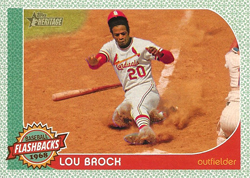 Brock hit nine home runs inside the park _ three with the Cubs and six with the Cardinals. He was 22 when he hit the first and 38 when he hit the ninth.
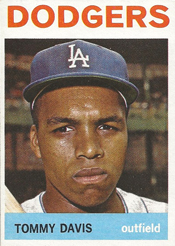 A two-time National League batting champion who totaled 2,121 hits, Davis batted .167 versus Gibson, but made a lasting impression on the Cardinals’ ace with those game-winning homers.
 Stargell struck out swinging in seven consecutive plate appearances versus the Cardinals in September 1964.
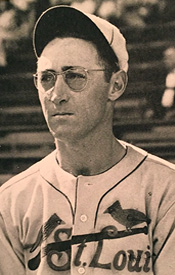 On April 11, 1932, six months after they became World Series champions, the Cardinals dealt left fielder Chick Hafey to the Reds for pitcher Benny Frey, first baseman Harvey Hendrick and cash.
 RetroSimba