Feeds:
Posts
Comments

Archive for the ‘Hitters’ Category

(Updated April 5, 2023)

Dusty Baker was 19 when he debuted in the majors with the Braves against the Astros in 1968.
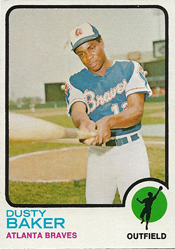
Baker was 73 when he managed the Astros to a World Series championship in 2022.

Music man

Johnnie B. Baker was born in Riverside, Calif. When he was a boy, his mother called him Dusty because he often got dust all over himself while playing, according to The New Yorker magazine.

Baker was a gifted athlete with a passion for music. He played the piano as a youth.

“Deep down inside, I don’t think of myself so much as a baseball man as I see myself as a music man, a blues man and much more than that,” Baker said in his 2015 book “Kiss The Sky.”

When he was 10, Baker wanted to stop playing baseball. “I couldn’t figure out what the big deal was playing ball,” Baker recalled to The Sporting News, “but, thankfully, my father wouldn’t let me quit. He kept me going, kept up my interest in playing.”

After he moved with his parents to the Sacramento area, Baker was the lead singer and only black member of a garage band. “I was going to be Hootie and the Blowfish before Hootie,” Baker said.

He excelled in multiple prep sports, including baseball, and was selected by the Braves in the 26th round of the amateur draft in June 1967, a week before he turned 18. The scout who recommended him to the Braves was Bob Zuk, who signed Willie Stargell for the Pirates and Reggie Jackson for the Athletics.

As an 18th birthday present, Baker’s mother bought tickets for him and a friend to the three-day June 1967 Monterey Pop Festival, featuring performances by Jimi Hendrix, the Who, Buffalo Springfield, Jefferson Airplane and Otis Redding, among others.

Turning pro

In a Zoom interview with the Baseball Hall of Fame on April 4, 2023, Baker recalled, “As a kid, I was always a Dodgers fan … I prayed that the Braves would not draft me. I didn’t want to go to the South.”

In August 1967, two months after they drafted him, the Braves brought Baker for a workout at Dodger Stadium and he said he got a warm welcome from the likes of Hank Aaron, Felipe Alou and Joe Torre.

After signing with the Braves that month, Baker reported to their Austin, Texas, farm club. Austin was managed by Hub Kittle, who would become the pitching coach for the 1982 World Series champion Cardinals.

Two of Austin’s most prominent players were Cito Gaston and Walt Hriniak. Like Baker, Gaston would become a Braves outfielder and a big-league manager, leading the Blue Jays to World Series titles in 1992 and 1993. Hriniak would become an influential hitting coach who mentored Hall of Famers Wade Boggs and Frank Thomas, among others.

Baker joined Austin too late in the season to do much, but it was a different story the next year. He hit .342 for the farm club at Greenwood, S.C., in 1968 and was called up to the Braves in September.

Big time

On Sept. 7, 1968, the Astros led the Braves, 2-0, at Atlanta when Baker appeared in a big-league game for the first time, batting for a future Hall of Famer, pitcher Phil Niekro, with one out and the bases empty. Facing Denny Lemaster, Baker grounded out to short.

Baker’s teammates in the game included four future Hall of Famers: players Hank Aaron, Joe Torre and Niekro, plus coach Satchel Paige.

The game had four players who would become big-league managers: Baker, Felipe Alou, Torre and the Astros’ Doug Rader. Boxscore

Baker made the most of his stint with the 1968 Braves. “You see the way he’s hitting the ball in batting practice?” Braves manager Lum Harris said to the Atlanta Constitution.

Baker’s first big-league hit was a single against the Astros’ Mike Cuellar, a former Cardinal. Boxscore His second hit was a single versus future Hall of Famer Juan Marichal of the Giants. Boxscore

“Baker will be a big-league star,” Lum Harris said. “I’d bet on that.”

After the season, Baker returned to California. In his book, he said he was on a street in San Francisco when he had a chance encounter with Jimi Hendrix and smoked a joint with him.

Distinguished career

In 1972, Baker’s first full season with the Braves, Hank Aaron said, “He does everything now but hit with consistent power. He’ll do that. I think he’ll hit between 25 and 30 homers a year in the future.”

Baker hit 20 or more home runs in a season six times, including a career high of 30 with the 1977 Dodgers.

In 19 seasons as a big-league player with the Braves, Dodgers, Giants and Athletics, Baker had 1,981 hits and 1,013 RBI.

Before accepting the Astros job in January 2020, Baker managed the Giants, Cubs, Reds and Nationals. The 2022 World Series title was his first as a manager.

Baker played for 11 managers in the big leagues: Lum Harris, Eddie Mathews, Clyde King and Connie Ryan with the Braves; Walter Alston and Tommy Lasorda with the Dodgers; Frank Robinson and Danny Ozark with the Giants; and Jackie Moore, Jeff Newman and Tony La Russa with the Athletics.
Read Full Post »

(Updated March 17, 2020)

Larry Walker, who completed his career with the Cardinals, had one of his greatest games as their opponent.

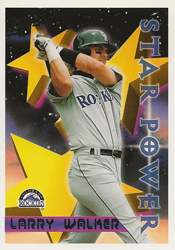
On April 28, 1999, Walker hit three home runs for the Rockies in their 9-7 victory over the Cardinals at Busch Memorial Stadium in St. Louis.
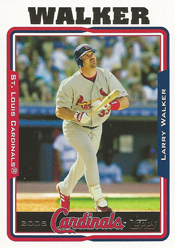
Walker was the first opposing player to hit three homers in a game at St. Louis since the Expos’ Larry Parrish did it 22 years earlier in 1977.

It was the second of three times Walker hit three home runs in a game for the Rockies. He also did it against his former club, the Expos, at Montreal in April 1997 and against the Indians at Cleveland in June 2004, two months before he was traded to the Cardinals.

On Jan. 21, 2020, Walker was elected to the Baseball Hall of Fame in balloting by the Baseball Writers Association of America.

An outfielder who batted left-handed, Walker began his career with the Expos and spent his prime seasons with the Rockies before finishing with the Cardinals.

In 144 regular-season games for the Cardinals, Walker batted .286 with 26 home runs and 79 RBI. He also hit six home runs in 15 postseason games for the 2004 Cardinals. In 150 regular-season games against the Cardinals, Walker hit .300 with 28 home runs and 110 RBI.

Canadian club

Born in Maple Ridge, British Columbia, Walker wanted to be a professional hockey player. When a junior-level hockey team coach told him he’d be their third-string goalie, Walker, 17, switched to baseball, according to the Associated Press.

Signed by the Expos in 1984, Walker became a prized prospect in their farm system when he hit 33 home runs in 1986 and 26 in 1987.

On Jan. 16, 1988, while playing winter baseball in Mexico, Walker tore ligaments in a knee when he slipped while crossing home plate. He sat out the 1988 season and “there were times I didn’t think I’d make it” to the majors, Walker told the Montreal Gazette.

“I wondered, ‘What am I going to do now? Be a garbageman?’ ” Walker said.

Walker was with Class AAA Indianapolis when he got called up to the Expos in August 1989. He became the fifth Canadian to play for the Expos, following Claude Raymond, Larry Landreth, Bill Atkinson and Doug Frobel.

Though he grew up 2,300 miles from Montreal, Walker said, “This is one big country. We’re one big family.”

In his debut game against the Giants at Montreal, Walker had a single and three walks in four plate appearances. Boxscore

“What I liked about him is he had an idea about what he wanted to do every time he went to the plate,” Expos manager Buck Rodgers said.

According to the Montreal Gazette, when Walker reached base for the fourth time in the game, Giants first baseman Will Clark turned to him and said, “Geez, three walks. Not bad. They’re pitching you like a 10-year veteran.”

At spring training in 1990, Walker impressed the Expos with his dedication. In a four-day stretch, he took 500 swings per day in the batting cage. “I can’t believe how hard he works,” said Expos hitting coach Hal McRae.

Walker won the Expos’ right field job and never looked back. He hit .281 in six seasons (1989-1994) with the Expos before becoming a free agent and signing with the Rockies.

Powering up

Walker won the first of his three National League batting titles in 1998, but a rib injury sidelined him for the Rockies’ first seven games of the 1999 season.

When he returned to the lineup, he went homerless in his first eight games before he busted out against the Cardinals on a Wednesday night in St. Louis.

Walker had four hits, including the three home runs, and a career-best eight RBI in the game. Boxscore

The performance drew comparisons to Mark McGwire, the Cardinals’ first baseman, who witnessed it, but Walker dismissed such talk.

“My name is Larry, not Mark,” Walker told the Associated Press. “I don’t have Popeye arms. I’ve just got little tiny ones.”

In the opening inning, after the first two Rockies batters singled, Walker hit a three-run homer on a 1-and-2 pitch from right-hander Jose Jimenez.

With the Rockies ahead, 4-3, in the second, Walker batted with runners on first and third, two outs, and hit the first pitch from Jimenez for another three-run home run.

Walker had three hits, all home runs, in four career at-bats versus Jimenez. The last also was in a three-homer game for Walker in 2004 when Jimenez was with the Indians. Walker and Jimenez were Rockies teammates from 2000-2003.

Walker’s third home run of the game at St. Louis came in the seventh. Facing Scott Radinsky with a runner on first and one out, Walker hit a 1-and-2 pitch from the left-hander for a two-run homer, giving the Rockies a 9-6 lead.

All three home runs were hit over the right-field wall.

In 17 seasons in the majors, Walker batted .313 with 2,160 hits, 383 home runs, 1,311 RBI and a .400 on-base percentage. He won the Gold Glove Award for his outfield play seven times.

In an interview with the Baseball Hall of Fame magazine, “Memories and Dreams,” Jim Leyland, who managed the Rockies in 1999, said, “Barry Bonds is the best player I ever managed, but Larry Walker was the best five-tool player I ever saw. There was nobody more impactful in a game than Larry Walker. He beat you all five ways _ defense, his throwing, his base running, his hitting and his power.”

Read Full Post »

Larry Walker hit two home runs in a game five times for the Cardinals, including once in the postseason.

A three-time National League batting champion who spent most of his career with the Expos and Rockies, Walker was elected to the National Baseball Hall of Fame on Jan. 21, 2020, by the Baseball Writers Association of America.

A left-handed batter and outfielder, Walker played his last two seasons for the Cardinals after being acquired from the Rockies on Aug. 6, 2004.

In 17 seasons (1989-2005) in the majors, Walker hit for average (.313) and power (383 homers).

With the Cardinals, Walker hit 26 home runs in the regular season and six in the postseason.

Here are Walker’s two-homer games with St. Louis:

Solving Nomo

On Sept. 12, 2004, at Los Angeles, Walker was 4-for-5 with two home runs, three RBI and three runs scored in the Cardinals’ 7-6 win over the Dodgers. Boxscore

Walker produced two homers and a double against Dodgers starter Hideo Nomo.

“I never think about hitting home runs,” Walker told the St. Louis Post-Dispatch. “I only think about hitting the ball hard.”

In the sixth inning, with the score tied at 6-6, Walker’s single against Edwin Jackson moved Tony Womack from first to third with none out. Womack scored the winning run when Albert Pujols grounded into a double play.

Mr. October

In the first game of the National League Division Series against the Dodgers at St. Louis on Oct. 5, 2004, Walker had two solo home runs in an 8-3 Cardinals victory.

Walker’s first home run, against starter Odalis Perez, sparked the Cardinals to a five-run third inning. His other was against Giovanni Carrara in the seventh. Boxscore and Video

“My heart was pounding the whole game,” Walker said. “It was a lot of fun.”

Walker became the third Cardinals player to hit two home runs in a postseason game, joining Willie McGee (Game 3, 1982 World Series) and Ron Gant (Game 3, 1996 NL Championship Series).

Walker was playing in the postseason for the second time in his career. The first time was nine years earlier for the Rockies in the 1995 NL Division Series versus the Braves.

“Normally, I’m up in my cabin in British Columbia with my brother and some fishing buddies for some salmon that are running up the rivers,” Walker said. “I’d much rather be here.”

Native son

A Canadian, Walker took pride in hitting two home runs at Toronto in a 7-0 Cardinals triumph over the Blue Jays on June 14, 2005.

Walker’s pair of two-run homers against Chad Gaudin provided support for Cardinals starter Chris Carpenter, a former Blue Jay, who pitched a one-hitterBoxscore

The home runs were Walker’s first in Canada since he hit one for the Rockies against the Expos’ Carl Pavano at Montreal on May 8, 2002. Boxscore

Walker was hitless in 10 career at-bats in Toronto before hitting the home runs.

“I feel good about it,” Walker told the Canadian Press. “I’ve had two-homer games before, but this one felt a lot better.”

Walker said he worked with hitting coach Hal McRae before the game and made “a couple of tweaks” in his stance.

“I moved my front foot to try and get a different wave on the bat, a different plant on my foot,” Walker said.

Pain in the neck

On June 29, 2005, Walker hit a pair of two-run homers against Reds starter Ramon Ortiz in an 11-3 Cardinals victory at St. Louis. Boxscore

“Don’t expect this every day,” Walker said.

Walker, 38, said he got a cortisone shot before the game to relieve discomfort from a herniated disc in his neck.

Hit man

The last two-homer game of Walker’s career came on Oct. 1, 2005, in a 9-6 Cardinals win against the Reds at St. Louis. Ortiz again was the pitcher. The home runs were the last of Walker’s career. Boxscore and Video

Walker was 6-for-13 versus Ortiz in his career. All six hits were for extra bases (four home runs and two doubles).

In two seasons with St. Louis, Walker batted .286 and had an on-base percentage of .387.

For his big-league career, Walker had 2,160 hits in 1,988 regular-season games and an on-base percentage of .400.

He won NL batting titles in 1998 (.363), 1999 (.379) and 2001 (.350). In 1997, he was the recipient of the NL Most Valuable Player Award. He had 208 hits, 143 runs scored, 130 RBI, 49 home runs and 33 stolen bases for the 1997 Rockies.

Walker also was the recipient of seven Gold Glove awards for his outfield play.

Read Full Post »

(Updated Jan. 21, 2020)

Ozzie Smith welcomed Derek Jeter as a peer among baseball’s best shortstops.

In 2014, when Jeter came to St. Louis with the Yankees for the last time as a player, he was embraced by Smith in a pre-game ceremony near home plate at Busch Stadium.

Smith, who won 13 Gold Glove awards, including 11 with the Cardinals, was elected to the Baseball Hall of Fame in 2002 in his first year on the ballot. Smith got 91.7 percent of the votes from the Baseball Writers Association of America.

On Jan. 21, 2020, Jeter was elected to the Hall of Fame in his first year on the ballot. Jeter got 99.7 percent of the votes from the baseball writers.

Parting gifts

After Jeter, 39, said 2014 would be his final season as Yankees shortstop, he was honored at each stop on the schedule.

The Yankees came to St. Louis for a three game series May 26-28 in 2014.

Jeter had played against the Cardinals in 2003 at Yankee Stadium and in 2005 at Busch Memorial Stadium in St. Louis. The 2014 visit was at the downtown ballpark that opened in 2006.

Before the Memorial Day series opener in 2014, the Cardinals presented Jeter with cuff links bearing the likeness of franchise icon Stan Musial. The Cardinals also gave Jeter a $10,000 donation to his Turn 2 Foundation. According to its Web site, the foundation “strives to create outlets that promote and reward academic excellence, leadership development and positive behavior” for young people.

Among those representing the Cardinals at the ceremony were Red Schoendienst, the Hall of Fame second baseman who wore the same uniform number (No. 2) as Jeter did, and Smith, the acrobatic fielder nicknamed The Wizard. Video

Special bond

Smith “put out his arms and embraced” Jeter, MLB.com reported.

Smith’s last two seasons in the majors (1995-96) were Jeter’s first two.

“He’s always treated me good, especially when I was a younger player,” Jeter said. “He’s a guy that I admire. I admire his career. When you’re a young player, you remember how guys treat you. Ozzie always treated me well.”

Smith told the New York Post, “He’s probably been the perfect example of what a baseball player should be. Great ambassador for the game. He’s done it the right way.”

Cardinals reliever Randy Choate, Jeter’s teammate from 2000-2003 with the Yankees, said to MLB.com, “He leads by example. When you play with him, you want to play like him.”

Showing respect

In his first at-bat after the ceremony, Jeter singled and received a standing ovation. Boxscore

Jeter “was feted at every opportunity” during the three-game series, the St. Louis Post-Dispatch reported.

Jeter started the first two games but sat out the third when the Yankees went with his backup, former Cardinal Brendan Ryan. In the seventh inning, Jeter got a standing ovation when the scoreboard camera showed him in the dugout. He responded by going to the top step and doffing his cap. Boxscore

“It’s much appreciated,” Jeter said. “It’s not something that’s expected.”

Hall of Fame stats

Jeter’s best performances against the Cardinals were in 2005 when he had five hits in 13 at-bats. His career batting mark versus St. Louis was .265 (9-for-34).

In 20 seasons (1995-2014) with the Yankees, Jeter won five Gold Glove awards and was named an American League all-star 14 times. One of his all-star appearances was the 2009 game in St. Louis.

Jeter produced a career batting mark of .310 and an on-base percentage of .377. He had 3,465 hits, including 544 doubles, with 1,311 RBI and 358 stolen bases.

Jeter has the most career hits of any shortstop.

According to MLB.com, the top six players all-time in career hits are Pete Rose (4,256), Ty Cobb (4,191), Hank Aaron (3,771), Stan Musial (3,630), Tris Speaker (3,515) and Jeter (3,465). Aaron is the only right-handed batter with more career hits than Jeter.

Jeter played in seven World Series and the Yankees won five of those. He had a World Series batting average of .321, with 50 hits in 38 games, and an on-base percentage of .384.

Read Full Post »

The Cardinals liked what they saw from Matt Holliday in the short term and decided to pay the price to keep him for the long term.

On Jan. 5, 2010, Holliday, a free agent, accepted the Cardinals’ offer of a seven-year contract for $120 million. It was the richest contract given by the Cardinals and it went to a left fielder who had played 63 regular-season games for them.
Holliday batted .353 and had an on-base percentage of .419 for the 2009 Cardinals after being acquired on July 24 in a trade with the Athletics. With Holliday, the Cardinals were 39-25 and won the 2009 division title with an overall mark of 91-71.

When Holliday became a free agent in November 2009, agent Scott Boras said his client wanted an eight-year contract with an average annual salary of $17 million to $18 million and a no-trade clause.

The prospect of featuring a middle of the batting order with Albert Pujols, Holliday, Colby Rasmus and Ryan Ludwick in the third through sixth spots motivated the Cardinals to propose a deal.

Leading suitor

On Dec. 10, 2009, as baseball’s winter meetings were ending, the Cardinals made a formal offer to Holliday, the St. Louis Post-Dispatch reported, but the terms were kept secret.

Club owner Bill DeWitt Jr. and general manager John Mozeliak were hoping to have negotiations settled by Christmas Day, but talks moved at a deliberate pace.

The Red Sox offered five years, but were rejected, according to the Post-Dispatch.

After the Red Sox dropped out of the bidding, it was unclear whether any other clubs were competing with the Cardinals for Holliday. The Orioles and Mets reportedly expressed interest, but it was believed only for a short-term deal.

Boras said Holliday “had a variety of options of various lengths from different teams.”

Waiting game

During the first weekend in January 2010, DeWitt and Mozeliak met with Boras and Holliday near the player’s home in Austin. Texas, in an effort to close a deal.

The Cardinals indicated if Holliday didn’t accept their offer by Jan. 8, 2010, they would have to move on to other candidates.

A possible alternative to Holliday in left field had been Mark DeRosa, who played for the Cardinals in 2009 before becoming a free agent, but he signed with the Giants. The Cardinals didn’t want to risk missing out on other free agents while waiting for Holliday to make a decision.

The Cardinals reportedly were interested in free-agent third baseman Miguel Tejada, who hit .313 with 46 doubles and 86 RBI for the 2009 Astros, if they couldn’t sign Holliday.

Regarding negotiations with Holliday, Cardinals manager Tony La Russa told the Post-Dispatch, “We’ve made it clear how much we want to keep him. At some point, you have to go in one direction or another.”

Good fit

Soon after DeWitt and Mozeliak returned to St. Louis from Austin, Holliday notified them he accepted their offer. Two hours later, Holliday made his decision public in an interview with ESPN Radio.

“Playing in St. Louis with guys I made friends with, and given the way the organization is run, became very appealing to me,” Holliday said.

Regarding the decision process, Holliday said, “You get into January, you want to get excited about spring training and not worry about contract stuff. I was ready for it to be over.”

The Cardinals’ willingness to approve no-trade protection and guarantee $17 million for a seventh season sealed the deal, according to the Post-Dispatch.

Holliday accepted the offer two weeks before he turned 30.

“The Cardinals did their homework and were willing to gamble that Holliday will age well as a player,” wrote Post-Dispatch columnist Bernie Miklasz.

At the announcement of the formal signing, the Cardinals said Holliday would wear uniform No. 7. Holliday said he chose the number to honor fellow Oklahoma native Mickey Mantle, whose No. 7 was retired by the Yankees.

With the Rockies and Athletics, Holliday had worn No. 5, but Pujols had that number with the Cardinals, When Holliday was traded to St. Louis in July 2009, he was given No. 15, previously worn by Cardinals luminaries such as Tim McCarver, Darrell Porter and Jim Edmonds.

Holliday played eight seasons (2009-2016) for the Cardinals and produced 1,048 hits in 982 games, with a batting average of .293 and a .380 on-base percentage.

The Cardinals qualified for the postseason in six of Holliday’s eight seasons with them. In the 2011 National League Championship Series versus the Brewers, Holliday batted .435 and had 10 hits and three walks in 26 plate appearances, giving him a .500 on-base percentage.

After his seven-year contract expired following the 2016 season, Holliday became a free agent and signed with the Yankees.

In 15 seasons with the Rockies, Athletics, Cardinals and Yankees, Holliday had 2,096 hits and 1,220 RBI.

Read Full Post »

(Updated Jan. 30, 2024)

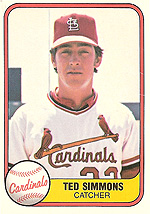
As a catcher for the Cardinals, Ted Simmons helped Steve Carlton achieve his first 20-win season. As an opposing hitter, Simmons hit with power against Carlton.

One reason Simmons was elected to the National Baseball Hall of Fame in December 2019 was he could hit any kind of pitching, including the best.

Of his 248 regular-season career home runs in the majors, Simmons hit 22 against future Hall of Famers.

The future Hall of Famer who Simmons hit the most home runs against was Carlton, who spent most of his career with the Phillies after being a teammate of Simmons with the Cardinals.

A switch-hitter, Simmons hit seven home runs against Carlton, a left-hander.

Here is a breakdown of the number of home runs Simmons hit versus future Hall of Famers:

_ Steve Carlton, 7 home runs against.

_ Tom Seaver, 3

_ Don Sutton, 2

_ Ferguson Jenkins, 2

_ Bert Blyleven, 2

_ Phil Niekro, 2

_ Rich Gossage, 1

_ Bruce Sutter, 1 (See story)

_ Lee Smith, 1

_ Gaylord Perry, 1

Battery mates

Carlton debuted with the Cardinals in 1965 and Simmons debuted with them three years later, in 1968.

Tim McCarver was Carlton’s primary catcher with the Cardinals from 1965-69. After McCarver got traded to the Phillies in October 1969, Simmons and Joe Torre split the catching for the Cardinals the next year. Torre caught Carlton in 20 games in 1970 and Simmons was his catcher in 15, according to baseball-reference.com.

The first time Carlton and Simmons started a regular-season game together was June 2, 1970, a 12-1 Cardinals win versus the Giants at St. Louis. Carlton pitched a four-hitter. Simmons had a single, a triple and a walk, scoring twice. Boxscore

In 1971, when Torre shifted to third base, Simmons was the Cardinals’ catcher. He caught in 33 of Carlton’s 37 games for the 1971 Cardinals.

On Sept. 28, 1971, Carlton earned his 20th win of the season, beating the Mets at New York. Simmons was the catcher and produced a single, a double and two RBI. Boxscore

It was the last time Carlton would pitch for the Cardinals. Five months later, on Feb. 25, 1972, he was traded to the Phillies on orders of Cardinals owner Gussie Busch, who was fed up with player salary demands.

Carlton and McCarver were reunited as Phillies. According to baseball-reference.com, the catchers who caught the most games pitched by Carlton were McCarver (236), Bob Boone (147), Bo Diaz (79) and Simmons (48).

Carlton had a 3.24 ERA over the 358.2 innings Simmons was his catcher.

Mighty matchup

Carlton’s career record against the Cardinals was 38-14 with five shutouts, 27 complete games and a 2.98 ERA.

Simmons batted .274 against Carlton. Of his 34 hits, 17 were for extra bases: nine doubles, seven home runs, one triple. Simmons had a .357 on-base percentage versus Carlton, drawing 16 walks and getting hit by a pitch once.

The most significant home run Simmons hit against Carlton was on June 25, 1977, at St. Louis.

In the seventh inning, with the Phillies ahead, 2-1, Hector Cruz led off for the Cardinals and pulled the ball down the third-base line. Third baseman Mike Schmidt snared it, but his throw sailed past first baseman Richie Hebner. Cruz was credited with a single and advanced to second on Schmidt’s throwing error.

Simmons, due up next, turned to teammate Mike Anderson and said, “I’m just going to look for anything inside that I can pull and hit hard,” the Philadelphia Inquirer reported.

With McCarver catching, the first pitch Carlton threw Simmons was a slider, low and on the inside corner of the plate.

“He might have wanted to get the ball in the dirt or something because usually he doesn’t give me the ball in the strike zone unless it’s outside,” Simmons told the St. Louis Post-Dispatch.

Simmons hit the ball into the left-field seats for a two-run home run, giving the Cardinals a 3-2 lead.

“That’s one of the hardest he’s hit right-handed,” said Cardinals manager Vern Rapp. “That was hit deep into the deck.”

Said McCarver: “Simmons is just a good hitter. He might be the purest hitter in the game outside of Rod Carew. Maybe even more than Pete Rose because Simmons has more power.”

Bob Forsch and Rawly Eastwick held the Phillies scoreless over the last two innings, preserving the win for the Cardinals. Boxscore

Three years later, on April 26, 1980, at Philadelphia, Simmons got another key hit against Carlton, but it wasn’t a home run. Carlton pitched a one-hitter versus the Cardinals. Simmons’ single in the second deprived Carlton of a no-hitter, a feat that eluded him throughout his career. Boxscore

Special deliveries

Among other noteworthy home runs by Simmons against fellow future Hall of Famers were one hit against the Braves and another hit for them.

On Aug. 23, 1975, Simmons hit a grand slam against Phil Niekro, snapping a 1-1 tie in the fifth and carrying the Cardinals to a 7-2 win over the Braves at St. Louis. Simmons said he hit a low screwball, not Niekro’s signature knuckleball.

“I just golfed it,” Simmons said. “He’s been throwing me a lot of screwballs.”

The grand slam was the fifth of Simmons’ major-league career but his first versus a right-hander. Boxscore

Simmons batted .203 against Niekro in his career. He had almost as many walks (15) as hits (16).

On Aug. 31, 1986, the Cubs played the Braves in Atlanta. The Cubs started and ended the game with two future Hall of Famers, Dennis Eckersley and Lee Smith.

Simmons, 37, and in his first season with the Braves, led off the ninth, batting for pitcher Jeff Dedmon with the score tied at 3-3.

Throwing sliders, Smith got ahead in the count 1-and-2.

“Being down 1-and-2 is not the best situation to be in against Smith,” Simmons told the Chicago Tribune. “You’re living on the edge.”

On the next pitch, “Simmons timed the slider properly and launched an electric rainbow to right field,” the Atlanta Constitution reported.

The walkoff home run gave the Braves a 4-3 triumph. Boxscore

“When they say go up there and get it done like this, it’s do or die,” Simmons said. “When you do, it’s the greatest. When you don’t, it’s the worst. I like it.”

In a 1981 interview with Roger Angell for the book “Late Innings,” Simmons said, “A Reggie Jackson, a Willie Stargell can fan three times in a game and walk up to the plate in the 10th inning, and still the pitcher is scared out there … because that man is feared.

“I’ve been in that position a few times. Some people have that kind of ability given to them, but I’ve had to learn it. I have it now. I have that respect. As far as I’m concerned, there is no greater pleasure in the world than walking up to the plate with men on base and knowing that you are feared.”

Read Full Post »

« Newer Posts - Older Posts »