Feeds:
Posts
Comments

Archive for the ‘Managers’ Category

(Updated April 12, 2025)

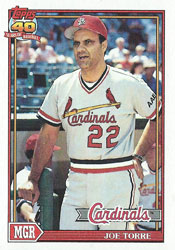
Ted Simmons was a key to Joe Torre being able to return to big-league managing in 1990 after a six-year hiatus. Without help from Simmons, Torre might never have gotten the chance to revive his career.

simmons_torreOn Dec. 9, 2013, three managers, Tony La Russa, Bobby Cox and Torre, were elected to the National Baseball Hall of Fame by the Expansion Era committee. A candidate needed 12 of the votes from the 16-member committee to earn election. Hall of Fame manager Whitey Herzog was one of those voters.

It was Herzog who triggered the chain of events that led to Torre becoming manager of the Cardinals.

Support for Simmons

On July 6, 1990, Herzog, the Cardinals’ manager since 1980, abruptly resigned.

Cardinals coach Red Schoendienst was named interim manager while general manager Dal Maxvill launched a search for Herzog’s replacement.

There was media speculation and popular sentiment for Simmons to get the job. The former St. Louis catcher was the Cardinals’ director of player development, overseeing the minor-league system.

Five days after Herzog quit, St. Louis Post-Dispatch columnist Bernie Miklasz opined that Simmons should be the manager.

“Simmons makes sense for a lot of reasons,” Miklasz wrote. “The manager must be a motivator, someone who can communicate with the millionaires in the dugout. Simmons … has fresh perspective on what makes today’s players click. And he’s wired. His high energy level is bound to be contagious. Maxvill said the new man must be intelligent … Simmons would beat Tony La Russa at ‘Jeopardy.’ ”

Two days later, in an interview with Vahe Gregorian of the Post-Dispatch, Simmons ended the speculation. “It’s flattering to have people asking me every five minutes if I’m going to be the next manager,” Simmons said. “But, however flattering, it’s not my objective. It’s safe and fair to say I won’t be the next manager. I don’t have any interest.”

After that, attention turned to Torre.

Friends in high places

Fired by the Braves in 1984, Torre became an Angels broadcaster. Six years later, he admitted he largely had abandoned hope of managing again.

Herzog’s surprise resignation provided the opportunity; Maxvill and Simmons provided the support.

Torre and Maxvill were friends and former teammates. They had played together for the Cardinals from 1969-72. Maxvill was on his coaching staffs when Torre managed the Mets and Braves.

Simmons was a Cardinals rookie when St. Louis acquired Torre from the Braves in March 1969. Torre, a five-time all-star catcher before converting to first baseman, became a mentor to Simmons, who was being groomed to replace Tim McCarver as the everyday catcher. Torre and Simmons were Cardinals teammates from 1969-74 and often batted back-to-back in the St. Louis order.

In late July 1990, Torre told the Los Angeles Times he would enjoy working with Maxvill and Simmons. “It would be the first time I’d be working with somebody instead of for somebody,” Torre said. “That can only be ideal.”

Maxvill told the Post-Dispatch he had seven candidates: Torre, big-league coaches Don Baylor, Hal Lanier, Pat Corrales and Gene Tenace, Class AAA Louisville manager Gaylen Pitts and Cardinals minor-league hitting instructor Mike Jorgensen. Torre, though, was the leading candidate all along.

When Torre was named Cardinals manager on Aug. 1, 1990, Herzog told Rick Hummel of the Post-Dispatch, “I don’t know why they didn’t do it on July 7 (the day after Herzog’s resignation). He was going to be the guy.”

Tips from Ted

With eight Cardinals eligible for free agency after the 1990 season, Herzog also said Torre would have to rely on Simmons for advice on which prospects were ready to contribute at the big-league level.

Torre agreed, telling the Post-Dispatch, “I’m going to pretty much take the rest of this season to work with Dal and Ted Simmons and make sure that when we go out there in 1991 we’re going in the right direction.

“I’m looking to Ted Simmons to see where it’s coming from.”

Wrote Miklasz: “Simmons will develop the prospects for Maxvill. Maxvill will pass them … along to Torre. Torre will manage. Presenting: The Three Amigos. United, they stand.”

Said Torre: “It’s going to be very comfortable working with people that I know so well. We were teammates. We were taught the game the same way. We played together and now we’re working together.”

Maxvill elaborated to the Post-Dispatch about the relationship between Torre and Simmons. “When Ted came up, Joe was his mentor,” Maxvill said. “Joe told him about the league, about opposing pitchers, about what to expect in situations, told him how to handle our pitching staff. I knew they had a good relationship and that their baseball philosophy was pretty much the same.

“That’s helpful. If we go through our minor-league system, we don’t like to have eight or 10 different opinions about the way cutoffs or rundowns or relays should be done. With all of us being pretty much brought up on the Cardinal Way _ through George Kissell, all of us _ I think we’ll be able to pull the wagon in the same direction from that standpoint.”

The Three Amigos, however, didn’t stay together long.

Simmons left the Cardinals in 1992 to become general manager of the Pirates. Maxvill was fired in 1994 and, a year after that, Torre was fired by Maxvill’s successor, Walt Jocketty (who selected La Russa to manage the Cardinals).

Maxvill and Simmons brought Torre back into managing and, in so doing, opened a path to his Hall of Fame election. After leaving the Cardinals, Torre was hired by the Yankees. He managed them to four World Series titles and six American League pennants in his first eight years in New York.

“Basically, I’m not in the Hall of Fame if Dal Maxvill doesn’t make that call,” Torre told Cardinals Yearbook in 2014. “Because once you’re out of the game, people don’t know you’re around. He got me back in the game.”

In 29 years managing the Mets, Braves, Cardinals, Yankees and Dodgers, Torre compiled 2,326 wins, ranking fifth all-time.
Read Full Post »

(Updated April 14, 2025)

Cardinals coach George Kissell was the most influential mentor in Joe Torre’s transformation from all-star player to manager.

joe_torre3Torre, who won four World Series titles and six American League pennants as Yankees manager, earned election to the National Baseball Hall of Fame on Dec. 9, 2013.

The path toward that achievement began when Torre, then a catcher and first baseman, was traded by the Braves to the Cardinals in March 1969 and connected with Kissell.

In his book “Chasing the Dream,” Torre credited Kissell with creating the foundation for his managing career and teaching him a style that helped Torre earn a World Series championship in his first season (1996) with the Yankees.

Torre also said he learned from Red Schoendienst, who managed the Cardinals during Torre’s playing tenure with St. Louis (1969-74).

Successful skippers

Torre, who managed the Mets, Braves, Cardinals, Yankees and Dodgers, joined another former Cardinals manager, Tony La Russa, and fellow manager Bobby Cox in being elected by the Expansion Era committee. La Russa (second at 2,821), Cox (fourth at 2,504) and Torre (fifth at 2,326) rank in the top five in career wins for managers. Connie Mack (3,731) is first and John McGraw (2,763) is third.

A candidate needed 12 of the votes from the 16-member committee. Hall of Fame managers Whitey Herzog and Tom Lasorda were on the committee.

According to Hall of Fame rules, a candidate must have been a big-league manager for 10 or more years and have been retired for at least five years before he is eligible for election. However, if the retired manager is 65 or older, he becomes eligible just six months after retiring.

Cardinals classics

Torre was 20 when he debuted in the majors with the Braves in 1960. “Warren Spahn and Lew Burdette took me under their wings,” Torre recalled to Cardinals Yearbook in 2014. “They were like big brothers to me. They took me to the movies the first time we came to St. Louis.”

A five-time all-star with the Braves, Torre was traded to the Cardinals for first baseman Orlando Cepeda on March 17, 1969.

Kissell was a coach on Schoendienst’s staff during Torre’s six seasons as a Cardinals player. He converted Torre into a third baseman with St. Louis.

When Tim McCarver, the catcher for three pennant-winning Cardinals clubs in the 1960s, returned to St. Louis to play in 1973 and 1974, he, Torre and Kissell spent much time together.

In his book, Torre said, “Timmy and I were almost always the first ones at the ballpark … Kissell always was there early, too. The three of us would spend hours talking about baseball. Looking back on it, that’s when I started to get the foundation for my managing career.”

Torre said he and McCarver “talked a lot about managing in those days” and discussed the possibility of operating as co-managers of a team.

“I learned more baseball from George Kissell than from anyone else in my life,” Torre said. “He used to have a great saying: The most important word in the baseball dictionary is why. And that’s pretty much what Timmy, George and I would do. We’d constantly ask ourselves why things had happened in games. Sometimes (Bob Gibson) and (Dal Maxvill) would sit in, too. They were very stimulating and enlightening sessions.”

McCarver, in his book “Few and Chosen,” said of Torre, “I came to know Joe as a man of intelligence, grace and compassion. His knowledge of baseball and his unique people skills made him a good bet to succeed as a manager.”

Lessons learned

Torre cited specific examples of how he was helped by Kissell.

“George showed me how to create runs by stealing bases and moving runners,” Torre related. “He taught me that while running to first base you should run through the bag and not to it. He taught me that outfielders should reposition themselves according to the count on the hitter and not just plant themselves in the same spot.

“And he taught me an unorthodox defense with a runner on third when it’s time to bring the infield in: With a right-handed hitter, and with the count in his favor, you leave your third baseman back at normal depth. That puts pressure on the runner and third-base coach in whether to decide to break for home on a ground ball.”

In an interview with Stan McNeal of Cardinals Magazine, Torre said Kissell “put in the most time with me and I learned the most baseball from him. There were a lot of things I never thought to think about until I associated with Kissell.”

Schoendienst, Torre’s only manager in St. Louis, was “perfect” for the Cardinals, Torre said. Schoendienst’s style helped Torre in his first season with the Yankees.

“As a manager, sometimes you assume a lot _ that your players know what they are supposed to do and that they understand your moves,” Torre said in his book. “Red was able to take that approach because he had such a smart, seasoned bunch. Luckily so did I with the (1996) Yankees. It was the first year that kind of approach worked for me. The Yankees’ professionalism really made me think back to those classy Cardinal teams.”

Schoendienst “was definitely an influence for me,” Torre told Cardinals Magazine.

In his 2014 interview with Cardinals Yearbook, Torre said Schoendienst “basically trusted the players. He knew what he wanted from them, and it was only to go out and do the best you can and not beat yourself. I took a great many things from his philosophy going forward. I was a little different from other managers. I didn’t try to micromanage everything. i trusted my players to go out there and hopefully be in a position to want the same things I wanted.”

When Torre managed the Cardinals from 1990-95, Kissell was a Cardinals instructor and Torre had him coordinate the team’s spring training.

“He questioned everything,” Torre said. “He had a favorite line: ‘Joe, who wrote the book?’ And I’d say, ‘Nobody, George. Nobody wrote the book.’ That was George’s way of reminding me that I could make any move I wanted as a manager as long as I had the right reasons for it _ whether it was unpopular or unorthodox. That style helped me in the 1996 World Series. I surprised some people with moves like benching Wade Boggs against a right-handed pitcher, letting my pitcher bat in the ninth inning and putting the potential winning run on base intentionally.”

Read Full Post »

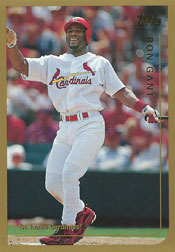
In 1998, the Cardinals were so eager to unload outfielder Ron Gant and reliever Jeff Brantley that they paid the Phillies $6 million to take the underperforming malcontents off their hands.

ron_gantGant and Brantley responded with a series of toxic salvos. Brantley ripped pitching coach Dave Duncan and Cardinals fans. Gant accused manager Tony La Russa of being unethical, immoral and a racist.

The attacks proved baseless. The accusers looked classless.

What both players were attempting to camouflage was their skills had eroded from the days when they were all-stars.

Seeking a transformation after failing to qualify for the postseason in 1997 and 1998, the Cardinals made a flurry of transactions on Nov. 19, 1998. They signed two free agents _ outfielder Eric Davis and reliever Scott Radinsky _ and traded Gant, Brantley and pitcher Cliff Politte to the Phillies for pitchers Ricky Bottalico and Garrett Stephenson.

To seal the deal, the Cardinals agreed to pay $5 million of the $11 million Gant was due on the last two years of his contract and $1 million of Brantley’s $2.8 million contract for 1999.

True grit

Though they hit 223 home runs, the 1998 Cardinals finished in third place in the National League Central Division, 19 games behind the champion Astros. Gant hit 26 home runs in 121 games, but struck out 92 times in 383 at-bats and hit .240. Brantley, expected to be the closer, produced 14 saves, but also had eight blown save chances, gave up 12 home runs in 50.2 innings and posted an 0-5 record and 4.44 ERA.

On the eve of the trade, Cardinals general manager Walt Jocketty told St. Louis Post-Dispatch columnist Bernie Miklasz, “We want more guys who are gritty and hard-nosed.”

Eric Davis had survived colon cancer surgery and Scott Radinsky had fought Hodgkin’s disease. “They’re very strong-willed and competitive and they’re battlers,” Jocketty said to Post-Dispatch reporter Rick Hummel. “That’s the type of people you want to bring to this club.”

After the trade, Brantley told Hummel that when he reported to spring training with the 1998 Cardinals “my arm still hurt.” Brantley had shoulder surgery in 1997 while with the Reds.

Boos for Brantley

Brantley said he was mishandled by Duncan and mistreated by the fans.

“My relationship with Duncan was absolutely terrible,” Brantley said to Hummel. “Whether it was my fault or his fault, I don’t know.”

Said Duncan: “All I can say is that it was not an ideal working relationship. It wasn’t because I didn’t try to make it work.”

Regarding the booing he received, Brantley said, “It’s kind of sorry to take a guy coming off major arm surgery and make him a scapegoat for your ballclub. … I’m not very happy the way I was treated. I was treated grossly unfairly in that ballpark.”

In a parting shot, Brantley said of Gant: “He’ll be glad to get a new place without all the head games and mind games.”

Big whiff

Gant, however, was uncomplaining when interviewed by Hummel about the trade. “There were times I didn’t do my job because of my injuries,” said Gant, slowed by a right hamstring injury in 1998. “… I would have liked to have been with the Cardinals. I had a great time here.”

Said La Russa of Gant: “He would have flashes where you saw what he could do and he could dominate a game and then he would swing and miss a lot where it was tough for him to help.”

A month after the trade, Gant sparked controversy when he told Philadelphia media that Mark McGwire, who hit 70 home runs that year, hampered others in the Cardinals lineup by batting third in the order.

Responding on a St. Louis radio show, La Russa said of Gant, “It was whiff, whiff, whiff. I really hope he goes to Philly and whiffs for them like he whiffed for us. And we’ll see what excuses he makes.”

La Russa also commented on Brantley’s earlier criticism of Duncan. Said La Russa: “Duncan went to bat for him a hundred times.”

“What really ticks me off is that these are the two guys that we, as an organization, worked harder for than anyone else,” La Russa said.

Getting personal

Gant waited to respond until he reported to Phillies spring training camp in February. He told the Philadelphia Inquirer that La Russa has “no morals or values. That’s just the type of person (La Russa) is. Anybody who treats (shortstop) Ozzie Smith like he’s a kid coming up from the minors has no ethics or morals to him.”

In an interview with Hummel, La Russa responded: “You can say I’m a stupid manager. But unethical? Immoral? That’s very strong stuff. That’s like lying, cheating and stealing. Did I do all those things to Ozzie Smith?”

Gant continued his attack in subsequent interviews. “I have nothing against St. Louis,” Gant told reporters. “It’s just the person I was playing under. He didn’t get along with Rickey Henderson. Royce Clayton didn’t like him. Ozzie Smith, he treated like he was the worst person on earth.”

Asked whether there was significance in that Gant and the players he mentioned are black, Gant replied. “Yeah, there is.”

A stunned La Russa responded: “He’s getting lower than cheap.”

Several black players, including former Cardinals outfielder Brian Jordan, defended La Russa and angrily discounted Gant’s accusations. Dave Stewart, a black pitcher who played for La Russa, said, “To call Tony a racist is off base.”

Wrote Miklasz: “Gant continues to embarrass himself by blaming someone else for his failure to earn the $15 million paid to him by the Cardinals over the past three seasons … In my 20 years as a sportswriter, I have never seen a baseball manager protect a player the way Tony La Russa covered for Gant.”

Fade away

Soon after that, Gant issued a half-hearted apology: “All I can say is I apologize to my fans and the families involved. … I apologize to anybody who might have been hurt.”

In May, just before the Phillies played the Cardinals for the first time in 1999, Gant, asked about the controversy, told the Post-Dispatch: “I’ve been told not to comment on that anymore. That whole situation is over. We both said things that we regret.”

By then, though, Gant was being booed regularly by Phillies fans. He entered that series against the Cardinals with a .223 batting average. In July 2000, the Phillies traded Gant to the Angels. He bounced from there to the Rockies, Athletics and Padres before playing his final season in 2003.

Brantley pitched in 10 games for the 1999 Phillies, posting a 1-2 record and 5.19 ERA. He had a 5.86 ERA for the 2000 Phillies and a 5.14 ERA for the 2001 Rangers before retiring as a player.

Read Full Post »

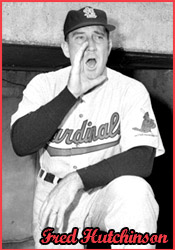
Ignoring the recommendation of general manager Bing Devine, Cardinals owner Gussie Busch ordered the firing of manager Fred Hutchinson.

fred_hutchinsonAt the press conference on Sept. 17, 1958, a distraught Devine spoke so glowingly about Hutchinson that the reporters there said it seemed like the manager was being hired, not fired.

Hutchinson had managed the 1957 Cardinals to an 87-67 record and second-place finish in the National League. Based on that performance, Busch was expecting the Cardinals to contend for a pennant in 1958.

However, the 1958 Cardinals lost 14 of their first 17 games. Lacking both power and run production, the Cardinals entered September in the second division of the eight-team league.

Busch wanted a change. Devine, in his first season as St. Louis general manager, wanted to keep Hutchinson and shake up the coaching staff instead.

Dick Meyer, an aide to Busch, called Devine and instructed him to prepare a report on his recommendations for the team. Devine was given a date and time to meet with Busch and Meyer and present the report.

Done deal

In his book “The Memoirs of Bing Devine,” Devine told writer Tom Wheatley, “So I wrote my report and I spent a lot of time on it … When we had our meeting, I handed the report to Mr. Busch. It featured rehiring Fred Hutchinson.

“Mr. Busch took the report and put it on his desk. He didn’t read it. He didn’t even open it.”

Instead, Busch told Devine, “We’re going to get rid of Fred Hutchinson. And you don’t need to think about replacing him because I already have the manager: Solly Hemus.”

Said Devine: “I was kind of hurt by the whole process of firing Hutchinson and hiring Hemus … I had made what I thought was a thorough report and the determination was made for me without my views being considered.”

On Sept. 13, Devine informed Hutchinson he would be fired during the last week of the season. When word leaked and reports appeared in the press, the Cardinals moved up the date of the dismissal, calling the press conference for Sept. 17.

Hearts and flowers

The Associated Press described Devine as “grim-faced” as he announced Hutchinson and his coaching staff were fired. (Coach Stan Hack agreed to remain as interim manager for the final 10 games.) Hutchinson, who attended the press conference, “appeared in good spirits,” the Associated Press reported.

Devine told The Sporting News, “We have no direct criticism and this is most difficult when it’s a man like Hutch, who gave us full effort, was most cooperative and 100 percent in giving young players a chance.”

According to United Press International, “It appeared clear Hutch was the victim of baseball’s strange logic: If the bus breaks down, fire the driver.”

The Cardinals, who were 69-75 when Hutchinson was fired, finished 72-82 and tied for fifth. They were last in the National League in runs (619), RBI (570) and home runs (111) and committed 151 errors, second-most in the league.

“It’s apparent the club has to score more than it did this year,” Hutchinson said. “It’s a good 50 runs behind the second-poorest offensive club in the league. Both the pitching and defense have to be steadier, too.”

Hutchinson was 232-220 in three years (1956-58) as Cardinals manager. Three years after his firing, he managed the Reds to the 1961 pennant. Hemus, a former Cardinals infielder, went 190-192 as St. Louis manager before he was fired in July 1961 and replaced by one of his coaches, Johnny Keane.

Read Full Post »

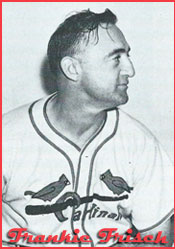
In September 1938, the relationship between Cardinals manager Frankie Frisch and executive Branch Rickey had become irreparable.

frankie_frisch2Cardinals owner Sam Breadon liked and respected Frisch, but he determined he couldn’t afford to lose Rickey.

On Sept. 11, 1938, Breadon reluctantly fired Frisch.

Frisch had been a Hall of Fame-caliber second baseman for the Cardinals and was Breadon’s favorite player. In 1933, Frisch became the Cardinals’ player-manager, replacing Gabby Street, and led them to a World Series championship the following year. The Cardinals contended in 1935 and 1936, finishing second in the National League both years.

Aggressive and feisty, Frisch managed the Cardinals’ rough-and-tumble Gashouse Gang clubs that featured colorful characters such as Dizzy Dean, Pepper Martin, Joe Medwick, Rip Collins and Leo Durocher.

Frisch was Breadon’s guy more than he was Rickey’s and he and Rickey clashed. Rickey, for instance, wanted Frisch to move center fielder Terry Moore to third base.

At a Chamber of Commerce luncheon at St. Louis in April 1938, Rickey put the heat on Frisch, telling the audience, “Except for pitching, this is the greatest ballclub the Cardinals ever had.”

Instead, the Cardinals were in sixth place in September 1938 and speculation grew Frisch wouldn’t be brought back in 1939.

Don Gutteridge, third baseman for the 1938 Cardinals, told author Peter Golenbock for the book “The Spirit of St. Louis” that “during the latter part of the season all of us were thinking Frankie might get fired …My guess is that Frisch wanted to play certain players and Rickey wanted him to play somebody else.”

Showdown with Breadon

After Labor Day, Frisch went to Breadon, seeking to learn whether he had the owner’s support. “I have the greatest admiration for the old man (Breadon),” Frisch told The Sporting News. “He’s been swell to me right along and we never had a cross word, but I had heard reports a new manager was to be brought in for 1939 and on Sept. 9 I decided to find out where I stood.

“I told the old man that if he was planning a change I would like to be free now so that I could get lined up with some other club. Breadon said he would give me his answer Sunday (Sept. 11). You know the rest.”

According to multiple published reports, Breadon told Frisch he would have to accept a pay cut if he wanted to return in 1939. When Frisch and Breadon were unable to agree on salary terms, Breadon told Frisch before the Pirates-Cardinals game at Sportsman’s Park on Sept. 11 that the manager would be replaced.

In a Page 1 article headlined “Sam Breadon Fires Frisch to Keep Peace With Rickey,” The Sporting News reported that Clarence “Pants” Rowland, a representative of Cubs owner P.K. Wrigley, had met three times with Rickey. Rowland, acting on instructions from Wrigley, offered Rickey either the job of president or general manager of the Cubs, The Sporting News surmised.

Breadon figured it was easier to replace a manager than it was to find a substitute for Rickey, but he didn’t like making the move.

As Frisch prepared to leave the ballpark after his termination, Breadon “put his arms around Frankie, bade him goodbye and there was mist in his eyes when he turned quickly and hustled out of the room,” The Sporting News reported.

“A good manager”

“I do not blame (Frisch) for the position of the club this year,” Breadon told The Sporting News. “He has not done anything we can find fault with and he has been a good manager.”

(In six seasons as Cardinals manager, Frisch had a record of 458-354, a .564 winning percentage.)

Rickey remained in the background and didn’t talk with reporters about Frisch’s departure. Frisch declined to discuss his strained relationship with Rickey.

“I leave St. Louis with the best of feeling toward the club officials, players and fans,” Frisch said. “… You know how it is _ a manager’s welcome often wears out with the front office.”

Wrote Jack Cuddy of The Pittsburgh Press: “When (Frisch) received his walking papers from president Sam Breadon and marched into the dressing room during Sunday’s game at St. Louis, the Gashouse Gang died a sudden death. His dismissal meant the final triumph of Branch Rickey in a long-standing feud. Rickey … always has been opposed to the hell-for-leather philosophies of the Gas House Gang on or off the field.”

Mike Gonzalez, the Cardinals’ Cuban-born coach, took over as manager for the rest of the 1938 season. Rickey selected Ray Blades, manager of the Cardinals’ Rochester farm club, to manage St. Louis in 1939.

Frisch was part of the Braves’ radio broadcast team in 1939 and became manager of the Pirates in 1940.

Previously: Why Cardinals dealt Dizzy Dean to Cubs 75 years ago

Read Full Post »

Tony La Russa brought out the evil twin in Dusty Baker.

dusty_baker2On Sept. 3, 2003, the Cardinals and Cubs played the fourth game of an intense five-game series at Chicago’s Wrigley Field. La Russa, the Cardinals’ manager, and Baker, the Cubs’ manager, engaged in a shouting match that added a memorable but ugly chapter to the rivalry between the franchises.

In the second inning, Cubs starter Matt Clement hit Cardinals pitcher Dan Haren with a pitch. An inning later, Haren hit Clement. That prompted the theatrics from the managers.

Baker rushed onto the field, confronted the umpires, then pointed angrily at the visitors’ dugout, where La Russa stood, glaring.

“Even back in the dugout, Baker kept pointing and yelling as La Russa smirked,” wrote Chicago Sun-Times columnist Jay Mariotti.

“Baker hollered, ‘I’ll (mess) you up,’ at La Russa,” wrote St. Louis Post-Dispatch columnist Bernie Miklasz.

“TV cameras caught Baker telling La Russa he’d gladly take him on any time and La Russa telling him to bring it on,” reported Mike Kiley of the Sun-Times.

“The two managers yelled at each other from across the field,” wrote Joe Strauss of the Post-Dispatch. “Baker at one point flipped an obscene gesture at La Russa.”

Wrote Miklasz: “A rumpus with an opposing manager makes La Russa’s blood surge and raises his competitiveness to maximum-testosterone level.” Video

Cardinals fold after feud

The teams hardly needed motivation. The day before, they split a gritty doubleheader. The Cubs won the opener in 15 innings. The Cardinals won the second game, 2-0, behind Matt Morris. Cubs pitcher Kerry Wood twice knocked down Morris with pitches and dusted him with a third, prompting La Russa to say Wood “likes to scare people. I’ve heard he likes to hit people.”

Baker and Wood objected to La Russa’s remarks.

After the La Russa-Baker macho match that followed Haren and Clement being hit by pitches, the intensity was raised to a fever pitch.

The Cardinals, who entered the Sept, 3 game in first place in the National League Central, a half-game ahead of the Astros and 1.5 games ahead of the Cubs, led, 6-0, in the sixth, but the Cubs scored three in the sixth, three in the seventh and two in the eighth and won, 8-7. Boxscore

Wrote Miklasz: “La Russa was nearly inconsolable.”

Said La Russa: “As far as bad losses go, it’s tied for first with any that I can remember. There’s been some savage losses, but this is right there with the worst of them.”

A defiant Baker told the Post-Dispatch: “Nobody intimidates me but my dad and Bob Gibson and a bully I had in elementary school. And I grew bigger than him, so he couldn’t bully me.”

Mariotti suggested the Cubs change their logo because “a cuddly little cub doesn’t fit the image any more when Dusty Baker is threatening to kick Tony La Russa’s butt.”

Beware the Gemini

The next day, La Russa and Baker met on the field before the game and had what was described by Strauss as “a decidedly serious conversation” for about five minutes.

Said La Russa to the Post-Dispatch: “I explained to him that the Cardinals and my players come first with me and I recognized that the Cubs and his players come first with him. If we both have that understanding, I think it’s easy for us to maintain a respect and friendship with each other.”

Baker, in comments to both the Sun-Times and Post-Dispatch, revealed there is a bad Dusty that tries to overtake the good one.

“I’m not proud of myself when I display that kind of action because I don’t really like that person when he comes out,” Baker said. “And he rarely comes out unless he’s provoked to come out.

“I’m a Gemini and I’ve definitely got an evil twin. I don’t like that twin. That’s the mean side. He’s got to run his course, then go back in there for a while. Everybody has a side they don’t like. I can get even hotter.”

Previously: Dusty Baker ended playing career with Tony La Russa at helm

Read Full Post »

« Newer Posts - Older Posts »