Feeds:
Posts
Comments

Archive for the ‘Managers’ Category

(Updated July 22, 2019)

The intensity got turned up to maximum levels when Whitey Herzog managed the Cardinals against counterpart Roger Craig of the Giants.
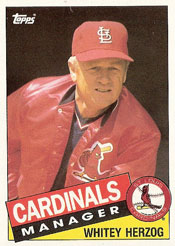
On July 22, 1986, a scuffle involving the Cardinals and Giants in St. Louis was sparked by a war of words between Herzog and Craig.

The Cardinals, powered by an eight-run fourth inning, led, 10-2, in the bottom of the fifth when their speedster, Vince Coleman, swiped second and third.

After a walk to Ozzie Smith, reliever Juan Berenguer threw a wild pitch to Willie McGee. As Coleman broke for home plate, catcher Bob Melvin recovered the ball and threw to Berenguer, who applied a hard tag on Coleman. Berenguer voiced his displeasure with Coleman for stealing bases with his team ahead by eight runs.

When Coleman next batted in the seventh, reliever Frank Williams spun him away from the plate with an inside pitch. Umpire Bob Davidson issued a warning to both teams. With his next delivery, Williams hit Coleman in the left leg.

Herzog and Craig, a former Cardinals pitcher, had a heated exchange at home plate and “got shoves in as umpire John McSherry tried to restrain them,” the St. Louis Post-Dispatch reported. Craig accused Herzog of ordering Coleman to steal in order to embarrass the Giants.

“Whitey is a great manager,” Craig said to the San Francisco Examiner, “but I told him that was bush.”

Herzog told the Post-Dispatch, “I guess he thinks he invented the damn game or something.”

Both benches emptied and skirmishes broke out.

Giants pitcher Mike Krukow butted Coleman with his head and Coleman wrestled him to the ground, according to The Sporting News. When Giants utility player Joel Youngblood tackled Cardinals pitcher Ricky Horton, Herzog grabbed Youngblood by the neck. Giants infielder Randy Kutcher tried to pry Herzog off Youngblood, and Herzog tangled with Kutcher.

According to the Post-Dispatch, Herzog said to Kutcher: “Oh, you want some of me?”

Someone spiked Cardinals second baseman Tommy Herr in the face and neck. He needed eight stitches to close the wound.

Craig, Williams and Giants third baseman Chris Brown were ejected.

“It’s an outrage,” Herzog told the Associated Press. “I’m talking about Roger Craig. It’s bush league. If he wants us to stop running, he can send over a note promising to stop trying to hit home runs.”

Replied Craig: “I’m glad it happened. It showed me what (the Giants) are made of.”

The players followed the lead of their managers.

“Vince is going to run regardless of what point of the game we’re in,” Herr said. “That’s his game.”

Said Cardinals outfielder Any Van Slyke: “To throw at Vince for running is like throwing at Mickey Mantle for hitting home runs.”

Said Youngblood: “You never want to humiliate your opponent. If you do, you have to be prepared to accept the consequences. It’s almost like an unwritten rule. It’s baseball.”

Giants first baseman Bob Brenly said to the Post-Dispatch, “They were kicking the snot out of us. There was no need to rub it in. I feel (Coleman) was trying to show us up.”

Said Coleman: “I wasn’t there to show anybody up.”

The fracas seemed to inspire the Giants. After pulling to within three runs, 10-7, the Giants had two runners on base with two outs in the ninth before Todd Worrell got Candy Maldonado on a flyout to right. Boxscore and Video

“They had the tying run at the plate in the ninth,” Herzog told The Sporting News. “That’s why we run.”

Read Full Post »

Described in a 1967 wire service story as having “the diplomacy and tact of a marine drill sergeant at boot camp,” Red Sox manager Dick Williams accused Cardinals pitcher Nelson Briles of deliberately hitting Boston slugger Carl Yastrzemski with a pitch in Game 3 of the World Series.

The incident was the biggest on-field controversy of that World Series.
Following the lead of their manager, Red Sox players complained bitterly.

Whether he hit Yastrzemski intentionally or, as Briles first claimed, the pitch squirted uncontrollably out of his tight grip, the Cardinals got the upperhand in a Series they would win in seven games.

Williams, a St. Louis native who grew up rooting for Cardinals outfielder Joe Medwick, was one of the game’s best managers. He led the Red Sox, Athletics and Padres to pennants, won consecutive World Series titles with Oakland and was elected to the National Baseball Hall of Fame.

In 1967, the fiery Williams took a dispirited Red Sox franchise that had finished ninth in the 10-team American League in 1966 and pushed them to an unlikely pennant in his first year as a big-league manager.

So respected was Williams that one of his managerial adversaries, Eddie Stanky, whose White Sox finished three games behind Boston in 1967, sent the Red Sox skipper a telegram that read, “You did a remarkable job. Continued success in the World Series. Win, lose or draw, you’re the greatest.”

Relishing the underdog role, Williams implored his players not to back down against the National League champions. After St. Louis won Game 1 behind ace Bob Gibson, Boston took Game 2 on Jim Lonborg’s one-hitter. Lonborg, following Williams’ tone, was the intimidator, brushing back several Cardinals.

Entering the pivotal Game 3 in St. Louis, the Cardinals needed to regain their swagger. Briles took the initiative, telling reporters the Red Sox are “a weaker hitting team than any team we face in the National League.”

After Boston leadoff batter Jose Tartabull grounded out against Briles to begin Game 3, the ball was being tossed around the infield until it got to third baseman Mike Shannon. In the book “Spirit of St. Louis,” Briles told author Peter Golenbock, “Shannon, who had a strong arm, … took the ball and tried to throw it through my chest. He was saying, ‘What the hell is going on? Isn’t anybody going to protect us?’ That’s the message that came with that throw.”

After the next batter, Dalton Jones, struck out, the ball again was whipped around the infield until reaching Shannon. He fired it back to Briles, with even more force than the first throw.

Briles got the message. Up next was Boston’s best player, Yastrzemski, who led the American League in batting average, home runs and RBI.

Briles’ pitch hit Yastrzemski in the back of the left leg, in the middle of the calf. As the Red Sox star went sprawling to the ground, Williams shot out of the dugout and confronted plate umpire Frank Umont.

“He did that deliberately,” Williams said to Umont. “What are we going to have, a throwing contest here?”

Umont replied, “Don’t worry. I’ll take charge of the situation.”

The umpire beckoned Cardinals manager Red Schoendienst and told both skippers that any more purpose pitches would result in substantial fines.

Yastrzemski attempted to steal second base and was thrown out by catcher Tim McCarver. Lou Brock then led off the Cardinals’ half of the first with a triple and scored on Curt Flood’s single. Inspired, the Cardinals went on to a 5-2 victory behind Briles’ complete-game seven-hitter. Boxscore

“From that point on,” Briles told Golenbock, “we had a Series. All that junk was out of the way. There were no more knockdowns, no more nonsense. And I think at that moment I gained the respect of the ballclub.”

After the game, Williams and his players lashed out.

“I know he was trying to hit him,” Williams told Will McDonough of the Boston Globe.

Said Lonborg: “When a pitcher goes behind the hitter like that, he is definitely trying to hit him. If a pitcher doesn’t have better control than that, he shouldn’t be in the big leagues.”

Yastrzemski told McDonough: “He tried to hit me. There’s no doubt about it.”

Briles and Schoendienst told different stories.

Briles to McDonough: “I didn’t throw at him. I was just gripping the ball too hard and the pitch got away from me.”

Said Schoendienst: “We hear so much about Lonborg brushing guys back.”

Responded Williams, “Yes, but there’s a difference between brushing someone back and deliberately hitting him.”

Red Sox pitcher Jose Santiago called the Cardinals “bush league” and Boston center fielder Reggie Smith said Briles “is a big-mouth popoff.”

All the huffing and puffing played into Briles’ hands. Smith admitted, “We wanted to beat him so bad that I think we got all fouled up. Everyone was overanxious and not waiting for good pitches.”

The Series went seven games, but only one other batter was hit by a pitch.

In Game 6 at Boston, Briles entered in relief to jeers in the fifth. The first batter he faced was Red Sox starting pither Gary Waslewski.

Briles hit him.

Read Full Post »

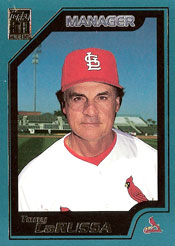
Besides ranking among the most successful managers, Tony La Russa and Casey Stengel have something else in common: Each had to leave his team during a season to receive treatment for a medical condition described as a virus.

At 66, La Russa, the Cardinals manager, sat out a six-game road trip to Chicago and Cincinnati in May 2011 to receive testing and treatment for shingles, a viral infection of the nerve roots.
At 69, Stengel, the Yankees manager who led them to 10 American League pennants and seven World Series titles, missed 12 games in 1960 when he entered a hospital for treatment of a virus condition that settled in his kidneys.

Known as “The Old Professor,” Stengel became ill on May 28, 1960.

When he was released from a New York hospital June 5, The New York Times reported the next day, “Casey Stengel, victorious in his battle with a low-grade virus, yesterday left Lenox Hill Hospital, where he had been confined since last Tuesday … Stengel, who first became ill on May 28, has been advised to rest for at least 24 more hours before resuming his job with the Bombers.”

Yankees coach Ralph Houk was acting manager in Stengel’s absence. The Yankees were 6-6 in the games Houk managed, including two doubleheaders.

Stengel returned to the Yankees on June 7. Dick Young of the New York Daily News described the scene at Yankee Stadium for The Sporting News: “He put on the white flannel uniform, and it felt good. For more than a week, he had worn nothing but silk pajamas or those baggy nightgowns they give you at the hospital, the ones that look shapeless enough to be Dior creations.”

Stengel met with reporters in the dugout before the Yankees faced the White Sox. Here is part of Dick Young’s account:

“You look good,” said a newspaperman, telling a little white lie.

“Well, I’ll tell you something,” said Casey. “They examined all my organs.

“Some of them are quite remarkable, and others are not so good. A lot of museums are bidding for them.”

Everybody laughed, including Stengel.

The Yankees, 22-21 when Stengel returned, beat the White Sox, 5-2, that night, sparking a seven-game winning streak. New York went on to win the American League pennant, finishing 97-57.

Read Full Post »

(Updated May 14, 2018)

A rough beginning doesn’t always result in a losing season. Some of the Cardinals’ best years began poorly:

_ 2011: Under manager Tony La Russa, the Cardinals lost six of their first eight and their relief pitching was a mess. However, they finished strong, posting an 18-8 record in September and qualifying for the postseason playoffs. From there, the Cardinals won the National League pennant and the World Series championship.

_ 2005: The Cardinals opened with a 3-4 record. Included in that stretch were back-to-back 10-4 and 13-4 poundings by the Phillies that led to concerns about St. Louis’ starting pitching. Jeff Suppan gave up 10 hits and six runs in four innings and Chris Carpenter was torched for 10 hits and eight runs in 3.1 innings. Carpenter finished with 21 wins, Suppan had 16 wins and the Cardinals earned the National League Central championship with a 100-62 record.

_ 2004: St. Louis started 1-3 and was 6-7 on April 19. The Cardinals lost three of four at home to the Brewers and were swept at home in a three-game series by the Astros. St. Louis went on to a 105-67 regular-season record and won its first pennant since 1987.

_ 2001: The Cardinals opened with three losses at Colorado and were 8-10 on April 22. In four of those losses, St. Louis gave up 10, 11, 13 and 17 runs. The Cardinals ended up 93-69, tied for first place with Houston in the NL Central and qualified for the playoffs.

_ 1985: After a 2-6 start, St. Louis still was struggling at 14-17 on May 14. Print reports speculated Whitey Herzog might be the first manager fired that year. The Cardinals opened with four consecutive losses _ two in extra innings and another by one run. St. Louis finished 101-61 and won the pennant.

_ 1982: The Cardinals started 1-3. Trailing the Pirates 6-5 with two outs and the bases empty in the bottom of the ninth, they were facing a fourth consecutive loss, but the Cardinals rallied to win 7-6, igniting a 12-game winning streak. The Cardinals finished 92-70 and won the World Series title.

_ 1942:  With a 6-7 record on April 29, the Cardinals were struggling for runs. They were held to three runs or fewer in six of their seven defeats. The Cardinals finished 106-48 and  were World Series champions.

_ 1934: St. Louis staggered to a 2-7 start. Dizzy Dean lost twice to the Cubs in that stretch. The Cardinals finished 95-58 and won the World Series championship.

_ 1930: The Cardinals dropped to 6-12 after losing a doubleheader to the Dodgers by scores of 2-1 in the opener and 11-10 in 13 innings in the second game. St. Louis went on to a 92-62 record and won the pennant.

Read Full Post »

This is the third of three parts from a telephone interview I conducted with former Cardinals all-star first baseman Bill White on March 23, 2011.

White has written an autobiography in collaboration with journalist Gordon Dillow. The book is called “Uppity: My Untold Story About The Games People Play” (2011, Grand Central Publishing). It is available on Amazon.

White, gracious with his time and thoughtful with his answers, didn’t dodge any questions.

Q: You got traded back to the Cardinals in April 1969. Was that a surprise?
Bill White: No. I had torn my tendon in ’67. I couldn’t play anymore after that. Gene Mauch (Phillies manager) would let the grass grow six inches at first base so that the ball would stop and I could walk over and toss it to the pitcher. I couldn’t run. I had no mobility. I probably should have gotten out then.

There was hope the tendon would come around. It never did.

In 1968, Dick Allen hurt his right hand. He tore all the tendons and he couldn’t throw. So they decided to put him at first base. We couldn’t have two cripples on the team. I couldn’t run and Rich couldn’t throw. But he was younger and could still hit.

The general manager of the Phillies called me and asked if I’d be willing to go back to the Cardinals. I said, ‘I don’t think so.’ He said, ‘Bing Devine (Cardinals general manager) wants you to come back.’

Bing brought me back because he wanted me to manage at (Class AAA) Tulsa and eventually manage the Cardinals. I didn’t want to manage. I didn’t want to try to tell 25 other guys how to play the game. I’d rather do something where the success depends on me, not on other people.

Q: Elston Howard had said the Cardinals contacted him about replacing Harry Caray on the Cardinals broadcast team after the 1969 season …

Bill White: When Harry Caray was fired, I had gone to St. Louis and accepted the job. Jack Buck and (KMOX station boss) Bob Hyland and I sat down and we talked about it. I was very close with Buck.

I had already accepted the job. So when I flew back to Philadelphia, I started thinking about moving the family back to St. Louis. They were in schools in Philadelphia. And Philadelphia had some great colleges. I thought about that.

I also thought about replacing Harry Caray, who was extremely popular in St. Louis, and I thought that was a negative. So I called Bob Hyland back and I said, ‘Bob, I’m sorry, but I have changed my mind. I’m going to stay here in Philadelphia.’

Jack Buck wasn’t very happy with that. Jack was a great guy. When I was trying to buy a home in St. Louis and having a problem, Jack invited me over to his house and he said, “I’m going to find you a home here in this area.’ I said, ‘Jack, I can’t afford to live here.’ I think I was making $12,000 or $14,000 a year.

But those are the kinds of things you appreciate. And when I did take the Yankees (broadcast) job (in 1971), Jack called me and sort of chuckled and said, ‘You didn’t want to work for me. You want to work for those bums.’

I flew out to St. Louis and spent six hours at the stadium club, talking with Jack Buck and taping our conversation about how to broadcast.

Q: So many players from that ’64 Cardinals team have gone on to become successful broadcasters _ you and Tim McCarver and Bob Uecker and Mike Shannon and even Bob Gibson and Lou Brock did some broadcasting. Why do you think that was?

Bill White: We were better B.S.ers than players (laughter).

I think it was mainly Bob Hyland. And Jack Buck. Jack didn’t mind helping. A lot of broadcasters didn’t want to help you. They didn’t feel players should go directly from the field into the broadcast booth.

That happened to Phil Rizzuto (of the Yankees). Red Barber and Mel Allen really treated him badly. They didn’t want him up there. They had spent so many years honing their craft and they didn’t want a ballplayer up there with them. Phil talked about that. We discussed that quite a bit.

Q: I’m going to finish with a name association. I have five names and I’m going to ask you to respond to each. First, Stan Musial.

Bill White: Stan, for flat-out hitting, was the best hitter I’ve seen. I argued with Rizzuto regarding Joe DiMaggio and Ted Williams. But Stan was the best I’ve seen.

Q: Ken Boyer.

Bill White: Best third baseman I played with. For a big guy, he ran well. He drove in runs, did a great job fielding, and he didn’t get the publicity he should have gotten. When I was on the Veterans Committee for the Hall of Fame, I tried to get Ken’s name on that list, because he belongs with great consideration for the veterans part of the Hall of Fame.

Q: Curt Flood.

Bill White: Curt Flood was an excellent center fielder and a great leadoff man. Prior to Brock coming, he was our catalyst. He started things. When we got Brock, it made it even better. We had two guys, batting one and two, who were always on base.

Q: Bob Gibson.

Bill White: One of the greatest competitors I played with, not only just pitching. On the bench, he pushed you. We were always good friends. One of the greatest pitchers I’ve seen.

Q: Albert Pujols.

Bill White: I’ve never seen him play, except for one exhibition game in Florida many years ago when I visited Bob Gibson. But if you look at his stats, he’s one heck of a player.

Do they knock him down? Oh, you can’t knock anybody down anymore, can you? That makes hitting a lot easier.

Bill White Interview: Part 1 // Part 2

Read Full Post »

The 1956 Cardinals had an unremarkable record with a remarkable cast of leaders.

Hampered by a pitching staff that yielded 698 runs (third-highest total in the National League), the Cardinals, managed by Fred Hutchinson, finished in fourth place at 76-78.

Yet nine players on the 1956 Cardinals became major-league managers. In alphabetical order, they are:

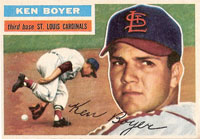
_ Ken Boyer: In his second big-league season, the third baseman became a star in 1956, with 26 home runs, 98 RBI and a .306 batting average. As Cardinals manager from 1978-80, he was 166-191, though he did post a winning record (86-76) in his only full season (1979).

_ Alvin Dark: Acquired from the Giants on June 14, 1956, in a trade involving fan favorite Red Schoendienst, Dark played shortstop and hit .286. In 13 years as a big-league manager (Giants, Athletics, Indians, Padres), Dark was 994-954. He won pennants in both leagues (1962 Giants and 1974 Athletics) and a World Series title (1974 Athletics).

_ Joe Frazier: A 33-year-old outfielder in 1956, Frazier hit .211 in 14 games for the Cardinals before being traded to the Reds on May 16 with shortstop Alex Grammas for outfielder Chuck Harmon. After managing the Mets to an 86-76 record in 1976, Frazier was replaced by Joe Torre when the Mets went 15-30 to start 1977.

_ Alex Grammas: In his third season with the Cardinals, Grammas was the Opening Day shortstop in 1956 and hit .250 in six games before being dealt with Frazier to the Reds. After managing the Pirates for five games at the end of the 1969 season, Grammas managed the Brewers in 1976 and 1977. His big-league managerial mark: 137-191.

_ Grady Hatton: A reserve second baseman, Hatton hit .247 in 44 games for the 1956 Cardinals before his contract was sold to the Orioles on Aug. 1. As Astros manager from 1966-68, he was 164-221.

_ Solly Hemus: A Cardinals player since 1949, Hemus was traded to the Phillies on May 14, 1956, for infielder Bobby Morgan. He was 190-192 as Cardinals manager from 1959-61, including an 86-68 record in 1960.

_ Whitey Lockman: Acquired from the Giants along with Dark, the outfielder batted .249 in 70 games in his only Cardinals season. Lockman was 157-162 as Cubs manager from 1972-74.

_ Red Schoendienst: An eight-time all-star as a Cardinal, the second baseman was hitting .314 for St. Louis in 1956 when he was traded to the Giants. As Cardinals manager from 1965-76 (plus stints as an interim in 1980 and 1990), Schoendienst won two pennants (1967, 1968), a World Series championship (1967) and compiled a record of 1,041-955.

_ Bill Virdon: The Opening Day center fielder for the Cardinals was hitting .211 in 24 games when traded to the Pirates on May 17 for pitcher Dick Littlefield and outfielder Bobby Del Greco. In 13 years as manager of the Pirates, Yankees, Astros and Expos, Virdon was 995-921.

Read Full Post »

« Newer Posts - Older Posts »