Feeds:
Posts
Comments

Archive for the ‘Managers’ Category

Immediately after the Cardinals beat the Dodgers in the playoff game that decided the 1946 National League pennant, Dodgers general manager Branch Rickey and his assistant, Arthur Mann, hustled into the home team clubhouse at Ebbets Field.

Rickey wanted to talk with Dodgers manager Leo Durocher, but the door to Durocher’s office was closed and locked. Rickey and Mann plopped down on a trunk filled with uniforms and waited.

Finally, when the door swung open, Rickey rose and started in, but was brushed aside by a small, brusque man.

“Just a minute, Pop,” the man said to Rickey. “Stand back.”

Startled, Rickey obeyed.

As the man pressed ahead, another followed close behind. As the second man passed, he said, “Hello, Branch.”

According to Mann in a piece published in the Newark Star-Ledger, the following exchange took place:

Rickey: “Who was that?”

Mann: “The little fellow in the front was Killer Gray, the bodyguard.”

Rickey: “And what body was he guarding?”

Mann: “George Raft, the movie actor.”

As Mann noted, “Rickey was nettled, but not because Raft got there first. He was distressed that Raft had got there at all.”

Described by the New York Times as “the cool tough guy who specialized in gangster roles,” Raft earned millions in his film career, but as he told Lloyd Shearer of Parade magazine, “Part of the loot went for gambling, part for horses and part for women. The rest I spent foolishly.”

A passionate baseball fan, Raft became a friend of Durocher, going back to Leo’s playing days, including his time as shortstop for the Gashouse Gang Cardinals. They spent lots of time together until baseball’s commissioner put a stop to it.

Street hustler

Raft (the original name was Ranft) grew up in the tough Hell’s Kitchen section of New York City at 41st Street and 10th Avenue. “You had to fight for your life everyday,” Raft said to the Saturday Evening Post. In recalling how he survived, Raft told the Los Angeles Times, “I could run good, and I carried a rock in the toe of an old sock.”

After quitting school in the seventh grade, he sold newspapers on street corners, was a bat boy for the New York Highlanders (who became the Yankees), delivered groceries and had a stint as an electrician’s apprentice.

Eventually, Raft tried boxing. In 14 pro fights as Dutch Rauft, he had nine wins, three defeats and two draws, according to Ring magazine. In 1911, Raft turned to baseball. He had a two-day tryout with the minor-league Springfield (Mass.) Ponies but didn’t make the team, according to the Springfield Republican.

Raft found success in his next undertaking as a dancer. Fast on his feet, he was adept at dancing the Charleston and tango. Working in New York City dance halls and nightclubs as a paid partner, or gigolo, Raft “charmed well-to-do women for money and favors,” according to the New York Times.

It was during this time that Raft began associating with gangsters. As Florabel Muir of the New York Daily News noted, “He was fascinated by them _ the lavish way they lived, the mysterious and underhanded way they did business, by their power and the perilous hold they had on life.”

One of Raft’s pals, mobster Benjamin “Bugsy” Siegel, got his nickname because he was “crazy as a bedbug,” according to PBS. “He hated to be called Bugsy,” Raft told Dean Jennings of the Saturday Evening Post, “and nobody in the mob dared use that word.”

Asked if he ever picked pockets or rolled a drunk, Raft replied to Dean Jennings, “Yes, I’m sorry to say. During Prohibition, we thought all the customers in the speakeasies were fair game.”

Raft also said he delivered bootleg booze for mobster Dutch Schultz and drove a bulletproof sedan for Owney Madden, a gang leader and bootlegger who operated the Cotton Club in Harlem. “I had a gun in my pocket and I was cocky because I was working for the gang boss of New York,” Raft recalled to the Saturday Evening Post. “I was as good as any driver in the mob, and I could have steered Owney’s car on the subway tracks without getting a scratch on the enameled armor plate.”

Leo Durocher was early in his playing career with the Yankees at this time. According to the book “Leo Durocher: Baseball’s Prodigal Son” by Paul Dickson, “Raft and Durocher first met in a poolroom on 48th Street and liked each other instantly … Raft was naturally drawn to the young ballplayer, who seemed every bit as brash as he was.”

Raft’s dancing got him parts in Broadway shows and his association with Owney Madden helped get him his start in Hollywood films. “The underworld put up money so I could try my luck in Hollywood,” Raft told the Saturday Evening Post.

Going Hollywood

The role that brought Raft stardom was his portrayal of playboy gangster Guino “Little Boy” Rinaldo, performed with coin-flipping menace, in the 1932 film “Scarface.” Other strong performances came in “Bolero” (1934), “Each Dawn I Die” (1939), “Invisible Stripes” (1939) and “They Drive by Night” (1940).

In a 2018 retrospective of Raft, Josh Sims of The Rake magazine wrote, “Other men of his era _ James Cagney, Spencer Tracy, Humphrey Bogart, Cary Grant, Gary Cooper _ entered the annals of cool, but the much-less-famous Raft embodied it. They played tough; he was tough.”

Unwittingly, Raft played a part in helping Bogart become a Hollywood legend. Raft turned down the lead roles in “High Sierra” and “The Maltese Falcon.” According to the Los Angeles Times, studio boss Jack Warner considered Raft for the lead in “Casablanca.” All of those parts went to Bogart.

Raft’s acting style might best be described as deadpan. Or, as Josh Sims wrote, “Raft made self-effacement an art form.” At a Friar’s Club event, comedian George Burns cracked, “Raft once played a scene in front of a cigar store, and it looked like the wooden Indian was overacting.”

“I don’t try to act,” Raft told the Detroit Free Press. “I try to get what the fellow in the story means, but I certainly can’t act.”

On set, he took punches at fellow actors Edward G. Robinson, Wallace Beery and Peter Lorre “because I thought they were needling me about my background,” Raft told the Saturday Evening Post.

He appeared in more than 100 movies. According to Josh Sims, Raft said, “I was killed 85 times. How unlucky can you go, right? I did pretty well with the girls, but, in the pictures, always got killed.”

Though married for 47 years, Raft and his wife separated early on. Among the actresses he romanced were Marlene Dietrich, Betty Grable, Carole Lombard, Norma Shearer and Mae West.

In West’s first film, “Night After Night,” starring Raft, she wrote some, or most, of her dialogue. When West enters a joint run by Raft, the checkroom clerk, dazzled by the jewelry, says, “Goodness, what beautiful diamonds.” West replies, “Goodness had nothing to do with it, dearie.”

Buddy system

Raft and Durocher stayed in contact as both grew their careers. When Durocher played for the Cardinals in the 1934 World Series, Raft attended games in St. Louis and Detroit, signing autographs for fans in the stands.

According to the New York Daily News, Raft “will gamble on anything, but he especially likes the horses … He likes to bet on baseball and football games, too. He will bet at the drop of a hat on either side of any known chance.”

In 1939, when Durocher became Dodgers manager, he and Raft hung out often. As author Paul Dickson noted, “The friendship was such that Durocher began parting his hair, dressing and talking like Raft. Durocher visited with Raft when he was in California, and Raft stayed with Leo in New York. Durocher had a duplicate Dodgers uniform _ complete with his number 2 _ made for Raft.”

When the Dodgers reached the World Series in 1941, Durocher gave his four tickets behind the dugout to Raft. Baseball commissioner Kenesaw Mountain Landis objected because of Raft’s gambling. Raft was put in different seats. After the World Series, Durocher, without his wife, moved into Raft’s 14-room house in the Coldwater Canyon section of Beverly Hills.

“Durocher’s infatuation with Hollywood in general and George Raft in particular seemed to intensify,” wrote author Paul Dickson. “Durocher was now dressing exactly like Raft, copying all of his details … Raft’s own tailor now made Leo’s clothes as well.”

Bad for business

Raft made headlines in 1944 for two gambling incidents.

In March, while Durocher was with the Dodgers at spring training, Raft was staying at Leo’s place on East 64th Street in Manhattan. Paul Dickson described it as “a plushy terrace apartment with a built-in bar whose stools were made of catchers mitts mounted on baseball bat tripods.” After the New York premiere of his movie “Follow the Boys,” Raft gave a party at the apartment.

One of the guests, Martin Shurin Jr., an aircraft parts manufacturing executive, filed a complaint with the New York district attorney, claiming he lost $18,500 that night to Raft in a crooked dice game. Raft said the amount was $10,000 and that the dice weren’t loaded. No formal action was taken against Raft, but Durocher now was linked publicly to high-stakes gambling.

Two months later, in June 1944, police raided a Hollywood apartment and arrested Bugsy Siegel for bookmaking. Raft was in the apartment, too. At the trial, Raft testified for the defense. “I’m ready to swear on all the St. Christopher medals I wear and everything else holy that there was no bookmaking being done,” Raft said on the witness stand.

Siegel pleaded guilty to a lesser charge, a misdemeanor, and received a small fine, the New York Daily News reported.

Durocher continued to reside in Raft’s house during baseball off-seasons. They also attended the 1946 World Series between the Red Sox and Cardinals. Newspapers published photos of Durocher, Raft, saloonkeeper Toots Shor and Joe DiMaggio seated together at a game in Boston.
The Cardinals’ 20-year-old catcher, Joe Garagiola, told syndicated columnist Jimmy Cannon, “I read in the newspapers that movie stars are here watching me play. I want to get a look at them. I want to see how they look in person. I saw Chico Marx the other night and I was looking for George Raft all day.”

Breaking up

In a series of columns he wrote for Hearst newspapers, Westbrook Pegler said the relationship between Durocher and Raft was bad for baseball and would lead to a gambling scandal similar to the one that tainted the 1919 World Series.

Happy Chandler, who succeeded Kenesaw Mountain Landis as baseball commissioner, met with Durocher in November 1946 and told him to move out of Raft’s house and end all contact with him. Durocher had stayed with Raft for nine winters in a row.

Following Chandler’s orders, Durocher returned to Raft’s house to remove his belongings. According to Paul Dickson’s book, when Durocher began to explain to his friend what Chandler commanded, Raft interrupted and said, “I know what he says. You’ll hurt your career chances hanging around with me. I don’t want that to happen. You better move out.”

Durocher replied, “Yeah, I better.”

According to Paul Dickson, Durocher “packed his bags that night and moved out the next morning. The two men never were seen alone together again.”

“Twenty years of friendship out the window,” Raft lamented to Parade magazine.

In January 1947, Raft met with Chandler, hoping to get the commissioner to change his mind about his directive to Durocher, but was unsuccessful. In his autobiography, Chandler recalled Raft said to him, “I got a bum rap.” Chandler replied, “I didn’t give it to you.”

Rough stuff

Under pressure to take action for Durocher’s perceived continued involvement with underworld figures, Chandler in April 1947 suspended Durocher for one year for conduct “detrimental to baseball.”

Two months later, in June 1947, Bugsy Siegel was killed in a hail of bullets while he sat on a couch reading a newspaper near a window inside the Beverly Hills home of an acquaintance, Virginia Hill. Shortly before midnight, the killer (never identified) rested a .30-caliber carbine rifle “on a white rose trellis in the driveway of the house next door and pumped nine bullets through a window,” the New York Daily News reported.

“Half of the mobster’s face was torn away and his right eye was found 15 feet across the room on the tiled floor. He … never knew what hit him,” Florabel Muir of the New York Daily News reported from the scene.

Dr. Fredrick Newbarr, who performed the autopsy on Siegel, called it a “typical gangland slaying,” the Los Angeles Daily News reported.

Beverly Hills police chief C.H. Anderson told the Los Angeles newspaper he wanted to question Raft for information about Siegel. Bodyguard Killer Gray, speaking for the actor, said Raft didn’t know what the shooting was all about.

(During a 1940 murder trial, a $3,200 check written by Siegel and endorsed by Raft was uncovered. At the time of Siegel’s murder, speculation was Siegel may have owed Raft $100,000, the Los Angeles Times reported. Raft denied it.)

In her gossip column, noting that Hollywood producers were considering a movie about Siegel, Hedda Hopper suggested Raft “would be a natural” for the lead role.

Read Full Post »

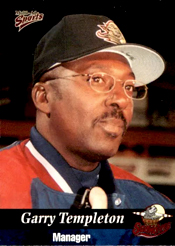
As a Cardinals player who struggled to manage his emotions, Garry Templeton didn’t seem a likely candidate to manage others. Yet that’s precisely what he did.

A shortstop for 16, sometimes stormy, seasons in the big leagues, Templeton went on to spend 13 years as a manager in the minors, often at the lowest levels.

He managed in the Angels’ system for four seasons, including two at Class AAA, one rung below the big leagues, and then for nine years with teams in independent leagues.

Beginning with Cedar Rapids, Iowa, in 1998 and concluding with Newark, N.J., in 2013, Templeton had an overall record of 636-692 as a manager. He was 294-272 with the Angels’ farm teams; 342-420 with the independent league clubs.

Asked why managing appealed to him, Templeton told the Cedar Rapids Gazette, “I like having a hand in everything … I like that challenge.”

Of the many players the former Cardinal managed, some who went on to become Cardinals were David Eckstein and John Lackey.

Growing pains

Templeton was 20 years old when he reached the majors with the Cardinals in 1976. He was exciting as well as excitable, and his six seasons with St. Louis were a mix of thrills and turmoil.

A switch-hitter with speed, Templeton was the first major-league player to get 100 hits from each side of the plate in a season. He produced a league-high 211 hits _ 111 from the left side; 100 from the right _ for the 1979 Cardinals. He also led the National League in triples for three consecutive seasons while with St. Louis (1977-79).

Before he turned 25, his prime years still ahead, Templeton was one of the sport’s top talents, but there was unhappiness. At 1979 spring training, Templeton asked the Cardinals to trade him and threatened to play at less than his best if his request wasn’t granted. During the season, he was chosen as a reserve on the National League all-star team, but turned down the opportunity because he said he should have been the starting shortstop.

Two years later, Templeton created his biggest tempest when he made obscene gestures to St. Louis spectators after he got booed for not hustling. Enraged by Templeton’s behavior, manager Whitey Herzog pulled him down the dugout steps and backed him against a wall before teammates separated them. The Cardinals suspended and fined Templeton, then moved him to the disabled list when he entered a St. Louis hospital for treatment of emotional problems.

During the winter, the Cardinals traded him to the Padres for a future Hall of Famer, Ozzie Smith.

“Of the thousands of players I’ve seen come and go, two who stand out are Garry Templeton and Dave Parker,” Cardinals broadcaster Jack Buck told the St. Louis Post-Dispatch in 1997. “I thought both could have been among the greatest players of all time … Templeton had more tools than Ozzie Smith, but Smith made himself a great player by working hard at it, and Templeton let his skills diminish because he didn’t work hard enough.”

Former Cardinals first baseman Keith Hernandez said to the New York Times in 2000, “The two greatest young players I ever saw were Darryl Strawberry and Garry Templeton, and both squandered it.”

In reflecting on those Cardinals days, Templeton told the Albuquerque Tribune in 2000, “I came into this game at a very young age. I think as a player everyone matures. It’s something gradual that happens. When you’re that young, you don’t even think about what things mean. You don’t think about what you’re saying.”

He also said to the Hammond (Ind.) Times in 2003, “I was just young and did young, foolish things … I wasn’t a hothead. I was more immature.”

Proud Padre

With the Padres, Templeton helped them to their first National League pennant (he hit .316 in the 1984 World Series) and was a steady contributor despite issues with his knees. (Templeton ranks second to Tony Gwynn for most career hits, doubles and games played as a Padre.)

He also had a good relationship with manager Dick Williams and their discussions got Templeton thinking about becoming a manager. “I’d ask (Williams) why he did certain things, and he’d tell me,” Templeton recalled to the Cedar Rapids Gazette. “We talked a lot of strategy. I learned a lot about the game. I learned how to play to win.”

Eventually, Templeton was asked by general manager Jack McKeon to help teach young teammates such as infielders Roberto Alomar, Joey Cora and Bip Roberts. Templeton found he liked doing it and was effective. “I love to teach,” Templeton told the Cedar Rapids Gazette.

After his playing days, Templeton was a roving infield instructor and baserunning coach in the Padres’ farm system in 1994 and 1995, then went home to be with his wife and their two sons and a daughter. He also developed a passion for golf. According to Mark Whicker of the Orange County Register, “Templeton had gotten so good (at golf) that he was playing in Golden State Tour events as an amateur and said he was seriously considering the PGA Tour Qualifying School.”

Then he got a call from a former Padres teammate, Angels minor-league hitting coach Gene Richards, who told him the Angels needed a manager for their Cedar Rapids farm club.

Manager material

Templeton applied for the job and was hired for the 1998 season by Angels director of player development Ken Forsch, brother of Templeton’s former Cardinals teammate, Bob Forsch. “His strength is teaching,” Ken Forsch said to the Cedar Rapids Gazette in explaining why he hired Templeton.

A skeptical Post-Dispatch declared, “Picture this: Garry Templeton sitting in the dugout of the Cedar Rapids Kernels, wearing a red, blue and silver uniform with a corncob logo and managing Class A ballplayers. Hard to imagine, if your memories of (Templeton) include him making obscene gestures to the Busch Stadium crowd at Ladies Day.”

Templeton, though, said he was committed to the task and that his goal was to return to the majors as a manager or coach. “This is the route I have to go,” he said to the Gazette. “I guess you could say I have to crawl before I can walk.”

Climbing the ladder

After a season at Cedar Rapids, Templeton was promoted to Class AA Erie, Pa., in 1999 and did well there, too. Baseball America magazine named Templeton the best managerial prospect in his league after each of his first two seasons.

Among the future big-leaguers he managed were pitchers Ramon Ortiz, Scot Shields and Matt Wise, and third baseman Shawn Wooten.

Templeton moved a step closer to his goal of the majors when he was named manager of Class AAA Edmonton for the 2000 season. Edmonton’s hitting coach was Templeton’s former Cardinals teammate, Leon Durham, who also was working to rebuild his baseball career. Durham got suspended for failing a drug test with the Cardinals in 1989, his final year as a big-league player.

Among the players on Edmonton’s roster was Edgard Clemente, nephew of Hall of Famer Roberto Clemente.

Edmonton was where David Eckstein revived his career. Placed on waivers in August 2000 after hitting .246 for the Red Sox’s Pawtucket farm club, Eckstein was claimed by the Angels, who assigned him to Edmonton. Playing for former Cardinals shortstop Templeton, future Cardinals shortstop (and World Series MVP) Eckstein hit .346. The Angels made him their shortstop the following year and Eckstein helped them become World Series champions in 2002.

Another future big-leaguer on that 2000 Edmonton team was pitcher Jarrod Washburn. “These guys are close to the next level,” Templeton told the Albuquerque Tribune. “I’m here trying to help them build on a few things and learn a few new things to get there.”

The Angels moved their Class AAA club to Salt Lake City for 2001. At the introductory news conference, Templeton and Angels front office staff wore Mickey Mouse ears, “welcoming Utah’s only triple-A team to the Disney Corp. family,” the Salt Lake City Tribune reported.

Among those who played for Templeton at Salt Lake City were catchers Bengie and Jose Molina (brothers of Yadier Molina) and John Lackey, who would pitch in the World Series for the Angels (2002), Red Sox (2013) and Cubs (2016), and in the playoffs for the Cardinals (2014-15).

The Angels, though, were overhauling their front office and Templeton wasn’t in the plans. General manager Bill Stoneman fired him after the 2001 season.

“He didn’t give me any reason other than (Angels manager) Mike Scioscia wanted someone easier to work with,” Templeton told the Salt Lake City Tribune. “It’s too bad … The Angels were good to me, but I felt I had at least one more year there.”

Wheel of Fortune

The next stop for Garry was Gary _ as in Gary, Ind., where he was named manager of a team in the Northern League. A son, Garry II, played for him there, but it didn’t work out. Templeton was fired after two seasons.

He then managed three teams in the Golden League (Fullerton, Long Beach, Chico) and one each in the North American League (Maui) and Canadian-American Association (Newark). One of the investors in the Golden League was TV game show host Pat Sajack. “I’m not in this to make money,” Sajack told the Los Angeles Times. “I’m in it to be closer to a game that I like very much.”

At Long Beach, Templeton managed a couple of former big-league pitchers trying to make comebacks _ Hideki Irabu and Jose Lima.

A year later, when Templeton managed the 2010 Chico Outlaws, one of his pitchers was Eri Yoshida, an 18-year-old Japanese woman knuckleball specialist. She said she learned to throw a knuckleball by watching video of Red Sox pitcher Tim Wakefield.

Yoshida was 0-4 for Chico but she played again for Templeton with Maui in 2011 and got her first win as a professional in the United States. “She’s not taken seriously (by others),” Templeton told the Honolulu Star-Advertiser. “Most people think of her as a novelty act, but you’ve got to look at her as if you’re looking at one of these guys who are out here trying to make it … I don’t see anything different between her and the (men) players.”

Another on the Chico roster was first baseman John Urick, a former Yankees prospect. Urick and Templeton had a serendipitous connection _ Whitey Herzog. Nearly 30 years after being yanked down the dugout steps by Herzog, Templeton was managing Whitey’s grandson.

Read Full Post »

Joe Schultz batted in a minor-league game when he was 14, played nine years in the majors, helped develop Cardinals prospects such as Bob Gibson and Tim McCarver, and coached for St. Louis clubs that won two World Series titles and three National League pennants.

The role that defined his baseball career, though, was his one season as Seattle Pilots manager.

In November 1969, Schultz was fired after the Pilots finished at the bottom of their division in their only American League season.

Instead of it being a footnote in his career, Schultz’s stint with Seattle became a climax because of the book “Ball Four.” In chronicling his time with the Pilots, pitcher Jim Bouton made Schultz a central figure in the bestseller.

All in the family

Though born in Chicago, Joe Schultz Jr. grew up in the family home in St. Louis on Labadie Avenue, a couple of blocks from Sportsman’s Park. His father, Joe Sr., was an outfielder who played 11 seasons in the majors, including from 1919-24 with the Cardinals. In those days, little Joe Jr. “wore a cutdown Cardinals uniform, circled the bases after games at Sportsman’s Park and slid until he was a tired tyke,” according to Bob Broeg of the St. Louis Post-Dispatch.

After his playing days, Joe Sr. managed in the minors, including three seasons (1930-32) with the Cardinals’ Houston farm team. During the summers, Joe Jr. joined his dad wherever he was managing.

Dizzy Dean pitched for Joe Sr. at Houston. The manager let his 12-year-old son catch Dean’s warmup throws. “I’d catch him all right _ until he really cut loose,” Joe Jr. recalled to the Post-Dispatch.

(Nearly 30 years later, when Joe Jr. managed Omaha, Bob Gibson pitched for him. So, father and son had the distinction of managing Dizzy Dean and Bob Gibson.)

In 1932, just after he turned 14, Joe Jr. made his pro baseball debut.

“My dad was managing Houston and we were playing Galveston in the last game of the season,” Joe Jr. recalled to the Kansas City Star. “He got to the ninth inning and sent me up (to bat). A left-hander named Hank Thormahlen (35 years old and a 20-game winner) was pitching. I got a single to center field. I don’t remember being nervous about it. I guess I was too young to realize what was happening.”

(After a stint as a Cardinals scout _ he was the one who recommended pitcher Mort Cooper to them _ Joe Sr. became farm director of the Pirates. He was in South Carolina to see Pirates farm teams training there when he died at age 47 of ptomaine poisoning.)

Player and teacher

As a ballplayer for St. Louis University High School and the Aubuchon-Dennison American Legion team, Joe Jr. “could pop the ball on the roof at Sportsman’s Park,” the Post-Dispatch declared.

The Cardinals signed Joe Jr. in 1936 and sent him to their farm club at Albany, Ga., where he roomed with another catcher from St. Louis, Bob Scheffing. (Like Joe Jr., Scheffing would play and manage in the majors.)

Schultz reached the big leagues with the Pirates in September 1939, but the next year, in the minors at Portland, he broke his right shoulder when he tripped over first base. Three years later, he hurt his throwing arm again. “It’s tough catching when you can’t throw properly,” Schultz said to the Post-Dispatch. “Like trying to play the piano without fingers.”

A backup catcher with the Browns (1943-48), Schultz excelled as a pinch-hitter. In 1946, he had a .516 on-base percentage (10 hits, six walks) in 31 plate appearances as a pinch-hitter. The left-handed batter hit .386 overall (22 for 57) that season.

After a year (1949) as a Browns coach, Schultz managed in the farm systems of the Browns, Indians, Reds, Orioles and Cardinals. He managed Cardinals farm teams from 1958-62. The former catcher was instrumental in the development of Tim McCarver, who played for three minor-league teams Schultz managed.

Calling McCarver “a natural born leader,” Schultz said to the Post-Dispatch, “He’s got the best hustle, drive, and most contagious winning spirit I’ve ever seen.”

After leading Atlanta to an International League championship in 1962, Schultz was promoted to the coaching staff of Cardinals manager Johnny Keane. (Thirty years earlier, Keane played shortstop and hit .324 for a Springfield, Mo., squad managed by Schultz’s father.)

Schultz coached first base for the 1964 World Series champion Cardinals. After Keane left for the Yankees, his successor, Red Schoendienst, retained Schultz and made him the third-base coach. Schultz also continued to mentor McCarver, who became an all-star with the Cardinals.

“I feel that my catching has become better,” McCarver told the Post-Dispatch in 1966. “A big reason is Joe Schultz. Schultz stays on me all the time, reminding me to work my arm up and throw strikes. He keeps driving me to work harder on defense and with the pitchers.”

(Schultz also liked backup catcher Bob Uecker. He told the Post-Dispatch, “Uecker has an excellent arm. He gives the pitcher a good target. He moves well around the plate and is an outstanding handler of pitchers.”)

In September 1968, with the Cardinals on their way to securing a second consecutive National League pennant, Schultz was named manager of the Seattle Pilots. He beat out two former Seattle minor-league managers, Joe Adcock and Bob Lemon, for the job.

No pressure

Schultz, 51, brought a relaxed, old-school style to managing the expansion club.

“I liked Joe Schultz a lot,” Pilots infielder John Kennedy said to the Everett (Wash.) Daily Herald. “He knew what he was dealing with. He wanted to win, but he was realistic enough to know that our chances of winning were also slim and none. So he took it that way. He was a fun guy to play for.”

Jim Bouton told the newspaper, “Joe was an easygoing guy, very spontaneously funny, very unintentionally funny. I don’t think he could really stomach being a baseball manager. He was much more suited to the backslapping and cheerleading that comes better from a coach.”

“Ball Four” is filled with examples of Schultz’s sanguine sayings to his players:

_ “Well, boys, it’s a round ball and a round bat and you got to hit it square.”

_ “Boys, I guess you know we’re not drawing as well at home as we should. If we don’t draw fans, we’re not going to be making the old cabbage.”

“OK, men, up and at ’em. Get that old Budweiser.”

On June 9, John Gelnar escaped a bases-loaded jam in the 10th inning to earn his first save in a Pilots victory at Detroit. According to Bouton, in the clubhouse afterward, Schultz told his team, “At a way to stomp on ’em, men. Pound that Budweiser into you and go get ’em tomorrow.” Then he spotted Gelnar sipping from a pop bottle. “For crissakes, Gelnar,” Schultz said, “You’ll never get them out drinking Dr. Pepper.” Boxscore

(“Some people have said I made all that stuff up,” Bouton told the Everett newspaper. “My answer is that I can’t write that well. I could never have dreamed up Joe Schultz. I’m not that clever.”)

In “Ball Four,” Bouton wrote, “There’s a zany quality to Joe Schultz that we all enjoy and that contributes to keeping the club loose.”

The Pilots won three of their first four games and continued to surprise skeptics with their play the first two months of the 1969 season. On May 27, their 20-21 record gave them a better winning percentage than the White Sox (17-19), Yankees (21-24), Senators (21-26), Angels (12-28) and Indians (10-27).

Tommy Harper, an infielder and outfielder who’d been in the majors since 1962, thrived under Schultz, who told the Kansas City Star: “At the start of the season, I called Harper in and told him, ‘Why don’t you be like Lou Brock? You can make yourself better known and earn some money. You’ve got speed. Any time you can get a jump, go ahead and steal.”

Emboldened, Harper had 73 steals for the 1969 Pilots and they led the major leagues in stolen bases (167). As Bouton noted of Schultz in his book, “He’s letting Harper run on his own and letting the guys hit and run, and he doesn’t get angry when they get thrown out stealing. It makes for a comfortable ballclub.”

The Pilots also had Don Mincher (25 homers) and Tommy Davis (80 RBI), plus a deep bullpen with Diego Segui (12-6, 12 saves), Bob Locker (2.18 ERA, six saves), John O’Donoghue (2.96 ERA, six saves) and Bouton (2-1, 3.91 ERA).

Overall, though, Pilots batters struck out too much (1,015 times, most in the league) and their pitchers gave up the most runs (799) and most home runs (172) in the majors.

After stumbling to 9-20 for July and 6-22 for August, the Pilots finished 64-98.

One and done

Though as Bouton noted in his book, “I’ve heard no complaints about Joe. I think he’s the kind of manager everybody likes,” Pilots general manager Marvin Milkes fired Schultz.

“I have no regrets,” Schultz told the Tacoma News Tribune. “I thought we did all right for the first year. The players hustled and never got into any trouble … We were an entertaining club … In the end, it’s always the manager’s fault, but I can go down in the record books as the one and only Pilots manager.”

Indeed, with ownership in financial trouble, the franchise was sold, moved to Milwaukee for the 1970 season and renamed the Brewers.

Schultz was a Royals coach in 1970, then joined manager Billy Martin’s staff with the Tigers in 1971. When Martin was fired in September 1973, Schultz became interim manager and guided the Tigers to a 14-14 record. He remained a Tigers coach on manager Ralph Houk’s staff through the 1976 season.

Asked his opinion of “Ball Four,” Schultz told Rich Myhre of the Everett Daily Herald he never finished reading it. “I wouldn’t waste my time reading the rest of it,” he said.

However, according to Bouton in his follow-up book, “I’m Glad You Didn’t Take It Personally,” Schultz said of “Ball Four,” “The more I think about it, it’s not so bad.”

Read Full Post »

Gabby Street knew well the highs and lows of managing professional baseball clubs in St. Louis.

In 1931, Street piloted the St. Louis Cardinals to their second consecutive National League pennant and a World Series title. Seven years later, as manager of the 1938 St. Louis Browns, his American League team had a 53-90 record before he was fired with 10 games left in the season.

That wasn’t the low point, though.

In November 1939, Street managed the St. Louis Pandas of the fledgling National Professional Indoor Baseball League.

The eight-team circuit, which had Baseball Hall of Famer Tris Speaker as its president, sought to provide fans an indoor version of professional baseball from November to March. Instead, the league folded after a month.

Winter wonder

In August 1939, the St. Louis Star-Times reported that “promoters, elated over the success of softball as an outdoor attraction during the summer, plan an indoor organization that has all the trimmings of major league baseballers.”

The National Professional Indoor Baseball League, slated to begin play in November 1939, proposed to operate franchises in eight markets: Boston, Brooklyn, New York and Philadelphia in the Eastern Division, and Chicago, Cincinnati, Cleveland and St. Louis in the Western Division.

Tris Speaker “is exuberantly enthusiastic about the venture which he confidently predicts will be a major sport during the comparatively dull, dead winter months,” International News Service reported.

Each club was scheduled to play 102 games in the season. The division champions would compete in a World Series in March for the league title.

Though the league marketed itself as a brand of professional baseball, the indoor game in 1939 was more a hybrid of softball and baseball to fit the dimensions of the arenas, fieldhouses and armories that served as game sites.

The baseball used for the indoor game was 14 inches in circumference (it’s nine inches for regulation baseball) and “quickly gets squishy,” The Sporting News noted. Also for indoor baseball:

_ The distance between the bases was 60 feet rather than 90.

_ The pitcher stood 41 feet from the plate rather than 60 feet, six inches.

_ Pitchers were required to use an underhand delivery.

_ Most of the players came from outdoor softball leagues.

St. Louis showman

The owner of the St. Louis franchise was Earl Reflow, a sports promoter who had been a professional boxer and vaudeville actor. As a youth, he stowed away on a freighter to fulfill a desire to see Australia and New Zealand. In St. Louis, he promoted ice shows, midget auto racing, boxing and rodeo, according to the St. Louis Post-Dispatch.

From 1929-32, Reflow also was secretary-treasurer of the St. Louis Flyers of the American Hockey Association. The Flyers played their home games at St. Louis Arena. Reflow’s connections to the operators of that facility enabled him to get his indoor baseball team booked there for its home games.

Like other indoor baseball franchise owners, Reflow sought someone with experience in the big leagues to manage the team. Gabby Street, 57, was a good hire for him. 

A former catcher in the majors, Street was quite familiar to St. Louis sports fans. He was a Cardinals coach in 1929 and then their manager from 1930-33 before being replaced by Frankie Frisch. Street coached the Browns in 1937 and was their manager in 1938, beating out Babe Ruth for the job.

(Street went on to broadcast Browns and Cardinals games. He was Harry Caray’s first partner on Cardinals broadcasts, starting in 1945.)

Other indoor league managers included former Indians second baseman Bill Wambsganss (who turned an unassisted triple play in the 1920 World Series) at Cleveland, former Reds catcher Bubbles Hargrave at Cincinnati, former Dodgers catcher Otto Miller at Brooklyn, former Giants outfielder Moose McCormick at New York and former Athletics first baseman Harry Davis at Philadelphia.

As a favor to Davis, A’s owner Connie Mack allowed one of his big-league players, rookie infielder Al Brancato, to play for the Philadelphia indoor team, The Sporting News reported. Brancato apparently was the only big-league player to appear in a National Professional Indoor Baseball League game.

Name of the game

In a contest to name the St. Louis franchise, the winning entry, Pandas, was submitted by W.R. “Pick” Messmer, a sign painter, who was inspired by two giant pandas brought to the Saint Louis Zoo from China. After being informed he’d won two Pandas season tickets, Messmer told the St. Louis Globe-Democrat, “I am going out to the zoo today to see a panda for the first time.”

The Pandas settled on a roster recruited primarily from neighborhood fast-pitch softball teams:

_ Pitchers: Dave McDowell, Santo Catanzaro (the oldest player at 28), Les Lees and Freddie Geldmacher.

_ Catcher: Ray Stroot.

_ Infielders: First baseman John Moynihan, second baseman Bill Hoffman, shortstop Joe Spica, third baseman Rich Egan.

_ Outfielders: Joe Herman, Joe Dennis, Barney Wallerstein.

_ Utility players: Eddie Moran, Bill Clifford.

“We hope the league will develop into a proving ground for big-time ballplayers,” Tris Speaker said to the Associated Press.

Shaky start

The Pandas were supposed to open their season with home games against Chicago on Nov. 21 and Nov. 23, but the league granted Earl Reflow’s request for a postponement because St. Louis Arena was not ready for play.

As the Globe-Democrat explained, “The rules insist that games be played on a tightly spread canvas infield. Large nets have not as yet been placed in front of the boxes and seats for the protection of fans.”

Playing their inaugural game on the road Nov. 24 against Cincinnati at Xavier University’s fieldhouse, the Pandas lost, 17-4, before 947 paid spectators. “Before the seventh inning, more than half of those who saw the start of the game had gone,” the Globe-Democrat reported. The Pandas made seven errors and struck out 17 times in the nine-inning game.

After two more losses at Cincinnati (and postponement of a game at unprepared Chicago), the Pandas returned to St. Louis for their Nov. 28 home opener. Tickets were priced at 40 cents, 75 cents and a $1.10.

The Pandas also signed Milford Wildenhauer, a second baseman in the Yankees’ farm system.

Facing Cincinnati again, the Pandas drew 2,200 for their home debut, but lost, dropping their record to 0-4.

Two nights later, in the opener of a doubleheader before 750 spectators at St. Louis Arena, the Pandas got their first win, beating Cincinnati, 7-1.

Going bust

The Pandas were scheduled to play Dec. 2 at Cleveland, but didn’t show. Skeptical of the game drawing enough people to make the trip worthwhile, the Pandas asked the league to guarantee expenses would be covered. When the league refused to do so, the Pandas stayed home.

“Cleveland is too far away to make one-night stands profitable,” Earl Reflow told the Globe-Democrat.

(The Cincinnati club filled in for the missing Pandas and played before 137 Cleveland spectators.)

With the Chicago club still unprepared to play and the St. Louis club reluctant to travel, Tris Speaker suspended the league schedule on Dec. 3.

“More and more it becomes evident that the league was not solidly organized before the schedule was started,” The Sporting News observed.

Unable to work out the problems, especially in finding suitable buildings for the dates games were scheduled, the National Professional Indoor Baseball League was dissolved on Dec. 22.

The St. Louis Pandas finished with a record of 1-5.

Read Full Post »

Though the minor leagues were where Gaylen Pitts spent most of his long and accomplished baseball career, he twice reached the majors _ and both times with the help of Dal Maxvill.

Pitts was a player, manager, coach and instructor in the minors, primarily with the Cardinals.

An infielder, he played 13 years in the farm systems of the Cardinals, Athletics and Cubs. He managed in the minors for 19 years for the Cardinals, A’s and Yankees.

Pitts got to the big leagues with the A’s for the first time in 1974 as an infield replacement for Maxvill, who got injured. Then, after the 1990 season, it was Maxvill, the Cardinals’ general manager, who recommended Pitts for the role of bench coach on the staff of manager Joe Torre.

Down on the farm

Pitts moved with his family from Wichita, Kan., to Mountain Home, Ark., when he was a boy. He listened to Cardinals games on the radio, played baseball in high school and caught the attention of scout Fred Hawn, who arranged for a tryout in St. Louis. Pitts was 18 when the Cardinals signed him for $8,000 in 1964. “I bought a car; a good one,” he recalled to the Arkansas Democrat Gazette.

Early in the 1966 season, Pitts was drafted into the Army and served in Vietnam. He returned to baseball in 1968. Two years later, Pitts, a utility infielder candidate, got invited to the Cardinals’ big-league spring training camp for the only time. He didn’t make the club, but he did become pals with the Cardinals’ shortstop, Dal Maxvill, Pitts recalled to the Society for American Baseball Research.

“When I was with the Cardinals, they wanted only veteran players,” Pitts told the Wichita Beacon. “If something went wrong with the big club, they’d go out and trade or buy a veteran. When they started their youth movement, I was traded.”

During the 1971 season, his seventh in the Cardinals’ farm system, Pitts was dealt to the A’s for Dennis Higgins, and sent to Class AAA Iowa, where he took the place of another veteran infielder, Tony La Russa, who got called up to Oakland.

Pitts never hit .300 in the minors. His single-season career highs in home runs (12) and RBI (58) were not robust. His hope for reaching the majors came from his ability to play multiple infield positions (second, short and third).

In May 1974, 10 years after he started out in the minors, Pitts got the call. With A’s second baseman Dick Green and third baseman Sal Bando sidelined because of injuries, Maxvill, their reserve infielder, got hurt. Needing someone who could fill in at multiple spots, the A’s promoted Pitts.

That’s a winner

When Pitts arrived in Oakland, Maxvill’s name was marked above the locker he was given, indicating the club didn’t expect the 27-year-old rookie to be around long. Nonetheless, his teammates “treated me great, from Catfish Hunter to Reggie Jackson,” Pitts recalled to the Memphis Commercial Appeal.

A highlight came on May 14, 1974, at Oakland against the Royals when Pitts drove in both runs with doubles in a 2-1 victory for the A’s.

Facing Lindy McDaniel, the 38-year-old former Cardinal _ “I used to follow him when I was a kid,” Pitts told the Oakland Tribune _ Pitts drove in Angel Mangual from second with a double in the fifth.

With the score tied at 1-1 in the 10th, Ted Kubiak was on first, one out, when Pitts lined a McDaniel slider over the head of left fielder Jim Wohlford. Kubiak slid around catcher Fran Healy to score just ahead of the relay throw and give the A’s a walkoff win.

Ron Bergman of the Oakland Tribune wrote of Pitts’ game-winning double, “He put some cream in his major league cup of coffee.”

Pitts told the newspaper, “I’ll remember this no matter what happens.” Boxscore

A month later, Pitts was back in the minors. He returned to the A’s in September 1975 and got three at-bats, his last as a big leaguer.

Follow the leader

After playing his final season in the minors in 1977, Pitts was named manager of an A’s farm club at Modesto, Calif. On a salary of $8,000, he couldn’t afford a car, so he rode a bicycle back and forth from his residence to the ballpark.

Recalling that first season as manager, Pitts told the Modesto Bee, “They say you learn from your mistakes, and I want to tell you, I did a lot of learning.”

After two years with Modesto, Pitts rejoined the Cardinals and spent 16 seasons managing their farm clubs. In other years with them, he was special assistant for player development, minor league field coordinator and a coach on the staff of Louisville manager Jim Fregosi.

“I’ve picked up a little from every manager I’ve ever played for or worked with,” Pitts told the Louisville Courier-Journal, “but I probably learned the most with Fregosi, not just on the field, but off the field, too.”

(According to the Courier-Journal, in 1990, when Pitts was Louisville manager, the team was waiting in the Denver airport for a flight when he struck up a conversation with a woman. They hit it off and eventually married.)

Among the Cardinals prospects Pitts managed were Rick Ankiel, Allen Craig, Daniel Descalso, J.D. Drew, Bernard Gilkey, Jon Jay, Ray Lankford, Joe McEwing, Adam Ottovino, Placido Polanco and Todd Zeile. Pitts also managed Andy Van Slyke and later Andy’s son, A.J. Van Slyke.

Future big-league managers who were managed by Pitts included Terry Francona, Oliver Marmol and Jim Riggleman.

“I’m really impressed with the job that Gaylen does,” Tony La Russa, the Cardinals’ manager, said to the St. Louis Post-Dispatch in 2000.

In describing Pitts as a manager who stressed fundamentals, Don Wade of the Memphis Commercial Appeal noted, “Pitts was old school before old school was retro. He’s brick foundation old school, not prefab.”

Regarding his managing style, Pitts told the Courier-Journal, “You’ve got to know when to bark and when not to. It’s just mutual respect. There’s a fine line there.”

Pitts briefly left the Cardinals’ organization. In 2003, he was the hitting coach on the staff of manager Cecil Cooper at Indianapolis, a Brewers farm team. Noting that Cooper had 2,192 big-league hits and Pitts had 11, the Post-Dispatch suggested the roles should be reversed. Pitts said with a laugh, “Cecil told me he would help me with the hitting stuff if I would help him with the managing.”

In 2006, Pitts managed a Yankees farm club, Staten Island, to the championship of the New York-Pennsylvania League.

Cardinals candidate

After Cardinals manager Whitey Herzog quit the team in July 1990, general manager Dal Maxvill interviewed seven candidates for the job: Don Baylor, Pat Corrales, Mike Jorgensen, Hal Lanier, Gene Tenace, Joe Torre and Pitts, according to the Post-Dispatch. (Ted Simmons removed himself from consideration.)

Noting that Pitts “has done a good job developing talent for the Cardinals,” columnist Bernie Miklasz wrote that Pitts would be “in over his head” as Cardinals manager because he “doesn’t have any experience working with major league players.” Miklasz suggested Pitts “needs to become a major league coach first to receive the needed exposure.”

Maxvill hired Torre in August 1990. After the season, Torre chose Pitts for his coaching staff on the suggestion of Maxvill, Pitts told researcher Gregory H. Wolf.

Pitts was Torre’s bench coach from 1991-94 and third-base coach in 1995.

When Torre was fired in June 1995 by Maxvill’s replacement, Walt Jocketty, Pitts and fellow coach Chris Chambliss were considered for the role of interim manager, but the job went to the club’s director of player development, Mike Jorgensen.

According to the Post-Dispatch, Jocketty said Pitts and Chambliss “were very qualified to manage, but I wanted to bring in someone who could change the dynamics a little … someone familiar with the situation, yet who was not there on the front line every day.”

Though he never got the chance to manage in the majors, Pitts told the Baxter (Ark.) Bulletin in 2004, “For a country boy from Arkansas who had never been out of Mountain Home much before I got out of high school, I’ve had a great ride.”

Read Full Post »

Gee Walker took a nap in St. Louis. Problem is, he did it on the base paths.

On June 30, 1934, Walker was picked off base twice in the same inning while sleep-walking for the Tigers against the Browns at Sportsman’s Park.

His blunders ruined a potential Tigers scoring threat, opening the door for the Browns to win in extra innings, and enraged Tigers player-manager Mickey Cochrane, who fined and suspended Walker.

Born to run

Gerald “Gee” Walker was an exciting ballplayer with multiple skills. He could run, hit for average and drive balls into the gaps for extra bases.

An outfielder and right-handed batter, Walker hit .300 or better in six of his 15 seasons in the majors with the Tigers (1931-37), White Sox (1938-39), Senators (1940), Indians (1941) and Reds (1942-45). He twice ranked among the top 10 in the American League in doubles, triples, RBI and total bases. He had 20 or more steals in a season five times.

At the University of Mississippi, Walker played football as well as baseball. He was a member of the “The Flying Five” backfield which also included Tadpole Smith, Rube Wilcox, Doodle Rushing and Cowboy Woodruff.

Walker brought a football-type aggressiveness to the diamond that could thrill but sometimes backfired. The Detroit News described him as a “base-running screwball” and the Detroit Free Press called it “dizzy base running.”

“He frequently was in hot water with his manager because of reckless running and his penchant for being picked off base,” The Sporting News noted.

Costly gaffes

The Tigers, who had not won a pennant since 1909, were challenging the Yankees for control of the American League in 1934. Entering a series-opening Saturday afternoon game with the Browns at St. Louis, the Tigers (40-25) were a mere half game behind the first-place Yankees (40-24). The Browns (28-34) were a team the Tigers were expected to beat, so Mickey Cochrane, Detroit’s manager and catcher, was looking for a strong start to the series.

With the score tied at 3-3, Hank Greenberg led off the Tigers’ eighth with a single. Walker followed with a grounder to third baseman Harlond Clift, who threw low trying to force out Greenberg at second.

Clift’s error gave the Tigers a scoring chance, with Greenberg at second, Walker at first, no outs and Marv Owen (who drove in 98 runs that season) at the plate.

Greenberg’s presence on second meant Walker had nowhere to go and thus didn’t need to take anything more than a normal lead, but after Jack Knott made a pitch to Owen, catcher Rollie Hemsley noticed Walker had drifted into a no-man’s land off first. Hemsley fired the ball to first baseman Jack Burns and Walker was trapped between first and second.

When Greenberg saw the predicament Walker was in, he tried to help by galloping toward third but got caught in a rundown. Before Greenberg was tagged out, Walker advanced to second. Owen then lined to left for the second out.

Though picked off once that inning, Walker wandered six feet from second base. Before making a pitch to the next batter, Knott whirled and threw to shortstop Alan Strange, covering second. Walker was caught flat-footed and tagged out, ending the inning. As the Detroit Free Press noted, Walker “broke up a rally with some of his characteristic crackpottery.”

The Browns won, 4-3, in 10 innings. Boxscore

Out of sight

“Cochrane was furious with Walker,” the Free Press reported. “Before he left the Tigers’ dugout at the end of the game, he almost blew four fuses.”

Citing Walker’s bungling on the base paths, Cochrane suspended him indefinitely and issued a fine.

“I’m through with that fellow,” Cochrane said to the Free Press. “I’ve done everything I could to help him. Then he goes and kicks away a ballgame through reckless, stupid base running. It would not be fair to the other players to keep a fellow of Walker’s type around.”

Walker told the Detroit newspaper, “I don’t blame Mickey for doing what he has done. I had it coming to me.”

(The contrite comments were in contrast to what Walker said years later. Walker said to Chicago reporter Edgar Munzel, “I thought it was a rotten deal because I had violated no baseball rule on the club. A base runner has to be given a lot of latitude. Cochrane never forgot that day … He never liked me after that.”)

The next day, Sunday, July 1, the Tigers and Browns split a doubleheader and Walker, not in uniform, watched from a box seat. Afterward, the Tigers departed by train for a series in Cleveland and Walker took a separate train back to Detroit.

“All I want to do is get that fellow out of my sight in a hurry,” Cochrane told the Free Press.

While the Tigers were splitting a doubleheader at Cleveland on Monday, July 2, Walker met with Tigers owner Frank Navin. Though it was a pleasant session, Navin told Walker he backed Cochrane’s right to fine and suspend the player.

Cochrane wanted to send Walker to the minors, but he needed to clear waivers first. When the Browns made a waiver claim for Walker, the Tigers scrapped the idea of a demotion, the Free Press reported.

After the Tigers beat the Indians at Cleveland on Tuesday, July 3, both teams headed to Detroit for a July 4 doubleheader.

Gee whiz

Walker met with Cochrane before the holiday games at Detroit and offered to make an apology to the team if given another chance. He also asked if he could work out with the club, but the request was denied. Walker watched from the stands as the Tigers and Indians split the doubleheader.

After the games, Cochrane asked his players to vote on whether Walker should be reinstated. Walker’s teammates supported his return. Cochrane then declared the suspension would end after 10 days. Because the punishment began July 1, Walker was eligible to play again July 11.

“When he returns, I’ll be for him again, provided he plays the right kind of ball,” Cochrane told the Free Press.

Three days later, on Saturday, July 7, Cochrane was the catcher when the Tigers faced the Browns at Detroit. In the first inning, Cochrane doubled, driving in a run. Then, lo and behold, Browns catcher Rollie Hemsley picked off Cochrane. He took off for third but was tagged out.

In the seventh, after Cochrane walked, Hemsley tried to pick off Cochrane again but he scrambled back to the bag in time.

The Tigers won, 4-0. Cochrane fined himself $10 for getting picked off second, the Free Press reported. Boxscore

He’s back

Although back in uniform on July 11, Walker didn’t get into a game until making a pinch-hit appearance against the Yankees’ Red Ruffing on July 13. He popped out to second.

The next day, July 14, Cochrane started Walker in center and he contributed a double, two singles and three RBI in the Tigers’ 12-11 victory at home versus the Yankees. Walker got an ovation from the crowd when he singled against Lefty Gomez in the first.

The game also was noteworthy because Lou Gehrig was listed in the starting lineup as the shortstop, batting leadoff. Gehrig was “weak from an attack of lumbago,” according to the Free Press, and was in the lineup “only long enough to extend to 1,427 the string of consecutive games in which he has played.”

After Gehrig led off the game with a single, Red Rolfe ran for him and stayed in to play shortstop. Boxscore

Walker went on to hit .300 with 20 stolen bases for the 1934 Tigers, who won the pennant, but Cochrane didn’t start him in any of the World Series games against the Cardinals. Walker was 1-for-3 in that Series as a pinch-hitter. In Game 2, his RBI-single against Bill Hallahan tied the score at 2-2. Bill Walker relieved _ and picked Walker off first. Boxscore

Most popular

Walker had outstanding seasons for the Tigers in 1936 (.353 batting average, 55 doubles, 105 runs scored) and 1937 (.335 batting average, 213 hits, 113 RBI, 105 runs scored). On Opening Day in 1937, he hit for the cycle against Cleveland. Boxscore

Walker “won the hearts of all Detroit baseball fans with his daring, hard play,” International News Service reported.

The Free Press referred to Walker as the “people’s choice” and rated him as “probably the most popular player on the Tigers.”

Thus, there was an outcry when on Dec. 2, 1937, in a trade engineered by Cochrane, the Tigers sent Walker, Marv Owen and Mike Tresh to the White Sox for Vern Kennedy, Tony Piet and Dixie Walker.

“Fans by the thousands were protesting” the trading of Gee Walker, the Associated Press reported. The angry phone calls and letters produced “the biggest fan protest in the club’s history,” according to The Sporting News.

John Lardner of the North American Newspaper Alliance noted that “Mickey Cochrane, hitherto a public monument, is being wildly reviled for trading” Walker.

Cochrane said he made the deal to get Kennedy, a pitcher who was 14-13 with a 5.09 ERA for the White Sox in 1937 after earning 21 wins the year before. “We had to have pitching, and the only way we could get it was by giving up Walker,” Cochrane told the Associated Press. “The Sox wanted him and they had the only pitcher I thought could help us.”

Asked his reaction to the trade, Walker, referring to Cochrane, said, “I am out of the doghouse for the first time in six years.”

Kennedy was 12-12 with a 5.20 ERA for the Tigers before they dealt him to the Browns in May 1939. Walker did well with the White Sox (.305 batting average in 1938; 111 RBI in 1939) before joining the Senators (96 RBI in 1940).

Walker finished his big-league career with 1,991 hits and a .294 batting average.

Read Full Post »

« Newer Posts - Older Posts »