Feeds:
Posts
Comments

Archive for the ‘Opponents’ Category

After climbing back from a 9-0 deficit against the Giants and tying the score, the Cardinals lost the game.

On July 17, 1954, at St. Louis, the Giants led 9-0 in the third inning behind their ace, Johnny Antonelli. The Cardinals rallied with five runs in the sixth, three in the seventh and one in the eighth, tying the score at 9-9, but the Giants won, 10-9, in 11.

The game matched Antonelli, 24 and hailed by Giants catcher Wes Westrum as the best left-handed pitcher in the National League, against Royce Lint, a 33-year-old rookie left-hander making his third big-league start for the Cardinals.

From the beginning, the game followed script as a mismatch. Three of the first four batters reached base against Lint. The Giants led 2-0 in the first before manager Eddie Stanky lifted Lint and replaced him with Cot Deal, a 31-year-old right-hander pitching in his last major-league season.

The Giants scored seven times against Deal in the third for a 9-0 lead.

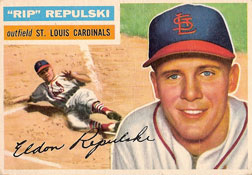
After cruising through five innings, Antonelli surrendered five runs in the sixth _ the big hits being a two-run single by Rip Repulski and a two-run double by Red Schoendienst.

In the Cardinals’ three-run seventh, pinch-hitter Joe Frazier hit a two-run triple against Hoyt Wilhelm.

The Cardinals tied the score, 9-9, in the eighth when pinch-runner Dick Schofield scored on first baseman Whitey Lockman’s error.

Marv Grissom and Windy McCall held the Cardinals hitless over the last three innings. In the 11th, Harvey Haddix, pitching his third inning of relief for the Cardinals, yielded a sacrifice fly to Don Mueller. Boxscore

The winning run was scored by Billy Gardner, who was a pinch runner for a pinch runner.

After pinch-hitter Bobby Hofman led off the 11th with a single, Giants manager Leo Durocher sent in pitcher Ruben Gomez as a pinch runner. Gomez reached second on a sacrifice and went to third on an infield single.

As Mueller stepped to the plate, Durocher looked at Gomez and remembered the pitcher was scheduled to start the next day’s game. Concerned Gomez might risk injury if he had to slide on a play at the plate, Durocher replaced Gomez with Gardner, a reserve infielder.

“If it all sounds screwy, that was the pattern of the contest,” the New York Daily News noted.

That was one of several unusual occurrences in the game:

_ Though the teams combined for 19 runs, no one hit a home run.

_ Though the Cardinals had nine runs and 15 hits, two of their top hitters, Stan Musial and Wally Moon, were a combined 0-for-10.

_ In the fourth, Giants center fielder Willie Mays received word of the death in Alabama of his aunt, Sarah Mays, with whom he had lived as a child. Heartbroken, Mays was unable to continue and was removed from the game by Durocher.

Read Full Post »

(Updated May 22, 2022)

Once a tradition as reliable as fireworks and ice cream, the big-league baseball doubleheader was a staple of Independence Day in the United States.

The Cardinals played a July 4 doubleheader every year from 1927 through 1950.

Since 1900, the Cardinals have played 59 Independence Day doubleheaders _ but none since 1984.

Played at San Francisco’s Candlestick Park on a Wednesday, with Game 1 beginning at 10:30 a.m., the last Cardinals doubleheader on July 4 featured the debut of one of their starting pitchers, the first career save for one of their relievers and a timely hitting display by a first baseman who would be dealt to the Giants after the season.

Riding a six-game winning streak entering the doubleheader, the Giants were stopped in Game 1 by the pitching of Cardinals rookie left-hander Ricky Horton.

Horton allowed the Giants’ leadoff batter to reach base in four of seven innings pitched, but limited San Francisco to two runs.

“I didn’t exactly have good stuff,” Horton said to the St. Louis Post-Dispatch. “The whole day I was behind a lot of hitters.”

Paced by first baseman David Green’s two-run home run, the Cardinals led, 4-2, when manager Whitey Herzog turned to closer Bruce Sutter in the eighth.

Sutter loaded the bases with one out before striking out pinch-hitters Chili Davis and Scot Thompson.

In the ninth, Sutter gave up three hits and a run, but with runners on first and second, one out, he retired Dusty Baker and Joel Youngblood on forceouts, preserving the 4-3 win for Horton and St. Louis. Boxscore

For Game 2, Herzog started Kurt Kepshire, a right-hander making his major-league debut.

Called up from Class AAA Louisville, where he was 7-5 with a 4.60 ERA in 16 starts, Kepshire limited the Giants to a run through eight innings.

In the ninth, with one out and the Cardinals ahead, 5-1, Kepshire walked Thompson and Youngblood. Jeff Lahti relieved and retired Bob Brenly on a flyout and Al Oliver on a groundout, earning his first big-league save. Boxscore

“I had butterflies, but I wasn’t petrified,” Kepshire said to the Associated Press. “The wind made my breaking ball hang early in the game, so I started using the fastball more.”

Said Herzog: “He challenges those guys. He’s got some guts. I love it.”

The Giants stranded 19 baserunners in the doubleheader. Referring to the Cardinals’ two rookie starting pitchers, Giants shortstop Johnnie LeMaster told the San Francisco Examiner, “We let two guys get away with some awful bad stuff.”

Green drove in the go-ahead run in Game 2. Seven months later, he was traded by the Cardinals to the Giants as a key part of the deal for slugger Jack Clark.

One unfortunate note: Late in the second game, the San Francisco Examiner reported, someone flung a large explosive from the upper deck in center field down past the scoreboard to the seats in the lower deck. “The bomb went off in a blast that sent white smoke billowing and a roar reverberating through the stands,” according to columnist Art Spander. A 24-year-old woman was injured, suffering facial burns and cuts, and taken to a hospital.

Read Full Post »

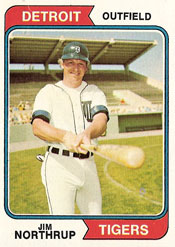
One of the most memorable and hotly debated plays in Cardinals history always will be the two-run triple by Detroit’s Jim Northrup on a drive that sailed over the head of center fielder Curt Flood in Game 7 of the 1968 World Series.
The contentious question remains: Would Flood have caught the ball if he hadn’t stumbled?

In the top of the seventh inning of the scoreless Game 7 on Oct. 10, 1968, at Busch Stadium, Northrup, a left-handed batter, faced Bob Gibson with Norm Cash on second base, Willie Horton on first and two outs. Northrup lined Gibson’s first offering to center field.

Flood initially broke in for the catch. Realizing his mistake, Flood tried to move back and to his right. As he did, his spikes appeared to catch in the turf. (Some say he slipped on a slick spot in the grass.) He briefly stumbled but didn’t fall. Though he recovered quickly, it was too late to catch the ball, which fell behind him, several yards in front of the warning track.

Both runners scored and Northrup raced to third base. The next batter, Bill Freehan, drove in Northrup with a double, giving the Tigers a 3-0 lead. Detroit went on to a 4-1 victory, winning its first World Series title in 23 years and stunning the defending champion Cardinals, who had taken a 3-games-to-1 lead in the best-of-seven series. Boxscore

Flood, a seven-time Gold Glove Award winner, was labeled the goat because many thought he would have caught Northrup’s liner if not for the slip. Others, though, have said Northrup’s shot was so well-struck it would have eluded Flood regardless of his stumble.

film clip of the play on YouTube shows Northrup hit the ball hard, but it landed in a spot where a center fielder (especially one of Flood’s skill) likely would be able to race back and make a catch.

Because a strong case can be made for either side, the argument likely will endure for as long as baseball has fans.

In his report for the Oct. 29, 1968, edition of The Sporting News, Dick Kaegel described this exchange between reporters and Flood, who sat on the edge of a table and sipped from a bottle of champagne that was intended for a Cardinals celebration:

Did you lose the ball in the crowd?

Yes.

Was the ground still soggy out there?

Yes.

Could you have caught the ball if you hadn’t slipped?

I think so. Yes. Look, I don’t want to make alibis. I should have made the play but I didn’t, and that’s all there is to it.

In the visiting team locker room, Northrup was asked whether Flood should have caught the ball.

“The guys on the bench all said he wouldn’t have caught it even if he hadn’t stumbled,” Northrup said in The Sporting News report. “I couldn’t really say myself.”

In the Associated Press accounts of the game, Flood said, “I couldn’t see it against the shirts (in the crowd). The reason I started in, I just didn’t know where the ball was. A ball hit right at me gives me trouble in day games. If I hadn’t slipped, I might have got it.”

Cardinals manager Red Schoendienst told the Associated Press, “I’m sure he could have caught it if he hadn’t charged in on it.”

In a tribute to Northrup after his passing, longtime Detroit sports columnist Jerry Green of FOXSportsDetroit.com reported Northrup had told him, “Flood never could have caught the ball.”

Denny McLain, ace of the 1968 Tigers staff, said in a June 8, 2011, interview with Drew Sharp of the Detroit Free Press, “I never once bought the argument that (Flood) misplayed the ball like everyone says. There was no way he was catching that.”

Yet, in his autobiography “Nobody’s Perfect,” McLain said, “Curt Flood simply blew it. Now, here’s a super outfielder, but he just couldn’t find the ball.”

In his autobiography “The Way It Is,” Flood barely mentions the play. “I attracted unfavorable attention by missing a catch that might have been easy for me if I had not been completely bushed,” Flood said.

Author Stuart L. Weiss, in his book “The Curt Flood Story” asked, “Why he was ‘bushed’ he did not say … That could have affected him after he started running back and to his right for the ball, but it could not have accounted for his initial misjudgment.”

It had rained in St. Louis the day before Game 7. Flood’s teammates have indicated Flood slipped on a spot still wet from the rain.

“As soon as the ball left the bat, I was confident Flood would track it down, as he had done on so many similar occasions over the years,” Bob Gibson said in his autobiography “Stranger to the Game.” “This time, though, Curt’s first step was toward the infield, and when he realized he had underestimated the hit, he turned sharply, and for a split second lost his footing on the wet grass.”

Cardinals catcher Tim McCarver told journalist William Mead, “The playing conditions that day were very bad in the outfield. Curt broke initially to his right and one or two steps in, and then he got stuck in the mud. When he got stuck, his quickness wasn’t there, and Northrup’s ball, which was well-hit, got past him.”

In comments to the Pittsburgh Post-Gazette after the game, Northrup supported that version. He played center field for the Tigers in Game 7, so he knew about the conditions.

“It was muddy out there,” Northrup said. “Most of the field was dry, but it was muddy in center field because of yesterday’s rain. The sun never hit center field. The grass and dirt didn’t get a chance to dry out.”

Often overshadowed is the fact Northrup had a terrific World Series overall. He hit a grand slam off Larry Jaster in Game 6. In the seven games, Northrup had eight RBI, seven hits, two home runs and four runs scored.

Read Full Post »
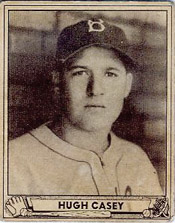
On May 7, 1940, the Cardinals raked Dodgers starter Hugh Casey for 15 hits, 13 runs and five home runs in seven innings during an 18-2 victory at St. Louis.

The Cardinals also hit two home runs against reliever Max Macon, giving them a total of seven for the game.
The outburst came against the hottest team in the National League. The 1940 Dodgers, managed by Leo Durocher, entered the Tuesday game at Sportsman’s Park with an 11-1 record. The Cardinals were 5-10.

Brooklyn featured a lineup of Dolph Camilli and Dixie Walker, and rookie shortstop Pee Wee Reese.

Casey, 26, was one of their top pitchers. The right-hander recorded 15 wins and a 2.93 ERA for the 1939 Dodgers.

Casey earned complete-game wins against the Giants and Phillies in his first two starts of 1940 before he stumbled against the Reds, yielding eight runs in four innings in Brooklyn’s first  loss.

In the series opener against the Cardinals on Sunday, May 5, Casey entered in relief, pitched a scoreless ninth and earned the save in Brooklyn’s 9-6 victory. Boxscore

Two days later, he was the starting pitcher, bringing a 2-1 record and 3.52 ERA against a Cardinals lineup that included three future Hall of Fame players: Joe Medwick, Johnny Mize and Enos Slaughter. All-star shortstop Marty Marion was unavailable because of a knee injury.

After a scoreless first inning, the Cardinals went to work against Casey. Don Padgett, Stu Martin and Eddie Lake hit solo home runs, and Medwick and Mize each launched a two-run homer. The home run by Lake, a slight second baseman, was the first of his big-league career.

Casey knocked down several Cardinals batters and hit three, the St. Louis Post-Dispatch reported.

Macon, a former Cardinal, relieved Casey in the eighth and yielded five runs, including another homer apiece by Mize and Lake. Boxscore

The Cardinals collected 49 total bases, topping the league mark of 47 established by the Giants in 1931. Their seven total home runs tied a league record shared by five others.

The Associated Press reported Durocher kept Casey in the game for seven innings “to save wear and tear on his other pitchers.”

“It was at his own request” that Casey remained in the game through seven innings, The Sporting News reported.

According to The Brooklyn Daily Eagle, Casey said to Durocher after giving up five runs in the third inning, “Let me keep pitching. I need the work.”

Casey’s performance got the headlines, but the game featured another significant development.

In the ninth inning, the Cardinals sent in Bill DeLancey to replace Padgett at catcher, drawing a big cheer from the few remaining in the announced crowd of 2,298. It was DeLancey’s first big-league appearance since 1935. He was attempting a comeback after more than four years spent in Arizona to overcome a lung ailment, The Sporting News reported.

(DeLancey would appear in 15 games for the Cardinals in 1940, his last big-league season. He died on his 35th birthday, Nov. 28, 1946).

After their sizzling start, the 1940 Dodgers finished in second place at 88-65, 12 games behind the champion Reds and four ahead of the Cardinals (84-69).

Casey was moved to the bullpen in early June and finished the 1940 season with an 11-8 record and 3.62 ERA.

Casey befriended the writer, Ernest Hemingway, pitched for Dodgers pennant winners in 1941 and 1947, earned two wins and a save in the 1947 World Series against the Yankees, and finished a nine-year big-league career with a 75-42 record, 55 saves and a 3.45 ERA.

On July 3, 1951, Casey, 37, died from a self-inflicted shotgun blast to the neck. The suicide occurred seconds after he had assured his wife in a telephone call he was innocent of a charge he fathered a son out of wedlock, according to the Associated Press.

Read Full Post »

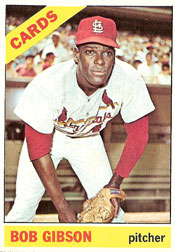
Eight times during his Cardinals career Bob Gibson had three hits or more in a game in which he pitched and earned the win.

Here are the eight games Gibson won while collecting at least three hits:
_ July 8, 1962, Cardinals 15, Mets 1, at New York: Gibson pitched a three-hitter for his 10th win of the season, and went 3-for-5 to improve his batting mark to .300 for the year. One of the hits was a leadoff home run in the third inning off Jay Hook, giving St. Louis a 3-0 lead. Boxscore

_ Sept. 29, 1965, Cardinals 8, Giants 6, at San Francisco: In a matchup of future Hall of Famers, Gibson belted an eighth-inning grand slam against Gaylord Perry.

It was Gibson’s fifth homer of the season, the first grand slam of his professional career and his third hit of the game.

“I knew it was going to the fence, but I didn’t think it was going over,” Gibson told the Associated Press.

With the Cardinals ahead 8-0 entering the bottom of the ninth, the Giants rallied for six runs against Gibson and Curt Simmons. With two on and two out, Hal Woodeshick struck out Willie McCovey on a 3-and-2 curve a foot outside the plate, ending the game and preserving Gibson’s 19th win of the season. Boxscore

_ May 12, 1969, Cardinals 6, Dodgers 2, at St. Louis: Gibson hit three singles, including one with the bases loaded that knocked in two runs in the fourth against Claude Osteen.

His seven-hitter earned Gibson his fourth win of the season. Boxscore

_ Sept. 10, 1969, Cardinals 11, Pirates 2, at Pittsburgh: Gibson stroked four hits, including a double and a single against Steve Blass, and notched his 17th win of the season with a six-hitter in the opener of a doubleheader. Boxscore

_ June 3, 1970, Cardinals 6, Giants 5, at St. Louis: With the score 5-5 in the seventh, Gibson gave the Cardinals the lead with his third hit, a two-out single to right against Frank Reberger that scored Ted Simmons from third.

In pitching an eight-hitter for his fifth win of the season, Gibson retired Willie Mays and Willie McCovey with two on in the ninth. Mays and McCovey went a combined 0-for-9 against Gibson. Boxscore

_ June 26, 1970, Cardinals 7, Phillies 0, at St. Louis: Gibson went 3-for-4 with a RBI and pitched a four-hit shutout for his 10th win of the year. He limited the Phillies to one hit over the last five innings. Boxscore

_ July 1, 1972, Cardinals 6, Phillies 4, at Philadelphia: In the opener of a doubleheader, Gibson hit a double and two singles, and pitched a seven-hitter, leading St. Louis to its fourth consecutive victory and its 11th in its last 12 games. Boxscore

_ Sept. 1, 1974, Cardinals 8, Giants 1, at San Francisco: Gibson, who had lost three of his previous four starts, pitched a seven-hitter and led all St. Louis batters with his three hits. Boxscore

Read Full Post »

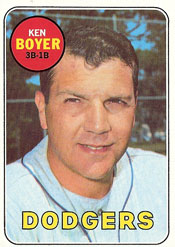
Ken Boyer’s unselfishness played an important role in the 31-game hitting streak of Dodgers outfielder Willie Davis in 1969.

On July 21, 1969, in the Pirates’ 2-1 victory over the Dodgers in 15 innings, Davis was 0-for-6, dropping his batting average to .260. Boxscore

One of Davis’ teammates that year was Boyer, who had been the Cardinals’ standout third baseman from 1955-65. Boyer was in the last season of a 15-year big-league career and primarily was being used as a pinch hitter by the Dodgers.

Entering a four-game series against the Cardinals at St. Louis, Davis “put down his slim-handled whip of a bat and picked up a heavier model, one Ken Boyer had been using,” John Kuenster wrote in Baseball Digest magazine.

“He choked up four inches on the knobless handle and started to hit.”

Davis, a left-handed batter, embarked on a 31-game hitting streak, stretching from Aug. 1 in St. Louis to Sept. 3 in Los Angeles, using Boyer’s 38-ounce Louisville Slugger U1 model. It was the longest hitting streak in the National League since Tommy Holmes’ 37-game stretch for the Braves in 1945.

Writing in 2011 for Examiner.com, Jim Smiley reported, “Boyer stopped using his own bats when his supply dwindled down to only two. After all, a teammate with a long hitting streak comes first.”

In a September 1969 interview with Charles Maher of the Los Angeles Times, Davis said, “I choke up about four inches to get more bat control. And I never try to pull the ball. Nine times out of 10, I’ll be trying to hit through the middle or to the opposite side.

“I’m not going to stop using Boyer’s bats … I think I broke one of them and he’s got two left. I don’t think Kenny’s even using them now. He knows I want to use them.”

Boyer understood the importance of teamwork and the elements needed to grow a hitting streak. Boyer had a 29-game hitting streak for the Cardinals in 1959.

Davis faced the Cardinals seven times during his streak:

_ Aug. 1, Cardinals 7, Dodgers 2, at St. Louis: In Game 1 of the streak, Davis went 1-for-4, hitting a double against Steve Carlton. Boxscore

_ Aug. 2, Cardinals 7, Dodgers 6, at St. Louis: Davis had an RBI-single against Mike Torrez and a two-run double against Joe Hoerner. Boxscore

_ Aug, 3, Dodgers 5, Cardinals 0, at St. Louis: Chuck Taylor yielded a double and a single to Davis. Boxscore

_ Aug. 4, Cardinals 2, Dodgers 1, at St. Louis: Davis singled against Nelson Briles, who pitched a complete-game seven-hitter. Boxscore

_ Aug. 11, Cardinals 4, Dodgers 2, at Los Angeles: In his final at-bat of the game, Davis hit an RBI-single off Steve Carlton in the eighth. Boxscore

_ Aug. 12, Dodgers 5, Cardinals 2, at Los Angeles: After starting 0-for-2, Davis singled in the sixth against Ray Washburn and singled in the eighth against Joe Hoerner. Boxscore

_ Aug. 13, Cardinals 5, Dodgers 0, at Los Angeles: Chuck Taylor pitched a six-hit shutout, but Davis had two of those hits _ singles in the seventh and ninth innings. Boxscore

Davis didn’t face Cardinals ace Bob Gibson during the streak. Gibson was 20-13 with a 2.18 ERA in 1969. Davis had a .320 (40-for-125) career batting average against Gibson.

Read Full Post »

« Newer Posts - Older Posts »