Feeds:
Posts
Comments

Archive for the ‘Opponents’ Category

About the same time that fans of Milwaukee baseball learned the Braves planned to abandon them, the club’s most prominent pitcher, Warren Spahn, got cast aside, too.

So, when Spahn returned to Milwaukee for the first time as a member of the Mets, the fans there came out to cheer for him and against the Braves.

The drama didn’t end there. Spahn was matched that night against his protege and former road roommate, Wade Blasingame. Both were destined to wind up with a Cardinals farm team.

Mr. Brave

A left-hander who developed into a consistently big winner, Spahn began his major-league career with the 1942 Boston Braves (managed by Casey Stengel), served in combat during World War II, and moved with the club to Milwaukee in 1953. He was revered in Milwaukee for being the staff ace and for helping the Braves win two National League pennants (1957 and 1958) and a World Series title (1957).

“No individual made a greater contribution to the fabulous Milwaukee baseball story,” The Sporting News reported on Spahn. “He was truly Mr. Brave.”

Spahn won 20 or more 13 times, including six years in a row (1956-61). He was 42 when he won 23 for the 1963 Braves.

Trouble developed for both Spahn and the Milwaukee fan base in 1964. Spahn quit winning, and was shifted to the bullpen against his wishes by manager Bobby Bragan. Spahn finished the season at 6-13 with a 5.29 ERA.

“He was dead on his feet,” Bragan told The Sporting News. “His legs were gone. He couldn’t get off the mound, and they were bunting him silly.

“If any other pitcher had been shelled the way he was,” Bragan said, “he would have been shipped to (minor-league) Denver.”

The Braves wanted Spahn to stop pitching and offered him several jobs in the organization, including a radio broadcasting gig, The Sporting News reported. Spahn wanted to play instead.

Then the Braves delivered a double salvo of damaging decisions to the fans of Milwaukee baseball:

_ In October 1964, the Braves’ board of directors voted to approve a move of the franchise to Atlanta. The Braves were ready to go, but the National League ordered them to play one more season in Milwaukee in 1965, putting them in a lame-duck position with a furious fan base.

_ A month later, the Braves sold Spahn’s contract to the Mets, a move the scorned fans viewed as thankless.

“They got rid of me because of the money, my salary,” Spahn told The Sporting News. According to the New York Daily News, Spahn was paid $85,000 in 1964.

Double duty

The Mets’ manager, Casey Stengel, gave him the dual role of pitcher and pitching coach. “Pitching is first, then coaching,” Spahn told The Sporting News. He said to Dick Young of the Daily News, “I think I’m still a 20-game winner.”

Whitey Ford, who attempted to be both pitcher and pitching coach for manager Yogi Berra’s 1964 Yankees and found it daunting, delivered a message to Spahn through The Sporting News: “You’ll be sorry.”

(Berra, who was fired by the Yankees after the club was defeated by the Cardinals in the 1964 World Series, joined Spahn as a coach on Stengel’s 1965 Mets staff. Berra played in four May games for the 1965 Mets, then stuck solely to coaching.)

Spahn, 44, won his first two decisions with the 1965 Mets. Both were complete games _ one against the Dodgers Boxscore and the other versus the Giants. Boxscore

(In his first start versus the Cardinals as a Met, Spahn was matched against Bob Gibson. Lou Brock hit a two-run home run and the Cardinals won, 4-3. Boxscore and radio broadcast)

Out for revenge

Spahn was 3-3 with a 3.51 ERA heading into his return to Milwaukee to oppose the Braves. The fans there were showing their contempt about the impending move to Atlanta by staying away from County Stadium. 

After a paid crowd of 33,874 attended the 1965 home opener, subsequent April and May Braves home games drew an average paid attendance of 3,000. Paid attendance figures for the Cardinals’ three-game series at Milwaukee April 27-29 were 1,677, 1,324 and 2,182.

The turnout for the Thursday night game with the Mets on May 20, 1965, was a lot bigger _ 19,140 total (17,433 at full price, 1,707 youngsters admitted for 50 cents each) _ and most were there to pay tribute to Spahn.

“They made no secret of the fact they were rooting not for the Braves but for Spahn,” The Sporting News reported. “They cheered when his name was announced, when he took the mound and when he threw so much as a strike. They gave him a standing ovation when he went to bat.”

Dick Young of the Daily News observed, “He was to be their instrument of revenge. They came just for him, hoping, praying, he would beat the Braves.”

Several brought homemade banners and placards, including one with the message, “Down the Lousy Saboteurs. C’mon, Spahn, Mow Down the Betrayers,” the Daily News reported.

The Braves’ lineup that night featured Hank Aaron, Eddie Mathews, Joe Torre, Felipe Alou and 21-year-old starting pitcher Wade Blasingame. A left-hander, Blasingame got called up to the Braves in June 1964 and roomed on the road with Spahn, who became a mentor. Blasingame was 9-5 (including a shutout of the pennant-bound Cardinals Boxscore) for the 1964 Braves.

“There is a growing feeling (Blasingame) is about to become the new Spahn,” The Sporting News reported.

Spahn “taught me more in a year than I ever knew before,” Blasingame told United Press International.

All business

Blasingame and Spahn waged a scoreless duel for four innings. Then, in the fifth, Spahn became unglued. The Braves scored twice, then loaded the bases for Eddie Mathews, the left-handed slugger who was, according to George Vecsey of Newsday, “one of Spahn’s closest friends.”

When the count got to 1-and-1, “I couldn’t afford to get behind,” Spahn explained to United Press International. “He had been looking bad on the slider all night, but I second-guessed myself and threw him a fastball. Trouble was, I was indecisive about whether to throw it down and in, or down and away. So I came right over the plate.”

Mathews clobbered it _ “a mile past the bleachers in right,” the Daily News reported _ for a grand slam, giving the Braves a 6-0 lead.

“Spahn kicked the top of the mound to dust, and picked up the resin bag and slammed it down,” Dick Young noted.

Mathews said to Newsday, “If I felt something special about hitting a home run against Spahn, I’d tell you. I didn’t. He’s just another pitcher.”

In his book, “Eddie Mathews and the National Pastime,” Mathews said, “Spahnie and I went out and drank together after the ballgame, but there was no sentiment while he was on the mound.”

Hank Aaron followed with a single, stole second and eventually scored on Rico Carty’s second double of the inning, capping the seven-run outburst.

Spahn completed the inning, then was lifted for a pinch-hitter.

Blasingame held the Mets hitless until the seventh when, with two outs, Ron Swoboda singled, scoring Billy Cowan, who had walked and moved to second on a wild pitch.

Blasingame, who finished with a one-hitter, told George Vecsey he felt bad for Spahn: “I know he wanted to beat us very much _ maybe more than I wanted to beat them.” Boxscore

Tulsa time

Four days after his loss at Milwaukee, Spahn pitched a complete game, beating Jim Bunning and the Phillies. Boxscore Then he lost eight in a row, and the Mets placed him on waivers. In 20 games with the Mets, Spahn was 4-12.

The Giants claimed him and he finished the 1965 season, his last, with them, going 3-4. Spahn’s 363 career wins are the most by a left-handed pitcher. 

“I never did retire from pitching,” Spahn told writer Roger Kahn. “It was baseball that retired me.”

Wade Blasingame was 16-10 for the 1965 Braves, but never achieved another double-digit win season. In 10 years with the Braves, Astros and Yankees, he was 46-51.

(Blasingame and Jim Bouton were Astros teammates in 1969. In his book, “Ball Four,” Bouton wrote, “Today, Blasingame was wearing a blue bellbottom suit, blue shirt, a blue scarf at his throat and was smoking a long thin cigar, brown. Teammate Fred Gladding said, ‘Little boy blue, come blow my horn.’ Everybody on the bus went ‘Oooooh.’ Blasingame feigned indifference.”)

In 1967, Cardinals general manager Stan Musial hired Spahn to be manager of the Tulsa farm club. Spahn held the job for five years, but was gone by March 1973, when the Cardinals acquired Blasingame from the Yankees and assigned him to Tulsa.

Blasingame was 1-0 with an 0.90 ERA in two months with Tulsa before being traded to the Cubs’ Wichita farm team for another left-hander, Dan McGinn.
Read Full Post »

(Updated June 12, 2023)

John Roseboro of the Dodgers and Tim McCarver of the Cardinals were opposing catchers with similar styles. Both were former football players who viewed baseball as a contact sport.

As a standout high school athlete in Memphis, McCarver had football scholarship offers from the likes of Alabama and Notre Dame. Roseboro played football at Central State, a historically black college, in Ohio.

According to the Los Angeles Times, Roseboro was “generally recognized as the toughest plate blocker” in baseball. When he and McCarver collided one day at the plate, the force was unlike any they’d experienced on a baseball field.

Matter of pride

The Dodgers came to St. Louis in June 1963 for a three-game weekend series with the first-place Cardinals. A sweep could vault the Dodgers from 2.5 games behind into the lead.

In the June 21 opener, Sandy Koufax was on the verge of pitching his third consecutive shutout when McCarver, batting with two outs in the ninth, slammed a three-run home run onto the pavilion roof in right. A left-handed batter, it was McCarver’s first big-league home run against a left-handed pitcher.

The Dodgers escaped with a 5-3 victory. Boxscore

Full impact

The next day’s pitching matchup on June 22 featured rookie left-hander Nick Willhite for the Dodgers against Bob Gibson. In his Dodgers debut six days earlier, Willhite shut out the Cubs. Gibson was riding a streak of four wins in a row.

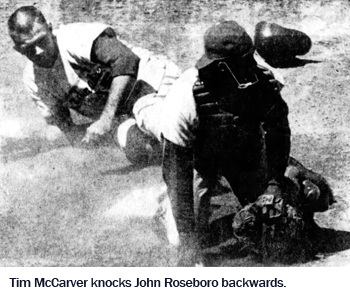
With the score tied at 1-1 in the fifth inning, McCarver was on third, one out, when Curt Flood tapped the ball toward third baseman Maury Wills. McCarver broke for the plate, but Wills got to the ball and tossed it to Roseboro. “I foolishly tried to score against him,” McCarver recalled in his autobiography, “Oh, Baby, I Love It.”

Roseboro, mentored by Roy Campanella, “was the best in baseball at blocking the plate,” pitcher Johnny Klippstein said in the book “We Played the Game.” “He was tough.”

McCarver knew that, too. In his autobiography, he said Roseboro “was as intransigent at home plate as a derrick.”

Favoring what The Sporting News described as a “rock-’em, sock-’em type of play,” McCarver gave no thought to turning back. As Roseboro protected the plate, bracing for a collision, McCarver barreled into him.

“He stood his ground, as always, his knee digging into me,” McCarver recalled in his book, “and the whole right side of my face opened up like a can of tomatoes. I had a long burn along one side of my face and he knocked my neck into a stiff state.”

According to the Los Angeles Times, McCarver came out of the crash with “a shiner, the size of a dollar.”

Roseboro lost a lens from his eyeglasses, but held onto the ball and tagged out McCarver. The impact “jammed Roseboro’s shoulder, hurt his knee and spiked his left ankle,” the Times reported. Roseboro told the newspaper it was the hardest he’d ever been hit _ “and I’ve got the bruises to prove it.”

In his 1987 book, McCarver said, “I still suffer from nerve damage in my neck, more than 20 years after that Roseboro collision. (Dodgers coach) Leo Durocher said it was the worst collision he’d ever seen.”

Another jolt

Both Roseboro and McCarver stayed in the game. Charlie James broke the tie with a solo home run for the Cardinals in the sixth.

In the seventh, McCarver batted for the first time since the collision at the plate. In his 1998 book, “Baseball for Brain Surgeons and Other Fans,” McCraver recalled, “Roseboro says through his mask, ‘Are you all right?’ “

McCarver replied, “Yeah, I’m fine. Are you?”

Roseboro said, “Oh, fine.”

After a pause, McCarver said that Roseboro, referring to the collision, told him, “That’s the way you’ve got to do it, you know.”

Like McCarver, Roseboro batted left-handed. With left-hander Bobby Shantz pitching in the ninth, Dodgers manager Walter Alston sent Doug Camilli to bat for Roseboro. Camilli singled, but the Cardinals held on for a 2-1 triumph, evening the series. Boxscore

Though the Cardinals started a right-hander, Ernie Broglio, in the series finale, Alston gave Roseboro the day off. McCarver was in the Cardinals’ lineup and tripled, but the Dodgers prevailed, 4-3. Boxscore

Roseboro didn’t start a game for more than a week because of the damage caused by the crash with McCarver.

The day after the Dodgers left town, the Giants began a series at St. Louis. In the June 24 opener, after leadoff batter Harvey Kuenn tripled, Chuck Hiller grounded to second. When Kueen broke for home, Julian Javier threw to McCarver.

“As I took the throw, I looked to my left, and Kuenn’s belt buckle was about two inches from my face,” McCarver said in his book.

Kuenn crashed into McCarver, then reached over him, trying to touch the plate, but McCarver held him off and made the putout. Boxscore

“I believed in denying the runner the plate on bang-bang, very close plays,” McCarver said in his autobiography. “That was the way I was taught, and I continued to think that’s what I was being paid to do.”

Playing to win

The Dodgers and Cardinals turned out to be the two best teams in the National League in 1963. The Dodgers took control of the pennant race in late September when they swept a three-game series in St. Louis. They also swept the Yankees in the World Series. The Cardinals, with 93 wins, placed second to the 1963 Dodgers. They won the pennant with the same number of wins in 1964.

Roseboro and McCarver were the catchers for the National League champions in seven of the 10 World Series played between 1959 and 1968, the last year the best team in the league automatically went to the World Series.

Roseboro started in all 21 games the Dodgers played in four World Series in that stretch (six in 1959, four in 1963, seven in 1965 and four in 1966). McCarver also started in all 21 games the Cardinals played in three World Series during that period (seven apiece in 1964, 1967 and 1968).

Read Full Post »

From his first regular-season game as a head coach in the NFL with the St. Louis Cardinals, Don Coryell showed signs of being special. He got the Cardinals to play with confidence and collective pride.

When he was elected to the Pro Football Hall of Fame on Feb. 9, 2023, Coryell correctly was hailed as an innovator whose offenses with the Cardinals, and later the San Diego Chargers, were thrilling to watch and nerve-wracking to defend.

Those progressive schemes were just part of his skillset. Coryell also was an effective leader who got players to buy into his philosophies and to execute consistently within a framework of selfless collaboration.

Meet the new boss

The season opener between the Cardinals and Eagles on Sept. 16, 1973, at Veterans Stadium in Philadelphia marked the NFL head coaching debuts of Coryell and Mike McCormack.

Coryell came to the Cardinals from the college coaching ranks. In 15 years as a college head coach, Coryell never had a losing season. His record was 127-24-3, including 104-19-2 in 12 seasons at San Diego State.

Like Coryell, McCormack would be elected to the Pro Football Hall of Fame, but, unlike Coryell, he got in as a player, not as a coach. An exceptionally quick and strong right tackle on the Cleveland Browns’ offensive line, McCormack protected quarterback Otto Graham and blocked for running back Jim Brown. In his autobiography, Browns head coach Paul Brown said, “I consider McCormack the finest offensive tackle who ever played pro football.”

(Paul Brown told the story of how another Browns quarterback, Milt Plum, had trouble staying in the pocket before releasing the ball. At practice one day, a frustrated McCormack picked up Plum by the neck, shook him, cursed him and put him back down. After that, “our passing game improved considerably,” Brown told The Sporting News.)

McCormack had been an assistant coach for seven seasons with the Washington Redskins, but never a head coach.

The 1973 opener also was the Eagles debut of quarterback Roman Gabriel, 33, who got traded to Philadelphia after 11 seasons with the Los Angeles Rams.

(Gabriel, a glamour boy in Los Angeles, still was effective. He would lead the NFL in passing yards, completions and touchdown passes as an Eagle in 1973.)

During training camp, Coryell made a favorable impression as a coach of “unquenchable spirit and unflagging energy.” The Sporting News reported. Cardinals director of operations Joe Sullivan told the publication, “He’s one of the best teachers I’ve ever seen.”

On the eve of the season opener, Coryell said to the St. Louis Post-Dispatch, “I think we’ll be pretty darn potent this season. We’ll have the capability of breaking things open.”

Will to win

The fired-up Cardinals charged out to a 21-0 lead in Coryell’s debut. Jim Hart threw touchdown passes to Donny Anderson and Mel Gray, and Anderson also rushed for a score.

“The Eagles came after Hart with a vengeance, and the veteran quarterback proceeded to waste them with draws and screens,” the Philadelphia Inquirer reported.

Cardinals turnovers (two fumbles and an intercepted pass) helped the Eagles rally. They got within a point, 24-23, in the fourth quarter.

Recent Cardinals clubs might have panicked, but the Coryell Cardinals kept their poise. Hart moved them into position for a Jim Bakken 20-yard field goal, extending the lead to 27-23 with 1:10 to play. When the Eagles’ Tom Sullivan fumbled the ensuing kickoff, the Cardinals recovered. Anderson capped a 34-23 victory with another scoring run, his third touchdown of the game.

Though describing the Eagles as “a poor team,” the Post-Dispatch noted that the Cardinals “showed the ability to move under pressure, to capitalize on opposition mistakes and to make the big offensive play, three areas sadly lacking for them in recent years.”

Anderson, the former Green Bay Packer acquired in a trade for MacArthur Lane, had 66 yards receiving, 58 yards rushing and also was praised by Coryell for his blocking. “He has such a great understanding and concept of our offense,” Coryell told the Post-Dispatch.

Terry Metcalf, a third-round draft choice making his NFL debut, rushed for 133 yards and added another 25 yards with a catch. Plus, “he was blocking on me all afternoon,” Eagles linebacker Dick Cunningham told the Inquirer. “He will stick his head into you.” Video

Coryell said to the Philadelphia Daily News that Metcalf “is quick, tough, agile and has a heart as big as a lion.” Game stats and Game video

In a “rah-rah-sis-boom-bah” locker room celebration after the victory, the Inquirer reported, tight end Jackie Smith presented Coryell with the game ball and said, “This is for the man with the most enthusiasm.”

High praise

After the Cardinals scored 34 points again in winning their home opener against the Redskins, defensive tackle Bob Rowe said to the Post-Dispatch, “We have a confidence in ourselves, a confidence that Coach Coryell built. He has made us believe we’re football players. He has made us respect one another.”

Recalling his days playing for Packers head coach Vince Lombardi, Donny Anderson told Rich Koster of The Sporting News, Lombardi “was more than a coach. He was a man who taught you to become a man. You seemed to grow up faster and accept the responsibilities that you have as a player. In Coach Coryell, I think we have a man who in many respects is like Lombardi. Both loved people, and that’s the biggest thing in relating to players.”

Though the Cardinals faded, finishing 4-9-1 in Coryell’s first season, the players recognized he had changed the clubhouse culture for the better.

“We’ve got great life on our team, as opposed to what it used to be,” linebacker Jamie Rivers said to The Sporting News.

Jim Hart told the publication, Coryell “is a great man. He won’t pull any punches with you privately, but he’ll defend you to the letter publicly.”

In five seasons with Coryell, the Cardinals posted a 42-27-1 record and twice qualified for the playoffs. Those were the Cardinals’ first playoff berths since 1948 and their first division titles since moving from Chicago to St. Louis in 1960.

Coryell continued to have success with the Chargers in San Diego. His overall record as a NFL head coach is 115-89-1. According to the College Football Hall of Fame, Coryell was the first head coach to win 100 games at both the college and pro levels.

Read Full Post »

(Updated Feb. 13, 2023)

Seven years after he integrated major league baseball, Jackie Robinson led an effort to end discrimination at the Chase Hotel in St. Louis.

In 1954, the Cardinals had their first black player, first baseman Tom Alston. The United States Supreme Court unanimously ruled in Brown v. Board of Education of Topeka that racial segregation of children in public schools was unconstitutional. Despite these milestones, the Chase Hotel still prohibited blacks from using its dining room, bar or pool.

Robinson took a stand in trying to uproot the hotel’s segregationist policies when the Dodgers came to St. Louis to play the Cardinals in 1954, but it created friction with other blacks on the team.

White lodge

Located at the corner of Lindell and Kingshighway and across the street from Forest Park, the elegant Chase Hotel was built in 1922 by Chase Ullman and became known for its luxury, glamour, fine dining and entertainment. Features included a roof garden, Turkish steam baths and “rubbing rooms” for men and women, St. Louis Magazine noted. The roof garden eventually was enclosed and turned into the Zodiac Room Lounge.

A Mediterranean-style swimming pool became another popular feature of the Chase. The pool was “about the shade of the gold lame briefs Rudolf Nureyev is rumored to have worn there,” according to St. Louis Magazine. Pirates baseball broadcaster Bob Prince dived into the pool from a third-floor guest room to settle a $20 bet, the Pittsburgh Post-Gazette reported, prompting the hotel to erect metal barriers on the windows facing the pool.

In 1929, the rival Park Plaza was built next door to the Chase. The two merged into the Chase Park Plaza in 1961. Today, the Chase Park Plaza Royal Sonesta Hotel boasts on its Web site: “Upholding the grand tradition of early 20th century style and gracious hospitality.”

Until the 1950s, the hospitality was extended only to whites. The hotel didn’t accept black guests, but it did entertain its white customers with top black performers such as Count Basie, Nat King Cole, Dorothy Dandridge, Ella Fitzgerald, Lena Horne and Eartha Kitt.

Horne told the Washington Post, “The first time I worked at the Chase, I couldn’t come in through the front door.”

In 1952, Dandridge demanded to be the first black performer to stay at the hotel. Though Chase officials “reluctantly agreed,” parts of the building remained off limits to her and all blacks. She was required to use the service elevator before and after each performance rather than walk through the lobby to the guest elevators, according to the website Vanguard of Hollywood.

Strings attached

After Jackie Robinson integrated the major leagues with the Dodgers in 1947, the Chase didn’t permit the black players of visiting ballclubs to stay there. If a ballclub chose to stay at the Chase, it meant the white team members went there and the blacks went to another hotel, usually a so-called black hotel.

“For years, St. Louis has been the only city on the circuit where Negro players lived apart from the team,” Lou Smith reported in the Cincinnati Enquirer.

In 1953, the Chase altered its policy and allowed the entire New York Giants team to stay there, including its three black players _ Ruben Gomez, Monte Irvin and Hank Thompson, the Baltimore Afro American newspaper reported. (Willie Mays wasn’t with the Giants in 1953 because of military service.)

The Giants’ black players “didn’t care for” the restrictions placed on them at the Chase, The Sporting News reported. The restrictions included no use of the bar, dining room or swimming pool, author Neil Lanctot noted in his book “Campy,” a biography of Dodgers catcher Roy Campanella.

Nonetheless, the Dodgers declared they would stay at the Chase in 1954. When the ballclub arrived in St. Louis on April 26, the Dodgers’ six black players (Sandy Amoros, Joe Black, Roy Campanella, Jim Gilliam, Don Newcombe and Jackie Robinson) were given the option by traveling secretary Lee Scott of staying at the Chase with its restrictions or going to the Adams Hotel, which catered to blacks.

If the black players stayed at the Chase, they would have to eat all meals in their rooms instead of the dining room, stay out of the bar and the pool, and not appear in the hotel lobby except for going to and coming from the ballpark and the train station, The Sporting News reported.

Split decision

Robinson was the only one of the six black Dodgers to agree to stay at the Chase. Though he bristled at the restrictions, Robinson said he believed staying there was an important step toward ending discrimination.

In a column by Sam Lacy of the Baltimore Afro American, Robinson said, “Other fellows coming along behind me will benefit by this opening wedge. If you don’t get your foot in the door, you’ll never force it open.”

The other black Dodgers disagreed. Roy Campanella and Joe Black persuaded Sandy Amoros, Jim Gilliam and Don Newcombe to go to the Adams Hotel in the Gaslight Square entertainment district, the Baltimore Afro American reported.

“The Chase is not for me,” Campanella said to Sam Lacy. “As I see it, they didn’t want us down there for seven years. So as far as I’m concerned, they can make it forever.”

Campanella also told Wendell Smith of the Pittsburgh Courier, “I’m not going to stay there. If they didn’t want us before, they won’t get my business now.”

Campanella and the others had additional reasons for preferring the Adams.

“The manager of the (Adams) had been good to us for years,” Newcombe told Dick Young of the New York Daily News in May 1954. “He even supplies us with a car to get to and from the ballpark. Why should we let him down now? We’re not trying to set any precedents.”

In an interview with Neil Lanctot, Dodgers executive Buzzie Bavasi said the Adams “had a superstretch limo pick up the black players, usually with a blonde or two in the backseat.”

Dodgers divided

Robinson, who viewed Campanella as being too timid on civil rights issues, was upset with his teammate’s decision to choose the familiar comfort of the Adams. According to Neil Lanctot, “The issue of segregation at the Chase destroyed whatever little remained of their relationship.”

Dick Young wrote in the Daily News, “A lively argument ensued in the clubhouse _ Robinson against Newcombe and Campanella.”

According to Young, Campanella said, “I’m no crusader. I’m a ballplayer and I’m happy right where I am,” and Newcombe said of Robinson, “He thinks we owe him something because he was the first. We owe him nothing.”

(Decades later, in interviews with the Daily News and Los Angeles Times, Newcombe claimed he joined Robinson in trying to reverse discrimination at the Chase.)

When the Pirates arrived at the Chase after the Dodgers departed, their black second baseman, Curt Roberts, registered, went to the dining room and waited 45 minutes without being served. Frustrated, he checked out and went to the Adams, the Pittsburgh Courier reported.

“Within a few days, the situation at the Chase had become a national story in the black press,” according to the Campanella biography. (Most of the mainstream newspapers, including the two St. Louis dailies, provided little or no coverage of the issue.)

Change for the better

The Pirates, whose general manager, Branch Rickey, was the Dodgers executive who brought Robinson to the majors, acted quickly to defend Curt Roberts. Pirates traveling secretary Bob Rice told Chase officials the ballclub wouldn’t return there unless Roberts was given the same treatment as other team members, the Pittsburgh Courier reported.

Jackie Robinson told Dodgers traveling secretary Lee Scott he would insist on being served in the Chase dining room the next time the ballclub went there. Dodgers management pledged support, the Baltimore Afro American reported.

Just before the Dodgers and Giants returned to St. Louis for games in June 1954, they received letters from Chase management, assuring them blacks no longer would be restricted from using the dining room or lobby, and could attend shows in the roof garden, according to the Baltimore Afro American.

(The bar and pool remained off limits to blacks as late as 1957, according to Neil Lanctot. In his autobiography, “I Had a Hammer,” Hank Aaron of the Braves said, “Even after we moved to the Chase … we always had rooms facing a brick wall or the alley where they threw the garbage.’)

The St. Louis NAACP (National Association for Advancement of Colored People) and two weekly newspapers, St. Louis Argus and St. Louis American, had protested to Chase management about discriminatory policies, “and this, along with the undesirable publicity, is believed to have influenced the hotel’s capitulation,” Sam Lacy reported.

When the Dodgers went to St. Louis in June 1954, the entire team, including all the black members, stayed at the Chase. It was the first time since 1946 that every member of the Dodgers stayed in the same St. Louis hotel.

It would not have happened when it did “if Robinson had not been made of sterner stuff than Campanella, Gilliam and Newcombe,” Clifford McKay concluded in the Baltimore Afro American.

Read Full Post »

(Updated Sept. 12, 2024)

Frank Thomas, a slugging outfielder for the 1950s Pirates, came close to being acquired by the Cardinals, but it would have come at a hefty price.

In 1957, Cardinals general manager Frank Lane was ready to deal Ken Boyer to the Pirates for Thomas and third baseman Gene Freese. When the deal got put on hold by Cardinals hierarchy, Lane quit and became general manager of the Cleveland Indians.
A right-handed batter, Thomas played for seven teams during 16 seasons in the majors, belting 286 home runs. He hit 30 or more home runs in a season three times, twice topped 100 RBI and never struck out as many as 100 times.

Different uniform

Born and raised in Pittsburgh, Thomas developed a passion for baseball at an early age. In the book “We Played the Game,” Thomas recalled, “My mother said I never went to bed without a bat or ball in my hand. I first used my dad’s pick hammer for a bat.”

Thomas said he attended the games of the Pirates and the Negro League Homestead Grays at Pittsburgh’s Forbes Field. “I got my first baseball from (Negro League catcher) Josh Gibson. He gave me two,” Thomas told author Danny Peary.

When Thomas was 12, he was sent by his parents to a Catholic seminary in Niagara Falls, Ontario, to study for the priesthood. He quit the seminary when he was 17, returned to Pittsburgh and played sandlot baseball. Six months later, after he turned 18, the Pirates signed him in July 1947. “It was like a miracle,” Thomas said in “We Played the Game.”

In his first professional season, playing for a 1948 minor-league Tallahassee team managed by former Cardinals outfielder Jack Rothrock, Thomas produced 132 RBI. Three years later, he made his debut in the majors with the 1951 Pirates.

Possessing power and a strong throwing arm, Thomas was a good player on mostly bad Pirates teams. In 1954, when he earned the first of three all-star honors, Thomas batted .298 with 32 doubles, 23 homers and 94 RBI.

Shopping list

During the 1957 season, the Cardinals shifted Ken Boyer from third base to center field. Boyer led National League center fielders in fielding percentage but his hitting declined. He batted .265 with 19 home runs and 62 RBI in 1957 after putting up better numbers (.290, 23 homers and 89 RBI) the year before.

At the 1957 World Series between the Braves and Yankees, Cardinals general manager Frank Lane met in New York with his Pirates counterpart, Joe Brown, and discussed a trade of Ken Boyer for Frank Thomas, The Pittsburgh Press reported. A pull hitter who stood close to the plate, Thomas hit .290 with 23 home runs and 89 RBI for the Pirates in 1957.

Lane said he and Cardinals manager Fred Hutchinson had two four-hour talks with Brown and Pirates manager Danny Murtaugh about the proposed trade, according to The Sporting News. The talks continued into the fall.

In the book “Ken Boyer: All-Star, MVP, Captain,” biographer Kevin D. McCann noted, “Lane had been Boyer’s biggest supporter and harshest critic. He expected much from him and felt he should be as good as _ or even better than _ Yankees slugger Mickey Mantle. He wasn’t timid about publicly chastising what he perceived to be Ken’s lack of competitive hustle and aggressiveness.”

On Oct. 23, 1957, the Pittsburgh Post-Gazette reported that Lane was willing to trade Ken Boyer and pitcher Willard Schmidt to the Pirates for Frank Thomas and Gene Freese.

“Boyer is reported to have told friends in St. Louis that he had been alerted by the Cardinals not to be surprised if he were traded,” The Sporting News reported. “He was expecting to come to Pittsburgh.”

Boyer told the St. Louis Globe-Democrat, “After the season I had, I had made up my mind that I was going to be traded by Lane.”

Too many chiefs

Lane said he and Joe Brown talked trade until the first week of November 1957 “and, for his part, was ready to make the deal,” The Sporting News reported, but there was a hang-up.

In 1956, after swapping Red Schoendienst to the Giants and trying to deal Stan Musial to the Phillies for pitcher Robin Roberts, Lane was told any trades he wanted to make must be approved by club owner Gussie Busch and team executive vice president Dick Meyer. “Lane was unhappy with the handcuffs on him,” The Sporting News reported.

Lane told The Pittsburgh Press that Busch “has too many advisers to suit me. If I’m the general manager, I want to stand or fall on my own decisions. Before I’d make a deal, I’d always tell Busch. Then his vice-presidents would call a meeting and in three or four days I’d get an answer.”

According to the Sporting News, when Lane sought permission to make the trade of Boyer and another player (possibly Schmidt) for Thomas and Freese, “the okay wasn’t forthcoming.”

“The Cardinals’ brass shuddered every time I’d mention Boyer in a trade,” Lane told The Pittsburgh Press, “but they should have known if I traded him I’d get somebody good in return.”

Though he had a year remaining on his Cardinals contract, a frustrated Lane quit in November 1957 and accepted an offer to be general manager of the Cleveland Indians, who agreed not to restrict his ability to make trades. Lane’s assistant, Bing Devine, replaced him as Cardinals general manager.

Just say no

Devine had no interest in pursuing the trade Lane had put together with the Pirates. “Stan Musial is the only player not tradeable, but Boyer comes close to it,” Devine said to The Sporting News.

Cardinals manager Fred Hutchinson had other ideas. Asked by the Post-Dispatch whether he would have made the deal with the Pirates that Lane had proposed, Hutchinson said, “I’d still be inclined to give it a considerable amount of attention. Boyer has potential, all right, but I don’t know whether he’s determined enough to achieve that potential.”

In December 1957, the Phillies offered outfielder Richie Ashburn and pitcher Harvey Haddix (a former Cardinal traded by Lane) for Boyer, but Devine declined, the Globe-Democrat reported.

Boyer said to the Post-Dispatch, “I told my wife that if I’d have been the Cardinals, I’d have made that trade.”

(In his autobiography, “The Memoirs of Bing Devine,” Devine said Lane had initiated talks with the Phillies about Ashburn for Boyer before departing St. Louis.)

Bob Broeg of the Post-Dispatch also revealed that the Pirates approached Devine with an offer of outfielder Bill Virdon (another former Cardinal traded by Lane) and Freese for Boyer, but that was rejected, too.

Returned to third base in 1958, Boyer hit .307 with 23 home runs and 90 RBI, and won the first of five Gold Glove awards. He remained a force for the Cardinals, powering them to a World Series title in 1964 and winning the National League Most Valuable Player Award.

Thomas had a big year in 1958 for the Pirates, batting .281 with 35 home runs and 109 RBI, but was traded to the Reds after the season.

Breaks of the game

After stints with the Cubs and Braves, Thomas was a Met when he hit a walkoff home run to beat the Cardinals’ Curt Simmons on July 9, 1964. Pinch-hitting with one on, two outs and the Cardinals ahead, 3-2, in the bottom of the ninth, Thomas pulled a changeup over the wall at Shea Stadium in his first at-bat since developing a glandular infection May 31. Boxscore

Nicknamed “Big Donkey,” Thomas “bet guys $100 he could catch their hardest throw barehanded at 100 feet,” Mets first baseman Ed Kranepool recalled to the New York Times. “He did it with a two-handed swinging motion to take the sting out of it. He even bet Willie Mays when Willie was at his best. Willie let one go, but the Big Donkey caught it.”

In August 1964, Thomas was traded to the first-place Phillies, who wanted him as their first baseman for the pennant stretch. Thomas provided a spark, hitting .294 with seven home runs and 26 RBI in 143 at-bats before fracturing his right thumb on Sept. 8.

The Phillies, who held a six-game lead at the time Thomas was injured, went into a slide soon after, allowing the Cardinals to overtake them and win the pennant.

Read Full Post »

If the career of Nate Colbert had gone according to script, he would have been the power-hitting first baseman the Cardinals needed in the early 1970s.

Unfortunately for the Cardinals, the Astros fouled up the plan and the Padres benefitted.

A right-handed slugger with power to all fields, Colbert played 10 years in the big leagues and clubbed 22 or more home runs in five consecutive seasons. He remains the Padres’ career leader in home runs with 163, two more than Adrian Gonzalez hit for San Diego.

Happy at home

Born and raised in St. Louis, Colbert was a Cardinals fan who attended games at Busch Stadium, formerly Sportsman’s Park.

“I lived close to old Busch Stadium,” Colbert said years later to the Los Angeles Times, “and I sat in the bleachers with a glove, trying to catch batting practice home runs.”

On May 2, 1954, Colbert, 8, was supposed to play in a youth baseball game, but skipped it to attend a Sunday doubleheader between the Giants and Cardinals. “I almost never missed a Sunday doubleheader when the Cardinals were at home,” Colbert recalled to the St. Louis Post-Dispatch.

That day, Colbert got to see Stan Musial become the first big-league player to slug five home runs in a doubleheader.

“Stan was my idol after that day,” Colbert said to the Los Angeles Times.

According to the Los Angeles newspaper, Colbert had a congenital defect in his spine that created a constant muscle spasm, but he developed into a standout baseball player, first with the Mathews-Dickey Boys Club team in the Khoury League and then at Sumner High School in St. Louis.

Also, while in high school, Colbert helped out in the Cardinals’ clubhouse, “and sometimes they let me take batting practice,” Colbert told Bob Wolf of the Los Angeles Times. “Before games, I would sit in Stan’s locker, and he was great to me. He was always so kind.”

Cardinals scout Joe Monahan said to the Post-Dispatch, “He was a good-looking hitter. He had fine wrists and was already capable of overpowering the ball.”

As a high school senior, Colbert got a formal tryout with the Cardinals at their ballpark. With manager Johnny Keane watching, Colbert hit two balls against the scoreboard in left and another into the screen in right. The Cardinals signed him three days after he graduated in June 1964.

Major leap

After a summer with a Cardinals rookie league team in Florida, a broken hand limited Colbert to 81 games with Class A Cedar Rapids in 1965 and he was left off the Cardinals’ winter roster. “I guess they figured no one would take a risk on a 19-year-old kid with a broken hand in Class A ball,” Colbert told the Post-Dispatch.

The Astros, though, were in a mood to gamble, and they selected Colbert in the November 1965 draft of unprotected players.

Baseball rules required the Astros to keep Colbert in the majors all of the 1966 season or offer him back to the Cardinals. 

“The Astros knew Colbert wasn’t ready for the major leagues,” The Sporting News noted, “but they liked his potential and decided to make the sacrifice of keeping a youngster on the bench who wouldn’t be able to help them much.”

Though he was in the big leagues with the likes of 1966 Astros teammates Joe Morgan, Rusty Staub and Jim Wynn, “I hated to leave St. Louis,” Colbert later told the Los Angeles Times. “It took me until my mid-20s not to root for the Cardinals. Whenever I saw their uniform, I wished I was in it.”

Colbert appeared in 19 games, 12 as a pinch-runner, with the 1966 Astros and was hitless in seven at-bats. After spending most of the next two seasons in the minors, he was picked by the Padres in the National League expansion draft.

Pride of the Padres

Bill Davis was the Opening Day first baseman for the 1969 Padres, but he struggled to hit early in the season. Colbert got a chance and made the most of it, hitting home runs in three consecutive games for the Padres from April 24-26 and earning the first base job.

When the Padres went to St. Louis for the first time in May 1969, Colbert had six hits in 12 at-bats during the three-game series. One of those hits was a two-run home run versus former Astros teammate Dave Giusti. Padres manager Preston Gomez credited hitting coach and ex-Cardinal Wally Moon with helping Colbert develop a more compact swing without losing power, the Post-Dispatch reported. Boxscore

For the 1969 season, his first as a big-league regular, Colbert hit .293 in 12 games against the Cardinals with an on-base percentage of .370.

Colbert went on to have seasons of 38 home runs in 1970, 27 in 1971 and 38 again in 1972. Contrast that with the home run totals of the primary Cardinals first basemen of that time: Joe Hague (14 in 1970 and 16 in 1971) and Matty Alou (three in 1972).

Before acquiring slugger Dick Allen from the Cardinals in October 1970, the Dodgers asked the Padres whether Colbert was available, Ross Newhan of the Los Angeles Times reported. “If we traded him now,” Preston Gomez responded, “we’d have to leave town.”

Colbert “may be baseball’s best young slugger,” the Times declared in April 1971.

Launching pad

Colbert did some of his best slugging against pitchers such as Don Sutton (seven home runs), Tom Seaver (five) and Phil Niekro (four). “He hits all of us good, but me he wears out,” Seaver told United Press International in July 1972.

A month later, on Aug. 1, 1972, Colbert had his biggest day, hitting five home runs in a doubleheader against the Braves in Atlanta and joining his boyhood hero, Stan Musial, as the only big-leaguers to achieve the feat.

In the first game that Tuesday night, Colbert hit a three-run homer versus Ron Schueler in the first inning and a solo shot against Mike McQueen in the seventh. He also had two singles, including one that drove in a run, and totaled five RBI. Boxscore

In the second game, Colbert slammed home runs against Pat Jarvis (grand slam in second), Jim Hardin (two-run shot in seventh) and Cecil Upshaw (two-run shot in ninth) and totaled eight RBI. For the doubleheader, Colbert produced 13 RBI and 22 total bases. Boxscore

Not only did he hit each home run against a different pitcher, he took just six swings to accomplish the feat. Colbert hit the grand slam on a 1-and-0 offering; the other four homers came on first-pitch swings, the Los Angeles Times reported. “Every pitch was either high in the strike zone or right down the middle,” Colbert told the newspaper.

Hank Aaron played first base for the Braves in both games that evening and after Colbert’s fifth home run, “He stopped me as I went out to first base,” Colbert told the Los Angeles Times. “He said, ‘That’s the greatest thing I’ve ever seen.’ “

According to the Times, Colbert came within inches of hitting two more home runs that evening. Both of his singles came after fly balls that barely curved foul. 

“Nate is just starting to mature as a hitter,” Hank Aaron said to the Post-Dispatch. “The five home runs he hit against us went to all fields and none of them was cheap. He didn’t even swing hard. That’s how strong he is.”

Reds manager Sparky Anderson told the St. Louis newspaper, “I used to think Lee May was the strongest hitter in the league, but now I think Colbert is.”

Stan the Man

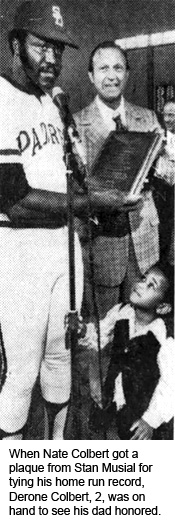
Two weeks later, on Aug. 16, 1972, when the Cardinals were in San Diego, Colbert was honored for his five-homer feat in a ceremony before the game. Stan Musial was on hand to congratulate him.

According to the Associated Press, in presenting a plaque to Colbert, Musial said to him, “Baseball is a game of records and they’re meant to be tied or broken. I’m happy one of mine was tied by a St. Louis boy and a former Cardinal.”

Musial then added, “We made a mistake when we let you go.”

In the game that followed, Colbert hit a home run against Bob Gibson, but the Cardinals won. (For his career, Colbert batted .239 with two home runs, 11 hits and 11 walks versus Gibson). Boxscore

Years later, the Los Angeles Times reported, “Musial and Colbert have a common bond that has made them good friends.”

Colbert said to the newspaper in 1989, “Now when I see him, he says, ‘We’re the only ones to do it.’ “

Trials and tribulations

Chronic back pain shortened Colbert’s playing career. “My back got worse and worse,” he told the Los Angeles Times. “It was deterioration of the vertebrae.”

In a three-way trade involving the Cardinals, Colbert was sent to the Tigers in November 1974. The next year he was shipped to the Expos and he ended his playing career with the 1976 Athletics.

Colbert hit 173 career home runs and had more strikeouts (902) than hits (833). “Considering my medical history, I probably shouldn’t even have played major league baseball,” he told the Los Angeles Times.

After his playing days, Colbert worked for the Padres as a minor-league coach and instructor, and in community relations, until October 1990 when he was indicted on 12 felony counts involving fraudulent loan applications.

Colbert was sentenced to a year in federal custody after he pleaded guilty to a federal bank fraud charge as part of a plea bargain arrangement, said assistant U.S. attorney William Hayes.

Read Full Post »

« Newer Posts - Older Posts »