Feeds:
Posts
Comments

Archive for the ‘Opponents’ Category

If not for the effective relief pitching of Ron Perranoski, the Cardinals, not the Dodgers, might have won the 1963 National League pennant and given Stan Musial a chance to end his playing career in a World Series.

A left-hander, Perranoski played 13 years in the majors and coached another 17 years in the big leagues.

In 1963, the Dodgers held a one-game lead over the Cardinals heading into a three-game series at St. Louis. The Dodgers swept, with Perranoski earning a save and a win, and went on to clinch the pennant.

Cool and collected

Born and raised in New Jersey, Perranoski early on displayed poise and a calm disposition on the mound. “As a high school pitcher, mom and dad used to complain they couldn’t tell whether I’d won or lost by the way I looked when I came home,” Perranoski told the Los Angeles Times.

He enrolled at Michigan State and was a roommate and teammate of Dick Radatz, who, like Perranoski, would become a dominant reliever in the majors.

Perranoski signed with the Cubs in June 1958. After two years in their farm system, the Cubs traded Perranoski to the Dodgers for infielder Don Zimmer. Former Cubs manager Bob Scheffing, who considered Perranoski a top prospect, told the St. Louis Post-Dispatch, “If I were still with Chicago, they’d have made that Perranoski trade over my dead body.”

After posting a 2.58 ERA in the minors in 1960, Perranoski pitched well at spring training in 1961 and earned a spot on the Dodgers’ Opening Day roster. His first big-league save came on April 18, 1961, against the Cardinals. In what the Los Angeles Times described as “a brilliant piece of relief pitching,” Perranoski retired Bill White with the bases loaded in the eighth, and set down the side in order in the ninth. Boxscore

A year later, in May 1962, Musial’s single off a curve from Perranoski gave Musial his 3,431st hit and moved him ahead of Honus Wagner for No. 1 on the National League career hit list.

Reliable relief

In 1963, there were no better relievers in the majors than the former Michigan State roommates, Perranoski and Radatz. Perranoski was 16-3 with 21 saves and a 1.67 ERA for the 1963 Dodgers. Radatz, a hulking right-hander nicknamed “The Monster,” was 15-6 with 23 saves and a 1.97 ERA for the 1963 Red Sox.

The Los Angeles Times described Perranoski as the “miracle man of the 1963 Dodgers. If the others can’t win them, he will.”

With Perranoski in the bullpen, and Sandy Koufax, Don Drysdale and Johnny Podres heading the starting rotation, the Dodgers had the best ERA in the National League in 1963, but the Cardinals kept pace with them.

Entering the Sept. 16-18 series at St. Louis, the Dodgers were 91-59 and the Cardinals were 91-61.

The Cardinals became sentimental favorites when Musial, their 42-year-old icon, revealed in August that 1963 would be his last year as a player. Musial had played in four World Series, but none since 1946, and many were pulling for the Cardinals to overtake the Dodgers and give Musial a storybook finish to his career.

Naturally, Perranoski and the Dodgers had other ideas.

Impressive pitching

Podres and Ernie Broglio were the starting pitchers for the opening game of the Dodgers-Cardinals series. The score was tied at 1-1 when the Dodgers struck for two runs in the top of the ninth against relievers Bobby Shantz and Ron Taylor.

Perranoski replaced Podres for the bottom of the ninth and got the save, retiring Dick Groat, Musial and Ken Boyer in order. Boxscore

“Podres still can make the big haul and Perranoski puts the cash in the bank,” the Post-Dispatch noted.

Said Podres: “I knew Perranoski would be ready. He’s the best relief pitcher there is.”

When Koufax pitched a four-hit shutout against the Cardinals in Game 2, the Dodgers moved three ahead in the standings. Boxscore

The Cardinals needed to win the series finale to keep their pennant hopes from fading.

Great escape

The starting pitchers for Game 3 were the Cardinals’ Bob Gibson and the Dodgers’ Pete Richert. In the eighth, with the Cardinals ahead, 5-1, the Dodgers scored three times against Gibson and Shantz, getting within a run.

Dodgers manager Walter Alston picked Perranoski to pitch the bottom of the eighth and he retired the side in order. In the ninth, Dick Nen, in his debut game, hit a home run against Ron Taylor, tying the score at 5-5.

Perranoski again retired the Cardinals in order in the ninth, but he got into trouble in the 10th. Dick Groat led off and tripled. “I tried to jam Groat with a fastball, but I got it up,” Perranoski told the Post-Dispatch.

Alston went to the mound for a conference with Perranoski. Don Drysdale was throwing in the Dodgers’ bullpen, but Alston later said, “I was going all the way with Perranoski.”

Alston asked Perranoski whether he wanted to pitch to the next batter, Gary Kolb, or load the bases with intentional walks to set up a forceout at the plate. Perranoski opted to pitch to Kolb, a left-handed batter who entered the game in the seventh to run for Musial.

“I wasn’t too alarmed because I knew I had control and I felt if I got beat they’d have to beat me on my best pitch,” Perranoski told the Los Angeles Times.

Kolb struck out looking at an outside curve.

Perranoski gave intentional walks to Ken Boyer and Bill White, loading the bases for Curt Flood. “I knew Flood was a tough cookie to double up, but I had to get him to hit the ball on the ground,” Perranoski said.

After jamming Flood with an inside fastball, Perranoski got him to chase an outside curve. Flood hit a bouncer to shortstop Maury Wills, who threw to the plate to get the forceout on Groat.

With two outs and the bases loaded, Mike Shannon came up next. “I knew Shannon was a good fastball hitter,” Perranoski said.

Perranoski started him off with a sinker. Shannon hit a tapper to third. Jim Gilliam fielded the ball and threw to first in time to retire Shannon and end the threat.

Long career

The Cardinals didn’t get another good scoring opportunity against Perranoski. In the 13th, the Dodgers scored an unearned run against Lew Burdette. Perranoski retired the Cardinals in order in the bottom half of the inning, sealing the 6-5 Dodgers win and crushing the Cardinals’ pennant chances. Boxscore

With six innings of scoreless relief, Perranoski got his 16th win of the season. “This was the biggest game I ever pitched,” he said. “It’s got to be my biggest thrill.”

Cardinals manager Johnny Keane said, “I’ve never seen anyone get them out better than he does time after time.”

The Dodgers went on to clinch the pennant, finishing at 99-63. The Cardinals placed second at 93-69.

Perranoski pitched in three World Series for the Dodgers. He also pitched for the Twins, Tigers and Angels, leading the American League in saves in 1969 and 1970.

Perranoski was Dodgers pitching coach from 1981-94. Among the pitchers he helped develop were Orel Hershiser, Rick Sutcliffe and Fernando Valenzuela.

He also mentored reliever Tom Niedenfuer. According to the Los Angeles Times, Perranoski “sort of adopted him.”

“Possibly the greatest thing Perranoski did for Niedenfuer was tell him to throw with the same motion as Goose Gossage,” the Los Angeles Times reported.

In 1985, Niedenfuer led the Dodgers in saves, but in Game 5 of the National League Championship Series he gave up a walkoff home run to the Cardinals’ Ozzie Smith. In the next game, Dodgers manager Tommy Lasorda ordered Perranoski to tell Niedenfuer to pitch to Jack Clark with two on, two outs and a base open, and Clark hit a home run, carrying the Cardinals to the pennant.
Read Full Post »

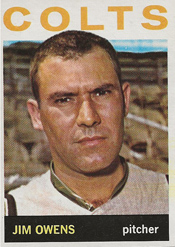
In 1964, the year he revived his baseball career, Jim Owens nearly derailed the Cardinals’ pennant chances. He also struck out Lou Brock in his first at-bat for the Cardinals.

Once a prized Phillies prospect, Owens clashed with the club’s management and created havoc as part of a group of hard-drinking pitchers dubbed the Dalton Gang.
The Phillies finally gave up on him, and so did his next team, the Reds.

With his career spiraling, Owens, 30, got a lifeline from the Houston Colt .45s in 1964, and made the most of the opportunity. Used as a reliever and spot starter, Owens was most effective against the Cardinals. He was 4-0 with one save and a 2.51 ERA against them in 1964.

Only the Mets had a worse record than the Colt .45s in the National League in 1964, but the Cardinals were unable to take full advantage. Partly because of Owens’ success against them, it took the Cardinals until the final day of the season to clinch the National League pennant.

Great expectations

Owens was born in Gifford, Pa., near the New York state border. The Phillies were defending National League champions when he signed with them at 17 in 1951.

A right-hander, Owens quickly rose throught the Phillies’ farm system. He was a 22-game winner in 1952, and he won 22 again in 1953 for Terre Haute, a team managed by Hub Kittle.

“Owens was the finest pitching prospect this club ever had, and that includes Robin Roberts,” Phillies owner Bob Carpenter told the Philadelphia Daily News.

Owens got to the majors with the Phillies in 1955, but lost his first six decisions. He didn’t get a win for them until 1958. Owens finally began to fulfill expectations in 1959, when he was 12-12 with 11 complete games, but it also was the year he joined the Dalton Gang.

Gang’s all here

Turk Farrell, Jack Meyer, Seth Morehead and Owens were the Phillies pitchers in 1959 who formed the Dalton Gang. According to Sports Illustrated, Phillies coach Tom Ferrick gave the group its name because of their outlaw antics. The real Dalton Gang robbed banks and trains in the late 1800s, primarily in the Kansas and Oklahoma territories.

Sports Illustrated described the Phillies’ Dalton Gang as “a group of wild-living, fun-loving, hell-raising players” who shared a “common love of the fast, loose life _ hard drinking, frequent fighting, late hours and casual friendships.”

Si Burick of the Dayton Daily News called the gang “a hard-riding, after-hours” group, and cited Owens for being “known as an athlete of questionable off the field habits, one who has been especially indiscreet in the drinking league.”

Asked about Owens, Phillies manager Gene Mauch told Burick, “There are people in baseball who drink as much as he does, maybe more, but they don’t get into trouble like him.”

Farrell and Owens were road roommates for one year in the minors and four years with the Phillies. During the 1960 season, in an effort to stop the shenanigans, Mauch split up the pair, rooming Farrell with coach Ken Silvestri and Owens with coach Peanuts Lowrey.

“Silvestri would go to bed at 10 o’clock,” Farrell told The Sporting News. “I’d keep the TV set on until 4 and order up some beer. Jim did the same thing in his room. We kept this up for 10 days and finally Silvestri and Lowrey went to Mauch and begged him to change his mind. So Mauch roomed me and Owens back together.”

One year, the Phillies offered Owens a $500 bonus if he promised to behave. According to Sports Illustrated, he “didn’t even make it through spring training. He got involved in a barroom brawl in Florida, lost the bonus and was fined an extra hundred to boot.”

In 1961, when Owens stormed out of Phillies training camp because of a disagreement with Mauch and threatened to quit, Larry Merchant of the Philadelphia Daily News described him as “a magnificent pitcher from the eyebrows down” and said the reason for Owens’ sulking was “as clear as a head full of vodka stingers.”

Not done yet

After the 1962 season, the Phillies traded Owens to the Reds for infielder Cookie Rojas. Owens pitched poorly for the 1963 Reds and in July they sent him to their San Diego farm club.

The demotion apparently was a wakeup call for Owens. He was 4-2 with a 2.21 ERA for the Reds’ farm team. The Colt .45s claimed him in the December 1963 minor-league draft, and Owens went to pitch winter ball in Venezuela in order to prepare to make a bid for a return to the majors in spring training.

In Venezuela, facing lineups stocked with major leaguers, Owens was the league’s best pitcher. He was 8-2 with an 0.72 ERA. All was going splendidly until on Jan. 29, 1964, when Owens was taken to a hospital for treatment of a leg wound.

According to The Sporting News, multiple variations were reported of how Owens cut his leg. Two newspaper reporters said Owens “had been stabbed during a Valencia barroom argument.” Valencia police said Owens “attempted to act as peacemaker on behalf of a friend during a fight and was cut in the right thigh” by someone wielding a knife. The president of the Valencia ballclub said Owens was injured in a swimming pool mishap. Owens said he slipped in a bowling alley and fell on top of a glass tumbler.

Old pro

Stitched up, Owens reported to the Colt .45s and “was the surprise of spring training,” The Sporting News reported. He earned a spot in the starting rotation and was reunited with his Dalton Gang buddy, Turk Farrell, who also was a Colt .45s starter.

“I always thought Jim was a good pitcher,” Farrell said. “He got the shaft in Philadelphia. Everybody tried to tell him how to pitch and how to live and he never got to pitch enough. If they would have left him alone, he’d have been all right.”

On April 26, 1964, Owens started against the Cardinals and got his first win for the Colt .45s, beating his former Phillies teammate, Curt Simmons. Boxscore

Two months later, on June 15, Owens relieved, retired all nine batters he faced, and got the win against the Cardinals. Brock, acquired earlier in the day from the Cubs, appeared as a pinch-hitter and struck out on three pitches from Owens. Boxscore

Owens also got relief wins versus the Cardinals on June 24 and Aug. 19, and earned a save against them on Aug. 8.

“Although Owens has been haunted in his career by a reputation for off the field hijinks, he has been a model of good deportment on the Colt .45s,” The Sporting News reported. “It is plain Jim would like to live down the playboy label of his youth.”

Owens was called “Bear” by his teammates because he had “the square build and somewhat lumbering gait of a medium-sized grizzly,” The Sporting News noted.

The nickname also fit his demeanor. According to The Sporting News, Owens “stays to himself as much, or more, than any other player on the Houston club. He is quiet, seldom smiles and does not engage much in small talk. On the mound, he acts like a man in a bad temper. He scowls as he pitches, and when he takes a throw from his catcher, he jerks at the ball in a short, angry gesture.”

Owens finished with an 8-7 record, six saves and a 3.28 ERA for the 1964 Colt .45s. The next year, the team became the Astros, and Owens again was tough versus the Cardinals, with a 1-0 record, a save and 2.08 ERA against them.

In June 1967, Owens made his last appearance as a pitcher, giving up a three-run home run to Orlando Cepeda in a relief stint versus the Cardinals. Boxscore

In a reversal of roles, the one-time baseball bad boy joined management, becoming an Astros coach for the remainder of 1967, and stayed in the job until 1972.

“He knows more about pitching than anybody on this club,” Astros manager Grady Hatton told The Sporting News.

Read Full Post »

(Updated Feb. 21, 2023)

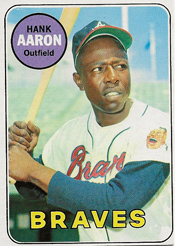
Hank Aaron was the recipient of a special delivery from Bob Gibson.

On July 28, 1970, Gibson threw a knuckleball in a game for the first time. The batter he threw it to was Aaron.

The unlikely pitch from a premier fastball pitcher to a premier fastball hitter occurred in a game between the Cardinals and Braves at Atlanta.

Mighty matchups

Aaron, 36, and Gibson, 34, still were at the top of their games in 1970. Aaron would finish the season with 38 home runs and 118 RBI. Gibson would finish at 23-7 and win his second National League Cy Young Award.

The two future Hall of Famers faced each other often. Aaron completed his career with 163 at-bats against Gibson. Only Billy Williams (174) batted more times versus Gibson.

Aaron batted .215 versus Gibson for his career. He had 35 hits, including eight home runs, and struck out 32 times. “Gibson was every bit as mean as (Don) Drysdale, and he threw harder,” Aaron said in his autobiography “I Had a Hammer.”

In his book, “Sixty Feet, Six Inches,” Gibson said, “There are very few guys who can consistently hit that 95 mph fastball that’s up above the belt. Hank Aaron could. Aaron swung down on the ball. He’d get backspin on it and hit line drives that would start off close to the ground and just keep going unless the fence got in the way.”

“I’d avoid throwing Hank Aaron a fastball over the plate if there was any possible way I could get around it,” Gibson said. “That man did not miss a fastball.”

In Gibson’s first two starts against the 1970 Braves, Aaron tagged him for five hits in eight at-bats.

Entering their third and final matchup of the season on a hot, humid night in Georgia, Gibson had a surprise for Hammerin’ Hank.

Ready or not

Before the game, Gibson told catcher Joe Torre he wanted to throw a knuckleball.

“I’ve been fooling around with that pitch on the sidelines for what, three, four years?” Gibson said to the St. Louis Post-Dispatch. “I figured I finally had enough guts to throw it in a game. I just wanted to see what would happen.”

In the first inning, the Braves had a runner on second, one out, and Aaron at the plate. When the count got to 2-and-2, Gibson decided to unveil the knuckleball.

“I got it over and it went down pretty good,” Gibson said.

Aaron swung at it and popped out to second baseman Julian Javier.

In his book, Gibson recalled, “As he ran back to the dugout, he yelled to me, ‘What the hell was that?’ I laughed and told him, all proud, ‘That was my knuckleball.’ ”

Gibson knew Aaron sometimes could be coaxed into chasing tantalizingly slow pitches. Five years earlier, in 1965, the Cardinals’ Curt Simmons threw a high, floating changeup to Aaron, who hit the ball over the wall but was called out by the umpire for stepping out of the batter’s box.

Gibson said he tried a knuckleball as a substitute for a changeup.

“Knuckleballs, incidentally, aren’t thrown with your knuckles,” Gibson said in his book. “They’re thrown with your fingernails. The reason they call it a knuckleball is because that’s what the hitter sees when you dig your fingernails into the seam.”

Encore in ninth

Gibson retired 12 of the first 13 Braves batters, and the Cardinals built a 6-0 lead against Jim Nash and Bob Priddy.

According to the Atlanta Constitution, Braves manager Lum Harris said Gibson “was bringing it up there in a hurry. I wondered if we’d get any runs off him.”

In the sixth, Aaron drove in a run with a single and the Braves scored three times in the inning. “I pitched dumb,” Gibson said of his sixth-inning effort. “I just tried to get by on nothing but fastballs, and I was getting tired.”

The Braves added another run in the seventh, getting within two at 6-4.

In the ninth, the Braves brought in the master knuckleball specialist, 48-year-old Hoyt Wilhelm, to pitch, and he retired the Cardinals in order. “Old Hoyt was something,” Harris marveled.

After retiring Felix Millan in the bottom half of the inning, Gibson again faced Aaron, who popped out to second base for the third time in the game.

“I got Aaron on that pop-up in the ninth on a knuckler,” Gibson told the Atlanta Constitution.

Torre said to the Post-Dispatch, “In the ninth, when Henry popped up, it looked as if he had a good ball to hit, but just when Henry got the bat around to where the pitch was, the ball sailed out. Henry never had a chance. All Henry said was, ‘Son of a bitch.’ ”

Gibson struck out the next batter, Rico Carty, to complete the game and earn the win, boosting his record to 13-5. His totals for the game: 9 innings, 12 hits, 4 runs, 1 walk, 7 strikeouts. Boxscore

“Twelve hits are a lot to give up and still win, but I’m not complaining,” said Gibson.

In his book, Gibson said he rarely threw another knuckleball.

“Every time I threw a changeup, somebody would whack it over some fence, or in between the outfielders,” Gibson said. “Unfortunately, my knuckleball wasn’t much better.”

Read Full Post »

After playing a twi-night doubleheader in St. Louis, the Dodgers were grateful to arrive alive for their afternoon game in Chicago the next day.

leo_durocher3On Sept. 15, 1945, a passenger train carrying members of the Dodgers from St. Louis to Chicago collided with a gasoline tanker truck at a road crossing in Manhattan, Ill.
The locomotive engineer was killed in the crash. The train’s fireman was burned, but survived with assistance from the Dodgers’ trainer.

None of the Dodgers were badly injured.

Scheduling conflicts

After playing a doubleheader at Cincinnati on Tuesday, Sept. 11, the Dodgers arrived by train in St. Louis the morning of Wednesday, Sept. 12, and were scheduled to play a doubleheader that evening versus the Cardinals.

The Cardinals won the opener but the second game was called off because of rain. Another doubleheader was scheduled for Thursday, Sept. 13, but rain wiped out both games. The games were rescheduled for Friday, Sept. 14, which was supposed to be a travel day for the Dodgers.

Dodgers manager Leo Durocher requested day games for the Sept. 14 doubleheader so that his club would have time to rest after traveling to Chicago for their day game on Saturday, Sept. 15, against the Cubs, but Cardinals owner Sam Breadon scheduled the Sept. 14 doubleheader to start at 5 p.m.

The Dodgers sent Les Webber, their starting pitcher for the Sept. 15 day game, to Chicago ahead of time.

The weather in St. Louis was chilly and damp on Sept. 14 and the doubleheader attracted a mere 2,103 paid customers, but both games were played. The Dodgers swept. Boxscore and Boxscore

The setbacks dropped the Cardinals 3.5 games behind the league-leading Cubs.

All aboard

After the Sept. 14 doubleheader, the eight starting position players for the Dodgers departed for Chicago on one train and the remainder of the club left on the midnight train, the Wabash Limited.

The same eight position players had started both games of the Sept. 14 doubleheader. They were Eddie Stanky, Goody Rosen, Augie Galan, Dixie Walker, Ed Stevens, Frenchy Bordagaray, Tommy Brown and Mike Sandlock.

Boarding the midnight train were manager Leo Durocher, coaches Chuck Dressen and Red Corriden, traveling secretary Harold Parrott, trainer Harold Wendler, and players Hal Gregg, Cy Buker, Vic Lombardi, Babe Herman, Ralph Branca, Tom Seats, Johnny Peacock, John Dantonio, Clyde King, Eddie Basinski, Art Herring, Curt Davis and Luis Olmo.

The Wabash Limited was a train operated by the Wabash Railroad, a Midwestern rail line popularized by the song, “The Wabash Cannonball.” The train of seven cars and three baggage coaches was listed as passenger train No. 18 on its run from St. Louis to Chicago.

The Dodgers were riding in the rear passenger car. Because of wartime restrictions, sleeper berths were limited, so the Dodgers settled for a day coach. Some of the team members were asleep on the floor of the passenger car when the train approached a diagonal crossing at Route 52, the main business street in the village of Manhattan, about 45 miles southwest of Chicago, at 6:30 a.m. on Sept. 15.

Death on the tracks

A truck, pulling two full gasoline tankers, tried to get through the crossing, but the train hit the rear tanker, causing an explosion, the Decatur (Ill.) Daily Review reported. The locomotive engine became enveloped in fire. Most of the windows on the train were shattered, sending glass flying inside the passenger cars, and flames lapped the open frames.

The train pushed the truck along the track before stopping and the inferno set fire to the office of the nearby Alexander Lumber Company, the Decatur newspaper reported. Two of the lumber company’s warehouses also were destroyed by the blaze, according to the Chicago Tribune.

“Townspeople who saw the collision declared the train was a flaming torch … and the Manhattan fire department had its work cut out for it to keep the flames from destroying the whole of the little town,” The Sporting News reported.

The driver of the train, engineer Charles Tegtmeyer, 69, died instantly of burns while in the cab of the locomotive. Tegtmeyer went to work for the Wabash Railroad as a fireman in 1901 and was promoted to engineer in 1910, the Decatur newspaper reported.

George Ebert, the train’s fireman, who was responsible for maintaining the correct steam pressure in the engine’s boiler, jumped from the locomotive.

Dodgers trainer Harold Wendler “saw the fireman lying outside on the embankment, his blue overalls smoldering,” The Sporting News reported.

According to the Decatur newspaper, Dodgers team members helped Ebert out of his burning clothes.

Wendler administered first aid to Ebert until an ambulance arrived and took him to a hospital about 10 miles away in Joliet, Ill.

The truck driver, Herman Cherry, was picked up along the road and taken to a Joliet hospital by a passing motorist, the Decatur newspaper reported.

Show must go on

According to The Sporting News, Leo Durocher kept the Dodgers calm in the moments immediately following the collision. “Don’t run, fellows,” Durocher said. “Take it easy and go out by the rear door.”

Six passengers on the train were injured slightly by broken glass, the Decatur newspaper reported. According to The Sporting News, Dodgers player Luis Olmo was cut on his right arm by flying glass. Coach Chuck Dressen injured a knee.

The train never left the track, the Decatur newspaper reported. After the fire was extinguished, the entire train was taken to Chicago.

The Dodgers played their game that afternoon and were defeated, 7-6, by the Cubs. Boxscore

Five players who were on the damaged train played in the game: pinch-hitters Babe Herman and Johnny Peacock, and relief pitchers Tom Seats, Clyde King and Cy Buker.

Read Full Post »

(Updated April 26, 2024)

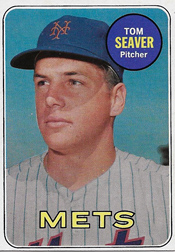
Bob Gibson of the Cardinals and Tom Seaver of the Mets opposed one another 11 times in the regular season and the results paralleled the paths of their careers.

Seaver was the winning pitcher in six of the matchups, Gibson was the winning pitcher three times, and twice their duels ended in no decisions.
The first win for Seaver vs. Gibson came in 1969, a year when he paced the Mets to an improbable World Series title, and the other five occurred in the 1970s, when Seaver was in his prime.

Gibson’s wins versus Seaver came in a three-year stretch, 1968-70, when he twice won the National League Cy Young Award.

From 1971, the year Gibson turned 36, to 1975, Seaver won five decisions in a row versus Gibson.

According to the St. Louis Post-Dispatch, Seaver is the only pitcher to beat Gibson three times in one season. Seaver did it in 1971.

In Gibson’s three wins versus Seaver, the Mets scored a total of four runs.

In Seaver’s six wins versus Gibson, the Cardinals scored a total of seven runs.

Gibson told the Post-Dispatch in 1975, “I could beat him, but that was when I was giving up only one or two runs a game. Later, when I started giving up more runs, he was a tough guy to beat because he wasn’t giving up that many.”

In 2021, catcher Ted Simmons said to the Baseball Hall of Fame yearbook, “Gibson was the best pitcher I ever caught. Seaver was the best pitcher I ever faced, and that’s because I never had to face Gibson.”

Simmons also told the Post-Dispatch in 1976, “Jim Palmer and Nolan Ryan may throw as hard, but as far as total command of what he’s doing, nobody is better than Seaver.”

The first matchup of Gibson versus Seaver may have been the best.

Pair of aces

In 1967, Seaver’s rookie season, he faced the Cardinals once, a start versus Al Jackson.

Seaver’s second career start against the Cardinals came on May 6, 1968, a Monday night in St. Louis, versus Gibson.

Seaver, 23, was making his sixth start of the season and was 1-1 with a 1.71 ERA. He went eight innings in his previous start May 1, a no-decision versus the Phillies.

Gibson, 32, was making his sixth start of the season and was 2-1 with a 1.43 ERA. He went 12 innings in his previous start May 1, a win versus the Astros. “I made 179 pitches in that game, and after 179 pitches, your arm doesn’t feel too good for a while,” Gibson told the Post-Dispatch.

Before his start against Seaver and the Mets, Gibson said, “I had my arm under a heat lamp for 20 minutes, trying to get it loosened up.”

Costly mistake

The Cardinals went ahead, 1-0, with an unearned run against Seaver in the second inning. After Tim McCarver led off with a single, Mike Shannon grounded to first baseman Ed Kranepool, who fielded the ball and turned to throw to second base for what seemed like a certain forceout.

Kranepool cocked his arm but stopped, unsure whether shortstop Bud Harrelson would get to the bag in time to take the throw. When he finally made the throw, Kranepool was off balance. The ball skipped along the ground and bounced off Harrelson’s chest for an error. Julian Javier followed with a single to right, scoring McCarver from second.

The Mets got three hits in the game against Gibson and all came in the fourth inning.

Harrelson led off with a single and advanced to third on Ken Boswell’s single. Art Shamsky lined a hit to left, driving in Harrelson and tying the score at 1-1. With Ron Swoboda at the plate, an inside pitch got away from McCarver, the catcher, for a passed ball, allowing Boswell to move to third and Shamsky to second with none out.

Wrong route

Swoboda hit a fly ball to center. Curt Flood ran forward and made the catch, but as Boswell tagged at third, Flood hesitated before making a throw. “Boswell looked like a cinch to score,” the Post-Dispatch reported.

“I didn’t think we had a chance to get Boswell,” McCarver said.

Flood’s throw tailed toward the third-base line, and McCarver went up the line to retrieve the ball. Boswell beat the throw “by plenty,” the New York Daily News reported, but McCarver was “blocking the line without the ball.”

Instead of barreling into McCarver in a straight path to the plate, Boswell slid wide around the catcher and reached for the plate with his hand.

Boswell touched nothing but dirt. As the ball reached McCarver, he wheeled around and tagged out Boswell to complete a double play. Instead of a 2-1 lead for the Mets, the score remained tied.

Dick Young of the New York Daily News described Boswell’s play at the plate as a “chicken slide.”

“He should have scored easily with the lead run,” Young wrote. “He should have bowled over McCarver.”

Mets manager Gil Hodges told the Post-Dispatch, “In that situation, you can’t go around the catcher. You have to hit him.”

In control

From then on, Gibson and Seaver settled into a groove.

Gibson allowed one base runner after the fourth inning. After Swoboda walked with one out in the seventh, Gibson retired 14 batters in a row.

Seaver held the Cardinals hitless from the third through ninth innings. After Shannon walked in the fourth, Seaver retired 17 in a row until Shannon got an infield hit in the 10th.

As the game entered the 11th, Gibson and Seaver were approaching their limits.

Joe Hoerner was ready in the Cardinals’ bullpen and would have come into the game if it went to a 12th inning. “I can’t let (Gibson) throw his arm out,” manager Red Schoendienst said.

Seaver told the Post-Dispatch the 11th inning would have been his last, too.

Cream of the crop

It took a couple of future Hall of Famers, Lou Brock and Orlando Cepeda, to settle the duel between future Hall of Famers Gibson and Seaver.

Brock led off the bottom of the 11th with a drive to the wall in left-center for a triple. Seaver gave intentional walks to Flood and Roger Maris, loading the bases in hope of a forceout or double play.

Cepeda foiled the strategy, lining Seaver’s first pitch to right for a single to drive in Brock and give the Cardinals and Gibson a 2-1 victory. Boxscore

The win improved Gibson’s career mark against the Mets to 18-3.

“My arm doesn’t hurt half as much as it will tomorrow,” Gibson said, “but that’s the price you have to pay if you want to be a pitcher.”

The 11-inning game was played in a snappy 2:10.

“They don’t fritter around,” Dick Young wrote of Gibson and Seaver. “They get the ball and fire.”

Read Full Post »

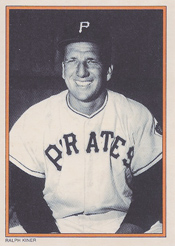
Cardinals manager Eddie Dyer preferred to put Pirates slugger Ralph Kiner on base, representing the potential winning run, rather than give him a chance to hit a walkoff home run.

On Sept. 3, 1950, with the score tied in the bottom of the 10th inning of a game between the Cardinals and Pirates at Pittsburgh, Dyer ordered pitcher Harry Brecheen to give an intentional walk to Kiner with the bases empty and two outs.

The unorthodox strategy backfired when the next batter, rookie Gus Bell, hit a double, scoring Kiner and giving the Pirates a 12-11 victory.

Home run king

The Cardinals carried a four-game losing streak into the Sunday afternoon series finale against the last-place Pirates at Forbes Field.

Kiner hit two home runs. The first was a solo shot against Red Munger in the opening inning. The second home run, a two-run clout versus Cloyd Boyer in the eighth, gave the Pirates a 9-8 lead.

In his first four seasons (1946-49) in the majors, Kiner led the National League in home runs in 1946 (23) and 1949 (54), and tied with Johnny Mize of the Giants for the top spot in 1947 (51) and 1948 (40). Kiner was on his way to winning the league’s home run crown again in 1950.

Comeback Cardinals

Bill Howerton of the Cardinals led off the top of the ninth with a home run into the upper deck in right against Junior Walsh, tying the score at 9-9.

Brecheen, usually a starter, relieved for the Cardinals in the bottom of the ninth and retired the Pirates in order.

In the top of the 10th, the Cardinals scored twice versus Bill Werle. With one out and none on, Red Schoendienst doubled, Stan Musial drove him in with a single and Enos Slaughter tripled, scoring Musial and extending the Cardinals’ lead to 11-9.

Dare to differ

Brecheen retired the first batter, Clyde McCullough, in the bottom of the 10th, but the next two, Pete Castiglione and Bob Dillinger, each hit a home run, tying the score at 11-11. For Castiglione, the home run was his third of the season and for Dillinger it was his first since the Pirates acquired him from the Athletics in July.

After the back-to-back home runs, Brecheen knocked down the next batter, Danny O’Connell, with his first pitch to him. O’Connell grounded out for the second out of the inning.

The next batter was Kiner. The only way he could beat the Cardinals was to hit a home run, but Dyer thought the risk was so high it was worth issuing an intentional walk.

Among the factors influencing Dyer’s thinking:

_ Kiner batted right-handed and Brecheen was a left-hander.

_ Brecheen already had given up two home runs in the inning and thus was vulnerable against Kiner.

“The fact it violated tried and true baseball strategy doesn’t bother us a bit,” columnist Bob Burnes wrote in the St. Louis Globe-Democrat. “We’ve always felt too many managers called too many plays in routine fashion purely because that’s the way the pattern said it should be.”

What did bother Burnes is the slumping Cardinals appeared to have lost confidence. “It was a desperation play, one dictated by something almost akin to panic,” Burnes said.

Take that!

As Kiner watched Brecheen lob four pitches wide of the plate, the fans booed.

With Kiner on first, cleanup hittter Gus Bell batted next. Bell had tripled twice and singled. Though a left-handed batter, Bell hit .320 versus left-handers in 1950.

Bell belted a pitch from Brecheen high and deep to right. The ball “appeared headed into the stands for a home run,” the Pittsburgh Press reported, but it hit high on the screen.

Right fielder Enos Slaughter gave chase and fell. The ball caromed about 35 yards from the screen, the Globe-Democrat reported, giving Kiner time to hustle from first base to home. Bell stopped at second with a double as Kiner crossed the plate with the winning run. Boxscore

The teams combined for 30 hits, including 20 for extra bases.

Each team hit three triples. The Pirates had five home runs and the Cardinals had three.

The Cardinals wasted a big performance from Stan Musial, who had four hits and two walks. Playing near his hometown of Donora, Pa., Musial had a two-run home run and scored four times.

Kiner went on to hit 47 home runs in 1950. Only eight came against left-handers.

Brecheen finished the 1950 season with a 3.55 ERA in 23 starts for the Cardinals and a 10.50 ERA in four relief appearances.

Read Full Post »

« Newer Posts - Older Posts »