Feeds:
Posts
Comments

Archive for the ‘Opponents’ Category

Don Pavletich achieved two special personal milestones versus the Cardinals, but one of his worst moments also occurred in a game against them.

A catcher and first baseman, Pavletich played 12 years in the major leagues for the Reds, White Sox and Red Sox. The 1965 Topps card pictured here incorrectly listed him as a pitcher.

In 1962, while with the Reds, Pavletich got his first major-league hit. A few weeks later, he got his first major-league RBI. Both feats came in games against the Cardinals.

Two years later, Pavletich had a prominent, but unwanted, role versus the Cardinals when his error led to a Reds loss in the thick of the 1964 National League pennant race.

Hot prospect

Born in Milwaukee and raised in nearby West Allis, Wisconsin, Pavletich was Croatian-American. All four of his grandparents immigrated to the United States from Croatia, according to the Society for American Baseball Research.

In high school and summer leagues, Pavletich was coached by Steve Belich, who had prepared another West Allis standout, Harvey Kuenn, for the majors.

A powerful right-handed batter, Pavletich, 18, signed with the Reds in August 1956 and made his major-league debut for them in his hometown of Milwaukee on April 20, 1957. A month later, Pavletich began a two-year hitch in the Army.

After hitting .295 with 22 home runs as a catcher and first baseman for manager Cot Deal at minor-league Indianapolis in 1961, Pavletich opened the 1962 season with the defending National League champion Reds as a backup to catcher Johnny Edwards and first baseman Gordy Coleman.

On April 29, 1962, in the first game of a doubleheader at St. Louis, the Cardinals led, 9-1, in the fourth inning when Reds manager Fred Hutchinson replaced Edwards with Pavletich.

In the fifth, Pavletich got his first big-league hit, a single versus Larry Jackson. Pavletich went on to hit .400 (6-for-15) in his career against Jackson. Boxscore

The next time Pavletich faced the Cardinals, on June 5, 1962, at St. Louis, he started at first base and hit a two-run single versus Curt Simmons in the third inning for his first RBI in the big leagues. Boxscore

Pavletich did some of his best hitting against some prominent left-handers, including Dick Ellsworth (.409), Denny Lemaster (.389), Warren Spahn (.364), Johnny Podres (.364) and Simmons (.318).

Costly miscue

On Sept. 19, 1964, the Cardinals and Reds, trying to catch the first-place Phillies in the final two weeks of the season, played a doubleheader at Cincinnati. The Cardinals were jolted in the opener when Frank Robinson hit a three-run walkoff home run against Bob Gibson in the ninth. Boxscore

In the second game, with the pressure on the Cardinals to avoid being swept, the pitchers were left-handers Billy McCool, making his first career start for the Reds, and Ray Sadecki for St. Louis. The catchers were a pair of Milwaukee natives, Pavletich and the Cardinals’ Bob Uecker.

In the second inning, with one out and the game scoreless, the Cardinals’ Bill White and Julian Javier each singled, putting runners on second and first.

As the next batter, Mike Shannon, struck out, White and Javier attempted a double steal. Pavletich’s throw sailed over the head of third baseman Chico Ruiz and into left field. White and Javier both scored on the error and those were the game’s only runs. Boxscore

The 2-0 victory kept the Cardinals in second place, 5.5 games behind the Phillies, and proved to be a difference-maker. The Cardinals clinched the pennant on the last day of the season, finishing a game ahead of both the Reds and Phillies.

Power hitter

At spring training in 1966, Pavletich made a bid to unseat Edwards, a three-time National League all-star, as the Reds’ starting catcher. When Edwards suffered ligament damage to the middle finger of his right hand when struck by a foul ball in an exhibition game on April 9, Pavletich was ready to take over.

After watching Pavletich hit his fifth home run of the spring training season, Edwards told the Dayton Daily News, “Every time I see him swing that bat, my finger feels better.”

With Edwards sidelined, Pavletich opened the 1966 season as the Reds’ catcher. On April 17, in his third consecutive game as starting catcher, Pavletich injured his left foot while rounding first base after hitting a double. He stayed in the game, but awoke the next morning with pain in his foot so intense “he nearly collapsed when he got out of bed,” the Dayton Journal-Herald reported.

Pavletich strained ligaments in the foot and couldn’t play. Edwards, wearing a metal splint on his injured finger, replaced him and remained the starting catcher.

Veteran vs. phenom

In August 1967, Johnny Bench made his major-league debut with the Reds and was their starting catcher the last month of the season.

Six months later, the Reds traded Edwards to the defending World Series champion Cardinals to clear the way for Bench to be their catcher in 1968.

“Bench was conceded the starting position at the start of spring training,” the Cincinnati Enquirer reported.

Pavletich, 29, wasn’t ready to give in to Bench, 20. Rising to the challenge, Pavletich hit seven home runs with 19 RBI in Reds spring training games in 1968 and was named the Opening Day starting catcher.

“I must say I’m most pleased by Pavletich’s home run hitting,” Reds manager Dave Bristol said.

Convinced the Reds were a contender, Pavletich said, “I know the Cardinals are a great club and definitely are the club to beat, but I feel we have it on them in two important departments _ pitching and bench strength.”

Pavletich started at catcher in the first five games of the 1968 season before he hurt his right arm swinging at a pitch in Chicago. With Pavletich sidelined for a month, Bench took over as starting catcher and never looked back, building a Hall of Fame career.

Pavletich batted .254 in his big-league career, including .264 in 50 games versus the Cardinals.

Read Full Post »

In assessing Joe McEwing’s value to the club as a utility player, the Cardinals placed a premium on productivity instead of popularity.

On March 18, 2000, the Cardinals traded McEwing to the Mets for reliever Jesse Orosco.
The deal was disliked by Cardinals fans who rooted for McEwing when he unexpectedly emerged as an overachieving underdog to become the team’s second baseman in 1999.

Nicknamed “Super Joe” for his all-out hustle, McEwing established a Cardinals rookie record with a 25-game hitting streak in 1999. The feat earned him another tag, “Little Mac,” in relation to his slugging teammate, Mark McGwire, who was “Big Mac.”

Though McEwing endeared himself to the Cardinals, sentiment was shoved aside the following spring when he struggled in a bid to earn a role as a utility player.

Job search

McEwing, chosen by the Cardinals in the 28th round of the 1992 amateur draft, was in his seventh season in their farm system when he earned a call to the big leagues in September 1998.

Placido Polanco was the Cardinals’ Opening Day second baseman in 1999, but McEwing eventually emerged from the bench to replace him. A right-handed batter, McEwing hit .275 with 28 doubles for the 1999 Cardinals, splitting time between second base and the outfield.

After the 1999 season, the Cardinals acquired second baseman Fernando Vina from the Brewers and made him their leadoff batter in 2000. McEwing, 27, went to spring training as a candidate for a utility role.

The competition for bench spots was intense. McEwing hit .143 in spring training and was outperformed by fellow utility players Shawon Dunston, Craig Paquette and Polanco.

When left-handed reliever Scott Radinsky developed elbow trouble, the Cardinals went searching for a replacement and made the swap of McEwing for Orosco.

“It would have been tough for Joe to make the club based on what we’ve seen this spring and the other candidates,” Cardinals general manager Walt Jocketty told the St. Louis Post-Dispatch.

When McEwing left the Cardinals’ clubhouse in Jupiter, Fla., he wrote on a message board, “I love you guys, Joe Mac.”

Fond farewell

Most were sorry to see McEwing depart.

Cardinals manager Tony La Russa said he planned to keep a pair of McEwing’s cleats in his office “to remind me of what a professional ballplayer is supposed to be.”

Jocketty said when he got home after making the trade he found a McEwing baseball card belonging to his son, Joey, on a table. “I’m not popular with my son,” Jocketty told the Post-Dispatch.

Columnist Bernie Miklasz called McEwing “one of my favorite St. Louis athletes ever” and wrote, “Trading Joe McEwing is like being mean to a kitten.”

Miklasz concluded, “I didn’t want to admit it at first, but this trade makes sense.”

Warranty expires

Orosco, who turned 43 a month after joining the Cardinals, was a standout with the Mets in 1986 when they were World Series champions. In 1999, he pitched in 65 games for the Orioles.

He told the Post-Dispatch he was glad to be with the Cardinals. “Hopefully, I’m the piece to that puzzle that they needed in the bullpen,” Orosco said.

Before becoming a Cardinal, Orosco pitched in 1,090 major-league games and never was on the disabled list.

“Maybe he’s just got elastic bands for rotator cuffs,” said Cardinals pitcher Paul Spoljaric.

Turns out, the elastic was ready to snap.

Orosco pitched in three April games for the Cardinals, hurt his elbow and went on the disabled list. He returned in June, pitched in three more games, went back on the disabled list, had surgery to repair a torn elbow tendon and was done for the season.

Orosco faced a total of 16 batters for the Cardinals. He became a free agent after the season, signed with the Dodgers and continued to pitch in the majors until 2003 with the Twins at age 46. His 1,252 games pitched, including six with the Cardinals, are a major-league record

Switching sides

With Melvin Mora and Kurt Abbott in utility roles for the Mets, McEwing began the 2000 season in the minors. In mid-May, he got called up to the Mets and was in their lineup as an outfielder for all three games of a series May 26-28 against the Cardinals at St. Louis.

“I’m excited to come back,” McEwing told the Post-Dispatch before adding, “I’m a Met now. I’m happy to be a Met.”

Helped by McEwing and another ex-Cardinal, Todd Zeile, the Mets swept the three-game series. McEwing was 4-for-12 with one RBI and was warmly greeted by Cardinals fans. Zeile was 5-for-13 with three home runs and seven RBI and was booed.

After teasing McEwing about the fan reactions, Zeile told the New York Daily News, “I get excited to play back here. With every at-bat, the fans booed me a little louder and it motivated me a little more. I don’t think there’s any animosity though.”

McEwing hit .222 for the 2000 Mets, who won the pennant by prevailing against the Cardinals in the National League Championship Series.

McEwing played five season (2000-2004) with the Mets before finishing his career in the majors with the Royals (2005) and Astros (2006). He played every position in the majors except pitcher and catcher.

Read Full Post »

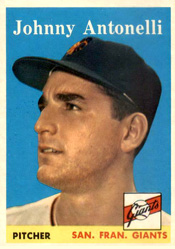
Johnny Antonelli lost more than he won versus the Cardinals, and Stan Musial and Ken Boyer often hit well against him, but when he was at his peak he was hard to beat.

A left-handed pitcher, he had a 126-110 record in 12 major-league seasons with the Braves, Giants and Indians.
His most prominent year was 1954 when he was 21-7 for the World Series champion Giants and led the National League in ERA (2.30) and shutouts (six).

His 20th win in 1954 came against the Cardinals and made him the first Giants left-hander to achieve the feat since Carl Hubbell and Cliff Melton each did it in 1937.

The Natural

Antonelli’s father was born in Italy and immigrated to Rochester, N.Y., where he worked for the railroad.

In the book, “We Played the Game,” Antonelli said he played organized baseball for the first time in high school. “It came pretty easy to me,” Antonelli said. “I started out playing first, but my coach, Charlie O’Brien, noticed that when I threw the ball it had a little tail to it, so he tried me out as a pitcher.”

As he prepared to graduate from high school in 1948, Antonelli said an exhibition game against a local semipro team was arranged for him so he could pitch before big-league scouts. The game was played at the ballpark used by the Cardinals’ farm club in Rochester.

In “We Played the Game,” Antonelli said the Red Sox made the highest offer, but he signed with the Braves for a $52,000 bonus. The Braves’ manager, Billy Southworth, had led the Cardinals to three consecutive pennants (1942-44) and two World Series titles.

“I let my father make the decision,” said Antonelli. “My father and I were fans of the Rochester Red Wings and my father was surely influenced to sign with the Braves because Billy Southworth had once coached at Rochester.”

Antonelli said it also helped that the Braves were owned by an Italian-American, Lou Perini.

Mixing pitches

Antonelli, who never played in the minor leagues, was 18 when he made his debut with the Braves on July 4, 1948. He spent two years (1951-52) in the Army and was traded to the Giants in 1954 in a deal involving slugger Bobby Thomson.

Giants pitching coach Freddie Fitzsimmons helped Antonelli develop an off-speed pitch to go with his fastball and curve. Antonelli described it as a “little snap screwball.”

In “We Played the Game,” Antonelli said, “It was meant to keep batters off stride. It was the pitch that made me successful.”

Changing speeds effectively, Antonelli’s pitching, along with Willie Mays’ hitting and fielding, helped the Giants replace the Dodgers as the best team in the National League in 1954.

On Aug. 30, 1954, Antonelli pitched a four-hitter in a 4-1 Giants victory over the Cardinals at St. Louis. The win gave Antonelli a season record of 20-3. All four Cardinals hits were singles.

The St. Louis Post-Dispatch described Antonelli as “tremendous” and reported he used a curve, a “clever changeup” and an “overpowering fastball.”

“I’ve never seen him so fast,” Musial said. “He almost shaved me with one inside.” Boxscore

In a nifty bit of foreshadowing, the Post-Dispatch concluded, “It’s difficult to figure them beating Antonelli in a close one.”

Two weeks later, on Sept. 13, 1954, Antonelli pitched a five-hit shutout and outdueled rookie Gordon Jones in the Giants’ 1-0 triumph over the Cardinals in New York. Again, all of the St. Louis hits were singles. Antonelli allowed no hits after the fourth inning. Boxscore

Cardinals challenge

Antonelli was the starter for the Giants in the first game the Cardinals played in San Francisco in 1958. Boxscore

He also allowed two of the five home runs Musial hit in a doubleheader against the Giants on May 2, 1954 at St. Louis. Boxscore

Musial hit .302 with 11 home runs in his career against Antonelli. No other batter hit more home runs versus Antonelli.

The first home run allowed by Antonelli in the big leagues was to Musial on May 24, 1949, at St. Louis. Boxscore

Musial’s Cardinals teammate, Boyer, batted .330 with five home runs versus Antonelli. Two of Boyer’s home runs came in a game on June 27, 1956, a 6-0 Cardinals victory at the Polo Grounds. Boxscore

For his career against the Cardinals, Antonelli was 17-18 with five shutouts and a 3.53 ERA.

In his book, “Stan Musial: The Man’s Own Story,” Musial said, “Antonelli was a good pitcher with great control for several years. In his peak, he came up with a terrific change of pace that made him outstanding. A little later, he lost that change, the pitch that went away from a right-handed hitter, and he never got it back. Losing that pitch cost him something in the way of effectiveness.”

After the 1959 season, the Cardinals offered to trade second baseman Don Blasingame and pitcher Larry Jackson to the Giants for Antonelli and shortstop Daryl Spencer, but the Giants wouldn’t part with Antonelli, a 19-game winner in 1959. With Antonelli unavailable, the deal was restructured and Blasingame was sent to the Giants for Spencer and outfielder Leon Wagner.

Read Full Post »

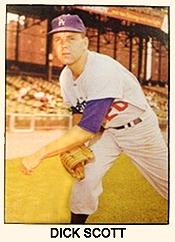
Dick Scott waited a long time to reach the major leagues, and when he got there, as a 30-year-old rookie, he quickly experienced highs and lows.

A left-handed pitcher, Scott was in his eighth season in the minor leagues when he got called up to the Dodgers for the first time in May 1963.
The first team Scott faced was the Cardinals at St. Louis. His debut went splendidly. The next night was a different story.

Down on the farm

Born in New Hampshire, Scott went to high school in Maine and played multiple sports. He was 20 when the Dodgers signed him as an amateur free agent in August 1953. After two years in the Army, Scott began his pro baseball career in the Dodgers’ farm system in 1956.

One of Scott’s biggest boosters was Bobby Bragan, who managed him at Spokane in 1958.

Scott “should make the majors,” Bragan said to the Spokane Chronicle.

Bragan, who managed the Pirates and Indians before taking the Spokane job, told the Spokane Review, “All that Scott needs is a little confidence, that feeling of thinking to himself, ‘Just give me the ball and let me out there. I’ll mow them down.’ ”

In 1960, Scott, 27, was 8-1 with a 2.27 ERA for the Dodgers’ farm club in Atlanta, but he had left elbow surgery in September, the Atlanta Constitution reported. Toward the end of spring training in 1961, Scott pitched 18 consecutive scoreless innings, but he remained in the minors.

While pitching for Spokane in 1962, Scott “has given up the idea of trying to overpower every batter and has become a better pitcher in the process,” according to the Spokane Chronicle.

“I’ve found out I have better control when I don’t throw too hard,” Scott said.

Meet me in St. Louis

Scott had a strong spring training in 1963 and nearly made the Dodgers’ Opening Day roster. His impressive pitching carried over to the regular season with Spokane. In his first start, he pitched a three-hit shutout at Denver in a game attended by heavyweight boxing champion Sonny Liston.

On May 7, 1963, Scott was leading the Pacific Coast League in ERA (0.77) when he was called up to the Dodgers.

Scott reported to the Dodgers at St. Louis on May 8 and made his major-league debut that night against the Cardinals.

Entering in the eighth, with the Dodgers ahead, 10-5, Scott retired Curt Flood, Dick Groat and Bill White in order.

After the Dodgers added a run in the top of the ninth, Stan Musial led off the bottom half against Scott and lined out to second. Ken Boyer doubled, but Scott got George Altman to ground out and Tim McCarver to pop out to third. Boxscore

Scott’s two scoreless innings against the star-studded Cardinals lineup made a strong impression. Scott “is ready to pitch any time the Dodgers need him,” the Los Angeles Times declared.

Tough encore

Scott didn’t have to wait long. The next night, May 9, the Dodgers led, 2-0, in the fifth when the Cardinals loaded the bases with none out against starter Pete Richert.

Manager Walter Alston called for Scott to face Bill White, a left-handed batter.

“I was looking for the fastball on the first pitch because I figured Scott would try to get ahead of me,” White told the St. Louis Post-Dispatch. “The ball was right down the middle.”

White hit the ball over the pavilion roof at Busch Stadium and onto Grand Avenue for a grand slam, giving the Cardinals a 4-2 lead.

After Boyer lined out to center and Musial flied out to right, Charlie James singled and Gene Oliver put the Cardinals ahead, 6-2, with a two-run home run off Scott.

Rattled, Scott gave up singles to Julian Javier and Bob Gibson before Larry Sherry relieved him. Sherry surrendered a RBI-single to Flood and the run was charged to Scott.

Scott’s line: 0.2 innings, four runs, five hits. Boxscore

Wrong place, wrong time

Scott pitched in nine games for the Dodgers before he was returned to Spokane in July 1963.

A month later, Scott was sitting on the edge of the visitors dugout at San Diego when the weighted end of a lead warmup bat swung by teammate Bart Shirley, who was in the on-deck circle, came loose and struck him above the right eye.

Scott was taken to a hospital and needed 25 stitches to close the wound, according to the Spokane newspapers.

Fortunately, Scott recovered, started against Portland on Sept. 3 and pitched 7.1 innings, allowing one run.

Scott finished with a 2.28 ERA for Spokane. In December 1963, the Dodgers traded him to the Cubs for pitcher Jim Brewer and catcher Cuno Barragan.

The 1964 season was Scott’s last as a professional player. He pitched in three games for the Cubs and spent most of the year with their Salt Lake City farm team.

Read Full Post »

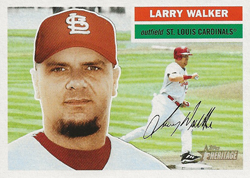
If Walt Jocketty had gotten what he wanted, Larry Walker would have spent most of his career, not just the last two seasons, with the Cardinals.

Walker, a three-time National League batting champion who was elected to the Baseball Hall of Fame on Jan. 21, 2020, played his first six seasons in the majors with the Expos and became a free agent in October 1994, the same month Jocketty replaced Dal Maxvill as Cardinals general manager.
Jocketty was looking for opportunities to improve the Cardinals, who were 53-61 in strike-shortened 1994, and wanted to sign Walker.

The Rockies made the most lucrative offer and Walker signed with them in April 1995.

Nine years later, Jocketty finally got his man, acquiring Walker in a trade with the Rockies in August 2004. Walker finished his career with the Cardinals, helping them reach the postseason in 2004 and 2005.

Opening at first

In December 1994, Walker, who threw right and batted left, had surgery on his right shoulder. The right fielder’s agent, Jim Bronner, said Walker would wait until March 1995 or later to sign because he wanted to show teams his shoulder was healed, the St. Louis Post-Dispatch reported.

Jocketty wanted Walker to be the Cardinals’ first baseman, replacing Gregg Jefferies, who became a free agent, according to the Post-Dispatch.

“Walt Jocketty says if he has time and money to sign only one free agent it would be a hitter to replace Gregg Jefferies rather than a pitcher,” the Post-Dispatch reported on Feb. 5, 1995. “His sights still are set on Larry Walker.”

A week later, as the Cardinals and all other major-league teams prepared to open spring training camps with replacement players while the big-leaguers remained on strike, Jocketty was in pursuit of Walker.

“He’s still the best player out there,” Jocketty said. “I think we’ve got as good a chance as anybody.”

Coors vs. Busch

Whatever amount Jocketty offered, it wasn’t enough to top the Rockies, who gave Walker a four-year contract for a guaranteed $22.49 million on April 8, 1995, according to the Associated Press.

The next day, with Walker out of the picture, the Cardinals acquired third baseman Scott Cooper from the Red Sox and planned to move Todd Zeile from third to first.

On April 26, 1995, Walker made his regular-season Rockies debut in the inaugural game played at Coors Field in Denver and produced three doubles and three RBI in a 14-inning victory against the Mets. Five inches of snow fell in the Denver area during the morning and the game, played at night in temperatures in the mid-30s, took 4 hours and 49 minutes to complete. Boxscore

Walker’s first game against the Cardinals since signing with the Rockies occurred on May 29, 1995, at Busch Memorial Stadium in St. Louis. The high-priced slugger went 0-for-6 and got razzed by some of the spectators after his last plate appearance. Boxscore

“One of the things about this type of deal is you get to hear a lot more imaginative things from the fans,” Walker told the Rocky Mountain News. “They were chanting, ‘Oh for six.’ They didn’t know the half of it.”

Walker’s hitless night extended his skid to 0-for-24 over his last six games.

The next night, Walker was benched by manager Don Baylor. He returned to the lineup for a day game, May 31, 1995, and snapped the slump with a two-run double and a solo home run against Cardinals starter Mark Petkovsek. The homer was a majestic shot which carried into the sixth row of the center-field bleachers, according to the Post-Dispatch. Boxscore

Petkovsek “made two bad pitches to Walker,” said Cardinals manager Joe Torre. “You’d like to make bad pitches to smaller guys, though.”

Said Walker: “I wasn’t sure if I should turn left or right the first time I got a hit because all I had been doing lately was turning to the right and going back to the dugout. That home run really messed me up, having to touch all four bases.”

Read Full Post »

(Updated March 17, 2020)

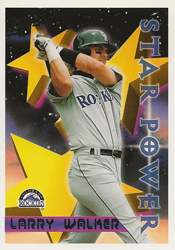
Larry Walker, who completed his career with the Cardinals, had one of his greatest games as their opponent.

On April 28, 1999, Walker hit three home runs for the Rockies in their 9-7 victory over the Cardinals at Busch Memorial Stadium in St. Louis.

Walker was the first opposing player to hit three homers in a game at St. Louis since the Expos’ Larry Parrish did it 22 years earlier in 1977.

It was the second of three times Walker hit three home runs in a game for the Rockies. He also did it against his former club, the Expos, at Montreal in April 1997 and against the Indians at Cleveland in June 2004, two months before he was traded to the Cardinals.

On Jan. 21, 2020, Walker was elected to the Baseball Hall of Fame in balloting by the Baseball Writers Association of America.

An outfielder who batted left-handed, Walker began his career with the Expos and spent his prime seasons with the Rockies before finishing with the Cardinals.

In 144 regular-season games for the Cardinals, Walker batted .286 with 26 home runs and 79 RBI. He also hit six home runs in 15 postseason games for the 2004 Cardinals. In 150 regular-season games against the Cardinals, Walker hit .300 with 28 home runs and 110 RBI.

Canadian club

Born in Maple Ridge, British Columbia, Walker wanted to be a professional hockey player. When a junior-level hockey team coach told him he’d be their third-string goalie, Walker, 17, switched to baseball, according to the Associated Press.

Signed by the Expos in 1984, Walker became a prized prospect in their farm system when he hit 33 home runs in 1986 and 26 in 1987.

On Jan. 16, 1988, while playing winter baseball in Mexico, Walker tore ligaments in a knee when he slipped while crossing home plate. He sat out the 1988 season and “there were times I didn’t think I’d make it” to the majors, Walker told the Montreal Gazette.

“I wondered, ‘What am I going to do now? Be a garbageman?’ ” Walker said.

Walker was with Class AAA Indianapolis when he got called up to the Expos in August 1989. He became the fifth Canadian to play for the Expos, following Claude Raymond, Larry Landreth, Bill Atkinson and Doug Frobel.

Though he grew up 2,300 miles from Montreal, Walker said, “This is one big country. We’re one big family.”

In his debut game against the Giants at Montreal, Walker had a single and three walks in four plate appearances. Boxscore

“What I liked about him is he had an idea about what he wanted to do every time he went to the plate,” Expos manager Buck Rodgers said.

According to the Montreal Gazette, when Walker reached base for the fourth time in the game, Giants first baseman Will Clark turned to him and said, “Geez, three walks. Not bad. They’re pitching you like a 10-year veteran.”

At spring training in 1990, Walker impressed the Expos with his dedication. In a four-day stretch, he took 500 swings per day in the batting cage. “I can’t believe how hard he works,” said Expos hitting coach Hal McRae.

Walker won the Expos’ right field job and never looked back. He hit .281 in six seasons (1989-1994) with the Expos before becoming a free agent and signing with the Rockies.

Powering up

Walker won the first of his three National League batting titles in 1998, but a rib injury sidelined him for the Rockies’ first seven games of the 1999 season.

When he returned to the lineup, he went homerless in his first eight games before he busted out against the Cardinals on a Wednesday night in St. Louis.

Walker had four hits, including the three home runs, and a career-best eight RBI in the game. Boxscore

The performance drew comparisons to Mark McGwire, the Cardinals’ first baseman, who witnessed it, but Walker dismissed such talk.

“My name is Larry, not Mark,” Walker told the Associated Press. “I don’t have Popeye arms. I’ve just got little tiny ones.”

In the opening inning, after the first two Rockies batters singled, Walker hit a three-run homer on a 1-and-2 pitch from right-hander Jose Jimenez.

With the Rockies ahead, 4-3, in the second, Walker batted with runners on first and third, two outs, and hit the first pitch from Jimenez for another three-run home run.

Walker had three hits, all home runs, in four career at-bats versus Jimenez. The last also was in a three-homer game for Walker in 2004 when Jimenez was with the Indians. Walker and Jimenez were Rockies teammates from 2000-2003.

Walker’s third home run of the game at St. Louis came in the seventh. Facing Scott Radinsky with a runner on first and one out, Walker hit a 1-and-2 pitch from the left-hander for a two-run homer, giving the Rockies a 9-6 lead.

All three home runs were hit over the right-field wall.

In 17 seasons in the majors, Walker batted .313 with 2,160 hits, 383 home runs, 1,311 RBI and a .400 on-base percentage. He won the Gold Glove Award for his outfield play seven times.

In an interview with the Baseball Hall of Fame magazine, “Memories and Dreams,” Jim Leyland, who managed the Rockies in 1999, said, “Barry Bonds is the best player I ever managed, but Larry Walker was the best five-tool player I ever saw. There was nobody more impactful in a game than Larry Walker. He beat you all five ways _ defense, his throwing, his base running, his hitting and his power.”

Read Full Post »

« Newer Posts - Older Posts »