Feeds:
Posts
Comments

Archive for the ‘Opponents’ Category

After being demoted to the minors early in his rookie season with the Cardinals, Bob Gibson got a chance to return a few months later and showed he belonged in the big leagues.
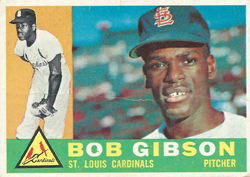
On July 30, 1959, Gibson made his first major-league start for the Cardinals and pitched a shutout in a 1-0 triumph over the Reds at Crosley Field in Cincinnati.

The win was the first of a club-record 251 Gibson achieved with the Cardinals. He and fellow Baseball Hall of Famer Jesse Haines (210) are the only pitchers to earn 200 wins as Cardinals.

Work in progress

Gibson, 23, made his big-league debut for the Cardinals on April 15, 1959, in a relief appearance against the Dodgers at Los Angeles Memorial Coliseum.

After pitching in three games, all in relief, for the Cardinals and posting a 10.12 ERA, Gibson was demoted to Class AAA Omaha on April 28, 1959.

Playing for manager Joe Schultz, Gibson was 9-9 with a 3.07 ERA in 135 innings pitched for Omaha.

In his book “From Ghetto to Glory,” Gibson said, “Pitching regularly, my early wildness practically vanished. That pleased me and evidently it pleased the Cardinals.”

The Cardinals brought him back on July 29, 1959, and manager Solly Hemus told him he’d start the next night against the Reds.

Close call

Before the game, Reds farm director Phil Seghi told Bill Ford of the Cincinnati Enquirer that Gibson nearly signed with the Reds instead of the Cardinals in 1957 when he was attending Creighton University in Omaha.

“As late as 2 in the morning, he agreed to verbal terms with us,” Seghi said, “but by daylight he had jumped to the Cardinals.”

Seghi said “a member of the Gibson family nixed the deal” with the Reds.

According to the Dayton Daily News, Gibson’s basketball coach at Creighton, Tommy Thomsen, scouted for the Reds and recommended Gibson.

“The Reds looked him over a few times and decided they liked what they saw,” the Dayton newspaper reported. “So they told Thomsen to go to work on him and try to get him to sign. Thomsen thought he was making progress until he read Gibson had signed with Omaha, a Cardinals farm. The Reds representatives quickly got in touch with Gibson and the youngster said he was a native of Omaha and he felt honor-bound to sign with the hometown team.”

Tested early

Gibson was matched in his first Cardinals start against Reds rookie Jim O’Toole. Years earlier, Gibson and O’Toole competed for a roster spot on a semipro team in South Dakota and Gibson got the job.

In the first inning, Gibson quickly got into trouble when Johnny Temple led off with a walk and the next batter, Vada Pinson, singled. Gus Bell grounded to short, forcing Pinson at second and advancing Temple to third. With runners on first and third, one out, Gibson escaped the mess unscathed when Frank Robinson flied out to shallow center and Jerry Lynch grounded out.

The Cardinals scored in the second. Ken Boyer led off with a double, moved to third on Bill White’s groundout to second and scored on Joe Cunningham’s single. In the bottom half of the inning, Gibson struck out his first big-league batter, Willie “Puddin’ Head” Jones.

In the fifth, O’Toole’s single “bounced off the left shin of Gibson, momentarily throwing fear into the Cards,” the Cincinnati Enquirer reported, but Gibson was able to continue and got the next batter, Temple, to ground into a double play.

Dramatic ending

Gibson’s biggest challenge occurred in the ninth.

Lynch led off with a single and Ed Bailey followed with a liner toward White at first base. White stopped the hard smash with the thumb of his glove. The ball fell to the ground and White picked it up and threw to second in time to force out Lynch.

With a runner on first, Jones popped out to the catcher for the second out, but Gibson walked pinch-hitters Frank Thomas and Don Newcombe on eight consecutive pitches to load the bases for Temple, who was batting .328.

In his book “Stranger to the Game,” Gibson said, “I was half-expecting Hemus to yank me out of the game.”

Reliever Marshall Bridges was ready in the bullpen, the St. Louis Post-Dispatch reported, but Hemus stuck with Gibson.

Gibson’s first two pitches to Temple were outside the strike zone and called balls. After a called strike on the third pitch, Temple fouled off a delivery to even the count at 2-and-2.

On the next pitch, a fastball, Temple hit a liner to shallow center and it was caught by Curt Flood for the final out.

The Cincinnati Enquirer called Gibson’s ninth-inning escape act “a credit to his competitive determination.”

Gibson, sipping a cup of orange soda, told the Post-Dispatch, “I can throw a lot harder, but my shoulder has been a little sore for the past week.” Boxscore

Hit or miss

Gibson lost his next five decisions before earning a win on Sept. 12, 1959, in a start against the Cubs at Wrigley Field in Chicago. Gibson pitched a six-hitter, struck out 10 and drove in a run in the 6-4 Cardinals victory.

He didn’t pitch again for two weeks until Hemus used him in relief in the last game of the season against the Giants on Sept. 27, 1959.

In “from Ghetto to Glory,” Gibson said, “I was so bored I would sit on the bench in the far corner of the dugout and I’d just about fall asleep because it’s no fun when you’re not playing.”

Gibson finished with a 3-5 record and 3.33 ERA in 13 appearances for the 1959 Cardinals. His ERA as a starter was 3.16.

“The few times I did get a chance to pitch I could not possibly be sharp because of lack of work,” Gibson said. “Especially when I went eight or nine days without pitching. I’d be exceptionally strong and the ball would move every which way. I never knew where it was going and, as a result, I walked a lot of men (39 in 75.2 innings) and made too many mistakes.”
Read Full Post »

Before he became a celebrated author with “Ball Four,” Jim Bouton was a power pitcher whose cap flew off with nearly every delivery.

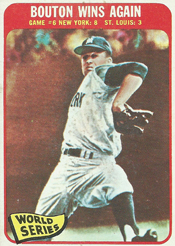
In 1964, Bouton made two starts for the Yankees against the Cardinals in the World Series and won both.
The Cardinals won the championship, but Bouton impressed with his ability to produce on the big stage. He was the first pitcher to earn two wins in a World Series versus the Cardinals since the Yankees’ Spud Chandler in 1943.

Stubbornly effective

Bouton, 25, was 18-13 with a 3.02 ERA for the 1964 Yankees. The right-hander led the team in wins, starts (37) and innings pitched (271.1).

For the first two World Series games in St. Louis, Yankees manager Yogi Berra started ailing ace Whitey Ford, who lost, and rookie Mel Stottlemyre, who won. Bouton was the starter for Game 3 at Yankee Stadium and was matched against Curt Simmons.

In his book “October 1964,” author David Halberstam called Game 3 “probably the best played and best pitched game of the series.”

Played on Saturday afternoon, Oct. 10, 1964, before 67,101 spectators, the game became a duel between Bouton and Simmons.

Bouton threw “virtually straight overhanded with his delivery and his forearm brushed the back of his cap, sending it sailing,” the Sporting News noted.

Said Berra: “We’ve tried a dozen different caps on him, and he wears a small, tight one now, but it doesn’t do any good.”

The Yankees got a run in the second on Clete Boyer’s RBI-double and the Cardinals tied the score, 1-1, on a RBI-single by Simmons in the fifth.

After retiring the Cardinals in order in three of the first four innings, Bouton worked out of multiple jams. The Cardinals loaded the bases in the sixth with two outs, but Mike Shannon grounded into a forceout. In the seventh, Dal Maxvill led off with a double and moved to third on Simmons’ sacrifice, but Curt Flood and Lou Brock stranded him.

“Bouton was keeping the ball away from me good,” Flood said to the St. Louis Post-Dispatch.

Said Brock: “I was out in front of this guy all day. I never do this … I hit the ball off the end of the bat all four times.”

In the ninth, Tim McCarver led off and reached on an error by shortstop Phil Linz. Shannon’s sacrifice bunt moved McCarver to second. Carl Warwick, batting for Maxvill, walked, but Bouton retired Bob Skinner and Flood.

Barney Schultz relieved Simmons in the bottom of the ninth and Mickey Mantle walloped his first pitch, a knuckleball, into the upper deck in right for a walkoff home run and a 2-1 Yankees victory. Boxscore

Bouton threw 123 pitches in what the New York Daily News described as a “stubborn pitching performance.” Video highlights at 1:30 mark

Under pressure

The Cardinals won Games 4 and 5 at Yankee Stadium. Back in St. Louis with a chance to clinch the title in Game 6 on Wednesday afternoon, Oct. 14, 1964, the Cardinals started Simmons in a rematch with Bouton, who welcomed the challenge.

“Far more than most baseball players, he was an adrenaline player, and he liked pitching under this kind of pressure,” said Halberstam. “He loved being the center of attention and being given the ball in a game this big.”

When Flood and Brock opened the bottom of the first with singles, it was a wakeup call for Bouton, who said, “I had to stop and boot myself in the fanny. Those hits kind of shook me up.”

Bouton got the next batter, Bill White, to ground into a double play. Flood scored from third, but Bouton settled down.

In the fifth, Bouton lined a single over the head of shortstop Dick Groat, driving in Tom Tresh from third and tying the score at 1-1.

The game turned in the sixth when Roger Maris and Mantle hit back-to-back home runs against Simmons, giving the Yankees a 3-1 lead.

In the seventh, Bouton told Berra to get a reliever ready because his right shoulder was getting tight. The Yankees extended their lead in the eighth, scoring five times. The big hit was a grand slam by Joe Pepitone against Gordon Richardson.

Bouton yielded a run in the eighth and another in the ninth. He went 8.1 innings before being relieved by Steve Hamilton, and the Yankees won, 8-3. Boxscore  and Video highlights at 1:45 mark

Cardinals slugger Ken Boyer said Bouton “kept the ball low and away all afternoon, and, if he missed the plate, he barely missed it.”

Jim and Joe

Bouton’s career took a downturn the next year. He developed a sore arm, posted records of 4-15 in 1965 and 3-8 in 1966, and was dropped from the starting rotation.

The Yankees sold Bouton’s contract to the Seattle Pilots, who joined the American League as an expansion team in 1969. The Pilots’ manager was Joe Schultz, who was a Cardinals coach from 1963-68 after managing in their farm system.

Schultz, a round, balding, good-natured baseball lifer, became a central character in “Ball Four.” Two samples of Bouton’s musings:

_ “Joe Schultz stopped by again today to say a kind word. I noticed he was making it his business to say something each day to most of the guys. He may look like Nikita Khrushchev, but it means a lot anyway. I’m sure most of us here feel like leftovers and outcasts and marginal players and it doesn’t hurt when the manager massages your ego a bit.”

_ “After the game, Joe Schultz said, ‘Attaway to stomp on ’em, men. Pound that Budweiser into you and go get ’em tomorrow.’ Then he spotted John Gelnar sucking out of a pop bottle. ‘For crissakes, Gelnar,’ Joe said, ‘You’ll never get them out drinking Dr. Pepper.’ ”

Fitting in

Bouton was 2-1 with a save and a 3.91 ERA in 57 appearances for the Pilots. On Aug. 24, 1969, they traded him to the Astros for pitchers Dooley Womack and Roric Harrison.

Two nights later, on Aug. 26, 1969, Bouton made his National League debut, relieving Larry Dierker and pitching a scoreless eighth against the Cardinals at St. Louis. Bouton retired Shannon on a groundout and Julian Javier on a pop-up before striking out Maxvill on a 3-and-2 knuckleball.

“The knuckleball was a doll,” Bouton said.

When Bouton got to the dugout, Astros pitching coach Jim Owens asked him why he threw a knuckleball with the count full.

“I told him that first time around I want to earn a little respect,” Bouton said. “I want everyone to know that I’m liable to throw that pitch in any situation … I want them to know that they can’t count on getting the fastball.” Boxscore

Read Full Post »

(Updated March 7, 2021)

After going two weeks without a win, the Cardinals broke their skid by scoring a week’s worth of runs in one game.

On July 6, 1929, the Cardinals set a franchise record for most runs in a game when they beat the Phillies, 28-6, in the second game of a doubleheader at Baker Bowl in Philadelphia.
The win was the Cardinals’ first since June 22, 1929, and snapped an 11-game losing streak.

10 in the 1st

The Cardinals-Phillies doubleheader was played on a steamy Saturday afternoon. “Swarms of Japanese beetles added to the discomfort of players and spectators,” the St. Louis Post-Dispatch reported.

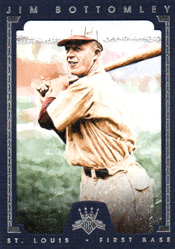
In the first game, Cardinals cleanup batter Jim Bottomley hit a pair of two-run home runs, but the Phillies won, 10-6. It was the 11th consecutive loss for the defending National League champions and it gave them a 36-36 record. Boxscore

The second game matched starting pitchers Fred Frankhouse of the Cardinals against Phillies ace Claude Willoughby.

A right-hander from the farm town of Buffalo, Kansas, Willoughby would finish with 15 wins for the 1929 Phillies, but he struggled against the Cardinals.

Willoughby faced six batters, yielding three singles and walking three, and was lifted without recording an out.

Elmer Miller, a rookie left-hander who later in the season was converted into a right fielder, relieved, faced two batters and walked both.

Phillies manager Burt Shotton, a former Cardinals outfielder and coach, pulled Miller and replaced him with Luther Roy, who started two days earlier against the Dodgers. Roy gave up singles to the first two Cardinals batters he faced.

Rookie second baseman Carey Selph made the first out of the inning, on a sacrifice bunt, after the first 10 Cardinals batters reached base.

The Cardinals scored 10 runs in the first inning on six singles and five walks.

Given a 10-0 lead, Frankhouse, pitching with a sore thumb, “didn’t have to bear down” and “merely lobbed the ball over the plate,” according to the Post-Dispatch.

The Cardinals scored a run in the second and two in the fourth, and led, 13-4.

Pour it on

In the fifth, the Cardinals produced their second 10-run inning of the game. Bottomley got the big hit, a grand slam against the Phillies’ fourth pitcher, June Greene. Bottomley’s home run cleared the right-field wall and carried into Broad Street, the Philadelphia Inquirer reported.

The Cardinals led, 23-4, after five innings. They scored again in one more inning, getting five runs in the eighth. The big blow was Chick Hafey’s grand slam into the left-field seats against Greene.

The grand slams by Bottomley and Hafey were the only Cardinals home runs in the game.

The Cardinals generated 28 hits and also received nine walks and had one batter hit by a pitch.

According to the Philadelphia Inquirer, the Cardinals also hit two line drives off the shins of Greene, but the balls caromed to infielders, who made the outs.

Every Cardinals player who made a plate appearance got a hit.

Leadoff batter Taylor Douthit was 5-for-6 with two walks. He scored four runs and drove in two. Hafey was 5-for-7 with five RBI and four runs scored.

Bottomley was 4-for-5 with two walks. He scored four runs and drove in seven. For the doubleheader, Bottomley was 7-for-10 with 11 RBI and six runs scored. Bottomley hit a home run in every game of the five-game series. He had seven home runs and 21 RBI for the series. For the season, Bottomley had 39 RBI versus the Phillies. According to researcher Tom Orf, that’s the most RBI a Cardinals player has ever had against one team in a season.

Frankhouse was as effective a hitter as he was a pitcher. He was 4-for-7 with four RBI and, though he pitched a complete game and got a win, he yielded 17 hits and walked three.

Most of the damage was done against Roy (13 hits, nine runs in 4.1 innings) and Greene (12 hits, 11 runs in 4.2 innings). Boxscore

Willoughby, the losing pitcher, played seven seasons in the big leagues and continued to have trouble versus the Cardinals. His career record against the Cardinals: 2-12 with a 8.62 ERA.

After their record-setting performance, the Cardinals lost five of their next seven, falling to 39-41. Billy Southworth, in his first stint as Cardinals manager, was fired in late July and replaced by Bill McKechnie, who’d managed the Cardinals to the National League pennant in 1928.

Read Full Post »

Called up from the minors to substitute for an injured Ted Simmons at catcher, Cardinals rookie Terry Kennedy contributed a bloop and a blast in a doubleheader sweep of the Phillies.

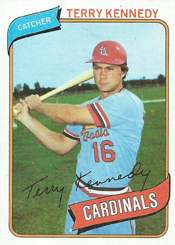
On July 1, 1979, Kennedy hit his first big-league home run, a grand slam, in Game 1 of the Sunday doubleheader at St. Louis and delivered a walkoff RBI-single on a broken-bat pop fly in Game 2.

Though Kennedy impressed the Cardinals, they eventually decided to trade both he and Simmons, opting instead for Darrell Porter as their catcher.

Stepping up

Kennedy’s father, Bob Kennedy, was a big-league player and manager who worked for the Cardinals from 1969-76 as a scout and front-office man.

In 1977, when Bob Kennedy became general manager of the Cubs, the Cardinals chose Terry Kennedy, a Florida State standout, in the first round of the draft.

A left-handed batter, Kennedy made his major-league debut with the Cardinals in 1978, appearing in 10 games, after hitting .309 with 100 RBI in the minors.

The 1979 Cardinals began the season with Simmons and Steve Swisher as their catchers and returned Kennedy to the minors. Kennedy, hitting .287 with 50 RBI for Class AAA Springfield, was called back by the Cardinals after Simmons broke his left wrist on June 24, 1979. Simmons was injured when struck by a foul ball off the bat of Mets pitcher Andy Hassler, who was attempting to bunt.

Simmons said he would work with Kennedy “every day, helping him any way I can,” the St. Louis Post-Dispatch reported.

Kennedy, who referred to Simmons as “the best hitter in the National League,” said he was “a little bit nervous” about substituting for the Cardinals’ catcher, but added, “I can do it.”

Mistake pitch

Kennedy’s breakout game occurred in the opener of the doubleheader versus the Phillies. In the eighth inning, with the bases loaded and the Cardinals ahead, 9-7, Kennedy batted against left-hander Tug McGraw. With the count 0-and-2, McGraw hung a screwball and Kennedy hit it over the right-field wall.

“My thinking was ass-backwards out there for some reason,” McGraw said to Bill Conlin of the Philadelphia Daily News. “I’ve never, ever thrown an 0-2 waste pitch screwball to a left-handed hitter, but I did today and don’t ask me why. The pitch was against all logic and I hung it. Maybe it was in the back of my mind that he’s a rookie and would be vulnerable to a screwball.”

Kennedy’s home run propelled the Cardinals to a 13-7 victory. He was 2-for-4 with a walk and threw out Bake McBride attempting to steal third. Boxscore

“He has to work on his defensive skills, but he’s going to create some thunder,” Cardinals manager Ken Boyer told the Philadelphia Inquirer.

Dumb luck

Swisher was the Cardinals’ catcher in Game 2, but Kennedy batted for him in the ninth inning with runners on first and second, two outs and the score tied at 1-1.

The first delivery from former Cardinal Ron Reed was “a killer pitch, a fastball that could have started a Midwest heat wave,” according to Jayson Stark of the Philadelphia Inquirer.

Kennedy swung and “his bat shattered with a splintering sound so loud they probably heard it in Kansas City,” the Inquirer reported.

“I got jammed,” Kennedy said to the Post-Dispatch.

The ball floated softly into shallow center.

“I was so embarrassed,” Kennedy said. “I started running to first base with my head down.”

Shortstop Larry Bowa and second baseman Manny Trillo converged on the ball.

“We both started to call it and we both looked at each other,” Bowa said, “and we both took a step away.”

With Bowa and Trillo standing like statues, the ball plopped onto the ground for a single and Keith Hernandez dashed home from second with the winning run. Boxscore

“I couldn’t believe it,” said Kennedy. “It was just dumb luck. The ball should have been caught.”

Reliever Mark Littell was the winning pitcher in each game of the doubleheader and got his first major-league RBI with a bases-loaded walk in the opener.

“When I was a kid, I read that book, ‘Baseball is A Funny Game,’ by Joe Garagiola,” Littell said. “Now I know what he meant.”

Multiple all-star

Kennedy hit .284 in 33 games for the Cardinals in 1979 and .254 in 84 games for them in 1980. Simmons, who returned to the lineup on July 24, hit 26 home runs for the 1979 Cardinals. He had 21 homers and 98 RBI for the Cardinals in 1980.

After the 1980 season, the Cardinals, who turned over their baseball operations to Whitey Herzog, traded Simmons to the Brewers and Kennedy to the Padres. Porter, a free agent, was signed to be their catcher and was backed by Gene Tenace, one of the players acquired for Kennedy.

In 14 seasons with the Cardinals (1978-80), Padres (1981-86), Orioles (1987-88) and Giants (1989-91), Kennedy was a four-time all-star who produced 1,313 career hits and played in two World Series.

In addition to his first big-league home run, Kennedy hit one other grand slam. It occurred on May 15, 1990, for the Giants against the Mets’ Ron Darling.

Read Full Post »

In a game against the Cardinals at Wrigley Field, Ernie Banks and the Cubs gave new meaning to the term, “Let’s play two.”

Banks, the Cubs’ sunny slugger, always wanted to play as much baseball as possible and his desire for doubleheaders led to his catchphrase.
On June 30, 1959, only one game was played between the Cardinals and Cubs, but “let’s play two” aptly described the madcap antics when two baseballs simultaneously were put into play.

Follow the bouncing ball

The Tuesday afternoon game matched starting pitchers Larry Jackson of the Cardinals against Bob Anderson of the Cubs.

In the fourth inning, the Cardinals led, 2-1, when Stan Musial faced Anderson with one out and none on.

With the count at 3-and-1, Anderson threw a pitch high and inside to Musial. The ball grazed Cubs catcher Sammy Taylor and plate umpire Vic Delmore, according to the St. Louis Post-Dispatch, and rolled to the backstop.

Musial headed to first base on what was called ball four.

Taylor, thinking the ball glanced off Musial’s bat and was foul, argued with Delmore and didn’t pursue the ball. Anderson left the mound and went to the plate to join in the discussion.

Cubs third baseman Alvin Dark, realizing the ball was in play, ran to get it, but a batboy, high school freshman Bobby Schoenfeldt, thought the play was dead. He picked up the ball and tossed it to the field announcer, Pat Pieper.

“I saw Dark flying toward me, but I already had thrown the ball away,” Schoenfeldt said to the Chicago Tribune.

Cardinals manager Solly Hemus said Pieper had the ball in his hand, but “dropped it like a hot potato” as Dark approached.

Pieper said, “Dark yelled at me, ‘Give me the ball.’ I told him to pick it up.”

First-base umpire Al Barlick said, “When Dark charged in from third base, I thought he was joining in the argument.”

Double trouble

As Dark reached for the ball, Delmore, unaware of what was happening behind him, absent-mindedly handed a new baseball to Anderson.

After arriving at first base, Musial said, “I heard our bench yelling for me to run,” and he took off toward second.

Dark and Anderson saw Musial attempting to advance.

Anderson hurriedly threw his ball and it sailed into center field.

At the same time, Dark threw his ball, which Banks, the shortstop, fielded on one bounce on the third-base side of second.

As Musial slid safely into second base, he looked up and saw second baseman Tony Taylor jump for a ball over his head.

“I didn’t even know there was a second ball,” Musial said.

Musial got up, started toward third, got tagged by Banks with the original ball and was called out by second-base umpire Bill Jackowski. Boxscore

Nonsense factor

The Cardinals argued Musial was entitled to second base because the batboy interfered with a ball in play. Barlick, the crew chief, disagreed, saying it was unintentional interference and Musial tried to advance at his own risk.

Hemus contended Musial “should have been safe because he was confused and deceived by the second ball, which went into center field,” but the umpires refused to reverse their decision.

The Cardinals played the game under protest, but it didn’t matter because they added a run in the seventh and another in the eighth and won, 4-1. Jackson pitched a four-hitter and retired 18 of the last 19 Cubs batters.

The Chicago Tribune concluded the game set a new standard for “baseball daffiness” and “not even Bill Veeck of the White Sox could have conjured up such a zany episode.”

Read Full Post »

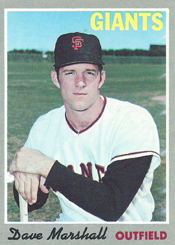
Dave Marshall got a big hit against the Cardinals and took some painful hits from them as well.

Marshall played in the big leagues from 1967-73 as an outfielder for the Giants, Mets and Padres.

A left-handed batter, Marshall hit his first home run in the majors against the Cardinals’ Ray Washburn after the Giants benefitted from a controversy involving Willie Mays and Willie McCovey.

A year later, Marshall took his lumps, getting hit by pitches from the Cardinals’ Bob Gibson three times, including twice in one game.

Pro potential

Marshall was a standout football player at Lakewood High School in California and at Long Beach City College. After a coach suggested he try baseball, Marshall excelled and impressed a scout for the Angels, who signed him to a professional contract at age 20 in 1963.

On April 6, 1966, after three seasons in their minor-league system, the Angels traded Marshall to the Giants for infielder Hector Torres. Marshall continued to progress in the minors and hit .294 for Phoenix in 1967.

Marshall made his major-league debut on Sept. 7, 1967, as a pinch-runner. After hitting .444 in 20 exhibition games at training camp the following spring, Marshall made the Giants’ 1968 Opening Day roster.

“He possesses a classic swing at the plate and throws with strength and accuracy,” The Sporting News reported.

The Giants began the 1968 season with an outfield of Mays in center, Jim Ray Hart in left and Jesus Alou in right. Hart and Alou batted right-handed, so manager Herman Franks used Marshall to fill in for them against some right-handers.

Odd start

On May 5, 1968, Marshall got the start in left field and batted sixth against the Cardinals at Candlestick Park in San Francisco.

After the Cardinals loaded the bases with one out in the first inning against Mike McCormick, Mike Shannon hit a drive to deep left.

“I thought it was going to land 15 rows up in the stands, but the wind pulled the ball back,” Marshall said to the St. Louis Post-Dispatch.

Marshall caught the ball near the fence for the second out.

Lou Brock, the runner on third, should have scored, but he “started for the plate, then went back to third, feeling he had broken from the bag before the ball was caught,” the San Francisco Examiner reported.

Marshall’s throw caught Brock in a rundown and he was tagged for the third out. What started out looking like a grand slam turned into a double play.

New rules

The unusual play foreshadowed more bizarreness.

In the fourth, Mays led off with a single. As the next batter, McCovey, swung and missed a third strike, Mays attempted to steal second. Catcher Tim McCarver made a throw, but the ball struck McCovey’s bat and Mays reached second.

In taking a mighty cut at Washburn’s pitch, McCovey’s bat “circled over his head and he finished up with it across the plate,” the San Francisco Examiner reported.

McCarver told the Post-Dispatch he threw the ball in the proper direction, but McCovey’s bat got in the way.

Cardinals manager Red Schoendienst said Mays “would have been out easily” if McCarver had made an unimpeded throw.

Plate umpire Bill Jackowski called interference on McCovey and ruled Mays out. After Franks objected, the four umpires met and reversed Jackowski’s call, allowing Mays to take second base.

According to the Post-Dispatch, “Schoendienst said the umpires admitted there had been interference, but they said also that the interference was not intentional.”

Schoendienst called the decision “a crime” and pointed out “the rule doesn’t say a thing about the interference having to be intentional.”

Said McCarver: “The umpires butchered the call and we’re expected to swallow it.”

First homer

When play resumed, Mays advanced to third on Jim Davenport’s groundout.

If the umpire’s interference call had stood, Davenport’s out would have been the third of the inning. Instead, it was the second, and Marhsall got to bat.

Washburn threw a low slider and Marshall drove it to right.

“He tried to get the pitch inside, I think, but it was out away,” Marshall told the Oakland Tribune.

The ball carried over the right-field fence for Marshall’s first major-league home run, giving the Giants a 2-0 lead.

“I got it up in the wind and I watched it all the way over the fence,” Marshall said to the San Francisco Examiner. “It sure felt good to make contact.”

An inning later, Marshall made a diving catch of Brock’s sinking liner.

The Giants won, 8-4, giving Washburn his first loss of the season and leaving him dispirited about dusty, wind-blown Candlestick Park. Boxscore

“It’s all right with me if I don’t see the place again,” Washburn said.

Four months later, Washburn pitched a no-hitter against the Giants at Candlestick Park.

Ouch!

On July 25, 1969, Marshall was involved in another Giants-Cardinals classic. Bob Gibson pitched 13 innings and scored the winning run in a 2-1 victory at St. Louis.

Marshall scored the lone Giants run. He led off the game with a single, advanced to third on Ron Hunt’s hit and scored on a groundout.

In the sixth, Gibson hit Marshall with a pitch and Marshall was thrown out attempting to steal second.

In the ninth, Marshall was hit again by a Gibson pitch. He advanced to second on a sacrifice bunt, but was stranded.

Marshall suffered “painful bruises on his right hand and right shoulder” from being hit by Gibson’s pitches, the Oakland Tribune reported. Boxscore

A month later, on Aug. 10, 1969, Gibson hit Marshall with a pitch in the third inning at Candlestick Park in a game won by the Cardinals, 7-4. Boxscore

Marshall batted .179 (7-for-39) in his career versus Gibson and .204 against the Cardinals. Overall, he batted .246 in the majors, with 16 home runs and was hit by pitches 10 times.

Broken-hearted

In 1984, Marshall began working security for the operators of the Queen Mary ocean liner, according to the Long Beach Press-Telegram. He married his wife, Carol, aboard the Queen Mary, the newspaper reported. In 2002, Marshall took a job with the Long Beach Convention Center.

On June 4, 2019, Carol, 82, who had multiple sclerosis, died with her husband at her side. He died two days later.

“I think he may have died of a broken heart,” Charlie Beirne, general manager of the Long Beach Convention Center, said to the Press-Telegram.

Read Full Post »

« Newer Posts - Older Posts »