Feeds:
Posts
Comments

Archive for the ‘Opponents’ Category

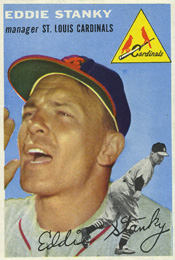
The actions of manager Eddie Stanky caused the Cardinals to forfeit a home game to the Phillies. When the Busch Stadium public address announcer declared the umpires had awarded the Phillies a victory, Cardinals fans cheered to show their displeasure with Stanky.

On July 18, 1954, the Cardinals forfeited a brawl-marred game to the Phillies because umpires ruled the combative Stanky, nicknamed “The Brat,” intentionally used stalling tactics in an attempt to avoid a loss.

After being suspended by National League president Warren Giles, Stanky issued an emotional public apology.

Pressure mounts

Booed with increasing regularity by Cardinals fans because his team was mired in sixth place in the eight-team league, Stanky was dealing with a series of setbacks and strains.

On July 17, a Saturday afternoon when the temperature reached 100 degrees, the first-place Giants built a 9-0 lead after three innings against the Cardinals at St. Louis. The Cardinals fought back impressively, scoring five runs in the sixth, three in the seventh and one in the eighth, tying the score, but the Giants won, 10-9, with a run in the 11th, dropping the Cardinals 17 games out of first with a 41-44 record. Boxscore

The next day, Sunday, July 18, the Phillies were in St. Louis for a doubleheader with the Cardinals.

Amid growing speculation about Stanky’s job security, club owner Gussie Busch issued a vote of confidence, saying, “I know there are many loyal Cardinal fans all over the country who are impatient and unhappy with the present standing … but I think it is altogether too simple and too easy to blame the manager every time something goes wrong or doesn’t work out exactly as it should.”

Adding to the drama was the matchup between Stanky and his Phillies counterpart. Three days earlier, the Phillies fired manager Steve O’Neill and replaced him with Terry Moore, the ex-Cardinals outfielder. When Stanky became Cardinals manager in 1952, Moore was on his coaching staff. Stanky fired him after the season. Moore reacted by ripping Stanky, telling reporters, “When he loses a ballgame, he acts more like a 9-year-old boy than a manager. The job is too big for him. Stanky is temperamentally unsuited for the job of manager.”

It was under this backdrop _ the booing by Cardinals fans, the speculation about his job status and the sight of Moore managing against him _ that Stanky approached the first game of the July 18 doubleheader.

Snap, crackle, pop

It didn’t unfold as Stanky hoped. The game was delayed 1 hour and 18 minutes by rain in the seventh. The Cardinals led 8-7 after eight. The Phillies scored three in the ninth for a 10-8 lead. The Cardinals rallied, tying the score in the bottom half of the inning on a two-out, two-run single by Solly Hemus, but the Phillies scored in the 10th, the Cardinals stranded Wally Moon on third with one out in the bottom half of the inning, and Philadelphia won, 11-10. Boxscore

In consecutive games, the Cardinals had scored 19 total runs _ and lost each by a run in extra innings.

Because of the rain delay and extra inning in the opener, the second game of the doubleheader didn’t begin until after 6 p.m. The Cardinals and umpires mistakenly thought a league rule prohibited ballpark lights from being turned on for a Sunday game beginning after 6. (The rule had been erased before the 1954 season.)

When the Phillies took an 8-1 lead, Stanky began making a series of deliberate pitching changes in an effort to prevent the game from being completed in the mandatory five innings before darkness arrived.

Each Cardinals reliever appeared to work slowly and issue pitches outside the strike zone. Tensions built as the game inched into the top of the fifth and darkness approached.

At that point, Cardinals catcher Sal Yvars and Phillies first baseman Earl Torgeson, who had a long-running feud, began fighting one another on the field. Moore raced toward the pair and grabbed Yvars. Stanky bolted toward the combatants and tackled Moore. The benches emptied and fighting continued until police broke up the melee.

When Stanky went to the mound to make another pitching change, umpire Babe Pinelli declared a forfeit in favor of the Phillies.

Wakeup call

Giles backed his umpires, saying, “The tactics employed in the game were palpably designed to delay the game.”

Stanky disagreed, telling the Associated Press: “My pitchers have been wild and ineffective all season, not only during this game.”

The next day, Giles suspended Stanky for five days and fined him $100. Yvars was suspended for three days and Torgeson for two.

Humbled, Stanky apologized for his actions and read a statement. Some excerpts:

“I called this press conference because of the impression I received Sunday when I heard the St. Louis people applaud Pinelli’s decision, forfeiting the game to the Phillies. I know in my heart indirectly that I have embarrassed and hurt the St. Louis people, baseball nationally, my reputation as a baseball man … and Gussie Busch and the Cardinals’ front office.

“… My spirit and desire to win could never be broken. However, my human and public relations will be improved. This affair Sunday has opened my eyes.”

Said Cardinals general manager Dick Meyer: “It takes a tremendous amount of fortitude to make the type of statement Eddie made unsolicited.”

Some were skeptical. “He said the same thing in 1952 right after he got the job, but the reform didn’t last long,” Moore said.

Stanky survived the season, but was fired in May 1955 after the Cardinals got off to a 17-19 start. Moore returned to the Cardinals in 1956 as a coach for manager Fred Hutchinson.


Read Full Post »

Fired up by the antics of manager Tommy Lasorda, fans at Dodger Stadium threw a barrage of souvenir baseballs and other items onto the field, prompting umpires to forfeit the game to the Cardinals.

On Aug. 10, 1995, a crowd of 53,361 packed Dodger Stadium for a Ball Night promotion and to see popular rookie starting pitcher Hideo Nomo face the Cardinals.

Tension began to build in the eighth inning. With the Cardinals ahead 2-1, the Dodgers had two on with two outs and Eric Karros at the plate. Karros was called out on strikes, argued the call and was ejected by plate umpire Jim Quick. Fans threw baseballs onto the field in protest.

After the Cardinals were retired in their half of the ninth, Raul Mondesi led off the bottom half of the inning. Mondesi took a pitch from Tom Henke and headed toward first base, thinking it was ball four, but Quick ruled the pitch a strike.

Mondesi eventually struck out, argued with Quick and was ejected. Lasorda rushed onto the field, jawed with Quick and was ejected as well.

With that, a hailstorm of baseballs was unleashed from the stands. Quick stopped play and a forfeit was declared, giving the victory to the Cardinals. Video

“We felt … the situation was getting out of hand,” Quick said to the St. Louis Post-Dispatch. Boxscore

(It was the first forfeit in the National League in 41 years. That game involved the Cardinals, too. On July 18, 1954, umpires forfeited to the Phillies the second game of a doubleheader at St. Louis because they believed Cardinals manager Eddie Stanky intentionally was using stall tactics.)

First-base umpire Bob Davidson called the decision to forfeit the Dodger Stadium game to the Cardinals “100 percent correct” and criticized Lasorda.

“This whole thing was Tom Lasorda’s fault,” Davidson said to the Associated Press. “He instigated the crowd, waving his arms. He has himself to blame, absolutely. He knows he’s to blame.”

Said Lasorda: “How did I instigate it? I was talking to Jim Quick. All I was asking was why he threw my players out. We didn’t throw the balls.”

Cardinals catcher Tom Pagnozzi told the Post-Dispatch, “Lasorda provoked the whole thing.”

Lasorda told the Los Angeles Times, “I’m disappointed in the ones who threw the balls, not the good fans.”

Cardinals players said they felt they were in danger because objects other than baseballs were thrown at them.

“I wasn’t too worried until a bottle of Southern Comfort flew out of the stands and hit me,” Cardinals right fielder John Mabry said to Bob Nightengale of The Sporting News. “I got hit by a rum bottle, too.”

Said St. Louis center fielder Brian Jordan: “I’m not going to stand out there and get busted in the head with a ball. The umpires made a good decision.”

Los Angeles Times columnist Mike Downey wrote, “Here, where fans are best known for leaving early, if this is the way people intend to behave, then please, leave early.”

Cardinals coach Bob Gibson said to Nightengale, “Dodgers fans used to be among the best in baseball. I’m afraid you can’t say that anymore.”

Said Quick: “I hope everybody has learned a lesson from this. I’ve been in the game 28 years and I’ve never been involved in a forfeit. This is very disappointing.”

Previously: Stayin’ alive: Baseball, drugs, rock n’ roll at Comiskey

Read Full Post »

Johnny Podres nearly put a damaging dent into the armor of baseball’s perfect knight.

Described by former baseball commisioner Ford Frick as “baseball’s perfect knight,” Stan Musial became a Cardinals icon as much for his good-guy demeanor as for his outstanding baseball ability, but he wasn’t immune from wild-armed pitchers and brushback pitches.

Musial was struck by pitches 53 times in a 22-year big-league career. The pitch that did the most damage was delivered by Podres, a Dodgers left-hander who, like Musial, would be inducted into the National Polish-American Sports Hall of Fame.

In 1955, Musial was hit by pitches a National League-leading eight times. One of those occurred on Aug. 29, 1955, when the Cardinals played the Dodgers at Brooklyn’s Ebbets Field. Though the Dodgers were in first place and the Cardinals were in seventh, the competition between these longtime rivals remained fierce.

In the first inning, catcher Roy Campanella hit a two-run home run off Cardinals starter Tom Poholsky. When Campanella batted again in the third, he was buzzed by a pitch.

Musial, playing in his 593rd consecutive game, led off the Cardinals’ fourth. Podres unleashed a fastball that sailed directly toward Musial’s head. Musial instinctively raised his right hand to protect himself _ and it was fortunate he did.

The ball struck the back of his hand. If it hadn’t, the ball would have struck him in the skull, according to multiple news reports.

Musial felt “acute pain” in the hand, the Associated Press reported. The Sporting News described the hand as “painfully bruised.”

In the bottom of the fourth, a pitch from Poholsky went behind the head of Dodgers batter Jackie Robinson. Umpire Jocko Conlon immediately stepped out from behind the plate, raised a finger on each hand, faced each dugout and declared, “All right, that’s one and one. The next one is out (for the manager and pitcher),” The Sporting News reported.

Soon thereafter, Dodgers pitcher Don Newcombe, out of the lineup that Monday afternoon, was ejected for using offending language within earshot of spectators while yelling at Cardinals manager Harry Walker.

In the seventh, with the hand throbbing, Musial was removed from the game. Boxscore

“It was feared he’d miss his first game since the 1951 season’s wind-up,” The Sporting News reported.

The next day, Aug. 30, Musial was placed sixth in the batting order against the Pirates at Pittsburgh. He played right field in the bottom of the first. When his turn at-bat came up in the second, he was lifted for a pinch-hitter. Boxscore

Musial was listed as the right fielder, batting fifth, the following day at Pittsburgh. When the Cardinals got two on with two out in the top of the first, Musial again was replaced by a pinch-hitter. Though he didn’t appear in the game, the consecutive-game streak officially continued because he was in the starting lineup. Boxscore

Dan Daniel of the New York World-Telegram and Sun wrote, “There is a well-founded suspicion that some of the club owners feel that duster pitching, sparking violent rhubarbs, helps the gate. However, what would have been the popular reaction around the country if Stan Musial had been skulled dangerously by the Johnny Podres pitch which he managed to soften with his hand the other day?”

Seven years later, Podres hit Musial with a pitch again on Sept. 22, 1962. Boxscore

In his book “Stan Musial: The Man’s Own Story,” Musial said of Podres: “If he hadn’t had back trouble, Podres would have been a 20-game winner … Podres has the best changeup since (Howie) Pollet or (Carl) Erskine, good control and a good curve.”

Though Podres twice pelted him with pitches, Musial, as usual, got the last laugh. On Sept. 16, 1963, Musial hit the 475th and last home run of his career. He hit it, of course, off Johnny Podres. Boxscore

Previously: Cardinals drilled Johnny Podres in their L.A. debut

Read Full Post »

For the 1977 Cardinals, there was no doubt about who was the most valuable player in the National League that season: Phillies left fielder Greg Luzinski.

Nicknamed “The Bull” because of his size (6-1, 230 pounds) and power, Luzinski produced one of the most destructive seasons ever against a Cardinals team.

Luzinski’s 1977 performance was referenced recently because of how Pirates third baseman Pedro Alvarez tormented the 2012 Cardinals. With seven home runs and 23 RBI against St. Louis in 2012, Alvarez became the first player to achieve those combinations versus the Cardinals since Luzinski _ and the first Pirates player to do so since left fielder Ralph Kiner in 1950 _ according to the Elias Sports Bureau.

A look at the numbers of that trio against the Cardinals:

PLAYER……………YEAR……..HOMERS……..RBI……..BATTING AVG

Pedro Alvarez……2012……….7…………………..23…….. .397 (23-for-58)

Greg Luzinski……1977……….9…………………..28…….. .351 (20-for-57)

Ralph Kiner………1950………9…………………..23…….. .337 (28-for-83)

In 16 games against the ’77 Cardinals, Luzinski also had seven doubles and nine walks. He posted a .441 on-base percentage and .947 slugging percentage versus St. Louis that year.

Luzinski, 26, did much of his damage against two of the Cardinals’ best pitchers _ Bob Forsch, a 20-game winner in 1977, and Al Hrabosky, St. Louis’ saves leader that year.

Against Forsch, Luzinski hit .467 (7-for-15) with four home runs in 1977. Luzinski was 3-for-4 (.750) with a homer against Hrabosky.

Starter Eric Rasmussen and reliever Butch Metzger were the most effective St. Louis pitchers against Luzinski in 1977. Luzinski was 0-for-10 against Rasmussen and 0-for-5 against Metzger that year. Luzinski was 20-for-42 (.476) against the rest of the 1977 Cardinals staff.

Luzinski had three 5-RBI games against the ’77 Cardinals. The second occurred on July 13 when Luzinski drove in all the Phillies’ runs and hit a pair of homers against Tom Underwood in a 5-2 Philadelphia victory. Underwood had been acquired by the Cardinals from the Phillies a month earlier. Boxscore

“Luzinski is the best two-out hitter in baseball,” Underwood said to the Associated Press. “He never misses a down-and-in pitch. I’m not the first guy he’s going to hit home runs off and certainly not the last. I made two bad pitches and I paid for it.”

Luzinski’s first homer off Underwood went 450 feet to “The Bull Ring,” a section of the left-field stands at Philadelphia’s Veterans Stadium that seated youngsters who were provided tickets by Luzinski.

Luzinski, who had signed a five-year, $1.5-million contract, bought 126 loge box seats for each of 36 Phillies home games and gave all of the tickets to youngsters from organizations such as the Salvation Army and the Big Brothers Association. Each ticket cost $4.50, so Luzinski paid $20,412, with no discount from the Phillies, both The Sporting News and Associated Press reported.

Luzinski also provided autographed pictures of himself to every youngster in “The Bull Ring” and he donated $100 to the organization in that section any night a Phillies home run landed there.

“There are many children who have never had box seats and I want to give some of them a chance to sit there and see how much fun it can be just to go to a baseball game at the Vet,” Luzinski said to The Sporting News.

In a three-game Phillies sweep of the Cardinals Sept. 9-11, 1977, Luzinski drove in eight runs and hit a home run apiece off Hrabosky, John Urrea and John Sutton. Afterward, the soft-spoken slugger surprised reporters when he told them he deserved to win the NL Most Valuable Player Award for his overall 1977 performance.

“I’ve had a hell of a season,” Luzinski said to the Associated Press. “… I’ve been consistent all year. That’s the key.”

Cardinals manager Vern Rapp agreed Luzinski would be the best choice for NL MVP. “What Luzinski has done proves he is the most valuable … Luzinski has always delivered when it meant something toward the ballclub winning,” Rapp said.

Luzinski finished the season with 39 homers, 130 RBI, a .309 batting average, a .394 on-base percentage and a .594 slugging percentage, leading the Phillies to their second consecutive NL East title.

But another left fielder, George Foster, playing for the second-place Reds of the NL West, was voted the NL MVP Award by the Baseball Writers Association of America. Foster received 291 total points and 15 first-place votes; Luzinski had 255 total points and 9 first-place votes.

Though the Reds finished 10 games behind the NL West-champion Dodgers, Foster had better statistics than Luzinski: 52 homers, 149 RBI, a .320 batting average, a .382 on-base percentage and a .631 slugging percentage.

“The way I figure it out we couldn’t win without The Bull,” Phillies catcher Tim McCarver said to The Sporting News, in explaining why Luzinski deserved the award. “And I think the Reds could have finished second without George Foster.”

Countered Reds second baseman Joe Morgan, who had won the award in both 1975 and ’76: “There’s really no comparison. If Foster replaced Luzinski in the Phillies lineup, they’d win by 20 games. George has done better in every offensive category and is a far better defensive player than Greg.”

Previously: Cardinals helped Joe Lis look like all-star

Read Full Post »

(Updated Oct. 7, 2020)

Bob Gibson and Sandy Koufax were scheduled to start against one another in a September 1962 showdown of two of the premier pitchers of the era.

The matchup never materialized.

Gibson broke his leg before the game and Koufax was knocked out without completing an inning.

The unlikely standout that night: Cardinals right fielder Charlie James.

On Sept. 21, 1962, at St. Louis, Koufax was making his first start in more than two months. The Dodgers left-hander had been sidelined because of an injured pitching hand. News reports called it a circulatory problem in the index finger of his left hand. The injury was much more serious _ a crushed artery in the palm of his hand, according to Jane Leavy in her book “Sandy Koufax: A Lefty’s Legacy.”

Though, Leavy reported, the hand injury had bothered Koufax since April (by July, the tissue was close to gangrene, she wrote), he entered the September start against St. Louis with a 14-5 record and 2.15 ERA.

Gibson was 15-13 with a 2.85 ERA. The Cardinals right-hander had lost his last four consecutive decisions and was looking to finish on a high note in his final three starts of the 1962 season, beginning with the Friday night game against the Dodgers.

Trouble occurred before the game started.

Wearing new spikes, Gibson participated in batting practice. Turning away sharply from a pitch, his spikes caught in the ground and he toppled over in pain, The Sporting News reported. Gibson fractured a bone above his right ankle and his leg was placed in a cast.

“It sounded just like a twig snapping,” Gibson told The Sporting News. “I could hear it and feel it tear.”

Gibson was replaced by Curt Simmons, a left-hander who had made one start since late August.

Koufax, meanwhile, was making his first appearance since a one-inning start July 17 at Cincinnati.

Relying mostly on fastballs against the Cardinals, Koufax walked the first two batters, Julian Javier and Curt Flood.

When Stan Musial struck out looking and Ken Boyer flied out to left, it appeared Koufax had found his groove, but he walked Bill White, loading the bases.

That brought to the plate James, a right-handed batter with a .277 average. James hadn’t hit a home run or driven in a run all month.

With the count 2-and-2, Koufax was a strike away from getting out of the jam. The next delivery was high and away. James swung and launched a shot onto the pavilion roof in right for a grand slam.

In a six-year big-league career, James hit 29 home runs. His only grand slam was the one off Koufax. James told New York Times columnist Arthur Daley the grand slam “gave me the most personal satisfaction and the most surprise” of any home run he hit.

“I was merely trying to meet the ball and was astonished to see it land on the roof in right field,” James said.

Years later, James told the St. Louis Post-Dispatch, “You couldn’t hit Koufax’s 100 mph fastball, but if the ball started at the knees, it would rise to belt high by the time it got to the plate. That was the only way you could hit it.”

Koufax walked the next batter, Gene Oliver, and was relieved by Ed Roebuck.

“If he had got out of that first inning,” Dodgers manager Walter Alston said about Koufax, “no telling how long he might have gone.”

Asked whether the left index finger still bothered him, Koufax replied, “My finger doesn’t feel 100 percent … but it does feel as good as it did the two or three games before I went under the doctor’s care.”

The Cardinals won, 11-2. Boxscore

Two years later, April 22, 1964, James hit another first-inning home run off Koufax, a three-run shot in a 7-6 Cardinals victory. Boxscore

In a 12-year big-league career, Koufax yielded 204 home runs, including six grand slams.

Read Full Post »

For a player who spent all 18 of his big-league seasons in the American League, outfielder Johnny Damon had his share of memorable performances against the Cardinals, including a home run to lead off Game 4 in the historic sweep of the 2004 World Series by the Red Sox.

Yet it was an incident that occurred in 1997, in Damon’s first regular-season series against St. Louis, that may be what many Cardinals fans will most remember about him.

Damon, 38, was released in August 2012 by the Indians, two months after his two-run home run off reliever Maikel Cleto helped Cleveland to a 6-2 victory at St. Louis on June 8, 2012. A left-handed batter with more than 2,700 big-league hits, Damon may be facing the end of his major-league playing career.

He excelled against the Cardinals, batting .330 (31-for-94) with 18 runs in 23 regular-season games. Damon also hit .286 (6-for-21) against them in the 2004 World Series.

From the start, he was a fiery combatant when facing St. Louis. In August 1997, the Cardinals played the Royals in the regular season for the first time. The Cardinals won the opener of the three-game weekend series at Kansas City.

The next night, a Saturday, Aug. 30, the Royals pounded starter Manny Aybar and reliever Mark Petkovsek. When right fielder Jermaine Dye hit a grand slam off Petkovsek in the fourth inning, it increased the Royals’ lead to 14-1.

The next batter was Damon. Petkovsek’s first pitch to him hit Damon in the ankle. Damon charged the mound. He grabbed Petkovsek in a headlock and they tumbled to the ground.

Both benches and both bullpens emptied. During the next five minutes, the Associated Press reported, “play was halted as players wrestled and jostled, screamed and postured.”

Cardinals pitcher Andy Benes went after Tim Belcher and tore the front of the Royals starter’s jersey. Royals bench coach Jamie Quirk and Cardinals pitching coach Dave Duncan wrestled one another to the ground, the Associated Press reported.

Damon and Petkovsek were ejected. Two innings later, Belcher hit St. Louis right fielder Phil Plantier in the hip with a pitch.

There were no serious injuries, but there was plenty of huffing and puffing in the clubhouse after the Royals’ 16-5 victory. Boxscore

“The guys in red versus the guys in blue. Or was it the Bloods versus the Crips?” Chili Davis, the Royals’ designated hitter, said to the Lawrence Journal-World.

Said Damon: “I kind of thought he’d throw at me. I did what I had to do.”

An incredulous Cardinals manager Tony La Russa told the Lawrence newspaper, “Hitting the guy on the ankle? With a sinker? Are you kidding?”

Said Petkovsek: “I was just trying to throw a fastball inside. I was surprised he came out there.”

Asked whether hitting Plantier with a pitch was retaliation, Belcher said, “I was pitching him in all night.”

The Kansas City Star and St. Louis Post-Dispatch gave heavyweight treatment to the melee.

_ La Velle Neal of the Star: Basebrawl broke out at Kauffman Stadium Saturday night.

_ Dick Kaegel of the Star: Now it’s absolutely official. This Royals-Cardinals thing is a rivalry. The boys got down and dirty Saturday night.

_ Rick Hummel of the Post-Dispatch: Emotions already were running reasonably high for this first interleague meeting between the Cardinals and Kansas City Royals. But, in a tumultuous fourth inning Saturday, they reached fever pitch.

Not all bought into the notion the series had created bad blood between Missouri’s major-league teams. Said Royals catcher Mike Macfarlane to the Lawrence Journal-World: “How can there be bad blood? We’ve only played them twice.”

Damon was in the lineup, batting leadoff, the next afternoon, Aug. 31. He struck out three times, including in the ninth inning when he batted with two on and one out against closer Dennis Eckersley. Cardinals pitchers hit two batters and St. Louis won, 5-4.

Previously: Cardinals were Royals’ first opponent in Kansas City

Read Full Post »

« Newer Posts - Older Posts »