Feeds:
Posts
Comments

Archive for the ‘Pitchers’ Category

(Updated Oct. 26, 2024)

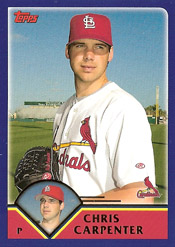
To appreciate how far pitcher Chris Carpenter had to come to develop into an ace, it’s helpful to go back to the beginning of his Cardinals career.

chris_carpenter9As Carpenter prepared for his first regular-season start with the Cardinals in 2004, there were genuine doubts about whether he could be an effective member of the rotation. Carpenter hadn’t pitched in a regular-season big-league game in 18 months and he had endured two shoulder surgeries since then.

In 2004, Carpenter began to show he was recovered from his shoulder ailments when he started the Cardinals’ fifth game of the season, April 9, at Phoenix, against the Diamondbacks.

Carpenter had made his previous regular-season start on Aug. 13, 2002, for the Blue Jays, against the Athletics. After signing with the Cardinals in December 2002, Carpenter didn’t pitch in the big leagues in 2003.

He got cuffed around in spring training games in 2004. Joe Strauss of the St. Louis Post-Dispatch wrote: “Carpenter confronted bouts of doubt late in spring training. He experimented with pitching from the opposite corner of the rubber, began leaving pitches up and was hit hard in his final two Grapefruit League appearances. The almost-daily winter workouts with teammate Matt Morris couldn’t eliminate the apprehension of appearing in a (regular-season) game for the first time in nearly 20 months.”

Step forward

Carpenter arranged for his wife, children and in-laws to travel from New Hampshire to Arizona to witness his Cardinals’ regular-season debut, according to the Post-Dispatch.

It began ominously. When Steve Finley and Roberto Alomar each singled and Luis Gonzalez followed with a double, Carpenter had yielded a run before recording an out. Arizona scored three in the first.

Fortunately for Carpenter, Cardinals batters teed off against Diamondbacks starter Casey Daigle, making his major-league debut.

After the Cardinals built a 4-3 lead in the second, Carpenter, with Mike Matheny catching, retired 12 of the next 15 batters. Meanwhile, the Cardinals hit five home runs _ two by Reggie Sanders and one each by Albert Pujols, Ray Lankford and Scott Rolen _ in the first three innings against Daigle.

When Carpenter departed after six innings, the Cardinals led, 9-5. They went on to a 13-6 victory. Carpenter earned the win, his first since July 24, 2002, against the Orioles, and the first by a Cardinals starter in 2004. Boxscore

Carpenter’s fastball reached 92 mph, a sign his shoulder was solid. He credited team orthopedic surgeon Dr. George Paletta and his staff and trainers Barry Weinberg and Mark O’Neal for his recovery.

“Physically, I felt great,” Carpenter told the Post-Dispatch. “I knew my stuff was there … Now I can tell myself no matter how hard I throw, or what I did, if I make quality pitches I’ll get hitters out at this level.”

Good guidance

Carpenter had an inconsistent April. In his second start, an 11-1 Astros victory over the Cardinals, he gave up a three-run home run to Lance Berkman. After five starts, Carpenter was 2-1 with a 5.28 ERA.

Pitching coach Dave Duncan helped find a key to turning Carpenter into a consistent winner. Rick Hummel of the Post-Dispatch reported Duncan “has been working with Carpenter on getting on top in his delivery by shortening his stride and consequently keeping the ball down more.”

Years later, Carpenter told Stan McNeal of Cardinals Magazine, “Duncan really understood how to get the best out of each pitcher he worked with. For me, that required a major change in the stuff I threw. Before I got to St. Louis, I relied on a four-seam fastball, sinker, curveball and a little on a changeup. In my first meeting with Duncan, he made it clear that would not be the mix moving forward.

“It wasn’t like he told me to never throw my four-seamer, but he wanted me to focus on my sinker. The other big thing: he wanted me to establish my cutter more. It was about keeping the ball down.”

Carpenter finished the season 15-5 with a 3.46 ERA and helped the Cardinals win their first National League pennant in 17 years.

In nine seasons with St. Louis, Carpenter had a regular-season record of 95-44 and a postseason mark of 10-4, including 3-0 in World Series games.

Read Full Post »

On Feb. 9, 1988, the Cardinals acquired a starter to complete what they hoped would be the premier pitching staff in the National League.

jose_deleon2The Cardinals got pitcher Jose DeLeon from the White Sox for pitcher Ricky Horton, outfielder Lance Johnson and $100,000. DeLeon, 27, was thought to be on the verge of transforming from underachiever to big winner. He long had been coveted by Cardinals manager Whitey Herzog.

With a starting rotation of DeLeon, John Tudor, Joe Magrane, Danny Cox and Greg Mathews, plus a bullpen of Todd Worrell, Ken Dayley, Bob Forsch, Scott Terry and Steve Peters, Herzog told Rick Hummel of the St. Louis Post-Dispatch “this has got a chance to be the best pitching staff I’ve ever had … Every day we go out there, we’ve got a chance to win.”

According to columnist Peter Pascarelli in The Sporting News, “Their pitching is now as deep as that of any club in the National League East.”

Unfortunately for the Cardinals, it didn’t turn out that way.

Cox (elbow) and Mathews (shoulder) had injuries and each was limited to 13 starts in 1988. Magrane spent two months on the disabled list that year because of a torn muscle in his right side. Tudor was dealt to the Dodgers in August 1988. National League champions the year before, the Cardinals finished 76-86 in 1988.

DeLeon had two good seasons for the Cardinals, then faded, losing more than twice as many as he won over his next three seasons with St. Louis.

When the trade was made, Herzog told Hummel that DeLeon is a “very good gamble for us. He gives us a right-handed pitcher who can scare some people.”

“With our ballpark, our defense and his maturity … if he’s ever going to blossom into an outstanding big-league pitcher, it should be now,” Herzog said.

Cardinals general manager Dal Maxvill said DeLeon is “a fine, young pitcher who … should be a starter for several years. There are not many pitchers out there who can throw 90 mph consistently.”

Maxvill and White Sox general manager Larry Himes had discussed a deal during the baseball winter meetings in December 1987. Himes wanted Horton, Johnson and catcher Tom Pagnozzi for DeLeon. “I didn’t want to make the deal with Pagnozzi in it,” Maxvill told Hummel.

When the White Sox settled instead for cash, the trade was made.

Johnson hit .333 with 42 stolen bases for Class AAA Louisville team in 1987, but the Cardinals already had a stellar center fielder, Willie McGee. If the Cardinals hadn’t signed free-agent first baseman Bob Horner to replace the departed Jack Clark, Johnson would have played center field for the 1988 Cardinals, with McGee moving to right field and Jim Lindeman shifting from right to first base, the Chicago Sun-Times reported.

Hummel wrote that Johnson didn’t fit as a backup outfielder because St. Louis already had Curt Ford and John Morris, both left-handed batters like Johnson.

Horton had been a versatile and effective starter and reliever for St. Louis. Herzog told Hummel, “I’m really sorry to trade Horton because Rick’s been a very good pitcher for us any way we used him.”

Said Horton (now a Cardinals broadcaster): “It would be a lot easier staying in St. Louis. I make my home here and I will continue to do so … but it might be the best thing for me to go to Chicago. The White Sox obviously are interested in my services and I feel I can do a job for them. Any time somebody wants you, it’s a positive thing.

“I have no bitterness toward the Cardinals … I hope Jose DeLeon wins 20 games for them and they go back to the World Series.”

Most observers thought the Cardinals made a good trade.

Columnist Moss Klein of The Sporting News: “DeLeon, loaded with ability, could become a consistent winner for the Cardinals if he improves his control.”

Pascarelli: “Jose DeLeon gives the Cardinals another starter capable of pitching 200 innings … It was a solid move by St. Louis.”

“All the people in the Cardinals organization have liked DeLeon for a number of years now,” Herzog said. “I know they think he’s got potential. I think he might be ready to come into his own.”

Said DeLeon to Hummel: “I’ve grown up as a man and everything is coming my way now.”

DeLeon was 13-10 for the 1988 Cardinals. His 208 strikeouts that season ranked third among National League pitchers.

In 1989, DeLeon had his best season with St. Louis. He was 16-12. He led the National League in strikeouts (201) and was second in games started (36) and third in innings pitched (244.7).

DeLeon was 29-22 in his first two seasons with the Cardinals; 14-35 in his last three years with them. He was 7-19 in 1990 (leading the league in losses), 5-9 in 1991 and 2-7 in 1992. The Cardinals released him Aug. 31, 1992, and he signed with the Phillies about a week later.

In five years with the Cardinals, DeLeon was 43-57 with a 3.59 ERA. He yielded just 778 hits in 917.2 innings, but wasn’t able to win consistently enough.

Read Full Post »

(Updated on Oct. 26, 2024)

Mike Matheny helped recruit Chris Carpenter to the Cardinals.

chris_carpenter8After becoming a free agent, Carpenter, 27, left the Blue Jays for a one-year incentive-laden contract with St. Louis on Dec. 13, 2002.
Carpenter had undergone shoulder surgery in September 2002 and the Cardinals were gambling he would recover and be able to pitch for them in the second half of the 2003 season as “a potential swing man,” the St. Louis Post-Dispatch reported.

Matheny, the Cardinals’ starting catcher from 2000-2004, had been Carpenter’s teammate with the Blue Jays in 1999. Before signing with the Cardinals, Carpenter went to St. Louis at the club’s request to have a magnetic resonance imaging test on his shoulder. While in the city, he met with Matheny, who urged him to accept the Cardinals’ deal, the Post-Dispatch reported.

Carpenter also spoke with two other former Blue Jays teammates, pitchers Woody Williams (a Cardinal from 2001-2004) and Pat Hentgen (a Cardinal in 2000). Like Matheny, they endorsed the Cardinals as the right fit for Carpenter.

“They all said it was the best city, the best fans, the best organization,” Carpenter told Joe Strauss of the Post-Dispatch in December 2002. “It wasn’t a financial decision at all. It was because it was the best situation.”

The Cardinals were interested in acquiring Carpenter in July 2002 before they traded for Chuck Finley of the Indians. Soon after that, Carpenter was sidelined for the season because of the shoulder problems.

The Sporting News quoted a big-league scout as saying Carpenter was “a steal” for the Cardinals.

Carpenter didn’t return to form as quickly as the Cardinals expected. He didn’t pitch for them in 2003 _  he made eight minor-league starts totaling 18.2 innings that year _ but the move paid off in the long term.

As a Cardinal, Carpenter had a 95-44 regular-season record and a 10-4 postseason mark, including 3-0 in World Series games. He won the National League Cy Young Award in 2005 and had the best ERA in the league in 2009.

Regarding his win against the Rangers in Game 7 of the 2011 World Series, Carpenter told Stan McNeal of Cardinals Magazine, “Without pitching coach Dave Duncan, I’m not sure how we win Game 7.”

Starting against the Rangers for the third time in 10 days, Carpenter gave up two runs in the first inning and still was struggling in the second before Duncan came to the mound for a visit.

“He told me to establish my breaking ball because they were all over my hard stuff,” Carpenter recalled to McNeal. “I started throwing breaking balls, they stopped sitting on my other stuff, and I ended up pitching into the seventh. We took the lead and ended up winning our second ring in six seasons.” Boxscore

Read Full Post »

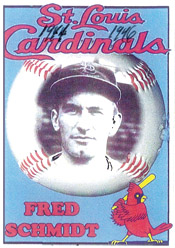
The National League Rookie of the Year Award didn’t exist in 1944. If it had, Cardinals pitcher Freddy Schmidt would have been a good candidate.

Schmidt contributed seven wins and five saves to the 1944 World Series championship club.

freddy_schmidtThe 1944 Cardinals dominated the National League with a 105-49 record, finishing 14.5 games ahead of the runner-up Pirates.
Discovered by the Cardinals when he attended one of their tryout camps in his hometown of Hartford, Conn., Schmidt joined the organization with Class D Shelby of the North Carolina State League in 1937.

It was the first of seven consecutive seasons in the Cardinals’ minor-league system for Schmidt. He was a 19-game winner for Class B Allentown in 1942 and was 13-10 for Class AA Rochester in 1943.

At 28, Schmidt made the Cardinals’ Opening Day roster in 1944. Initially used in relief, Schmidt earned the confidence of manager Billy Southworth and was given occasional starts.

His first big-league start was an eye-opener to the degree of difficulty in the major leagues. Starting for the Cardinals in the second game of a doubleheader on June 4, 1944, at Philadelphia, Schmidt held the Phillies to an unearned run and four hits in seven innings, but was the losing pitcher. His counterpart, Bill Lee, shut out the Cardinals on two hits and the Phillies won, 1-0. Boxscore

Schmidt earned his first big-league win in his next appearance, a relief stint on June 14, 1944, against the Cubs at St. Louis, when the Cardinals scored three in the bottom of the eighth and won, 10-9. Boxscore

In August, Southworth used Schmidt as a starter more frequently _ and the rookie responded, pitching a pair of shutouts in an 11-day stretch.

On Aug. 16, 1944, at St. Louis, Schmidt pitched a five-hitter in the Cardinals’ 5-0 victory over the Giants. The win was the Cardinals’ fifth in a row and enabled them to achieve their 80th victory on the earliest date in National League history. Boxscore

Schmidt used his arm and his bat to lead the Cardinals to a 4-0 victory over the Pirates in a cold drizzle on Aug. 25, 1944, at St. Louis. Schmidt pitched a six-hitter and struck out nine. He also produced two singles and two RBI. Pirates manager Frankie Frisch twice ordered intentional walks to the Cardinals’ No. 8 batter, Marty Marion, and Schmidt foiled the strategy each time with a RBI-single, the Associated Press reported. Boxscore

Schmidt finished the regular season with a 7-3 record, five saves and a 3.15 ERA in 37 games, including nine starts.

In his lone appearance in the 1944 World Series, Schmidt pitched 3.1 innings of scoreless, one-hit relief in Game 3, a 6-2 victory for the Browns. Boxscore

Two months later, Dec. 8, 1944, Schmidt was drafted into the Army.

Schmidt rejoined the Cardinals in 1946 and was 1-0 with a 3.29 ERA in 16 relief appearances, helping St. Louis to its fourth pennant of the decade.

After appearing in two games for St. Louis in 1947, Schmidt and outfielder Harry Walker were traded to the Phillies for outfielder Ron Northey on May 3. In September, after he posted a 5-8 record for Philadelphia, the Phillies placed him on waivers and Schmidt was claimed by the Cubs. He pitched in one game for Chicago _ and never appeared in the big leagues again.

Schmidt had a career major-league record of 13-11, 8-3 as a Cardinal.

Previously: Danny Litwhiler: perfect fit for champion Cardinals

Read Full Post »

(Updated April 17, 2022)

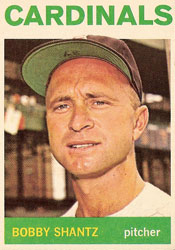
Four Cardinals pitchers have won a Gold Glove Award for fielding. Bobby Shantz, the first pitcher to earn a Gold Glove in each league, won two while with the Cardinals. Shantz was the first Cardinals pitcher to earn the award.

Shantz, who stood 5 feet 6 and weighed less than 140 pounds, was Jim Kaat’s favorite boyhood player. After Kaat reached the majors, he won the Gold Glove Award 16 times while with the Twins, White Sox and Phillies.
In his book “Still Pitching,” Kaat said as a boy he imitated the pitching motion of Shantz.

“If there was a game on the radio and Shantz was pitching, I would listen intently as the announcers described his delivery _ finishing square to the plate on the balls of his feet and taking a small hop toward home after delivering so as to be in perfect position to field a ball hit back to the mound,” Kaat recalled. “The next day, I would be outside … trying to finish in the same position as Bobby Shantz. Shantz was probably the greatest fielding pitcher of all time, quick as a cat and always on balance when he finished his delivery.”

The Gold Glove Award first was given in 1957. One Gold Glove was awarded at each of the nine positions in the major leagues that year. Shantz, then with the Yankees, won his first of eight in a row in 1957. The next year, a Gold Glove was given at each position in each league. Shantz earned four in the American League (with the Yankees) and one with the National League Pirates.

The Cardinals coveted Shantz for a long time and nearly traded Bob Gibson to the Senators for him in December 1960.

In 1962, Shantz, 36, began the season with the National League expansion Houston Colt .45s. On May 6, Houston traded him to the Cardinals for outfielder Carl Warwick and pitcher John Anderson.

Shantz bolstered the Cardinals’ bullpen and lived up to his reputation as a fielder. Reporting on a May 21, 1962, game in which Shantz earned his first St. Louis save, The Sporting News wrote, “After Bobby Shantz made a brilliant stab of a hot liner and flipped perfectly to third for a rally-stopping double play, manager Johnny Keane called the little guy the best-fielding pitcher in the league.”

“With Bob Gibson, I feel we have the two best-fielding pitchers in the league,” Keane said.

Shantz and Cardinals first baseman Bill White each won a Gold Glove in 1962. In those years, big-league players voted for the Gold Glove winners. Players could vote for anyone in their league except teammates. Shantz received 89 votes. Harvey Haddix of the Pirates was second at 70 and Gibson was third with 23. Shantz made one error in 22 chances for St. Louis that year and, including his errorless stint with Houston, had an overall .972 fielding percentage in 1962. Shantz also had a 5-3 record, four saves and a 2.18 ERA for St. Louis.

In 1963, Shantz was one of four Cardinals who earned Gold Glove honors. Joining White, third baseman Ken Boyer and outfielder Curt Flood, Shantz received votes from 113 players. Gibson placed second with 23 again. Shantz commited one error in 32 chances for the 1963 Cardinals. His record was 6-4 with 11 saves and a 2.61 ERA in 55 games.

Shantz became a largely forgotten part of one of the most famous trades in baseball history in 1964. Fielding flawlessly and sporting a 1-3 record with a 3.12 ERA in 16 games, Shantz was packaged with starter Ernie Broglio and outfielder Doug Clemens in the deal that brought outfielder Lou Brock and pitchers Jack Spring and Paul Toth to the Cardinals from the Cubs on June 15, 1964.

Two months later, the Cubs sent Shantz to the Phillies, who were in first place. With a significant boost from Brock, the Cardinals overtook the Phillies in September, won the pennant and beat the Yankees in the World Series.

Shantz won the last of his Gold Glove awards in 1964. He got 111 votes from the players. Gibson again was second, with 30. Shantz had one error in 35 fielding chances with the Cardinals, Cubs and Phillies that year.

The next year, Gibson won the first of his nine consecutive Gold Glove awards (1964-73) with the Cardinals. Since then, Cardinals pitchers to earn a Gold Glove are Joaquin Andujar (1984) and Adam Wainwright (2009 and 2013).

Read Full Post »

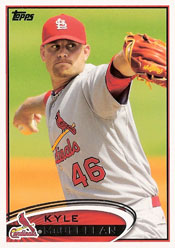
Kyle McClellan should be remembered as one of the key contributors in the Cardinals’ remarkable run to the World Series title in 2011.

Though he lacked the star power and big-game swagger of colleagues such as Chris Carpenter and Jason Motte, McClellan gave the 2011 Cardinals a significant early-season boost to their starting rotation and also contributed wins in relief down the stretch as St. Louis successfully made a frantic push to overtake the Braves for the National League wild-card spot.

The wear McClellan put on his right arm that year as he converted from reliever to starter in the spring and back to reliever in late July may have shortened his Cardinals career. Plagued by a damaged right shoulder, McClellan, 28, was sidelined for most of the 2012 season and was released by the Cardinals Nov. 13, 2012.

When starter Adam Wainwright suffered a season-ending arm injury at the start of spring training in 2011, McClellan moved into the rotation to replace him, even though McClellan had been used exclusively as a reliever since his rookie season of 2008.

Joining a rotation of Chris Carpenter, Jaime Garcia, Kyle Lohse and Jake Westbrook, McClellan’s selfless teamwork paid big early-season dividends for the Cardinals.

On April 11, 2011, McClellan earned his first win as a starter, limiting the Diamondbacks to a run in six innings and collecting his first two RBI in an 8-2 Cardinals triumph. “He did it all,” Cardinals manager Tony La Russa said to the St. Louis Post-Dispatch. Boxscore

McClellan won his first five decisions of 2011. On May 8, after he held the Brewers to a run and four hits in eight innings in a 3-1 Cardinals victory on Mother’s Day, McClellan had a 5-0 record and 3.30 ERA and St. Louis was in first place in the National League Central. McClellan’s mother and his wife, who was pregnant, attended the game. Afterward, Wainwright told St. Louis reporter Derrick Goold that McClellan’s record “is not surprising any of us.” Boxscore

Soon thereafter, McClellan fell into a funk. After earning a win on May 19, McClellan went more than two months before recording another. On July 25, in the last of his 17 starts for the 2011 Cardinals, McClellan held the Astros to a run in seven innings and got the win in the Cardinals’ 10-5 victory. “There’s been games where I’ve let the big inning kill me,” McClellan said to the Post-Dispatch. “Today, I felt like I was able to keep control of the game.” Boxscore

Two days later, the Cardinals acquired starting pitcher Edwin Jackson from the Blue Jays. McClellan quickly agreed to move to the bullpen to open a spot for Jackson in the rotation. La Russa told St. Louis reporter Rick Hummel that McClellan “showed a lot of character” in accepting the move. “He could have been bitter,” La Russa said.

Explained McClellan: “I felt like the time I was in the rotation, I did a good job. I don’t feel that I pitched my way out of a job.”

On Sept. 16, McClellan earned a big win in relief, pitching a scoreless 10th inning in the Cardinals’ 4-2 victory in 11 over the Phillies. McClellan retired Jimmy Rollins, Shane Victorino and Chase Utley in order, helping the Cardinals get within 3.5 games of the Braves in the wild-card chase. Boxscore

Joe Strauss of the Post-Dispatch wrote that the victory transformed the Cardinals’ postseason chances “from improbable to, dare it be said, believable.”

St. Louis did catch the Braves, swept through the National League postseason series and won the World Series championship in seven games.

The Cardinals couldn’t have qualified for the postseason without the contributions of McClellan. The right-hander was 12-7 overall _ 6-6 as a starter and 6-1 in relief _ in 43 apperances.

Previously: 2011: a year of titles, turnarounds, turmoil for Cardinals

Read Full Post »

« Newer Posts - Older Posts »