Feeds:
Posts
Comments

Archive for the ‘Pitchers’ Category

(Updated May 31, 2020)

No Cardinals pitcher has achieved perfection, but Danny Cox came close.
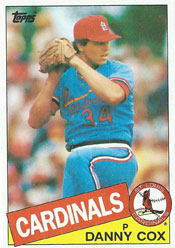
danny_cox2On May 31, 1985, Cox retired the Reds in order through 7.2 innings at St. Louis.

Cox was fully aware of the drama his performance was creating. Asked about the ovation he received when batting in the seventh, Cox said, “I knew it wasn’t for my hitting.”

In the eighth, Cox retired the first two batters, Alan Knicely and Gary Redus, giving him 23 consecutive outs and putting him within four outs of the perfect game.

All about location

The next batter was Dave Concepcion. At 36, the shortstop was in his 16th season with the Reds and his last as an everyday player.

According to the St. Louis Post-Dispatch, when Concepcion got to the plate, he said to umpire Jerry Crawford and catcher Darrell Porter, “It’s all over,” referring to Cox’s bid for a perfect game.

Crawford laughed and Concepcion said, “Do you want to bet?”

Crawford declined and Porter said, “I can’t bet against you. You’re a dandy player.”

From the dugout, Reds outfielder Dave Parker yelled to Concepcion, “Break his heart, Davey, break his heart,” the Dayton Daily News reported.

The first pitch from Cox to Concepcion was a strike. The second was grounded into left field for a single.

“It was a fastball,” Cox told the Associated Press. “I tried to get it inside, but I left it out over the plate.”

Said Concepcion: “He was pitching me up and in. He got (the pitch) down a little.”

Ron Oester followed with a single, moving Concepcion to second. Protecting a 5-0 lead, Cox got Wayne Krenchicki to ground out to first, ending the inning.

Praise from Pete

In the ninth, Cox set down the Reds in order. Player-manager Pete Rose flied out to left, ending the game. Rose, who four months later would become baseball’s career hits leader, grounded out in each of his previous three at-bats.

“He changes speeds well and he throws a lot of strikes,” Rose said.

Cox used an effective combination of fastballs and changeups. “He throws his fastball so hard, he can freeze you with his changeup,” Cardinals first baseman Jack Clark told The Sporting News.

Parker said, “He’s got an exceptional changeup. His whole game revolved around the changeup.”

The line for Cox: 9 innings, 2 hits, 0 runs, 0 walks, 3 strikeouts, 96 pitches, 29 batters faced. The loss went to Reds starter John Stuper, the former Cardinal. Boxscore

Rare feat

Cox was trying to become the first National League pitcher to toss a perfect game since the Dodgers’ Sandy Koufax did it versus the Cubs on Sept. 9, 1965.

A perfect game is defined as one in which a pitcher earns a win, pitches a minimum of nine innings and no opposing player reaches base by any means. Games less than nine innings don’t qualify as perfect games. Nor do games in which an opposing player reaches base only in extra innings.

The Cardinals never have been involved in an official perfect game. They were involved in two unofficial ones.

On Aug. 11, 1907, in the second game of a doubleheader versus the Braves, Cardinals starter Ed Karger retired all 21 batters he faced. The game was called by mutual agreement after seven innings, with the Cardinals winning, 4-0. In those days, teams were allowed to shorten the second game of a doubleheader if both sides agreed.

Seventy-seven years later, on April 21, 1984, in the second game of a doubleheader versus the Cardinals, Expos starter David Palmer retired all 15 batters he faced. The game was called because of rain after five innings, with the Expos winning, 4-0.

Previously: Danny Cox vs. Mike Aldrete: Duel of 1987 Cardinals, Giants
Read Full Post »

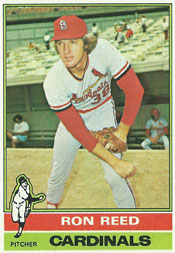
Convinced Bob Gibson no longer should be a starter, the Cardinals acquired Ron Reed from the Braves and put him in the rotation as the replacement for their long-time ace.

ron_reedOn May 28, 1975, the Cardinals traded relievers Ray Sadecki and Elias Sosa to the Braves for Reed and a player to be named. Five days later, the Braves sent Wayne Nordhagen, a minor-league outfielder, to the Cardinals, completing the deal.

At the time of the trade, the Cardinals’ rotation consisted of Gibson, Bob Forsch, Lynn McGlothen and John Curtis. With the May acquisitions of Reed from the Braves and Ron Bryant from the Giants, the Cardinals planned to move Gibson to the bullpen and go with a revamped rotation of Forsch, McGlothen, Reed, Curtis and Bryant.

Embarrassment to Bob

Gibson, 39, was upset with the decision.

“I think they’re making a mistake,” Gibson said to The Sporting News. “I still think I can throw better than 50 percent of the pitchers in the league. I think I’ve still got good stuff, not just competitive fire.”

Said Cardinals manager Red Schoendienst: “It was a tough decision to make. He’s still a good pitcher, but he’s not pitching as great as he has in the past.”

Gibson was a five-time 20-game winner and eight-time all-star with the Cardinals. He twice was named winner of the World Series Most Valuable Player Award and twice was named winner of the National League Cy Young Award.

In 1975, though, his record was 1-5 with a 4.80 ERA when he was dropped from the rotation on June 1. He yielded 71 hits in 65.2 innings and had more walks (33) than strikeouts (32).

Gibson was hampered by damaged knees. He also admitted he was reeling from a divorce.

In his 1994 book “Stranger to the Game,” Gibson said, “I didn’t conceal my anger at being sent to the bullpen, but I suspect now that some of it actually stemmed from my frustrations at home. There was a lot of pressure in suddenly being the primary parent for two teenage girls and a degree of devastation over the shattering of a family life that had been nearly 20 years in the making.”

Said Cardinals outfielder Reggie Smith: “When his body didn’t respond and then the club put him in the bullpen, it was an embarrassment to Bob.”

Two-sport standout

Reed, 32, was a good acquisition for the Cardinals. Bryant, 28, wasn’t.

Like Gibson, Reed was an outstanding basketball player. Gibson played basketball in college for Creighton and as a professional for the Harlem Globetrotters. Reed played basketball in college for Notre Dame and as a professional for the NBA’s Detroit Pistons.

A basketball and baseball standout at LaPorte (Ind.) High School, Reed was offered a contract by Athletics owner Charlie Finley, a LaPorte resident, after he graduated. Instead, Reed accepted a basketball scholarship from Notre Dame.

At 6 feet 6, Reed averaged 19 points and 14 rebounds per game in three varsity seasons at Notre Dame. He holds the Notre Dame single-season record for rebounding average at 17.7 per game.

After his senior season, Reed was selected by the Pistons in the third round of the 1965 NBA draft. Reed, who played baseball at Notre Dame only as a senior, wasn’t selected in the 1965 major-league amateur draft.

Looking for something to do in the summer before the start of the 1965-66 NBA season, Reed used a connection to contact Braves general manager John McHale, a fellow Notre Dame graduate. McHale signed Reed to a free-agent contract and assigned him to the minors.

The player-coach of the Pistons was Dave DeBusschere. He had pitched for the White Sox in 1962 and ’63. As a rookie, Reed averaged 7.5 points in 57 games for the Pistons. In his second season, Reed averaged 8.5 points in 62 games, including a 30-point performance on Dec. 16, 1966, versus the Baltimore Bullets.

At a crossroads, Reed opted for baseball. “At 6-foot-6, I was sort of caught in the middle (between forward and guard) and I doubt if I could have become anything more than a utility player in the NBA,” Reed told The Sporting News.

By 1968, Reed was in the Braves’ starting rotation. He achieved double-digit wins in five of his seven full seasons with the Braves.

Cardinals contributor

Reed was having breakfast when he learned he had been traded to the Cardinals. “I stood there with my mouth wide open,” Reed said. “I didn’t know how to react. I had never been traded before.”

In his Cardinals debut, on June 3, 1975, Reed got the start against the Braves and earned the win in a 4-2 Cardinals triumph. “When the game started, my knees began to shake,” Reed said. “I wasn’t scared … but my knees were just shaking.”

Reed won each of his first three starts with the Cardinals and had a 0.76 ERA.

Bryant, meanwhile, was a bust. A left-hander who had 24 wins for the 1973 Giants, Bryant was acquired by the Cardinals from San Francisco on May 9, 1975, for outfielder Larry Herndon and minor-league pitcher Tony Gonzalez.

In his first and only start for the Cardinals on June 16, 1975, Bryant gave up five runs in one inning against the Pirates.

Unimpressed, the Cardinals yanked Bryant from the rotation. Given a reprieve, Gibson replaced him and made four starts, winning one and losing three between June 21 and July 8. After the all-star break, Gibson was sent back to the bullpen, didn’t start again and retired in September.

John Denny and Harry Rasmussen were promoted from the minor leagues to join Forsch, McGlothen and Reed in the rotation, with Curtis being sent to the bullpen.

Reed won eight of his first 12 decisions with the Cardinals and finished 9-8 with a 3.23 ERA in 24 starts for St. Louis.

On Dec. 9, 1975, the Cardinals traded Reed to the Phillies for outfielder Mike Anderson. Converted to a reliever, Reed pitched for the Phillies in the 1980 and 1983 World Series.

Reed finished his career for manager Tony La Russa and pitching coach Dave Duncan with the 1984 White Sox. In 19 big-league seasons, Reed was 146-140 with a 3.46 ERA and 103 saves.

Previously: Bob Gibson and his final Opening Day with Cardinals

Read Full Post »

(Updated May 23, 2020)

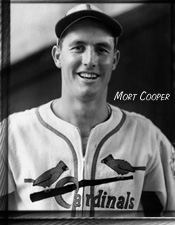
Convinced he had the leverage to demand a more lucrative contract, Cardinals ace Mort Cooper played hardball with Sam Breadon. The club owner responded by trading Cooper rather than negotiating with him.

mort_cooper4“In reckoning on his ability to outmaneuver Sam Breadon, Cooper encountered an old master who is familiar with a wide variety of curves,” The Sporting News reported.

On May 23, 1945, the Cardinals traded Cooper, 32, to the Braves for pitcher Red Barrett, 30, and $60,000. Three months later, Cooper had elbow surgery. Barrett earned 21 wins for the 1945 Cardinals.

Show me the money

Cooper was a key reason the Cardinals won three National League pennants and two World Series championships from 1942-44. He was named winner of the NL Most Valuable Player Award in 1942 when he was 22-7 with a 1.78 ERA. He followed that with a 21-8 record and 2.30 ERA in 1943 and a 22-7 record and 2.46 ERA in 1944.

Before the 1945 season, Cooper signed a one-year contract for $12,000. That amount, Breadon told Cooper, was the club ceiling on salaries. In spring training, Cooper learned the Cardinals made an exception for Marty Marion and signed the shortstop for $13,000.

Breadon offered to increase Cooper’s 1945 salary by $1,500, giving him a total of $13,500, but Cooper demanded $15,000, according to the St. Louis daily newspapers. Breadon refused. In protest, Cooper and his brother, catcher Walker Cooper, left the Cardinals’ spring training camp at Cairo, Ill., and threatened to boycott the club’s opening series against the Cubs.

The Cooper brothers eventually gave in and were with the club on Opening Day at Chicago. Soon after, Walker Cooper was inducted into the Navy. Mort Cooper made his first appearance of the season on April 22, pitching in relief against the Reds at St. Louis.

Cooper still was miffed about his contract and he didn’t show when the Cardinals left St. Louis by train for a series at Cincinnati. Instead, he arrived in Cincinnati the next day with his lawyer, Lee Havener, and demanded a salary increase.

Cooper started on April 29 against the Reds and earned the win. He also won his next start, versus the Cubs, on May 6 and got a no-decision in his third start on May 13 against the Giants.

With a 2-0 record and 1.52 ERA, Cooper appeared headed toward another big season. Because of injuries and commitments to military service, the Cardinals had little pitching depth. Sensing he had the upper hand, Cooper decided the time was right to force the issue of a new contract.

Jumping ship

In mid-May, while the Cardinals were in Boston, Cooper called traveling secretary Leo Ward about 3 a.m. at the team hotel and informed him he was leaving without permission and returning to St. Louis. Manager Billy Southworth suspended the pitcher indefinitely and fined him $500.

In St. Louis, Cooper and Havener asked Breadon to discuss a new contract. A meeting was scheduled for May 23 in Breadon’s office.

Secretly, Breadon began talking with clubs to gauge interest in Cooper. The Giants offered cash but no players. The Cubs and Phillies offered a combination of players and cash. The Braves offered the most cash, plus Barrett.

Cooper and Havener arrived at Breadon’s office, expecting to renegotiate a contract. Southworth was there with Breadon. After exchanging pleasantries, Breadon delivered his surprise, informing Cooper he was traded to the Braves.

“You could have floored Cooper and Havener with a feather,” the St. Louis Star-Times reported.

According to the St. Louis Post-Dispatch, Cooper “was shocked and crestfallen.”

“This is all a big surprise to me,” Cooper said to the Star-Times.

Deal of the year

“In disposing of Cooper, Breadon took the best course, since there was little chance of an amicable agreement,” The Sporting News opined.

Post-Dispatch columnist John Wray suggested “pitchers like Cooper today are rarer than banana trees in Iceland,” but added, “a disgruntled, malingering Cooper, forced to labor in a vineyard he hated, might have hurt the morale of the other players and done even greater damage.”

United Press called the transaction “the most important baseball deal of 1945” because the departure of a perennial 20-game winner gave hope to NL teams that the three-time defending champion Cardinals could be dethroned.

Cooper “almost overnight transformed (the Braves) into a pennant contender,” wrote The Sporting News.

Braves right fielder Tommy Holmes told the Boston Globe, “Brother, he’s got everything and he knows how to use it. I’m glad to have him on my side.”

Braves general manager John Quinn deemed Cooper “the best pitcher in the league.” The Braves reworked his contract and gave Cooper $15,000 for 1945.

Singing slinger

Barrett nearly was overlooked in most reviews of the trade. He was 2-3 with a 4.74 ERA for the 1945 Braves.

Informed of the trade by Braves manager Bob Coleman, Barrett said, “I didn’t give them a chance to change their minds. I was packed and ready to leave for St. Louis two minutes later. I’d have been ready sooner but I had difficulty in getting my suitcase closed.”

Breadon told the Post-Dispatch, “Barrett is not a star, but he’s an earnest, conscientious pitcher who will strive always for the best interests of his club.”

Barrett was almost as well-known as a singer as he was a pitcher. He sang a role in the opera “Narcissus” with the Los Angeles Philharmonic. He toured with bands during the off-season. “There is scarcely a big jazz band in the country that I haven’t sung with,” Barrett said. “Sammy Kaye. Tommy Dorsey. Skinny Ennis and the rest of them.”

No one expected Barrett would be the equal of Cooper. His career record in seven seasons with the Reds and Braves was 16-37.

Inserted into the rotation, Barrett produced a 21-9 record and 2.74 ERA for the 1945 Cardinals. Cooper was 7-4 with a 3.35 ERA for the 1945 Braves.

Final years

The 1945 Cardinals finished in second place at 95-59, three games behind the Cubs. The Braves finished sixth in the eight-team league at 67-85, 30 games behind Chicago.

With Breadon’s approval, Southworth left the Cardinals after the 1945 season and accepted an offer to manage the Braves. His replacement, Eddie Dyer, preferred using Barrett in relief and giving him spot starts. Barrett was 3-2 for the 1946 Cardinals. After the season, he was sent back to the Braves and pitched three more years for them.

Under Southworth, Cooper was 13-11 with a 3.12 ERA for the 1946 Braves. It was his last hurrah. In 1947, Cooper was a combined 3-10 with a 5.40 ERA for the Braves and Giants.

Previously: How Mort Cooper pitched 2 straight one-hitters for Cardinals


Read Full Post »

(Updated Feb. 4, 2023)

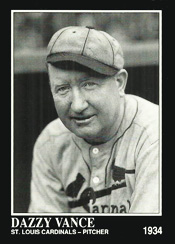
Combining an effective hitting stroke with a strikeout pitch that dazzled a lineup stacked with fellow future Hall of Famers Rogers Hornsby, Jim Bottomley and Chick Hafey, Dazzy Vance gave one of the best individual performances all-time against the Cardinals.

dazzy_vanceOn July 20, 1925, Vance, 34, struck out 17 and produced three RBI, including the walkoff hit in the 10th, carrying Brooklyn to a 4-3 victory over the Cardinals at Ebbets Field.

The New York Daily News called it an “epoch-making performance” from a “smokeball artist.”

Ninety years later, on May 13, 2015, Corey Kluber, 29, struck out 18 in eight innings, lifting the Indians to a 2-0 victory over the Cardinals at Cleveland. Boxscore

Kluber’s strikeouts are the most by one pitcher against the Cardinals, topping the mark held by Vance.

Whiff wiz

A right-hander, Vance didn’t get his first big-league win until he was 31 in 1922.

He was named winner of the National League Most Valuable Player Award in 1924 when he was 28-6 for Brooklyn and led the league in wins, ERA (2.16), strikeouts (262) and complete games (30).

Mixing a fastball with a curve, Vance led the NL in strikeouts with Brooklyn for seven consecutive years (1922-28). His 17 against St. Louis represented his single-game high in 16 big-league seasons.

Vance struck out every player in the Cardinals lineup that day except shortstop Specs Toporcer, who got his nickname because he wore eyeglasses.

Hornsby and Bottomley each struck out three times, tying career highs. Hafey struck out once.

“The Cardinals “punched yawning gaps in the atmosphere trying to connect with the Dazzler’s fast ones,” the New York Daily News reported.

Unlike Kluber, who held the 2015 Cardinals to one hit, Vance wasn’t untouchable against the 1925 Cardinals. He yielded nine hits and walked six. Vance used his bat as well as his strikeout pitches to put himself in position to win.

Power hitter

After Les Bell reached Vance for a two-run single in the fourth, breaking a scoreless tie, Vance responded with a two-run home run the next inning.

Vance hit .143 in 1925 and .150 for his big-league career. Most of his hits came against off-speed pitches. Known for his wit, Vance explained his approach to hitting in the 1976 book “The Gashouse Gang” by Robert Hood:

“I was a slow-ball hitter,” Vance said. “I found that out years ago when I was a boy on a farm. We were plagued with rats, so we got a ferret and shoved him down a hole. I stood at another hole with a baseball bat. When a rat ran out, I swung and missed. Another came and I swung and missed. I must have missed half a dozen.

“Then out came this fellow nice and slow and I clouted him good. Unfortunately, it was the ferret. From then on, I knew I was a slow-ball hitter.”

Walkoff winner

In the eighth, with Hornsby on first, one out and the score still tied at 2-2, Vance struck out Bottomley and Hafey. Then Vance singled leading off the bottom half of the inning and Brooklyn got the go-ahead run on Milt Stock’s RBI-double.

The Cardinals tied the score at 3-3 in the ninth when Toporcer tripled and Bell singled for his third RBI of the game.

After nine innings, Vance had struck out 15, tying his career high. Rube Waddell of the 1908 Browns had established the big-league record for strikeouts in nine innings with 16 against the Athletics.

In the 10th, Vance struck out Hornsby and Bottomley, giving him his total of 17.

“The great Rogers Hornsby was practically helpless before Dazzy’s speed,” according to the New York Daily News.

In addition to the fastball, Vance “had a sharp-breaking curve that was amazing,” the Brooklyn Daily Eagle reported. “The funny thing was that Vance was reported to have an arm which was still blue from the rupturing of a blood vessel in his four disastrous innings against Pittsburgh last Thursday. On Sunday his arm was still red and angry-looking from the use of secrets from Doc Hart’s medicine chest.”

After catcher Hank DeBerry led off the bottom of the 10th with a double and was lifted for pinch-runner Johnny Mitchell, Vance followed with a single, scoring Mitchell with the winning run. Boxscore

Vance finished the 1925 season with a 22-9 record and 221 strikeouts in 265.1 innings.

He pitched for the Cardinals in 1933 and 1934, giving St. Louis a tandem of Dazzy and Dizzy (Dean). Vance appeared in his lone World Series in 1934 for St. Louis against the Tigers. His career record is 197-140 (190 wins for Brooklyn and seven for St. Louis) with 2,045 strikeouts.

He was elected to the National Baseball Hall of Fame in 1955.


Read Full Post »

Earning wins in his first two appearances for the Cardinals, Troy Percival went from being perceived as a risk to being viewed as a valuable reliever.

troy_percivalA closer with the Angels and Tigers, Percival sat out the 2006 season because of persistent arm ailments.

In 2007, Percival, 37, found he was able to throw effectively again. He was in contact with several former Angels teammates who had become Cardinals and they put in a good word for him. Percival threw for the Cardinals during a workout and impressed. The Cardinals signed him on June 8, 2007, and sent him to their minor-league Memphis club to get into game condition.

Percival posted a 1.35 ERA in six appearances for Memphis and was called up by St. Louis before a weekend series against the Reds at Cincinnati.

In his Cardinals debut, on June 29, 2007, Percival earned a win with a flawless inning of relief in the Cardinals’ 4-2 victory over the Reds.

“It’s a dream come true,” Cardinals manager Tony La Russa said to the Associated Press. “He gets three outs and gets the winning decision. That’s movie material.”

Said Percival: “I didn’t come back for myself. A lot of friends on this team called me and said they needed pitching help. My arm felt good enough to do it.” Boxscore

Two days later, on July 1, Percival made his second Cardinals appearance. With the Cardinals ahead, 8-5, in the fourth, Percival relieved starter Mike Maroth with two runners on base and no outs. Percival got out of the mess by retiring all three batters he faced without allowing either base runner to advance. The Cardinals won, 11-7, and Percival was credited with the win in a scorer’s decision for his successful rescue effort in the fourth. Boxscore

Percival contributed a 3-0 record and 1.80 ERA in 34 appearances for the 2007 Cardinals. Granted free agency after the season, he signed with the Rays and finished his career with them in 2009.

Previously: The story of how the Cardinals acquired Lee Smith


Read Full Post »

Rescued from the minors and given the chance for a final fling with the franchise he rooted for as a boy in Illinois, T.J. Mathews delivered his longest and most impressive big-league performance for the Cardinals.

tj_mathewsOn Sept. 9, 2001, Mathews pitched 4.1 flawless innings of relief for the Cardinals and got the win in an 8-1 St. Louis victory over the Dodgers at Busch Memorial Stadium. Mathews retired all 13 batters he faced, striking out five.

Baseball pedigree

Mathews, a Belleville, Ill., native, grew up as a Cardinals fan. His father, Nelson Mathews, had been an outfielder with the Cubs and Athletics in the 1960s. In 1992, T.J. Mathews was selected in the 36th round of the amateur draft by the Cardinals.

A right-hander, Mathews debuted with the Cardinals in 1995 and pitched effectively for them in relief. On July 31, 1997, Mathews was one of three players traded by the Cardinals to the Athletics for first baseman Mark McGwire.

Four years later, on June 22, 2001, Mathews, 31, was released by the Athletics. The Cardinals signed him two weeks later. After three appearances for St. Louis, Mathews was sent to Class AAA Memphis. In September, when the minor league seasons ended and big-league rosters expanded, the Cardinals brought him back.

Postseason quest

On Sept. 9, 2001, the Cardinals entered the day tied for second place with the Cubs in the National League Central Division at 77-64, 5.5 games behind the Astros. With 21 games remaining, the Cardinals needed a strong finish to have a chance at earning a postseason berth as either division champion or the wild-card entry.

Matt Morris, seeking his 20th win, was the Cardinals’ starter that Sunday afternoon against the Dodgers. After an inning, the game was halted by rain. The delay lasted two hours and four minutes.

Morris wanted to continue. Cardinals manager Tony La Russa, concerned the long delay could hamper Morris’ ability to properly loosen his arm, sent Luther Hackman to pitch the second.

“That was a real tough decision,” La Russa said to the St. Louis Post-Dispatch.

Said Morris: “When they make a decision that benefits your future, you can’t really complain.”

Hackman pitched a scoreless second. In the third, with the Cardinals ahead, 2-0, Hackman lost command. With one on and two outs, he walked three consecutive batters, forcing in a run and enabling the Dodgers to get within a run, 2-1.

La Russa lifted Hackman and brought in Mathews to face Adrian Beltre with the bases loaded. Mathews got Beltre to fly out, ending the threat.

Untouchable

Mathews retired the Dodgers in order in the fourth through seventh innings. He was lifted for a pinch hitter with the Cardinals ahead, 7-1. Mike James and Mike Timlin mopped up, pitching an inning apiece. Boxscore

Mathews got the win, the last of his 32 in an eight-year major-league career. The win also was his first since 2000 with the Athletics and his first as a Cardinal since 1997.

“He’s hard (for batters) to pick up,” said Cardinals catcher Mike Matheny. “Even catching him is tough. The ball comes right out of his jersey. His release point is kind of funny.”

Said Mathews: “Somebody had to go out and give us some innings. I thought maybe I’d go three at the most. After that third one, I thought, ‘Aw, what the heck.’

“I haven’t thrown that much since I was in the starting rotation in (Class AAA) Louisville in ’95. I wasn’t tired. When you get outs early, you can stay out there a little bit longer.”

Said La Russa to the Associated Press: “It’s kind of hard to believe he could throw that many pitches and keep his effectiveness.”

The win by Mathews sparked a stretch in which the Cardinals won 16 of their last 21 games, tying the Astros for first place in the NL Central at 93-69 and qualifying for the postseason as the wild-card entry.

Mathews became a free agent after the season and signed with the Astros. His 2002 season with Houston would be his last in the big leagues.

Previously: Deal for Woody Williams sparked 2001 Cardinals

Previously: Matt Morris close to perfect at home in 2001

Read Full Post »

« Newer Posts - Older Posts »