Feeds:
Posts
Comments

Archive for the ‘Records’ Category

(Updated April 3, 2022)

In 1939, a Cardinal was National League batting champion, but it wasn’t the player who nearly hit .400.

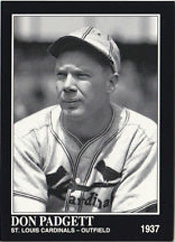
don_padgettCardinals first baseman Johnny Mize won the 1939 league batting title with a .349 mark in 153 games. At that time, a player needed to appear in 100 games in a season to qualify for the National League batting crown.

Mize’s teammate, catcher Don Padgett, hit .399 in 92 games for the 1939 Cardinals. Padgett produced 93 hits in 233 at-bats. No National League player with at least 200 at-bats in a season has had a higher batting average since then, according to baseball-reference.com.

If not for bad timing, Padgett, 27, would have hit .400 that season.

Untimely time out

On Oct. 1, the last day of the 1939 season, the Cardinals played the Cubs at Chicago’s Wrigley Field. Padgett, a left-handed batter, was sent by manager Ray Blades to pinch-hit for pitcher Max Lanier against the Cubs starter, right-hander Claude Passeau.

Padgett lined a single to center, according to author John Snyder in the book “Cardinals Journal,” but the hit didn’t count. First-base umpire Bick Campbell had called time out just before Passeau delivered the pitch because a ball had rolled from the bullpen onto the field.

The hit in his final at-bat of the season would have given Padgett a .402 batting average.

Instead, Padgett returned to the batter’s box and drew a walk, settling for the .399 mark. Boxscore

Ripping righties

Two years later, Ted Williams of the Red Sox became the last big-league player to hit .400 in a season with at least 200 at-bats. Williams hit .406 in 1941.

Padgett was used almost exclusively against right-handed pitchers in 1939. He hit .399  (89-for-223) versus right-handers and .400 against left-handers (4-for-10). He was especially productive at home, hitting .455 (46-for-101) for the 1939 Cardinals at Sportsman’s Park in St. Louis.

Primarily a backup to starting catcher Mickey Owen, Padgett enjoyed a torrid June (.441 batting average) and July (.484). His batting average was .400 on Sept. 27. Then he went 1-for-3 against the Reds on Sept. 28, dropping his batting mark to .399 and setting up that final at-bat versus the Cubs three days later.

Defense was not his specialty. Regarding Padgett’s catching skills, Bob Broeg of the St. Louis Post-Dispatch described him as “a shoemaker in shin guards.”

In five years with the Cardinals, Padgett hit .292 in 525 games. His career mark in eight big-league seasons with the Cardinals, Phillies, Dodgers and Braves was .288.

Previously: The strange case of Hugh Casey versus 1940 Cardinals

Previously: Baseball and romance: Cardinals’ Cuban adventures

Read Full Post »

Since 1944, the Cardinals are the only National League franchise to win three consecutive pennants.

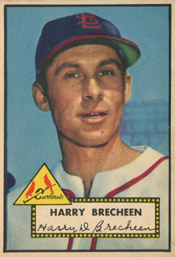
harry_brecheenBefore the Cardinals’ stretch of pennants from 1942-44, the last National League franchise to win three consecutive pennants was the Giants. They won four in a row from 1921-24.

Since 1900, the only other franchises that have won three National League pennants in a row are: Pirates (1901-03), Cubs (1906-08) and Giants (1911-13).

Managed by Billy Southworth, the 1942-44 Cardinals also were the first National League teams with 100 or more wins in each of three consecutive seasons.

Familiar feeling

In 1944, the Cardinals took the National League lead on April 29 and never relinquished it. A September slump kept them from clinching early in the month. They’d lost eight of nine entering a Sept. 21 doubleheader against the Braves at Boston.

In the first game of the doubleheader, the Cardinals broke a 4-4 tie in the eighth when George Fallon singled to right with two outs, scoring Whitey Kurowski from second. Harry Brecheen pitched five innings in relief of starter Mort Cooper and got the win.

The 5-4 victory clinched the pennant for the Cardinals, giving them a 13-game lead over the second-place Pirates with 12 remaining. Boxscore

Wrote The Sporting News, “The Redbirds walked off the field as if it had been an ordinary game, probably one of the least demonstrative reactions that has followed a pennant clincher. Except for the customary picture showing the players in a jubilant mood, there was no celebration in the clubhouse.”

Keep on rolling

In the second game, Cardinals pinch-hitter Walker Cooper slugged a two-run home run off starter Jim Tobin in the ninth, tying the score at 5-5, and Marty Marion drove in Ken O’Dea from second with a single in the 10th, lifting St. Louis to a 6-5 victory.

Brecheen pitched two scoreless innings, the ninth and 10th, to get his second win of the day and improve his record to 15-5. Boxscore

In saluting the 1944 Cardinals on their pennant-clinching day, The Sporting News noted, “Every player except two _ Danny Litwhiler and Debs Garms _ bears the Cardinals trademark, having come up through the club’s farm system.”

In an interview with author Peter Golenbock for the book “The Spirit of St. Louis,” Litwhiler said, “In 1944, we played the same Billy Southworth baseball. He never went for the big inning. Get a man on and get him over. At the time, we defined National League baseball. What I remember most about ’44 was that every day you knew you were going to win … It was so easy. And it wasn’t one person who did it. It was always someone new.”

The Cardinals finished the 1944 season at 105-49, 14.5 games ahead of the runner-up Pirates, and clinched the World Series championship with four wins in six games against the crosstown Browns.

Previously: Why the Cardinals played baseball in Delaware on D-Day

Read Full Post »

(Updated Feb. 3, 2019)

No National League night game has gone more innings than the one played by the Cardinals and Mets on Sept. 11-12, 1974.

bake_mcbride2Beginning at 8:08 p.m. on Sept. 11 and ending at 3:15 a.m. on Sept, 12, the Cardinals beat the Mets, 4-3, in 25 innings at New York’s Shea Stadium. Started before a crowd of 13,460, it ended before about 1,000 spectators, including baseball commissioner Bowie Kuhn.

The Cardinals-Mets marathon remains the longest National League night game in innings played.

In the longest major-league game by innings, the Dodgers and Braves played to a 1-1 tie in 26 innings on May 1, 1920. That National League game was played on a Saturday afternoon at Braves Field in Boston. Boxscore

Only one 25-inning game has been played in the major leagues since the Cardinals-Mets classic in 1974. In an American League game, the White Sox, managed by Tony La Russa, beat the Brewers, 7-6, in 25 innings at Chicago’s Comiskey Park. That night game began on May 8, 1984, was suspended after 17 innings with the score tied at 3-3 and completed on May 9. Boxscore

With no National League curfew, the Cardinals and Mets played their 25-inning game without a stop in play.

When it ended, Cardinals outfielder Reggie Smith told his teammates, “There’s no way that your wives are going to believe you guys were out playing baseball all night.”

Reitz to the rescue

The Cardinals trailed, 3-1, entering the ninth. After Joe Torre struck out, Ted Simmons singled and was replaced by pinch-runner Larry Herndon. Herndon went to second on a wild pitch by starter Jerry Koosman, but Bake McBride struck out.

With the Mets an out away from victory, the Cardinals’ last hope, Ken Reitz, hit a two-run home run, tying the score at 3-3.

“I was looking for a fastball, a strike, and I got it,” Reitz said to the St. Louis Post-Dispatch.

Cardinals reliever Claude Osteen, who had a clear view of the home run from his perch in the bullpen, held his hands less than a foot apart when he told United Press International the ball “went out by about that much.”

Scoreless relief

For the next 15 innings, Cardinals and Mets relievers threw shutouts.

Al Hrabosky, Rich Folkers, Ray Bare, Osteen and Sonny Siebert were the Cardinals relievers who stopped the Mets in extra innings. Osteen pitched 9.1 innings _ the equivalent of a complete-game shutout.

A pair of former Cardinals, Harry Parker and Bob Miller, joined Bob Apodaca and Jerry Cram as the Mets relievers who stopped the Cardinals. Cram pitched eight innings.

They escaped several jams.

_ Torre was out at the plate trying to score on a single by McBride in the 13th.

_ In the 20th, the Cardinals had runners on first and second, no outs, but Smith was picked off at second and the threat fizzled.

_ In the 23rd, the Mets loaded the bases with two outs before Cleon Jones flied out.

_ Both teams loaded the bases with two outs in the 24th but failed to score.

Bake was cooking

Hank Webb relieved Cram in the 25th inning. McBride led off with an infield single and Reitz was up next.

Cardinals manager Red Schoendienst gave the hit-and-run sign. Webb made a pickoff throw, but it sailed over first baseman John Milner and rolled into foul territory in right field.

“I figured I could get to third,” McBride told the Associated Press. “Then, when I turned second, I said to myself, ‘I’m going all the way.’ ”

McBride raced around third without looking toward coach Vern Benson, who was showing the stop sign. “I didn’t see any sense in sending him home with nobody out,” Benson said.

Milner retrieved the ball and fired a throw to catcher Ron Hodges. McBride and the ball arrived at the plate about the same time. Hodges dropped the ball before he could attempt a tag.

“I don’t think he would have had me, even if he had held the ball,” McBride said. “He was out in front of the plate and I was past him.”

Benson saw it differently. “It was a good throw by Milner, and Hodges probably would have got McBride if he hadn’t taken his eyes off the ball,” Benson said.

The Cardinals led, 4-3, but the Mets still had their turn to bat.

Happy ending

Siebert retired the first two batters, Ken Boswell and Felix Millan, on fly outs.

Brock Pemberton, appearing in his second big-league game, batted for Webb and singled, prolonging the drama with his first big-league hit. When the ball was removed from the game so Pemberton would have a keepsake, Mets pitcher Tom Seaver quipped from the dugout, “Don’t give it to him. It’s the last ball we’ve got left.” (Fifteen dozen balls were used in the game, The Sporting News reported.)

Milner, the Mets’ top home run hitter, batted next.

Siebert struck him out, ending the game at 7 hours, 4 minutes. Boxscore

Dizzying stats

The Cardinals used 26 players and the Mets, 24. The Cardinals stranded 20 base runners and the Mets, 25.

Nine players played the entire game. They were McBride, Reitz, Smith, Torre and Ted Sizemore for the Cardinals; Millan, Milner, Wayne Garrett and Dave Schneck for the Mets.

“Ordinarily, I get two hits and it’s a decent night, but 2-for-11?” Schneck said to the New York Daily News.

McBride, Reitz and Millan each had four hits in 10 at-bats. Garrett was 0-for-10 with four strikeouts. Lou Brock, the Cardinals’ future Hall of Famer, was 1-for-9 and was caught stealing in his lone attempt.

The home plate umpire, Ed Sudol, also had worked the plate in a 23-inning game between the Mets and Giants in 1964 and a 24-inning game between the Mets and Astros in 1968.

“My legs feel like a couple of lead posts,” Sudol said.

Asked to sum up the long night, Mets pitcher Tug McGraw said, “The only thing I regret now is that all the eating places are closed. I’ll have to go home and make myself a baloney sandwich.”

Previously: Reggie Smith and the Cardinals’ after-hours club

Read Full Post »
(Updated Jan. 25, 2024)

On the night he broke the record for stolen bases in a season, Lou Brock triggered a wide range of emotions. Cool Papa Bell was delighted. Maury Wills was melancholy. Bob Boone was bitter.

lou_brock10Brock was relieved.

“I’m glad to get it behind me,” Brock said to the Associated Press.

On Sept. 10, 1974, in an 8-2 Phillies victory over the Cardinals at St. Louis, Brock got his 104th and 105th stolen bases of the season, surpassing the mark of 104 established by Maury Wills of the 1962 Dodgers. The steals were the 739th and 740th of Brock’s career and made him the all-time National League leader, surpassing Max Carey, who swiped 738 for the Pirates and Dodgers from 1910-29.

In achieving the single-season record, Brock stole second base 100 times and third base five times.

Sorry, Maury

Brock, 35, got his 105 steals in 134 games. Wills got his 104 steals in 165 games. (The Dodgers and Giants had a three-game playoff after ending the 162-game schedule in a tie for first place.)

“I never thought anyone would approach the record this soon, probably not in my lifetime,” Wills said. “I just feel that was my record. I was very proud of it … I don’t think anyone looks forward to seeing his own record broken.”

Asked by The Sporting News to compare his skills with Brock’s, Wills replied, “I had more finesse and got a better lead, but I guess Brock has more speed.”

In his book “On the Run,” Wills said, “I wasn’t at the game when Brock stole his 105th base. I was at an NBC studio, waiting to comment on it. When it happened, they asked me how I felt about it. ‘I don’t like it at all,’ I said honestly. ‘I wasn’t pulling for him.’ ”

Hometown hero

The game against the Phillies on Sept. 10 was the Cardinals’ last at home before embarking on a trip to New York, Philadelphia and Pittsburgh. Brock was motivated to break the record at St. Louis.

“The only pressure was that which I’d put on myself by saying I wanted to do this at home,” Brock said.

In the first inning, before 27,285 at Busch Stadium, Brock led off with a single against Dick Ruthven. On the second pitch to the next batter, Ron Hunt, Brock broke for second and beat Boone’s throw, which bounced into center field. Brock was credited with a steal of second and advanced to third on the error.

Brock led off the seventh with a single. On Ruthven’s second pitch to Hunt, Brock took off and beat a wide throw from Boone to shortstop Larry Bowa for the record-breaking 105th steal. Video at 2-minute mark

“On 105, I felt my legs swaying just before I reached the base,” Brock said. “I didn’t even have enough energy to pop up with my slide. I guess I was pretty well spent.”

Salute to Lou

As Cardinals fans chanted “Lou, Lou, Lou,” the game was halted and Brock was honored in an on-field ceremony. Second-base umpire John McSherry shook hands with Brock. Bowa did, too.

Bell, a Negro League speedster who had been inducted into the National Baseball Hall of Fame, presented Brock with the second-base bag. “We decided to give him his 105th base because if we didn’t he was going to steal it anyway,” Bell said.

Addressing the crowd, Brock thanked Ted Sizemore _ “My partner in crime.” _ who had batted behind him for most of the season and patiently took pitches in order to provide Brock with the chances to attempt steals.

Brock also thanked teammates Bake McBride and Reggie Smith “for helping me clock the pitcher’s delivery” and trainer Gene Gieselmann because he “pumps my legs up every day.”

Said Brock of the record: “The key to it all was getting on base enough and staying healthy.”

Sour grapes

Two innings later, with the Cardinals trailing by six, Brock led off the ninth and reached first on Bowa’s error. He tried to swipe second, but was caught by Boone.

Boone criticized Brock for running into an out with the Cardinals so far behind.

“I thought it was brutal,” Boone said. “When anybody tries to steal with his club six runs behind, he better darn sure make it. I lost a lot of respect for the man when he tried that … You just can’t get thrown out in that situation.

“My dad played with a guy named Jungle Jim Rivera and he was paid by the number of bases he stole. Maybe Brock’s got something like that in his contract, too. I don’t know why he did it. It wasn’t good baseball.”

Said Phillies third baseman Mike Schmidt: “What the hell’s he stealing for in the ninth inning?”

Replied Brock: “Sometimes you can make things happen by the unexpected.”

Green means go

Several Phillies defended Brock.

“Everybody knows he’s going to run and he still does and makes it most of the time,” Bowa said.

Said Phillies second baseman Dave Cash: “When a man steals 104 or 105 bases, you don’t put the red light on.”

Phillies pitcher Steve Carlton, Brock’s former Cardinals teammate, said, “These people came to see him run.” Boxscore

Brock finished the 1974 season with 118 steals. It was the only time in 19 seasons in the majors he swiped more than 74.

In 1979, Brock told writer Roger Angell, “That record meant the most, because it was the only one where I challenged. All the other records I just caught up with, because of time. They were milestones.”

Brock’s record of 118 steals in a season didn’t last long. In 1982, Rickey Henderson swiped 130 for the Athletics. Henderson is the big-league career leader in steals at 1,406. Brock is second at 938.

Read Full Post »

(Updated June 29, 2019)

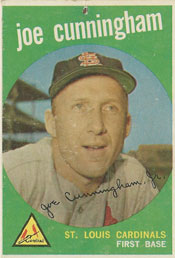
Joe Cunningham hit for average, not for power, so the three home runs he slugged in his first two big-league games with the 1954 Cardinals were surprising.

joe_cunninghamA left-handed batter and first baseman, Cunningham, 22, began the 1954 season at Class AAA Rochester. On June 28, 1954, the Cardinals came to Rochester to play an exhibition game versus the Red Wings. Cardinals manager Eddie Stanky said the prospect he was most interested in seeing was Cunningham.

Cunningham had two singles and walked twice in four plate appearances against the Cardinals.

Impressed, the Cardinals decided to promote Cunningham. On June 29, 1954, before the Red Wings played a doubleheader against Havana at Rochester, Cunningham was told he would be joining the Cardinals in Cincinnati the next day.

Cunningham was replacing rookie first baseman Tom Alston. In 66 games, Alston, the Cardinals’ first black player, hit .246 with four home runs and 34 RBI, but he slumped in June (.181 batting average for the month).

Whirlwind journey

Cunningham planned to catch an overnight train from Rochester to Cincinnati after playing both games of the doubleheader against Havana, but because of the length of the games, he missed the train.

A member of the Rochester publicity staff agreed to drive Cunningham from Rochester to the Buffalo airport the next morning. Cunningham took a flight from Buffalo to Cincinnati, arrived in the afternoon and went to the ballpark.

Cunningham barely had time “to bolt down a meal, sign a contract and learn the club’s signs,” the St. Louis Post-Dispatch reported.

Stanky put Cunningham in the starting lineup, batting him fifth against the Reds that night.

St. Louis slugger

In his debut game on June 30, 1954, Cunningham produced five RBI.

In the fifth inning, facing Art Fowler, a 32-year-old rookie, Cunningham hit a three-run home run for his first big-league hit, “a towering drive that landed well up into the right-field bleachers,” according to the Cincinnati Enquirer.

Cunningham followed with a two-run single off Harry Perkowski in the seventh, helping the Cardinals to an 11-3 victory. Boxscore

Immediately afterward, the Cardinals traveled to Milwaukee for a game the next day, July 1, 1954, against the Braves and their ace, Warren Spahn.

Cunningham hit two home runs off Spahn. The first was a 390-foot solo shot to right in the second inning. In the fifth, he connected for a three-run home run that landed just inside the right-field foul pole. The Cardinals won, 9-2. Boxscore

Dream come true

“This is just like a dream,” Cunningham said to the Associated Press. “I always wanted to be a big leaguer, but I had no idea it would come so soon.

“I left the minors in such a hurry I only brought along one pair of trousers,” Cunningham said. “I guess I’m still in a sort of shock. I had all my stuff at the cleaners and the only pants I’ve got are the ones I’ve been wearing.”

The next day, July 2, 1954, playing in his third game in his third city in three days, Cunningham was 1-for-3 with a single and a walk against the Cubs at Chicago. Boxscore

Cunningham finished the 1954 season with a .284 batting average, 11 home runs and 50 RBI in 85 games for the Cardinals.

In 12 big-league seasons, seven with the Cardinals, Cunningham hit .291 with 64 home runs. His single-season high in home runs was 12 for the 1958 Cardinals.


Read Full Post »

(Updated Oct. 23, 2017)

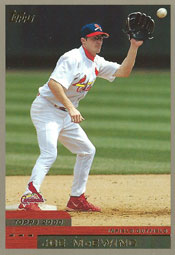
An overachiever with a team-oriented attitude, Joe McEwing was Tony La Russa’s kind of Cardinals player.

joe_mcewingMcEwing played for the Cardinals in 1998 and 1999 when La Russa was their manager. Called up from the minors in September 1998, McEwing, 25, made his big-league debut with the Cardinals and played in 10 games that month.

Ticketed for a utility role with the 1999 Cardinals, McEwing earned the second base job over Placido Polanco.

McEwing achieved a 25-game hitting streak from June 8-July 4. He broke the Cardinals rookie record held by Johnny Mize (22-game streak in 1936). McEwing’s streak was the longest by a Cardinals player since Lou Brock (26 consecutive games) in 1971.

“I appreciate Cardinal history,” McEwing said to columnist Bernie Miklasz of the St. Louis Post-Dispatch during the streak. “I’m a big fan of the game and to be mentioned in the same sentence with Johnny Mize, Lou Brock, Hall of Famers. You couldn’t ask for anything more.”

Asked whether he thought of the streak when he awoke each morning, McEwing replied to Miklasz, “When I get up, I worry about getting my coffee and doughnuts.”

Super streak

The streak began with a pair of singles against Royals starter Chris Fussell on June 8 at Kansas City. Boxscore

It reached 25 games in a row on July 4 with a home run off Diamondbacks starter Andy Benes, a former Cardinal. Boxscore

“He plays each game like it’s the seventh game of the World Series,” La Russa said of McEwing during the streak. “He is never different.”

Willie McGee, who had a 22-game streak for the 1990 Cardinals, said McEwing “deserves it. He works hard … He’s an outstanding person and an outstanding player.”

Beaten by the best

McEwing’s streak was snapped by Diamondbacks left-hander Randy Johnson on July 5. McEwing was 0-for-4 against Johnson, who won the National League ERA title and the second of his five Cy Young awards in 1999. In his last at-bat, McEwing lined out to left in the seventh with the bases loaded and two outs. Boxscore

“I told him he just got beat by a Hall of Famer,” La Russa said.

Added McEwing: “It was a good run and I enjoyed it.”

McEwing hit .318 during the streak, with 13 runs scored.

McEwing finished the 1999 season with a .275 batting average and 141 hits, including 28 doubles, in 152 games. He paced the Cardinals with 16 infield hits. McEwing made 85 starts at second base, 18 in center field, 16 in left and eight in right.

After the season, the Cardinals acquired second baseman Fernando Vina from the Brewers. During spring training in March 2000, the Cardinals traded McEwing to the Mets for reliever Jesse Orosco. McEwing helped the Mets win their first pennant in 14 years, eliminating the Cardinals in the National League Championship Series.

In eight big-league seasons with the Cardinals, Mets, Royals and Astros, McEwing batted .251 with 443 hits.

Read Full Post »

« Newer Posts - Older Posts »