Feeds:
Posts
Comments

Archive for the ‘Records’ Category

(Updated Dec. 25, 2018)

Solly Hemus had a knack for getting on base atop a Cardinals lineup stacked with Hall of Fame hitters.
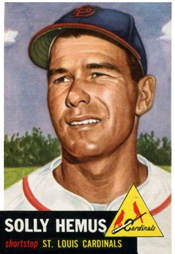
solly_hemusIn 1953, Hemus established a Cardinals record when he reached base safely in the first 33 home games of the season.

A left-handed batter who primarily played shortstop, Hemus was listed at 5 feet 9, 165 pounds. In 11 big-league seasons, Hemus had an on-base percentage of .390.

Mighty Mouse

Eddie Stanky, manager of the 1953 Cardnals, described Hemus to The Sporting News as a batter who “worried pitchers” and “annoyed catchers.” St. Louis baseball writer Bob Broeg tabbed Hemus as “Mighty Mouse.”

Usually batting first or second in a 1953 Cardinals lineup with eventual Hall of Fame inductees Stan Musial, Red Schoendienst and Enos Slaughter, Hemus ranked sixth in the National League that year in most times on base (261).

Hemus didn’t bat for a high average, so he depended on working walks and getting hit by pitches to boost his on-base percentage.

In his first 55 games overall in 1953, Hemus reached base 108 times _ 62 hits, 43 walks and three hit by pitches, including one that knocked him cold, The Sporting News reported.

Hemus led the National League in most times hit by pitches (12) in 1953, one of three times he led the league in that category.

Explaining why Hemus often was struck by pitches, Oscar Ruhl of The Sporting News wrote, “Hemus stands with his feet almost even with the plate and leans his arms far over it.”

Shortcomings at short

After reaching base safely _ by base hit, walk or hit by pitch _ in the first 33 Cardinals home games of 1953, Hemus had the streak snapped in the second game of a doubleheader versus the Phillies on June 27 at St. Louis. Hemus was 0-for-4 against Phillies pitchers Bob Miller and Andy Hansen. Though Hemus reached on an error by first baseman Earl Torgeson, that didn’t count toward the streak because it occurred as a result of a miscue. Boxscore

Hemus finished the 1953 season with 163 hits in 154 games and 86 walks. He scored 110 runs and achieved double figures in doubles (32), triples (11) and home runs (14).

Though a favorite of Stanky, Hemus’ assets on offense couldn’t overcome his liabilities on defense.

“Hemus is handicapped by limited range and, though he has adhesive hands, his throwing arm isn’t top-grade either,” Broeg reported in The Sporting News.

Though better suited for second base than shortstop, Hemus couldn’t supplant Schoendienst at second. Alex Grammas became the Cardinals’ starting shortstop in 1954 and Hemus became a utility player.

Previously: Why Bing Devine was forced to fire Fred Hutchinson

Read Full Post »

Ever since Stan Musial became the first big-league player to hit five home runs in a doubleheader, only one other has matched the feat and no one has surpassed it.

musial_marisOn May 2, 1954, Musial hit three home runs in the Cardinals’ 10-6 victory in Game 1 and clubbed two more in Game 2, a 9-7 victory for the Giants at Busch Stadium in St. Louis.

Eighteen years later, on Aug. 1, 1972, Padres first baseman Nate Colbert, a St. Louis native who began his pro career in the Cardinals’ farm system, hit five home runs off five different pitchers in a doubleheader against the Braves at Atlanta.

Musial is the only left-handed batter to achieve the feat in the majors. Colbert is the only right-handed batter to do the same.

Although sluggers such as Roger Maris, Hank Aaron, Mark McGwire and Barry Bonds have broken single-season and career home run records in the years since Musial hit five home runs in a doubleheader, the record likely will continue to endure because of the degree of difficulty and because the number of doubleheaders played each season has decreased significantly.

For instance, in 2001, when he hit a single-season record 73 home runs for the Giants, Bonds didn’t play in both games of any doubleheader.

Move over, Babe

Maris came close to matching Musial’s feat.

In 1961, when he surpassed Babe Ruth by hitting 61 home runs for the Yankees, Maris played in both games of 23 doubleheaders. On July 25 that season, he hit four home runs in a doubleheader against the White Sox at Yankee Stadium. Maris hit two homers in Game 1 and two in Game 2. In his last at-bat of Game 2, with a chance to match Musial’s record, Maris grounded out to second base.

When Ruth hit 60 home runs for the 1927 Yankees, the most he had in a doubleheader were three against the Red Sox at Boston on Sept. 6. Ruth played in both games of a doubleheader 18 times that season. He also hit three home runs in a doubleheader, all in Game 1, on May 21, 1930, versus the Athletics at Philadelphia.

Jolting the Giants

In 1954, Musial hit more home runs (12) and had more RBI (27) versus the Giants than he did against any other team. He batted .338 against them that year.

Musial’s five home runs in the May 2, 1954, doubleheader came off three pitchers: left-hander Johnny Antonelli and right-handers Jim Hearn and Hoyt Wilhelm (who, like Musial, would be elected to the National Baseball Hall of Fame).

Musial hit well against all three throughout his career. Here’s a look:

_ vs. Antonelli, 11 home runs, .302 batting average.

_ vs. Hearn, 4 home runs, .326 batting average.

_ vs. Wilhelm, 4 home runs, .333 batting average.

5 for No. 6

In Game 1, Musial hit two home runs off Antonelli, with the bases empty in the third and one on in the fifth, and a three-run shot off Hearn in the eighth, breaking a 6-6 tie. Here is how The Sporting News described each:

_ Home run #1: “Swinging like a golfer with arms close to his body, Stan lifted a low pitch inside the strike zone onto the right field roof at Busch Stadium.”

_ Home run #2: Musial “socked a slow curve to the top of the 40-foot pavilion.”

_ Home run #3: Musial hit “a slider and the ball … reached the roof.”

It was the first time Musial hit three home runs in a big-league game. Boxscore

In Game 2, Musial hit both home runs off Wilhelm, with one on in the fifth and none on in the seventh. The Sporting News report:

_ Home run #4: Musial “hammered a slow curve clear out of the park onto Grand Boulevard.”

_ Home run #5: Musial “whacked a knuckler out on the streetcar tracks, this one farther toward right-center.”

In his book “Stan Musial: The Man’s Own Story,” Musial said of that fifth home run, “I’m especially proud that it was hit off a knuckleball. Not just any old knuckleball _ and they’re all pretty tough _ but a great knuckler’s, Wilhelm’s.”

Musial almost had a sixth home run that Sunday afternoon. In the third inning of Game 2, he “sent a tremendous drive to dead center, where it was caught by Willie Mays some 410 feet away and just 15 feet from the bleacher wall,” The Sporting News wrote.

In his book, Musial wrote of that long fly out, “The wind that day blew toward left field. If it had blown toward right, I believe I would have had two three-homer games the same afternoon.”

In his last at-bat of Game 2, facing right-hander Larry Jansen, a pitcher he hit .289 against in his career with four home runs, Musial admitted he was swinging for a home run. Instead, he popped out to first base. “It was high, inside _ a bad pitch,” Musial said to The Sporting News. Boxscore

Musial, batting third and playing right field in both games, was 4-for-4 with six RBI, three runs scored and a walk in the opener. He was 2-for-4 with three RBI, three runs scored and a walk in the second game.

Musial’s totals for the doubleheader: 6-for-8, five home runs, nine RBI, six runs scored, two walks.

“In the clubhouse afterward,” Musial said, “manager Eddie Stanky, who had been coaching third base, told reporters I not only had smiled, but actually had laughed as I trotted around the bases after that fifth homer. You know, I just couldn’t believe I’d hit five homers in one day _ and that no one else had.”

Previously: How Stan Musial got his fourth 5-hit game in one season

Read Full Post »

In a game filled with excellent catchers, the one who stood out was the unlikeliest of all.

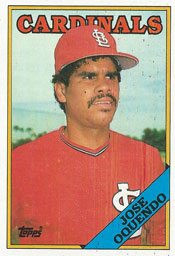
jose_oquendo4In 1988, Jose Oquendo caught an inning for the Cardinals in a game against the Mets at St. Louis.

In doing so, Oquendo became the first National League player in 70 years to play all nine positions in one season.

Before Oquendo, the last to accomplish the feat in the National League was Gene Paulette, primarily a first baseman for the 1918 Cardinals. Cesar Tovar of the American League Twins played all nine positions in 1968.

On Sept. 24, 1988, the Mets jumped to a 6-0 lead in the second inning against the Cardinals. Oquendo, 25, started the game at his primary position at second base and moved to shortstop in the sixth inning, replacing Ozzie Smith.

With the Mets ahead, 10-1, Cardinals manager Whitey Herzog, looking to give the home crowd something to cheer, decided the time was right to play Oquendo at catcher.

Move over, Tony

In the seventh, Oquendo moved from shortstop to catcher, replacing starter Tony Pena, the National League leader among catchers in fielding percentage in 1988.

First up for New York with Oquendo behind the plate was Gary Carter, the Mets’ 1988 all-star catcher.

“I told (Carter), ‘Don’t foul it off. I don’t want to get hit,’ ” Oquendo said to the St. Louis Post-Dispatch.

Facing reliever Steve Peters, Carter obliged, flying out.

Tim Teufel was the next batter. With the count 3-and-1, Peters shook off Oquendo’s sign. Before he could offer another, Peters went into his wind.

“I told Teufel, ‘Get ready. I don’t know what’s coming,’ ” Oquendo said. “He was laughing. That’s why he fouled the pitch off.”

On the next pitch, a 3-and-2 curve called by Oquendo, Teufel swung and missed, striking out.

Easy as 1,2,3

Kevin Elster then lined out to third. It was the only one of the nine innings the Mets were retired in order.

His goal accomplished, Herzog lifted Oquendo and replaced him with catcher Tom Pagnozzi in the eighth.

“It was fun,” Oquendo said. “I felt pretty good. I didn’t feel nervous at all.”

Said Peters to the Associated Press: “He called a good game … He’s got a nice, low target.” Boxscore

In 1988, Oquendo appeared in 69 games at second base, 47 at third base, 17 at shortstop, 16 at first base, nine in right field, four in center field, two in left field, one at catcher and one as a pitcher.

On May 14, 1988, Oquendo pitched four innings of relief against the Braves at St. Louis. Oquendo held Atlanta scoreless for three innings before the Braves scored twice in the 19th inning for a 7-5 victory. Boxscore

Oquendo took the loss, becoming the first non-pitcher to get a decision in a major-league game since the Yankees’ Rocky Colavito in 1968. Boxscore

Previously: Whiteyball: Willie McGee at shortstop; Ricky Horton in right

Read Full Post »

Like a scene from the movie “The Natural,” Stan Musial achieved one of baseball’s rarest hitting feats with flair.

stan_musial28Shedding the bandages from his ailing wrists, Musial took just five swings in the Cardinals’ game against the Braves at Boston on Sept. 22, 1948.

Each swing produced a hit.

It was Musial’s fourth five-hit game of the season. No major-league player had done that in 26 years. Only two have done it since.

Joining Musial as the only big-league players with four five-hit games in a season: Willie Keeler (1897 Orioles), Ty Cobb (1922 Tigers), Tony Gwynn (1993 Padres) and Ichiro Suzuki (2004 Mariners).

Musial had jammed his left wrist making a diving catch at Brooklyn on Sept. 17, 1948. The next day, he was hit on the right hand, near the wrist, by a pitch.

With his wrists taped, Musial remained in the lineup as the Cardinals pursued the National League-leading Braves.

A win over the Cardinals on Sept. 22 would clinch for the Braves their first pennant in 34 years. The Braves started their ace, left-hander Warren Spahn.

Going for broke

When Musial arrived at the Boston ballpark that day, he noticed the wind was blowing out toward right field, favoring a left-handed batter.

St. Louis writer Bob Broeg approached Musial at the batting cage and said, “A great day for the hitters.”

“Yeah, but I can’t hit like this,” Musial responded.

In his book “Stan Musial: The Man’s Own Story,” Musial said, “I held up the wrists with the flesh-colored tape. Angrily, I ripped it off.”

Without the tape to restrict him, Musial wanted to be able to snap his wrists, no matter how painful, and try to take advantage of the favoring wind and the short carry (319 feet) to the right-field bleachers.

Musial’s first two hits that day came against Spahn.

In the first inning, Musial singled to left. He said he punched the ball in that direction “to minimize wrist strain.”

In the third, Musial lined the ball over the head of left fielder Mike McCormick for a double.

Musial batted in the fourth against right-hander Red Barrett, who had been a teammate on the 1946 Cardinals.

Said Musial: “He tried to fool me with a 2-and-0 changeup, but I saw it coming and said to myself, ‘To hell with the wrists.’ ”

Musial pulled the pitch over the right-field wall for a two-run home run, his 38th of the season.

Swing away

In the sixth, Musial singled off left-hander Clyde Shoun. Musial said he was “entirely aware” Cobb had been the last player to achieve four five-hit games in a season.

“I wanted that fifth hit,” he said.

In the eighth. Musial got his chance against Al Lyons.

The first two pitches from the right-hander missed the strike zone. Musial didn’t want a walk.

“I made up my mind, with the Cardinals far ahead (8-2), that I’d swing at anything close to the plate _ wrists be hanged,” Musial said.

“The next pitch was a bit outside, but I jerked it around … It bounced in the hole between first and second and got through. Saving the sore wrists as much as possible, I had hit safely five times by taking the absolute minimum number of swings _ just five.” Boxscore

All four of Musial’s five-hit games in 1948 came away from home.

“If I could have played the 1948 season on the road, I might have hit .400 and ripped the record book apart,” Musial said.

Instead, Musial batted .376 overall _ .415 on the road and .334 at home.

Here is a look at his other five-hit games in 1948:

_ April 30, 1948, at Cincinnati: Musial hit a home run, two doubles and two singles off four right-handers in the Cardinals’ 13-7 victory over the Reds. The homer, a two-run shot, was off starter Howie Fox. Musial batted .447 (21-for-47) at Crosley Field in 1948. Boxscore

_ May 19, 1948, at Brooklyn: Musial singled twice off right-hander Rex Barney, tripled against right-hander Erv Palica and had a single and double off left-hander Preacher Roe in the Cardinals’ 14-7 victory over the Dodgers. Musial batted .522 (24-for-46) at Ebbets Field in 1948. Boxscore

_ June 22, 1948, at Boston: Musial had five singles, four off right-handed starter Bill Voiselle and another against Shoun that snapped a 2-2 tie in the ninth inning, in the Cardinals’ 5-2 triumph over the Braves. Musial hit .467 (21-for-45) at Braves Field in 1948. Boxscore

In his 22-year big-league career with the Cardinals, Musial had eight five-hit games. In addition to the four in 1948, the others were:

_  July 21, 1943, versus the Giants, at St. Louis. It was his only five-hit game at home.

_ Sept. 19, 1946, at Boston. Former Cardinals ace Mort Cooper started for the Braves.

_ Sept. 3, 1947, at Wrigley Field in Chicago.

_ Sept. 27, 1962, two months before his 42nd birthday, at Candlestick Park in San Francisco. The fifth hit was a single off former teammate Stu Miller.

Previously: How Stan Musial turned in a great comeback year at 41

Read Full Post »

(Updated on Sept. 12, 2018)

Helped by three newcomers, dubbed the Polish Falcons, the 1953 Cardinals led the major leagues in doubles with 281.

Eight members of the 1953 Cardinals each produced 20 or more doubles: Stan Musial (53), Red Schoendienst (35), Enos Slaughter (34), Solly Hemus (32), Rip Repulski (25), Steve Bilko (23), Ray Jablonski (23) and Del Rice (22).

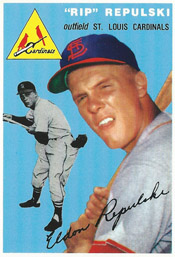
rip_repulski2Bilko, Jablonski and Repulski, all everyday starters for the first time in the big leagues, were called the Polish Falcons because of their Polish-American heritage. (Musial, in the majors since 1941, also was Polish-American.)

Eddie Stanky, manager of the 1953 Cardinals, played the trio in nearly every spring training game and they earned his trust. All three opened the season as starters _ Bilko at first base, Jablonski at third and Repulski in center.

(Stanky also was of Polish descent. He was born Edward Raymond Stankiewicz in Philadelphia.)

Bilko, 24, had appeared in 57 games for St. Louis from 1949-52, but never put in a full season with the Cardinals. Jablonski, 26, and Repulski, 24, both were making their big-league debuts with the 1953 Cardinals. All three had played together in 1952 for Rochester, a Cardinals farm team.

“During the training season, The Brat (Stanky) concentrated on the three Poles from Rochester, playing them daily, and they convinced him the Cardinals would field their strongest right-handed power since, first, Walker Cooper, and then George Kurowski left the Redbird batting order, seven and five years ago, respectively,” The Sporting News reported.

Said Stanky: “A lot of those left-handers who throw lollipops are going to find us an altogether different ballclub.”

In May, The Sporting News followed up with a glowing report on the Cardinals’ hitting: “The pickup in power had been a result largely of the presence of the three Polish Falcons, the newcomers from Rochester … They were hitting just about as had been hoped for.”

Polish power

Bilko, 6 feet 1 and at least 230 pounds, struck out a league-high 125 times in 1953, but he also punished pitchers with his power. On May 28, Bilko struck out five times in a game against the Reds. Boxscore The next day, against the Braves, Bilko doubled twice in the same inning _ one each against Vern Bickford and Ernie Johnson. Boxscore

In July, The Sporting News reported, “Although Repulski had been rested eight days after a slump and though Jablonski could look horrible in the field now and then and Bilko helpless against an occasional pitcher, the Falcons passed the first third of the season in fine style.”

The Falcons, all married with children, were friends as well as teammates. “On the road, they take in movies together (and) eat as a unit,” The Sporting News noted.

As the season wound down, the debut of the Polish Falcons was declared a success. “They’re better hitters than I thought they were and they’ll be even better next year with this season’s experience,” Musial said.

In a Sporting News story headlined “Cards Hit Jackpot with Polish Falcon trio,” Stanky said, “They have not only done as well as expected, but better.”

The final 1953 hitting statistics for the Falcons:

_ Bilko: 21 home runs, 84 RBI, .251 batting average.

_ Jablonski: 21 home runs, 112 RBI, .268 batting average.

_ Repulski: 15 home runs, 66 RBI, .275 batting average.

In voting for the National League Rookie of the Year Award, Jablonski placed third and Repulski tied with Braves outfielder Bill Bruton for fourth. The winner was Dodgers infielder Jim Gilliam, with Cardinals pitcher Harvey Haddix the runner-up.

Read Full Post »

(Updated Sept. 7, 2019)

In comparing playing styles and careers, Carlos Beltran and Chris Duncan had little in common. Yet both prospered for the Cardinals as power producers from the No. 2 spot in the batting order.

chris_duncan2In 2013, Beltran, a switch-hitter in his 16th season, had 19 home runs while batting second in 83 games.

Beltran topped the 18 hit by Duncan from the No. 2 spot in 57 games for the 2006 Cardinals. Duncan, a left-handed batter, was a rookie who spent most of the first three months in the minors before sticking with St. Louis in July 2006.

Beltran had 24 home runs overall for the 2013 Cardinals. He hit 19 from the No. 2 spot, three from the No. 3 position and two from the cleanup spot in the batting order.

When batting No. 2, Beltran often benefitted from the high on-base percentage (.392) of leadoff batter Matt Carpenter. With Carpenter on base frequently, opponents often had to pitch to, rather than around, Beltran.

Protected by Pujols

In 2006, Duncan benefitted from batting directly in front of Albert Pujols. Because Pujols was having a sensational season (49 home runs, 137 RBI), opponents preferred taking their chances pitching to Duncan rather than Pujols.

“Duncan has aggressively jumped on the strikes he’s seeing when used as the No. 2 hitter in (manager Tony) La Russa’s lineup, batting before Pujols,” Bernie Miklasz, columnist for the St. Louis Post-Dispatch, wrote in July 2006.

Duncan batted .290 (62-for-214) from the No. 2 spot in 2006. Almost 30 percent of his hits from that spot were home runs. He had an on-base percentage of .368 (20 points higher than his career average) while batting second that year.

On July 24, 2006, Joe Strauss of the Post-Dispatch wrote, “La Russa agrees that Duncan’s recent breakout has provided a new look to the lineup’s No. 2 spot, which has bounced among 10 players since Juan Encarnacion opened the season in the role.”

Mentored by McRae

Duncan credited Cardinals hitting coach Hal McRae for instructing him on “hitting out, not hitting up” and encouraging line drives rather than high drives.

“He’s trying to work with me on staying in the (strike) zone longer and becoming a better overall hitter,” Duncan said. “If you stay through the zone more, the home runs will come.”

Duncan hit .361 from the No. 2 spot in August 2006. He was integral in the Cardinals’ successful push toward the National League Central title.

Wrote Miklasz on Aug. 21, 2006: “Where would the Cardinals be without Chris Duncan? Left field was a crater until he filled it. The No. 2 hole in the lineup was a weak spot until he stepped in.”

Duncan finished the 2006 season with 22 home runs overall. In addition to the 18 from the No. 2 spot, Duncan hit two from the seventh position and one each from the third and ninth spots.

The next year, Duncan hit 21 homers, nine from the No. 2 position. He spent five years in the majors before his career was cut short by injuries.


Read Full Post »

« Newer Posts - Older Posts »