Feeds:
Posts
Comments

Archive for the ‘Trades’ Category

Earl Morrall thought he was going to be a quarterback for the St. Louis Cardinals.

It might have happened if the team he was with, the New York Giants, had been less cautious.

Rather than replacing, or substituting for, the Cardinals’ Jim Hart, Morrall went on to play for the Baltimore Colts and Miami Dolphins, successfully filling in for Johnny Unitas and Bob Griese.

As the Los Angeles Times noted, “Morrall was the NFL’s answer to a brilliant Broadway understudy.”

Passed around

Born in Muskegon, Mich., Morrall excelled in athletics at Michigan State. A shortstop and third baseman in baseball, he played in the College World Series. In football, he was a consensus all-America at quarterback and led Michigan State to victory in the Rose Bowl.

The San Francisco 49ers selected Morrall in the first round of the 1956 NFL draft. As a rookie, Morrall backed up Y.A. Tittle. After the 49ers took Stanford’s John Brodie in the 1957 draft, they traded Morrall to the Pittsburgh Steelers.

At Pittsburgh, Morrall was the starting quarterback in 1957 and his backups were Len Dawson and Jack Kemp. Harry Gilmer was the Steelers’ backfield coach and Buddy Parker was head coach.

Parker, a former Cardinals player, had been head coach of the Detroit Lions and led them to two NFL championships before joining the Steelers. His quarterback in Detroit was Bobby Layne. During the third week of the 1958 season, the Steelers traded Morrall to the Lions for Layne.

Returning to his home state wasn’t a treat for Morrall. He mostly was a backup to the likes of Tobin Rote, Jim Ninowski and Milt Plum. “I was at my lowest ebb,” Morrall told The Sporting News. “I thought about giving up the game.”

An exception was in 1963 when Morrall made 10 starts and threw 24 touchdown passes, but the next year he hurt his shoulder and the Lions reinstated Plum as the starter.

A positive from Morrall’s time with Detroit is he made a connection with Don Shula, a Lions assistant coach for three seasons (1960-62). Shula joined the Lions as a defensive backs coach and became defensive coordinator. “When I was in Detroit, I always had a lot of respect for the way Earl could come in off the bench and win games for you,” Shula told The Sporting News.

Help wanted

In August 1965, the Giants, seeking an experienced quarterback to replace Y.A. Tittle, acquired Morrall from the Lions.

Morrall, 31, threw 22 touchdown passes as the Giants’ starter in 1965, but the next year he broke his wrist and was limited to seven starts. After the season, the Giants got Fran Tarkenton from the Minnesota Vikings and declared him the starter for 1967.

The Cardinals’ quarterback for 1967 was supposed to be Charley Johnson, who’d been their starter since 1962. His backup was Jim Hart, who spent his rookie season in 1966 on the sidelines until getting into the final game as a substitute.

In August 1967, the Cardinals’ plans got scrambled when Johnson, a reserve Army officer, received orders to report for military service.

With Johnson unavailable, Hart was their starter unless the Cardinals could acquire a veteran quarterback before the Sept. 17 start of the season.

“If there’s anyone I’d like to have, it would be the Rams’ Bill Munson,” Cardinals head coach Charley Winner told the St. Louis Post-Dispatch.

The Cardinals contacted the Rams, who decided to keep Munson as their backup to Roman Gabriel.

“Earl Morrall might be available,” the Post-Dispatch reported.

A matter of timing

The Giants needed a defensive lineman. With second-year pro Tom Kennedy groomed as a potential backup to Tarkenton, published reports indicated Morrall was available in exchange for a defensive tackle or end.

Harry Gilmer, the Steelers’ backfield coach when Morrall was their quarterback, was in his first year as Cardinals quarterback coach in 1967 and was thought to be advocating for Morrall.

“I thought they would try to trade for an experienced quarterback because I didn’t think they thought I was ready,” Hart told Sports Illustrated.

In the 1977 book, “The Jim Hart Story,” Hart said, “You can’t tell me the Cardinals didn’t try to go after another veteran quarterback. I’ve since learned they were willing to beg, borrow or steal somebody with experience.”

When the Giants didn’t play Morrall in exhibition games, speculation suggested he was being kept out to prevent the chance of an injury while trade talks were held.

One proposed deal was for the Cardinals to send defensive lineman Don Brumm to the Giants for Morrall, the New York Daily News reported.

“The way I understand it, I would have been sent to St. Louis earlier (in the exhibition season),” Morrall told The Sporting News, “but the Giants were reluctant doing it too soon because we were going to open the (regular) season against the Cardinals and they didn’t want me revealing too much information.”

The Giants’ stalling worked in their favor. In the Giants’ final exhibition game, against the Green Bay Packers, Kennedy fractured a collarbone and separated a shoulder. With Kennedy out for the season, the Giants needed to keep Morrall as backup to Tarkenton.

“Morrall believed he was pegged for a trade to St. Louis,” The Sporting News reported. “He says he heard the deal was practically made, but was called off when Kennedy (was) injured.”

In “The Jim Hart Story,” Cardinals defensive tackle Bob Rowe said the subject of who would start at quarterback dominated discussion among the players.

“One guy wanted to know if anybody had heard who they were going to get to replace Charley (Johnson),” Rowe said. “Somebody said he was pretty sure they were going to go with Hart. Then everybody in the group said, ‘Oh my God!’ “

In the 1967 regular-season opener, the Giants beat the Cardinals, 37-20, at St. Louis. Tarkenton threw three touchdown passes and wasn’t intercepted. Hart had one scoring throw and was intercepted four times.

(In retirement, Morrall and Hart both resided in Naples, Fla., and became friends. In 2014, the Naples Daily News shed a different light on the 1967 trade talk. “According to Hart, the quarterbacks nearly were traded for one another,” the newspaper reported.)

Center stage

Morrall spent the 1967 season as Tarkenton’s backup. In August 1968, the Colts’ No. 2 quarterback, Jim Ward, got hurt in an exhibition game. At the urging of Don Shula, who had become their head coach, the Colts acquired Morrall from the Giants to back up Johnny Unitas.

The minor transaction turned out to be a big deal for the Colts.

Two weeks later, on Sept. 7, 1968, Unitas severely injured his right elbow in the Colts’ final exhibition game. Morrall, 34, became the Colts’ starter and led them to a 13-1 record in the regular season. Morrall’s 26 touchdown passes were the most in the league and he was named the NFL’s Most Valuable Player.

The Colts advanced through the playoffs before losing to the New York Jets and their flashy quarterback, Joe Namath, in the Super Bowl.

Two years later, the Colts returned to the Super Bowl against the Dallas Cowboys. Unitas left the game after injuring his ribs. Morrall replaced him, helping the Colts to victory.

Don McCafferty was the Colts’ head coach then. Don Shula left after the 1969 season to become Miami Dolphins head coach.

The Colts placed Morrall on waivers before the 1972 season and the Dolphins signed him to back up Bob Griese.

Just like with the Colts in 1968, the timing was superb.

After winning their first four games, the 1972 Dolphins were playing the San Diego Chargers when Griese suffered a broken leg and dislocated ankle. Morrall, 38, could feel the tension from his teammates as he entered the huddle. According to lineman Bob Kuechenberg, Morrall took a look at the worried faces staring back at him and said, “All right, anyone know any dirty jokes?”

The relaxed confidence of the unfazed old pro calmed the Dolphins. With Morrall the starter, they completed the regular season with a 14-0 record. He led them to a win in the first playoff game and started the second before Griese replaced him. Griese was the starter when the Dolphins capped their perfect season with a Super Bowl victory against the Washington Redskins.

Morrall played for the Dolphins until he was 42. At the invitation of University of Miami head coach Howard Schnellenberger, Morrall later mentored Hurricanes quarterbacks Jim Kelly, Bernie Kosar and Vinny Testaverde.

Read Full Post »

Jerry Johnson had the right stuff, but the wrong timing, in his short, strange stay with the Cardinals.

A right-handed pitcher who grew up rooting for the Cardinals, Johnson was acquired from the Phillies in the trade that brought slugger Dick Allen to St. Louis.
The Cardinals needed quality relief pitching and Johnson provided it, but, after making a mere seven appearances, was dealt to the Giants.

Johnson developed into the Giants’ closer and helped them win a division title.

Position change

A son of an oil rigger, Johnson was raised in Odessa, Texas.

In addition to playing baseball and football, Johnson was a Golden Gloves boxer and won 14 of 15 fights, according to the Wilmington (Del.) News Journal.

After he graduated from high school in 1962, Johnson signed with the Mets and was a third baseman in their farm system. As a hitter, he lacked power and failed to make consistent contact. “I couldn’t hit the curveball,” Johnson told The Sporting News.

According to Bob Broeg of the St. Louis Post-Dispatch, the Mets were prepared to release Johnson in 1963 until his teammate on the Salinas, Calif., farm team, pitcher Dick Selma, spoke up to management.

“How can you release a guy, no matter how poor he looks at the plate, when he can throw harder from third base than I can from the mound?” Selma asked.

The Mets reconsidered and converted Johnson to a pitcher. but, because of subsequent military service and a shoulder injury, it was 1967 before he had a full season of pitching.

With the Class AA Williamsport, Pa., team in April 1967, Johnson, 23, got national attention when he was matched in a start against future Hall of Famer Robin Roberts, 40, who was attempting a comeback with the Phillies’ Reading, Pa., affiliate after 19 seasons in the majors. Johnson won the duel, pitching a shutout in a 1-0 Williamsport win.

Though Johnson had a 2.78 ERA in 26 starts for Williamsport, he was left off the Mets’ 40-man winter roster and picked by the Phillies in the November 1967 minor-league draft.

Living dangerously

During the baseball off-seasons, Johnson was employed as an iron worker on bridges and high rises. “I’ve worked as high as 300 feet above the ground,” he told The Sporting News.

The heavy lifting built muscle, but made it difficult for Johnson to loosen his pitching arm. When he reported to training camp “looking like he should be on muscle beach, rubbing his pectorals with baby oil,” the Phillies told him to find a different off-season job, the Philadelphia Daily News noted.

Johnson began the 1968 season at Class AAA San Diego, posted a 1.95 ERA in 10 starts and was called up to the Phillies in July.

Relying on a fastball and slider, Johnson had early success against the Cardinals. On Sept. 24, 1968, he pitched a complete game in a 2-1 Phillies victory at St. Louis. The hard-luck losing pitcher was Ray Washburn. Boxscore

In 1969, Johnson beat the Cardinals twice in six days. On April 27, he pitched a shutout in a 1-0 Phillies win at Philadelphia. Boxscore He followed with another win on May 2 in a start at St. Louis. Boxscore Washburn was the losing pitcher in each game.

Cardinals manager Red Schoendienst harrumphed to the Post-Dispatch, “A third baseman beat us. From where I watched, he looked nice to hit.”

Cardinals general manager Bing Devine, who was a Mets executive when Johnson became a pitcher in their system, was more impressed than Schoendienst. After the 1969 season, he acquired Johnson, Dick Allen and Cookie Rojas from the Phillies for Curt Flood, Tim McCarver Joe Hoerner and Byron Browne.

Family team

Johnson’s mother was from Flora, Ill., about 100 miles east of St. Louis, and Johnson lived there as an infant. When he’d return with his mom for family visits, “they indoctrinated me” with stories about the Cardinals, Johnson told The Sporting News.

“All I heard from the time I could remember was the Cardinals and Stan Musial,” Johnson said to the Post-Dispatch. “The Cardinals have been my ballclub since I was old enough to know about baseball. Later on, I became attached to Mickey Mantle, too, but the Cardinals still were the family ballclub.”

The Cardinals projected Johnson to be a spot starter and reliever, but at spring training in 1970 he was sidetracked by a “recurrence of an elbow ailment and a pulled side muscle. The latter injury occurred when he reached too abruptly for a telephone,” The Sporting News reported.

Johnson opened the 1970 season in the minors and was called up to the Cardinals on May 1. In his first game with them, he pitched three scoreless innings and earned a save against the Astros. Boxscore

Johnson followed that with a pair of wins _ one against the Braves Boxscore and the other versus the Pirates. Boxscore

In seven appearances, Johnson was 2-0 with a save and 3.18 ERA.

Sent packing

The Cardinals were in Houston on May 19 when Johnson went to a movie theater to see a western, “Barquero,” starring Lee Van Cleef and Warren Oates. When he returned to the hotel that night, coach Dick Sisler approached Johnson in the lobby and informed him he’d been traded to the Giants for reliever Frank Linzy.

“I’m shocked,” Johnson said. “I can’t believe it.”

The Cardinals wanted an experienced late-inning reliever and liked Linzy, a sinkerball specialist, for the AstroTurf at Busch Memorial Stadium. Linzy was 9-3 with 20 saves and a 1.43 ERA for the Giants in 1965 and had 17 saves and a 1.51 ERA in 1967. His ERA for the 1970 Giants was 7.01, but the Cardinals were convinced Linzy, 29, could return to form.

The next year, with Johnson as their closer, the Giants won the National League West Division title. He led the team in saves (18) and games pitched (67), and was third in wins (12).

“Jerry always had smoke on his fastball. Now he has the poise to go with it,” The Sporting News observed.

Linzy was 4-3 with six saves and a 2.12 ERA for the 1971 Cardinals.

The 1971 season was Johnson’s career highlight. In 10 years in the majors with the Phillies, Cardinals, Giants, Indians, Astros, Padres and Blue Jays, Johnson was 48-51 with 41 saves and a 4.31 ERA.

In 1975, when Johnson pitched for minor-league Hawaii, a bullpen teammate was Frank Linzy.

When the Blue Jays entered the American League as an expansion team, they selected Hawaii manager Roy Hartsfield to be their manager. Hartsfield gave Johnson a spot on the Blue Jays’ Opening Day roster. Johnson was the winning pitcher in their first regular-season game on April 7, 1977. Boxscore

Read Full Post »

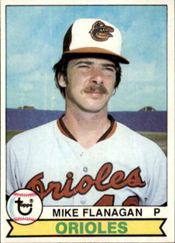
Two years after Mike Flanagan won the American League Cy Young Award, the Orioles were willing to trade him to the Cardinals.

The Orioles made Flanagan the centerpiece of a package they offered to the Cardinals in 1981. In exchange, the Orioles wanted two players the Cardinals were willing to trade, outfielder Sixto Lezcano and shortstop Garry Templeton.

The trade talks between the Cardinals and Orioles began in November 1981 and extended to the baseball winter meetings in December, but despite several attempts to structure a deal, the two sides couldn’t reach an agreement.

Neither club regretted the outcome. The Cardinals traded Templeton and Lezcano to the Padres for a future Hall of Famer, Ozzie Smith, who helped them win the World Series championship in 1982.

Rather than have Templeton at shortstop, the Orioles turned to an internal candidate, Cal Ripken, who, like Smith, developed into a Hall of Famer and helped them win the World Series championship in 1983.

Trade chip

A durable left-hander, Flanagan was 23-9 in 1979 when the Orioles won the American League pennant. Flanagan received 26 of 28 first-place votes in the Cy Young Award balloting.

In September 1981, Flanagan developed tendinitis in his left elbow and missed a turn in the rotation, ending a streak of 157 consecutive starts since 1977. “It’s just an oil change and a 30,000-inning checkup,” he told The Sporting News.

With Flanagan eligible to become a free agent after the 1982 season, the Orioles wanted to get him signed to a multiyear contract in November 1981. When he wouldn’t commit, the Orioles let it be known they were willing to deal him.

As the Baltimore Evening Sun noted, “Rather than take a chance on losing a pitcher of Flanagan’s caliber as a free agent, it is preferable to trade him.”

A player the Orioles wanted was outfielder Sixto Lezcano. Acquired by the Cardinals from the Brewers in December 1980, Lezcano asked to be traded after the 1981 season.

When he was with the Brewers, then an American League team, Lezcano had a .378 on-base percentage in games against the Orioles.

“The Orioles have coveted Lezcano almost since the day he broke in with Milwaukee,” The Sporting News reported, also noting that Orioles manager Earl Weaver “long has been a fan of Lezcano.”

Whitey Herzog, who had the dual role of Cardinals manager and general manager, wanted a pitcher in exchange for Lezcano. Orioles general manager Hank Peters “apparently is willing to part with Mike Flanagan,” according to The Sporting News.

Mix and match

A trade of Lezcano for Flanagan likely would have been made, but the Orioles opted to expand the deal to include Templeton.

Herzog wanted to trade Templeton, who was unhappy in St. Louis, and sought a shortstop in return. The shortstops the Orioles offered were veteran backup Lenn Sakata and rookie Bobby Bonner.

Jim Russo, who resided in St. Louis and scouted the National League for the Orioles, recommended Lezcano and Templeton. Russo was “instrumental in these discussions from the beginning,” the Baltimore Evening Sun reported.

In November 1981, the Baltimore Sun reported the proposed deal was Flanagan, outfielder Gary Roenicke and either Sakata or Bonner for Lezcano and Templeton.

Both sides were intrigued but agreed to suspend talks until the December baseball winter meetings in Hollywood, Fla.

At those meetings, the Baltimore Evening Sun reported, Orioles third baseman Doug DeCinces was added to the offer. The proposed trade was Flanagan, DeCinces, Roenicke and either Sakata or Bonner for Lezcano and Templeton.

The Orioles were willing to include DeCinces because they projected Cal Ripken, who debuted with them in August 1981, to be their third baseman, with either Sakata or Bonner playing shortstop.

The Cardinals, though, were not sold on having either Sakata or Bonner as their replacement for Templeton. A shortstop Herzog liked was Ivan DeJesus of the Cubs. Herzog also asked the Orioles for pitcher Sammy Stewart as a substitute for Flanagan. A right-hander who could start and relieve, Stewart had a 2.32 ERA for the 1981 Orioles. In 26 relief appearances that year, his ERA was 1.58.

“Herzog has a high regard for Flanagan,” the Baltimore Evening Sun reported, “but the pitcher he coveted most … was Sammy Stewart.”

Eager to make a deal, the Orioles tried to accommodate Herzog and the Cardinals. According to the Baltimore Sun, the Orioles, Cardinals and Cubs discussed a three-way trade. The Orioles would send Flanagan, DeCinces and Bonner to the Cubs for DeJesus and pitchers Mike Krukow and Lee Smith. Then the Orioles would swap DeJesus and Sammy Stewart to the Cardinals for Templeton, Lezcano and pitcher Bob Shirley.

“We’ve talked to the Cubs extensively, very extensively,” Hank Peters told the Baltimore Sun.

The Cubs, though, foiled the plan, trading Krukow to the Phillies on Dec. 8 for Keith Moreland, Dickie Noles and Dan Larson.

The Cardinals and Orioles continued to try to find the right combination of players to complete a deal. The Cardinals asked for outfielder John Shelby instead of Roenicke, the Baltimore Evening Sun reported, and the Orioles asked for outfielder Gene Roof.

According to the St. Louis Post-Dispatch, “one possible combination would have had Templeton and Lezcano going to the Orioles for pitchers Flanagan and Steve Stone and either Bonner or DeCinces.”

“Whatever the other teams offer St. Louis, we’ll make a better offer,” Earl Weaver said to the Baltimore Sun. “I’m definitely not against overloading the deal with pitchers if we can get a shortstop who bats .300 and a man who can go get fly balls like Sixto.”

On Dec. 10, the Baltimore Evening Sun reported, “The trade has been restructured so many times that the two teams have talked nine times in the last two days.”

Change in plans

By then, the Padres had entered the picture, and the Cardinals’ interest in the Orioles cooled considerably.

Before the winter meetings ended, the Padres agreed to trade Ozzie Smith and pitchers Steve Mura and Al Olmsted to the Cardinals for Templeton, Lezcano and pitcher Luis DeLeon.

A month later, in January 1982, the Cubs traded Ivan DeJesus to the Phillies for Ryne Sandberg and Larry Bowa, and the Orioles dealt DeCinces to the Angels for outfielder Dan Ford.

Ford became the Orioles’ right fielder in 1982, filling the role the team had envisioned for Sixto Lezcano.

The Orioles opened the 1982 season with Cal Ripken at third base and Lenn Sakata at shortstop. Ripken shifted to shortstop in July.

Mike Flanagan earned 15 wins for the 1982 Orioles.

In 18 seasons in the majors with the Orioles and Blue Jays, Flanagan had a record of 167-143.

Read Full Post »

(Updated June 9, 2024)

The Cardinals weren’t looking to trade for outfielder Lonnie Smith. The deal fell into their laps.

On Nov. 19, 1981, the Cardinals obtained Smith in a three-way trade with the Indians and Phillies. The Indians sent catcher Bo Diaz to the Phillies for Smith and a player to be named (pitcher Scott Munninghoff). The Indians then swapped Smith to the Cardinals for pitchers Lary Sorensen and Silvio Martinez.

Smith and another outfield newcomer, Willie McGee, became the catalysts of the Cardinals’ offense, igniting the team’s run to the 1982 National League pennant and World Series championship.

Mix and match

Whitey Herzog, who had the dual role of Cardinals manager and general manager, sought to swap two unhappy players, shortstop Garry Templeton and outfielder Sixto Lezcano, after the 1981 season. Herzog wanted a shortstop and starting pitcher in return.

Neither the Indians nor the Phillies seemed a likely trade partner for the Cardinals. The Indians wanted pitching and the Phillies needed a catcher. Neither was looking for Templeton or Lezcano.

Bo Diaz of the Indians was the catcher the Phillies coveted. Phillies scout Hugh Alexander rated Diaz “the best-throwing catcher in the major leagues,” the Philadelphia Daily News reported. Phillies manager Pat Corrales, a former catcher, managed Diaz during winter baseball in Venezuela and viewed him as a successor to Bob Boone.

The Indians, who had catchers Ron Hassey and Chris Bando, were willing to trade Diaz, but the Phillies didn’t have the pitching needed to get him.

An offer you can’t refuse

A pitcher the Indians wanted was Lary Sorensen, who was 7-7 with a 3.27 ERA for the 1981 Cardinals. Sorensen had seasons of 12, 15 and 18 wins for the Brewers before being traded to the Cardinals in December 1980.

Indians general manager Phil Seghi “has long been a fan of” Sorensen, The Sporting News reported, “and continually pestered the Cardinals” about dealing him. The Indians didn’t have what it took to get Sorensen from the Cardinals, but the Phillies suggested a creative solution. They thought the Cardinals would like Lonnie Smith.

The Cardinals were solid in right field with George Hendrick, but planned to try rookie David Green in center in 1982 and go with a platoon of Dane Iorg and Tito Landrum in left.

The Phillies, figuring Smith would be an upgrade for the Cardinals in either center or left, suggested sending Smith to the Indians for Diaz, and, in turn, the Indians would swap Smith to the Cardinals for Sorensen.

In his book, “White Rat: A Life in Baseball,” Herzog said Phil Seghi called Cardinals assistant general manager Joe McDonald and asked whether the club would be interested in Lonnie Smith.

McDonald relayed the message to Herzog: “(Seghi) says he needs pitching more than he needs Lonnie Smith, and you can have him for Silvio Martinez and Lary Sorensen.”

Herzog replied, “Get (Seghi) on the phone and make that deal right now.”

“All we gave up was two guys who didn’t figure to pitch much for us anyway,” Herzog said. “It’s deals like that which make you look like a genius.”

As good as advertised

In Philadelphia, the trade “provoked a firestorm of fan outrage that lit the Phillies’ switchboard like the White House Christmas tree,” the Philadelphia Daily News reported. Smith was “the club’s most explosive young offensive player.”

Smith finished the 1981 season with a 23-game hitting streak. The year before, he batted .339 with 33 stolen bases for the World Series champions. The Phillies planned to replace him with rookie Bob Dernier.

Though “shocked and disappointed” to be traded, Smith said to the Philadelphia Daily News, “I’m glad to go to a team that can beat the Phillies.”

After acquiring Lonnie Smith, the Cardinals traded Templeton and Lezcano to the Padres and got another important player, shortstop Ozzie Smith, and starting pitcher Steve Mura.

Lonnie Smith settled into left field for the Cardinals and Willie McGee, called up from the minors in May to replace injured David Green, became the center fielder.

The 1982 Cardinals won the National League East Division title, finishing three games ahead of the runner-up Phillies, and Smith had a lot to do with it. He led the league in runs scored (120). He also led the Cardinals in hits (182), doubles (35), stolen bases (68), batting average (.307) and total bases (257).

In the 1982 World Series, when the Cardinals prevailed in seven games versus the Brewers, Lonnie Smith batted .321 with nine hits, including four doubles and a triple, and six runs scored. Video

“Lonnie was a very tough ballplayer, very good hitter,” Herzog told Cardinals Magazine. “Below average defensively, below average arm, but … a good offensive player. He could bust up the double play as good as anybody in the league.”

When left fielder and speedster Vince Coleman emerged as a force for the Cardinals, Lonnie Smith was traded to the Royals in May 1985.

Though he battled cocaine addiction, Lonnie Smith went on to play 17 seasons in the majors and appeared in a total of five World Series _ one each for the Phillies, Cardinals and Royals, and two with the Braves.

Read Full Post »

In a decision that impacted the course of baseball broadcasting, the Braves rejected a chance to acquire Mike Shannon from the Cardinals for Bob Uecker.

During spring training in 1964, the Cardinals were in the market for a backup catcher and the Braves were seeking a reserve outfielder.

The Cardinals targeted Uecker because of his strong arm, quick release and defensive skills. To get him, they offered the Braves their choice of an outfielder _ Shannon or Gary Kolb. The Braves picked Kolb.

If the Braves had taken Shannon, he likely wouldn’t have contributed as he did to Cardinals clubs that won two World Series championships and three National League pennants in the 1960s.

If Shannon hadn’t had a prominent role as a Cardinals player, he likely wouldn’t have gotten the opportunity to become a team broadcaster.

As it turned out, Uecker, with the Brewers, and Shannon, with the Cardinals, built successful careers as broadcasters and continued in those roles into their 80s.

Outfield glut

After being called up from the minors to the Cardinals during the 1962 and 1963 seasons, Shannon was looking to be on their Opening Day roster in 1964.

Shannon had lots of competition for one of the six outfielder spots. The favorites to open the season as outfield starters were Charlie James in left, Curt Flood in center and Carl Warwick in right, The Sporting News reported.

Competing with Shannon for backup jobs were Doug Clemens, Ron Cox, Gary Kolb, Johnny Lewis, Bobby Tolan, Corky Withrow and Don Young.

As spring training neared its end, the Cardinals settled on Clemens and Lewis for two of the three reserve outfield spots. Clemens and Lewis batted left-handed, giving the Cardinals the chance to platoon them with James and Warwick.

The last outfield spot came down to Kolb and Shannon.

What the Cardinals needed was a backup to catcher Tim McCarver. The Cardinals had Jim Coker and Dave Ricketts as candidates, but were looking for an upgrade.

Uecker, who had spent parts of the 1962 and 1963 seasons with the Braves, was available because he was third on the depth chart behind Joe Torre and Ed Bailey.

Easy choice

The Cardinals offered Coker and an outfielder for Uecker.

“We had a choice of Gary Kolb or Mike Shannon,” Braves general manager John McHale told the St. Louis Post-Dispatch.

Kolb produced a .403 on-base percentage (26 hits, 22 walks) with the 1963 Cardinals. He also batted .500 (9-for-18) against the Braves that year. Shannon batted .308 (eight hits) for the 1963 Cardinals. “We asked 15 people, some with the Braves and others who were friends of mine in baseball, which one they preferred,” McHale said. “It was 14-to-1 in favor of Kolb.”

McHale said Walter Shannon, a former Cardinals farm director who had joined the Indians’ scouting staff, cast the lone vote for Mike Shannon. A couple of St. Louis natives, Walter and Mike were not related, but those Shannons stuck together.

Taking advantage

The trade of Uecker to the Cardinals for Kolb and Coker was made on April 9, five days before the Cardinals opened the season.

Cardinals consultant Branch Rickey rated Kolb a top prospect and opposed the deal made by general manager Bing Devine. According to the book, “October 1964,” when Uecker was introduced to Rickey in the Cardinals’ clubhouse, Rickey replied, “I didn’t want you. I wouldn’t trade 100 Bob Ueckers for one Gary Kolb.”

Uecker, though, gave the 1964 Cardinals the defense they desired. He threw out 38 percent of runners attempting to steal. By comparison, McCarver’s rate was 29 percent. Uecker also contributed a game-winning hit against the Braves in the pennant stretch.

Shannon hardly played early in the 1964 season. He had three at-bats and struck out each time. The Cardinals sent him to their Jacksonville farm club in early May. Called back to the majors in July, Shannon took over in right field and drove in 43 runs in 88 games. He also hit a home run against Yankees ace Whitey Ford in Game 1 of the World Series.

Kolb hit .188 with no home runs in 64 at-bats for the 1964 Braves and was traded to the Mets in July 1965.

Read Full Post »

Hal Smith, a Cardinals catcher in the 1950s, had a significant role in the club’s success in the 1980s.

On Oct. 21, 1981, the Cardinals got minor-league outfielder Willie McGee from the Yankees for pitcher Bob Sykes. The Cardinals made the trade on the recommendation of Smith, a Cardinals scout, who watched McGee play for the Yankees’ Nashville farm club and liked what he saw.

McGee went on to become one of the Cardinals’ best and most popular players, using his hitting, fielding and speed to help them win three National League pennants and a World Series title.

Pining for pinstripes

McGee was 17 and recently graduated from high school in 1976 when the White Sox selected him in the June amateur baseball draft. McGee was chosen in the seventh round, just after the Tigers took Ozzie Smith and just before the Red Sox selected Wade Boggs.

If McGee had signed with the White Sox, he eventually might have made his debut in the majors for Tony La Russa, who became White Sox manager in August 1979. Instead, McGee decided to attend community college.

The decision appeared to be shrewd when the Yankees took him in the first round of the secondary phase of the draft in January 1977, “but, unwise to the ways of negotiating contracts, he wound up signing for less than the White Sox had offered him,” the St. Louis Post-Dispatch reported.

“I probably could have got more if I knew what I was doing,” McGee said.

In 1978, his second season in the Yankees’ system, McGee, a natural right-handed batter, started switch-hitting.

He was considered a promising prospect when he got to Class AA Nashville in 1980, but in July he suffered a broken jaw and was limited to 78 games for the season. McGee hit .283. Designated hitter Buck Showalter, the future big-league manager, led Nashville in batting average (.324) and hits (178) in 1980.

Odd man out

The Yankees put McGee on their 40-man big-league winter roster after the 1980 season, but in December they signed free-agent outfielder Dave Winfield and needed to open a spot for him.

McGee was one of two players the Yankees considered dropping from their roster. The other was his best friend on the Nashville team, Ted Wilborn, a switch-hitting outfielder who played briefly with the Blue Jays and Yankees.

Yankees vice president for baseball operations Bill Bergesch, a former Cardinals minor-league executive who signed Bob Gibson to his first pro contract, told the New York Daily News, “We liked Willie. We considered him a fine prospect, but our minor-league people liked the other player (Wilborn) better.”

McGee said to The Tennessean newspaper, “Somebody had to go and I was the least experienced.”

By being reassigned outright to Nashville, McGee was frozen on the minor-league roster and couldn’t be recalled by the Yankees.

Good report card

McGee, Wilborn and Don Mattingly formed the Nashville outfield in 1981. McGee led Nashville in batting (.322) and had 24 stolen bases. Mattingly batted .316 and led the club in hits (173). Wilborn hit .295 and had 43 steals.

Hal Smith, the Cardinals’ starting catcher from 1956-60, was scouting the Nashville team extensively because the Yankees were looking to make a deal for Cardinals pitcher Bob Sykes.

During the 1981 season, “a proposed trade with the Yankees that would have involved Sykes fell through,” the Post-Dispatch reported, but the clubs were hopeful of reviving the deal after the season.

Cardinals executive Joe McDonald said the trade evolved when he received a report from Smith about McGee.

“Smith scouted Willie and turned in a good report,” McDonald said to the Post-Dispatch. “We liked his speed and we liked his bat.”

The Yankees looked to trade McGee to get something in return rather than lose him in the Rule 5 draft of players left unprotected on minor-league rosters.

In exploring potential deals, Bergesch told the New York Daily News, “There wasn’t a whole lot of interest in him” except from the Cardinals.

The trade of Sykes for McGee was made the same day the Yankees played the Dodgers in Game 2 of the 1981 World Series and drew little attention.

As good as advertised

McGee was placed on the Cardinals’ 40-man big-league winter roster.

Though he never had played above the Class AA level, he impressed the Cardinals at spring training in 1982.

“He speaks only when spoken to and goes largely unnoticed in the clubhouse,” the Post-Dispatch noted, “but he has skills that have marked him as a soon-to-be major leaguer.”

“Got a quick bat,” said Cardinals manager Whitey Herzog. “It’s unusual to see a young hitter with a quick bat from both sides of the plate.”

Batting from the right side, McGee dazzled by dashing from the plate to first base in 3.9 seconds.

At Yankees training camp, Sykes, weakened by shoulder ailments, was sent to the minors. He’d never pitch in a big-league game for the Yankees.

Upset about receiving what they considered damaged goods, the Yankees wanted the trade voided. “They think they’re going to get McGee back,” Herzog told the Post-Dispatch, “and they’re not.”

Making an impact

McGee began the 1982 season at Louisville. “I thought I was going to play the full year in triple-A to get some experience because I hadn’t played there before,” he told The Sporting News.

The plan changed when Cardinals outfielder David Green tore his right hamstring and was placed on the disabled list on May 8. The Cardinals called up McGee, who had hit .291 in 13 games with Louisville.

From the start, the rookie played like he belonged. He hit .378 for the Cardinals in May and .349 in June.

“I certainly didn’t think he’d be able to come up here and handle the pitching like he has,” Herzog told The Sporting News.

For the season, McGee hit .296 and swiped 24 bases for the Cardinals. He hit .308 in the National League Championship Series versus the Braves, and was the standout of World Series Game 3, with two home runs and two spectacular catches against the Brewers. Boxscore and Video.

On Jan. 24, 1983, the Cardinals traded outfielder Stan Javier and infielder Bobby Meacham to the Yankees for outfielder Bob Helson and pitchers Steve Fincher and Marty Mason. The Post-Dispatch reported the deal was to appease Yankees owner George Steinbrenner, who held hard feelings toward the Cardinals for sending Sykes in exchange for McGee 15 months earlier.

Read Full Post »

« Newer Posts - Older Posts »