Feeds:
Posts
Comments

Archive for the ‘Trades’ Category

The Cardinals wanted Joe Girardi to be their backup catcher but settled for Mike Matheny.

On Dec. 15, 1999, the Cardinals signed Matheny, a free agent, after failing in their bid to get Girardi, who went to the Cubs.

The Cardinals’ No. 2 choice turned out to be a No. 1 catcher.

Matheny became the Cardinals’ starter in 2000, helped them become division champions and won a Gold Glove Award for his defensive excellence. Matheny played five seasons for the Cardinals, who got to the postseason in four of those years, and won the Gold Glove Award three times.

In a nifty twist, Girardi became a free agent after the 2002 season and signed with the Cardinals to be Matheny’s backup in 2003.

Prayers answered

After five years (1994-98) with the Brewers, Matheny was a backup to Blue Jays catcher Darrin Fletcher in 1999 and hit .215 in 57 games.

“Matheny is an intelligent, studious catcher with a quiet motion behind the plate and an easy rapport with the pitchers,” The Sporting News noted, but his weak hitting was keeping him from being a starter.

“It’s a simple matter of the requisite bat speed being absent,” The Sporting News concluded in September 1999. “Barring a miraculous transformation at the plate, his destiny is to be a backup catcher.”

When Matheny, 29, became a free agent after the 1999 season, the Brewers showed interest, but not the Cardinals.

St. Louis general manager Walt Jocketty “thought he had a good chance to sign Joe Girardi,” the St. Louis Post-Dispatch reported.

Girardi was with the Yankees from 1996-99 and played in three World Series for them before becoming a free agent. Though the Cardinals offered more money than the Cubs did, he signed with Chicago to be near his home.

Pitcher Pat Hentgen, whom the Cardinals acquired from the Blue Jays in November 1999, urged them to sign Matheny.

The Cardinals gave Matheny a one-year deal for $750,000 and planned to have him back up incumbent starter Eli Marrero.

“I like to think I’m an unselfish player and will be helpful whether I’m playing or not,” Matheny said. “That doesn’t mean I’m not interested in playing, because I am.”

An Ohio native who attended the University of Michigan, Matheny was residing with his wife, Kristin, and four children in Weldon Spring, Mo., about 25 miles from St. Louis. Kristin grew up in the St. Louis suburb of Chesterfield and she and her husband had decided to raise their family in the area.

“She must have some powerful prayers because we really didn’t think about the Cardinals being interested in us,” Matheny told the Post-Dispatch.

Fighting for a job

A couple of weeks before spring training began in 2000, the Cardinals signed another free-agent catcher, Rick Wilkins, creating competition for Matheny. Wilkins had been in the big leagues for nine seasons (1991-99) and hit .303 with 30 home runs for the 1993 Cubs.

If Matheny didn’t hit, Wilkins gave the Cardinals an option.

“I wish I could take a little of the enthusiasm I feel when I’m behind the plate and have it when I get into the batter’s box,” Matheny told the Post-Dispatch. “I just love being behind the plate, all the strategy that goes unseen there, but I’m working on revamping my swing and improving on the things that have held my statistics back.”

The Cardinals entered spring training committed to Marrero, 26, as their starting catcher. Marrero, diagnosed with thyroid cancer in 1998, hit .192 in 114 games for the Cardinals in 1999, but management expected him to be stronger and better in 2000.

Initially, all three catchers struggled to hit in spring training. Two weeks before the season opener, their batting averages were .091 for Matheny, .100 for Marrero and .217 for Wilkins.

“I put a lot more pressure on myself early on than I should,” Matheny said. “I was trying to do too much and open eyes … Then I started to panic, trying to make up for lost ground.”

A hot streak near the end of spring training earned Matheny the backup job over Wilkins, who was sent to the minor leagues. Wilkins “was very much in the picture until Matheny had a stronger last week offensively,” the Post-Dispatch reported.

On March 29, 2000, manager Tony La Russa informed Matheny he was on the Opening Day roster. “It was like making the big leagues for the first time,” Matheny said.

Taking charge

When the Cardinals opened the season on April 3, 2000, at home against the Cubs, the starting catchers were Matheny and Girardi. With his father and brothers attending from Ohio, Matheny contributed a single and a double and scored a run in the Cardinals’ 7-1 triumph. Boxscore

Experiencing an Opening Day in St. Louis for the first time, Matheny said, “I can honestly say it was about the most fun I’ve ever had playing in the game.”

Hitting and fielding well and displaying a quick release on throws, Matheny supplanted Marrero as the No. 1 catcher. In May 2000, The Sporting News declared, “Matheny continues to exceed expectations.”

On July 1, 2000, Marrero tore a ligament in his left thumb. A couple of weeks later, Matheny cracked a rib but continued to play. He wore a flak jacket and had his chest taped before every game. Carlos Hernandez, acquired from the Padres at the trade deadline, gave the Cardinals insurance at the catcher position.

Matheny hit .261 with 47 RBI in 128 games for the 2000 Cardinals and led National League catchers in number of runners caught attempting to steal (49). He sat out the postseason after he severed two tendons and a nerve in his right ring finger while using a hunting knife he received as a 30th birthday gift.

After their playing careers, Girardi and Matheny became big-league managers. Girardi won a World Series championship with the 2009 Yankees and Matheny won a National League pennant with the 2013 Cardinals.
Read Full Post »

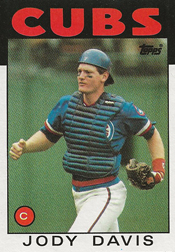
Jody Davis was with the Cardinals when he experienced a life-threatening health crisis, recovered and got on a fast track to the major leagues.

On Dec. 10, 1979, the Cardinals traded pitcher Ray Searage to the Mets for Davis, a catcher.
Three months later, in March 1980, Davis was in the Cardinals’ spring training clubhouse when he began coughing up blood. Bleeding internally, he was rushed to a hospital, lost large amounts of blood and underwent two surgeries.

By June 1980, Davis was playing for a Cardinals farm club. The next year, he made his big-league debut against the Cardinals.

Peach state product

Davis was born in Gainesville, Ga., and started playing organized baseball when he was 9. He excelled at baseball and basketball in high school. Davis continued playing baseball at Middle Georgia Junior College and was a freshman when the Mets drafted him in 1976.

Davis played four seasons (1976-79) in the Mets’ farm system. In 1979, he hit .296 with 21 home runs and 91 RBI for Jackson of the Class AA Texas League.

The Cardinals, planning to keep their best catching prospect, Terry Kennedy, in the big leagues in 1980, were seeking a catcher for the top level of their farm system. The Mets agreed to trade them Davis for Searage, a left-hander who was 10-4 with a 2.22 ERA for Arkansas of the Texas League in 1979.

Searage eventually played seven seasons in the majors and was Pirates pitching coach for 10 years (2010-19).

Intestinal issues

Davis attended 1980 spring training at St. Petersburg, Fla., with the Cardinals and was glad to be in their organization. “I didn’t think too highly of the Mets,” he told the St. Petersburg Times. “The Cardinals are so much nicer. As far as I’m concerned, it’s the difference between night and day.”

On March 20, 1980, Davis played in a “B” squad game in St. Petersburg and was hit in the shoulder by a foul tip. He went to the hospital for X-rays, was released and went to Al Lang Stadium, the Cardinals’ spring training home.

Inside the clubhouse, Davis, 23, became ill and vomited blood. When paramedics arrived, Cardinals third baseman Ken Reitz helped them lift Davis’ stretcher up the steps.

At the hospital, doctors determined he had a stomach ulcer and decided to operate.

“I guess I must have had one at one time because they found some scar tissue there,” Davis told the Chicago Tribune. “At any rate, they removed one-fourth of my stomach.”

The next morning, in his hospital room, Davis vomited blood again. A second surgery was performed the next day.

“Just beneath my stomach, they found an artery that was leaking, that never had developed properly,” Davis said. “So they cut away about six inches of it, attached the loose ends and sewed me up again.”

Throughout the three-day ordeal, doctors gave him transfusions totaling four gallons of blood, Davis said.

“I guess I’m lucky to be around,” he said.

Almost everyone on the Cardinals’ roster either donated blood or committed to do so to a St. Petersburg blood bank that provided about 30 pints to Davis, the St. Louis Post-Dispatch reported.

Back in action

Davis spent three weeks in the hospital before returning home to Georgia to continue his recuperation.

On June 22, 1980, Davis played in his first game since his surgeries. Catching and batting fifth for the Cardinals’ Class A St. Petersburg farm club, he had a hit and a RBI against Winter Haven.

“I’ve had to start all over,” Davis said to the St. Petersburg Times. “I lost 40 pounds in the hospital. When I was recovering, I could only walk a short distance.”

Davis played in 45 games for St. Petersburg and hit .277 with six home runs. On Aug. 6, 1980, he advanced to the Cardinals’ Class AAA team in Springfield, Ill., and played in 13 games.

When the Cardinals failed to protect Davis on their 40-man winter roster, the Cubs claimed him for $25,000 in the Rule 5 draft on Dec. 8, 1980.

Rapid rise

The Cubs had to include Davis on their 1981 Opening Day roster or offer the Cardinals the chance to take him back for $12,500. Cubs general manager Bob Kennedy, father of catcher Terry Kennedy, liked what he saw of Davis in spring training and decided to keep him.

“As a catcher, his style reminds me a lot of Sherm Lollar,” Kennedy said, referring to the White Sox all-star of the 1950s and 1960s.

Davis was the Cubs’ third-string catcher behind Barry Foote and Tim Blackwell. Among his Cubs teammates was Ken Reitz, who had helped him while he lay bleeding in the Cardinals’ clubhouse a year earlier.

On April 21, 1981, 13 months after his surgeries, Davis made his major-league debut as the starting catcher for the Cubs against the Cardinals at St. Louis. Boxscore

A week later, the Cubs traded Foote to the Yankees. In June, Davis became the Cubs’ starting catcher.

“Everyone on the club is surprised by this unbridled rookie’s raw talent, potential and aggressiveness,” wrote Chicago Tribune columnist John Husar.

Davis had a powerful throwing arm and was adept at working with pitchers.

“I’m just amazed at his maturity,” said Cubs pitcher Doug Bird. “He seems to know more about the other batters than you expect from a rookie.”

Pitcher Doug Capilla said, “I have confidence in him any time, any situation, any pitch. He’s not afraid to call a breaking pitch with two strikes and the bases loaded. He gives pitchers a personal assurance that what he calls will be good.”

Davis played for the Cubs from 1981-88 and for the Braves from 1988-90. In 1984, when the Cubs won a division title, Davis contributed 19 home runs and 94 RBI.

Davis twice was a National League all-star (1984 and 1986) and he won a Gold Glove Award (1986).

Read Full Post »

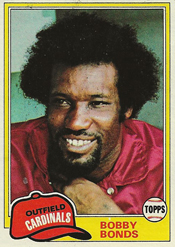
Bobby Bonds, expected to bring power and balance to the lineup, symbolized the dysfunction of the 1980 Cardinals.

On Dec. 7, 1979, the Cardinals acquired Bonds from the Indians for pitcher John Denny and outfielder Jerry Mumphrey.
An outfielder, Bonds figured to join George Hendrick to give the Cardinals two right-handed sluggers to balance a lineup with switch-hitters Ted Simmons and Garry Templeton and batting champion Keith Hernandez, who hit left-handed.

Bonds, who had 25 home runs and 34 stolen bases for the 1979 Indians, was projected to play left field and replace Lou Brock, who retired.

The deal turned out to be a dud. Bonds, 34, injured his right wrist early in the season and couldn’t hit for average or power. The 1980 Cardinals, who fired their manager and general manager during the season, finished 74-88.

All in the family

Bobby Lee Bonds was born in Riverside, Calif. An older brother, Robert Vernon Bonds Jr., a receiver and defensive back at San Jose State, got selected by the St. Louis football Cardinals in the fifth round of the 1965 NFL draft and played in Canada. A sister, Rosie, was a hurdler for the U.S. in the 1964 Olympics.

Bonds excelled in baseball, football and track in high school and became a state long jump champion. He married at 17 and became a father at 18 when his son, future home run champion Barry Bonds, was born in July 1964. A month later, with a wife and child to support, Bonds signed an $8,000 contract with the Giants.

The Giants sent Bonds to their farm club in Lexington, N.C., in 1965. Disheartened by the racism he encountered, Bonds wanted to quit, but Lexington manager Max Lanier, the former Cardinals pitcher, became his trusted mentor and advisor. Bonds stayed and began his rise through the Giants’ system.

On June 25, 1968, Bonds made his major-league debut against the Dodgers at Candlestick Park and hit a grand slam. Boxscore He formed a friendship with the Giants’ shortstop, Hal Lanier, Max’s son.

Mixed reviews

Bonds and Willie Mays were the first players to achieve 300 home runs and 300 stolen bases in their careers. Bonds won three Gold Glove awards and three times was an all-star.

He also struck out a lot and drank a lot. Bonds twice was arrested for drunk driving and had another arrest for an altercation with a police officer. Bob Broeg of the St. Louis Post-Dispatch wrote, “When the poor guy did drink too much, as one sympathetic soul put it, he must have gone looking for a policeman.” After his playing days, Bonds joined Alcoholics Anonymous, according to the Society for American Baseball Research.

Bonds played for six teams (Giants, Yankees, Angels, White Sox, Rangers and Indians) in six years (1974-79). In July 1979, he told the Indians he wanted to be traded unless they increased his yearly salary from $440,000 to $672,000. Indians fans responded with a barrage of boos. In September 1979, Bonds made an obscene gesture to a fan and was fined.

Asked about Bonds’ controversies after acquiring him, Cardinals general manager John Claiborne told The Sporting News, “I don’t know about his history and I don’t care. He has produced and that’s all I’m concerned about.”

Cardinals manager Ken Boyer said Bonds will “make a big difference in our offense” and “with Bonds’ arm, you’re going to see things defensively you haven’t seen in a while.”

Indians outfielder Rick Manning viewed Bonds differently, saying, “Bobby wouldn’t hit the cutoff man if he were King Kong.”

Bonds predicted, “If I just do what’s average, it should be enough to win the pennant and get in the World Series.” He also cautioned, “If it doesn’t go the way they expect it to go with the Cardinals, I’ll be the first one gone.”

A season unravels

Bonds preferred uniform No. 25, but in St. Louis it belonged to Hendrick, so Bonds became the first Cardinal to wear No. 00.

Boyer began the 1980 season with Bonds batting fifth in the order between Simmons and Hendrick.

On April 17, 1980, in Bonds’ seventh game with the Cardinals, he was hit on the right wrist by a pitch from the Pirates’ Eddie Solomon. Boxscore

Bonds continued to play, but the damaged wrist hampered his swing and he was committing too soon on breaking balls. On May 18, 1980, after striking out three times in a game against the Giants, Bonds asked Boyer to send someone to bat for him when his turn came again in the ninth. Boxscore

“Bonds swung a bat that resembled a fly swatter,” wrote Post-Dispatch columnist Tom Barnidge.

With the Cardinals’ record at 18-33, Boyer was fired in June 1980 and replaced by Whitey Herzog, who benched Bonds against right-handed pitching.

Bonds said he was experiencing “the most frustrating season of my life. I want to contribute and I haven’t been. I have no criticism of Whitey.”

On July 21, 1980, Bonds went on the 15-day disabled list. When he returned, he cut a finger on his right hand trying to get an item off a room service tray.

Claiborne was fired in August 1980 and one reason cited was the trade for Bonds.

Bonds hit no home runs after July 13 and had no hits after Aug. 18. He finished his Cardinals season with a .203 batting average, five home runs and 15 stolen bases. He batted .145 against right-handers.

On Dec. 22, 1980, after failing to trade Bonds, the Cardinals released him.

He played for the Cubs in 1981, his final big-league season, and twice in a span of three days, Sept. 7 Boxscore and Sept. 9 Boxscore, hit two home runs in a game against the Cardinals at St. Louis.

Read Full Post »

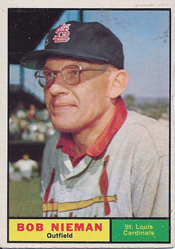
Outfielder Bob Nieman, who made an unprecedented debut with the Browns, returned to St. Louis as an accomplished hitter with the Cardinals.

On Dec. 2, 1959, the Cardinals acquired Nieman from the Orioles for outfielder-catcher Gene Green, plus catcher Chuck Staniland.

Eight years earlier, Nieman became the first player to hit home runs in his first two major-league at-bats. Since then, the only other player to do it is the Cardinals’ Keith McDonald.

A right-handed batter, Nieman appealed to the Cardinals because he hit left-handers well and “southpaws have been a constant plague” to them, The Sporting News reported.

Marty Marion, the former Cardinals shortstop who was Nieman’s teammate with the Browns, said to the St. Louis Post-Dispatch, “He’s only a mediocre outfielder and he’s a hypochondriac, but, man, he can whale that ball.”

Overcoming hurdles

Nieman was born in Cincinnati and began going to Reds games when he was 3 with his father, a semipro catcher.

Nieman developed into a baseball catcher and football fullback in high school. After graduation, he joined the Army, was stationed in France and got pneumonia. The drugs used to treat him damaged his kidneys and he developed nephritis. Given a medical discharge, Nieman returned home, recovered, married his high school sweetheart and tried out with the Reds.

After Nieman signed a minor-league contract with the Reds, a tumor was discovered in his right arm and he underwent surgery. When he healed, the Reds converted him from catcher to outfielder. In 1948, his first minor-league season, Nieman hit .367.

During his off-seasons in the minors, Nieman pursued a college education at Kent State. Nieman was studying journalism in the hope of being a sports reporter and his wife, Patricia, was majoring in advertising.

“Next to actual participation, I can think of no life more enjoyable than watching games and being paid to do so,” Nieman said.

In June 1951, the Reds determined they had a surplus of outfielders in the minors and placed Neiman on waivers. He was claimed by Oklahoma City, an unaffiliated team in the Texas League. Nieman led the league in hitting (.324) and his contract was purchased by the Browns.

Boston fireworks

Nieman, 24, joined the Browns in Boston. Manager Zack Taylor didn’t plan to play him, but changed his mind when the Red Sox started a left-hander, Mickey McDermott. Nieman played left field and batted fifth in the Friday afternoon game on Sept. 14, 1951, at Fenway Park.

When he came to bat for the first time as a big-leaguer in the second inning, Nieman hit a solo home run. In his second at-bat in the third, he hit a two-run home run. According to the Post-Dispatch, those were the only pitches he swung at in those at-bats.

“This is really the day of my life,” Nieman said.

He almost got upstaged in the eighth when Satchel Paige, 45, relieved for the Browns and faced Ted Williams. With the count 0-and-2, Williams moved up in the batter’s box, expecting an off-speed pitch. Paige fired a fastball and Williams swung and missed, striking out.

When Williams got to the dugout, he “smashed his bat into pieces,” the Boston Globe reported. “He first whacked it against the railing leading to the dressing room. When that didn’t suffice, Williams flung the bat toward the rack. He still wasn’t satisfied, so he smashed it on the floor of the dugout. That ended the bat’s worth for good.”

Watching from the mound, Paige “was laughing his head off,” the Globe noted.

“I’ve never seen anything like it in the big leagues,” Paige said. “He was sore because I crossed him up.”

Asked about Nieman’s performance, Paige said the burly rookie “is just a lot of boy. Leans into that ball pretty good and hits the pitch where it is.” Boxscore

Designated hitter

Nieman hit .372 in 12 games for the 1951 Browns. The next year, he led the 1952 Browns in batting average (.289), home runs (18) and RBI (74), but they traded him to the Tigers after the season. Nieman played for the Tigers (1953-54), White Sox (1955-56) and Orioles (1956-59). He batted .322 for the Orioles in 1956 and .325 in 1958.

In 1959, when Nieman hit .292 with 21 home runs for the Orioles, The Sporting News described him as “a terror at the bat but sometimes frightful in the field.” Bob Broeg of the Post-Dispatch suggested Nieman “thought defense was the time to rest.”

The Cardinals got Nieman for his hitting, not his fielding. He batted .287 in 81 games in 1960 and had an on-base percentage of .372.

Among his highlights:

_ A home run against Sandy Koufax in a 2-0 triumph over the Dodgers on Aug. 21. Boxscore

_ A double, triple and home run for four RBI against Dick Ellsworth in a 4-3 victory versus the Cubs on Sept. 4. Boxscore

_ A ninth-inning home run against Johnny Podres to force extra innings against the Dodgers on Sept. 21. Boxscore

In 1961, Nieman, 34, was hitting .471 (8-for-17) when the Cardinals traded him to the Indians on May 10. The Cardinals made the deal because they wanted to give more playing time to Charlie James, 23, who they were grooming to replace Stan Musial in left.

“At least Nieman has the consolation of being one of the few .471 hitters ever traded,” the Post-Dispatch concluded.

Nieman said, “I certainly hate to leave this club. I mean it when I say this is the finest outfit I’ve ever been associated with.”

As he departed, Nieman wrote a message on the blackboard in the Cardinals’ clubhouse: “Good luck, boys, see you in the World Series.”

The Cardinals didn’t reach the World Series in 1961, but Nieman did a year later. After hitting .354 in 39 games for the Indians in 1961, they traded him to the Giants the next year and Nieman appeared in the 1962 World Series.

Read Full Post »

Jose Cardenal, looking for the right fit for a baseball home after being exiled from his native Cuba, embraced an opportunity to be center fielder for the Cardinals.

On Nov. 21, 1969, the Cardinals dealt right fielder Vada Pinson to the Indians for Cardenal, who was expected to replace Curt Flood. A month earlier, Flood was traded to the Phillies.

“Cardenal won’t hit or field as did Curt Flood, but he’ll run even more rapidly and throw better,” Bob Broeg noted in the St. Louis Post-Dispatch.

Formative years

Cardenal was born and raised in Cuba as the youngest of five children. His father was a carpenter. Cardenal’s brother, Pedro, was an outfielder in the Cardinals’ farm system from 1955-58 but didn’t reach the majors. Cardenal’s cousin, Bert Campaneris, was a big-league shortstop.

As a youth, Cardenal played baseball on fields covered with stones and broken glass. “Some day, I will show you the scar from a cut on my right foot from stepping on a broken bottle,” he told the Post-Dispatch. “I was 9 years old and we played barefoot then.”

The Giants recognized Cardenal’s talent, signed him for $250 and brought him to the United States to begin his career in their farm system. He started out playing second and third before being shifted to the outfield.

In 1961, when Cardenal was 17, he hit .355 with 35 home runs and 108 RBI for El Paso. After the season, he wanted to visit family in Cuba but couldn’t. Cuba and the United States had severed relations and there were no assurances Cardenal would be permitted to leave Cuba if he went there. “Those were lonely, confusing months” for Cardenal, the Post-Dispatch reported.

“When I came to this country from Cuba to play baseball, I couldn’t speak much English,” Cardenal said, “so I ordered ham and eggs or hamburgers all the time. I couldn’t say anything else to eat in English.”

While playing for El Paso in 1963, Cardenal, 19, met a college coed in Tulsa, where the Cardinals had a farm club, and she became his wife.

Multiple skills

When Cardenal made his major-league debut with the Giants in 1963, manager Alvin Dark thought the rookie bore a facial resemblance to slugger Orlando Cepeda and called him “Junior.” The nickname stuck, but Cardenal didn’t. The Giants traded him to the Angels. After the 1967 season, the Indians, who hired Dark to be their manager, obtained Cardenal.

In 1969, Cardenal produced 143 hits and 36 stolen bases for the Indians. After the Cardinals traded Flood, they considered moving Pinson, 31, from right to center, “but there was a question about whether he could handle the position adequately in a big park such as Busch Stadium,” the Post-Dispatch reported.

The Cardinals preferred Cardenal, 26, who had “a throwing arm that could really skip a ball as fast as he’ll run on the new synthetic surface,” Broeg observed.

At Cardinals spring training in 1970, Cardenal impressed with his baserunning and hitting. After watching Cardenal steal bases in Grapefruit League exhibition games, teammate Lou Brock said, “Jose has good form, good speed and he gets a very good jump.”

Hitting coach Dick Sisler said Cardenal “has good bat control.”

Cardenal’s hitting improved when he choked up on the bat. “That way, I get more wood on the ball,” he said. “I choke up a little more when I have two strikes on me.”

Said Sisler: “By choking extra, he protects the plate all the more. He’s attacking the ball and he’s hitting to all fields.”

Big year

The Cardinals issued uniform No. 1 to Cardenal. Before him, others to wear the number for the Cardinals included Pepper Martin and Whitey Kurowski. The Cardinals retired the number after Ozzie Smith wore it from 1982-96.

Cardenal had a torrid start to his first Cardinals season. In the home opener against the Mets, he had three hits, a RBI and a run scored. In 16 April games, Cardenal batted .353 with 24 hits and 15 runs scored.

He finished the 1970 season with a .293 batting average, 74 RBI and 26 stolen bases and led the club in doubles (32). Cardenal was especially good from the No. 2 spot in the order, batting .350 with a .412 on-base percentage in 44 games.

It was a different story the following year. Cardenal was moved from center to right, hit .243 for the 1971 Cardinals and was traded to the Brewers in July. He returned to the Cardinals in 1994 as a coach on the staff of manager Joe Torre.

Read Full Post »

With one bold move, the Cardinals got a No. 1 starter for their rotation and a closer for the bullpen.

On Nov. 16, 1999, the Cardinals acquired pitchers Darryl Kile, Dave Veres and Luther Hackman from the Rockies for pitchers Manny Aybar, Jose Jimenez, Rich Croushore and infielder Brent Butler.

Kile, a bust with the Rockies, became the Cardinals’ ace. Veres, relying on a split-fingered pitch, brought stability to the closer’s role.

The trade was bold because, as Cardinals general manager Walt Jocketty told the St. Louis Post-Dispatch, “We gave up an awful lot of young talent.” Five months earlier, Jimenez pitched a no-hitter against the Diamondbacks. Aybar became a premier prospect when he was 10-0 for the Cardinals’ top farm club in 1998.

As it turned out, the trade paid immediate dividends for the Cardinals. Kile and Veres filled two prominent roles and significantly helped the Cardinals return to the postseason in 2000 for the first time in four years.

Ups and downs

Kile was obtained by the Cardinals two weeks before he turned 31. He made his major-league debut in 1991 with the Astros and developed into a consistent starter for them. In 1997, Kile was 19-7 with a 2.57 ERA for the Astros. He became a free agent after the season and signed with the Rockies.

The move to mile-high Denver was a disaster for Kile. When his curveball flattened out in the rarefied air of Coors Field, he tried to improvise by making perfect pitches and lost both his groove and his confidence.

In 1999, he was 8-13 with a 6.61 ERA in 32 starts. One of his few good performances was on April 29, 1999, when he pitched a complete game in a 6-2 Rockies win against the Cardinals at St. Louis. Boxscore

“Kile just wasn’t a good pitcher at Coors Field,” said Jim Leyland, manager of the 1999 Rockies. “Most guys aren’t. He just didn’t trust his stuff in that ballpark.”

Kile was 5-3 with a 7.44 ERA at Coors Field in 1999, but he also was bad on the road _ 3-10 with a 5.89 ERA, an indication he “just lost his confidence,” Jocketty said.

Post-Dispatch columnist Bernie Miklasz wrote, “Kile’s road stats essentially are irrelevant. His confidence was shot because of the battering he took at Coors. Once a pitcher’s confidence is punctured, it doesn’t matter if he’s pitching in Coors, Busch Stadium or Yellowstone National Park. He will be ineffective.”

Time for a change

The Cardinals were convinced Kile would regain his confidence and effectiveness if he pitched his home games in St. Louis.

In seven seasons with the Astros, Kile was 71-65. In two seasons with the Rockies, he was 21-30. Kile impressed the Cardinals by taking ownership of his poor Rockies record rather than blaming the conditions.

“When you make good pitches, you get outs,” Kile said. “You make bad pitches, you don’t, no matter where you pitch.”

Miklasz concluded, “There is nothing wrong with Kile’s arm or attitude. His mind and his curveball should benefit from the switch to St. Louis.”

Kile’s stoicism aside, Veres said pitching in Denver was different than anywhere else. “A bad pitch there doesn’t go to the wall,” Veres said. “It goes 20 feet over the wall.”

Stepping up

Veres was 33 when the Cardinals acquired him and he was relatively new to the closer’s role. In 1993, he was in his eighth minor-league season and headed nowhere when Astros instructor Brent Strom taught him to throw a split-fingered pitch. Veres mastered it and got to the big leagues for the first time with the Astros in 1994 at age 27.

Used as a setup reliever by the Astros and Expos, Veres was made a closer with the Rockies in 1999 and thrived in the role, earning 31 saves.

When Dennis Eckersley departed for free agency after the 1997 season, the Cardinals tried Jeff Brantley and Ricky Bottalico as the closers without much success. Veres was their next choice.

Success in St. Louis

At spring training in 2000, Cardinals pitching coach Dave Duncan was impressed by what he saw from Kile, who was 3-0 with a 1.35 ERA in his first 10 innings in exhibition games.

“He doesn’t act like he’s lacking in confidence,” Duncan said.

Kile was named the Opening Day starter for the Cardinals in 2000, beat the Cubs and went on to post a 20-9 record. Veres had 29 saves.

In three seasons with the Cardinals, Kile was 41-24. On June 22, 2002, Kile, 33, died of a heart attack caused by blocked arteries.

Veres appeared in 71 games in each of his three Cardinals seasons and earned 48 saves and 11 wins.

Luther Hackman, the other pitcher acquired in the deal with the Rockies, also pitched in three seasons for St. Louis and was 6-6 with one save.

Read Full Post »

« Newer Posts - Older Posts »