Feeds:
Posts
Comments

Archive for the ‘Trades’ Category

Cardinals general manager Dal Maxvill dealt for Gregg Jefferies, believing the error-prone third baseman could transform into a first baseman and provide consistent hitting.

gregg_jefferies2On Feb. 22, 1993, the Cardinals acquired Jefferies and outfielder Ed Gerald from the Royals for outfielder Felix Jose and infielder Craig Wilson.

Jefferies, who made 26 errors at third base for the 1992 Royals and never played first base in the major leagues, was tabbed to replace departed free agent Andres Galarraga.

Seeking contact

The deal was made because the Cardinals were looking to cut down on the number of runners stranded in scoring position. Jose, who usually batted third or fourth, too often stranded a runner at third base with less than two outs because of his inability to make contact consistently. “That killed us more than anything last year,” Cardinals manager Joe Torre said to the St. Louis Post-Dispatch.

Jefferies struck out a mere 29 times in 604 at-bats for the 1992 Royals and said he took pride in driving in runners from third by making contact.

“Having somebody with thunder in the lineup is going to help,” said Cardinals pitcher Bob Tewksbury. “It’s not thunder like Jack Clark, but (Jefferies) is going to hit the ball hard a lot.”

Said Torre: “Jefferies is a legitimate good hitter. Felix probably scared people more, but he would swing and miss too often.”

Jefferies never balked at learning to play first base and said, “I take as much pride in my defense as I do in my offense … It will be nice taking throws from (shortstop) Ozzie Smith. I can get used to that.”

Though Jefferies was 5 feet 10, short by most first baseman standards, Maxvill noted Steve Garvey, an all-star first baseman with the Dodgers and Padres, was the same height. “I don’t think that’s a factor,” Maxvill told the New York Times. “Most throws from infielders are in the dirt rather than high.”

Maxvill and Royals general manager Herk Robinson discussed a Jefferies-for-Jose deal at the 1992 winter meetings, but it wasn’t until Maxvill agreed to include Wilson that the deal was made shortly before the start of spring training.

“We feel he’s a more consistent and more disciplined hitter (than Jose),” Maxvill said of Jefferies. “… We think he can win a batting championship.”

Big numbers

The move paid off spectacularly.

Jefferies, 26, had a career year for the 1993 Cardinals, hitting .342 with 16 home runs, 83 RBI and 46 stolen bases. He committed only nine errors.

Jefferies placed third in the 1993 National League batting race, behind the Rockies’ Galarraga (.370) and the Padres’ Tony Gwynn (.358). Jefferies struck out 32 times in 612 plate appearances.

After hitting .325 for the Cardinals in strike-shortened 1994, Jefferies became a free agent and signed with the Phillies. In two years with the Cardinals, Jefferies had a .335 batting average and a .401 on-base percentage.

Read Full Post »

As a Cardinals rookie in 1962, first baseman Fred Whitfield was one of the best power-hitting prospects the franchise had produced in years.

fred_whitfield“He has a quicker bat than anyone on the Cardinals and he can reach the roof at Busch Stadium,” coach Vern Benson told The Sporting News.

Said Phillies manager Gene Mauch after watching Whitfield pound Philadelphia pitching: “Fred Whitfield is the greatest hitter I’ve ever seen _ for the number of times I’ve seen him bat against us.”

The Sporting News hailed Whitfield as the Cardinals’ “biggest surprise of 1962” and Whitfield was selected by big-league managers, coaches and players as the first baseman on the 1962 Topps all-star rookie team.

Signed by Cardinals scout Mercer Harris, Whitfield was a standout in the minor leagues. He hit .309 with 23 home runs for Keokuk in 1958; .285 with 28 homers for Winston-Salem and Tulsa in 1959; .310 with 22 homers for Tulsa in 1960; and .301 with 18 homers for Charleston in 1961.

Whitfield, 24, went to the big-league spring training camp in 1962, but was sent to the Cardinals’ farm club in Atlanta before the season began. Atlanta manager Joe Schultz said Whitfield “could hit 30 home runs in our park.”

He was batting .323 and leading the International League in home runs (eight) and RBI (28) when he was promoted to the Cardinals on May 26, 1962.

The Cardinals were seeking a right-handed batter to replace injured outfielder Minnie Minoso. Because of a weak throwing arm after he hurt his shoulder as an American Legion pitcher, Whitfield only could play first base. Unlike Minoso, he batted left-handed.

According to The Sporting News, it was Cardinals business manager Art Routzong who convinced general manager Bing Devine and manager Johnny Keane to promote Whitfield.

Routzong asked, “Why not bring up the best hitter in our farm system, Fred Whitfield?”

Replied Keane: “Maybe you’ve got something there.”

In his first five pinch-hit appearances for the Cardinals, Whitfield produced three hits and a walk.

On June 10, 1962, in the second game of a doubleheader at St. Louis against the Giants, Cardinals first baseman Bill White pulled a thigh muscle and Whitfield replaced him. In the sixth inning, Billy Pierce twice brushed back Whitfield. On the next pitch, Whitfield hit a three-run home run. “The ball disappeared over the roof in right-center and sailed across Grand Boulevard,” The Sporting News reported. Boxscore

Whitfield went on a tear, with 10 RBI in four games. On June 12, 1962, his two-run homer in the eighth inning off Paul Brown erased a one-run deficit and lifted the Cardinals to a 3-2 victory over the Phillies. Boxscore

“In the five years I’ve been with the Cardinals,” said Routzong, “we have never brought up anyone who has come through with so many clutch hits in so few opportunities as Whitfield.”

Among Whitfield’s other big hits for St. Louis:

_ A three-run pinch-hit home run against the Braves’ Claude Raymond on July 3, 1962. Boxscore

_ A 10th-inning pinch-hit home run off Pirates closer Roy Face on July 15, 1962. Boxscore

_ A pinch-hit three-run home run against Jay Hook of the Mets on July 28, 1962. Boxscore

_ A grand slam off Phillies left-hander Bill Smith on Aug. 12, 1962. Boxscore

Whitfield finished the 1962 season with a .266 batting average, eight home runs and 34 RBI in 158 at-bats for the Cardinals. He hit .333 as a pinch-hitter and .412 with two outs and runners in scoring position. He was especially effective versus the Phillies, batting .313 with 13 RBI in 12 games.

“Fred did an exceptionally good job, especially as a pinch-hitter and part-time player, jobs usually handled by older, experienced men,” Devine said.

However, Whitfield became expendable because White, who batted left-handed, was entrenched at first base, and the Cardinals needed pitching.

On Dec. 15, 1962, the Cardinals dealt Whitfield to the Indians for pitcher Ron Taylor and infielder Jack Kubiszyn.

“If eyebrows were raised over the price Devine had to pay … it was understandable,” The Sporting News reported. “The Cardinals had not come up with a genuine longball threat for years until Fred Whitfield exploded on the scene early last summer.”

Whitfield hit 20 or more home runs three times for the Indians (21 in 1963, 26 in 1965 and 27 in 1966). In a nine-year major-league career (1962-70), he played for the Cardinals, Indians, Reds and Expos, batting .253 with 108 home runs.

Read Full Post »

On Feb. 9, 1988, the Cardinals acquired a starter to complete what they hoped would be the premier pitching staff in the National League.

jose_deleon2The Cardinals got pitcher Jose DeLeon from the White Sox for pitcher Ricky Horton, outfielder Lance Johnson and $100,000. DeLeon, 27, was thought to be on the verge of transforming from underachiever to big winner. He long had been coveted by Cardinals manager Whitey Herzog.

With a starting rotation of DeLeon, John Tudor, Joe Magrane, Danny Cox and Greg Mathews, plus a bullpen of Todd Worrell, Ken Dayley, Bob Forsch, Scott Terry and Steve Peters, Herzog told Rick Hummel of the St. Louis Post-Dispatch “this has got a chance to be the best pitching staff I’ve ever had … Every day we go out there, we’ve got a chance to win.”

According to columnist Peter Pascarelli in The Sporting News, “Their pitching is now as deep as that of any club in the National League East.”

Unfortunately for the Cardinals, it didn’t turn out that way.

Cox (elbow) and Mathews (shoulder) had injuries and each was limited to 13 starts in 1988. Magrane spent two months on the disabled list that year because of a torn muscle in his right side. Tudor was dealt to the Dodgers in August 1988. National League champions the year before, the Cardinals finished 76-86 in 1988.

DeLeon had two good seasons for the Cardinals, then faded, losing more than twice as many as he won over his next three seasons with St. Louis.

When the trade was made, Herzog told Hummel that DeLeon is a “very good gamble for us. He gives us a right-handed pitcher who can scare some people.”

“With our ballpark, our defense and his maturity … if he’s ever going to blossom into an outstanding big-league pitcher, it should be now,” Herzog said.

Cardinals general manager Dal Maxvill said DeLeon is “a fine, young pitcher who … should be a starter for several years. There are not many pitchers out there who can throw 90 mph consistently.”

Maxvill and White Sox general manager Larry Himes had discussed a deal during the baseball winter meetings in December 1987. Himes wanted Horton, Johnson and catcher Tom Pagnozzi for DeLeon. “I didn’t want to make the deal with Pagnozzi in it,” Maxvill told Hummel.

When the White Sox settled instead for cash, the trade was made.

Johnson hit .333 with 42 stolen bases for Class AAA Louisville team in 1987, but the Cardinals already had a stellar center fielder, Willie McGee. If the Cardinals hadn’t signed free-agent first baseman Bob Horner to replace the departed Jack Clark, Johnson would have played center field for the 1988 Cardinals, with McGee moving to right field and Jim Lindeman shifting from right to first base, the Chicago Sun-Times reported.

Hummel wrote that Johnson didn’t fit as a backup outfielder because St. Louis already had Curt Ford and John Morris, both left-handed batters like Johnson.

Horton had been a versatile and effective starter and reliever for St. Louis. Herzog told Hummel, “I’m really sorry to trade Horton because Rick’s been a very good pitcher for us any way we used him.”

Said Horton (now a Cardinals broadcaster): “It would be a lot easier staying in St. Louis. I make my home here and I will continue to do so … but it might be the best thing for me to go to Chicago. The White Sox obviously are interested in my services and I feel I can do a job for them. Any time somebody wants you, it’s a positive thing.

“I have no bitterness toward the Cardinals … I hope Jose DeLeon wins 20 games for them and they go back to the World Series.”

Most observers thought the Cardinals made a good trade.

Columnist Moss Klein of The Sporting News: “DeLeon, loaded with ability, could become a consistent winner for the Cardinals if he improves his control.”

Pascarelli: “Jose DeLeon gives the Cardinals another starter capable of pitching 200 innings … It was a solid move by St. Louis.”

“All the people in the Cardinals organization have liked DeLeon for a number of years now,” Herzog said. “I know they think he’s got potential. I think he might be ready to come into his own.”

Said DeLeon to Hummel: “I’ve grown up as a man and everything is coming my way now.”

DeLeon was 13-10 for the 1988 Cardinals. His 208 strikeouts that season ranked third among National League pitchers.

In 1989, DeLeon had his best season with St. Louis. He was 16-12. He led the National League in strikeouts (201) and was second in games started (36) and third in innings pitched (244.7).

DeLeon was 29-22 in his first two seasons with the Cardinals; 14-35 in his last three years with them. He was 7-19 in 1990 (leading the league in losses), 5-9 in 1991 and 2-7 in 1992. The Cardinals released him Aug. 31, 1992, and he signed with the Phillies about a week later.

In five years with the Cardinals, DeLeon was 43-57 with a 3.59 ERA. He yielded just 778 hits in 917.2 innings, but wasn’t able to win consistently enough.

Read Full Post »

The Cardinals thought so highly of Gene Freese they offered to trade Ken Boyer for him.

Freese, an infielder, hit 14 home runs as a Pirates rookie in 1955 and batted .283 for them in 1957.
“I like that Freese … He’s my type of player,” Cardinals general manager Frank Lane told The Sporting News. “He’s aggressive and strong.”

In November 1957, Lane agreed to deal Boyer and another player (probably pitcher Willard Schmidt) to the Pirates for Freese and outfielder Frank Thomas, according to The Sporting News, but “Anheuser-Busch brass is understood to have frowned on the proposed deal.”

Soon after, Lane resigned to become general manager of the Cleveland Indians. Bing Devine replaced Lane in St. Louis and Freese appealed to him, too. On June 15, 1958, Devine acquired Freese and utility player Johnny O’Brien from the Pirates for shortstop Dick Schofield and cash.

The Cardinals projected Freese as a player who could back up Don Blasingame at second, Eddie Kasko at short or Boyer at third. In late July 1958, Blasingame was injured and Freese got his first stretch of starts for the Cardinals. After Blasingame returned to the lineup, manager Fred Hutchinson, unhappy with the weak hitting of Kasko and backup Ruben Amaro, installed Freese as the shortstop.

Though he lacked range, Freese provided pop. On Aug. 7, 1958, Freese, batting second, was 3-for-5 with a double and three runs scored in the Cardinals’ 12-1 victory over the Giants at St. Louis. Boxscore

Freese also was part of a power performance against the Dodgers at the Coliseum in Los Angeles. On Aug. 17, 1958, Curt Flood and Freese led off the game with back-to-back home runs to left field off Sandy Koufax. It was only the fifth time a National League team opened a game with consecutive homers. Boxscore Freese slugged three home runs in the four-game series.

Impressed, The Sporting News reported, “Since coming to the Redbirds, the 24-year-old Freese has been a life-saver. He’s filled in competently at both second base and shortstop … Neither the ex-Pirate nor the Cards’ high command has any illusions about his defensive talent. He doesn’t pretend to be a premier shortstop, but Hutchinson reluctantly sacrificed defense to get some hitting.”

Freese hit .257 with six home runs in 62 games for the 1958 Cardinals, but his on-base percentage was a poor .294. He committed eight errors in 28 games at shortstop and four errors in 14 games at second base.

On Sept. 29, a day after the 1958 season ended, the Cardinals traded Freese to the Phillies for infielder Solly Hemus, who became St. Louis’ player-manager, replacing Hutchinson.

Freese became the starting third baseman for the 1959 Phillies, hitting 23 home runs. His best season was 1961. As the third baseman for the National League champion Reds, managed by Hutchinson, Freese posted single-season career highs of 26 home runs and 87 RBI.

Read Full Post »

(Updated Feb. 19, 2023)

In a classic example of the adage “if you can’t beat ’em, join ’em,” the pitcher who posted the worst career record against the Cardinals got traded to them and enjoyed the best stretch of his big-league tenure.

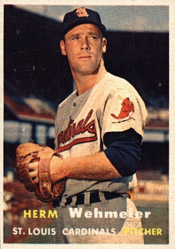
In 31 appearances against the Cardinals for the Reds and Phillies from 1949-1956, Herm Wehmeier was 0-14 with a 4.89 ERA.
(Yovani Gallardo has the second-worst career mark versus the Cardinals. In 19 starts against the Cardinals, Gallardo was 1-11 with a 6.45 ERA.)

Wehmeier’s 14th loss to St. Louis occurred May 9, 1956, in the Cardinals’ 3-0 victory over the Phillies. Boxscore

Two days later, on May 11, 1956, the Cardinals traded pitchers Harvey Haddix, Stu Miller and Ben Flowers to Philadelphia for Wehmeier and pitcher Murry Dickson. The deal was unpopular with many Cardinals fans. Haddix won 20 in 1953 and 18 in 1954. Though his record in 1955 fell to 12-16, many saw him as a pillar of St. Louis’ rotation.

Cardinals coach Terry Moore, who was the Phillies’ manager when Philadelphia acquired Wehmeier from the Reds in 1954, recommended Wehmeier to St. Louis general manager Frank Lane. According to The Sporting News, Lane said he sought Wehmeier “because he can be depended upon to trouble Brooklyn and Milwaukee, teams the Cards must stop to win.”

Cardinals pitching coach Bill Posedel was successful in working with Wehmeier. Reporting for The Sporting News, Bob Broeg wrote, “Wehmeier began to work with a high leg kick, similar to Paul Derringer’s, and … he concentrated on letting up on his fastball and curve when the opposition would expect the Wehmeier of old to try to bust his fastball by ’em.”

The results were impressive. Wehmeier won eight of nine decisions for the 1956 Cardinals from July 21 to Sept. 11. He saved his best for his last start of the year.

On the morning of Saturday, Sept. 29, the next-to-last day of the 1956 season, the Braves held first place in the National League, a half-game ahead of the Dodgers.

That day, the Dodgers swept a doubleheader against the Pirates. The Braves entered their night game at St. Louis knowing they needed to win to keep a share of first place. Milwaukee started its ace, Warren Spahn, against Wehmeier.

(In his autobiography, “I Had a Hammer,” Hank Aaron called Wehmeier “my worst nightmare,” because in 1955 he batted .105 against him, with two singles in 19 at-bats.)

Spahn and Wehmeier dueled into the 12th inning with the score tied 1-1. In the bottom of the 12th, Rip Repulski lashed a double against Spahn, scoring Stan Musial from second and giving the Cardinals a 2-1 victory. Boxscore

In Aaron’s book, Spahn said, “Beyond a doubt, that Saturday game in St. Louis was the most heartbreaking moment I had in 21 years of baseball.”

The loss dropped the Braves a game behind the Dodgers, who clinched the pennant the next day. The win capped a successful season for Wehmeier. The right-hander finished 12-9 with a 3.69 ERA for St. Louis. It would be the most single-season wins he’d post in his big-league career.

Wehmeier was named the Cardinals’ 1957 Opening Day pitcher by manager Fred Hutchinson. The assignment was especially important for Wehmeier because he would be facing the Reds in Cincinnati.

A Cincinnati native, Wehmeier had been an outstanding athlete at Western Hills High School. When he signed with the Reds at age 18, he was billed as a hometown hero. Instead, plagued by wildness and high expectations, Wehmeier was a bust. In nine seasons with the Reds, Wehmeier was 49-69. He issued more walks (591) than strikeouts (478) and became a target of fan hostility.

“He was one of the greatest natural athletes we ever had in Cincinnati,” Reds general manager Gabe Paul said. “But never in my long baseball experience have I heard a man booed as bitterly as was Wehmeier. Nothing he could do was right. Even when he won, they booed him.”

Wrote Broeg: “One of Wehmeier’s troubles as a Red was that the former Cincinnati high school hero tried too hard. The more red-necked he became and the harder he tried to throw, the wilder he became, either walking himself into trouble or getting the ball up where power hitters and others could swing for the fences.”

When Wehmeier took the mound in the Cardinals’ 1957 opener, his mother, father, sister and brother were in the stands. What they witnessed must have stunned many Reds fans. Wehmeier pitched a complete game and got the win in the Cardinals’ 13-4 victory. Boxscore

Wehmeier was winless in May and June, but recovered to win five consecutive decisions from Aug. 24 to Sept. 15. He finished the 1957 season at 10-7 with a 4.31 ERA.

In May 1958, Wehmeier was sent to the Tigers in a waiver deal. He suffered an elbow injury soon after and, at 31, his playing career was done. His big-league record: 92-108. For St. Louis, Wehmeier was 22-17.

Wehmeier scouted for the Reds for three years (he recommended they sign another phenom from Western Hills High School, Pete Rose) and then left baseball. He worked for a trucking company in Texas.

In May 1973, Wehmeier, 46, was testifying during a theft trial in federal court in Dallas when he suffered a fatal heart attack. In an obituary, The Sporting News reported, “Wehmeier was on the witness stand testifying for the government when he collapsed. The case involved theft of merchandise from a shipping company of which Wehmeier was an official.”

Previously: An interview with former Cardinals pitcher Al Jackson

Read Full Post »

(Updated March 24, 2019)

The second baseman who participated in one of the happiest periods in Cardinals history parted with the franchise in an unhappy manner.

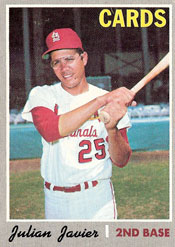
Only three players _ Frankie Frisch, Julian Javier and Tommy Herr _ have been the everyday second basemen on three Cardinals pennant winners. Javier started for the National League championship clubs of 1964, 1967 and 1968.

By 1972, Javier, 35, no longer was prominent in the Cardinals’ plans. Ted Sizemore had taken over as St. Louis’ second baseman and Ed Crosby was seen as a capable backup.

On March 24, 1972, the Cardinals traded Javier to the Reds for pitcher Tony Cloninger. Bob Howsam, who’d been Cardinals general manager before taking the same role with the Reds, acquired Javier to back up Joe Morgan at second base and Denis Menke at third.

After the deal was made, Javier indicated he was unhappy with general manager Bing Devine and manager Red Schoendienst for not getting the chance to play more in spring training and compete for a starting job.

“I feel too good, like 20, to be sitting around,” Javier said to the Associated Press.

During the off-season, Devine and Schoendienst had talked with Javier about his future and were of the impression Javier had agreed to a reserve role in 1972, the St. Louis Post-Dispatch reported. “I thought Bing and I had a perfect understanding with Hoolie,” Schoendienst said to The Sporting News.

At spring training, however, Javier asked the Cardinals for his release because he was upset Schoendienst was taking a look at other candidates for a reserve infield role, according to Post-Dispatch sports editor Bob Broeg.

Javier told Schoendienst, “I think I can play everyday for two more years,” the Dayton Journal Herald reported.

Javier’s complaints prompted an uncharacteristic blast from Schoendienst, a former all-star second baseman. “Hoolie wasn’t in shape, didn’t want to play and scarcely could get the ball from second base to first, yet he wants to say we didn’t use him,” Schoendienst told Broeg. “I’m tired of people who don’t want to play but say they do.”

In 12 seasons (1960-71) with the Cardinals, Javier twice was named an all-star (1963 and 1968), twice led National League second basemen in putouts (1963 and 1964) and collected 1,450 hits.

A right-handed batter, Javier hit .299 against left-handed pitching during his major-league career.

Javier’s role with the Cardinals changed after the 1970 season when the club acquired Sizemore from the Dodgers for first baseman Dick Allen.

Javier was found to owe back taxes to the U.S. government, leading to speculation the native of the Dominican Republic could become entangled in a legal case that might jeopardize his career. However, Javier worked out a settlement on his tax problems. When he reported to spring training in 1971, he was 10 pounds lighter (at 180) and performed more like the player he’d been on those championship teams.

Because of an injury to Dal Maxvill, Sizemore opened the 1971 season at shortstop and Javier remained the starter at second base. Javier batted .309 in the first two months of the season, slumped and entered July at .234. Maxvill returned to shortstop and Sizemore moved to second, replacing Javier.

At spring training in 1972, the Cardinals determined they were ready to move on without Javier. The trade to the Reds turned out to be a blessing for him. Javier had several key hits for the Reds and helped them win the 1972 NL pennant. Among the highlights:

_ Reds 11, Cardinals, 2, May 13, at Cincinnati: Facing Cloninger, the pitcher for whom he was traded, Javier delivered a RBI-single, scoring Johnny Bench. Boxscore

_ Reds 4, Giants 3, May 16, at San Francisco: Starting at third base, Javier hit a three-run home run against left-hander Ron Bryant. Boxscore

_ Reds 6, Phillies 5, June 3, at Philadelphia: Javier hit a two-run home run against left-hander Steve Carlton, a former Cardinals teammate. It was the 78th and last homer of Javier’s big-league career. Boxscore

_ Reds 8, Mets 2, June 17, at Cincinnati: Facing another former Cardinals teammate, left-hander Ray Sadecki, Javier hit a two-run single. Boxscore

Javier capped his career by appearing in four games for the Reds against the Athletics in the 1972 World Series.


Read Full Post »

« Newer Posts - Older Posts »