Feeds:
Posts
Comments

Archive for the ‘Trades’ Category

About the same time that fans of Milwaukee baseball learned the Braves planned to abandon them, the club’s most prominent pitcher, Warren Spahn, got cast aside, too.

So, when Spahn returned to Milwaukee for the first time as a member of the Mets, the fans there came out to cheer for him and against the Braves.
The drama didn’t end there. Spahn was matched that night against his protege and former road roommate, Wade Blasingame. Both were destined to wind up with a Cardinals farm team.

Mr. Brave

A left-hander who developed into a consistently big winner, Spahn began his major-league career with the 1942 Boston Braves (managed by Casey Stengel), served in combat during World War II, and moved with the club to Milwaukee in 1953. He was revered in Milwaukee for being the staff ace and for helping the Braves win two National League pennants (1957 and 1958) and a World Series title (1957).

“No individual made a greater contribution to the fabulous Milwaukee baseball story,” The Sporting News reported on Spahn. “He was truly Mr. Brave.”

Spahn won 20 or more 13 times, including six years in a row (1956-61). He was 42 when he won 23 for the 1963 Braves.

Trouble developed for both Spahn and the Milwaukee fan base in 1964. Spahn quit winning, and was shifted to the bullpen against his wishes by manager Bobby Bragan. Spahn finished the season at 6-13 with a 5.29 ERA.

“He was dead on his feet,” Bragan told The Sporting News. “His legs were gone. He couldn’t get off the mound, and they were bunting him silly.

“If any other pitcher had been shelled the way he was,” Bragan said, “he would have been shipped to (minor-league) Denver.”

The Braves wanted Spahn to stop pitching and offered him several jobs in the organization, including a radio broadcasting gig, The Sporting News reported. Spahn wanted to play instead.

Then the Braves delivered a double salvo of damaging decisions to the fans of Milwaukee baseball:

_ In October 1964, the Braves’ board of directors voted to approve a move of the franchise to Atlanta. The Braves were ready to go, but the National League ordered them to play one more season in Milwaukee in 1965, putting them in a lame-duck position with a furious fan base.

_ A month later, the Braves sold Spahn’s contract to the Mets, a move the scorned fans viewed as thankless.

“They got rid of me because of the money, my salary,” Spahn told The Sporting News. According to the New York Daily News, Spahn was paid $85,000 in 1964.

Double duty

The Mets’ manager, Casey Stengel, gave him the dual role of pitcher and pitching coach. “Pitching is first, then coaching,” Spahn told The Sporting News. He said to Dick Young of the Daily News, “I think I’m still a 20-game winner.”

Whitey Ford, who attempted to be both pitcher and pitching coach for manager Yogi Berra’s 1964 Yankees and found it daunting, delivered a message to Spahn through The Sporting News: “You’ll be sorry.”

(Berra, who was fired by the Yankees after the club was defeated by the Cardinals in the 1964 World Series, joined Spahn as a coach on Stengel’s 1965 Mets staff. Berra played in four May games for the 1965 Mets, then stuck solely to coaching.)

Spahn, 44, won his first two decisions with the 1965 Mets. Both were complete games _ one against the Dodgers Boxscore and the other versus the Giants. Boxscore

(In his first start versus the Cardinals as a Met, Spahn was matched against Bob Gibson. Lou Brock hit a two-run home run and the Cardinals won, 4-3. Boxscore and radio broadcast)

Out for revenge

Spahn was 3-3 with a 3.51 ERA heading into his return to Milwaukee to oppose the Braves. The fans there were showing their contempt about the impending move to Atlanta by staying away from County Stadium. 

After a paid crowd of 33,874 attended the 1965 home opener, subsequent April and May Braves home games drew an average paid attendance of 3,000. Paid attendance figures for the Cardinals’ three-game series at Milwaukee April 27-29 were 1,677, 1,324 and 2,182.

The turnout for the Thursday night game with the Mets on May 20, 1965, was a lot bigger _ 19,140 total (17,433 at full price, 1,707 youngsters admitted for 50 cents each) _ and most were there to pay tribute to Spahn.

“They made no secret of the fact they were rooting not for the Braves but for Spahn,” The Sporting News reported. “They cheered when his name was announced, when he took the mound and when he threw so much as a strike. They gave him a standing ovation when he went to bat.”

Dick Young of the Daily News observed, “He was to be their instrument of revenge. They came just for him, hoping, praying, he would beat the Braves.”

Several brought homemade banners and placards, including one with the message, “Down the Lousy Saboteurs. C’mon, Spahn, Mow Down the Betrayers,” the Daily News reported.

The Braves’ lineup that night featured Hank Aaron, Eddie Mathews, Joe Torre, Felipe Alou and 21-year-old starting pitcher Wade Blasingame. A left-hander, Blasingame got called up to the Braves in June 1964 and roomed on the road with Spahn, who became a mentor. Blasingame was 9-5 (including a shutout of the pennant-bound Cardinals Boxscore) for the 1964 Braves.

“There is a growing feeling (Blasingame) is about to become the new Spahn,” The Sporting News reported.

Spahn “taught me more in a year than I ever knew before,” Blasingame told United Press International.

All business

Blasingame and Spahn waged a scoreless duel for four innings. Then, in the fifth, Spahn became unglued. The Braves scored twice, then loaded the bases for Eddie Mathews, the left-handed slugger who was, according to George Vecsey of Newsday, “one of Spahn’s closest friends.”

When the count got to 1-and-1, “I couldn’t afford to get behind,” Spahn explained to United Press International. “He had been looking bad on the slider all night, but I second-guessed myself and threw him a fastball. Trouble was, I was indecisive about whether to throw it down and in, or down and away. So I came right over the plate.”

Mathews clobbered it _ “a mile past the bleachers in right,” the Daily News reported _ for a grand slam, giving the Braves a 6-0 lead.

“Spahn kicked the top of the mound to dust, and picked up the resin bag and slammed it down,” Dick Young noted.

Mathews said to Newsday, “If I felt something special about hitting a home run against Spahn, I’d tell you. I didn’t. He’s just another pitcher.”

In his book, “Eddie Mathews and the National Pastime,” Mathews said, “Spahnie and I went out and drank together after the ballgame, but there was no sentiment while he was on the mound.”

Hank Aaron followed with a single, stole second and eventually scored on Rico Carty’s second double of the inning, capping the seven-run outburst.

Spahn completed the inning, then was lifted for a pinch-hitter.

Blasingame held the Mets hitless until the seventh when, with two outs, Ron Swoboda singled, scoring Billy Cowan, who had walked and moved to second on a wild pitch.

Blasingame, who finished with a one-hitter, told George Vecsey he felt bad for Spahn: “I know he wanted to beat us very much _ maybe more than I wanted to beat them.” Boxscore

Tulsa time

Four days after his loss at Milwaukee, Spahn pitched a complete game, beating Jim Bunning and the Phillies. Boxscore Then he lost eight in a row, and the Mets placed him on waivers. In 20 games with the Mets, Spahn was 4-12.

The Giants claimed him and he finished the 1965 season, his last, with them, going 3-4. Spahn’s 363 career wins are the most by a left-handed pitcher. 

“I never did retire from pitching,” Spahn told writer Roger Kahn. “It was baseball that retired me.”

Wade Blasingame was 16-10 for the 1965 Braves, but never achieved another double-digit win season. In 10 years with the Braves, Astros and Yankees, he was 46-51.

(Blasingame and Jim Bouton were Astros teammates in 1969. In his book, “Ball Four,” Bouton wrote, “Today, Blasingame was wearing a blue bellbottom suit, blue shirt, a blue scarf at his throat and was smoking a long thin cigar, brown. Teammate Fred Gladding said, ‘Little boy blue, come blow my horn.’ Everybody on the bus went ‘Oooooh.’ Blasingame feigned indifference.”)

In 1967, Cardinals general manager Stan Musial hired Spahn to be manager of the Tulsa farm club. Spahn held the job for five years, but was gone by March 1973, when the Cardinals acquired Blasingame from the Yankees and assigned him to Tulsa.

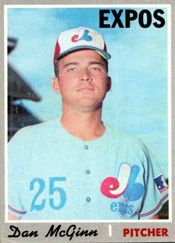
Blasingame was 1-0 with an 0.90 ERA in two months with Tulsa before being traded to the Cubs’ Wichita farm team for another left-hander, Dan McGinn.

Read Full Post »

Following a formula that worked well for them before, the Cardinals went looking for an old pro who was trying to cap his career with a championship. The character they found was as charismatic as he was competent.

On Feb. 8, 1933, the Cardinals acquired pitcher Dazzy Vance and shortstop Gordon Slade from the Dodgers for pitcher Ownie Carroll and infielder Jake Flowers.

Vance was a strikeout artist who dominated National League batters in the 1920s with a fastball the New York Times described as on par with Walter Johnson’s in the American League.

Though a month away from turning 42 when the Cardinals obtained him, the club was hoping Vance could replicate the success achieved from the acquisitions of pitchers Grover Cleveland Alexander, 39, in 1926 and Burleigh Grimes (nearly 37) in 1930. Alexander helped the Cardinals win two National League pennants (1926 and 1928) and a World Series title (1926). With Grimes, the Cardinals won two more pennants (1930 and 1931) and another World Series crown (1931).

Worth the wait

Dazzy Vance was born in Orient, Iowa, a town that also was the birthplace of Henry Wallace, vice president of the United States during the third term of President Franklin Roosevelt.

Reports vary about whether Vance was named Arthur Charles Vance, Charles Arthur Vance or Clarence Arthur Vance. When he was 5, he moved with his family to Nebraska and eventually settled in Hastings, according to the New York Daily News. As a boy, Vance got his nickname because of his mimicry of a neighboring plainsman who pronounced “Daisy” as “Dazzy,” the New York Times reported.

He was 21 when he entered pro baseball in 1912 with the York Prohibitionists of the Nebraska State League. Vance got to the majors with the Pirates in April 1915, pitched in one game and was sent to the Yankees. He appeared briefly with them but spent much of the next seven seasons in the minors until he was acquired by the Brooklyn Dodgers.

A right-hander, Vance was 31 when he got his first big-league win with the Dodgers in April 1922. Manager Wilbert Robinson, the convivial former catcher, “doted on big pitchers who could throw hard. The Dazzler qualified,” the New York Times noted.

“When he pitched, he kicked his leg high in the air and leaned back as far as possible, then released either a fastball or a hard curveball, with the same motion, making it next to impossible for a batter to ascertain which was bearing down on him,” David Hinckley wrote in the New York Daily News.

“He wore a chopped up undershirt under his uniform, and its tatters would flutter as he threw. In that same spirit, his favorite day to pitch was Monday, when the housewives in the apartment houses behind Ebbets Field hung out the wash and provided one more waving white element to camouflage the ball.”

Vance was the National League strikeout leader seven straight seasons (1922-28). In 1924, he topped the league in wins (28), ERA (2.16), strikeouts (262) and complete games (30). Rogers Hornsby hit .424 for the Cardinals that year, but Vance beat him out for the National League Most Valuable Player Award and, according to The Sporting News, the $1,000 in gold that went with the honor.

In a game at Brooklyn in 1925, Vance struck out 17 Cardinals, including Hornsby and Jim Bottomley three times each, hit a homer and drove in the winning run.

Described by the New York Times as a “hard and shrewd businessman” and “one of baseball’s most stubborn (contract) holdouts,” Vance negotiated a 1929 salary of $25,000, the highest paid a pitcher.

Dazzy with daffies

The Brooklyn ballclub sometimes was known during Dazzy’s days there as the Daffy Dodgers. The New York Times described them as an “assortment of crackpots,” but pointed out that Vance “was not a screwball.”

Vance was “a natural schmoozer and raconteur,” David Hinckley observed.

Arthur Daley of the New York Times described him as “a whimsical, homespun philosopher with the dry wit of a Will Rogers.”

On Aug. 15, 1926, at Ebbets Field, the Dodgers loaded the bases against the Braves. With Hank DeBerry on third, Vance on second and Chick Fewster on first, Babe Herman smacked a ball to deep right. Vance and Fewster hesitated, making sure the drive wasn’t caught.

The ball crashed against the fence, and DeBerry scored easily. According to the New York Daily News, Vance rumbled around third, then turned back. Vance slid into the third-base bag as Fewster arrived there from first. Herman, running full steam, slid into third, too. Ed Taylor, the Braves’ astonished rookie third baseman, tagged “everyone in sight, including the umpire,” the New York Times reported.

Vance was ruled safe, but Fewster and Herman were called out, resulting in Herman having doubled into a double play. Boxscore

A month later, against the Cubs, Vance became the first National League pitcher to strike out the first five batters in a game, a feat later matched by the Cardinals’ Bob Gibson. One of Vance’s strikeout victims that day was slugger Hack Wilson, “the Dazzler’s favorite pigeon,” the New York Times reported. Wilson whiffed 45 times in his career versus Vance. Boxscore

Veteran presence

After the Cardinals acquired Hack Wilson from the Cubs in December 1931, they attempted to flip him to the Dodgers for Vance or pitcher Watty Clark. When the Dodgers balked, the Cardinals sent them Wilson for cash and a prospect.

The next winter, the Cardinals again shopped for Vance. Max Carey had replaced Wilbert Robinson as Dodgers manager in 1932 and was willing to deal Dazzy, who, at 41, was 12-11 that year.

After Vance was traded to St. Louis, published reports predicted the Cardinals would send him to the Giants before spring training. The St. Louis Post-Dispatch reported the Giants agreed to pay $15,000 for Vance, but then called off the deal.

Cardinals manager Gabby Street didn’t want Vance either. “I figured he’d be a terrible load on my team and I was eager for a trade that would get him off my squad,” Street said to the Post-Dispatch.

However, Cardinals executive Branch Rickey told the St. Louis Globe-Democrat, “If Dazzy Vance shows that he wants to pitch for us to the best of his real ability, we’ll keep him. I think he’s still a great pitcher.”

The relationship teetered when the Cardinals asked Vance to accept a $5,000 salary. “I wrote Branch Rickey that I couldn’t be bothered with any $5,000 offer,” Vance told the Post-Dispatch.

When he finally signed on March 17, terms were not disclosed.

The addition of Dazzy gave the 1933 Cardinals a colorful cast that included a Dizzy (Dean), a Ducky (Medwick), a Pepper (Martin), a Rajah (Hornsby), a Flash (Frankie Frisch) and a Rip (Collins).

Vance, 42, also joined a pitching staff that would come to include two others who turned 40 during the 1933 season, Burleigh Grimes and Jesse Haines.

Gabby Street soon changed his mind about Vance. “There ain’t a man on the club with a better spirit … He’s worked as hard as any man on the roster,” Street told the Post-Dispatch. “He’s done everything he’s been asked to do and a lot more.”

Dazzy delivers

Vance got a mix of starts and relief stints with the Cardinals, even though, as the New York Times noted, “he abhorred” pitching in relief. In August, he pitched a four-hitter against the Reds. Boxscore In September, he struck out nine in a complete game against the Cubs, fanning his former Dodgers crony, Babe Herman, three times. Boxscore

In 28 appearances, including 11 starts, for the 1933 Cardinals, Vance was 6-2 with three saves. Despite his distaste for the role, he was quite good as a reliever (3-0, 2.97 ERA).

The Cardinals, who finished fifth in the league at 82-71, placed Vance on waivers after the season and he was claimed by the Reds. The Cardinals got him back in June 1934 and he contributed to the pennant-winning Gashouse Gang, posting a 1-1 mark and a save. The win was a complete game against the Braves in which he retired the last 10 batters in order. Boxscore

At 43, Vance got to pitch in a World Series for the only time in his 16 years in the majors, appearing in relief in Game 4 versus the Tigers. Vance is one of five players 40 or older to appear in a World Series for the Cardinals. 

Vance, 44, went back to Brooklyn for a last hurrah with manager Casey Stengel’s Dodgers in 1935. His final win, No. 197 of his career, came against the Cardinals, a relief stint in which he allowed one run in 5.1 innings. Boxscore

Vance was elected to the Baseball Hall of Fame in 1955.

Read Full Post »

(Updated Sept. 12, 2024)

Frank Thomas, a slugging outfielder for the 1950s Pirates, came close to being acquired by the Cardinals, but it would have come at a hefty price.

In 1957, Cardinals general manager Frank Lane was ready to deal Ken Boyer to the Pirates for Thomas and third baseman Gene Freese. When the deal got put on hold by Cardinals hierarchy, Lane quit and became general manager of the Cleveland Indians.

A right-handed batter, Thomas played for seven teams during 16 seasons in the majors, belting 286 home runs. He hit 30 or more home runs in a season three times, twice topped 100 RBI and never struck out as many as 100 times.

Different uniform

Born and raised in Pittsburgh, Thomas developed a passion for baseball at an early age. In the book “We Played the Game,” Thomas recalled, “My mother said I never went to bed without a bat or ball in my hand. I first used my dad’s pick hammer for a bat.”

Thomas said he attended the games of the Pirates and the Negro League Homestead Grays at Pittsburgh’s Forbes Field. “I got my first baseball from (Negro League catcher) Josh Gibson. He gave me two,” Thomas told author Danny Peary.

When Thomas was 12, he was sent by his parents to a Catholic seminary in Niagara Falls, Ontario, to study for the priesthood. He quit the seminary when he was 17, returned to Pittsburgh and played sandlot baseball. Six months later, after he turned 18, the Pirates signed him in July 1947. “It was like a miracle,” Thomas said in “We Played the Game.”

In his first professional season, playing for a 1948 minor-league Tallahassee team managed by former Cardinals outfielder Jack Rothrock, Thomas produced 132 RBI. Three years later, he made his debut in the majors with the 1951 Pirates.

Possessing power and a strong throwing arm, Thomas was a good player on mostly bad Pirates teams. In 1954, when he earned the first of three all-star honors, Thomas batted .298 with 32 doubles, 23 homers and 94 RBI.

Shopping list

During the 1957 season, the Cardinals shifted Ken Boyer from third base to center field. Boyer led National League center fielders in fielding percentage but his hitting declined. He batted .265 with 19 home runs and 62 RBI in 1957 after putting up better numbers (.290, 23 homers and 89 RBI) the year before.

At the 1957 World Series between the Braves and Yankees, Cardinals general manager Frank Lane met in New York with his Pirates counterpart, Joe Brown, and discussed a trade of Ken Boyer for Frank Thomas, The Pittsburgh Press reported. A pull hitter who stood close to the plate, Thomas hit .290 with 23 home runs and 89 RBI for the Pirates in 1957.

Lane said he and Cardinals manager Fred Hutchinson had two four-hour talks with Brown and Pirates manager Danny Murtaugh about the proposed trade, according to The Sporting News. The talks continued into the fall.

In the book “Ken Boyer: All-Star, MVP, Captain,” biographer Kevin D. McCann noted, “Lane had been Boyer’s biggest supporter and harshest critic. He expected much from him and felt he should be as good as _ or even better than _ Yankees slugger Mickey Mantle. He wasn’t timid about publicly chastising what he perceived to be Ken’s lack of competitive hustle and aggressiveness.”

On Oct. 23, 1957, the Pittsburgh Post-Gazette reported that Lane was willing to trade Ken Boyer and pitcher Willard Schmidt to the Pirates for Frank Thomas and Gene Freese.

“Boyer is reported to have told friends in St. Louis that he had been alerted by the Cardinals not to be surprised if he were traded,” The Sporting News reported. “He was expecting to come to Pittsburgh.”

Boyer told the St. Louis Globe-Democrat, “After the season I had, I had made up my mind that I was going to be traded by Lane.”

Too many chiefs

Lane said he and Joe Brown talked trade until the first week of November 1957 “and, for his part, was ready to make the deal,” The Sporting News reported, but there was a hang-up.

In 1956, after swapping Red Schoendienst to the Giants and trying to deal Stan Musial to the Phillies for pitcher Robin Roberts, Lane was told any trades he wanted to make must be approved by club owner Gussie Busch and team executive vice president Dick Meyer. “Lane was unhappy with the handcuffs on him,” The Sporting News reported.

Lane told The Pittsburgh Press that Busch “has too many advisers to suit me. If I’m the general manager, I want to stand or fall on my own decisions. Before I’d make a deal, I’d always tell Busch. Then his vice-presidents would call a meeting and in three or four days I’d get an answer.”

According to the Sporting News, when Lane sought permission to make the trade of Boyer and another player (possibly Schmidt) for Thomas and Freese, “the okay wasn’t forthcoming.”

“The Cardinals’ brass shuddered every time I’d mention Boyer in a trade,” Lane told The Pittsburgh Press, “but they should have known if I traded him I’d get somebody good in return.”

Though he had a year remaining on his Cardinals contract, a frustrated Lane quit in November 1957 and accepted an offer to be general manager of the Cleveland Indians, who agreed not to restrict his ability to make trades. Lane’s assistant, Bing Devine, replaced him as Cardinals general manager.

Just say no

Devine had no interest in pursuing the trade Lane had put together with the Pirates. “Stan Musial is the only player not tradeable, but Boyer comes close to it,” Devine said to The Sporting News.

Cardinals manager Fred Hutchinson had other ideas. Asked by the Post-Dispatch whether he would have made the deal with the Pirates that Lane had proposed, Hutchinson said, “I’d still be inclined to give it a considerable amount of attention. Boyer has potential, all right, but I don’t know whether he’s determined enough to achieve that potential.”

In December 1957, the Phillies offered outfielder Richie Ashburn and pitcher Harvey Haddix (a former Cardinal traded by Lane) for Boyer, but Devine declined, the Globe-Democrat reported.

Boyer said to the Post-Dispatch, “I told my wife that if I’d have been the Cardinals, I’d have made that trade.”

(In his autobiography, “The Memoirs of Bing Devine,” Devine said Lane had initiated talks with the Phillies about Ashburn for Boyer before departing St. Louis.)

Bob Broeg of the Post-Dispatch also revealed that the Pirates approached Devine with an offer of outfielder Bill Virdon (another former Cardinal traded by Lane) and Freese for Boyer, but that was rejected, too.

Returned to third base in 1958, Boyer hit .307 with 23 home runs and 90 RBI, and won the first of five Gold Glove awards. He remained a force for the Cardinals, powering them to a World Series title in 1964 and winning the National League Most Valuable Player Award.

Thomas had a big year in 1958 for the Pirates, batting .281 with 35 home runs and 109 RBI, but was traded to the Reds after the season.

Breaks of the game

After stints with the Cubs and Braves, Thomas was a Met when he hit a walkoff home run to beat the Cardinals’ Curt Simmons on July 9, 1964. Pinch-hitting with one on, two outs and the Cardinals ahead, 3-2, in the bottom of the ninth, Thomas pulled a changeup over the wall at Shea Stadium in his first at-bat since developing a glandular infection May 31. Boxscore

Nicknamed “Big Donkey,” Thomas “bet guys $100 he could catch their hardest throw barehanded at 100 feet,” Mets first baseman Ed Kranepool recalled to the New York Times. “He did it with a two-handed swinging motion to take the sting out of it. He even bet Willie Mays when Willie was at his best. Willie let one go, but the Big Donkey caught it.”

In August 1964, Thomas was traded to the first-place Phillies, who wanted him as their first baseman for the pennant stretch. Thomas provided a spark, hitting .294 with seven home runs and 26 RBI in 143 at-bats before fracturing his right thumb on Sept. 8.

The Phillies, who held a six-game lead at the time Thomas was injured, went into a slide soon after, allowing the Cardinals to overtake them and win the pennant.

Read Full Post »

In their first venture into free agency, the Cardinals pursued a closer, Bill Campbell, but were unprepared for what it would cost to get him.

Campbell signed with the Red Sox instead of the Cardinals in November 1976.

Nine years later, when the Cardinals acquired Campbell in a trade with the Phillies, he became part of a bullpen by committee constructed to replace closer Bruce Sutter.

Campbell helped the Cardinals win a National League pennant in his only season with the club.

From battlefield to diamond

After serving with the Army in the Vietnam War, Campbell was playing semipro baseball in California when the Twins signed him in September 1970.

Two years later, when he was a starting pitcher in the Twins’ system, Campbell told Bob Padecky of the Charlotte News, “Vietnam is still something that lives with me. The Charlies had this rocket over there you could hear coming for miles. Even now, I still flinch occasionally from a loud noise.”

A right-hander who featured a screwball, Campbell, 24, reached the majors in July 1973 with the Twins, who converted him into a reliever. After the 1975 season, when he played for $22,000, Campbell sought an $8,000 raise, but Twins owner Calvin Griffith said no, the Minneapolis Star Tribune reported.

Until then, Campbell would have had to accept Griffith’s terms or quit, but in December 1975 arbitrator Peter Seitz had overturned baseball’s reserve system, opening the way for eligible players to become free agents in November 1976.

Campbell could become a free agent if he didn’t sign and played out his contract at the $22,000 salary offered by the Twins in 1976. That’s what he decided to do. 

With Campbell piling up wins and saves for the 1976 Twins, Griffith approached him during the season and offered him what he had asked, the Star Tribune reported, but now it was Campbell’s turn to say no.

Campbell posted a 17-5 record with 20 saves in a league-leading 78 relief appearances for the 1976 Twins.

“It’s all in his delivery,” Twins manager Gene Mauch said to the Star Tribune. “Take all the pitchers in the league and time their fastball on a speed machine and there won’t be much difference. It’s where the ball comes from that counts. Good delivery equals consistency and endurance and deception.”

Top dollar

Campbell was the free agent who interested the Cardinals the most in November 1976. They envisioned him joining Al Hrabosky in giving them a dominant pair of late-inning stoppers _ Campbell from the right side and Hrabosky from the left.

“Campbell is an impressive individual, physically and personally,” Cardinals general manager Bing Devine said to the St. Louis Post-Dispatch.

Cardinals officials, including owner Gussie Busch, met with Campbell and his agent, LaRue Harcourt. “They asked me if I would give them the first shot,” Campbell told Peter Gammons of Sports Illustrated.

Campbell said to the Post-Dispatch, “Money will be the most important factor in my decision. You consider location and you want to play with a contender, but money comes first.”

Because the Cardinals “seemed more interested” than any other club, Campbell told Gammons he was “resigned to playing with the Cardinals.”

Then the Red Sox entered the bidding. Assistant general manager John Claiborne led the negotiations for Boston. (Claiborne had been mentored by Devine in St. Louis and would replace him there in 1978.) Once Campbell and his agent heard the Red Sox’s proposal, they quickly accepted it.

The reliever who played for $22,000 in 1976 got from the Red Sox a five-year contract worth $1.075 million. Campbell received a $250,000 signing bonus and yearly salaries of $165,000, Gammons reported.

Asked why Campbell didn’t sign with the Cardinals, agent LaRue Harcourt said to the Boston Globe, “Not enough money. That was St. Louis. Not enough money.”

As Bob Broeg noted in the Post-Dispatch, the Cardinals “weren’t in the ballpark financially in the bidding.”

Big in Boston

Campbell’s bonanza was stunning in a day when the average salary for a big-league ballplayer was $51,500. “No player is really worth what they’re paying me,” Campbell told Sports Illustrated, “but if they want to, then fine.”

Red Sox followers had high hopes for a $1 million reliever. Or, as columnist Leigh Montville put it, “He was expected to deliver instant pitching salvation.”

His first appearance for the 1977 Red Sox, on Opening Day at Fenway Park, drew boos. Tasked with protecting a 4-2 lead, Campbell gave up a two-run home run to Buddy Bell in the ninth. The Indians went on to win, 5-4, in 11 and Campbell was the losing pitcher. Boxscore

He was the losing pitcher again in the second game of the season. Boxscore

Campbell was 0-3 with a 6.94 ERA in eight appearances in April 1977. “His public image fell somewhere between that of an auto repairman and a politician under indictment,” Montville wrote.

A month later, he was a darling of the Red Sox faithful, posting a 4-0 record and five saves in May. “He comes in, and it’s like Christmas morn,” Red Sox pitching coach and former Cardinal Al Jackson told the Globe.

Campbell finished the 1977 season with 13 wins and a league-leading 31 saves.

Wiley veteran

After fulfilling his contract with the Red Sox (1977-81), Campbell pitched for the Cubs (1982-83) and Phillies (1984).

That’s when the Cardinals came back into the picture. Bruce Sutter, who had 45 saves for the 1984 Cardinals, became a free agent and went to the Braves. The Cardinals wanted a veteran reliever to join holdovers Jeff Lahti and Ken Dayley in forming a bullpen corps that manager Whitey Herzog could use to fill the closer vacancy created by Sutter’s departure.

On April 6, 1985, the Cardinals traded pitcher Dave Rucker to the Phillies for Campbell and shortstop Ivan DeJesus.

Campbell, 36, used a herky-jerky motion to deliver an assortment of pitches, primarily the screwball. “It’s tough for hitters to decipher because they’re seeing a lot of arms and legs,” Campbell told the Post-Dispatch. “My leg hits the ground and then my arm comes through … It looks like I’m jumping out there.”

In his first two saves for the Cardinals, Campbell pitched three scoreless innings against the Giants Boxscore and four scoreless innings versus the Braves. Boxscore

“He throws all the pitches _ screwball, slider, curveball, fastball,” Cardinals pitching coach Mike Roarke said to the Post-Dispatch. “He uses his pitch selection well. When he’s going good, it can be very confusing for a hitter.”

Campbell was at his best during the Cardinals’ drive for a division title. On Sept. 14, 1985, he was the winning pitcher with three scoreless innings against the Cubs, a victory that vaulted the Cardinals ahead of the Mets and into first place in the National League East. The Cardinals remained on top the rest of the season. Boxscore

For the month of September, Campbell pitched in nine games for the Cardinals and had an 0.93 ERA.

During the season, he allowed just six of 39 inherited runners to score. From Aug. 18 to Sept. 28, he pitched 13.1 innings without yielding a run.

Campbell finished the season with a 5-3 record and four saves in 50 appearances. Seven Cardinals relievers _ Jeff Lahti (19), Ken Dayley (11), Todd Worrell (five), Campbell (four), Bob Forsch (two), Neil Allen (two) and Ricky Horton (one) _ combined for 44 saves, basically matching the total of 45 Sutter had for them the year before.

Campbell pitched in the 1985 National League Championship Series (no runs allowed in three games) and in the 1985 World Series (one run in three games). Those were his only postseason appearances in 15 years in the majors.

Released by the Cardinals in November 1985, Campbell pitched for the Tigers (1986) and Expos (1987). He ended up with 83 wins and 126 saves in 700 games in the majors.


Read Full Post »

Looking to cut costs during the Great Depression and open a spot at first base for the aptly named Rip Collins, the Cardinals decided the time was right to peddle a player who was popular and productive.

On Dec. 17, 1932, the Cardinals traded their future Hall of Fame first baseman, Jim Bottomley, to the Reds for pitcher Ownie Carroll and outfielder Estel Crabtree.

Nicknamed Sunny Jim for “his friendly disposition,” as the Associated Press described it, Bottomley had been a consistent run producer in 11 seasons with the Cardinals, and though there had been indications he was being shopped, it was thought he’d bring more than what St. Louis got for him.

Style and substance

Bottomley was born in Oglesby, Ill., and settled with his family in Nokomis, Ill., a farming and mining town. Bottomley’s father and brother worked in the mines. Bottomley’s brother was killed in a cave-in, the St. Louis Post-Dispatch reported.

When Bottomley was 16, he quit high school and clerked in a grocery store, the Associated Press reported. According to the Post-Dispatch, he also worked on a farm and as a blacksmith’s helper.

In his spare time, Bottomley played semipro baseball for $5 a game, walking eight miles each way to the home ballpark, the Associated Press reported. A St. Louis policeman saw him hit two home runs and three triples in a game and told Cardinals executive Branch Rickey he should give Bottomley a look. Invited to a Cardinals tryout camp in 1919, Bottomley was awarded a contract.

During 1922, his third season in their farm system, Bottomley got called up to the Cardinals and became their first baseman. He made an immediate impression with the fans because of his strut and the way he wore his cap.

“He was the only man I ever knew who could strut while he was crouched in the batter’s box,” Rickey told the St. Louis Globe-Democrat.

As for the cap, it “was never pulled down to shade the eyes like most ballplayers wore it,” the Globe-Democrat observed. “Sunny Jim’s was always cocked at a rakish angle.”

Before long, nearly everyone who followed the Cardinals knew Bottomley simply as Sunny Jim. He “smiled and swaggered his way into the hearts of baseball fans,” J. Roy Stockton noted in the Post-Dispatch.

According to the Associated Press, “Sunny Jim was one of those rare ballplayers who combined genuine color with honest-to-goodness ability.”

Playing to win

A left-handed batter, Bottomley hit for power, using a choked grip on a heavy bat.

On Sept. 16, 1924, Bottomley drove in 12 runs in a game against the Dodgers. Boxscore Since then, the only player to match that feat has been another Cardinal, Mark Whiten, versus the Reds on Sept. 7, 1993. Boxscore

Bottomley helped the Cardinals to four National League pennants (1926, 1928, 1930 and 1931) and two World Series titles (1926 and 1931). He won the National League Most Valuable Player Award in 1928 when he led the league in triples (20), home runs (31), RBI (136) and total bases (362).

Bottomley hit better than .300 in nine of his 11 seasons with the Cardinals. (In the other two years, he hit .299 and .296.) He ranks fourth in career RBI as a Cardinal (1,105). Only Stan Musial (1,951), Albert Pujols (1,397) and Enos Slaughter (1,148) produced more RBI for the franchise.

As for his fielding, “It doesn’t make any difference how wide or how high they are thrown to Sunny Jim. He always manages to get them,” the Dayton Daily News reported.

Time to go

Bottomley’s best friend on the Cardinals, another future Hall of Famer, left fielder Chick Hafey, was traded to the Reds on the eve of the 1932 season opener. Rip Collins, a natural first baseman, replaced Hafey in left field on Opening Day.

After Bottomley started slowly, hitting .158 with no home runs in April, manager Gabby Street benched him and moved Collins to first base.

Collins, 28, went on to lead the 1932 Cardinals in hits (153), home runs (21), RBI (91), runs scored (82) and total bases (260). Bottomley, 32, hit .296 with 11 homers.

With Collins making a convincing claim for the first base job, the Cardinals began making plans to move Bottomley. In September 1932, the last-place Reds revealed that manager Dan Howley would depart after the season. Reds owner Sidney Weil was an admirer of Bottomley and sought permission from the Cardinals to interview him for the job.

At the urging of Branch Rickey and Cardinals owner Sam Breadon, Bottomley went to Cincinnati on Sept. 23, 1932, while the season still was being played, and interviewed with Weil for the role of player-manager, the Cincinnati Enquirer reported. Donie Bush, a veteran manager, eventually got the job, but Weil was determined to acquire Bottomley to play for the Reds.

After Cardinals shortstop Charlie Gelbert was shot in a hunting accident in November 1932, the Cardinals offered Bottomley to the Reds for shortstop Leo Durocher and starting pitcher Si Johnson, a 13-game winner, the Enquirer reported.

When the Reds deemed the price too high, the Cardinals settled for Ownie Carroll (10-19 in 1932) and Estel Crabtree (.274, two home runs, in 1932). It was suspected the Reds sent the Cardinals a stack of cash as well.

Asked whether the Cardinals got cash in the deal, Breadon told Red Smith of the St. Louis Star-Times, “I wouldn’t want to say anything on that.”

According to The Sporting News, the trade garnered the Cardinals “a sizeable sum of money.” The Post-Dispatch informed its readers, “Close followers of baseball did not have to be told that it was a cash transaction.”

In addition to reaping the cash, the Cardinals also rid themselves of Bottomley’s $13,000 salary, about double what most players were making in 1932.

Worth the price

The Reds proposed to Bottomley a salary of $8,000, a $5,000 cut, for 1933, The Sporting News reported. After a negotiation, Bottomley, who wed St. Louis beauty shop owner Betty Brawner in February 1933, eventually signed for $10,000.

In May 1933, the Cardinals got the Reds to trade them Leo Durocher. (Three years later, the Cardinals also got Si Johnson from the Reds.)

Bottomley delivered what the Reds hoped from him. He led the 1933 Reds in triples (nine), home runs (13) and RBI (83). He had 16 RBI in 22 games versus the Cardinals. The following year, with the 1934 Reds, Bottomley was their leader in doubles (31), triples (11) and RBI (78). He hit .313 versus the Cardinals.

After a third season with Cincinnati, Bottomley was traded to the St. Louis Browns, finishing his career with them, including a stint as manager in 1937.

Read Full Post »

Brett Tomko was a sketch artist who made his living painting corners as a pitcher.

On Dec. 15, 2002, the Cardinals got Tomko from the Padres for reliever Luther Hackman and a player to be named (pitcher Mike Wodnicki).

A right-hander, Tomko was a durable, but hittable, member of the Cardinals’ 2003 starting rotation, earning 13 wins despite some rough outings.

Arts and crafts

In 1970, three years before Brett was born, his father Jerry entered a contest to name the new Cleveland NBA franchise. His suggestion, Cavaliers, was selected from more than 11,000 entries submitted, The Cleveland Plain Dealer reported. His prize for naming the team was a pair of season tickets for the club’s first year.

When Brett was 3, he moved with the family from Euclid, Ohio, to Placentia, Calif., near Anaheim, and developed skills in baseball and in art. 

An art communications major at Florida Southern College, Tomko had a 15-2 record for the baseball team in 1995 and was named NCAA Division II player of the year, pitching a shutout in the national championship game.

When not playing baseball, he’d sometimes spend his nights at the campus art studio. “I’d stay until 4 in the morning, drawing and painting,” he recalled to the Dayton Daily News. “It relaxes me totally.”

He said to the Tampa Tribune, “I’ve always taken art courses. It’s come easy to me, like majoring in baseball.”

The Reds chose Tomko in the second round of the 1995 June amateur draft. After he reached the majors with them in May 1997, art remained a part of his life. “Tomko always carries with him a sketch pad and charcoals,” The Cincinnati Post reported. On road trips, he visited art museums. “I am the biggest nerd in major league baseball,” Tomko told Peter Gammons of the Boston Globe.

Before long, Tomko “dazzled teammates with his charcoal drawings,” Jeff Horrigan of The Cincinnati Post reported. Hal McCoy of the Dayton Daily News wrote, “Tomko drew beautifully in charcoal.”

(On April 15, 2007, the 60th anniversary of Jackie Robinson integrating the big leagues, each fan attending the Dodgers game that day received a copy of Tomko’s drawing of Robinson, the Los Angeles Times reported.)

Traveling man

Tomko had 11 wins for the Reds his rookie season and 13 the next year. In April 1999, the Dayton Daily News reported, the Reds could have acquired Jim Edmonds from the Angels for Tomko but refused to part with him. (The next year, Edmonds was traded to the Cardinals.)

In February 2000, the Mariners made the Reds an offer they couldn’t refuse, sending them Ken Griffey Jr. for a package of players, including Tomko. The Mariners used him primarily as a reliever before shipping him to the Padres in December 2001.

Tomko was 10-10 with a 4.49 ERA in 32 starts for the 2002 Padres, but Cardinals manager Tony La Russa and pitching coach Dave Duncan noticed he was developing an effective sinkerball. “When he was in Cincinnati, he would just rear back and fire,” La Russa told the St. Louis Post-Dispatch. “We saw that he has really started to move the ball around and pitch.”

Shopping for pitching at the baseball winter meetings in December 2002, the Cardinals talked to the Giants about a trade of second baseman Fernando Vina for either starting pitchers Russ Ortiz or Livan Hernandez, the Post-Dispatch reported, but the Giants instead opted to sign free-agent second baseman Ray Durham.

Turning to the Padres, the Cardinals discussed swapping Vina for Tomko and another pitcher, Kevin Jarvis, before scaling back the framework of the deal, according to the Post-Dispatch.

The Cardinals projected Tomko, 29, to join a starting rotation with Matt Morris, Woody Williams, Garrett Stephenson and Jason Simontacchi.

“He’s a guy who we’re getting in the prime of his career,” La Russa said to the Post-Dispatch.

Skeptics noted that Tomko was joining his fourth team in five years and only once posted an ERA below 4.44, but Dave Duncan told the newspaper, “He’s a low-ball pitcher, gets a lot of ground balls, and we have a good defense. I think he has pitched in some other places where the defense wasn’t so good and he had to suffer through that and paid a penalty for it.”

After seeing Tomko pitch in spring training with the Cardinals, Duncan said to the Post-Dispatch, “I feel good about everything about him. I like the way he’s throwing. I like the way he goes about his business, his willingness to work, his drive to win. All the ingredients are there.”

Like he had elsewhere, Tomko continued his art work while with the Cardinals. Among his projects was a portrait of teammate Woody Williams.

“The moments when Tomko has a charcoal pencil in his hand are among the most relaxing he can imagine,” Stu Durando wrote in the Post-Dispatch.

Good, bad, ugly

Tomko’s 2003 season with the Cardinals was a mix of gems and duds. He pitched complete games in wins against the Marlins (Boxscore) and Rockies (Boxscore). He also gave up nine runs in a game three times _ versus the Rockies (Boxscore), Red Sox (Boxscore) and Yankees (Boxscore).

Tomko finished the season with a 13-9 record and ranked second on the club in wins, but he gave up more hits (252) and more earned runs (119) than any pitcher in the National League. He allowed 35 home runs and batters hit .305 against him, helping account for a 5.28 ERA. Video

At times, Tomko impressed as much with his bat as he did with his arm. He hit .286 with nine RBI for the Cardinals. 

Granted free agency after the season, Tomko signed with the Giants _ the fifth of 10 clubs he pitched for in 14 seasons. The others: Dodgers, Royals, Yankees, Athletics and Rangers.

Tomko finished with a career mark of 100-103. His 13 wins for the Cardinals tied his single-season career high.

Read Full Post »

« Newer Posts - Older Posts »