Feeds:
Posts
Comments

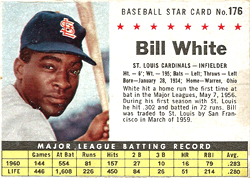
To acquire Bill White, the Cardinals had to give up their best pitcher.

On March 25, 1959, the Cardinals traded pitchers Sam Jones and Don Choate to the Giants for White and utility player Ray Jablonski.
Jones was National League strikeout leader (225) in 1958 and shattered the Cardinals’ single-season record of 199 set by Dizzy Dean in 1933. Jones also led the 1958 Cardinals in wins (14) and ERA (2.88).

White, a first baseman and outfielder, was highly regarded, but couldn’t get a spot in the Giants’ lineup and wasn’t the Cardinals’ first choice. Giants outfielder Leon Wagner was the hitter the Cardinals wanted before they took White, according to the St. Louis Post-Dispatch.

The Cardinals took heat for the deal, but it turned out to be the right move.

Who’s on first?

White made his major-league debut with the Giants in 1956 and hit 22 home runs as their first baseman. He served in the Army in 1957 and the first six months of 1958. Orlando Cepeda became the Giants’ first baseman in 1958 and excelled.

When White returned to the Giants in July 1958, he was relegated to a reserve role. White hit .241 in 26 games for the 1958 Giants. Cepeda hit .312 with 25 home runs and won the National League Rookie of the Year Award.

At spring training in 1959, Cepeda was back and a power-hitting prospect, Willie McCovey, whose best position was first base, was close to joining the team. White, seeing his path blocked, asked the Giants to trade him.

Help wanted

Cardinals general manager Bing Devine was determined to acquire a hitter to boost the 1959 lineup. In 1958, Ken Boyer was the only Cardinal to hit as many as 20 home runs.

According to Post-Dispatch sports editor Bob Broeg, the Cardinals set their sights on Wagner, who hit 13 home runs in half a season as a Giants rookie in 1958 after producing impressive power numbers in the minor leagues.

Wagner’s ability to hit home runs was appealing, but Cardinals talent evaluators concluded White was a better player.

While scouting winter baseball in the Dominican Republic, Cardinals manager Solly Hemus and farm director Walter Shannon saw White and were impressed. Cardinals minor-league manager Joe Schultz, who managed a team in the Dominican Republic, also raved about White.

After Cardinals scout Ollie Vanek filed glowing reports about White from Arizona spring training in 1959, Devine sent his special assistant, Eddie Stanky, to take a look. Stanky managed the Cardinals from 1952-55 and managed White in the minor leagues.

Stanky scouted White for a week. In his 2004 autobiography, “The Memoirs of Bing Devine,” Devine said he called Stanky in Arizona from a phone booth on the beach near St. Petersburg, Fla., to get his opinion on whether to acquire White.

“How well do you like him?” Devine asked Stanky.

Stanky replied, “Let’s not debate it. You sent me out here to see him. I like him. I’m telling you right now I’d make the deal. I suggest you do, too.”

Worth a risk

The trade was unpopular in St. Louis because Jones was so well-regarded. “He was, and we do not mind saying it out loud, one of our special favorites,” the Post-Dispatch declared in an editorial.

Broeg noted the deal “took nerve” because “the Cardinals gambled front-line pitching for potential batting power.”

The Cardinals were heartened by the reaction of former Giants manager Leo Durocher, who told the Associated Press, “I’ll bet you that in one or two years White will be one of the great players in the National League.”

Cardinals reliever Marv Grissom, a former Giant, said the Cardinals made the right choice. “Wagner has more power, all right, as much as anybody in the game,” Grissom said. “White is a smarter player, faster, better defensively and good and strong enough at the plate.”

White told The Sporting News, “I’m happy with the trade. With the Cardinals, I’ll get to play regularly. Naturally, I’m in baseball for the money, and when you play regularly you have a better argument for salary terms.”

In his autobiography, “Uppity,” White said he was glad to be traded, but “St. Louis was the worst city in the league for black players” because of segregationist attitudes. In 2011, when I interviewed White about the deal, he said, “St. Louis wasn’t my first choice, but it ended up that it was a great trade for me.”

Finding the groove

The Cardinals opened the 1959 season with an outfield of Stan Musial in left, Gino Cimoli in center and Joe Cunningham in right, with White at first base.

Pressing to fulfill expectations of being a power hitter, White struggled and had one hit, a single, in his first 19 at-bats. Cardinals coach Harry Walker urged him to relax and make contact rather than try for home runs. “White was lunging too much, was ahead of the pitch, wasn’t getting a good look,” Walker said.

After starting three games at first base and another in left field, Hemus had White make six starts in center field, even though Curt Flood was available.

In his autobiography, White said, “I was a terrible outfielder. I couldn’t judge fly balls. I couldn’t throw and I couldn’t cover the ground.”

On April 29, 1959, Hemus moved Musial to first base and shifted White to left. White was the left fielder from late April until early June. After that, he alternated between first base and left field.

After batting .195 in April, White hit .393 in May and .382 in June. He finished the season at .302, with 33 doubles and 12 home runs.

Jones was 21-15 for the 1959 Giants and led the league in ERA at 2.83.

After the season, the Cardinals acquired Wagner from the Giants, hoping he’d fill an outfield spot, but he played one season for them as a reserve before going to the American League and becoming an all-star for the Angels.

In eight seasons with the Cardinals, White batted .298, topped 100 RBI three times and hit 20 or more home runs five years in a row. He won the Gold Glove Award six times as a Cardinals first baseman. He also was a National League all-star with the Cardinals in 1959, 1960, 1961, 1963 and 1964 and helped them become 1964 World Series champions.
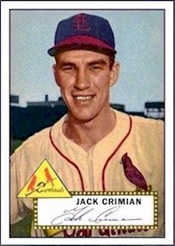
 

Surviving a scare from the last batter he faced in the game, Jack Crimian earned his first major-league win for the Cardinals in his hometown of Philadelphia.

Crimian reached the big leagues with the Cardinals in 1951, pitched in two seasons for them and also played for the Athletics and Tigers.
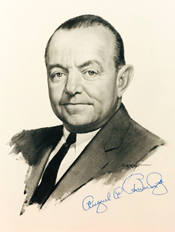
A right-hander, Crimian was a relief specialist with the Cardinals, but had his most successful season as a starter in the minor leagues.

Willing to work

After graduating high school in Philadelphia, Crimian was signed by the hometown Phillies. In 1944, his first season in the Phillies’ minor-league organization, Crimian earned 18 wins. He joined the Army in 1945 and served as a paratrooper. A year later, he returned to the Phillies’ farm system and was chosen by the Cardinals in the November 1946 minor-league draft.

In 1951, Crimian’s fifth season as a Cardinals minor leaguer, he thrived as a reliever for Columbus manager Harry Walker.

Crimian worked in 30 of Columbus’ first 50 games, developing a reputation as a “rubber-armed pitcher,” according to The Sporting News.

“Crimian is a big-league relief pitcher,” said Charlie Grimm, manager of the Braves’ Milwaukee farm team. “I’ll not miss him when the St. Louis Cardinals call him up.”

On Walker’s recommendation, the Cardinals promoted Crimian on July 1, 1951, as they were about to embark on a three-week road trip. “Harry told me Jack was one of those guys you can use every day for a couple of innings and have him go at top speed,” said Cardinals manager Marty Marion. “That’s what we need.”

Frustrating the Phillies

Crimian, 25, made his major-league debut for the Cardinals on July 3, 1951, against the Reds at Cincinnati. Relieving Harry Brecheen in the sixth inning, Crimian faced two batters, yielding a walk to Dixie Howell and a three-run double to Barney McCosky. Boxscore

The highlight of Crimian’s stint with the Cardinals came two weeks later, on July 15, 1951, in the first game of a doubleheader against the Phillies at Shibe Park in Philadelphia.

With the score tied at 3-3, Crimian relieved Brecheen and held the Phillies scoreless in the sixth, seventh and eighth innings, working around a leadoff triple by Granny Hamner in the seventh. The Cardinals scored twice in the seventh and twice in the eighth, taking a 7-3 lead into the bottom of the ninth.

With one out, Del Ennis hit a home run against Crimian, cutting the Cardinals’ lead to 7-4. After Hamner grounded out, Jimmy Bloodworth walked and Del Wilber doubled, putting runners on second and third and bringing the potential tying run to the plate.

Dick Sisler, a former Cardinal, was the batter. After working the count to 2-and-1, he hit a pitch from Crimian over the right-field wall. If the ball landed fair, it would have been a three-run home run, tying the score, but it curved into foul territory.

Unwilling to let Crimian throw another pitch to Sisler, Marion brought in Al Brazle to finish the job. Brazle’s first pitch was a curveball and Sisler watched it bend across the plate for strike three, preserving the win for Crimian. Boxscore

A week later, on July 24, 1951, Crimian made his first appearance at Sportsman’s Park in St. Louis and Sisler again played a central role. With the Cardinals leading the Phillies, 8-5, Crimian relieved Brecheen with two on and two outs in the eighth and struck out Sisler. The Cardinals scored a run in the bottom of the eighth and Crimian retired the Phillies in order in the ninth, earning a save. Boxscore

On the move

Crimian made 11 appearances, all in July, for the 1951 Cardinals and was 1-0 with a 9.00 ERA before he was returned to the minors.

In 1952, Crimian was called up to the Cardinals in June, pitched in five games, posted a 9.72 ERA and was demoted.

Playing for Walker at Rochester in 1953, Crimian was 13-5 with a 2.86 ERA, but the Cardinals didn’t call. On Dec. 2, 1953, the Cardinals sent Crimian and $100,000 to the Reds for shortstop Alex Grammas.

According to the Dayton Daily News, Walker spoke to Reds manager Birdie Tebbetts about Crimian and said there’s “no reason why he can’t relieve successfully in the majors.”

The Reds, though, never gave Crimian a chance. On April 8, 1954, the Reds sold Crimian’s contract to the Toronto Maple Leafs, an unaffiliated minor-league club owned by Jack Kent Cooke. The Maple Leafs manager was Luke Sewell, who managed the St. Louis Browns to the 1944 American League pennant and a berth in the World Series against the Cardinals.

Back in the bigs

Crimian earned 30 saves for the Maple Leafs in 1954. During the summer, the Yankees expressed interest in acquiring him, “but Cooke wouldn’t part with Crimian in midseason,” The Sporting News reported.

In 1955, Sewell put Crimian in the starting rotation because he “wasn’t getting enough work to stay sharp” as a reliever.

“I have trouble keeping a fine touch if I don’t get enough work,” Crimian said.

Crimian posted a 19-6 record and 2.10 ERA, earning International League pitcher of the year honors.

The pitching-poor Athletics of the American League took notice. On Oct. 12, 1955, the Athletics acquired Crimian from the Maple Leafs for pitcher Marion Fricano and $60,000.

“If they give this fellow a chance to learn the hitters, he can’t miss,” Sewell said. “He’s got the best control I’ve seen in any pitcher.”

Crimian spent the 1956 season with the Athletics and was 4-8 with a 5.51 ERA in 54 appearances. His highlight came on Sept. 4, 1956, when he won a start against the Indians and outdueled Herb Score, a 20-game winner. Boxscore

In December 1956, the Athletics traded Crimian to the Tigers. He pitched in four games for them in 1957, including on April 18 when Indians rookie Roger Maris hit his first major-league home run, a grand slam, against Crimian in the 11th inning at Detroit. Boxscore

(Updated April 28, 2020)

In a meeting with Cardinals players after they won two consecutive National League pennants and a World Series title, club owner Gussie Busch warned them about getting fat, greedy and selfish, and scolded them for backing union leadership he considered disrespectful to management.

Players expecting gratitude and support for achieving back-to-back championship seasons, and seeking encouragement in their pursuit of more success, instead were told they needed to do a better job of conforming and representing the organization.

Busch’s speech on March 22, 1969, played well with some of the public, but backfired with some of the players, who were demoralized rather than inspired by his words. His rant was cited as a turning point in transforming the Cardinals from proud champions to dispirited underachievers.

Playing hardball

In the weeks leading to spring training in 1969, Busch became irritated and frustrated when the players’ union threatened to strike in a dispute with owners over the percentage players would get from television revenue.

Busch also was miffed by the salary demands of his players. The player payroll for the 1969 Cardinals was reported to be the highest in baseball at an estimated total of $900,000 to $1 million.

On Feb. 4, 1969, Cardinals pitcher Bob Gibson was a guest on NBC’s “The Tonight Show,” appearing with entertainers Vince Edwards, Redd Foxx, Peter Lind Hayes and Tina Louise. Gibson explained to host Flip Wilson, subbing for Johnny Carson, why players were prepared to boycott spring training and defended their stance.

In his 1994 book “Stranger to the Game,” Gibson said his comments upset Busch. With a 1969 salary of $125,000, Gibson was the highest-paid Cardinals player and joined Stan Musial as only the second to receive $100,000 in a season. In return for such compensation, Busch expected Gibson to be supportive of management.

Though the players’ union called off the proposed spring training boycott after reaching a compromise on percentage of television revenue shared, the amount owners would contribute to the pension fund and the years needed to qualify for a pension, Busch didn’t like what he was seeing and hearing from players and decided to “get it off my chest.”

Busch prepared a speech and previewed it with Cardinals executive vice-president Dick Meyer, senior vice-president Stan Musial, general manager Bing Devine and manager Red Schoendienst.

With those key management people onboard, Busch invited the media to attend his meeting with the players on a Saturday morning in the team clubhouse at the St. Petersburg, Fla., training camp.

Being bossed

“It was unusual for players to meet with the owner and unprecedented, not to mention discomfiting, to do it with reporters in attendance,” Gibson said.

The players gathered in full uniform as Busch took a seat and began speaking.

“Fans no longer are as sure as they were before about their high regard for the game and the players,” Busch said.

“Too many fans are saying our players are getting fat, that they only think of money, and less of the game itself. The fans will be looking at you this year more critically than ever before to watch how you perform and see whether you really are giving everything you have.”

Regarding the players’ union, Busch said, “Baseball’s union representatives made all kinds of derogatory statements about the owners. We suddenly seem to be your greatest enemies. Representatives threw down all sorts of challenges, threats and ultimatums. Personally, I don’t react well to ultimatums.”

When Busch finished his 25-minute talk, players applauded “politely,” the St. Louis Post-Dispatch reported. Busch invited players to comment or ask a question, but none did.

Meyer spoke next and made remarks tailored to drive a wedge between players and union leader Marvin Miller.

“He works for you,” Meyer said of Miller. “You don’t work for him. You cannot assign your future and the future of your family to someone else. If you do, you’re in trouble.”

Keeping up appearances

Asked by the Post-Dispatch for their reactions, most players stuck to generalities. “It was well said,” offered Tim McCarver. Lou Brock called it “very well put” and Dal Maxvill said “it was first class.” Others, such as Gibson and Curt Flood, declined comment.

In his 1971 book “The Way It Is,” Flood explained, “I feared that if I so much as hinted at the truth about that meeting I would be gone from the team in a week. I was sick with shame and so was everyone else on the Cardinals except Busch and his claque.”

Flood said Busch “depicted us as a rabble of ingrates” and “humiliated us to the best of his ability.”

“Busch was using the occasion not only to revile us but to reassert the uniquely feudal privileges vested to him and other club owners by baseball’s reserve system,” Flood said.

Anheuser-Busch printed 100,000 copies of Busch’s speech and distributed versions to its 21,000 stockholders, about 10,000 employees and anyone else who wanted one, The Sporting News reported.

Changes in attitude

Busch’s remarks made headlines, but “there is no evidence this had any effect” in him getting what he wanted, The Sporting News observed. On the eve of the 1969 season opener, “several key players refused to attend” a civic dinner.

The Cardinals played poorly in the first half of the 1969 season, posting records of 9-12 in April, 12-13 in May and 14-16 in June. After the Cardinals were swept by the Pirates in a three-game series to open the season, coach Dick Sisler said, “If we don’t win one pretty soon, we are going to have the first million-dollar bench.”

In summarizing the 1969 Cardinals, Sports Illustrated wrote, “The Cards threw to the wrong bases on defense and sometimes did not throw at all. Opposing runners stole with impunity and the St. Louis bullpen collapsed almost completely.”

The Cardinals finished at 87-75 and in fourth place in a six-team division. The Cardinals wouldn’t return to the postseason until 1982.

Gibson cited Busch’s speech as “defining a moment as any” in the Cardinals’ decline. “It seems our deterioration as a ballclub traced back to the fact the Cardinals, as an organization, were simply not willing or prepared to keep up with the times,” Gibson said.

Said Flood: “We Cardinals became a morose and touchy team. Our concentration suffered. So did the remarkable spirit of fraternity that had helped us dominate the league for two years in succession.”

(Updated June 15, 2023)

Joe Gibbon grew up as a Cardinals fan in Mississippi, passed up a career in basketball for baseball and pitched in the major leagues for 13 seasons.

Gibbon spent his big-league career in the National League with the Pirates (1960-65 and 1969-70), Giants (1966-69), Reds (1971-72) and Astros (1972).

A left-hander who threw sidearm and possessed a sinking fastball, Gibbon was used as a starter and reliever. He had a record of 61-65 with 32 saves and a 3.52 ERA in the majors. Gibbon was 38-46 with a 3.98 ERA as a starter and 23-19 with a 2.73 ERA as a reliever.

Against the Cardinals, Gibbon was 3-9 with three saves and a 5.05 ERA, giving up 155 hits in 117.2 innings. Curt Flood batted .531 in 49 at-bats versus Gibbon, but Lou Brock hit .159 in 44 at-bats.

In the book “We Played the Game,” Cardinals catcher Tim McCarver, comparing the pitching motions of National League left-handers, said, “Sandy Koufax came over the top, so he wasn’t as frightening as left-handers like Joe Gibbon and (Pirates teammate) Fred Green.”

In his book, “Baseball for Brain Surgeons and Other Fans,” McCarver explained why he thought Gibbon was intimidating for a left-handed batter to face: “On his delivery, he’d drop his arm to first and our rear ends would follow. It was impossible to stay in against him. I said, ‘I’m going to stand away from the plate and I’ll take anything inside,’ but when I moved off the plate, he’d cleverly follow me with his sinker. I still couldn’t extend my arms. I’d lose all sense of where I was in the box.”

Hoops talent

Gibbon was born and raised in Hickory, Mississippi, a town named after President Andrew Jackson, who earned the nickname “Old Hickory” because of his toughness as an Army general.

Gibbon followed the Cardinals as a youth and his favorite player was Stan Musial, according to the Society for American Baseball Research. Gibbon listened on radio to the broadcast of Game 7 of the 1946 World Series when Harry Walker of the Cardinals drove in Enos Slaughter with the winning run against the Red Sox. Walker would become one of Gibbon’s managers in the big leagues.

At 6 feet 4, Gibbon was talented in baseball and basketball, excelling in both sports at the University of Mississippi. In the 1956-57 NCAA Division I basketball season, Gibbon was second in the nation in scoring, averaging 30 points and 14.1 rebounds a game. Grady Wallace of South Carolina averaged 31.2 points and he and Gibbon finished ahead of Seattle’s Elgin Baylor (29.7) and Kansas’ Wilt Chamberlain (29.6).

Gibbon was drafted by the NBA Boston Celtics but signed with the baseball Pirates in 1957. In 1959, his third season in the Pirates’ farm system, Gibbon was 16-9 with a 2.60 ERA for Class AAA Columbus, Ohio, gaining him a spot in the majors with the 1960 Pirates.

Rookie success

After earning two wins in relief in April 1960 for the Pirates, Gibbon’s first win as a big-league starter came against the Cardinals on May 19 at Pittsburgh.

Matched against 19-year-old Ray Sadecki, who was making his major-league debut for the Cardinals, Gibbon pitched six scoreless innings before yielding a run in the seventh and another in the eighth. The second run was scored by Musial, who walked in a pinch-hit appearance the first time he faced Gibbon.

Gibbon pitched 7.1 innings, allowing two runs, striking out seven and getting the win in an 8-3 Pirates triumph over the Cardinals. Boxscore

The Pirates won the 1960 National League pennant and Gibbon contributed with a 4-2 record. In the 1960 World Series against the Yankees, Gibbon made two relief appearances, surrendering a three-run home run to Mickey Mantle in Game 2 Boxscore and pitching a scoreless inning in Game 3. The Pirates won the championship in Game 7.

Birthday blast

In 1961, Gibbon earned 13 wins for the Pirates, but against the Cardinals he was 0-3 with a 7.71 ERA.

On Aug. 9, 1961, the Cardinals’ Julian Javier broke up a scoreless game with a grand slam against Gibbon in the eighth inning at Pittsburgh. Javier, a former Pirates prospect playing on his 25th birthday, hit an outside fastball down the right-field line and over the wall at Forbes Field. Boxscore

Six years later, on June 29, 1967, Gibbon started for the Giants against the Cardinals at St. Louis. The Giants scored 11 runs in the top of the first against Bob Gibson and Nelson Briles, but Gibbon couldn’t take advantage of the gift. He gave up two runs in the bottom half of the inning without getting an out and was lifted for a reliever. Boxscore

(Updated April 13, 2025)

For such a straightforward deal, the trade of Joe Torre to the Cardinals for Orlando Cepeda took some twists and turns involving pitcher Nolan Ryan and center fielder Curt Flood.

On March 17, 1969, the Cardinals sent Cepeda to the Braves for Torre in a swap of first basemen.

The Braves were shopping Torre because he was feuding with general manager Paul Richards and hadn’t signed a contract. Most thought Torre would go to the Mets, who’d been in trade talks with the Braves for several weeks.

The Mets offered pitcher Nolan Ryan, first baseman Ed Kranepool, infielder Bob Heise and a choice of catchers, J.C. Martin or Duffy Dyer, for Torre and third baseman Bob Aspromonte, The Sporting News reported. Torre and Aspromonte were Brooklyn natives.

Ryan, who would become baseball’s all-time leader in strikeouts, impressed the Braves but was a raw talent. Richards rejected the four-for-two proposal because he wanted catcher Jerry Grote or outfielder Amos Otis, but the Mets “labeled them untouchables,” according to Atlanta Constitution sports editor Jesse Outlar.

When the Mets wouldn’t budge, the Braves offered Torre to the Dodgers for catcher Tom Haller, but the Dodgers weren’t interested, the Constitution reported.

Cardinals general manager Bing Devine offered Cepeda and Flood for Torre and outfielder Felipe Alou, according to the Constitution, but Richards wouldn’t trade Alou, so the clubs settled on Cepeda for Torre. Seven months later, when the Cardinals traded Flood to the Phillies, he refused to report, prompting his legal challenge of the reserve clause and opening a path to the creation of free agency.

Cepeda feels chill

The Cardinals were willing to trade Cepeda because his performance declined in 1968 and he miffed management by reporting late to spring training in 1969.

After batting .325 with 111 RBI and winning the National League Most Valuable Player Award with the Cardinals in 1967, Cepeda hit .248 with 73 RBI in 1968.

Cepeda “found himself taken advantage of by well-wishing friends who helped him pile up debts and other problems that didn’t endear him to management … especially when at times he’d duck out of the dugout between innings to conduct personal matters,” Bob Broeg of the St. Louis Post-Dispatch reported.

The Cardinals hoped Cepeda would be more focused in 1969, but he informed Devine by telegram he would report late to spring training.

When Cepeda arrived at camp on March 5, he said he’d been sick, but Devine fined him $250 for reporting 48 hours later than he said he would.

Cepeda said he detected “a coolness” from Devine, and Broeg reported “Cepeda realized there had been a change in attitude toward him.”

“Bing was not terribly friendly and he was all business,” Cepeda said in his 1998 book “Baby Bull.”

In his 2004 book “The Memoirs of Bing Devine,” Devine said, “I thought Cepeda might be on the way down.”

Mother knows best

Torre, meanwhile, was having issues with Braves management because Richards wanted him to take a salary cut. Torre hit .294 in nine seasons (1960-68) as Braves catcher, but he tore ligaments in his ankle in 1967 and suffered a broken cheek and broken nose when hit by a pitch from Chuck Hartenstein of the Cubs in 1968. Limited to 115 games in 1968, Torre batted .271 with 55 RBI.

The Braves planned to move Torre to first base in 1969, but when he refused to report to spring training because of the salary squabble, Richards told him he could “hold out until Thanksgiving” because the club would be OK without him.

The Cardinals were interested because Torre (28) was three years younger than Cepeda (31), had a less expensive salary ($65,000) than Cepeda ($80,000) and could play multiple positions.

“This is all part of our belief that we can’t just sit and ride along with a winner, but must look for changes that make sense,” Devine said.

Devine projected Torre to play first base and back up Tim McCarver at catcher.

When Torre told his mother he’d been traded to the two-time defending National League champions, she replied, “Now go to church and thank God.”

“Mom recognized what going with a championship ballclub like the Cardinals meant,” Torre said.

Looking back on the trade, Torre told Cardinals Yearbook in 2014, “The fact I was traded for Orlando Cepeda surprised the hell out of me. He was so well thought of as a player and a great leader.”

Cepeda, described by pitcher Bob Gibson as the team’s “spiritual leader,” said he was “shocked” by the trade, “but I’m not mad at the Cardinals. They treated me very well.”

Said Richards: “Now we have someone to hit behind Hank Aaron. The opposition can no longer pitch around Aaron.”

Good fit

When Torre joined the Cardinals at training camp, he was greeted by Warren Spahn, a manager in their farm system and a former battery mate. “You’ll love it here,” Spahn told Torre.

Torre wore uniform No. 15 with the Braves, but McCarver had that number with the Cardinals. “I think I’ll ask for No. 6,” Torre said with a smile, knowing it was the retired number of Stan Musial.

Torre was given No. 9, last worn by recently retired Roger Maris. “I thought No. 9 was great, knowing who had worn it the year before,” Torre recalled to Cardinals Yearbook in 2014. “I knew Roger a little bit, and I knew what kind of guy he was, so I was really proud to have it.”

In his 1997 book, “Chasing the Dream,” Torre said, “I felt a lot of pressure trying to replace Cepeda, but found myself surrounded by a great bunch of teammates.”

With Cepeda, the Braves won a division title in 1969 and played in the National League Championship Series against the Mets, who’d acquired Donn Clendenon to play first after they failed to get Torre. The Cardinals placed fourth in their division and Gibson good-naturedly chided Torre, saying, “You know, we used to win before you got here.”

Individually, Torre had a better 1969 season than Cepeda. Torre hit .289 with 101 RBI. Cepeda hit .257 with 88 RBI.

Cepeda played four seasons with the Braves and hit .281. Torre played six seasons with the Cardinals and hit .308. In 1971, Torre was named winner of the National League Most Valuable Player Award when he batted .363 with 137 RBI as Cardinals third baseman.

Years later, Devine said acquiring Torre “was one of my favorite deals on the basis of his long-term success.”

(Updated April 13, 2020)

Don Newcombe was as tough on the Cardinals with a bat as he was with pitches.

Newcombe was a hard-throwing, hard-hitting pitcher who spent his prime years with the Dodgers.

At 6-4, 220 pounds, Newcombe was an imposing figure on the mound, where he threw right-handed, and at the plate, where he hit left-handed.

In 10 years in the major leagues, Newcombe had a 149-90 record and hit .271 with 15 home runs. Against the Cardinals, Newcombe was 23-11 and hit .299 with six home runs.

In 1955, when he was 20-5 for the champion Dodgers, Newcombe “toyed with the Cardinals as though they were a sandlot team,” the St. Louis Post-Dispatch reported. Newcombe was 4-0 with a 1.75 ERA and batted .524 with seven RBI versus the 1955 Cardinals.

Newcombe “is downright unbelievable these days,” marveled the Post-Dispatch. “The way he’s going, the only question is whether he can throw as hard as he can hit, or hit as hard as he can throw.”

Rookie vs. Redbirds

Newcombe, 22, made his major-league debut for the Dodgers against the Cardinals on May 20, 1949, at St. Louis and it was a hard-luck initiation.

With the Cardinals ahead, 3-2, Newcombe relieved Rex Barney to open the bottom of the seventh inning. The St. Louis Star-Times, getting its first glimpse of the rookie, described him as “bull-shouldered” and a “massive mountain man.”

Newcombe struck out the first batter, Chuck Diering, on three pitches _ two fastballs and a curve _ and Red Schoendienst followed with a lined single to right.

Next up was Stan Musial. Newcombe fooled him with a low, outside pitch, causing Musial to check his swing, but the ball met his bat and was blooped into shallow left for a single, moving Schoendienst to second.

Newcombe overpowered the next batter, Eddie Kazak, who topped the ball to short so weakly Pee Wee Reese had no play.

The infield single loaded the bases for Enos Slaughter, who drove Newcombe’s first pitch deep down the left-field line for a bases-clearing double. Newcombe was relieved by Erv Palica and the Cardinals won, 6-2. Boxscore

“I had good stuff,” Newcombe said to The Brooklyn Daily Eagle. “My arm felt good and loose, too.”

According to a Saturday Evening Post article reported on in The Sporting News, when Newcombe struck out Diering, “the Negro fans in the right field stands at Sportsman’s Park went wild. White fans resented this _ cheers for the visiting Negro player and hoots for the hometown Cardinals. So when the Cardinals began pounding away at Newcombe, the white fans gave him the business.”

Three months later, on Aug. 24, 1949, in what The Brooklyn Daily Eagle called “quite possibly the most important single game the Dodgers will have this season,” Newcombe pitched a shutout and drove in three runs in a 6-0 victory over the Cardinals at Brooklyn. The win moved the Dodgers within a game of the first-place Cardinals. Boxscore

Newcombe is “the closest thing to a real blow-’em-down pitcher the National League has seen since Mort Cooper was at his best,” declared the Post-Dispatch.

Solved by Stan

The Dodgers won the 1949 pennant, finishing a game ahead of the Cardinals. Newcombe posted a 17-8 record, pitched 244.1 innings and won the National League Rookie of the Year Award.

In the 1994 book “We Played the Game,” Newcombe said as a rookie, “I had the talent and desire _ and I was cocky. I knew I was good, as good or better than the white guys who were trying to keep me from being there.”

Newcombe led the National League in winning percentage in 1955 (20-5, .800) and 1956 (27-7, .794), and was 4-0 versus the Cardinals in each season.

The Cardinal who hit Newcombe the hardest was Musial. Newcombe gave up more home runs (11) to Musial than to any other batter. Musial hit .349 against him.

In “We Played the Game,” Newcombe said, “I pitched toward batters’ weaknesses. Except for Stan Musial and Hank Aaron, they all had weaknesses, even Willie Mays.”

On June 21, 1956, during a season when Newcombe won both the Cy Young Award and the National League Most Valuable Player trophy, Musial hit a pair of two-run home runs and a single against him, but the Dodgers won, 9-8, with a four-run rally in the bottom of the ninth. Boxscore

Newcombe and Carl Erskine were the pitchers when Musial hit for the cycle against the Dodgers on July 24, 1949, at Brooklyn. Musial tripled against Newcombe and had a single, double and home run off Erskine. Boxscore

In his 1964 autobiography, “Stan Musial: The Man’s Own Story,” Musial said, “Newk had as great control for a hard thrower as any pitcher I ever faced. I hit him good, but he had a good fastball and curve.”