Feeds:
Posts
Comments

“You’re going to like us” was the slogan used for many years by Trans World Airlines (TWA), but the upbeat pitch didn’t fly with a trio of Cardinals miscreants.
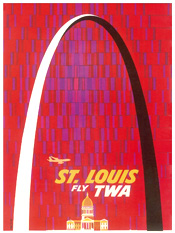
On April 11, 1979, Cardinals players Keith Hernandez, Ken Reitz and Silvio Martinez, frustrated by a lengthy flight delay, tore up a TWA hospitality room at Lambert Field in St. Louis.

The incident embarrassed Cardinals management and created a public relations headache for the club.

Storms brewing

After an April 11 afternoon game against the Cubs at St. Louis was rained out, the Cardinals boarded a bus at Busch Stadium and went to the airport for a scheduled 4:50 p.m. commercial flight to Pittsburgh.

The TWA flight, originating in San Francisco, was delayed when the plane was rerouted to Kansas City because of severe thunderstorms in St. Louis. Eventually, all flights in and out of Lambert Field were suspended for two hours because of the weather, the St. Louis Post-Dispatch reported.

TWA arranged for the Cardinals to wait out the delay in a hospitality room. The flight didn’t take off until 1:30 a.m., about nine hours later than scheduled.

At some point during the long wait, Hernandez, Reitz and Martinez went on “a destructive rumpus” and left the room “a shambles,” the Post-Dispatch reported.

Grow up, guys

Initially, details about the incident were slow to emerge.

The story took a turn when an eyewitness told the Post-Dispatch, “They put them in this VIP room and they just completely demolished it. One guy threw a chair, then threw a cabinet and tore down some signs. They just wrecked it. If it had been some college kids going to Fort Lauderdale, they’d been in the newsreels and in jail in Clayton. It was just terrible.”

TWA spokesman Larry Hillard confirmed the Cardinals “damaged folding doors, tore lettering off the walls and ripped out telephones. They also broke up some chairs and other types of wooden doors.”

While the Cardinals were in Pittsburgh, where they lost three of four games against the Pirates, public outrage in St. Louis about the airport incident was rising and club management was feeling pressure to respond. General manager John Claiborne met the team at its next stop in Chicago, fined the players involved and told them they would have to pay for the damages they caused.

“Those responsible realize they were wrong and have apologized to TWA and any other offended body, including Anheuser-Busch,” Claiborne said, referring to the Cardinals’ parent company.

Post-Dispatch columnist Dick Kaegel said the vandalism done by the players “was inexcusable” and a “childish act by grown men who should know better.”

“Sure, a nine-hour wait in an airport is frustrating,” Kaegel wrote. “It was an inconvenience. But that same night in the St. Louis area hundreds of persons were leaving their flood-devastated homes. Some were wiped out. A High Ridge mother lost her 11-year-old son to the raging torrent. A St. Charles man drowned. Compared to that, the Cardinals’ inconvenience is inconsequential.”

My fault

Days later, after the team returned home, Reitz said he was responsible for doing most of the damage at the airport and may have had too much to drink. “Keith and Silvio didn’t do all that much,” he said. Hernandez and Martinez declined comment.

“You do some things sometimes you’re sorry for later,” Reitz said. “At that point in time, I didn’t think it was that big a deal.”

Reitz said he began to realize the consequences of his behavior when Claiborne “told us what the damages were and how many people were offended.”

“I screwed up,” Reitz concluded. “Let’s put it plain and simple.”

A month later, in May 1979, the Cardinals signed Reitz, a third baseman, to a five-year contract extension totaling between $1.25 million and $1.3 million.

In October 1979, Stan Isle of The Sporting News reported Ozark Air Lines, which provided charter flights for the Cardinals and other teams, “may be having second thoughts about future service for some baseball clubs,” according to a company official, because of bad behavior by players.

According to The Sporting News, “On one of the Cardinals’ charter flights, from Pittsburgh to Chicago, witnesses said right-hander Pete Vuckovich had to be restrained after an altercation with manager Ken Boyer. The incident alarmed flight attendants and the pilot threatened to land in Indianapolis before order was restored.”
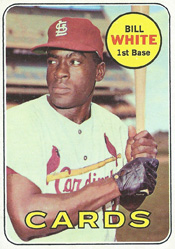
A friendship with general manager Bing Devine enabled first baseman Bill White to finish his playing career with the Cardinals.

On April 2, 1969, the Cardinals reacquired White from the Phillies for infielder Jerry Buchek and utility player Jim Hutto.
The trade gave White, 35, the opportunity to return to the team for whom he’d achieved the most success.

White no longer was an everyday player and he was preparing to transition into a television career in Philadelphia, but Devine wanted him to fill a bench role and White was willing to do so as a favor to his friend and to bring closure to his playing days.

Ties that bind

In White’s first stint with the Cardinals, from 1959-65, he topped 100 RBI three times, hit 20 or more home runs five years in a row and won the Gold Glove Award six times as a first baseman. He also was a National League all-star in five of his seasons with the Cardinals and helped them become 1964 World Series champions.

In October 1965, Cardinals general manager Bob Howsam traded White to the Phillies. He had 22 home runs and 103 RBI for them in 1966, but he injured an Achilles tendon in 1967 and his production declined considerably.

According to the Philadelphia Inquirer, White decided in August 1968 he would retire after the season, but Phillies general manager John Quinn convinced him to play another year.

At spring training in 1969, when the Phillies shifted Richie Allen from third base to first base, White asked Quinn what the club planned to do with him. Quinn said the Phillies wouldn’t cut White from the roster but might trade him to the Cardinals.

“Bing Devine has expressed an interest in you,” Quinn told White.

Devine was Cardinals general manager in March 1959 when the club acquired White from the Giants. Devine and White developed a mutual respect and their bond remained strong, even after Devine was fired by Cardinals owner Gussie Busch in August 1964.

In 1967, when White was with the Phillies and Devine was with the Mets, Devine visited White at his home to offer support and encouragement while White was attempting to recover from the Achilles tendon injury. “I think a lot of him,” White said to the Inquirer.

Welcome back

In his 2011 autobiography, “Uppity,” White said, “At first I said no to the proposed trade, but Bing was persuasive.”

White told Quinn he agreed to the trade because of Devine, who returned to the Cardinals after the 1967 season. “I wouldn’t have gone to any other team,” White said to the Inquirer. “I wouldn’t even have gone to St. Louis if it were not for Bing Devine.”

The Philadelphia Daily News described the two-time defending National League champion Cardinals as “a dynasty.” Joe Torre, acquired from the Braves for Orlando Cepeda, was the first baseman for the 1969 Cardinals and Devine saw White as being an ideal backup as well as a left-handed pinch-hitter.

“Bill fits the bill,” Devine said to the St. Louis Post-Dispatch.

In a 2011 interview, White told me another reason Devine wanted him back with the Cardinals is he hoped to groom him to become a manager when White was done playing, but White wasn’t interested.

“Bing brought me back because he wanted me to manage at (Class AAA) Tulsa and eventually manage the Cardinals,” White said. “I didn’t want to manage. I didn’t want to try to tell 25 other guys how to play the game. I’d rather do something where the success depends on me, not on other people.”

Open and shut

White wore No. 12 for most of his first seven seasons with St. Louis, but backup outfielder Joe Hague had that number with the 1969 Cardinals. White asked for and received No. 7 because he liked low numbers, he said to the Post-Dispatch.

“I’m ready to do anything they want me to _ even pitch batting practice,” White said to the Post-Dispatch.

“This isn’t a knock at the Phillies’ organization _ they’ve been good to me _ but the difference between playing in St. Louis and Philadelphia is night and day,” White said to the Inquirer. “It’s depressing playing in that Philadelphia ballpark. Heck, my locker was over a sewer … And it’s depressing to hear your teammates booed.”

On April 8, 1969, the Cardinals opened the season against the Pirates at St. Louis. In the 12th inning, with the score tied at 2-2, two outs and Mike Shannon on first base, Cardinals manager Red Schoendienst sent White to bat for second baseman Julian Javier.

White was “cheered loudly” as he stepped to the plate, the Post-Dispatch reported.

Facing right-hander Ron Kline, White lined a pitch to left-center.

“What appeared to be a sure double turned out to be a mere out because the ball hooked toward” left fielder Willie Stargell, who made a one-handed catch while on the run, according to the Post-Dispatch.

If the ball had eluded Stargell, Shannon likely would have circled the bases and scored the game-winning run.

“That could have been a great way to open up,” hitting coach Dick Sisler said to White.

White replied, “Yeah, that would have carried me all year.”

Instead, the Pirates scored four runs in the 14th against Mel Nelson and won, 6-2. Boxscore

The 1969 season turned out to be disappointing for the Cardinals, who finished in fourth place in a six-team division, and for White. He suffered sore ribs and cuts to his left elbow in a car accident in St. Louis on May 3. For the season, White hit .211 with no home runs and four RBI in 57 at-bats. As a pinch-hitter, he batted .167 (5-for-30).

White retired as a player after the 1969 season and launched a broadcasting career before becoming president of the National League.

Five months after he suffered multiple injuries when struck by a car, Harry Caray returned with a flourish to broadcast the season opener for the Cardinals.

On April 8, 1969, when the two-time defending National League champion Cardinals opened the season against the Pirates at St. Louis, Caray called the game from the Busch Memorial Stadium broadcast booth.
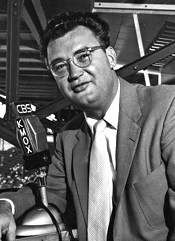
Caray’s appearance was a testament to his determination to recover from compound fractures of both legs, a broken right shoulder, a broken nose and facial cuts and he made certain his comeback was noticed. Given center stage as emcee for pre-game ceremonies on the field, he put on a performance for the audience.

Road to recovery

At about 1:15 a.m. on Nov. 3, 1968, Caray, 51, was hit by a car while he attempted to the cross the street outside the Chase Park Plaza Hotel in St. Louis.

Caray’s injuries were disabling and he spent several weeks in a St. Louis hospital. After his release just before Christmas in 1968, Caray went to Florida and continued his recuperation near St. Petersburg at the beach house of Cardinals owner Gussie Busch.

In his 1989 book “Holy Cow!,” Caray said he was under the care of a male nurse at Busch’s residence and dutifully did isometric exercises daily. According to The Sporting News, he also did a daily radio show from the beach house for St. Louis station KMOX.

Though both legs were in casts, Caray said in his book, “I managed to keep myself entertained. I had a lot of friends there and they were always coming by the house or taking me out to restaurants. I could get around in a collapsible wheelchair.”

In early February 1969, Caray went to St. Louis to be evaluated by his doctors. He convinced them to remove the casts from his legs and returned to Florida as the Cardinals were arriving in St. Petersburg for spring training.

“I was determined to get myself in shape right along with the players,” Caray said.

Caray reported daily to Cardinals trainer Bob Bauman at the club’s spring training facility. “Caray has spent more time in the rubbing room than the adhesive tape,” The Sporting News noted.

Said Caray: “I worked hard, kept on the leg exercises and by the end of spring training I had advanced from crutches to canes to the point where I didn’t really need anything to help me walk.”

Ribbed at roast

On April 7, 1969, on the eve of the Cardinals’ opener, Caray was the guest of honor at the annual Knights of the Cauliflower Ear banquet at the Stouffer’s Inn in downtown St. Louis. The event was similar to the famous Friars Club roasts where the guest of honor was expected to be skewered, or “roasted,” by colleagues.

According to the St. Louis Post-Dispatch, Caray used a cane to maneuver his way around the banquet hall.

Jack Buck, Caray’s Cardinals broadcast partner, was master of ceremonies for the event and delivered several zingers at the guest of honor.

“What nice things can I say about Harry that you haven’t heard from the man himself?” Buck said in his opening remarks.

Referring to Caray getting hit by a car, Buck said to the audience, “What can I say to make you believe I didn’t do it?”

As the event ended, Buck told the crowd, “Please drive carefully. Harry’s walking again.”

St. Louis showman

The Cardinals opened the 1969 season on a Tuesday night.

When Caray emerged from the dugout to begin the pre-game ceremonies at home plate, he used two canes to walk onto the field. He received polite applause while “hobbling along rather pathetically,” he said in his book.

As Caray approached the first-base line, “I whirled one cane over my head and flung it as far as I could,” he said.

With the crowd cheering and urging him on, Caray started toward home plate with the help of the remaining cane. Just before he got to his spot, Caray stopped and tossed the cane into the air as spectators roared in approval.

After the ceremony, Caray made his way to the dugout and was approached by pitcher Bob Gibson. According to Caray, they had the following exchange:

Gibson: “Harry, what the hell was that all about?”

Caray: “Hey, Gibby, it’s like I’ve always told you, pal. This isn’t just baseball. It’s show biz.”

During the broadcast of the game, won by the Pirates in 14 innings, Caray interviewed baseball commissioner Bowie Kuhn and let him do some play-by-play. Boxscore

The 1969 season turned out to be Caray’s last with the club. On Oct. 9, 1969, he was fired after serving as the voice of the Cardinals for 25 years.

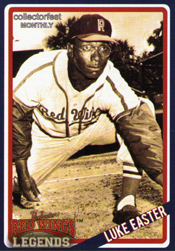
Luke Easter was a popular player with a power-packed swing who produced home runs well past age 40, including two seasons with a Cardinals farm club.

Easter grew up in St. Louis and played semipro baseball there. He became one of the top sluggers in the American League with the Indians in the 1950s before extending his career in the minors at Buffalo and Rochester.
His life ended tragically, on March 29, 1979, when he was robbed and murdered by two gunmen outside a bank in Euclid, Ohio.

Hard hitting

Easter was born in Jonestown, Mississippi, and moved with his family to St. Louis when he was a boy. At 21, he joined a semipro team, the St. Louis Titanium Giants, in 1937 and played for them until he entered the Army in 1942.

A left-handed hitter, Easter was 6 feet 4 and 240 pounds. After his stint in the military, he eventually signed with the Pittsburgh-based Homestead Grays of the Negro National League and played for them in 1947 and 1948.

In 1949, two years after Jackie Robinson of the Dodgers integrated the major leagues, Easter signed with the defending World Series champion Indians and was assigned to their San Diego farm club in the Pacific Coast League. Though he missed time because of a broken right kneecap, Easter hit .363 with 25 home runs and 92 RBI for San Diego and was called up to the Indians in August 1949, a week after he turned 34.

Over the next three seasons, Easter was the Indians’ first baseman and produced 28 home runs with 107 RBI in 1950, 27 home runs with 103 RBI in 1951 and 31 home runs with 97 RBI in 1952. Easter was one home run short of tying teammate Larry Doby for the American League crown in 1952.

In 1950, Easter hit the longest home run at Cleveland’s Municipal Stadium. The ball carried 477 feet into the upper deck in right.

A broken left foot limited Easter to 68 games for the Indians in 1953. He batted six times for them in 1954 before being sent to the minors.

Better with age

Though he’d never again play in the big leagues, Easter, 38, wasn’t done as a player. He hit 28 home runs in the minors in 1954 and 30 in 1955.

In 1956, Easter joined the Buffalo Bisons of the International League and over the next three seasons he became their most popular and productive player. He hit 35 home runs with 106 RBI in 1956 and 40 home runs with 128 RBI in 1957. Many of Easter’s home runs were prodigious. In 1958, the year he turned 43, Easter hit 38 home runs with 109 RBI for Buffalo.

The spring weather was especially cold in upstate New York in 1959 and Easter struggled. He was batting .179 with one home run when he was released by Buffalo on May 13. “He gave it all he had, but it wasn’t enough,” Buffalo manager Kerby Farrell said to the Rochester Democrat-Chronicle.

Easter was immensely popular with fans, who marveled at his home run prowess and could count on him to accommodate autograph requests. The Rochester Red Wings, a farm club of the Cardinals, saw an opportunity and signed him. “We’ve been looking for another left-hand hitter with power,” said Rochester manager Cot Deal. “This could be the answer.”

Before sealing the deal, Rochester general manager George Sisler Jr., consulted with Cardinals farm director Walter Shannon and got approval to open a spot at first base for Easter by moving prime prospect Gene Oliver to left field, the Rochester newspaper reported.

Sisler wanted to be certain Oliver’s development wouldn’t be hurt by shifting positions. “As he goes, the team seems to go,” Sisler said, “and we don’t want to do anything to upset his playing or hitting.”

Right for Rochester

Easter got six hits in his first nine at-bats for Rochester and became a mainstay in the lineup. In August 1959, catcher Tim McCarver, 17, joined Rochester and became a teammate of Easter, 44.

Easter hit 21 home runs for Rochester in 1959. The last produced a walkoff win against Buffalo.

“There can be no arguing about Luke’s popularity, so clear-cut is the big man’s superiority in the goodwill department,” wrote Rochester sports editor Paul Pinckney. “He always will be the No. 1 choice of the youngsters.”

Though productive, the Cardinals didn’t call up Easter because they had George Crowe, 38, a left-handed batter who served as their backup first baseman and pinch-hitter.

In 1960, the year he turned 45, Easter produced a 22-game hitting streak for Rochester and overall hit .302 with 14 home runs.

After the 1960 season, Rochester dropped its affiliation with the Cardinals and became a farm club of the Orioles, but Easter remained. In 1962, the year he turned 47, Easter batted .281 with 15 home runs for Rochester. His last full season as a player was 1963. He also appeared in 10 games for Rochester as a pinch-hitter in 1964, the year he became 49.

Gentle giant

After his baseball career, which included a stint as Indians coach in 1969, Easter worked in Cleveland for TRW Inc., an aerospace and automotive manufacturer.

As chief steward for the Aircraft Workers Alliance at TRW, Easter provided a service to co-workers who couldn’t get to a bank. Easter regularly collected their paychecks, cashed them at a bank and delivered the cash back to his fellow employees at work.

Easter, 63, was leaving a bank with thousands of dollars in cash when he was approached by two men who demanded he give them the money. When Easter refused, they shot him dead.

In an interview with David Condon of the Chicago Tribune, Bill Veeck, the Indians owner who signed Easter in 1949, called him “a wonderful, gentle person.”

“Everyone will miss Luke as a man,” Veeck said. “Baseball also will mourn him as a superstar talent never fulfilled. Luke’s talent would have found fulfillment if he’d reached the big-time as a youth.”

Said Hall of Fame pitcher Bob Feller, who was Easter’s teammate with the Indians: “If Luke had come into the majors 10 years earlier, I think he’d have been one of the top hitters all-time.”

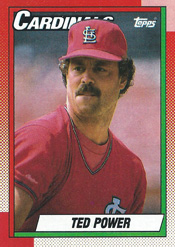
After a rough beginning to his season with the Cardinals, Ted Power recovered and developed into a reliable starting pitcher for them.

On March 28, 1989, the Cardinals signed Power, 34, to a minor-league contract following his release by the Tigers.
Five months later, Cardinals manager Whitey Herzog was referring to Power as the “savior” of the pitching staff.

Versatile pitcher

In 1981, Power debuted in the major leagues with the Dodgers, spent parts of two seasons with them and was traded to the Reds. A right-handed reliever, his breakout season came in 1985 when he produced eight wins, 27 saves and a 2.70 ERA for Cincinnati.

Reds manager Pete Rose put Power into the rotation in August 1986 and he was 6-1 with a 2.59 ERA in 10 starts. The next year, Power led the 1987 Reds in starts (34), innings pitched (204) and strikeouts (133).

The Reds traded Power to the Royals for pitcher Danny Jackson after the 1987 season. According to the St. Louis Post-Dispatch, Royals reliever Steve Farr displayed two baseball cards _ one of Dan Quisenberry and the other of Power _ atop his locker. “One of them is my idol on the field (Quisenberry) and the other my idol off the field,” Farr said.

The Royals sent Power to the Tigers in August 1988 and after the season he had surgery to remove calcium deposits near his right elbow. When spring training began in 1989, Power was ready to pitch for the Tigers.

Comeback bid

In March 1989, the Cardinals were in the market for pitching depth after starters Danny Cox and Greg Mathews went on the disabled list because of elbow ailments. General manager Dal Maxvill sent scout Rube Walker to Tigers camp to assess Power, and Herzog spoke with Detroit manager Sparky Anderson about the pitcher.

On March 25, 1989, the Tigers released Power and three days later he signed with the Cardinals, who assigned him to their Louisville farm club. Under terms of the contract, if Power received an offer from another big-league team while with Louisville, the Cardinals would have 48 hours to decide whether to promote him to St. Louis or let him depart.

“I look at those major-league box scores every day and see middle relievers and starters who aren’t doing the job,” Power said to the Louisville Courier-Journal. “I have all the confidence in the world that I’m going to get back. When I do, I won’t take anything for granted. You can get too comfortable up there. I won’t ever do that again.”

Louisville manager Mike Jorgensen placed Power in the rotation and he produced a 3-1 record and 2.73 ERA in five starts, prompting the Phillies to make him an offer. Unwilling to let Power go, the Cardinals promoted him to St. Louis on May 4, 1989.

“We were kind of forced to bring him up,” Herzog said to The Sporting News. “We didn’t want to bring him up that early.”

On the brink

After appearing in two games for the Cardinals, Power pulled a ribcage muscle while taking batting practice on May 17 and didn’t pitch again for them until June 20.

Herzog put Power in a rotation with Jose DeLeon, Joe Magrane, Ken Hill and Scott Terry, but he wasn’t effective. He reached a nadir on July 17, 1989, when he gave up seven runs to the Giants before being lifted with one out in the second inning. Boxscore

Power said he was overthrowing, causing his breaking pitches to “flatten out.” Said Herzog: “A lot of high sliders.”

Though he was 1-4 with a 7.43 ERA, Power made his next scheduled start against the Padres on July 22, 1989, held them to a run in 6.2 innings and got the win. Boxscore

“I feel like I belong in the big leagues, but this makes me feel like I belong on this team,” Power said.

Over his next three starts, Power shut out the Expos for seven innings, limited the Mets to a run in 6.2 innings and held the Pirates scoreless for eight innings.

“He’s kind of been a savior to us,” Herzog said.

Said Cardinals shortstop Ozzie Smith: “He’s throwing the ball as well as I’ve ever seen him throw it. It’s nice to see a guy like that come back. He was really on his way out.”

Getting it done

On Aug. 22, 1989, Power, matched against Derek Lilliquist, took a no-hitter and a 10-0 lead into the eighth against the Braves before he tired and gave up home runs to Tommy Gregg and Dale Murphy. Boxscore

In six August starts, Power produced a 2.61 ERA.

“He has more idea of what he wants to do,” said Cardinals catcher Tony Pena. “Before, he had no idea where he was throwing the fastball.”

Said Maxvill: “I look at 25 other clubs and how many have better fifth starters than Ted Power?”

On Sept, 2, 1989, Power beat the Astros in Bob Forsch’s last big-league start and last appearance against his former Cardinals teammates. Boxscore

Five days later, in a start against the Mets, Power suffered a hamstring injury. He was sidelined for two weeks and when he returned he made six appearances in relief.

Power finished with a 7-7 record and 3.71 ERA for the Cardinals in 1989. He became a free agent after the season and got a one-year offer from the Cardinals, but signed with the Pirates, who gave him a contract for 1990 with an option for 1991.

“I would really love to go back to St. Louis … but I’ve got to think of myself and my family,” Power said to the Post-Dispatch. “It looks like a deal that could be solid for a couple of years.”

Power went on to pitch the next four seasons for the Pirates (1990), Reds (1991), Indians (1992-93) and Mariners (1993). He completed 13 seasons in the big leagues with a 68-69 record, 70 saves and a 4.00 ERA.

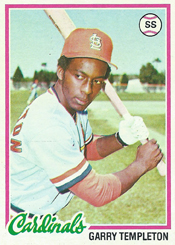
Feeling disrespected by management at the bargaining table and on the field, shortstop Garry Templeton lashed out at the Cardinals.

On March 27, 1979, Templeton asked to be traded and threatened to play at less than his best if his request wasn’t granted.

Templeton, 23, was upset because general manager John Claiborne wanted him to take a pay cut and because manager Ken Boyer and coach Dal Maxvill wanted him to change the way he played shortstop.

A day after expressing his unhappiness, Templeton apologized and remained the St. Louis shortstop.

Hurt feelings

In 1978, his third season with St. Louis, Templeton hit .280 with 31 doubles, 13 triples and 34 stolen bases, but he committed 40 errors.

After the season, the Cardinals hired Maxvill, their former Gold Glove shortstop, as a coach and assigned him to work with Templeton in 1979.

When Claiborne made a contract offer to Templeton for 1979, it called for a 10 percent cut in the $100,000 salary he received in 1978, according to the St. Louis Post-Dispatch. Claiborne proposed the cut because of Templeton’s high number of errors. Templeton was insulted because he led the 1978 Cardinals in hits (181) as well as triples and stolen bases and believed his production should be rewarded.

“There are guys in this league making more than I am who can’t even hold my shoestrings, or tie my shoestrings,” Templeton told The Sporting News in February 1979.

The sides resolved the matter, with Templeton getting a 1979 salary of $130,000, but the increase didn’t erase the sting of his bruised feelings.

“That really hurt him,” Templeton’s friend and teammate, outfielder Jerry Mumphrey, said. “He hasn’t gotten over it.”

At spring training, Maxvill worked with Templeton on fielding fundamentals, but Templeton resisted the instruction because he believed he was being constrained.

Playing chicken

When Templeton’s frustration reached a breaking point, he went to the media to express his views.

“I’m not going to play hard,” Templeton said to Rick Hummel of the Post-Dispatch. “I’m not going to do my best here. Hopefully I’ll be traded if the Cardinals aren’t too chicken to trade me.

“Either get me traded or get me more money. They can take the Cardinals uniform and shove it.”

Templeton said he twice asked the Cardinals to trade him. “They’d rather mess with you instead of sending you to someplace where you’ll be happy,” Templeton said.

In an interview with Mike Shannon of KMOX, Templeton said, “I don’t want to play with the Cardinals. I think they’re giving me too much trouble and I’m not happy here. I don’t want to play here and I’m not trying to play hard.”

After the outburst, Templeton met with his agent, Richie Bry, the Post-Dispatch reported. Bry met with Claiborne. After that, Templeton and Bry met with Claiborne and Boyer.

On second thought

The next day, Templeton attempted to control the damage he caused. He apologized for his words, claimed he no longer wanted to be traded and said “my contract is not and has never been the problem.”

In a prepared statement, Templeton said, “I regret the statements I made yesterday in the heat of anger for they do not accurately reflect my feelings for the Cardinals team, the city of St. Louis or the fans.

“The crux of my problem with management has always been my style of playing shortstop. Since I was 7 years old, I have developed certain habits and routines which have now become second nature to me. I believe that they give me more mobility, speed and range.”

Templeton contended his error total was high because he covered more ground than most shortstops. “Cardinals management and I disagreed on this and thus my anger and frustration,” he said.

Hummel noted, “Templeton’s style has on occasion been one of seeming nonchalance. He emphasizes catching balls with one hand, something Boyer and infield coach Dal Maxvill have suggested he alter.”

Said Boyer: “We haven’t tried to drive anything down his throat.”

To err is human

Reaction from Cardinals players and media generally was supportive of Templeton.

“All I know is that before long this guy is going to be the greatest shortstop I ever saw,” said Cardinals catcher Ted Simmons. “I just wish that when that happens he’ll be in St. Louis.”

Said first baseman Keith Hernandez: “I hope they can resolve the problem because we need him.”

Post-Dispatch sports editor Bob Broeg declared no Cardinals shortstop “has had anywhere near the basic all-round talent” of Templeton. “If Templeton is miffed most because Boyer had Maxvill trying to tell the kid how to do it at shortstop … tell Maxie to learn a few jokes to keep the kid loose and let him alone,” Broeg wrote.

Post-Dispatch columnist Doug Grow offered, “There is no greater insult to any working person than a reduction in pay. My guess is that management never will recover from that offer. An effort to save a few thousand a few months ago eventually could cost the Cardinals a shortstop worth millions.”

Templeton hit .314 with 32 doubles, 19 triples and 26 stolen bases for the Cardinals in 1979. He produced 211 hits and made 34 errors.

Two years later, in August 1981, Templeton created another controversy when he made obscene gestures to fans who booed him for lack of hustle in a game at St. Louis. He was traded after the season to the Padres for shortstop Ozzie Smith.