Feeds:
Posts
Comments

Gussie Busch made a handshake agreement to hire Leo Durocher to manage the Cardinals, lied about it to the public and reneged on the commitment.

Busch’s mishandling of the Durocher deal was one of several missteps made by the meddling Cardinals owner during the 1964 season.

Despite Busch’s bumbling, the Cardinals rallied to win the National League pennant on the last day of the regular season and went on to clinch a World Series title against the Yankees.

Holy cow!

On Aug. 17, 1964, the Cardinals were nine games out of first place when Busch, figuring there was no hope for a pennant, fired general manager Bing Devine and replaced him with Bob Howsam, a colleague of consultant Branch Rickey.

Busch wanted to fire manager Johnny Keane, too, but decided to wait until after the season.

On Aug. 29, 1964, before a Saturday game between the Dodgers and Cardinals at St. Louis, Durocher was interviewed by broadcaster Harry Caray. Durocher, a shortstop for the Cardinals’ Gashouse Gang clubs in the 1930s before becoming a manager and leading the Dodgers (1941) and Giants (1951 and 1954) to pennants, was in his fourth season as a Dodgers coach in 1964 and Caray asked him whether he wanted to manage again.

If an offer was made, Durocher replied, “I just know I would accept if it was a good ballclub.”

Busch liked what he heard. He contacted Caray and said he wanted to meet with Durocher the next morning. Caray called Durocher at his hotel room that night and said he’d drive Durocher to Busch’s estate in the morning.

In his book “Nice Guys Finish Last,” Durocher said, “Harry was going to pick me up at 8 in the morning, not in front of the hotel but two blocks down on Lindell Boulevard where nobody would see us.”

It’s a deal

Caray took Durocher to Busch’s home and waited in the car as Durocher went inside. Busch and Durocher had breakfast before going into an office where they talked for about an hour. According to Durocher, Busch stuck out his hand and said, “You’re the manager of the ballclub. Don’t worry about the salary.”

Durocher returned to the car and told Caray what happened. “Harry was simply overjoyed,” Durocher said.

When the Dodgers got back to Los Angeles, Durocher informed club owner Walter O’Malley about his talk with Busch. O’Malley already knew, Durocher said, because Busch had phoned him. Durocher and O’Malley agreed Durocher would resign near the end of the season, clearing the way for the Cardinals to hire him.

Left hanging

On Sept. 22, 1964, three weeks after Busch and Durocher met, Milt Richman of United Press International reported Keane would be fired within two weeks and Durocher “most likely will succeed him.”

“The decision to fire Keane was reached some time ago” by Busch “who conferred with Durocher the last time the Dodgers were in St. Louis,” Richman reported.

Contacted by the St. Louis Post-Dispatch, Busch said he had “great admiration for Durocher,” but denied he had met with him.

Durocher told United Press International, “I haven’t approached anybody and nobody has approached me.”

Asked about Keane’s performance as manager, Busch declined comment.

Busch “left Johnny Keane hanging by his thumbs,” the Post-Dispatch concluded.

On the day Richman broke the story, the Cardinals, in New York to play the Mets, were six games behind the first-place Phillies. It later was learned Keane met that day with a “trusted emissary” for the Yankees about the club’s managerial job, according to the Associated Press. The Yankees planned to fire manager Yogi Berra after the season and contacted Busch to get permission to talk to Keane. Busch gave his approval, but soon came to regret it.

The plot thickens

On Oct. 1, 1964, Dodgers general manager Buzzie Bavasi announced Durocher would not return as coach “at his own request.”

Asked whether he was going to become Cardinals manager, Durocher told the Los Angeles Times, “My hands are tied. I just can’t say.” Bavasi said Durocher asked for his release so he could negotiate for a managerial job and he got the impression the Cardinals were the club.

Durocher’s timing was terrible because the Cardinals had surged while the Phillies had faltered. From Sept. 24 to Oct. 1, the Cardinals won eight in a row and moved into first place with three games remaining.

On Oct. 2, 1964, the day after Durocher resigned, Busch met Keane in the clubhouse and offered him a contract extension, but Keane said he preferred to wait until after the season to discuss an offer, the Post-Dispatch reported.

On Oct. 4, 1964, after the Cardinals clinched the pennant that day, Busch approached Keane at the team party and offered him “whatever you want,” but Keane said he wouldn’t talk terms until after the World Series.

October surprise

Busch’s attempts to sign Keane put Durocher in limbo. Durocher expected “to accept Busch’s offer to manage the Cardinals next season but when Leo pounced the cupboard was bare,” the Post-Dispatch reported.

On Oct. 9, 1964, the New York Journal-American reported Busch offered Durocher $100,000 to forget about their agreement. Durocher denied getting any payoff from Busch.

The Cardinals clinched the World Series title on Oct. 15, 1964. Busch scheduled a news conference for the next morning with the intention of announcing a contract extension for Keane, but when Keane arrived at the gathering he handed Busch a resignation letter. Keane cited Busch’s firing of Devine and flirtation with Durocher among the reasons for his decision.

A few hours later, the Yankees fired Berra.

With Keane’s departure, Busch could have hired Durocher, but he feared a backlash from a fan base who blamed the two conspirators for driving out Keane. “Although Durocher has the qualifications and credentials to do the job on the field, indications are that public pressure might make this choice unwise for the ballclub _ and the (Anheuser-Busch) brewery,” the Post-Dispatch reported.

Thanks, Leo

Busch called Durocher and “right from the beginning I didn’t like the way the conversation was going,” Durocher said. “All hemming and hawing and not a word about managing his ballclub.”

“I could understand the fix he was in,” Durocher said. “He had become the laughingstock of the country.”

As Busch dawdled, Durocher said to him, “Apparently what you’re trying to tell me is you can’t make me manager of your club. Is that what you’re trying to tell me?”

“Yeah,” said Busch, “in sort of a way.”

“It’s perfectly all right,” Durocher responded. “Forget the handshake. Forget you gave me the job.”

Busch replied, “Thanks very much, Leo. I knew you’d understand the predicament I was in” and hung up.

“There I sat, with the telephone in my hand,” Durocher said.

On Oct. 20, 1964, the Cardinals named coach Red Schoendienst to be the manager and the Yankees hired Keane to replace Berra.

Durocher did broadcasting for a year before becoming Cubs manager in 1966.
(Updated May 1, 2022)

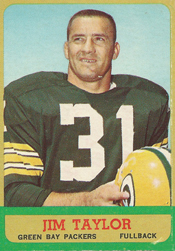
The punishing rushes of Green Bay Packers fullback Jim Taylor shredded a daring defense of the St. Louis football Cardinals.

Taylor was a bruising rusher for the championship Packers teams of the 1960s. Paired in a backfield with “Golden Boy” halfback Paul Hornung, Taylor was a powerful force who twice led the NFL in rushing touchdowns and was elected to the Pro Football Hall of Fame.
In 1962, Taylor topped the NFL in rushing yards with 1,474 in 14 games. He faced the St. Louis Cardinals for the first time that season and his rushing and pass-catching skills were key to enabling the Packers to overcome a challenging defensive scheme.

Game plan

The Cardinals and Packers each had 1-0 records entering their game on Sept. 23, 1962, at Milwaukee County Stadium. The Packers were the reigning NFL champions and the Cardinals were looking to establish themselves as contenders.

Cardinals head coach Wally Lemm and his staff devised a plan to apply pressure on Packers quarterback Bart Starr by having St. Louis defensive players use stunting maneuvers and blitzing schemes.

The stunting meant two or more Cardinals defenders would alter their usual paths to the quarterback in an effort to confuse the Packers’ offensive linemen.

The blitzing freed a defensive back or linebacker to leave his usual post and become an extra pass rusher. New York Giants linebacker Donald “Red Dog” Ettinger is credited with being the first to use the technique from 1948-50 and blitzes came to be known as “red dogging.” In 1960, Cardinals assistant coach Chuck Drulis designed a blitz using safety Larry Wilson and named it “wildcat.”

Pressuring Pack

The blitzing and stunting of Cardinals defenders confused the Packers in the first half of their 1962 game. Starr “was under considerable pressure from the Cardinals’ determined rush, including red-dogging defensive halfbacks,” the Green Bay Press-Gazette reported.

Packers offensive tackle Forrest Gregg said the Cardinals “were doing a lot of jumping around in there and we weren’t picking them up.”

Said Packers coach Vince Lombardi: “Their defense upset us in the beginning. We had a hell of a time trying to find them. They did a lot of stunting in there … It was new to us. We hadn’t seen it before this year.”

Lombardi and his staff tried to make adjustments during the first half, but were unsuccessful in communicating effectively during the helter-skelter pace of the game. The best the Packers could do was hold on until they could regroup in the locker room at halftime. “We had to put it on the (chalk) board,” Lombardi said.

The Packers’ defense, led by linemen Willie Davis and Henry Jordan, stopped the Cardinals, and Green Bay led, 3-0, at halftime on Hornung’s field goal.

Fast learners

Using the chalkboard to illustrate what needed to be done to counter the Cardinals’ aggressive blitzing and stunting, Lombardi and his staff instructed their offensive linemen to block in assigned areas rather than man against man, and they told Starr to turn Taylor loose to rumble and mix in short passes to Taylor and tight end Ron Kramer.

The adjustments worked. Taylor, 6 feet and 215 pounds, pounded the Cardinals with runs up the middle and put the Packers in position to score a pair of touchdowns.

“In three years, nobody has run through our middle as the Packers did,” defensive tackle Frank Fuller, who played for the Cardinals from 1960-62, told the St. Louis Post-Dispatch.

Taylor “turned the tide with his powerful smashes in the second half,” the Green Bay Press-Gazette reported. Taylor “punished the Cardinals’ defense with his hard hitting … His thrusts up the middle helped the (Packers) loosen up the Cardinals’ defense and thus make their passing work.”

Taylor finished with 122 yards rushing on 23 carries and also had four catches for 40 yards. Hornung had a three-yard touchdown run in the third quarter, Starr connected with Max McGee on a 19-yard scoring strike in the fourth quarter and the Packers won, 17-0. Boxscore

“We adjusted between halves,” Lombardi said. “In the second half, we zone blocked and area blocked. The boys picked them up real well.”

Said Taylor: “We just got to zone blocking in the second half and they changed their defense. They weren’t red-dogging so much and the red dogs were not real hard to pick up.”

One of a kind

Lemm praised the Packers as “the best-balanced team in football. Father Time is the only thing that’s going to beat the Packers.”

Regarding Taylor, Lemm said to the Post-Dispatch, “He has a great ability to slide out and get moving. He takes a pitchout quick with that sliding ability.”

Lemm added, “The blocks Hornung throws for Taylor are really something.”

The Cardinals totaled 16 yards rushing and their top receiver, Sonny Randle, had one catch for five yards. Halfback John David Crow had nine yards on nine carries.

“We don’t have a Taylor,” Lemm lamented.

The 1962 Packers repeated as NFL champions and Taylor also played for league champions in 1965 and 1966. The Cardinals finished 4-9-1 in 1962.

Taylor played two more regular-season games against the Cardinals in his career. On Oct. 20, 1963, he rushed for 67 yards and two touchdowns in a 30-7 Packers victory. On Dec. 12, 1967, in his final NFL season with the Saints, the former Louisiana State standout had 34 yards rushing in a game the Cardinals won, 31-20.

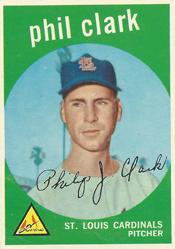
The Cardinals projected rookie Phil Clark to be their top reliever in 1958, but the role eventually went to the opposing pitcher who earned a win in Clark’s major-league debut.

Clark was a well-regarded prospect for the Cardinals in the 1950s. After graduating from Albany (Ga.) High School, Clark signed with St. Louis before the 1951 season and was assigned to his hometown Albany Cardinals, a Class D farm club.
Clark, 18, pitched 219 innings for Albany and was 18-7 with a 2.96 ERA. He spent the next two years in the Navy before returning to the Cardinals system in 1954.

A sensational 1957 season with the Class AA Houston Buffaloes elevated Clark’s status. The right-hander was 16-6 with a 1.83 ERA in 63 relief appearances that year.

High hopes

At spring training in 1958, Clark impressed with a string of eight scoreless innings in three exhibition games. “He’s temperamentally and physically equipped to be our No. 1 man in the bullpen.” Cardinals general manager Bing Devine told The Sporting News.

A sinkerball specialist with excellent control, Clark threw an assortment of pitches, but relied on a slider. Clark knew more about pitching technique than any other Cardinals prospect, scout Joe Mathes said.

The Sporting News reported Clark was “the best bet among the newcomers to stick and help the club” in 1958 and Sports Illustrated declared Clark as the rookie the Cardinals were “counting on most.”

On April 15, 1958, the Cardinals opened the season at home against the Cubs. Clark made his big-league debut in the seventh and pitched two scoreless innings, but the Cubs won, 4-0. Cubs starter Jim Brosnan pitched six innings, didn’t allow a run and got the win. Boxscore

After losing their first four games, the Cardinals won on April 20, 1958, against the Cubs at Chicago. Clark earned the save, holding the Cubs scoreless over the final three innings of a 9-4 Cardinals triumph. Brosnan, the Cubs’ starter, gave up four runs in three innings and was the losing pitcher. Boxscore

In his first three Cardinals appearances, all against the Cubs, Clark pitched a total of six scoreless innings. His next two outings, however, caused the Cardinals to lose confidence in him.

Changing course

On April 23, 1958, at San Francisco, Clark relieved in the bottom of the ninth with two outs, Giants runners on first and second and the Cardinals ahead, 7-4. The first batter Clark faced, Orlando Cepeda, hit a two-run triple and the next, Daryl Spencer, followed with a two-run home run, giving the Giants an 8-7 victory. Boxscore

In Clark’s next appearance, May 2, 1958, at St. Louis, he entered in the ninth with the Reds ahead, 4-3. He faced four batters and all reached base. Vada Pinson singled, Frank Robinson walked, George Crowe hit a three-run home run and Don Hoak doubled. Boxscore

Two weeks later, on May 20, 1958, the Cardinals sent Clark, 0-1 with one save and a 3.52 ERA in seven relief appearances, to their Class AAA Omaha farm club and acquired Brosnan from the Cubs for shortstop Alvin Dark.

In 12 starts for the 1958 Cardinals, Brosnan, an aspiring author, was 4-3 with a 4.50 ERA. Converted into a reliever by Cardinals manager Fred Hutchinson, Brosnan was 4-1 with seven saves and a 1.67 ERA in 21 relief appearances, successfully filling the role given to Clark at the start of the season.

Bullpen buddies

As the Cardinals began spring training in 1959, Brosnan was the closer and Clark, 10-6 with a 2.75 ERA in 44 relief appearances for Omaha in 1958, was a candidate for a bullpen role.

The two pitchers, whose career paths intersected so often in 1958, met for the first time during training camp and became friends. In his book, “The Long Season,” Brosnan wrote, “My first impressions of Phil Clark were reasonably soul-satisfying. Phil is a Georgia boy with a pleased-to-give-you-the-shirt-off-my back personality.”

Clark earned a spot on the Cardinals’ 1959 Opening Day roster and Brosnan wanted him as a road roommate, but the club assigned another pitcher, Alex Kellner, to room with Brosnan instead.

The erudite Brosnan, nicknamed “Professor,” and Kellner, a big-game hunter who roped mountain lions, were an odd couple. Kellner liked to watch TV westerns while Brosnan preferred to read. “I had to read my book with a pillow over my left ear, a pillow beneath my right ear and just enough light to see the larger type,” Brosnan wrote.

Tough game

Neither Clark nor Brosnan pitched well for the 1959 Cardinals.

On April 26, 1959, Clark entered a game against the Dodgers at St. Louis with the score tied at 9-9. He pitched a scoreless seventh, but in the eighth he gave up three runs, one earned. The Dodgers won, 17-11, and Clark was the losing pitcher. Boxscore

“Clark, being a good pitcher and knowing how to pitch, had made so many good pitches only to see them turned into handle-hits, bad hops over the infielders’ shoulders, bloops to the outfield and squibs through the infield, that a sympathetic observer, like a wife, could almost cry in desperation,” Brosnan wrote.

On May 9, 1959, Brosnan and Clark rode together to Busch Stadium for the game that day against the Cubs. Brosnan was in the training room when Clark walked in and asked Doc Bauman if he could use the phone. Clark called his wife and asked her to come get him. The Cardinals had informed him he was going back to the minors.

“He dropped the phone back onto its cradle, looked down at the floor for a moment and walked quickly from the room back to his locker,” Brosnan wrote. “I started to follow him, thought better of it, picked up the morning paper and went into the latrine to read.

“There was nothing I could say to Philip that would help. At cutdown date in organized baseball it’s every man for himself. My first reaction was relief that it wasn’t I who had just lost his job.”

Clark was 0-1 with a 12.86 ERA in seven relief appearances when the Cardinals demoted him. A month later, on June 8, 1959, Brosnan, 1-3 with two saves and a 4.91 ERA, was traded to the Reds for pitcher Hal Jeffcoat.

Brosnan regained his effectiveness with the Reds and was a relief ace in 1961 when they won the National League pennant.

Clark was with Omaha until July when he was traded to the St. Paul Saints, Class AAA farm club of the Dodgers, for pitcher Bob Darnell.

Clark pitched in the Dodgers’ minor-league system from 1959-61. He was a teacher, coach and assistant principal for public schools in Albany, Ga., from 1960-88.

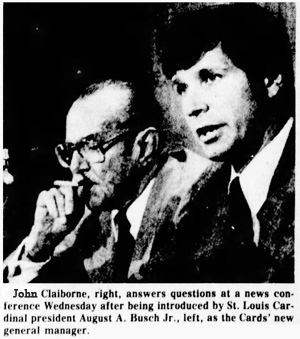
Bing Devine gave John Claiborne his first job in professional baseball, mentored him, promoted him and helped him get career opportunities. When Devine, the Cardinals’ general manager, got ousted for the second time, Claiborne replaced him in an awkward takeover.

On Oct. 18, 1978, Devine was fired after the Cardinals finished the season at 69-93, their most losses since 1916.
Claiborne, 39, was the choice of Cardinals owner Gussie Busch to replace Devine, 62. Claiborne was out of baseball at the time, but looking to get back in. He’d developed a reputation as an effective executive after being groomed in baseball operations by Devine with the Mets and Cardinals before continuing his career with the Athletics and Red Sox.

Immediately after informing Devine he was out as general manager, Busch asked him to stay with the Cardinals as a consultant; in effect, to continue to advise and mentor the protégé who took part in a coup to oust him.

Devine, of course, refused, though his rejection of the offer puzzled a clueless Busch. Devine understood it wouldn’t be fair to himself to be a subordinate to his successor, nor would it be fair to Claiborne to have his predecessor maintaining a voice in decision-making.

Besides, Devine was hurt by how Claiborne handled the takeover. In Devine’s view, Claiborne should have informed him beforehand he was taking his job. In his book, “The Memoirs of Bing Devine,” Devine said, “He knew just before they fired me that he would be the guy replacing me. John didn’t tell me. He later apologized for that.”

Fellow alumni

After graduating from Washington University in St. Louis, Devine joined the Cardinals as an office assistant in 1939 and worked his way up through the organization. In November 1957, he became general manager and held that position until he was fired by Busch in August 1964, two months before the Cardinals won the World Series championship.

Devine went to the Mets as a special assistant and eventually became club president. In 1967, Devine met Claiborne at a Washington University function. Like Devine, Claiborne was a Washington University alumnus and he also was the school’s head baseball coach. Three months later, Devine hired Claiborne to be an administrative assistant.

Devine gave Claiborne the chance to learn many facets of baseball operations with the Mets. Among Claiborne’s tutors were Mets director of scouting Joe McDonald and director of player development Whitey Herzog.

In December 1967, two months after the Cardinals won another World Series championship, general manager Stan Musial resigned and Devine replaced him.

Devine hired Claiborne to be the Cardinals’ administrative assistant in scouting and player development. Claiborne thrived in the role, working for Cardinals director of player procurement George Silvey and director of player development Bob Kennedy.

Jack of all trades

In 1971, Athletics owner Charlie Finley was seeking an administrator with player development skills. Devine recommended Claiborne and Finley hired him to be director of minor-league operations and scouting for the Athletics.

The Athletics won three consecutive World Series titles from 1972-74 and Claiborne was promoted to assistant general manager.

“The years with Oakland gave me my biggest boost,” Claiborne said to the St. Louis Post-Dispatch. “I did just about everything.”

In August 1975, Claiborne was seeking a change. Finley was making cost cuts and considering selling the club. Devine later told the Post-Dispatch he recommended the Cardinals hire Claiborne, but the budget wouldn’t allow it. Claiborne left the Athletics to become special assignment scout for the Red Sox.

Two months later, the Red Sox swept the Athletics in the American League Championship Series and Claiborne’s scouting reports were credited with providing valuable insights. The Red Sox rewarded Claiborne by promoting him to assistant general manager.

In 1976, Red Sox owner Tom Yawkey died and a year later, after the 1977 season, Yawkey’s widow Jean fired Claiborne and general manager Dick O’Connell to make way for new ownership and management.

Claiborne became a consultant for Monogram Industries. Wanting to return to baseball, he turned to Devine for help.

“He and I had been talking a lot on the phone about how he wanted to get back in the game,” Devine said. “This went on for a period of weeks and months during the 1978 season.”

Plot thickens

At the same time, Busch began thinking about replacing Devine. The Cardinals won a pennant in 1968, the first season of Devine’s second stint as general manager, but failed to qualify for the postseason over the next 10 years.

“For some time, there appeared to be a breakdown of communications between Busch and Devine,” the Post-Dispatch reported. Devine could contact Busch “only through intermediaries, usually Lou Susman, Busch’s personal attorney,” according to the newspaper.

Susman was urging Busch to make a change and recommended Claiborne. “Susman had a hand in it,” Devine said in his book. “He influenced Mr. Busch.”

Unaware of the plot against him, Devine was working his baseball connections, trying to help Claiborne. “So I was giving him recommendations on the side for other jobs while Susman was pushing for him to replace me,” Devine said.

Claiborne said he was first contacted about the Cardinals’ job on Oct. 11, 1978. He said he met with Busch the next day, Oct. 12, and they reached an agreement.

A week later, on Oct. 17, Devine said he got a confidential call from Al Fleishman, a public relations executive, who tipped off Devine that a press conference was scheduled the next day.

At about 1:30 p.m. on Oct. 18, Devine was called to a meeting with Busch. Claiborne was there, too. Both asked Devine, who had a year left on his contract, to take a subordinate role as consultant, reporting to Claiborne.

When Devine refused, they asked him to take a day to think it over, but Devine had made up his mind.

“John, I don’t think you would under the circumstances,” Devine said to Claiborne.

“You’re absolutely right,” Claiborne replied.

Busch later said, “I thought Bing would accept it because of (Claiborne’s) friendship with Mr. Devine.”

Said Devine: “He underestimated the self-esteem in which I hold myself.”

Two hours after the meeting with Devine, Busch and Claiborne held their press conference, announcing the change.

Claiborne admitted to “some awkwardness” in replacing his mentor and acknowledged Devine “has touted me, pushed me and recommended me.”

Asked why the change was made, Susman said, “Because of the availability of Claiborne. He might have been taken up. Quite a few people were after him. Mr. Busch wanted to get new thoughts, fresh ideas in the organization.”

Full circle

The Cardinals finished third in their division in 1979 and started poorly the next season. In June 1980, manager Ken Boyer was fired and replaced by Herzog.

Two months later, Busch fired Claiborne and elevated Herzog to the general manager role. Herzog hired McDonald, his former Mets colleague, to be his assistant. Herzog’s first choice for the assistant’s role had been Devine, but Susman opposed the move and blocked it, according to the Post-Dispatch.

After hiring McDonald, Herzog kept the dual role of general manager and manager. In February 1982, Herzog suggested to Busch that McDonald should become general manager. Busch agreed and the announcement was made in April. Six months later, the Cardinals were World Series champions.

After leaving the Cardinals, Claiborne launched a second career as a sports television executive. He was president of New England Sports Network, which carries Red Sox games, and he helped start a similar network in the mid-Atlantic region to televise Orioles games.

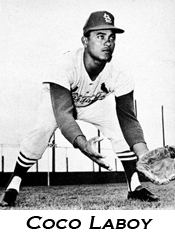
The National League expansion draft enabled third baseman Coco Laboy to get out from under control of the Cardinals and earn a chance to play in the big leagues.

On Oct. 14, 1968, Laboy was selected by the Expos in the sixth and final round of the draft.

Laboy, 28, had been in the Cardinals’ system for six seasons, including the last four at the Class AAA level. Though he hit for average and with power and fielded well, he never got the call to play for the Cardinals.

Given an opportunity by the Expos, Laboy delivered, becoming a popular and productive player in the franchise’s inaugural year.

Stay or go?

After the 1968 season, the National League expanded from 10 teams to 12 with the addition of the Expos in Montreal and the Padres in San Diego.

To help stock their rosters, the newcomers were permitted to draft a total of 60 players, 30 for each expansion club, from the existing National League franchises. The draft consisted of six rounds, and the Expos and Padres were allowed to each select five players per round from the major-league and minor-league rosters of the other clubs.

Each National League team could protect 15 players. A team could protect three more players each time one was taken from its list of unprotected.

The 15 players protected by the two-time defending National League champion Cardinals were pitchers Nelson Briles, Steve Carlton, Bob Gibson, Jerry Reuss and Ray Washburn; catchers Tim McCarver and Ted Simmons; infielders Orlando Cepeda, Joe Hague, Julian Javier, Dal Maxvill and Mike Shannon; and outfielders Lou Brock, Curt Flood and Vada Pinson, according to Bob Broeg of the St. Louis Post-Dispatch.

The Cardinals wavered until the last minute before protecting Washburn instead of newly acquired pitcher Dave Giusti, the Post-Dispatch reported.

When the Padres chose Giusti in the first round, the Cardinals added pitchers Joe Hoerner and Mike Torrez and infielder Steve Huntz to the protected list.

Joining Giusti and Laboy among the players drafted from the Cardinals were pitcher Clay Kirby (second round) and infielder Jerry DaVanon (third round) by the Padres and pitchers Jerry Robertson (fourth round) and Larry Jaster (fifth round) by the Expos.

Laboy batted .292 with 44 doubles and 100 RBI for the Tulsa Oilers in 1968. “He’s been a fine Triple-A hitter,” said Cardinals general manager Bing Devine, “but he’s been in our minor-league system a long time without having been brought up. Frankly, we were glad to see him get a chance in the big leagues.”

Going nowhere

Jose Laboy was born in Ponce, Puerto Rico, the same hometown of Orlando Cepeda. Laboy told the Montreal Gazette people called him Coco for as long as he could remember, but he didn’t know why.

At 18, he signed with the Giants and played for four seasons (1959-62) in their farm system. He batted .305 with 83 RBI for the Class C Fresno Giants in 1960, but in 1962 Laboy suffered a serious back injury on a slide into second base, was limited to 13 games and got released after the season. “The doctors told me I’d never play again,” Laboy said to The Sporting News.

Laboy played winter ball in Puerto Rico, proved he was healthy and signed with the Cardinals in February 1963. The Cardinals assigned him to the Class A Winnipeg Goldeyes and he batted .292 with 21 home runs that season.

In 1964, Laboy was sent to the Class A Raleigh Cardinals, who were managed by George Kissell. Laboy thrived, batting .340 with 24 home runs, but an incident late in the season tarnished him.

On Aug. 20, 1964, in a game at Rocky Mount, N.C., Laboy became convinced pitcher Carl Middledorf was throwing at him and others. In the fifth inning, Laboy bunted along the first-base line. As Middledorf fielded the ball, Laboy charged at him with a bat. Laboy hit Middledorf twice with the bat, striking him in the back and chest, and a brawl ensued, the Rocky Mount Telegram reported.

Middledorf was not badly hurt and continued pitching until the eighth inning, according to the Rocky Mount newspaper.

Police arrested Laboy, took him to headquarters and charged him with assault with a deadly weapon. Laboy was released on $150 bail, appeared in court the next morning and entered a guilty plea. Judge Tom Matthews sentenced Laboy to 30 days on a road crew, suspended the sentence and fined him $20.25. The Carolina League suspended Laboy for three days and fined him $25.

Oh, Canada

While playing winter ball in Puerto Rico, Laboy’s teammate for three years was Phillies second baseman Tony Taylor.

“I knew when I first saw him that he could make the major leagues,” Taylor said to Sports Illustrated.

Taylor shared his insights with Phillies manager Gene Mauch. When Mauch became Expos manager, he remembered Taylor’s recommendation of Laboy.

“Several times when I was managing the Phillies I talked to Tony Taylor about Laboy,” Mauch said. “Before we went to the draft meetings, I talked to Tony again.”

Taylor said Laboy “is a good ballplayer and a smart one. He is the kind of player Mauch likes.”

At Expos spring training camp in West Palm Beach, Fla., in 1969, Mauch and his staff showed unwavering confidence in Laboy, even though he struggled while trying to impress.

The Expos went into their inaugural season with Laboy as their third baseman. In the season opener on April 8, 1969, against the Mets at New York, the Expos led, 8-6, in the eighth when Laboy hit a three-run home run against Ron Taylor, the former Cardinal. Laboy’s home run proved the difference in an 11-10 Expos triumph. Boxscore

A week later, on April 14, 1969, the Expos played their first home game, facing the Cardinals at Jarry Park. In the seventh, with the score tied at 7-7, Laboy hit a double against Gary Waslewski and scored on pitcher Dan McGinn’s single to left. “I never ran harder,” said Laboy, whose run provided the winning margin in an 8-7 Expos victory. Boxscore

Laboy acknowledged getting special pleasure from beating the Cardinals. “They never gave me a chance,” he said. “I wanted especially to beat them today.”

Fun while it lasted

Laboy’s magical beginning to his major-league career continued throughout the first month. He batted .377 with 14 RBI in 20 April games.

“Every day he does something that just tickles me,” Mauch said. “Sometimes I want to kiss him.”

Asked to explain why Laboy was performing so well, Mauch said, “Character. Coco’s got that. He just tries so damn hard to do what you want _ and he’s doing it.”

Laboy finished his rookie season with a .258 batting mark, 18 home runs and 83 RBI.

The next season was a different story. Laboy hit .199 in 1970, was replaced by Bob Bailey at third base in 1971, and spent three seasons as a reserve before the Expos released him in September 1973 at age 33.

A deal designed to make the Cardinals a surefire bet to win a third consecutive pennant backfired on them and instead helped the Reds develop into the most dominant team in the National League.

On Oct. 11, 1968, the Cardinals acquired outfielder Vada Pinson from the Reds for outfielder Bobby Tolan and relief pitcher Wayne Granger.

The trade was made the day after the Tigers beat the Cardinals in Game 7 of the 1968 World Series and it seemed to signal the two-time defending National League champions would be back in 1969 for a chance to reclaim the World Series crown they’d won in 1967.

Pinson, 30, was acquired to replace right fielder Roger Maris, who retired. Like Maris, Pinson batted left-handed and earned a reputation as a special talent.

The Cardinals were able to obtain him without giving up a frontline player. Tolan, 23, was a reserve and Granger, 24, was deemed expendable in a bullpen featuring Joe Hoerner and Ron Willis.

However, Reds general manager Bob Howsam was able to see what Cardinals general manager Bing Devine could not: Pinson’s skills were fading while Tolan and Granger were on the verge of becoming prominent players.

Prolific hitter

Pinson grew up in Oakland and went to McClymonds High School, which also produced athletes such as Frank Robinson and Curt Flood in baseball and Bill Russell in basketball.

Like Robinson and Flood, Pinson signed with the Reds. Robinson and Flood made their major-league debuts with Cincinnati in 1956 and Pinson was projected to be with the Reds in 1958.

The Reds could have had an outfield of Robinson, Flood and Pinson, but on Dec. 5, 1957, they traded Flood in the first deal Devine made for St. Louis. In the book “October 1964,” author David Halberstam said Flood “always suspected they were not enamored of having an outfield of three black players” in Cincinnati.

Pinson became one of the game’s best players. He led the National League in hits in 1961 (208) and 1963 (204). Pinson also led the league in doubles in 1959 (47) and 1960 (37) and in triples in 1963 (14) and 1967 (13).

In 1968, Pinson, hampered by a groin injury, hit .271 with 29 doubles and 17 stolen bases, but was limited to five home runs and 48 RBI.

Judging talent

When Devine was fired by Cardinals owner Gussie Busch in August 1964, Howsam replaced him. After the 1966 season, Howsam left the Cardinals for a more lucrative deal with the Reds. Stan Musial replaced Howsam, resigned after the Cardinals won the 1967 World Series championship and was succeeded by Devine.

Several Cardinals staffers, including farm director Chief Bender and minor-league managers Sparky Anderson, Charlie Metro and Vern Rapp, eventually followed Howsam to the Reds’ organization and recommended Tolan and Granger.

As a backup outfielder and first baseman, Tolan hit .253 for the Cardinals in 1967 and .230 in 1968. Granger, a rookie, was 4-2 with four saves and a 2.25 ERA for the 1968 Cardinals.

The Cardinals “were disappointed” in Tolan’s hitting, the St. Louis Post-Dispatch reported, and “felt too many pitchers were able to handle him.”

“The front office and the field command had developed serious doubts Tolan would progress sufficiently as a hitter,” Post-Dispatch columnist Bob Broeg reported.

Howsam, however, thought differently, telling the Cincinnati Enquirer, “He’s got the ability and he has the desire.”

As for Granger, he “didn’t impress manager Red Schoendienst sufficiently,” Broeg wrote, even though minor-league manager Warren Spahn advocated for him.

Outstanding outfield

On Oct. 7, 1968, the day the Cardinals and Tigers played Game 5 of the World Series, Devine and Howsam agreed to the trade, the Dayton Journal-Herald reported. Though the clubs waited until after the World Series to announce the deal on Oct. 11, word leaked and it was widely reported on Oct. 10.

“Unless Pinson has aged overnight or has a hidden physical handicap, he’s likely to help the Cardinals with more speed on the bases and with a supply of doubles and triples,” Broeg surmised.

In a column for the Post-Dispatch, Cardinals pitcher Bob Gibson told readers, “With Vada, Lou Brock and Curt Flood, I think we have the best outfield in baseball. Certainly it is the fastest.”

“Can you imagine the three of us out there?” Pinson said to the Associated Press. “We’ll have some fun. I’ve known since early this season I would be traded … but I thought I’d go to San Francisco. There was talk of Ray Sadecki or Gaylord Perry for me. I never dreamed it would be St. Louis. I’m really thrilled.”

In an interview with the Dayton Daily News, Pinson said, “I don’t believe I could have made a better deal for myself. I’m going to the top. Now I’ve got to make sure we stay at the top.

“I see no problem in bouncing back with the Cardinals. I’m only 30 and I figure I’ve got at least four or five more good years. The Cards must think so, too. I talked to Red Schoendienst and Bing Devine. They said the Cards had been scouting me for a good while.”

According to Bill Ford of the Cincinnati Enquirer, “Contemporaries congratulated Howsam” for acquiring Tolan. “They say Tolan, if handled properly, can be better than Brock.”

Said Tolan: “All I want is a chance to play every day because that’s the only way you can make any money. I can’t count on a World Series check every year.”

Reds strike gold

Pinson started splendidly for St. Louis in 1969, batting .293 in his first 21 games, before he was sidelined the first two weeks of May because of a hairline fracture in his right leg after being hit by a pitch from the Pirates’ Bob Moose.

After he returned to the lineup on May 14, Pinson struggled and batted .136 for the month. He rebounded in June (.286) and July (.302, 20 RBI), but slumped in August (.174) and September (.241).

The Cardinals finished in fourth place in the East Division and Pinson received part of the blame. Though his 70 RBI ranked second on the team, Pinson batted .255, with a poor on-base percentage of .303, and had four stolen bases.

On Nov. 21, 1969, the Cardinals sent Pinson to Cleveland for Jose Cardenal.

Tolan and Granger had breakout seasons for the 1969 Reds. Tolan batted .305 with 194 hits, 21 home runs, 93 RBI and 26 stolen bases. Granger pitched in 90 games and had nine wins, 27 saves and a 2.80 ERA.

In 1970, the Reds won the pennant and Tolan and Granger were key contributors. Tolan hit .316 with 34 doubles, 80 RBI and 57 steals. Granger had 35 saves and a 2.66 ERA.

Two years later, when the Reds won the pennant again, Tolan batted .283 with 82 RBI and 42 stolen bases.