Feeds:
Posts
Comments

Mike Shannon was a willing pupil in an experiment integral to the Cardinals becoming World Series champions in 1967.

mike_shannon6Seeking a starting third baseman, the Cardinals gave Shannon first crack at earning the job during spring training at St. Petersburg, Fla.

Cardinals manager Red Schoendienst and instructor George Kissell developed a series of drills to convert Shannon from right fielder to third baseman.

The Cardinals needed to replace third baseman Charlie Smith, who was traded to the Yankees for right fielder Roger Maris in December 1966.

Shannon batted .288 with 16 home runs as St. Louis’ right fielder in 1966 and Schoendienst wanted to keep him in the lineup in 1967, joining first baseman Orlando Cepeda and Maris in forming a trio of run producers.

Moving Shannon to third enabled the Cardinals to have both Maris and Shannon in the lineup.

The conversion, though, wasn’t easy.

Head start

Shannon’s main competitors within the Cardinals for the starting third base job were Ed Spiezio, Phil Gagliano, Jerry Buchek and Ted Savage. None were considered Shannon’s equal in hitting with power and driving in runs.

Before pitchers and catchers reported for spring training, the Cardinals held a special instructional camp starting Feb. 17 at St. Petersburg, with Schoendienst, Kissell and coach Joe Schultz as teachers.

The Cardinals invited eight players _ Shannon, Gagliano, Buchek, Savage, infielder Jimy Williams, outfielders Bobby Tolan and Alex Johnson, and catcher Pat Corrales _ to the camp. Spiezio would have been invited but was excused because he played winter ball in the Caribbean.

“The Shannon-at-third experiment is rated a longshot by most observers,” The Sporting News reported.

Schoendienst and his assistants devised infield workouts to determine whether Shannon could be effective at third base.

“Schoendienst is giving Shannon and other infielders the toughest defensive drills they probably have ever seen. … Instead of fielding friendly grounders off a fungo stick, the athletes had to handle the most difficult chances,” the St. Louis Post-Dispatch reported.

With Kissell pitching to Schoendienst, the manager hit balls to the infielders.

“Red still can swing a vicious bat with unusual place-hitting skill,” the Post-Dispatch reported. “The infielders never knew who was going to have to tackle the next shot off the manager’s bat.”

Bat man

Shannon did well enough at the instructional camp to enter spring training as No. 1 on the depth chart at third base.

“I prefer Shannon because he has the best bat of anybody we might consider for third base,” Schoendienst said.

Post-Dispatch sport editor Bob Broeg declared, “If Shannon … can be in the lineup with his aggressive bat, the Redbirds’ attack will be considerably stronger than if the club is forced to give up and return him to compete in an outfield overcrowded with talent.”

Shannon struggled with his fielding during spring training games.

“Mike isn’t reacting quite as well … because he’s got his hands on his knees and his weight back on his heels,” Schoendienst said. “He doesn’t come up on the balls of his feet, hands loose in front of him, ready to go in any direction with the pitch. He’s got to concentrate better, too.”

Hot pepper

With the season opener about two weeks away, Schoendienst took Shannon “to the private infield beyond the left-field fence at Al Lang Field and brought along virtually the entire pitching staff,” the Post-Dispatch reported.

Schoendienst wanted Shannon and the pitchers to work together at calling plays and handling bunts.

Afterward, “Schoendienst slashed and lashed hot grounders and line drives at Shannon in a torrid one-man pepper game,” the Post-Dispatch observed. Shannon “lunged left, then right and threw his hands up in self-defense as Schoendienst smashed the ball at him … from a distance of no more than 40 feet.”

Said Cardinals shortstop Dal Maxvill: “I feel sorry for Mike. He’s really giving it the old try. Red has been hitting balls at him like that every day.”

Making the grade

Shannon produced 19 RBI in spring training games, validating the Cardinals’ view that his bat was needed.

Named the starter at third base, Shannon pulled a muscle in his left side in the April 11 season opener and didn’t return to the lineup until April 23.

As the Cardinals hoped, Shannon played well enough at third base and delivered 12 home runs and 77 RBI. Only Cepeda, with 111, drove in more runs for the 1967 Cardinals.

Batting primarily in the fifth and sixth spots in the order, Shannon hit .293 with runners in scoring position.

Shannon played in 123 regular-season games at third base and made 29 errors. He also committed two errors in seven World Series games.

With Shannon providing punch and Maris delivering timely hitting and solid defense in right, the 1967 Cardinals finished 101-60, 10.5 games ahead of the second-place Giants, and won four of seven from the Red Sox in the World Series.


(Updated Nov. 20, 2024)

In his bid to join the Cardinals, Red Schoendienst had no trouble with the baseball skills part of the challenge. It was the hassle of everyday life that proved to be his biggest obstacle to becoming a professional player.

red_schoendienst12In 1942, Schoendienst impressed the Cardinals at a tryout camp and earned a contract, launching him on a career that would lead to election to the National Baseball Hall of Fame and special status as a beloved franchise icon.

Displaying the tenacity that enabled him to spend eight decades in the big leagues as a player, manager, coach and advisor, Schoendienst overcame a series of roadblocks _ from serious to annoying _ to give himself a chance to receive an offer from the Cardinals.

Damaging accident

Schoendienst was born and raised in Germantown, Ill., about 40 miles from St. Louis. In 1939, at 16, Schoendienst quit high school and got a job in the Civilian Conservation Corps. He played amateur baseball after work and on weekends.

While on the job, Schoendienst and a friend, Joe Linneman, were building fences.

In the 1998 book “Red: A Baseball Life,” Linneman recalled, “We would stretch the wire as tight as we could get it and then use a hammer to drive a staple into a dry hedge post, which was almost as hard as a piece of steel.”

As Linneman slammed the hammer into a post, a staple caromed off the hardwood and into Schoendienst’s left eye.

“It was,” said Schoendienst, “the most intense pain I’ve ever felt in my life.”

Doctors wanted to remove the eye, but Schoendienst objected. Under treatment, Schoendienst’s sight gradually improved. Three years later, he felt confident enough in his vision to pursue a career with the Cardinals.

Big city

In 1942, Schoendienst and Linneman noticed a newspaper item about a Cardinals tryout camp to be held at Sportsman’s Park in St. Louis. Anyone attending would be admitted for free to a Cardinals game against the Dodgers that week.

Neither Schoendienst nor Linneman had been to a big-league game, so they decided to take part in the camp. “I don’t think either one of us went to that tryout camp thinking we had it made,” Schoendienst said.

Lacking a car or the money for bus fare, Schoendienst, 19, and Linneman hitched a ride on a dairy truck and were dropped off about a mile and a half from the ballpark. They walked the rest of the way.

Schoendienst and Linneman were among the players who performed well enough at the daylong camp to get an invitation to return for more workouts the next day.

Linneman planned to spend the night at an aunt’s home in suburban St. Louis. He invited his friend to come along, but Schoendienst didn’t want to impose.

Possessing 25 cents, Schoendienst went to a diner and spent 10 cents on a hot dog. A sympathetic waitress brought the freckle-faced teenager a glass of milk on the house.

Schoendienst went from there to the train terminal at Union Station and planned to spend the night on a bench. When he was ushered out by security, he found a bench in a nearby park, but it started to rain.

With his remaining 15 cents, a tired, soaked Schoendienst rented a room at a flophouse. He awoke the next morning covered in insect bites.

“When I got to the ballpark, they gave me some lotion to put on the bites, but I think that was part of the reason I moved so fast that day,” Schoendienst said. “I made up my mind I was going to swallow my pride and stay with Joe’s aunt the next night _ and I did.”

Impressive prospects

Schoendienst’s tryout lasted a week. Near the end, Cardinals executive Branch Rickey drove Schoendienst and two other prospects, Yogi Berra and Joe Garagiola, to Forest Park for a workout because there wasn’t enough room at the ballpark.

Schoendienst said Rickey “was a terrible driver. That car ride was scary. He was talking and driving like there was nobody else on the road.”

During the workout, Schoendienst, Berra and Garagiola took turns hitting against one another. Garagiola signed with the Cardinals but Berra went with the Yankees.

(In the book “Voices From Cooperstown,” Berra recalled to author Anthony J. Connor, “I wanted to be in St. Louis, but the Cardinals wouldn’t give me the bonus I wanted and neither would the Browns. I wouldn’t sign for less than $500 because that’s what my pal Joey Garagiola got.”)

When the training camp ended, Schoendienst hitchhiked back to Germantown. Cardinals scout Joe Mathes asked Schoendienst to return to St. Louis _ again he hitched a ride on a dairy truck _ and signed him to a contract for $75 per month.

Rise through ranks

The Cardinals assigned Schoendienst to their Union City, Tenn., team in the Class D Kitty League. After Schoendienst played six games at shortstop for Union City, batting .407, the Kitty League folded and he was sent to Albany, Ga., of the Class D Georgia-Florida League. His teammate there was his friend, Linneman, who had been signed by the Cardinals as a pitcher.

With his weak left eye causing him problems against right-handed pitchers, Schoendienst became a switch-hitter. He batted .269 in 68 games for Albany in 1942, but also committed 27 errors at shortstop.

From there, Schoendienst made a meteoric rise through the organization.

In 1943, a year after his tryout with the Cardinals, Schoendienst, a shortstop for Class AA Rochester, was named Most Valuable Player of the International League. Though he committed 48 errors at shortstop, Schoendienst batted .337 with 187 hits and 20 stolen bases.

Schoendienst “showed poise and an instinct for doing the right thing,” The Sporting News reported, and added he “gets a good jump on a ball, owns a good pair of hands and strong arm.”

In October 1943, Cardinals owner Sam Breadon said Schoendienst “is a great prospect, but needs experience,” the St. Louis Post-Dispatch reported.

Two years later, in 1945, Schoendienst, 22, debuted with the Cardinals and primarily played left field. He shifted to second base in 1946 and was named an all-star that season.

For reliever Hoyt Wilhelm, a stint with the Cardinals turned out to be a detour on his path to the Hall of Fame.

hoyt_wilhelmOn Feb. 26, 1957, the Cardinals acquired Wilhelm from the Giants for first baseman and outfielder Whitey Lockman.

Wilhelm, 34, had a 42-25 record with 41 saves and a 2.98 ERA in five seasons with the Giants, but his success didn’t carry over to the Cardinals.

Help wanted

Wilhelm, a knuckleball specialist, was a rookie for the Giants in 1952 when he produced a 15-3 record, 11 saves and a 2.43 ERA. For the pennant-winning 1954 Giants, Wilhelm was 12-4 with seven saves and a 2.10 ERA.

He was regarded a big upgrade to a Cardinals bullpen whose best reliever in 1956 was converted starter Larry Jackson.

Wilhelm became available because the Giants needed help at first base and left field after first baseman Bill White and left fielder Jackie Brandt went into military service. Lockman played both positions and the Giants were quite familiar with him because he played for them before going to the Cardinals in June 1956 in a deal involving second baseman Red Schoendienst.

Before approaching the Cardinals about Lockman, the Giants attempted to replace White with Jackie Robinson, who was acquired from the Dodgers in December 1956, but Robinson retired and the deal was voided. Cardinals general manager Frank Lane told The Sporting News he doubted he could have obtained Wilhelm if Robinson had reported to the Giants.

When the trade for Wilhelm was made, the Cardinals were at spring training in St. Petersburg, Fla., and the Giants were at their camp in Phoenix. In the book “The Original San Francisco Giants,” Lockman said, “So I left St. Petersburg, driving to Phoenix, and (Wilhelm) did the same thing, driving from Phoenix to St. Petersburg. We passed each other in Dallas, and saw each other, and stopped and had a little chat and went on our ways. Can you believe that?”

Insider tips

Before making the trade, Lane asked manager Fred Hutchinson whether the Cardinals had a catcher who could handle Wilhelm’s knuckleball. Hutchinson “assured Lane that Hal Smith could master the assignment,” The Sporting News reported.

Smith was the Cardinals’ starting catcher and Hobie Landrith was his backup. Lane and Hutchinson arranged for their catchers to have a dinner meeting with retired catcher Rick Ferrell, who’d caught five knuckleball pitchers while with the Senators, to get insights into how to deal with the elusive pitch.

Asked about the session with Ferrell, Landrith told the St. Louis Post-Dispatch: “He advised us not to crouch or squat as low when catching knuckleball pitchers as we would for others. He told us that from a half standing position … we could move laterally better and also drop on a knuckler falling off the table.”

Wilhelm was one of three pitchers with the 1957 Cardinals who threw a knuckleball. The others were Murry Dickson and Jim Davis.

“The thing about a good knuckler is that it’s tough to hit whether you’re hitting .300 or .200,” said the Cardinals’ best hitter, Stan Musial. “It jumps around like mercury in a bottle.”

Said Wilhelm: “The biggest factor in your knuckler is the wind condition. It’s a non-rotating pitch and therefore does better the more resistance it meets, meaning against the wind. When the wind is blowing in _ from behind the pitcher _ the knuckler seldom will do anything. Then it’s only a mediocre pitch and you’re a batting practice target.”

Disappointing results

After a good spring training, Wilhelm had a poor start to the 1957 season. He didn’t earn his first save until May 24 when he lowered his ERA from 6.11 to 5.89.

Wilhelm had one stellar month _ six saves and a 1.88 ERA in June _ but otherwise was unimpressive.

Though the Cardinals contended with the Braves in pursuit of a 1957 National League title, Hutchinson lost confidence in Wilhelm and seldom used him during the September pennant stretch.

Wilhelm said he needed to pitch regularly in order to regain effectiveness with his knuckleball. When Hutchinson stopped using him, Wilhelm had trouble controlling the pitch.

On Sept. 21, 1957, the Cardinals sent Wilhelm to the Indians for the waiver price. He had a 1-4 record, a team-leading 11 saves and a 4.25 ERA in 40 appearances for the Cardinals.

When Hutchinson informed Wilhelm the Cardinals had dealt him, the pitcher shook hands with the manager and said, “It’s good to have been with you. I’m sorry I couldn’t help you more.”

Wilhelm went on to pitch in 1,070 big-league games. He was inducted into the National Baseball Hall of Fame in 1985 and was the first reliever to earn the honor.

Previously: Enduring record: Stan Musial and his 5 homers in a day

The relationship formed by Ozzie Canseco and the Cardinals was based on mutual need rather than mutual affection. Neither expected it to last long.

ozzie_cansecoCanseco, after flopping during a stint in Japan, was looking to revive his career in the United States in order to make himself appealing in the National League expansion draft.

The Cardinals were seeking a slugger to generate fan interest at their top farm club in Louisville.

In January 1992, the Cardinals signed Canseco, a free agent, to a minor-league contract. It was the start of a relationship that would take several twists and turns.

Changing roles

Ozzie and his twin brother Jose were born in Cuba on July 2, 1964. Jose, an outfielder, became a standout on three pennant-winning Athletics teams managed by Tony La Russa. Ozzie entered the Yankees organization in 1983 as a pitcher.

“He had a good breaking ball and he could throw hard,” Bucky Dent, Ozzie’s manager with the Class A Fort Lauderdale Yankees, told the St. Louis Post-Dispatch. “We liked him a lot as a pitcher, but he was always wanting to switch over (to outfield).”

Said Ozzie: “I asked them every year, ‘Please let me make the transition from pitching to hitting.’ ”

In 1986, Ozzie got his wish. Released by the Yankees, he signed with the Athletics and became an outfielder. In 1990, Ozzie made his major-league debut with the Athletics as a teammate of Jose. Appearing in nine games, Ozzie batted .105.

Oh, brother

Jose was one of baseball’s top players. In 1988, when he won the American League Most Valuable Player Award, Jose became the first big-league player to have 40 home runs and 40 steals in a season.

“Jose cast a tremendous shadow over me because of who he is, because we’re identical twins,” Ozzie told Scripps Howard News Service. “… When I was trying to make the transition from pitcher to hitter, people expected me to hit like Jose did and I had a problem with that.”

Released by the Athletics after the 1990 season, Ozzie signed with the Kintetsu Buffaloes of the Japanese Pacific League.

“I basically went over there to learn how to hit the breaking ball,” Ozzie told the Post-Dispatch. “The forkball, the slider _ that’s all you see over there if you’re a power hitter.”

However, Ozzie never made it to the majors in Japan. The Buffaloes assigned him to their minor-league club at Osaka and, after 38 games, Ozzie returned home to Miami.

Louisville lumber

When the NL announced plans to expand in 1993 to Miami and Denver, Ozzie saw opportunity. If he could have a strong season in 1992, he believed the Marlins, with a large fan base of Cuban-Americans, would select him in the expansion draft. First, though, he needed to find a team to play for in 1992.

Ted Simmons, Cardinals player development director, was seeking veterans to stock the Louisville roster and offered Ozzie a contract.

“This is purely a ‘Come to spring training and show me what you got’ type of deal,” Simmons said.

Ozzie showed enough to make Louisville’s Opening Day roster and began belting home runs, many prodigious.

In July 1992, the Post-Dispatch reported Ozzie “is drawing fans and drawing respect as one of the most feared power hitters in the American Association.”

Cardinals management took notice. Though Ozzie struck out 96 times in 98 games with Louisville, he slugged 22 home runs. When big-league rosters expanded on Sept. 1, 1992, Ozzie, 28, was one of the players the Cardinals promoted.

Ozzie got into nine games with the 1992 Cardinals, hit .276 with no home runs and made several fielding mistakes before he injured his right shoulder, but the club saw enough to view him as a potential contributor in 1993.

“He has raw power,” said Cardinals hitting coach Don Baylor.

In November 1992, Ozzie was one of 15 players the Cardinals protected from the expansion draft.

Spring disappointment

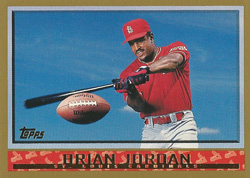
Ozzie’s hopes of sticking with the Cardinals got a boost in February 1993 when they traded starting right fielder Felix Jose to the Royals for first baseman Gregg Jefferies. The Cardinals declared Brian Jordan and Ozzie the candidates to compete in spring training for the starting right fielder job.

“I want to see them both play and see who wins it,” said manager Joe Torre. “I don’t think it’s Jordan’s job to lose.”

Cardinals general manager Dal Maxvill said of Ozzie, “What we saw at the Triple-A level was that he could hit the ball out of any ballpark … We don’t have anybody with that kind of power and really haven’t had in the organization for a long time.”

Asked about Ozzie’s outfield skills, Maxvill replied, “He’s no Willie McGee or Willie Mays … but he did a very adequate job.”

“Mainly,” Maxvill concluded, “he needs to whack the ball for us.”

After hitting .192 in his first 10 spring training games, Ozzie finished as the 1993 Cardinals’ Grapefruit League leader in home runs (four) and RBI (14), but neither he nor Jordan won the job.

On March 31, 1993, the Cardinals traded pitcher Mark Clark to the Indians for Mark Whiten and named him their starter in right field.

Ozzie was demoted to Louisville.

“I thought I did well enough to make the team,” Ozzie said. “I’m disappointed.”

Farewell, St. Louis

Ozzie went on a tear at Louisville, hitting nine home runs, and on May 5, 1993, he was brought back to the Cardinals.

He floundered in the field, however, and hit .176 with no home runs in six games, so the Cardinals returned him to Louisville.

Ozzie continued to slug home runs for Louisville _ 13 in 44 games _ but he also struck out 59 times. On June 11, 1993, Ozzie informed the Cardinals he was quitting.

“It got to a point where I was miserable and it seemed like I was constantly fighting an uphill battle,” Ozzie said.

Said Maxvill: “He definitely had gone backwards in all aspects and complained the whole way. So I guess he needs a career change and, quite frankly, it’s probably a good idea.”

Ozzie sat out the rest of the 1993 season. On Dec. 14, 1993, the Cardinals traded him to the Brewers for minor-league outfielder Tony Diggs.

Ozzie played professional baseball for several more seasons, including a stint in the Mexican League, but he never returned to the majors after his trials with the 1992-93 Cardinals.

Looking to rebuild his reputation, Dave LaPoint returned to the organization where he felt the most comfortable and had enjoyed his greatest success.

dave_lapointOn Jan. 19, 1987, LaPoint, a free agent, signed with the Cardinals, who expected him to compete for a spot in their starting rotation.

At 27, his career was at a crossroads.

Five years earlier, LaPoint, a left-hander, helped the Cardinals win the 1982 National League pennant and World Series championship.

After the Cardinals traded him in February 1985, LaPoint’s career spiraled. He pitched for three teams in two years, posting losing records at each stop, got traded twice and released once.

Out of shape and labeled a clubhouse jester, LaPoint said he was committed to rededicating himself to becoming a winner and was seeking a nurturing environment in which to attempt that comeback.

The 1987 Cardinals and manager Whitey Herzog provided the setting LaPoint sought.

Cards contributor

LaPoint’s tenure with the Cardinals began in December 1980 when he was acquired from the Brewers in a deal engineered by Herzog. The Cardinals traded Rollie Fingers, Ted Simmons and Pete Vuckovich for Sixto Lezcano, David Green, Lary Sorensen and LaPoint.

LaPoint’s breakthrough year was 1982. He began the season as a reliever and joined the starting rotation in May. LaPoint appeared in 42 games, including 21 as a starter, for the 1982 Cardinals and had a 9-3 record and 3.42 ERA. He started Game 4 of the 1982 World Series against the Brewers, yielded one earned run in 6.1 innings and got no decision in a 7-5 Milwaukee victory.

LaPoint earned 12 wins for the Cardinals in both 1983 and 1984.

When the Cardinals, seeking a run producer to replace George Hendrick, had a chance to get Jack Clark before the start of the 1985 season, they sent LaPoint, Green, Jose Uribe and Gary Rajsich to the Giants.

Rick Hummel of the St. Louis Post-Dispatch later reported the Cardinals parted with LaPoint because they “thought he might be influencing young players unduly.”

Hummel described LaPoint as a “leader in clubhouse revelry” and “a top consumer of the owner’s (Anheuser-Busch’s) product.”

Prodigal son

LaPoint had a 7-17 record for the 1985 Giants, who traded him to the Tigers after the season.

LaPoint and Tigers manager Sparky Anderson were a bad match. “I couldn’t get along with Sparky,” LaPoint said. After posting a 3-6 record and 5.72 ERA for the Tigers, LaPoint was traded to the Padres in July 1986. He was 1-4 for the Padres, who released him after the season.

LaPoint decided to make changes. Weighing between 230 and 240 pounds, he dropped to 220.

The Expos and Giants wanted to sign LaPoint, but he chose the Cardinals, whose offer of a base salary of $125,000 was a cut from his $550,000 contract in 1986.

“It feels finally that I’m back where I belong,” LaPoint said. “… In talking to Whitey, he said he would use me like he did in ’82. That’s fine with me. It got me a World Series ring.”

Asked his reaction to LaPoint rejoining the Cardinals, center fielder Willie McGee said, “I like him … He’s kind of a clown, but that’s Dave LaPoint.”

It’s a reputation LaPoint said he was determined to change.

“I used to mess around during drills and I don’t do that anymore,” LaPoint said after reporting to Cardinals camp. “… It was time to put a stop to it.”

Redbird reliever

LaPoint had a successful spring training. He was 2-0 with a 2.34 ERA in 15.1 innings pitched in Grapefruit League exhibition games.

The Cardinals opened the 1987 regular season with five left-handers: starters John Tudor and Greg Mathews and relievers Ricky Horton, Pat Perry and LaPoint. (Ken Dayley, another left-handed reliever, was on the disabled list.)

In his first appearance for the 1987 Cardinals, on April 10 against the Pirates at Pittsburgh, LaPoint took the loss when he yielded a RBI-double to Sid Bream in the bottom of the ninth. Boxscore

LaPoint was scheduled to make a start April 25, 1987, versus the Mets at New York, but that plan was scratched when the Cardinals called up Joe Magrane from the minors and put the rookie left-hander into the rotation.

LaPoint remained in the bullpen and largely was ineffective.

He got a win on April 18, 1987, against the Mets at St. Louis, but didn’t perform well. In the 10th, LaPoint threw a wild pitch, enabling Al Pedrique to score from third with the go-ahead run. LaPoint was rescued when the Cardinals scored five times off Jesse Orosco in the bottom half of the inning. Tom Pagnozzi’s RBI-single tied the score at 8-8 and Tommy Herr’s grand slam made LaPoint the winner. Boxscore

On the road again

With his ERA at 6.75 after four relief appearances, LaPoint was demoted to Louisville on April 27, 1987. LaPoint had the option of declaring himself a free agent, but agreed to return to the minor leagues for the first time since 1981.

Placed in the starting rotation by Louisville manager Dave Bialas, LaPoint lost his first three decisions, but found his groove. He completed four of his last five starts for Louisville and had a 5-5 record when he was recalled by the Cardinals on July 8, 1987.

“It was the best thing in the world for me,” LaPoint said of his stint in the minors. “… I’ve learned to pitch a little different style.”

LaPoint made two July starts for the Cardinals and got no decision in either.

On July 30, 1987, the Cardinals traded LaPoint to the White Sox for minor-league pitcher Bryce Hulstrom.

“LaPoint’s main problem has been control,” the Post-Dispatch reported. “If he gets the ball up, he gets hammered. It usually takes him a couple of innings to find the strike zone and by then the game usually is out of control.”

After posting a 1-1 record and 6.75 ERA for the 1987 Cardinals, LaPoint was 6-3 with a 2.94 ERA for the 1987 White Sox.

The Cardinals, helped by a combined 30 wins from left-handed starters Mathews, Tudor and Magrane, finished 95-67 and won the pennant.

Previously: Trade for Jack Clark shook Cards from their slumber

(Updated May 3, 2026)

Given a choice of facing Del Ennis or Stan Musial with runners in scoring position and the game on the line, Warren Spahn did what no other big-league pitcher had done before him: He opted to pitch to Musial.

warren_spahnIt was the only time in Musial’s illustrious 22-year Cardinals career that a pitcher intentionally walked a batter in order to get to him.

It happened on Aug. 17, 1957, when the Cardinals and Braves played at Milwaukee’s County Stadium.

Pennant race

The slumping Cardinals, who had lost nine in a row, were fighting to remain in the 1957 National League pennant race when they went to Milwaukee for a four-game series in August. The Braves, riding a 10-game winning streak, were in first place, 7.5 games ahead of the Cardinals.

St. Louis won the series opener, 6-2, behind the slugging of Ennis, who hit a three-run home run off Juan Pizarro.

Game 2 of the series matched Larry Jackson of the Cardinals against Lew Burdette. The Cardinals jumped ahead with three runs in the first, but the Braves came back with two in the sixth and one in the eighth, tying the score at 3-3.

Managerial moves

Don McMahon, a rookie, relieved Burdette in the ninth. After Eddie Kasko grounded out, Jackson hit a broken-bat pop fly to right that fell safely in front of Bob Hazle for a single. The next batter, Ken Boyer, reached base when shortstop Felix Mantilla booted a grounder for an error.

With Wally Moon at the plate, McMahon’s first pitch eluded catcher Del Crandall for a passed ball. Jackson advanced to third on the play and Boyer to second.

Braves manager Fred Haney lifted McMahon and brought in Spahn, a left-hander, to face Moon, a left-handed batter, with the count at 1-and-0.

Two nights earlier, on Aug. 15, Spahn started against the Reds at Cincinnati and pitched a complete game in an 8-1 Braves victory. With one day of rest, the Braves ace was making his fourth and final relief appearance of the season.

Unforgettable ploy

Cardinals manager Fred Hutchinson countered by bringing in Ennis, who batted from the right side, to replace Moon.

Ennis, batting .275 with 17 home runs, was a threat, but he was no Musial. At 36, Musial was batting .333 and would finish the year at .351, earning his seventh National League batting crown.

With first base open, Spahn issued an intentional walk to Ennis, loading the bases with one out and bringing Musial, a left-handed batter, to the plate.

In his autobiography “Stan Musial: The Man’s Own Story,” Musial said the sight of Spahn walking Ennis to face him is one “I’ll never forget.”

Musial rapped a groundball to the second baseman, friend and former teammate Red Schoendienst, who fielded the ball and flipped it to Mantilla for the force of Ennis at second. Mantilla’s relay throw to first baseman Frank Torre was in time to retire Musial, completing the inning-ending double play.

“He’s the only pitcher ever to walk a batter to face me,” Musial said in his book.

Musial told writer Roger Kahn, “Spahnie knew everything about his profession, and he was smart enough to change before he had to … He began tinkering with a screwball, and as the fastball began to go, he’d come at you with the screwgie. Then came the slider.”

In Jim Brosnan’s book “Great Baseball Pitchers,” he said of Spahn, “His carefully controlled motion gave no hint of the type of pitch he was delivering. Batters had to wait, watch for the spin and break of the screwball. Yet they had to be ready also for the fastball … Spahn exercised tight control on each of his deliveries. Most pitchers work for years just to be able to throw the ball consistently into the strike zone. Spahn worked just on the edges (of) the strike zone.”

Spahn said, “The plate is 17 inches wide. I try to avoid the foot in the middle. I pitch to the two-and-a-half inches on each side.”

Back and forth

Even after Spahn got Musial to ground into the double play, the drama wasn’t over. Braves center fielder Hank Aaron had a large role to play in the outcome.

In the 11th, with Spahn pitching, Don Blasingame led off and stretched a single into a double. Kasko grounded out to second, advancing Blasingame to third.

Larry Jackson was due up next, but Hutchinson sent Walker Cooper, 42, to bat for the pitcher. Cooper lifted a sacrifice fly to left, scoring Blasingame and giving the Cardinals a 4-3 lead.

Billy Muffett, a rookie, was Hutchinson’s choice to pitch the bottom half of the inning. Muffett retired the first batter, Schoendienst, on a pop-up.

The next batter, Frank Torre, hit a low line drive to left. Ennis lumbered in, got a glove on the ball and dropped it. Torre, credited with a single, was replaced by pinch-runner Hawk Taylor.

Eddie Mathews followed with a single to center and Taylor advanced to third.

That brought Aaron to the plate.

Hank hammers

Aaron was angry. In the ninth, Jackson moved Aaron off the plate with a high, tight pitch. Aaron, in comments to the Associated Press, accused Jackson of “trying to stick one in my ear.”

“It’s on purpose,” Aaron said. “I can tell when they’re throwing at me.

“If that’s the only way they can win a ballgame, they ought to get other jobs. I don’t mind being brushed back … but I don’t like them balls aimed at my head. We don’t knock Stan Musial down, so why do they do it to me?”

Aaron hit Muffett’s first pitch into right-center for a two-run double, giving the Braves a 5-4 victory and making a winner of Spahn. Boxscore

The Braves went on to clinch the pennant Sept. 23 on Aaron’s 11th-inning walkoff home run against Muffett. Boxscore

Previously: Del Ennis provided power in Cardinals lineup