Feeds:
Posts
Comments

(Updated March 23, 2025)

In Game 2 of the National League Championship Series against the Mets, Scott Spiezio and So Taguchi symbolized the grit, determination and teamwork of the 2006 Cardinals.
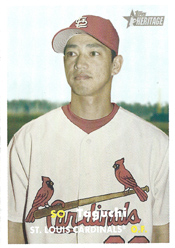
so_taguchi3After the Mets won the opener at Shea Stadium in New York, they had a chance to take command of the best-of-seven series with a victory in Game 2.

Many expected them to do so.

The Mets completed the 2006 regular season with the best record in the National League at 97-65. The Cardinals at 83-78 had the worst record of the teams that qualified for the fall tournament.

When the Mets took a 6-4 lead into the seventh inning of Game 2 at New York, the odds seemed stacked against the Cardinals.

That’s when role players Spiezio and Taguchi came through.

Spiezio tied the score with a two-run triple in the seventh and Taguchi knocked in the go-ahead run with an improbable home run in the ninth, carrying the Cardinals to a 9-6 victory and tying the series at 1-1.

Saved from having to overcome a deep deficit, the Cardinals won the series in seven games and went on to clinch the World Series championship, their first since 1982.

Coming back

Guillermo Mota, the fourth Mets pitcher used in Game 2, entered in the seventh to protect the 6-4 lead. Mota had a 3-0 record and 1.00 ERA in 18 regular-season appearances for the Mets.

He retired the first two batters of the inning, David Eckstein and Chris Duncan.

Albert Pujols then worked an 11-pitch at-bat, hitting a single after fouling off six pitches. Mota, either rattled or worn down by the duel with Pujols, walked Jim Edmonds on four pitches.

That brought Spiezio to the plate.

Soap opera

Manager Tony La Russa had given Spiezio the start at third base, batting him fifth in the order, in place of slumping Scott Rolen, who had produced one hit in the 2006 postseason.

“There’s something in his (batting) stroke that’s not right,” La Russa said of Rolen to the St. Louis Post-Dispatch.

Rolen said he was “very surprised” by and “very disappointed” in La Russa’s decision. As columnist Bernie Miklasz wrote, “It’s never entirely about baseball, the Cardinals have to introduce a new soap opera plot, ignite a feud or smolder through a psychodrama.”

Spiezio validated La Russa’s move. With the count at two strikes, Spiezio hit a triple to right, scoring Pujols and Edmonds and tying the score at 6-6. Right fielder Shawn Green prevented Spiezio’s smash from being a home run by leaping over the fence and deflecting the ball back onto the field with his glove.

So sweet

With the score still deadlocked at 6-6, Mets closer Billy Wagner, who posted 40 saves in 2006, was brought in by manager Willie Randolph to pitch the ninth.

The first batter he faced was So Taguchi, who was pinch-hitting for Duncan. Though Duncan had hit 22 home runs in 2006 and Taguchi had hit two, La Russa preferred to have a right-handed batter face Wagner, a left-hander.

Wagner got ahead in the count 0-and-2 against Taguchi. Then, like Pujols did versus Mota in the seventh, Taguchi frustrated Wagner by fouling off four pitches and working the count to 3-and-2.

Wagner threw a fastball and Taguchi hit it over the left-field wall for a home run, giving the Cardinals a 7-6 lead. Video

A stunned Taguchi said to Sports Illustrated, “Who expected that I would hit a home run? Nobody, not even me.”

The Cardinals scored two more runs off Wagner. Pujols doubled, moved to third on a groundout and scored on Spiezio’s double. Juan Encarnacion singled, scoring Spiezio and extending the lead to 9-6.

In the bottom half of the inning, Tyler Johnson struck out Carlos Delgado. Adam Wainwright relieved and got David Wright and Shawn Green to ground out, ending the game. Boxscore

In his book “The Captain,” Wright said, “The entire Cardinals team, with La Russa at the helm and defensive wizard Yadier Molina behind the plate, were tremendous at discovering and exploiting weaknesses.”
Less than two weeks after they finished the 1936 season tied for second place in the National League, the Cardinals and Cubs determined each had what the other needed in order to win a pennant.

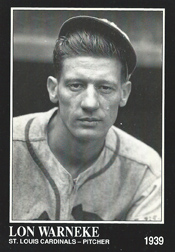
lou_warnekeThe Cardinals, whose team ERA of 4.47 ranked seventh in the eight-team league in 1936, needed a reliable starting pitcher to pair with their ace, Dizzy Dean.

The Cubs, whose 76 home runs ranked fifth in the league, wanted a slugger.

On Oct. 8, 1936, the Cubs traded a premier pitcher, Lon Warneke, to the Cardinals for power-hitting first baseman Rip Collins and pitcher Roy Parmelee.

The blockbuster deal between the rivals rocked the baseball world.

Cubs clout

The Cardinals and Cubs each finished the 1936 season at 87-67, five games behind the champion Giants.

Cubs owner Phil Wrigley directed manager Charlie Grimm to make any trade necessary to improve the club’s chances of winning the 1937 pennant.

Grimm wanted more production from his first baseman. Phil Cavarretta hit nine home runs as the first baseman for the 1936 Cubs. Grimm wanted to move Cavarretta to center field in 1937.

Collins, the Cardinals’ first baseman from 1932-35, hit 35 home runs _ a franchise record for a switch hitter _ in 1934. He became expendable when Johnny Mize took over the position for St. Louis in 1936.

Collins, 32, batted .307 for the Cardinals from 1931-36. His best season was 1934 when he led the league in slugging percentage (.615), extra-base hits (87) and total bases (369). He batted .333 with 200 hits for the National League champions that season. In the 1934 World Series versus the Tigers, Collins batted .367 (11-for-30) with four runs scored.

According to the Associated Press, Grimm told Wrigley “he offered the Cardinals … every other hurler on the staff. The Cardinals, however, insisted on Warneke. Grimm, determined to get Collins, yielded.”

Said Collins to the St. Louis Post-Dispatch: “It’s a great break for me … The front office at St. Louis might have traded me to a second-division club, but they didn’t.”

Great addition

Warneke, 27, a right-hander, earned 100 wins for the Cubs from 1931-36. At the time of the trade, The Sporting News described him as “one of the few great pitchers in the league.”

Warneke compiled 20 wins or more for the Cubs three times between 1932-35. He was 16-13 with a 3.45 ERA in 1936.

“With Dizzy Dean and Warneke, the Cardinals assured themselves of a nucleus for what may be the best pitching staff in the major leagues,” the Associated Press reported.

Grimm said he “hated like hell to part with Warneke” and praised him as a “great pitcher and a loyal, faithful player.”

The Sporting News concluded the Cubs had “given up a lot in Warneke,” adding that “with the Cardinals, he should be even better. He’ll be pitching for a team able to give him some runs, a pleasure he seldom experienced as a Cub.”

The third player in the deal, Parmelee, 29, posted an 11-11 record and 4.56 ERA in his lone season with the Cardinals after being acquired the year before from the Giants.

Coming up short

Even though Warneke and Collins delivered, the trade didn’t bring the results in the standings either team wanted.

The 1937 Giants repeated as National League champions at 95-57. The Cubs placed second at 93-61 and the Cardinals were fourth at 81-73.

Warneke had a stellar season, leading the 1937 Cardinals in wins with an 18-11 record. He would play six seasons (1937-42) with the Cardinals, posting an 83-49 record.

Collins batted .274 with 16 home runs and 71 RBI for the 1937 Cubs. In two seasons with Chicago, Collins totaled 29 home runs and 132 RBI.

Parmelee was 7-8 with a 5.13 ERA in 1937, his lone season with the Cubs.

Previously: Rip Collins was one-of-a-kind hitter for Cardinals

Concerned about the direction of a franchise that had gone eight consecutive years without qualifying for the postseason, the Cardinals pushed sentiment aside and fired manager Red Schoendienst.

red_schoendienst11On Oct. 5, 1976, general manager Bing Devine informed Schoendienst he was out after 12 seasons as manager.
Schoendienst, who had built a Hall of Fame career as a Cardinals second baseman in the 1940s and 1950s, won two National League pennants (1967 and 1968) and a World Series title (1967) as St. Louis manager.

From 1969 through 1976, though, with a core that included Bob Gibson, Lou Brock, Ted Simmons and Joe Torre, the Cardinals never reached the postseason, even though a division format had expanded the number of teams that qualified.

In 1976, the Cardinals had an abysmal season. Their 72-90 record gave them a .444 winning percentage, their lowest since the .442 mark of the 1955 Cardinals (69-86).

“There are times, regardless of one’s capabilities, when a different perspective is in order,” Cardinals owner Gussie Busch said in explaining the decision to fire Schoendienst.

Devine told Neal Russo of the St. Louis Post-Dispatch he recommended the move to Busch.

“I felt a change in managers was in the best interests of the club,” Devine said. “We wanted a new approach, a new atmosphere.”

Red’s assessment

Schoendienst said he was “absolutely surprised” by the firing.

“I thought I did a good job with the young kids,” Schoendienst said. “I don’t think anyone could have done any better with the club this year. It was great to see some of the kids playing so hard and showing so much potential. That’s why I would have liked to be around another year.”

In the book “Red: A Baseball Life,” Schoendienst said of the firing, “It caught me a little off guard … The organization decided to make changes. It was as simple as that and there really was no argument I could make. I never second-guessed myself. I never regretted any move or decision I made and I was happy with the job I had done.”

Old school

The 1976 Cardinals had an array of players who were 24 or younger, including infielders Keith Hernandez, Garry Templeton and Hector Cruz, outfielder Jerry Mumphrey and pitchers John Denny, Pete Falcone an Eric Rasmussen.

Some critics thought Schoendienst didn’t connect with the younger players.

“What hurt him most was that we’re a young club and maybe Red’s managing is  directed more to a veteran ballclub _ just let ’em go out there and play,” Cardinals pitcher John Curtis said to Dick Kaegel of the Post-Dispatch. “I think you need a stronger approach than that. You need to reinforce things.”

The 1976 Cardinals, though, had the fewest saves (18) in the NL and committed the second-most errors (174), indicating the personnel, not the manager, was the problem.

In an article for The Sporting News, Russo, who covered the team on a daily basis, wrote, “Key injuries, erratic defense, disappointing pitching and the failure of the offensive leaders to produce doomed Red in ’76. There had been criticism of Red as being too easy-going, but the fact remains that his style was preferred by most players and observers.”

Schoendienst told longtime writer Bob Broeg, “I’m not going to kick benches or kick bats. I had meetings with the team and I asked them for 100 percent.”

Replacing Red

Two days after firing Schoendienst, the Cardinals hired Vern Rapp, a minor-league manager and former Cardinals prospect, to replace him.

Said Schoendienst: “I don’t expect to be working for the Cardinals in some other capacity _ at least not now. But maybe I’ll be back in a few years.”

Schoendienst became a coach for the 1977 Oakland Athletics on the staff of manager Jack McKeon.

in 1978, a month into his second season as Cardinals manager, Rapp was fired and replaced by Ken Boyer.

After two seasons with the Athletics, Schoendienst returned to the Cardinals as a coach on Boyer’s staff in 1979.

When Boyer was fired in 1980, Schoendienst served a stint that season as interim manager for the Cardinals. He was on the coaching staff of manager Whitey Herzog when the Cardinals returned to the postseason in 1982 and won the World Series championship.

Schoendienst served on the Cardinals coaching staffs of managers Boyer, Herzog and Torre from 1979-95.

Previously: The pitfalls of Cardinals rookie manager Vern Rapp

Previously: How Red Schoendienst became Cardinals manager

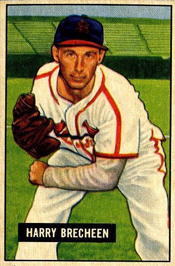
Harry Brecheen prevented the Cardinals from experiencing an epic collapse, saving the victory that carried them into the 1946 World Series.

harry_brecheen2On Oct. 3, 1946, the Cardinals beat the Dodgers, 8-4, at Ebbets Field in Brooklyn in Game 2 of a best-of-three playoff series to determine the National League champion. The Dodgers trailed by seven runs before mounting a ninth-inning rally that threatened to steamroll the Cardinals until Brecheen relieved and put a stop to it.

In the ensuing World Series against the American League champion Red Sox, Brecheen, a left-hander nicknamed “The Cat,” continued his poised mastery, earning three of the Cardinals’ four wins.

Dickson delivers

The Cardinals and Dodgers completed the 1946 regular season tied for first place in the NL with records of 96-58.

In Game 1 of the playoff series on Oct. 1, 1946, the Cardinals won, 4-2, at St. Louis. The starting pitchers for Game 2 were Murry Dickson for the Cardinals and Joe Hatten for the Dodgers. Each entered the game with 14 wins that season.

After yielding a run and two hits in the first inning, Dickson held the Dodgers hitless over the next seven innings. The Cardinals scored five runs in five innings against Hatten and added three more off Dodgers relievers. Whitey Kurowski, Enos Slaughter and Marty Marion contributed two RBI apiece. After eight innings, St. Louis led, 8-1.

Dickson “turned in a magnificent pitching job as the Redbirds put the squelch on the loud-mouthed Dodgers of Brooklyn,” the St. Louis Post-Dispatch opined.

Brooklyn frenzy

Dickson, though, as he later admitted to The Sporting News, was tired. The Dodgers scored twice against him in the ninth, cutting the St. Louis lead to 8-3, and had runners on first and second, one out, when manager Eddie Dyer went to the mound to replace Dickson with Brecheen.

Brecheen primarily was a starting pitcher, though he earned two saves in five relief appearances that season.

The first batter he faced, Bruce Edwards, hit a curve for a single, scoring Carl Furillo from second and getting the Dodgers within four at 8-4.

When Brecheen issued a walk to Cookie Lavagetto, loading the bases and bringing the potential tying run to the plate, the crowd of 31,437 “almost went into convulsions,” The Sporting News reported. According to the United Press, the crowd “was roaring with all the bloodthirsty ferocity of ancient Romans watching the kill.”

Though he later told The Sporting News he never was worried, Brecheen said to Oscar Fraley of United Press, “It felt like being under a microscope with a million horns blowing in your ears.”

Under pressure

Eddie Stanky, who led the NL in on-base percentage (.436) and walks (137) in 1946, stepped to the plate.

Brecheen struck out Stanky looking at a fastball.

Up next was Howie Schultz, a 6-foot-6 slugger. Working the count to 3-and-2, the tension increasing with each pitch, Brecheen struck out Schultz swinging at a screwball, ending the game. Boxscore

(In the book “Redbirds Revisited,” Brecheen told authors David Craft and Tom Owens that Pirates pitcher Cy Blanton taught him the screwball when Brecheen was playing American Legion baseball at home in Oklahoma. Blanton also was from Oklahoma and would return there in the baseball off-seasons. “Blanton showed me how to put the reverse spin on the pitch,” Brecheen said.)

Brecheen’s effectiveness carried over into the World Series. He started and won Games 2 and 6, holding the Red Sox to a run in 18 innings.

Dickson got the start in Game 7, yielding three runs in seven innings before being relieved by Brecheen. The Cardinals snapped a 3-3 tie in the eighth when Slaughter made a daring dash from first to home on a hit to center by Harry Walker. Brecheen pitched two shutout innings and got the win, giving the Cardinals their third World Series title in five years.

The King and The Man. The nicknames alone reflect the stature golfer Arnold Palmer and the Cardinals’ Stan Musial have in the sports world.

palmer_musialBoth hailed from western Pennsylvania. Both were champions who represented the best in their professions.

Both were special athletes who deeply appreciated their fans and never wavered in connecting with them.

Each legend respected and enjoyed the other.

In one of his last major honors in a life filled with significant tributes, Palmer received the Stan Musial Lifetime Achievement Award in December 2015.

Best of class

Musial was born in Donora, Pa. Palmer was a native of Latrobe, Pa. Their hometowns are located about 35 miles from one another, just south of Pittsburgh.

In November 1962, when Musial was a year away from retiring as a player and Palmer was in his prime, Esquire magazine selected four athletes of the time that it regarded as guaranteed for immortality. They were: Palmer, Musial, football’s Jim Brown and tennis’ Pancho Gonzales.

A year later, in October 1963, the newly created Pennsylvania Sports Hall of Fame elected its inaugural class. Three came from the western Pennsylvania chapter: Palmer, Musial and baseball’s Pie Traynor.

At the induction dinner in Philadelphia on Dec. 8, 1963, Musial told the audience, “Pennsylvania can be proud of all its athletes.”

That afternoon, Musial had visited a Philadelphia hospital to present a plaque to one of the Pennsylvania Sports Hall of Fame inductees, Hans Lobert, who had undergone surgery, the Philadelphia Inquirer reported.

Before the induction dinner, Stan Hochman of the Philadelphia Daily News asked Musial, who had retired as a player after the 1963 season, about the possibility of making a comeback in 1964.

A playful, good-natured Musial replied, “I can’t come back. It would take me too long to give the plaques back. Heck, it would take me two months at least.”

Asked how he was adjusting to his new role as a Cardinals vice president, Musial said, “I went out to the (baseball) winter meetings on the West Coast. Boy, executives have it soft. I told them if I had known it was like this, I’d have retired five years ago.”

Honoring Arnie

In July 1970, Palmer was selected athlete of the decade (1960-70) by the Associated Press. A testimonial dinner at the Hilton Hotel in downtown Pittsburgh had 800 guests, including Musial.

“I am grateful that you would invite me to help honor Arnie,” Musial said to the Pittsburgh Post-Gazette. “In my opinion, there is no greater golfer and finer man anywhere than Arnold Palmer.”

Throughout the years, Palmer and Musial continued their friendship. They appeared together at celebrity charity golf events. In 1978, during the PGA Championship at Oakmont Country Club near Pittsburgh, Musial visited with Palmer as his guest in the clubhouse.

Life like Stan

The Musial Awards celebrate sportsmanship in North America. The signature award is the Stan Musial Lifetime Achievement Award. Joe Torre was the first recipient in 2014. Palmer was the second recipient.

After needing assistance from two aides to walk onto the stage at the Peabody Opera House in downtown St. Louis to accept the award, Palmer was seated and told the crowd Musial was “one of the greatest people I ever knew.”

“If every person in the world lived their life like Stan Musial did his, you could all walk away proud,” Palmer said.

Previously: How Frank Sinatra, Dean Martin sang for Stan Musial

Of the many tributes expressed on Ozzie Smith Appreciation Day, the best came from a Cardinals opponent.

larkin_smithOn Sept. 28, 1996, Barry Larkin, the heir apparent to Smith as the top shortstop in the National League, was at Busch Stadium in St. Louis, playing for the Reds against the Cardinals in the next-to-last game of the regular season.

The Cardinals had chosen that Saturday afternoon to honor Smith, 41, who in June had announced that the 1996 season would be his last as a player.

In the pre-game festivities before a crowd of 52,876, master of ceremonies Jack Buck was joined by an array of Cardinals legends, including Stan Musial, Red Schoendienst, Bob Gibson, Lou Brock and Whitey Herzog.

Larkin, who like Smith would be elected to the National Baseball Hall of Fame, took his turn at the microphone and spoke for the profession.

“Ozzie created a fraternity among shortstops and all those who had a relationship with him,” Larkin said. “On behalf of all baseball players, we thank you. For your sportsmanship. For your humanitarian work. For your great defensive plays. For hitting that home run in the 1985 playoffs. For representing baseball with honesty and integrity.”

Paving the way

Also in attendance were Smith’s mother and his three children.

Cardinals management announced the franchise would retire the uniform No. 1 worn by Smith during his St. Louis playing career from 1982-1996. Among the gifts Smith received was a baby grand piano from his teammates and staff.

“I’d like to thank God for giving me the ability to go out and perform for 19 years in a sport that I love,” Smith said. “I’d like to thank my mom for being my inspiration and driving force. I thank my family for their support. I thank the Cardinals organization for its support and the opportunity to perform for the greatest fans in the world. I thank all my teammates, past and present, because I could not have done it without all of you.”

In summary, the master fielder known as the Wizard of Oz, said, “You have all been part of my dream. Thanks to every one of you for traveling down my Yellow Brick Road.”

Observing the lovefest, columnist Bernie Miklasz of the St. Louis Post-Dispatch noted, “We saw an all-time record for most hugs and kisses in a single day at Busch Stadium.”

Touch of class

Cardinals manager Tony La Russa started Smith at shortstop that day and put him in the leadoff spot in the batting order.

As he headed to his position to begin the game, Smith treated fans to a somersault and his signature backflip.

The Reds started pitcher Mike Morgan, who had been released by the Cardinals a month earlier.

When Smith stepped to the plate in the first inning, Morgan tipped his cap to his former teammate. “Mike is one of the nicest guys in the game,” Smith told Rick Hummel of the Post-Dispatch.

Smith grounded out to Morgan.

In the third, Smith sliced a grounder down the third-base line. Eduardo Perez, the Reds’ third baseman and son of Hall of Famer Tony Perez, dived to his right, fielded the ball and threw out Smith from his knees.

Smith grounded out routinely to third against Morgan in the fifth.

Reaching base

In the sixth, facing left-hander Mike Remlinger, Smith hit a looping liner to left for a RBI-single. It would be the last regular-season hit of his career.

In his final at-bat of the game in the eighth, Smith was hit on the foot by a pitch from Scott Sullivan.

The Reds went down in order in the ninth. Bret Boone and Perez each grounded out to Smith. Larkin made the last out on a pop-up to first. The Cardinals won, 5-2. Boxscore

Smith had six fielding assists in the game and started a double play.

Starting again the next day in the season finale, Smith was 0-for-2 before he was replaced by Royce Clayton.

In the 1996 postseason, Smith was 1-for-3 in the NL Division Series versus the Padres and hitless in nine at-bats in the NL Championship Series against the Braves.

Previously: Ozzie Smith cheered Barry Larkin’s best personal feat

Previously: Bitterness at Ozzie Smith retirement announcement