Feeds:
Posts
Comments

Bing Devine thought he added the final piece to a championship contender when he acquired Gold Glove shortstop Ed Brinkman for the Cardinals. What the general manager didn’t know was he had dealt for a shortstop who did better playing on grass and dirt than on artificial turf.

ed_brinkmanFor the Cardinals, who played their home games on artificial turf at Busch Stadium, the deal was a dud.

On Nov. 18, 1974, the Cardinals, Tigers and Padres made a blockbuster trade. The Tigers sent Brinkman, outfielder Dick Sharon and pitcher Bob Strampe to the Padres for first baseman Nate Colbert. The Padres then swapped Brinkman and catcher Danny Breeden to the Cardinals for pitchers Sonny Siebert, Alan Foster and Rich Folkers.

Brinkman, who turned 33 three weeks after the deal, won a Gold Glove Award in 1972 with the Tigers when he led American League shortstops in fielding percentage (.990). Brinkman played 72 consecutive games without an error that season. He was named an American League all-star in 1973.

The Cardinals finished 1.5 games behind the first-place Pirates in the National League East in 1974 with a starting shortstop, Mike Tyson, who made 30 errors in 143 games. Tyson also struggled to stay trim. The Sporting News described him as being “built more like a catcher than a shortstop. Barrel-chested and with a belly to match.”

Moving Tyson to a utility role and adding Brinkman to a starting infield of Keith Hernandez at first, Ted Sizemore at second and Ken Reitz at third appeared to strengthen the Cardinals’ defense and give them the piece they needed to catch the Pirates in 1975.

Positive vibes

In a story headlined “Bing Beams Over Brinkman,” Devine told The Sporting News, “We now have eight solid men in our starting lineup.”

The Sporting News agreed, calling Brinkman “the experienced shortstop the Cardinals long had been seeking.”

Said Cardinals pitcher Bob Gibson: “We’re stronger at shortstop with Eddie Brinkman.”

Steady Eddie

Brinkman was a Cincinnati Western Hills High School teammate of Pete Rose. At 19, Brinkman debuted in the major leagues with the 1961 Senators. He joined the Tigers in October 1970 in the trade that sent pitcher Denny McLain to the Senators. With his steady defense, Brinkman helped Detroit win a division title in 1972.

Tigers general manager Jim Campbell called Brinkman “one of the finest professional players I’ve ever been around in my life.”

Detroit correspondent Jim Hawkins described Brinkman as “one of the best shortstops ever to wear a Detroit uniform.”

Good start

The early reviews about Brinkman with the Cardinals were encouraging. He asked for and was issued uniform No. 5 because he said it was the number closest to the No. 6 worn by two of his favorites, Stan Musial of the Cardinals and Al Kaline of the Tigers.

Brinkman hit .355 in spring training exhibition games for St. Louis. He produced RBI in five of six regular-season games from April 11 through April 18.

After 17 April games for the Cardinals, Brinkman was batting .283.

Plastic grass

Rather than solidify the shortstop position, though, Brinkman weakened it. Getting to balls on the lightning-quick artificial turf was far different than fielding on grass and dirt.

“The Cardinals quickly became disenchanted with Brinkman, who was accustomed to the real grass in the American League,” The Sporting News reported.

Brinkman started 24 games at shortstop for the 1975 Cardinals and committed six errors, five on artificial turf.

Cardinals manager Red Schoendienst reinstated Tyson as the starting shortstop on May 5. Later that month, Mario Guerrero, acquired in April from the Red Sox, became the starter. Brinkman, who made three errors in seven May games, was relegated to the bench.

Devine, admitting he had erred but noting there had been a robust market for the shortstop, said, “A lot of other people were fooled about Brinkman.”

Sent packing

On June 4, 1975, the Cardinals traded Brinkman and pitcher Tommy Moore to the Rangers for outfielder Willie Davis. Brinkman played one game for the Rangers and was dealt to the Yankees for cash. The Rangers needed the money to swing a deal with the Indians for pitcher Gaylord Perry.

The 1975 Cardinals tied for third in the National League East, 10.5 games behind the champion Pirates.

During spring training in 1976, the Yankees released Brinkman, ending his playing career.

Seven years later, in 1983, Brinkman became a coach under White Sox manager Tony La Russa, joining a staff that included Dave Duncan and Jim Leyland. Brinkman remained with the White Sox after Jim Fregosi replaced La Russa in June 1986. He coached until 1988, became a scout and worked for the White Sox until he retired in 2000.
 

(Updated Dec. 8, 2024)

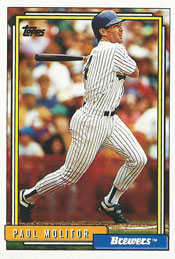
Paul Molitor is linked with Willie McGee and Darrell Porter as central figures in two prominent plays in the 1982 World Series between the Brewers and Cardinals.

paul_molitorMolitor was the third baseman and leadoff batter for the American League champion Brewers in 1982. He was selected by the Cardinals in the 28th round of the 1974 amateur draft, but chose to attend the University of Minnesota instead. Three years later, the Brewers drafted him in the first round, launching him onto a 21-year career in the majors. Molitor produced 3,319 hits and was elected to the National Baseball Hall of Fame.

In 1982, Molitor, along with Robin Yount, Cecil Cooper and Ted Simmons, played a prominent role in the Brewers winning their lone pennant. He followed that with a World Series versus the 1982 Cardinals that was both sensational and strange.

Here’s a look:

Hits record

Molitor became the first player to get five hits in a World Series game. After grounding out in the first inning, Molitor had five singles in his next five at-bats in Game 1 at St. Louis.

No one else produced five hits in a World Series game until the Cardinals’ Albert Pujols did it in Game 3 of the 2011 World Series. Boxscore

Molitor got his five hits in Game 1 off three pitchers: Bob Forsch (in the second, fourth and sixth), Dave LaPoint (in the eighth) and Jeff Lahti (in the ninth). Boxscore

“He’s a heck of a ballplayer,” Cardinals manager Whitey Herzog said to The Sporting News, “but he had only one line drive. He had three infield singles and a broken-bat bloop. Nothing you can do to stop things like that.”

In the book “Where Have You Gone ’82 Brewers?,” Molitor said, “Five singles. Ozzie (Smith) dove and knocked down three of them at short and almost threw me out on two of them. It was a heck of a way to have your first World Series game unfold.”

Molitor and Yount (four hits in Game 1) were the first teammates to get four hits apiece in a World Series game since the Cardinals’ Joe Garagiola, Whitey Kurowski and Enos Slaughter each had four hits against the Red Sox in Game 4 of the 1946 World Series. Boxscore

Bashing at Busch

Molitor batted .355 (11-for-31) in the seven-game World Series in 1982. He hit .526 (10-for-19) in the four games at St. Louis and .083 (1-for-12) in the three games at Milwaukee.

After his 5-for-6 performance in Game 1, Molitor hit .240 (6-for-25) for the remainder of the World Series. When he grounded out to lead off Game 2, he missed a chance to tie Goose Goslin (1924 Senators) and Thurman Munson (1976) for the World Series record of hits in six consecutive at-bats.

Molitor was devastating when batting with runners in scoring position, hitting .714 (5-for-7) against the Cardinals.

Porter power

After the Brewers won Game 1, 10-0, at St. Louis, the Cardinals felt pressure to win Game 2 before heading to Milwaukee. In the eighth, the Cardinals scored a run, breaking a 4-4 tie.

Molitor led off the ninth against closer Bruce Sutter. In a matchup of future Hall of Famers, Molitor bunted for a single, increasing the pressure on Sutter and his catcher, Darrell Porter.

The next batter was another future Hall of Famer, Robin Yount.

“I told Bruce to be sure to hold him (Molitor) close to the base because I figured they might either try a bunt or a steal,” Porter said to The Sporting News.

Brewers manager Harvey Kuenn called for a hit-and-run.

Said Porter: “I never thought they would try to hit and run.”

Sutter threw his signature pitch, the split-finger fastball. When thrown effectively, the ball dipped sharply into the dirt.

This time, Sutter made a mistake. The pitch stayed up, at shoulder level.

Yount, trying to hit the ball the opposite way to right field, swung and missed. Porter fired a strike to second base and nailed Molitor.

Sutter retired the next two batters and the Cardinals had their first World Series win since Game 4 of 1968. Boxscore

Robbed by McGee

In Game 3 at Milwaukee, Molitor led off the bottom of the first by smashing a Joaquin Andujar fastball into the teeth of a 16 mph wind in center field. Willie McGee, the rookie center fielder, raced to the wall, 402 feet from home plate, climbed the canvas and made the catch.

Inspired, McGee went on to have one of the all-time best games in World Series lore, hitting two home runs, driving in four runs and making another leaping grab in the ninth to deprive Gorman Thomas of a two-run home run. Boxscore

Recalling the catch of Thomas’ drive, McGee said to Cardinals Yearbook in 2016, “The key to making that catch is timing … You condition yourself during batting practice to chase fly balls like that one, and to working on timing your jump.”

(Updated Jan. 20, 2019)

Performing an escape act on the sport’s grandest stage, the Cardinals were the first team to emerge victorious in a World Series that ended with the tying run on third base.

red_schoendienst9It happened in Game 7 of the 1946 World Series between the Red Sox and Cardinals.

Nervous ninth

Game 7 of the 1946 World Series is best remembered for the daring dash by Enos Slaughter from first to home on a hit by Harry Walker that scored the decisive run in the eighth inning, earning the Cardinals their third championship in five years. What often is overlooked is the Red Sox nearly tied the score in the ninth.

Cardinals left-hander Harry Brecheen was pitching in relief in Game 7 in 1946 after having achieved wins in two starts in the World Series.

Rudy York led off the Red Sox ninth with a single and Bobby Doerr followed with another single, advancing York to second. Red Sox manager Joe Cronin replaced York with pinch-runner Paul Campbell.

That brought to the plate Pinky Higgins, 37, a 14-year big-league veteran. In what would be his last major-league at-bat, Higgins grounded to third baseman Whitey Kurowski, who threw to shortstop Marty Marion to get the force on Doerr at second base. Campbell advanced to third on the play.

With one out, Roy Partee batted next and popped out to first baseman Stan Musial for the second out.

Brecheen vs. McBride

Cronin sent Tom McBride, a right-handed batter, to bat for pitcher Earl Johnson. McBride hit .301 in 1946, including .333 against left-handers.

In the press box, some expected Cronin to use Don Gutteridge as a pinch-runner for Higgins at first base, but Cronin didn’t make the move.

Brecheen threw “a good screwball” and McBride rapped it on the ground. Second baseman Red Schoendienst got to the ball and gloved it, but the ball rolled up his arm.

In his book “Red: A Baseball Life,” Schoendienst said, “Just as I went to field the ball, it took a crazy hop and I blocked the ball with my left shoulder. Luckily, I was able to trap it.”

Schoendienst kept his cool and flipped a low, underhand toss to Marion, who caught it in time to nip Higgins at second base for the final out.

In his book “Stan Musial: The Man’s Own Story,” Musial told writer Bob Broeg, “Our hearts stood still” as the ball rolled up Schoendienst’s arm. “Red looked like a magician pulling a rabbit out of his sleeve when he finally flipped the ball to Marion,” said Musial.

$40,000 assist

In the St. Louis Star-Times, Sid Keener reported Schoendienst’s toss beat Higgins to the bag “by no more than a step.”

“Cronin’s critics insist Gutteridge would have beaten the play at second,” enabling Campbell to score from third with the tying run, Keener concluded.

McBride told the Society for American Baseball Research, “The ball I hit was a low liner right by Brecheen’s left knee, and when it went by Harry, I thought I had a hit … But the second baseman, Schoendienst, made a good play on the ball. He didn’t catch it clean. The ball bounced up and looked as if it balanced on the web of his glove. He picked it off and threw to second base for a force out.”

Said Schoendienst: “People began to refer to that play as the $40,000 assist because the $40,000 was the approximate difference between the total shares for the winning team and the losing side.”  Boxscore

The play had another benefit for Schoendienst. He wanted to marry his girlfriend, Mary, but her grandfather, Patrick O’Reilly, said he wasn’t keen about a “German” joining the family.

Said Mary: “He was still not sure about Red until he made that play. After the ball hit him in the chest, then rolled up his arm, and he still made the play and we won the game, then my grandfather said, ‘You can marry him now.’ “

(Updated April 3, 2022)

In 1939, a Cardinal was National League batting champion, but it wasn’t the player who nearly hit .400.

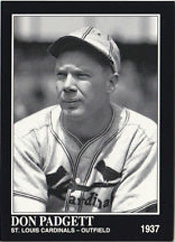
don_padgettCardinals first baseman Johnny Mize won the 1939 league batting title with a .349 mark in 153 games. At that time, a player needed to appear in 100 games in a season to qualify for the National League batting crown.

Mize’s teammate, catcher Don Padgett, hit .399 in 92 games for the 1939 Cardinals. Padgett produced 93 hits in 233 at-bats. No National League player with at least 200 at-bats in a season has had a higher batting average since then, according to baseball-reference.com.

If not for bad timing, Padgett, 27, would have hit .400 that season.

Untimely time out

On Oct. 1, the last day of the 1939 season, the Cardinals played the Cubs at Chicago’s Wrigley Field. Padgett, a left-handed batter, was sent by manager Ray Blades to pinch-hit for pitcher Max Lanier against the Cubs starter, right-hander Claude Passeau.

Padgett lined a single to center, according to author John Snyder in the book “Cardinals Journal,” but the hit didn’t count. First-base umpire Bick Campbell had called time out just before Passeau delivered the pitch because a ball had rolled from the bullpen onto the field.

The hit in his final at-bat of the season would have given Padgett a .402 batting average.

Instead, Padgett returned to the batter’s box and drew a walk, settling for the .399 mark. Boxscore

Ripping righties

Two years later, Ted Williams of the Red Sox became the last big-league player to hit .400 in a season with at least 200 at-bats. Williams hit .406 in 1941.

Padgett was used almost exclusively against right-handed pitchers in 1939. He hit .399  (89-for-223) versus right-handers and .400 against left-handers (4-for-10). He was especially productive at home, hitting .455 (46-for-101) for the 1939 Cardinals at Sportsman’s Park in St. Louis.

Primarily a backup to starting catcher Mickey Owen, Padgett enjoyed a torrid June (.441 batting average) and July (.484). His batting average was .400 on Sept. 27. Then he went 1-for-3 against the Reds on Sept. 28, dropping his batting mark to .399 and setting up that final at-bat versus the Cubs three days later.

Defense was not his specialty. Regarding Padgett’s catching skills, Bob Broeg of the St. Louis Post-Dispatch described him as “a shoemaker in shin guards.”

In five years with the Cardinals, Padgett hit .292 in 525 games. His career mark in eight big-league seasons with the Cardinals, Phillies, Dodgers and Braves was .288.

Previously: The strange case of Hugh Casey versus 1940 Cardinals

Previously: Baseball and romance: Cardinals’ Cuban adventures

Charlie Peete, a highly regarded Cardinals outfield prospect, died in a violent accident as he was on the verge of fulfilling his potential with the big-league club.

Charlie_PeeteOn Nov. 27, 1956, four months after he made his major-league debut with the Cardinals, Peete, 27, was killed in an airplane crash in Venezuela. His wife and three children also died in the crash.

Peete was a potent left-handed batter. Playing for the Cardinals’ Omaha affiliate, managed by Johnny Keane, Peete was the 1956 batting champion of the Class AAA American Association. Peete was planning to play winter ball before reporting to spring training as a strong contender for a starting spot in the Cardinals’ outfield.

Path to the majors

Peete was born Feb. 22, 1929, in Franklin, Va., and went to high school in Portsmouth, Va. After serving a two-year hitch in the Army, Peete began his professional baseball career with the independent Portsmouth team in the Piedmont League. The Cardinals signed him in 1954 and he advanced to Class AAA the next year. Because of his thick build (190 pounds) and short frame (5 feet 9), Peete was nicknamed “Mule.”

In July 1956, Peete was promoted from Omaha to the Cardinals. Hampered by a split thumb, he hit .192 in 23 games for St. Louis and made 13 starts in center.

There were some highlights.

Peete got his first major-league hit, a single to left, off the Dodgers’ Roger Craig on July 21, 1956, at St. Louis. Boxscore

Five days later, July 26, Peete had his most significant game in the majors, hitting a two-run triple off Phillies ace Robin Roberts, giving the Cardinals a 7-6 lead and propelling them to a 14-9 victory at Philadelphia. Boxscore

Peete also had a RBI-triple against the Pirates’ Ron Kline on Aug. 1 at Pittsburgh. Boxscore

Peete had his batting average above .250 before going into an 0-for-13 tailspin that led to his being sent back to Omaha. He finished the minor-league season with a .350 batting mark, winning the American Association hitting crown. The runner-up was Yankees prospect Tony Kubek (.331).

The Sporting News suggested Peete’s performance “made him one of the brightest prospects in the Redbirds system” and rated him a “highly regarded outfielder.”

Omaha general manager Bill Bergesch predicted to the Associated Press that Peete would be a Cardinals contributor in 1957. “I don’t think there’s any doubt about that,” Bergesch said. “He can do everything the rest of them (in the majors) do _ plus hit the ball a little harder than most.”

Disaster in Venezuela

Accepting a chance to play winter ball in Cuba, Peete signed with a Cienfuegos team that included Senators pitchers Camilo Pascual and Pedro Ramos. Peete expected to spend the winter in Cuba, but he slumped early and was released.

The Valencia team in the Venezuela winter league wanted Peete. He could have flown from Cuba to Venezuela to begin play. Instead, Peete chose to return to the United States to meet his wife, Nettie, and their children, Ken, Karen and Deborah, and bring them to Venezuela with him.

At 10 p.m. on Nov. 26, the Peete family boarded a commercial flight at Idlewild Airport in New York. The plane was scheduled to arrive in Caracas at about 7 a.m. on Nov. 27.

The flight was late. At 8:05 a.m., the French pilot, Capt. Marcel Combalbert, 34, radioed to the control tower that he was preparing his approach to the airport.

It was raining and foggy. Clouds limited visibility.

About two miles from the airport, the four-engine Constellation slammed into a 6,000-foot mountain top. All 25 people _ 18 passengers and seven crew _ on board were killed.

Previously: Oscar Taveras, Eddie Morgan: Flashy starts to Cardinals careers

(Updated Sept. 9, 2025)

Unable to supplant Lou Brock, Bake McBride or Reggie Smith, outfielder Jose Cruz left the Cardinals in 1974 and fulfilled his potential with the Astros.

jose_cruzThough he’d been a sensation in the minors and Puerto Rican winter league, Cruz, a left-handed batter, struggled with the Cardinals after debuting with them in 1970. His stock dropped so low that the Cardinals didn’t get anyone in return for him.

Instant upgrade

On Oct. 24, 1974, the Cardinals sent Cruz, 27, to the Astros in a cash transaction for $25,000.

A grateful Preston Gomez, the Astros’ manager, told The Sporting News, “This boy Cruz is better than anybody we had on the ballclub last year. He can hit with power, has better than average speed and he has a good arm.”

(Gomez had his eye on Cruz for several years. In 1971, as manager of the Padres, Gomez told the St. Louis Post-Dispatch he was impressed by Cruz and teammate Luis Melendez. “I like Cruz the best of the lot,” Gomez said of the Cardinals outfield prospects in April 1971. “Melendez is quite a ballplayer, too … I’d take either him or Cruz right now. I wish we had something to offer the Cardinals.”)

Cruz told the Houston Chronicle, “I can hit .300 if I play regularly.”

Cruz spent 13 seasons with the Astros, batting .292 with 1,937 hits in 1,870 games. He twice was named a National League all-star (1980 and 1985), won two Silver Sluggers awards (1983-84), led the league in hits (with 189 in 1983) and helped the Astros to the first three postseason appearances in franchise history.

Struggles in St. Louis

Though impressed by his range and arm, the Cardinals had found Cruz to be an undisciplined hitter, who regularly swung at bad pitches.

Cruz made 89 outfield starts for the 1972 Cardinals and batted .235. In 1973, he made 110 outfield starts for St. Louis and hit .227.

By 1974, Cruz was relegated primarily to being a pinch-hitter and late-inning defensive replacement. He made 25 outfield starts for the 1974 Cardinals and batted .261. He hit .217 as a pinch-hitter that season.

Forgotten man

“The Redbirds had been losing patience with Cruz, who seemed to be leaving too many hits in the winter leagues,” The Sporting News reported.

With Jerry Mumphrey, Jim Dwyer and Larry Herndon also vying for outfield playing time, the Cardinals deemed Cruz expendable. The Sporting News described Cruz as “a forgotten man” most of the 1974 season.

In five seasons with the Cardinals, Cruz batted .247 with 298 hits in 445 games, 26 home runs and 128 RBI.

With Bob Watson moving from the outfield to first base, Cruz was handed the Astros’ starting right field job in 1975. Gomez was fired that season _ he became a Cardinals coach for manager Red Schoendienst in 1976 _  but Cruz remained a starting outfielder for Houston every season through 1987.

Meanwhile, the Cardinals ended up with a void in right field. Reggie Smith was traded to the Dodgers in 1976. The Cardinals tried Hector Cruz, Jose’s brother, as the right fielder in 1977 and Jerry Morales in 1978. It wasn’t until 1979, when George Hendrick took over, that the position stabilized.

Recalling his Cardinals days, Cruz said to Bernie Miklasz of the Post-Dispatch in 1985, “I don’t know if I really had the chance here (in St. Louis), but … the Cardinals did me a favor by sending me to Houston. I got a chance there.”

In May 1988, Jack Clark, a slugger on two Cardinals pennant-winning clubs (1985 and 1987), told Kenny Hand of the Houston Post, “Jose Cruz never got the recognition he deserved. He swings the bat like George Brett. He has been one of the best hitters in the game. I consider myself a good hitter. Jose Cruz is a great hitter. He’s always looked so natural, used the whole field. I have power, but if I could do everything he can do I’d be a great hitter.”