Feeds:
Posts
Comments

(Updated Dec. 8, 2024)

Teetering on the brink of another letdown in their bid to end a pennant drought, the Cardinals got the matchup they sought against the Astros in Game 6 of the 2004 National League Championship Series.

Jim Edmonds provided the desired result.
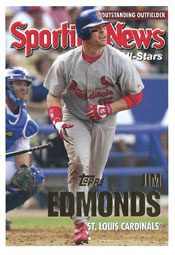
jim_edmonds4On Oct. 20, 2004, Edmonds launched a two-run, walkoff home run in the 12th inning, carrying the Cardinals to a 6-4 victory at St. Louis.

Kept alive by Edmonds’ home run, the Cardinals won Game 7 _ helped, in part, by a diving catch by Edmonds that prevented two runs from scoring in the second inning _  and earned their first National League pennant in 17 years.

Under manager Tony La Russa, the Cardinals had gotten to the National League Championship Series three previous times (1996, 2000 and 2002) but couldn’t clinch a pennant.

It appeared during Game 6 in 2004 that the Cardinals would fall short again.

Sense of dread

After scoring four runs in the first 2.1 innings off starter Peter Munro, the Cardinals were held scoreless by four Astros relievers _ Chad Harville, Chad Qualls, Dan Wheeler and Brad Lidge _ over the next 8.2 innings.

Lidge, the Astros’ closer, had been especially dominating. St. Louis Post-Dispatch columnist Bernie Miklasz described him as “bulletproof.”

Lidge, who entered in the ninth, retired all nine batters he faced. He struck out five, including Edmonds. Only one batter, pinch-hitter Marlon Anderson, who flied to left in the 11th, hit a ball out of the infield against Lidge.

Miklasz wrote that “a growing sense of dread spread through Busch Stadium” as Lidge mowed down the Cardinals.

Lidge, though, had been stretched to the limit with his three innings of relief. He had appeared in 80 games during the regular season and never had worked more than a two-inning stint.

In the 12th, manager Phil Garner lifted Lidge _ along with the Cardinals’ hopes.

High pitch, high drive

Dan Miceli, a right-hander pitching for his 10th big-league team, replaced Lidge.

After Miceli walked leadoff batter Albert Pujols, Scott Rolen popped out.

Edmonds batted next, giving La Russa the matchup he wanted. In the 2004 regular season, left-handed batters hit .307 versus Miceli, with seven home runs. Edmonds hit 37 of his 42 home runs against right-handers in 2004. More than half of Edmonds’ hits (83 of 150) that season were for extra bases.

“I was yelling at him, ‘Hit a line drive. Let’s get first and third.’ That’s all I wanted,” La Russa said to the Associated Press.

On an 0-and-1 pitch, Edmonds got a high, tight fastball, and sent it on a majestic arch over the right-field fence. Check out the You Tube video.

“I got the pitch up again and they hit it out again,” said Miceli, who yielded home runs to Pujols and Rolen in the eighth inning of Game 2.

Said Edmonds: “I wasn’t trying to go deep. I was just trying to hit the ball hard.”

La Russa, delighted Edmonds hadn’t settled for the single he’d been urging him to hit, said, “I didn’t feel too smart. Just happy. Happy and stupid.” Boxscore

Ten years later, in 2014, La Russa told Cardinals Magazine, “He was such a terrific big-game player I wasn’t surprised that he delivered. You’re talking about an individual who is very strong mentally. He was going to keep grinding.”

Big catch

Ahead 1-0 in the second inning of Game 7, the Astros had two on when Brad Ausmus drilled a Jeff Suppan pitch to left-center. An extra-base hit would give the Astros and their ace, Roger Clemens, a 3-0 lead, but Edmonds, with his back to the infield, dived, stretched and snared the ball for the out. The Cardinals went on to win, 5-2. Boxscore

Recalling the catch in an interview for the 2016 Cardinals Yearbook, Edmonds said when he saw where Suppan’s pitch was headed, he adjusted his fielding position, taking a step back.

“Ausmus hit it right where I thought he was going to hit it,” Edmonds said. “I got a really good jump, and when I get a jump like that, I expect to make the catch.” Video
(Updated March 30, 2026)

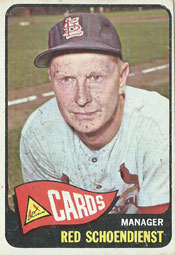
With the Cardinals in need of a public relations boost, Stan Musial went to bat for Red Schoendienst.

red_schoendienst8As usual, Musial delivered.

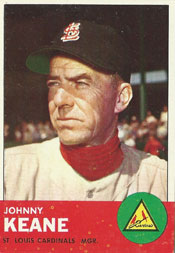
On Oct. 20, 1964, the Cardinals hired the popular Schoendienst to replace Johnny Keane as their manager. Four days earlier, Keane stunned the Cardinals by resigning less than 24 hours after leading St. Louis to a World Series championship.

Schoendienst, 41, a former second baseman who was a coach on Keane’s staff, had no managerial experience. “I never had really thought about managing,” Schoendienst said in his book “Red: A Baseball Life.”

According to broadcaster Harry Caray, in his book “Holy Cow,” the Cardinals had told Schoendienst that summer they wanted him to get experience managing in the minor leagues. Schoendienst said he told the Cardinals he had no desire to manage and would prefer to remain a major league coach for the next 25 years.

Fan favorite

Keane quit because Cardinals owner Gussie Busch fired general manager Bing Devine in August and plotted to replace Keane with former St. Louis shortstop Leo Durocher after the season. Even though Busch changed his mind about firing Keane after the Cardinals rallied to win the National League pennant and World Series crown, Keane refused to stay. His surprise departure triggered a firestorm of criticism against Busch and general manager Bob Howsam.

Desperate to repair the damage, Busch ordered Howsam to fire consultant Branch Rickey, who had advocated for Devine’s dismissal, and he formed a six-person executive committee to seek a replacement for Keane.

Musial, in his first year as Cardinals vice president after a stellar playing career, and Howsam were the key members of the committee. Joining them were Busch, club executive Dick Meyer and Cardinals board of directors members Jim Conzelman and Mark Eagleton.

According to multiple sources, Howsam favored hiring either White Sox scout Charlie Metro, who had managed for Howsam in the minor leagues at Denver, or former Giants manager Alvin Dark, a one-time Cardinals shortstop.

Musial advocated for Schoendienst, who was Musial’s friend and road roommate during their playing days together for St. Louis.

“I knew Red needed experience _ we all did _ but we felt he was the best man for the job,” Musial said, according to biographer George Vecsey.

Asked whether nice-guy Schoendienst was tough enough for the job, Musial told Bob Burnes of the St. Louis Globe-Democrat, “That would be one of the least of my worries about Red. He’s down to earth about baseball. He knows how the game is played. He knows what he wants and he can say so. He won’t have any problems with discipline.”

Said Schoendienst: “With Musial leading my support, it came down to as much a public relations decision as a baseball one and that’s where I had the advantage … The prevailing thought was the new manager needed to be someone who was a favorite of the fans.”

Quick decision

Schoendienst got tipped off by a Busch relative, Ollie Von Gontard, that the committee was considering him as a serious candidate.

Caray told Schoendienst, “Red, if you keep your nose clean with all the craziness that’s going on here, you’re going to wind up being manager of this club.”

Schoendienst said Busch called and asked to meet at the ballpark. Schoendienst said he met with Busch and Howsam. After Howsam quizzed Schoendienst about game strategies and player personnel evaluations, Schoendienst said the general manager “suddenly jumped up from his chair and asked how I would like to manage. I said that would be great and he said, ‘You’re my new manager.’ It happened so quickly I really didn’t have time to think about it.”

Said Schoendienst: “I felt comfortable that I could do the job and was ready to put my full-time energy and devotion into the post.”

Take my advice

Ed Spiezio, a Cardinals infielder, told Larry Harnly of The Journal-Register of Springfield, Ill., he didn’t expect Schoendienst to be elevated from coach to manager. “It really surprised me when they named Schoendienst manager,” Spiezio said. “… I never thought of him being the manager. He was so close to all the guys. Then all of a sudden he’s the manager.”

Cardinals players, who respected and supported Keane, were tolerant of Schoendienst, who avoided micro-managing while learning on the job.

In his book “Stranger to the Game,” pitcher Bob Gibson said, “The only problem I had with Schoendienst was that he wasn’t Johnny Keane, but he was a good man and a good man for us … Schoendienst, like Keane, respected our intelligence and our professionalism. His only rules were ‘Run everything out’ and ‘Be in by 12.’ Somehow, we got the words tangled up and lived instead by the motto ‘Run everything in and be out by 12.’ ”

Schoendienst said to the Globe-Democrat, “Managers don’t make rules on major league clubs. The players do. If the players show that they need to have a lot of regulations, I’ll issue those regulations. From what I’ve seen, though, most players don’t need a lot of tough regulations.”

Schoendienst also listened to his players. Said Gibson: “Red was uncertain of himself in the beginning, a fact which the ballplayers were well aware.”

Gibson said he and catcher Tim McCarver would sit on either side of Schoendienst in the dugout and offer suggestions to one another about game strategy. “We never actually told him to make a move; we were just there as birdies in the ear, now and then providing information he needed to make his decision,” Gibson said.

Center fielder Curt Flood, in his book “The Way It Is,” said of Schoendienst, “When he was required to think two or three moves ahead, as in choosing pinch-hitters or replacing pitchers, he accepted advice readily. It was given matter-of-factly, with every consideration for Red’s position.”

In the book “Few and Chosen,” McCarver said, “Red is one of the nicest people in the world, and that’s how he was as a manager. He was like a member of the family … and his approach to managing was fatherly or avuncular.”

The Cardinals finished seventh and sixth in Schoendienst’s first two years as manager, then won two consecutive pennants and a World Series title. He managed the Cardinals from 1965-76 and for parts of 1980 and 1990. His 1,041 wins rank second to Tony La Russa (1,408 wins) among Cardinals managers.


(Updated Oct. 20, 2018)

Gussie Busch broke Johnny Keane’s cardinal rule and Keane couldn’t forgive him.

johnny_keane2On Oct. 16, 1964, just 19 hours after the Cardinals won the World Series championship, Keane resigned as manager, stunning Busch, the club owner, who had expected to sign Keane to a contract extension that day.

Loyalty was sacrosanct to Keane. He had been loyal to the Cardinals, serving the franchise for 35 years. When Busch became disloyal to him, Keane’s personal code of conduct required he take action: He quit.

Surprising news

In the celebration that immediately followed the Cardinals’ World Series Game 7 victory over the Yankees on Oct. 15, Busch announced he would hold a news conference at the Anheuser-Busch brewery the next morning. Busch intended to present Keane with a three-year contract extension for $50,000 per year.

When Keane arrived at the brewery, he handed Busch a resignation letter 30 minutes before the news conference. Busch, in a hurry to begin the event, gave the letter to an assistant without reading it, according to the book “October 1964.” The assistant read the letter and insisted the owner do the same.

Flanked by Keane and general manager Bob Howsam, Busch, visibly shaken, announced Keane’s resignation to the surprised gathering, who were expecting a contract signing.

“This really has shocked me,” Busch said. “I didn’t know a thing about it until I saw Johnny this morning. All I can say is that I’m damned sorry to lose Johnny.”

Said Keane: “I told Mr. Busch not to make any offer. I handed him my resignation and said my decision was firm _ that I didn’t want to embarrass him _ but that no offer would be acceptable.”

In his book “Uppity,” Cardinals first baseman Bill White said, “I wasn’t there, but I was told Busch and Howsam looked as if Johnny had just kicked them in the teeth _ which, in effect, he had.”

The resignation letter was dated Sept. 28 _ the day after the Cardinals had completed a five-game sweep of the Pirates, with six games remaining in the regular season.

The decision had been made 10 days before then.

Higher calling

Keane, a St. Louis native, briefly studied for the priesthood at St. Louis Prepatory Seminary. At 18, he signed a Cardinals contract and was assigned to the minor leagues.

“I’ve been asked about that often,” Keane told The Sporting News. “Did I give up the priesthood for baseball? The answer is no. I knew after consultation with the priests at the seminary that the life was not for me.”

Keane was a baseball lifer. More specifically, a Cardinals lifer, or so it seemed.

He was an infielder in the St. Louis organization from 1930 until becoming a Cardinals minor league player-manager in 1938. He spent 21 seasons as a manager in the St. Louis farm system and had winning records in 17 of those years.

In 1959, Keane made it to the major leagues for the first time as a coach on the staff of Cardinals manager Solly Hemus. Keane replaced Hemus as St. Louis manager in July 1961.

Matter of principle

In August 1964, Busch, thinking the fifth-place Cardinals were out of contention, fired general manager Bing Devine and business manager Art Routzong. Both were friends of Keane.

Though Keane remained manager, published reports indicated Busch planned to replace Keane after the season with Dodgers coach and former Cardinals shortstop Leo Durocher. In his book “Nice Guys Finish Last,” Durocher said he and Busch met in St. Louis at the end of August and Busch told him he would become Cardinals manager after the season.

Keane felt betrayed.

In early September 1964, Yankees general manager Ralph Houk and club president Dan Topping decided to fire manager Yogi Berra but wanted to wait until after the season to tell him. Their top two candidates to replace Berra were Keane and Giants manager Al Dark. Houk and Topping sought and received permission from Busch and Giants owner Horace Stoneham to talk with Keane and Dark and had a “trusted emissary” conduct “a number of conversations with both in the ensuing weeks,” the Associated Press later reported.

Keane later told the St. Louis Post-Dispatch he hadn’t been in contact with Yankees officials before his resignation, but “other people, not the Yankees management, told me the Yankees were interested in me” as early as Sept. 22.

On Sept. 18, with the Cardinals 6.5 games behind the first-place Phillies, Keane and his wife privately agreed Keane would resign after the Cardinals’ final game, regardless of his job status.

On Sept. 25, Houk and Topping decided they’d hire Keane, according to the Associated Press. Three days later, on Sept. 28, Keane wrote and dated his resignation letter and put it aside.

Hold that letter

The Cardinals won four of their final six games, including a sweep of the Phillies, and clinched the pennant on the last day of the regular season.

The late-season surge prompted Busch to change course and he frantically tried to get Keane to accept a contract extension to remain Cardinals manager. On Oct. 2, with three games left in the regular season, Busch met Keane in the clubhouse and offered “a new contract at a substantial pay increase,” but Keane said he preferred to wait until after the World Series to discuss a contract offer, the Post-Dispatch reported.

On Oct. 4, after the Cardinals clinched the pennant that day with a win against the Mets, Busch approached Keane at the team party and offered him “whatever you want,” but Keane again said he wouldn’t talk terms until after the World Series, according to the Post-Dispatch.

In the World Series, the Cardinals won four of seven against the Yankees, clinching their first title in 18 years.

At the news conference the next day, Keane told reporters a series of “little things” led to his resignation. Pressed for details, Keane admitted Devine’s firing and Busch’s open flirtation with Durocher were factors that caused him to depart.

Devine and Keane became friends in 1949 when Devine was general manager of the Cardinals’ minor league club at Rochester and Keane was the manager.

In his book “The Memoirs of Bing Devine,” Devine said, “As a person, Keane impressed me as Stan Musial did … I’m talking about basic traits as a person.

“I didn’t think he needed to _ or should have _ quit the Cardinals because of me. But Johnny Keane was a loyal guy _ and that’s how he felt.”

Most Cardinals players said Keane’s resignation surprised them, but pitcher Roger Craig told United Press International he had predicted Keane’s decision in August when it became known Busch wanted Durocher as manager. “Knowing the pride he has,” Craig said of Keane, “I knew this would happen.”

In his book “Stranger to the Game,” pitcher Bob Gibson said, “My anger toward the ballclub _ and it was tangible _ stemmed largely from the needless nature of Keane’s departure … I stayed mad through the winter.”

Hours after Keane’s resignation became public, the Yankees fired Berra. Three days later, on Oct. 19, Houk met with Keane to discuss the job and the next day, Oct. 20, 1964, Keane was hired to replace Berra.


(Updated April 14, 2025)

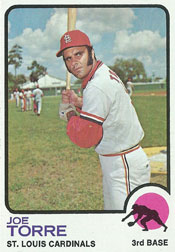
Having achieved personal success while falling short of the team goal, Joe Torre’s six-year stay with the Cardinals came to an unsatisfying end.

joe_torre5On Oct. 13, 1974, Torre was dealt to the Mets for pitchers Ray Sadecki and Tommy Moore.

Popular and productive, Torre hit .308 with 1,062 hits in 918 games for the Cardinals from 1969-74. His on-base percentage in that time was .382, nearly 20 points better than his career mark.

Though a multi-time all-star who regularly ranked among baseball’s top hitters, Torre exceeded all expectations in 1971 when he led the National League in hits (230), RBI (137) and batting average (.363) and was awarded the NL Most Valuable Player honor over Willie Stargell of the World Series champion Pirates.

Time for change

After the 1974 season, the Cardinals were ready to make Keith Hernandez, 21, their first baseman. In an interview with United Press International, Cardinals manager Red Schoendienst said of Hernandez, “He looks like a tremendous prospect. We had to make room for him.”

Though Torre also played third base and catcher, the Cardinals were set at those positions with Ken Reitz and Ted Simmons.

At 34 and with a yearly salary of $150,000, Torre was deemed expendable.

“His ample salary and his age may have been factors in arranging the deal,” the Associated Press reported. “He was one of a half dozen Cardinals players earning more than $100,000.”

Torre, too, was expecting a departure. In his book “Chasing the Dream,” Torre said, “I knew I wasn’t going to be back with the Cardinals. They had brought up a young first baseman from the minor leagues named Keith Hernandez and made him eligible for the playoffs if we won the East.”

Falling short

The Cardinals, though, finished in second place in the National League East Division in 1974 for the second consecutive year and for the third time in four seasons. They never qualified for the postseason during Torre’s time with the club.

Torre in 1974 hit .312 for the Cardinals in July and .320 in August before he slumped to a .200 batting mark with 22 strikeouts in September. After the season, The Sporting News reported Torre had played the last month of the season with a cracked thumb.

When Torre was acquired by the Cardinals from the Braves for Orlando Cepeda in March 1969, the Cardinals were a premier team, the two-time defending National League champions. “Torre did a heck of a job for us,” Cardinals general manager Bing Devine said. “I’m sincere when I say he took me off the spot by doing so well for us after we traded Cepeda for him.”

Meet the Mets

The Braves almost dealt Torre to the Mets instead of to the Cardinals. “The Mets thought they had him before the 1969 season and Gil Hodges, who was then their manager, went so far as to tell Torre during spring training that, ‘You’ll be with us in a couple of days.’ But that deal fell through because the Mets refused to part with Amos Otis, then a red-hot prospect to play center field for New York,” United Press International reported.

Six years later, the Mets finally got their man. It was the first trade for Mets general manager Joe McDonald, who would become general manager of the Cardinals from 1982-84.

“We’ve needed another right-handed hitter in our lineup and Torre gives us that,” Mets manager Yogi Berra said.

Said Torre, a Brooklyn native: “If I had to be traded anywhere, I’m glad I’m going to New York.”

Devine said Torre didn’t want to be a Cardinals reserve and his first choice among teams to be dealt to was the Mets.

In his book, Torre revealed, “I was going to a team whose season had just ended with 91 losses. That was a very fragile time for me. On top of being unhappy with my marriage, I hit rock bottom in the big leagues with a losing team. And to make matters worse, I became a part-time player. I hated it _ and it showed.”

Aftermath of the deal

Though Torre was the Mets’ starting third baseman on Opening Day in 1975, he eventually was platooned at first base with Ed Kranepool and at third base with Wayne Garrett. Torre hit .247 in 114 games for the 1975 Mets.

“In 1975, for the first time in my life, I dreaded going to the ballpark,” Torre said. “Baseball felt like work. I thought maybe it was time to quit.”

Torre became Mets player-manager in 1977 after he rejected a trade to the Yankees. As Torre recalled to Cardinals Yearbook in 2014, “In 1976, I was approached by Mets general manager Joe McDonald and he said, ‘How would you like to be traded to the Yankees?’ I didn’t jump at it … I said, ‘Not if it’s going to affect my chances of managing this team at some point.’ ”

Torre would manage the Mets, Braves, Cardinals, Yankees and Dodgers, winning four World Series titles with the Yankees and earning induction into the National Baseball Hall of Fame in 2014.

The pitchers the Cardinals got from the Mets for Torre had short stays.

Moore, 26, was 0-0 with a 3.86 ERA in 10 relief appearances for the Cardinals before he was traded in June 1975 with shortstop Ed Brinkman to the Rangers for outfielder Willie Davis.

Sadecki, 34, was in his second stint with St. Louis. He’d been a 20-game winner for the 1964 Cardinals and got the win in Game 1 of the World Series that year. In 1975, Sadecki was 1-0 with a 3.27 ERA in eight relief appearances for the Cardinals before being traded in May with pitcher Elias Sosa to the Braves for pitcher Ron Reed and outfielder Wayne Nordhagen.

Nine years earlier, in 1966, the Cardinals had sent Sadecki to the Giants for Cepeda. In proving the adage “what goes around, comes around,” the Cardinals dealt Sadecki for Cepeda, who later was traded to the Braves for Torre, who eventually was traded to the Mets for Sadecki.


A decade after the Cardinals and Dodgers were matched again in a National League Division Series, the result was familiar. So was the touch of class.

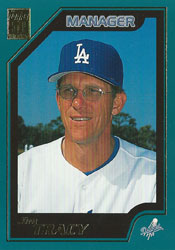
jim_tracyAfter the Cardinals eliminated the Dodgers from the 2004 National League Division Series, players and staff from both teams met on the field and shook hands.

After the Cardinals eliminated the Dodgers from the 2014 National League Division Series, St. Louis manager Mike Matheny tipped his cap to his opponent.

On Oct. 7, 2014, the Cardinals beat the Dodgers, 3-2, in Game 4 at St. Louis and advanced to the National League Championship Series. Boxscore As Matheny entered the field to congratulate his team, he turned toward the Dodgers’ dugout, doffed his cap and, in a gesture of respect, nodded in their direction. Check out the video clip.

Ten years earlier, on Oct. 10, 2004, the Cardinals beat the Dodgers, 5-2, in Game 4 at Los Angeles and advanced to the National League Championship Series. In an unscripted act of sportsmanship prompted by Cardinals outfielder Larry Walker and led by managers Jim Tracy of the Dodgers and Tony La Russa of St. Louis, the teams met near the third-base line and the Dodgers offered congratulations.

A surprised Matheny, then the Cardinals’ catcher, told the St. Louis Post-Dispatch afterward, “I didn’t know what was going on. I thought we were going to brawl.”

Hockey lesson

Late in the regular season, after the Cardinals had clinched the 2004 Central Division crown, Walker suggested to La Russa that the Cardinals and their Division Series opponent shake hands on the field after the series finale. Walker, a Canadian, was impressed by how National Hockey League players formed a line on the ice after games and congratulated one another.

“Those guys (hockey players) go out and beat the daylights out of each other and then shake hands,” Walker said. “I think it’s a class thing.”

At the time Walker proposed his idea, the Cardinals didn’t know who they’d face in the first round of the postseason. “It sends a great message,” La Russa said of Walker’s suggestion. “But it depended on who we go up against. I know some managers better than others. But I know Jim Tracy really well.”

Before Game 1 of the Cardinals-Dodgers series, La Russa and Tracy discussed Walker’s idea, but neither mentioned it again.

Impromptu gesture

After the Cardinals’ clinching victory in Game 4, La Russa, like Matheny in 2014, went onto the field and turned toward the Dodgers’ dugout. He waved to Tracy. Then, La Russa made a handshake motion.

Tracy got the message.

He led the Dodgers onto the field.

“It was a class act,” said Cardinals pitching coach Dave Duncan. “Tracy led the way.”

Said an appreciative La Russa: “I know it had to be much more difficult for them to come out of the dugout and meet us halfway. It was impressive.” Boxscore

Walker, who had joined the Cardinals two months earlier in a trade with the Rockies, was delighted.

“This is something I’ve thought about for a long time,” Walker said. “You can laugh at it, but I think it’s something that can be done. It can’t hurt.”

Previously: Mike Matheny sparked Cardinals over Dodgers in 2004 NLDS

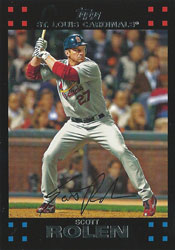
Cardinals third baseman Scott Rolen followed the most consistently excellent regular-season performance of his career with a postseason effort that was extraordinarily erratic.

scott_rolen2In 2004, the Cardinals won three of four games against the Dodgers in the National League Division Series, even though Rolen went hitless.

Super season

In the 2004 regular season, Rolen achieved career highs in home runs (34), RBI (124), batting average (.314), on-base percentage (.409) and slugging percentage (.598). His RBI total was second only to the 131 of the Rockies’ Vinny Castilla in the National League.

Rolen also was named a National League all-star in 2004, won a Gold Glove Award and finished fourth in the league’s Most Valuable Player Award balloting, behind Barry Bonds of the Giants, Adrian Beltre of the Dodgers and teammate Albert Pujols.

However, Rolen missed 16 games from Sept. 11 through Sept. 27 because of a calf strain. He still was experiencing soreness in the calf when the Cardinals opened the Division Series versus the Dodgers on Oct. 5, but he told the St. Louis Post-Dispatch he was “close to being close” to 100 percent.

Like 0-for-a-zillion

What happened next was unexpected. Rolen played in all four game of the Division Series and was hitless in 12 at-bats. He did walk six times, so along with a .000 batting average for the series Rolen had a .333 on-base percentage.

Batting in the cleanup spot, Rolen drew three walks in Game 4, a 6-2 Cardinals victory that eliminated the Dodgers and advanced St. Louis to the National League Championship Series versus the Astros. Boxscore

Said Rolen, who had sat out most of the 2002 postseason because of a shoulder injury: “I’m standing here after going 0-for-a-zillion and this feels so much better (than 2002). We’ve put ourselves in a position to do something special and I’m just glad to be part of it.”

Asked by Derrick Goold of the Post-Dispatch how he planned to end his slump before facing the Astros, Rolen replied, “I’m going to assess, approach, focus … Oh, that sounded pretty corny. A LaRussaism. He’s getting it in my head. That’s what Tony would say.”

Actually, what Cardinals manager Tony La Russa told Goold was: “Sometimes you have to go beyond the stats. (Rolen) was not a hitless hitter in the Dodgers series. You watch his at-bats, he had tough bases on balls.”

Timing is key

Cardinals hitting coach Mitchell Page said he told Rolen that six walks are as good as six singles.

“What six walks tells you is that they were pitching him careful,” Page said. “They weren’t just going to put something down the middle for him to hit.”

Rolen, though, acknowledged he had fouled off pitches he should have stroked for hits.

“My timing might have been here and there,” said Rolen. “I’m pulling some balls foul that I don’t normally pull foul.”

Rolen recovered, hitting .310 (9-for-29) with three home runs and six RBI in the League Championship Series. He produced the key hit, a two-run home run off Roger Clemens that snapped a 2-2 tie in the sixth inning of Game 7 and lifted St. Louis to a 5-2 pennant-clinching victory. Boxscore

Then, in the World Series versus the Red Sox, Rolen slumped again, going hitless in 15 at-bats.