Feeds:
Posts
Comments

In a 1964 World Series Cardinals lineup of future Hall of Famer Lou Brock and standouts Ken Boyer, Curt Flood, Dick Groat, Bill White, the hitter who performed with the most sustained excellence was their 22-year-old catcher, Tim McCarver.
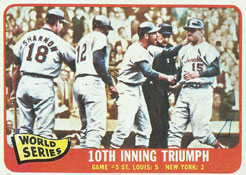
10th_inning_triumphDefeating the Yankees in seven games, the 1964 Cardinals received spectacular performances from pitcher Bob Gibson (two wins, 31 strikeouts in 27 innings), Boyer (two home runs, including a game-winning grand slam), Brock (nine hits, .300 batting average) and relievers Roger Craig and Ron Taylor (a combined 9.2 scoreless innings).

McCarver was every bit as good; perhaps the best of all. He hit a game-winning home run, stole home, led the Cardinals in hits (11) and walks (five) and fielded flawlessly (no errors in 63 innings) while helping a pitching staff navigate a Yankees lineup led by Mickey Mantle and Roger Maris.

Hot hitter

In hitting .478 with five RBI in the 1964 World Series, McCarver compiled a .552 on-base percentage.

The Cardinals have appeared in nine World Series since then and no St. Louis regular has had a higher on-base percentage than McCarver’s. (Among those who came close: Dane Iorg at .529 in 1982, Lance Berkman at .516 in 2011 and Brock, also at .516, in 1968.)

McCarver had the highest batting average by a Cardinal who played in every game of a World Series since Pepper Martin hit .500 in 1931, The Sporting News noted.

Gibson deservedly won the 1964 World Series Most Valuable Player Award, though a case could be made for McCarver, who was runner-up in the voting.

In Game 1, McCarver had a double and a triple against Whitey Ford, who was making his last World Series start in a Hall of Fame career. After his double in the sixth inning, McCarver scored the go-ahead run on a Carl Warwick single, breaking a 4-4 tie and sparking the Cardinals to a 9-5 victory at St. Louis. Boxscore

Swinging away

After the Cardinals and Yankees split the first four games, the score in Game 5 on Oct. 12, 1964, at Yankee Stadium was tied 2-2 after nine innings.

In the 10th, with White on third and Groat on first and one out, McCarver batted against reliever Pete Mikkelsen.

Cardinals manager Johnny Keane told The Sporting News he almost instructed McCarver to bunt.

“I considered a squeeze for Tim, but I was afraid of a pitchout,” Keane said.

With the count at 3-and-2, Mikkelsen threw a fastball and McCarver pulled it over the right-field fence for a three-run home run, lifting the Cardinals to a 5-2 victory. Boxscore and Video

“I was just trying to meet the ball, to get the guy (White) in from third base,” McCarver said. “I hit it good _ it was a waist-high fastball _ but at first I didn’t think it would be a homer. I didn’t think it would carry.

“I was dazed when I saw the ball go out. By the time I got to third, I was laughing out loud. I’m always laughing, even when I’m sad. The way I feel now, I’ll never be sad again.”

McCarver had singled in the two at-bats before hitting the home run. He also singled in his first two at-bats in Game 6, giving him five hits in a row. That was one short of the World Series record of six consecutive hits by Goose Goslin of the 1924 Senators.

Daredevil on base

In the fourth inning of Game 7, McCarver was on third and Mike Shannon on first with one out and the Cardinals ahead, 1-0. With Dal Maxvill at the plate and Mel Stottlemyre pitching, Shannon broke for second on a steal attempt.

Catcher Elston Howard threw to second, trying to nail Shannon, who eluded the tag of Bobby Richardson. McCarver dashed for home, beating Richardson’s return peg to Howard. McCarver had a steal of home. It would be his lone stolen base in 21 World Series games. Video

The Cardinals went on to a 7-5 victory and their first World Series title in 18 years. Boxscore

The next day, McCarver turned 23, celebrating his birthday as a World Series sensation.
(Updated May 2, 2023)

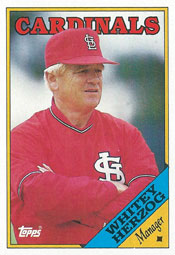
After managing the Cardinals, Whitey Herzog decided to extend his baseball career as an executive with the Angels.

whitey_herzog4Herzog joined the Angels one year after his last season as Cardinals manager. He led the Cardinals to three National League pennants and one World Series title, quitting in midseason with the team mired in last place in July 1990.

Job confusion

In September 1991, Herzog was named senior vice president and director of player personnel of the Angels.

Herzog said he believed he was overseeing the entire Angels baseball operation.

Instead, he found himself in a power struggle.

Dan O’Brien was the Angels’ senior vice president for baseball operations when Herzog was hired.

Herzog thought O’Brien primarily would be his assistant, handling paperwork.

In his book “You’re Missin’ a Great Game,” Herzog said, “I made sure I worked out every detail in advance … I’d be in complete charge of baseball operations: the minor-league system, the hiring and firing of coaches and scouts, the ballclub’s trades and drafts.”

O’Brien thought Herzog primarily would be evaluating players, leaving O’Brien to direct most of the baseball operations, including approval of trades and free-agent signings.

Herzog won the battle _ O’Brien eventually was fired _ but lost the war, resigning before the Angels could become contenders.

Work from home

His friends, Angels owners Gene and Jackie Autry, hired Herzog with the goal of bringing the franchise its first American League pennant and World Series title.

Herzog was given an apartment in Anaheim, but kept his residence in the St. Louis area and did most of his work from that home. He didn’t have an office at the Angels ballpark.

“Whitey doesn’t want to be an office person and he doesn’t have to be,” Angels president Richard Brown told the Los Angeles Times. “My exact words to him were, ‘If I see you in Anaheim in the office, you’re not doing your job.’ He has to be on the road a lot. I’m going to be relying on him constantly to evaluate our young players, and I don’t want him reading scouting reports. I want him evaluating what he saw.”

O’Brien did have an office at the Angels ballpark.

In a March 1992 interview, six months after Herzog was hired, O’Brien told the Los Angeles Times, “You can’t do things in this business in 1992 as you did in 1990 because it’s in a constant state of change. Contracts, more than anything else, keep getting in the way. The talent is probably now one of the easier things to analyze.”

In 1992, Herzog’s first full season with the team, the Angels finished 72-90 and ranked last in the American League in hitting and runs scored.

The next year wasn’t much better. The 1993 Angels finished 71-91. Herzog and O’Brien remained at odds. Bob Nightengale of the Los Angeles Times described the working relationship of the two senior vice presidents as “deteriorated beyond repair.”

O’Brien ouster

In mid-September 1993, Brown convinced the Autrys to fire O’Brien. Bill Bavasi, the Angels’ farm director, was promoted to general manager, reporting to Herzog. Bavasi was to handle administrative duties. Herzog was given the title of vice president in charge of baseball operations and was allowed to continue to work primarily from his suburban St. Louis home.

Wrote Nightengale, “The Herzog-O’Brien conflict was set in motion by the Angels two years ago when they appointed Herzog as vice president in charge of player personnel. Herzog was told that he would be in charge of all baseball operations, but O’Brien carried the title of vice president in charge of baseball operations and never relented in his duties, creating the impression within baseball that no one was in charge.”

Said Angels manager Buck Rodgers: “It was doomed from Day 1 … They are two good baseball men, but it’s hard to succeed when you don’t have one guy in control. You have to have a No. 1 guy.”

(A year later, in a November 1994 interview with Nightengale, O’Brien said he was surprised by his firing. “The thing that I find funny is that people kept saying that Whitey and I never got along,” O’Brien said. “That wasn’t true. I mean, Whitey was never around. He did things his way and I did things my way. All I know is that I was there every day in the office.”)

In his book, Herzog said, “They never told (O’Brien) what my duties were until I’d arrived. He got protective of his job, cut me out of meetings and fought my authority for two years.”

Old-school dropout

With O’Brien gone, Herzog gave an ill-advised multi-year contract to pitcher Joe Magrane, the former Cardinal. (Magrane would have elbow surgery 12 days before spring training began.) Herzog also created a stir by exploring the possibility of acquiring another former Cardinal, outfielder Vince Coleman, who had flopped with the Mets. (It didn’t happen.)

Herzog’s old-school tactics backfired with some players or their agents. He also may have felt restricted by a reduced player payroll. In January 1994, four months after O’Brien was fired, Herzog resigned, stunning the Angels. Bavasi replaced him.

In a blistering column, Mike Penner of the Los Angeles Times opined, “Herzog was baseball’s first absentee general manager _ he ran a ballclub based in Anaheim from his den in St. Louis _ and the best thing he generally managed from there was his leisure time.”

Said Herzog: “I don’t really want to be traveling all over and going back and forth to California or anywhere else.”

Wrote Nightengale, “Herzog was told that the Angels’ budget would have to be slashed to about $19 million, and instead of acquiring players in the free-agent market, he couldn’t even secure his own. He alienated several of his players in negotiations with his brash, sometimes abusive, style. He screamed at starter Mark Langston in a closed-door session. He slammed the phone in reliever Steve Frey’s ear. He bullied agents.”

“He had a great deal of respect and recognition among his peers, but the reality now is that this is a different era, and he hasn’t crossed that bridge,” said Steve Comte, Frey’s agent.

Said Arn Tellem, Langston’s agent: “Whitey’s strengths were finding and evaluating players, but not in the art of diplomacy dealing with lawyers and agents.”

In his book, Herzog took credit for identifying Angels minor leaguers Garret Anderson, Tim Salmon, Jim Edmonds and Gary DiSarcina as prospects and for preparing them to advance to the majors.

Said Herzog, “When I finally handed the reins over to Billy Bavasi in ’94 _ I’d been grooming him to replace me _ he said, ‘Man, you’re leaving at the wrong time. You’re the guy who put this together and it’s ready to blossom.’ I knew it was, but I didn’t need any credit.”

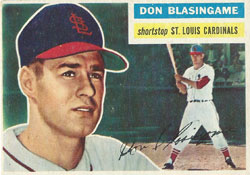
In 1956, Cardinals rookie second baseman Don Blasingame sprayed singles to all fields, ignited the offense with stolen bases and was superb at bunting for base hits.

don_blasingameWith the bases empty, Blasingame bunted for 66 hits in 77 attempts _ an 86 percent success rate _ during his 12-year big-league career, according to research conducted by James Gentile of SB Nation.

Of Blasingame’s 1,366 big-league hits, 1,105 (81 percent) were singles. In five years (1955-59) with the Cardinals, Blasingame produced 663 hits, with 528 (80 percent) being singles.

Blasingame got an opportunity to become the starting second baseman for the Cardinals because of a trade involving a fan favorite. In June 1956, the Cardinals dealt second baseman Red Schoendienst to the Giants, opening the position for Blasingame.

Gashouse Gang connection

In five games for the 1955 Cardinals after his promotion from the minor leagues in late September, Blasingame gave an indication of his electrifying potential. He had six hits and six walks in 23 plate appearances (a .545 on-base percentage).

Cardinals manager Fred Hutchinson opened the 1956 season with Schoendienst at second base and Alex Grammas at shortstop, but after three games Blasingame replaced Grammas.

Journalist Bob Broeg noted Blasingame wore uniform No. 3, the same worn from 1932-37 by Frankie Frisch, the Cardinals’ fiery Gashouse Gang second baseman who was elected to the National Baseball Hall of Fame.

In The Sporting News, Broeg wrote, “Blasingame’s skill at winning fans and followers _ as well as his share of games _ is no accident. For one thing, he’s extremely fast, probably the fleetest man on a St. Louis club that has its greatest collective speed since the famed Swifties of 1942.”

Blasingame said his playing style was inspired by Hall of Famer Ty Cobb. “I never saw him, of course, but I’ve read a lot about him, the way he could put the pressure on the other club and keep it there,” Blasingame said.

Firebrand like Fox

Because of his throwing arm, the Cardinals projected Blasingame as a better fit for second base than for shortstop. One of the players general manager Frank Lane acquired from the Giants for Schoendienst was Alvin Dark. Blasingame replaced Schoendienst at second, with Dark taking over at shortstop.

According to The Sporting News, Lane saw Blasingame “as a firebrand,” much like Nellie Fox, all-star second baseman of the White Sox.

“It was evident he had a chance for future greatness if he could be placed at second,” Lane said of Blasingame.

Wrote Broeg, “Blasingame, taking advantage of his speed and his small stature, has developed into an able leadoff man, a spray hitter and able drag bunter.”

Nicknamed the “Corinth Comet” (he hailed from Corinth, Miss.) and the “Blazer,” Blasingame finished his rookie season with 153 hits in 150 games, with 72 walks and 94 runs scored.

In his four full seasons (1956-59) with the Cardinals, Blasingame ranked in the top 10 in the National League in singles each year. In 1959, Blasingame led the league in singles, with 144, seven ahead of the runner-up, Reds second baseman Johnny Temple.

Blasingame also ranked among the top 10 in the league in stolen bases for three consecutive Cardinals seasons (1957-59).

The Cardinals, however, were last in the league in home runs in 1958 and sixth among eight teams in 1959. Desperate for power, Cardinals general manager Bing Devine traded Blasingame to the Giants for shortstop Daryl Spencer and outfielder Leon Wagner in December 1959.

(Updated May 15, 2020)

Three factors combined to make the last home run of Joaquin Andujar’s career both special and unconventional: It was a grand slam, he called the shot and the Cardinals pitcher, a right-hander, hit it left-handed.

joaquin_andujar5On May 15, 1984, Andujar pitched a complete game and slugged the fifth and final home run of his big-league career in the Cardinals’ 9-1 victory over the Braves at St. Louis.

In the eighth inning, the Cardinals led, 5-1, and had Andy Van Slyke on third and Ozzie Smith on second with two outs and catcher Tom Nieto at bat. The Braves opted to walk Nieto intentionally, loading the bases.

As reliever Jeff Dedmon delivered the mandatory four pitches outside the strike zone to Nieto, Andujar, waiting at the on-deck circle, pointed to the right-field wall.

“I told (teammates) George (Hendrick) and Tito (Landrum) that I was going to hit a home run,” Andujar told The Sporting News.

Smith, watching from second base, confirmed to the St. Louis Post-Dispatch he saw Andujar call his shot. “He pointed while he was in the on-deck circle and said he was going to do it,” Smith said. “Can you believe that?”

Said Andujar to the Atlanta Constitution: “Everyone knows that I’m strong.”

Special formula

Leaving the on-deck circle, Andujar strode toward the plate and settled into the left side of the batter’s box.

His first four major-league home runs had been hit right-handed. Andujar hit three homers _ off Bill Lee of the Expos, Steve Rogers of the Expos and Rick Wise of the Padres _ with the Astros. The fourth was hit for the Cardinals, again off the Expos’ Rogers, on April 27, 1984, at Montreal.

A career .127 hitter in his 13 major-league seasons, Andujar used a personal formula to determine whether he would bat right-handed or left-handed. He usually opted for the left side when facing a right-hander (such as Dedmon) with runners in scoring position, according to St. Louis reporter Rick Hummel.

Watching from the dugout, Cardinals manager Whitey Herzog never knew what side of the batter’s box Andujar would choose. “What the hell do I know?” Herzog said to The Sporting News. “I’m only the manager.”

Sultan of Swat

With the bases loaded, “I knew they’d have to pitch to me,” Andujar told the Associated Press.

Andujar dug in and waited for a pitch in the strike zone.

Dedmon delivered.

“It was right down the middle,” said Braves manager Joe Torre.

Andujar uncoiled what the Atlanta Constitution described as “his left-handed going deep swing” and hit the ball to where he had pointed _ over the right-field wall _ for his lone grand slam and his only home run struck left-handed. Boxscore and Audio

“Every day, I hit five or six home runs in batting practice,” Andujar told The Sporting News. “I know I’m not a good hitter. I know I’m a lousy hitter. But … if I make contact, it’s gone.”

Previously: Cardinals pitchers enjoy grand slam streak

Tom Poholsky had a remarkable performance against the Dodgers on Aug. 3, 1956, at Ebbets Field in Brooklyn. The Cardinals pitcher gave up 14 hits, all singles, and managed to avoid getting a loss.

tom_poholskyThe latter was no small feat. Ebbets Field was a house of horrors for Poholsky. His career record against the Dodgers at Brooklyn: 0-11 with a 5.72 ERA. Ten of those losses were as a Cardinal, one as a Cub.

Poholsky, who pitched five years for the Cardinals and one for the Cubs, was 4-17 overall against the Dodgers. As a Cardinal, he was 4-15 versus the Dodgers.

In 1956, Poholsky, 26, a right-hander, was one of the Cardinals’ top starters. He ranked second on the staff in starts (29) and innings pitched (203).

6-run cushion

On Aug. 3, he appeared headed for a win at Brooklyn. The Cardinals led, 8-2, after five innings, but the Dodgers kept piling up singles against Poholsky. Jackie Robinson had three. Carl Furillo, Jim Gilliam, Gil Hodges and Duke Snider had two apiece. Sandy Amoros, Roy Campanella and Randy Jackson had one each.

Poholsky also unleashed two wild pitches, but he protected the lead, in part, because the Dodgers hit into three double plays against him.

When Poholsky was relieved by Larry Jackson, with one on and one out in the seventh, the Cardinals led, 8-4.

Jackson gave up a home run to the first batter he faced, Hodges, narrowing the margin to 8-6, and the Dodgers scored twice more in the eighth, tying the score at 8-8.

Poholsky’s line: 6.1 innings, 14 singles, 5 runs, 3 walks, 4 strikeouts, 2 wild pitches.

History repeats

The Cardinals prevailed because their third pitcher of the game, left-hander Jackie Collum, held the Dodgers scoreless for 4.1 innings in relief of Jackson. Collum yielded one hit, a single by Campanella.

In the 12th, facing Clem Labine, the Cardinals scored three runs, two on a single by their 41-year-old catcher, Walker Cooper, and won, 11-8. The Dodgers had 19 hits, 18 singles and the Hodges homer. Boxscore

Fifty-eight years later, May 9, 2014, the Mariners’ Brandon Maurer became the first pitcher since Poholsky to yield 14 hits in a game, with all being singles, ESPN.com reported. Unlike Poholsky, Maurer was the losing pitcher. The Royals beat the Mariners, 6-1, at Seattle.

Maurer’s line: 7.1 innings, 14 singles, 6 runs, 0 walks, 0 strikeouts. Boxscore

The Royals had 16 hits (including two off Tom Wilhelmsen), all singles.

Poholsky was 1-5 against the Dodgers in 1956. He pitched a complete-game three-hitter in a 4-1 Cardinals triumph over the Dodgers at St. Louis on May 5. Snider homered, Gilliam tripled and Amoros had the lone single.

Overall for the 1956 Cardinals, Poholsky was 9-14 with a 3.59 ERA. He was traded to the Cubs in December 1956 and was 1-7 (including two losses to the Cardinals) in his lone season with Chicago.

Previously: Duke Snider, Stan Musial put on big show

For George Hendrick, the combination of a nervous pitcher and a hanging changeup was a recipe for hitting heroics.

george_hendrickOn May 12, 1984, Hendrick, the Cardinals’ cleanup hitter, ruined a no-hit bid by the Reds’ Mario Soto, slugging a home run with two outs in the ninth inning.

Though the Reds recovered to win, 2-1, against closer Bruce Sutter, Hendrick’s home run after Soto got within a strike of a no-hitter got the headlines.

Soto, 27, a right-hander, was in his eighth season with the Reds when he faced the Cardinals on a Saturday afternoon at Cincinnati’s Riverfront Stadium. Primarily relying on a fastball, Soto struck out 10 Cardinals in the first six innings and 12 overall.

Backed by sparkling defensive plays from second baseman Ron Oester, who stopped an Ozzie Smith grounder in the seventh and swatted the ball to first baseman Dan Driessen, and from right fielder Dave Parker, who made a diving catch of Tommy Herr’s liner to the gap in right-center in the eighth, Soto held the Cardinals hitless.

Nervous ninth

With a 1-0 lead, Soto faced Ozzie Smith leading off the ninth. Most of the 24,355 in attendance rose and cheered wildly. Instead of inspiration, Soto felt fear.

“I was too nervous,” Soto told the Associated Press. “I just couldn’t stand it out there. I was nervous after I made the last out in the eighth. I’ve never felt that way before.”

Still, Soto had a promising start to the ninth. Ozzie Smith grounded out and Lonnie Smith popped out to second. That brought up Hendrick, who had entered the game with one home run and a .224 batting average.

Soto got two strikes on the right-handed batter. Hendrick then fouled off a couple of pitches, building the drama. Hoping to induce Hendrick to swing and miss, Soto threw his next two pitches high. Hendrick wasn’t tempted, though, and the pitches were called balls, evening the count at 2-and-2.

Looking to catch Hendrick off-guard, Soto delivered a changeup.

“As soon as I threw the pitch, I said, ‘That’s trouble.’ I hung the pitch,” Soto said.

Hendrick swung at the high, inside offering and walloped it over the left-field wall, tying the score at 1-1.

Nowhere to hide

Soto appeared stricken as Hendrick circled the bases.

“I almost died right there,” Soto said. “I don’t think anybody felt worse than I did. I wanted to leave. I almost walked out.”

Instead, he walked the next batter, Andy Van Slyke, before getting Ken Oberkfell on a fly out to center, ending the inning.

Cardinals manager Whitey Herzog sent in Sutter to pitch the bottom half of the ninth, even though it wasn’t a save situation. With one out, Dave Concepcion singled and swiped second. Brad Gulden, the Reds catcher who began the day with a .103 batting average, singled, scoring Concepcion, lifting the Reds to a 2-1 victory and salvaging the win for Soto. Boxscore

In his next start, Soto pitched a three-hitter and got the win against the Cubs, even though he yielded a two-run home run on a changeup to Jody Davis. “I’d say that three or four of the seven homers I’ve given up this season have come on the changeup, but that’s not going to stop me from throwing it,” Soto said to The Sporting News.

Soto, who three times led National League pitchers in most home runs given up in a season, finished 1984 with an 18-7 record while yielding 26 home runs, second-most in the league and one behind Bill Gullickson of the Expos.

In his last of seven seasons with the Cardinals. Hendrick finished 1984 with nine home runs and a .277 batting mark.

Previously: George Hendrick influenced hitting style of John Mabry