Feeds:
Posts
Comments

(Updated June 26, 2020)

The Cardinals paid $75,000 and gave up a trio of players for a pitcher who netted them two outs.

memo_lunaGuillermo Romero “Memo” Luna pitched in one game for the Cardinals in 1954, failed to complete an inning and never played in the majors again.

A left-hander, Luna was the first Mexican-born player to appear in a game for the Cardinals.

On April 20, 1954, he got the start in his Cardinals debut against the Reds at St. Louis, even though his arm was hurting. In the clubhouse before the game, the St. Louis Globe-Democrat reported, “Luna smiled his usual pleasant fashion and said his arm felt fine and indicated by widening the grin and slapping his glove that he was ready to go out and do a little pitching.”

The confidence gave way to a shelling.

In the first inning, Luna yielded two runs on two doubles, two walks and a sacrifice fly. He was lifted with two outs. One of the outs came on a fly ball caught by Stan Musial with his back against the wall. Boxscore

“He was pounded so hard … that manager Eddie Stanky would hardly be justified in another such risky trial,” the St. Louis Post-Dispatch observed.

The Globe-Democrat declared Luna had “a hard time throwing a nickel’s worth” of the price the club paid to acquire him.

A few days later, the Cardinals sent Luna to their farm club in Rochester, N.Y.

Though he continued to pitch in the minor leagues and in Mexico until 1961, Memo Luna never returned to the majors.

His big-league career totals: 0-1 record, 27.00 ERA, 0.2 innings, 2 hits, 2 runs, 2 walks, 6 batters faced.

Super southpaw

In 1951, after he was 26-13 for Tijuana of the Southwest International League, Luna was pursued by the St. Louis Browns, but the San Diego club in the Pacific Coast League had a working agreement with Tijuana and acquired him. In addition to his pitching, Luna was a sketch artist. Asked what he sketched, Luna told the Globe-Democrat, “Everything in life.”

On Sept. 23, 1953, the Cardinals acquired Luna from San Diego for $75,000 and players to be named. They eventually sent pitchers Cliff Chambers and John Romonosky and outfielder Harry Elliott to San Diego, completing the deal.

At the time, Luna, 23, seemed worth the price. He had a 17-12 record and a league-best 2.67 ERA with 16 complete games for San Diego in 1953. Jack Bliss, a catcher for the 1908-1912 Cardinals, watched Luna at San Diego and told Cardinals manager Eddie Stanky, “He’s got exceptional control and a good curve.”

Cardinals scout Joe Mathes checked him out and was impressed. Luna is “a great control pitcher with other skills,” Mathes told the Post-Dispatch. “His knuckleball and curve are very good, he has tremendous poise on the mound and is outstanding in fielding his position and holding runners on base.”

That fall, Luna pitched in the Cuban League for Almendares and manager Bobby Bragan. The Cardinals granted permission with the understanding Luna would quit around Dec. 1, The Sporting News reported.

Luna posted a 4-1 record in his first five decisions for Almendares. The Sporting News wrote Luna “has shown remarkable poise and control, plus a fine knuckler.”

After Luna lost his next two decisions as the Dec. 1 deadline loomed, the Cardinals suggested he leave Cuba and rest his arm before reporting to spring training in February. Luna obliged and went to St. Louis, where he passed a physical examination.

While in St. Louis, Luna told the Cardinals that a day in his honor was being planned in Mexico City and he was being asked to pitch, the Globe-Democrat reported. The Cardinals misunderstood, thinking the game was in December, not February, and agreed to let Luna pitch, the Globe-Democrat reported.

Luna went home to Mexico, believing he had the Cardinals’ approval to pitch on Memo Luna Day.

Worn down

On Feb. 19, 1954, pitching for the Mexico City Reds against Aztecas, Luna struck out a batter in the third inning and grabbed his left elbow in pain.

According to The Sporting News, Luna stayed in the game until its completion, yielding five runs and nine hits in nine innings, and “was throwing with only half speed after the injury.” It was the second farewell game he pitched since returning to Mexico. The Cardinals’ front office had approved him to pitch only one, the Post-Dispatch reported.

Luna reported late to Cardinals spring training camp in Florida, complaining of a sore arm.

“We asked Luna to quit pitching Dec. 1, but we have no way of controlling what a man does back in his home country,” said Stanky.

In spring training, Luna failed to impress. He gave up three runs in two innings to the Phillies and surrendered a two-run, game-winning home run to the Reds’ Gus Bell. The Post-Dispatch described his exhibition game efforts as “a sorry spring.”

Having paid a high price for him, the Cardinals put Luna on the Opening Day roster. He got the start in the Cardinals’ sixth game of the season _ and never got another chance with them again.

“Luna, in Spanish, means moon, but only the English version, outfielder Wally Moon, has resembled a star in the making,” the Post-Dispatch concluded.

After Luna’s demotion to Rochester, Bob Burnes of the Globe-Democrat wrote, “Whether he hurt his arm before he started for spring training or whether it was something else, like maybe getting and feeling a little lost in the hustle and bustle of major league work, no one can say except Luna and he apparently can’t explain it himself. If he regains his control and confidence, both of which he must have to win, the Cardinals probably will accommodate him with a second look. If he doesn’t, they’ll probably leave him at Rochester.”

In late June 1954, when asked whether Luna would be a candidate to return to the Cardinals, Rochester manager Harry Walker told the Post-Dispatch, “Frankly, I’d have to consider him doubtful.”

Luna told the Rochester Democrat and Chronicle, “Could I pitch for the Cardinals? Without the fastball, no. If my arm was not hurt anymore, I can pitch for the Cardinals.”

Said Walker: “His changeup and his curveball are his strong points, but his control has to be sharp or he’s in trouble.”

Luna was 9-11 with a 3.50 ERA for Rochester in 1954.

Used primarily in relief, Luna pitched for manager Johnny Keane with the Cardinals’ farm club in Omaha in 1955 and was 4-4 with a 5.43 ERA. Luna spent a season in the Orioles’ farm system and played the rest of his career in Mexico.
 

(Updated Sept. 20, 2024)

Two years after his professional baseball debut at the Class C level of the minor leagues, Tom Alston was the Opening Day first baseman for the Cardinals. Making that leap in such a short time would be a challenge for any prospect. Alston had the additional pressure of being the player who integrated the Cardinals.

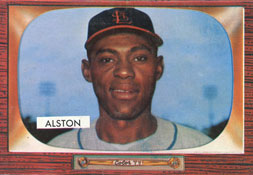
tom_alstonOn April 13, 1954, Thomas Edison Alston became the first African-American to play in a regular-season game for the Cardinals, batting sixth and playing first base against the Cubs at St. Louis.

Seven seasons after Jackie Robinson joined the Dodgers, the Cardinals became the 10th of the 16 major-league teams to integrate.

Alston, 28, was the 14th African-American player in the Cardinals’ organization, but the only one on the big-league roster. (Among the other blacks in the Cardinals’ system in 1954 were pitchers Bill Greason, Brooks Lawrence and John Wyatt. All eventually pitched in the big leagues.)

Rapid rise

Alston and Jackie Robinson were born on the same date, Jan. 31. Robinson’s birth year was 1919 and Alston’s was 1926.

Alston’s rise from baseball novice to Cardinals pioneer was fast and unexpected. After serving in the Navy from 1945-47, Alston enrolled at North Carolina A&T in his hometown of Greensboro and earned a degree in physical education and social sciences. College was where Alston first played organized baseball.

In 1952, he entered professional baseball with Porterville, Calif., of the Class C Southwest International League, hit .353 in 54 games and caught the attention of the San Diego club of the Class AAA Pacific Coast League.

Alston joined San Diego midway through the 1952 season and hit .244.

In 1953 for San Diego, Alston had 207 hits in 180 games, with 101 runs scored, 23 home runs, 101 RBI and a .297 batting average. Cardinals scouts recommended him.

On Jan. 26, 1954, the Cardinals sent first baseman Dick Sisler, pitcher Eddie Erautt and $100,000 to San Diego for Alston. San Diego manager Lefty O’Doul called Alston “a great prospect who can field as good as any first baseman in the big leagues.”

He “looks like he’s going to be a great hitter, too,” O’Doul told The Sporting News.

Said Cardinals owner Gussie Busch: “When we purchased the Cardinals, I promised there would be no racial discrimination. However, Alston was not purchased because of his race. Our scouts and manager Eddie Stanky believe he is a great prospect. While he may need more experience, we didn’t want him to slip away from us.”

Bill Starr, president of the San Diego club, offered to cut the cash portion of the deal to $75,000 if the Cardinals would wait until 1955 to take Alston, according to the Los Angeles Daily Mirror, but the Cardinals wanted Alston for 1954. The incumbent at first base was Steve Bilko, who hit 21 home runs for the 1953 Cardinals but also led the National League in striking out (125 times). The Cardinals used spring training in 1954 as a competition between Alston and Bilko for the first base job.

“I think we have a real ballplayer in this colored boy,” Stanky said to The Sporting News in March 1954.

Said Alston: “They treat me here just the same as any other ballplayer and that’s how I want to be treated.”

Major leaguer

Stanky said he’d platoon Alston (a left-handed batter) and Bilko (right-handed), but Alston got the Opening Day start against Cubs left-hander Paul Minner.

“I guess I’ve come a long way in a short time,” Alston said. “I guess I came up like a real rocket.”

Alston went 0-for-4 with a strikeout and committed an error in his debut game. Boxscore

In his next game, April 17, 1954, at Chicago, Alston went hitless in his first four at-bats. In the eighth, he led off with a home run, his first big-league hit, against Cubs reliever Jim Brosnan. Boxscore

The next day, April 18, Alston got his second hit, a pinch-hit, three-run homer off left-hander Jim Davis, lifting the Cardinals to a 6-4 triumph. Boxscore

On April 30, in an endorsement of Alston, the Cardinals sent Bilko to the Cubs.

In a doubleheader against the Giants on May 2, Alston was 5-for-6 with five RBI, an inside-the-park home run and three walks. His performance was overshadowed by teammate Stan Musial, who hit five home runs with nine RBI. Game 1 boxscore Game 2 boxscore

In The Sporting News, Bob Broeg wrote of Alston’s inside-the-park home run: “His speed enabled him to circle the bases easily after Willie Mays misjudged his long wind-blown drive to left-center.”

Slowed by slump

Alston hit .301 (37-for-123) in May and was at .285 overall on May 30, but he slumped in June, enduring a 2-for-27 stretch and batting .181 (15-for-83) for the month. He had seven RBI in his last 42 games.

On June 30, the Cardinals sent Alston to Class AAA Rochester and called up another rookie, Joe Cunningham, to replace him at first base. Alston’s overall numbers for the 1954 Cardinals: 60 hits in 66 games, 14 doubles, four home runs, 34 RBI and a .246 batting average. He made 62 starts at first base.

Said Cardinals general manager Dick Meyer: “Alston wasn’t ready … Eddie (Stanky) and I still have a very high regard for Alston as a prospect.”

Cunningham hit .284 with 11 home runs in 85 games for the 1954 Cardinals. The next season, the Cardinals moved Musial from the outfield to first base.

Alston made brief appearances with the Cardinals in 1955, 1956 and 1957. According to the Associated Press, when Gussie Busch asked Cardinals manager Fred Hutchinson why he didn’t play Alston, Hutchinson coldly replied, “If you want a clown to play first base, why don’t you hire (circus performer) Emmett Kelly?”

In 91 big-league games, all with St. Louis, Alston had 66 hits and batted .244.

Ten years after Alston’s big-league debut, the Cardinals became World Series champions, building a reputation as a franchise that embraced diversity with players such as Bob Gibson, Bill White, Curt Flood, Lou Brock and Julian Javier.

Tom Alston took the first steps toward making that possible.


(Updated April 11, 2020)

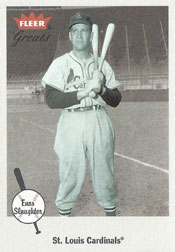
Uncertain whether outfielder Enos Slaughter could adjust to being a role player, the Cardinals decided to trade him.

enos_slaughter3Caught off-guard, Slaughter and teammate Stan Musial broke into tears.

On April 11, 1954, the Cardinals sent Slaughter to the Yankees for three prospects: outfielders Bill Virdon and Emil Tellinger and pitcher Mel Wright.

The trade occurred two weeks before Slaughter turned 38. He was the Cardinals team captain, a 10-time all-star who held the team record for games played (1,820) and RBI (1,148). Slaughter joined the Cardinals in 1938 and helped them to a World Series championship in 1942. After three years in the service, he returned to the Cardinals in 1946 and led them to another World Series title, scoring the winning run with his mad dash from first to home in Game 7.

In 13 seasons with the Cardinals, Slaughter batted .305 with 2,064 hits and an on-base percentage of .384. Known for his all-out hustle, he twice led the National League in triples (17 in 1942 and 13 in 1949). In 1942, he was the league leader in hits (188) and total bases (292). He also led the league in RBI (130) in 1946 and doubles (52) in 1939.

Slaughter showed no signs of slowing. In 143 games for the 1953 Cardinals, he produced 143 hits, 34 doubles, 89 RBI, a .291 batting average and .395 on-base percentage as the right fielder.

Youth movement

Slaughter went to spring training camp in St. Petersburg, Fla., in 1954 expecting to be a regular again in an outfield with Musial and Rip Repulski. He was surprised when, late in spring training, Cardinals manager Eddie Stanky told The Sporting News, “I’ll be satisfied if we can get 75 to 90 games out of the captain.”

Slaughter groused about the possibility of becoming a role player. Whether that was the normal grumbling of a proud veteran who didn’t want to concede playing time, or a tone of dark dissent that threatened to divide the team isn’t certain.

The Cardinals weren’t taking any chances. They wanted rookie Wally Moon to be the starting center fielder, moving Musial from left to right and Repulski from center to left.

Moon “is the best young prospect I’ve seen here in three years outside of Repulski,” Stanky told the St. Louis Post-Dispatch.

Informed of the trade by general manager Dick Meyer and Stanky after an exhibition game, Slaughter sobbed.

Slaughter called the trade “the greatest shock I ever had in my life.”

“You give everything you’ve got for an organization and then you get stepped on,” Slaughter said to the St. Louis Globe-Democrat.

Crying game

In his book “Stan Musial: The Man’s Own Story,” Musial said, “In the clubhouse, when the rest of us got the word, we were stunned. Dressing even more slowly than usual, I was the last one out. At the lot where I parked my car … I found Slaughter, still wiping his eyes. We looked at each other _ and both burst into tears.”

In justifying the trade, Stanky said, “A player like Slaughter just can’t stand sitting on a bench.”

“We are building this club with young talent,” Stanky said, “I’m sold on the way Wally Moon performed for us. If we kept Slaughter, it would mean Moon would go back to the minors.”

Said Slaughter: “I’ll be around when a lot of these guys are gone. I’m not finished. I’ll prove it to them.”

According to newspaper reports, the trade was the most unpopular with Cardinals fans since the club dealt Rogers Hornsby to the Giants after winning the 1926 World Series championship.

St. Louis writers reflected the mood of their readers. Among the tributes to Slaughter:

_ Bob Broeg in The Sporting News: “There never was a more determined competitor or hustler than the last of the old Gashouse Gang _ a hard runner, brilliant outfielder, clutch hitter.”

_ Bob Burnes in the Globe-Democrat: “Slaughter was more than a ballplayer, as any Cardinals fan could tell you. He was an institution _ not only among the fans but among the players as well.”

_ J. Roy Stockton in the Post-Dispatch: “Enos was the best competitor the club had. He still was a standout for batting skill and hustle.”

Desperate move?

The Yankees, who had an outfield of Gene Woodling in left, Mickey Mantle in center and Hank Bauer in right, were delighted with the deal for Slaughter. “We gave up practically nothing for him, so why not take him?” Yankees co-owner Del Webb said.

Other baseball executives saw Slaughter as a fading talent. The Sporting News polled the seven National League general managers besides Meyer and each said he wasn’t interested in pursuing a deal with the Cardinals for Slaughter.

Buzzy Bavasi of the Dodgers, who were planning to put rookie Sandy Amoros into an outfield with Duke Snider and Carl Furillo, said, “Personally, I wouldn’t take Slaughter over Amoros, would you?”

In response to the Yankees, Frank Lane, general manager of the American League White Sox, scoffed, “You can’t pack Old Man Time on your back and still be a great ballplayer … It was a desperate move by them.”

Actually, it was a good move for the Cardinals and Yankees.

Moon hit a home run in his first at-bat for the Cardinals on Opening Day and went on to win the 1954 National League Rookie of the Year Award, generating 193 hits, 106 runs, 18 steals, a .304 batting average and a .371 on-base percentage.

The next year, Virdon came up to the Cardinals and won the 1955 National League Rookie of the Year Award.

Slaughter adjusted well to being a role player with the Yankees. He hit .355 with 12 walks as a pinch-hitter for the 1954 Yankees. He played in the major leagues until 1959, appeared in three World Series (1956, 1957 and 1958) for the Yankees and was elected to the National Baseball Hall of Fame.


(Updated Sept. 20, 2022)

Embarrassed by their inability to stop the Dodgers from stealing bases and convinced they needed to find a solution in order to win a pennant, the 1964 Cardinals turned to an unlikely source for help: Bob Uecker.

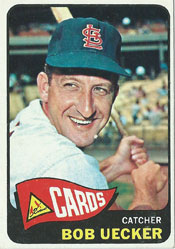
bob_uecker2The second-string catcher couldn’t slow Dodgers speedsters, but he did provide a defensive upgrade to a 1964 Cardinals club that won its first pennant and World Series title in 18 years.

On April 9, 1964, St. Louis sent Gary Kolb and Jim Coker to the Braves for Uecker.

Even then, at age 29, well before he became known as a broadcaster and for his comedy roles on television and in the movies, Uecker had a reputation throughout baseball as a funnyman.

Wrote The Sporting News: “Those who know him regard new Cardinals catcher Bob Uecker as a good-humor man.”

“Yes, I guess you can call me a stand-up type of comic,” Uecker said to St. Louis reporter Jack Herman.

The Cardinals, though, were serious about finding a way to overtake the Dodgers.

Armed for defense

In 1963, the Cardinals finished in second place at 93-69, six games behind the National League champion Dodgers. The Cardinals were 6-12 against the Dodgers and stolen bases were a significant reason for that. The Dodgers were successful on 27 of 33 stolen base attempts (82 percent) against the 1963 Cardinals. For the second season in a row, Dodgers speedster Maury Wills had 11 steals in 12 attempts versus the Cardinals.

“If we have a catcher who can throw well, they might think twice about running,” Cardinals manager Johnny Keane said.

Tim McCarver became the starting catcher for the Cardinals after Gene Oliver was traded to the Braves in June 1963 and his primary backup was Carl Sawatski.

McCarver nailed 38 percent of runners (28 of 73) attempting to steal in 1963 and Sawatski nabbed 30 percent (7 of 23). When Sawatski retired after the 1963 season, the Cardinals went looking for a backup for McCarver.

Uecker spent seven seasons in the Braves’ minor-league system. The Braves had groomed Joe Torre to replace veteran Del Crandall as their starting catcher.

In stints with the 1962 and 1963 Braves, Uecker impressed with his arm. He caught 5 of 7 runners attempting to steal in 1962 and 1 of 2 in 1963.

Office politics

Cardinals general manager Bing Devine was ready to make the trade for Uecker, but club consultant Branch Rickey opposed it, in part, because he didn’t want Gary Kolb to be dealt. Rickey had the support of Cardinals owner Gussie Busch and that gave him a voice in any proposed trade.

In his book “October 1964,” author David Halberstam wrote, “As both Keane and Devine pushed hard for the trade, Rickey resisted with a vehemence out of all proportion to the importance of the players at stake.”

As spring training neared its end, Keane asked Devine to make another attempt for Uecker.

“I’m sorry, Johnny, but I can’t go back there anymore,” Devine replied. “I’ve gone as far as i can go on that one.”

According to Halberstam, Devine suggested that Keane could approach Busch and appeal to him to approve the deal. Keane did and Busch granted his permission.

“We got Uecker to help Timmy and make our catching solid,” Keane said. “We’re certainly not vulnerable behind the plate anymore.”

In Uecker’s 1982 book “Catcher in the Wry,” McCarver said, “Uke really did have some talent. The first thing you looked at was his defensive ability _ his throwing arm and glove. I envied his arm (and) his relaxed, quick hands.”

On his first day with the Cardinals, Uecker was introduced to Rickey. According to Halberstam, Uecker extended his hand and said, “Mr. Rickey, I’m Bob Uecker, and I’ve just joined your club.”

“Yes, I know,” Rickey replied, “and I didn’t want you. I wouldn’t trade 100 Bob Ueckers for one Gary Kolb.”

Then Rickey turned and walked away.

Tough test

The 1964 Cardinals opened the season against the Dodgers at Los Angeles. With left-hander Sandy Koufax starting, Keane put Uecker, a right-handed batter, in the Opening Day lineup. (Uecker, the prankster, posed in a left-handed batting stance for his 1965 Topps baseball card.)

Uecker went 0-for-2 at the plate and 0-for-3 in attempting to prevent stolen bases that night. Willie Davis, Maury Wills and Jim Gilliam swiped bases against Uecker and starting pitcher Ernie Broglio.

“Uecker’s arm was not at fault,” The Sporting News reported. “The Dodgers speedsters just got too much of a jump on Ernie Broglio and the catcher’s strong throws were a little too late.” Boxscore

For the season, the 1964 Dodgers had 11 steals in 14 attempts (78 percent) against the Cardinals, but on July 16, 1964, Wills twice was caught attempting to steal against the Cardinals at St. Louis. McCarver was the catcher. Ray Sadecki was pitching the first time Wills was caught; Mike Cuellar was on the mound the second time. Boxscore

Overall, Uecker threw out 38 percent (8 of 21) of all attempted base stealers in 1964. He was 0-for-5 against the Dodgers; 8-for-16 against the rest of the National League. He hit .198, but his defense and his clubhouse popularity enabled him to stick with the Cardinals throughout the season.

The Phillies and Reds turned out to be the Cardinals’ main competition for the crown. Each finished a game behind St. Louis. The Dodgers were 80-82, in sixth place, 13 games behind the Cardinals.

(Updated Jan. 19, 2026)

Facing the defending World Series champion Pirates, Cardinals starter Pete Vuckovich performed a high-wire act in the 1980 season opener.

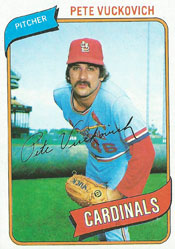
pete_vukovichVuckovich pitched a three-hit shutout in the Cardinals’ 1-0 victory on April 10, 1980, at St. Louis. It was the first of only two times the Cardinals won a season opener by a score of 1-0. The second occurred March 31, 2014, against the Reds at Cincinnati.

In the 2014 game, the Cardinals escaped an eighth-inning jam in which the Reds had runners on first and third with none out. Boxscore

In the 1980 game, Vuckovich performed a Houdini act by striking out the side with two runners on base in the ninth.

Strikeout pitch

Using a variety of off-speed pitches called by catcher Ted Simmons, Vuckovich retired 14 Pirates in a row between the first and sixth innings.

The Cardinals got a run against Bert Blyleven in the second when Bobby Bonds, in his Cardinals debut after being acquired from the Indians, walked and scored on a George Hendrick double.

Vuckovich held the Pirates to two hits through eight innings, but in the ninth it began to unravel.

Pinch-hitter Lee Lacy led off with a single and Omar Moreno followed with a walk, putting runners on second and first with none out.

“We couldn’t ask to be in a better situation,” Pirates manager Chuck Tanner told United Press International.

Tim Foli, who the year before was the toughest National League batter to strike out, stepped to the plate.

Vuckovich struck him out swinging.

Next up, Dave Parker, who was nicknamed “The Cobra” for his ability to uncoil quickly and lash line drives.

Vuckovich struck him out swinging.

“The pitches were looking good and then the ball would break away,” Parker told the St. Louis Post-Dispatch.

Willie Stargell, destined for the Hall of Fame, followed. With the count 0-and-1, Stargell swung and missed at a low pitch that glanced off the wrist of Simmons and rolled into the Pirates’ dugout, enabling Lacy to advance to third and Moreno to second.

Simmons told the Post-Dispatch, “I went to sleep … The ball hit the dirt, but I could have blocked it.”

Stargell watched the next three pitches sail outside the strike zone, making the count 3-and-2.

“You can’t do anything but respect these guys,” Vuckovich said. “There’s no room for getting scared or nervous because they can sense that, too. If they get that feeling, they can get you.”

The payoff pitch from Vuckovich was a wicked breaking ball. “The ball dropped eight inches,” Vuckovich told the Pittsburgh Post-Gazette. Stargell swung and missed with such intensity his bat flew out of his hands and into the stands. The strikeout of Stargell set off a celebration among the 42,867 spectators at Busch Stadium. Boxscore

Praise from Stan

“I was lucky,” Vuckovich said. “It could just as easily have gone the other way.”

Vuckovich delivered 111 pitches, striking out nine and walking two.

“Today was an emotional drain,” Vuckovich said to the Associated Press.

The performance earned Vuckovich the admiration of everyone who witnessed it.

“Amazing,” Stan Musial, the Cardinals’ all-time greatest player, said to The Sporting News. “He throws the best right-handed breaking pitches I ever saw.”

Cardinals pitching coach Claude Osteen said to Bob Fallstrom of the Decatur (Ill.) Herald and Review, “He has total command. Nobody in our league has as many kinds of pitches and such command. There are guys who throw harder. Vuckovich has so many speeds. He has a changeup, an off-speed slider, an off-speed curve. He has great motion on the off-speed pitches. He knows how to pitch.”

Pirates second baseman Phil Garner said, “Vuckovich gets my vote for Cy Young Award already.”

Vuckovich finished 12-9 with three shutouts and a 3.40 ERA for the 1980 Cardinals. After the season, Vuckovich, Simmons and reliever Rollie Fingers were traded to the Brewers. Vuckovich led the American League in winning percentage in each of his first two years with the Brewers and won the 1982 Cy Young Award.


(Updated April 26, 2020)

Scott Cooper enjoyed a storybook start to his Cardinals career.

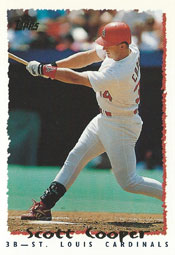
scott_cooperCooper, a St. Louis native and lifelong resident, got a walkoff RBI in his Cardinals debut.

On April 26, 1995, two weeks after he was dealt to St. Louis by the Red Sox, Cooper lifted the Cardinals to a 7-6 Opening Day victory over the Phillies at Busch Memorial Stadium in St. Louis. The season began later than usual because of the players’ strike that carried over from the 1994 season.

Playing third base and batting fourth, Cooper was 3-for-5 with four RBI.

In his first plate appearance for the Cardinals, Cooper struck out against Curt Schilling. “My first at-bat I was more nervous than any at-bat in my life,” Cooper said to the Springfield (Ill.) State Journal-Register. “I have played in front of 50 million fans in the All-Star Game, but in that first at-bat I had problems getting down to the basics.”

In the ninth inning, with the Phillies ahead, 6-5, the Cardinals loaded the bases with none out against Norm Charlton, who was making his first regular-season appearance since undergoing ligament transplant surgery in his left elbow in 1993. Bernard Gilkey sparked the rally with a single. Ozzie Smith and Ray Lankford each followed with a four-pitch walk.

Cooper, acquired along with reliever Cory Bailey in a April 9, 1995, trade for pitcher Rheal Cormier and outfielder Mark Whiten, stepped to the plate with the chance to be a hometown hero. He had supplied 40 tickets to the game for friends and family, including his mother, father, sister and two brothers.

The first two pitches Charlton delivered to Cooper nearly hit him. He fouled off a pitch, then grounded the next past diving first baseman Dave Hollins for a single into right field, scoring Gilkey and Smith. Boxscore and Video

Cardinals fans chanted “Coop” in tribute.

“I’ve probably dreamed up 50,000 different scenarios for how this game would go,” Cooper said to the Associated Press, “but I probably couldn’t have written it any better.”

Said Cardinals manager Joe Torre: “He knows he’s up there to knock in runs. He was up there swinging. That’s very aggressive and I like that.”

Charlton told the Philadelphia Daily News, “We played a great game and I screwed it up.”

After a fast start to his Cardinals career _ he was batting .325 on May 17 _ Cooper tailed off. A .284 hitter in five years with the Red Sox, Cooper batted .230 in 118 games for the Cardinals. He had almost as many strikeouts (85) as hits (86).

Granted free agency after the season, Cooper played in Japan in 1996. He returned to the big leagues with the 1997 Royals in his final season as a player.