Feeds:
Posts
Comments

(Updated Dec. 15, 2018)

Robin Ventura had a record of delivering knockout blows against the Cardinals.
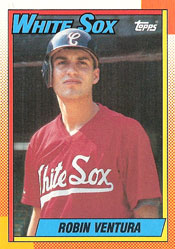
In a 16-year playing career (1989-2004) as a third baseman for the White Sox, Mets, Yankees and Dodgers, Ventura hit .250 versus the Cardinals, with five home runs and 19 RBI.

Two of his most devastating hits came on June 10, 1998, at Chicago. The Cardinals had built a 7-0 lead through five innings and were ahead of the White Sox, 8-4, entering the bottom of the ninth.

Curtis King retired the first two batters of the inning and needed one out to seal a Cardinals win, but Mike Caruso got an infield hit, Frank Thomas walked and Albert Belle slugged a three-run home run, making the score 8-7. Ventura followed with a home run, tying the score.

In the 11th, Belle singled with one out and Ventura hit a 3-and-0 pitch from Sean Lowe over the right-field fence for a two-run walkoff home run and a 10-8 White Sox victory. Boxscore

“I was just trying to get a pitch to hit in the air and I did,” Ventura said to the Arlington Daily Herald.

Asked about Ventura swinging on a 3-and-0 count, White Sox manager Jerry Manuel replied, “All three of those guys (Ventura, Belle and Thomas) have the green light to hit. They’re marquee players.”

Ventura became a free agent after the 1998 season and signed with the Mets. On June 17, 1999, he went 3-for-4 with two RBI and a run scored in the Mets’ 4-3 victory over the Cardinals at St. Louis. Ventura’s two-run home run to right-center in the sixth off Kent Mercker pushed the Mets’ lead from 2-1 to 4-1 and produced the winning run. Boxscore

“I made a bad pitch to Ventura and it cost me a game,” Mercker said to the St. Louis Post-Dispatch. “It was probably right down the middle of the plate. Three-and-two count, you leave a pitch down the middle to Robin Ventura … You expect bad things to happen.”

In 2000, Ventura had consecutive three-RBI games in Mets victories over the Cardinals at St. Louis, 5-2 on May 26 Boxscore and 12-8 on May 27. Boxscore

The Cardinals and Mets advanced to the National League Championship Series that year, with New York winning in five games. Ventura had the key hit in Game 4, a two-run first-inning double off Darryl Kile that landed between center fielder Jim Edmonds and right fielder J.D. Drew and gave New York a 3-2 lead. Ventura had a team-high three RBI in the game, which the Mets won, 10-6, at Shea Stadium. Boxscore

A year later, the Mets traded Ventura to the Yankees for outfielder David Justice. On June 15, 2003, Ventura won a classic duel with pitcher Woody Williams and lifted the Yankees to a 5-2 victory over the Cardinals in New York. Boxscore

In the sixth inning, with the Cardinals ahead 2-1, the Yankees had runners on first and second. Ventura faced Williams, who quickly got two strikes on the batter. Ventura fouled off four two-strike pitches. On the 10th pitch of the at-bat, Williams threw a high fastball on a 3-and-2 count and Ventura laced a two-run double into the gap in right-center, giving New York a 3-2 lead.

“That was a huge at-bat,” Yankees manager Joe Torre said to the New York Daily News. “He got behind and he was fighting off and fighting off. Those are the kind of at-bats we need.”
(Updated May 26, 2020)

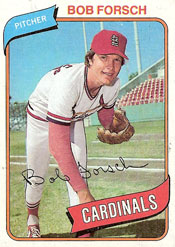
An official scorer’s ruling created a controversy when Bob Forsch pitched his first big-league no-hitter for the Cardinals.

Forsch’s gem in the Cardinals’ 5-0 victory over the Phillies on April 16, 1978, at St. Louis stirred an array of emotions. Boxscore
Garry Maddox opened the eighth against Forsch with a grounder to the left of third baseman Ken Reitz, who was playing in front of the bag. “I thought he might bunt,” Reitz told the Philadelphia Inquirer. The ball bounced into the outfield after Reitz appeared to tip it with his glove. Video at 8:36 mark

Official scorer Neal Russo, a reporter for the St. Louis Post-Dispatch, ruled it an error. The next batter, Bob Boone, grounded into a double play and Forsch retired the final four batters without incident for the first of his two big-league no-hitters. Video

It was the first Cardinals no-hitter in St. Louis since Jesse Haines achieved the feat against the Braves, also by a 5-0 score, on July 17, 1924. Boxscore

Varying opinions

The Phillies were unsparing in their criticism of Russo’s call.

“Base hit all the way,” Phillies manager Danny Ozark told Russo. “Reitz didn’t even touch the ball.”

Said Phillies third baseman Mike Schmidt: “Forsch pitched a dazzling one-hitter.”

Bake McBride, the Phillies’ right fielder and a former Cardinal, said, “We almost all fell off the bench when the call was made.”

Russo, who had 15 years of experience scoring National League games, never wavered. “I thought Reitz should have had it,” Russo told the Associated Press. “I called it immediately. It was an ordinary play, maybe a step to Reitz’s left. The ball wasn’t hit that hard. There was no doubt in my mind.”

Responding to the criticism, Russo said, “Of course, the Phillies, to a man, argued. That’s human nature.”

The Cardinals were just as adamant in their support of the call. Broadcaster Mike Shannon, the former Cardinals third baseman, told Russo, “It was an error, but it’s going to be controversial. Reitz had a chance to make the play and he didn’t.”

Catcher Ted Simmons told the Post-Dispatch, “It hit off his glove. If it wasn’t an error, I’d say so.”

Explained Reitz: “I thought the ball was hit a lot harder than it was. When I went for the ball, I double-pumped and when I came up with the glove the second time, the ball hit the webbing and went by me. I make that play 99 out of 100 times. This was the 100th time. It was an error all the way.”

Good luck

Somewhat lost amid the hubbub was the pitching of Forsch, who used mostly fastballs, curves and changeups to stop the Phillies. “He had full command of everything he threw,” Simmons said.

In a 2020 interview with Stan McNeal of Cardinals Gameday Magazine, Simmons recalled, “Forsch threw a profound power sinker,” and he used it to try to get the Phillies to hit grounders.

Said Forsch: “When I was warming up, I didn’t think I had real good stuff. So I just tried to keep the ball down in the first three innings and mixed up my pitches.”

Forsch’s biggest threat to the no-hitter was Schmidt, who hit three drives to the warning track. All were caught by center fielder Tony Scott. “1,200 feet of outs,” the Philadelphia Inquirer declared.

On a day when the temperature was 41 degrees, the wind was blowing in “and the ball carried like a shotput through the heavy river air,” wrote Bill Conlin of the Philadelphia Daily News.

“The ball Schmidt hit in the first inning I thought was going to hit the Stadium Club,” Forsch said candidly to the Philadelphia Daily News. “I think that’s a home run easy on a normal day here.”

Forsch concluded, “You’ve got to be lucky to pitch a no-hitter, and I was lucky, but I made some good pitches and any time I got into trouble I got right out of it.”

It was the first Cardinals no-hitter since Bob Gibson’s masterpiece against the Pirates in an 11-0 victory at Pittsburgh on Aug. 14, 1971. Simmons also was the catcher in that game. Boxscore

An appreciative Cardinals manager Vern Rapp said of Forsch, “He’s a complete pitcher now. He was a master out there this time. An artist.”

It would be the last win of Rapp’s tenure as St. Louis manager. After the Cardinals lost their next five in a row, Rapp was fired.

Previously: The story of how Bob Forsch converted to pitching

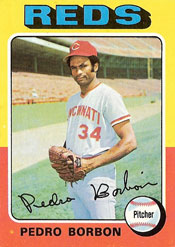
Pedro Borbon was best-known as a Reds pitcher, but he began and ended his professional playing career with the Cardinals.

Borbon was a reliable reliever for the Big Red Machine teams of the 1970s. In 12 big-league seasons (1969-80), Borbon was 69-39 with 80 saves. He pitched in the World Series for the Reds in 1972, 1975 and 1976. He won 11 and saved 14 for Cincinnati in 1973 and was 10-5 with 18 saves for the 1977 Reds.
What’s not as well-known is Borbon became a professional baseball player on one of the most magical days in Cardinals history. He was signed as a non-drafted free agent by St. Louis on Oct. 15, 1964, the day the Cardinals won Game 7 of the World Series against the Yankees.

Borbon was a success in his three seasons in the St. Louis system. He was 6-1 with a 1.96 ERA in 38 games for Class A Cedar Rapids in 1966 and 5-4 with a 2.29 ERA in 36 games for Class A St. Petersburg in 1967. Both clubs were managed by Ron Plaza.

In 1968, Borbon, 21, caught the attention of several big-league organizations with his performance for the Cardinals’ Class A Modesto club of the California League.

He established a league record by appearing in 18 consecutive games without allowing an earned run. In a May 15 game against Fresno, with the score 4-4, Modesto manager Joe Cunningham brought  in Borbon in the ninth inning with a runner on first, one out and a 3-and-0 count on batter Chris Arnold. Borbon struck out Arnold on three pitches and catcher Ted Simmons, 18, threw out the runner attempting to steal second. Modesto scored in the bottom of the ninth, giving Borbon the win.

Borbon finished 8-5 with a 2.34 ERA and 96 strikeouts in 100 innings for Modesto in 1968. In December, the two-time defending National League champion Cardinals failed to protect Borbon on their major-league roster and he was chosen by the Angels as the fourth pick in the first round of the Rule 5 draft.

The Angels were one of at least five big-league clubs that rated Borbon as the best available player in the draft, according to The Sporting News.

“He might be a real catch,” Angels manager Bill Rigney said. “Everyone was high on him.”

Borbon made the Angels’ roster in 1969. He got the win in his major-league debut on April 9 against the Seattle Pilots. Boxscore He finished 2-3 with a 6.15 ERA in 22 games for the 1969 Angels. In November, the Angels dealt Borbon and pitchers Jim McGlothlin and Vern Geishert to the Reds for outfielder Alex Johnson and infielder Chico Ruiz. Bob Howsam, the Reds’ general manager, had been the Cardinals’ general manager when Borbon signed with St. Louis.

Eleven years later, Borbon, 33, was looking for work after being released by the Giants in April 1980. The Cardinals gave him a job as their batting practice pitcher. After two weeks, they determined Borbon was better than some of the pitchers in their bullpen. St. Louis relievers had a collective 7.46 ERA. Desperate for help, general manager John Claiborne acquired Jim Kaat, 41, from the Yankees and signed Borbon. A headline in The Sporting News blared, “Redbirds Turn to Greybeards to Liven Up Their Bullpen.”

Borbon provided immediate results. He pitched three scoreless relief innings against the Astros in his Cardinals debut on May 3, 1980. Boxscore

In his second Cardinals appearance, Borbon earned a save _ and got revenge against the team that released him _ with 2.2 scoreless relief innings against the Giants. Boxscore

Borbon’s third appearance resulted in his first Cardinals win _ and last of his career in the majors _ in a 15-7 St. Louis victory over the Dodgers. Boxscore

But Borbon’s effectiveness soon waned. He yielded a home run in each of his final three appearances. The last two came in consecutive games _ a three-run homer by Padres catcher Gene Tenace on May 24 Boxscore and a grand slam by Padres third baseman Barry Evans (his second and last home run of a five-year big-league career) on May 25. Boxscore

Four weeks after they had added him to the roster, the Cardinals released Borbon. His St. Louis record: 1-0 with one save and a 3.79 ERA in 10 games. With that, Borbon’s big-league career was finished.

His son, a left-handed pitcher also named Pedro Borbon, had a nine-year career in the majors with the Braves, Dodgers, Blue Jays, Astros and Cardinals. Like his father, he finished as a Cardinal, pitching seven games for St. Louis in 2003 and posting an 0-1 record and 20.25 ERA.

(Updated April 11, 2026)

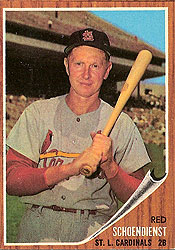
If second baseman Red Schoendienst had signed with the expansion Angels _ and he came close to doing just that _ he might never have returned to the Cardinals and become their manager, guiding them to two National League pennants and a World Series title.

Rejecting a “lush contract” from the 1961 Angels, Schoendienst accepted an invitation to try out for a spot with the Cardinals, made the roster, finished his playing career with them, became a coach on manager Johnny Keane’s staff and then replaced Keane.
In October 1960, a year after his comeback from tuberculosis, Schoendienst, 37, was released by the Braves. “It doubtless was shocking to many that the Braves began cleaning house by cutting one of baseball’s biggest names,” The Sporting News reported.

In his book, “Eddie Mathews and the National Pastime,” Braves third baseman Eddie Mathews said, “That move made no sense to us. They didn’t trade him for anybody. They just let him go. Red was getting up in years, but he had some baseball left.”

Schoendienst had opened the 1960 season as the Braves’ starting second baseman. He was batting .306 on May 13, but manager Chuck Dressen eventually lost confidence in him. After starting at second base for the Braves on Aug. 10, Schoendienst appeared in only one game after Aug. 11 and finished the season with a .257 batting average in 68 games.

General manager John McHale offered Schoendienst a non-playing job in the Braves’ organization (The Sporting News reported it probably was a minor-league manager position) but Schoendienst rejected it. “I don’t know what they had in mind,” Schoendienst said, “but I told them to forget it.”

Schoendienst, who had excelled for the Cardinals from 1945-56 before being traded to the Giants and then the Braves, told reporters he preferred to stay in the National League. “You hear some people say I’ve slowed up in the field,” Schoendienst said. “Well, maybe I have a little bit, but I’m confident that I can still make the plays at second base and I know I can help some club next year.”

In November 1960, St. Louis general manager Bing Devine invited Schoendienst to attend Cardinals spring training in 1961 for a tryout. “There is no question in my mind that he can prove valuable in a reserve capacity,” Devine said. “Meanwhile, I told him that if any other opportunity comes his way he is not committed to the Cardinals.”

A month later, Angels general manager Fred Haney offered Schoendienst a contract to join the expansion team as a second baseman, The Sporting News reported. Haney had been manager of the Braves in 1957 and 1958 when Schoendienst helped Milwaukee win two pennants and a World Series title.

Schoendienst told friends, “If the contract is satisfactory, I’ll sign it. I think I can play 100 games in 1961.”

The Sporting News reported the contract as “lush” and Haney “undoubtedly will take the veteran second baseman to camp with the club at Palm Springs.”

Instead, Schoendienst, who turned 38 in February 1961, chose to attend Cardinals camp as a non-roster player. “I told Fred (Haney) I’d be better off staying in St. Louis with my family,” Schoendienst said.

In the book “Redbirds Revisited,” Schoendienst recalled, “I promised Bing Devine and the Cardinals that I’d go to spring training if they’d give me a shot to make the club. I made the promise … and I thought I should keep my promise.”

Reporting in top condition after a winter of workouts, Schoendienst impressed Devine and manager Solly Hemus with his play. On March 15, they signed him to a contract and declared he would back up starting second baseman Julian Javier.

The move paid off for the Cardinals and Schoendienst. He hit .300 in 72 games for the 1961 Cardinals. He was a player-coach for Keane (who replaced Hemus) in 1962 _ and did even better, hitting .301 in 98 games.

Schoendienst remained a Cardinals coach in 1963 and 1964 (appearing as a pinch-hitter in 1963) and became St. Louis manager in 1965. In 14 years as Cardinals manager, Schoendienst had a 1,041-955 record. Only Tony La Russa had more wins as a Cardinals manager.


(Updated April 24, 2022)

The Cardinals played a significant role in the birth of the Mets as a National League franchise.

In 1962, the Cardinals were the opponent when the expansion Mets played their first spring training exhibition game and their first regular-season game. The Cardinals won both.

The Cardinals and Mets had their spring training camps in St. Petersburg, Fla., in 1962. Two former Cardinals player-managers, Rogers Hornsby and Solly Hemus, were on Mets manager Casey Stengel’s coaching staff. Former Cardinals on the 1962 Mets roster included catchers Hobie Landrith and Chris Cannizzaro, outfielder Bobby Gene Smith and pitchers Bob Miller, Craig Anderson and Herb Moford.

First game

On March 10, 1962, before an Al Lang Field crowd of 6,872, including baseball commissioner Ford Frick, the Cardinals beat the Mets, 8-0, in their spring training opener, the first game played by the expansion team.

Minnie Minoso and Gene Oliver each hit home runs for the Cardinals, who collected 12 hits. Mets starter Jay Hook allowed five runs in four innings. Curt Flood was the first batter to face the Mets. Stan Musial contributed a sacrifice fly for the Cardinals.

Three Cardinals pitchers, Lindy McDaniel, Ray Washburn and Curt Simmons, combined to limit the Mets to four hits, including a triple by Don Zimmer.

First win

The Mets earned their first victory the next afternoon, March 11, 1962, beating the Cardinals, 4-3, before 2,574 at St. Petersburg.

Larry Jackson and Paul Toth held the Mets scoreless on one hit through seven innings and the Cardinals built a 3-0 lead.

In the eighth, the Mets broke their streak of 16 consecutive scoreless innings when Choo Choo Coleman hit a two-run home run to right against Johnny Kucks. Elio Chacon, Rod Kanehl and Gus Bell followed with consecutive singles, tying the score.

The Mets won in the ninth against Ed Bauta when, with two outs and none on, Richie Ashburn doubled and Chacon followed with a RBI-single.

Bob Botz, a right-hander who pitched a scoreless top of the ninth, earned the first win in Mets history. Botz never appeared in a regular-season game for the Mets. On April 2, 1962, he was traded to the Braves. The Cardinals acquired him from the Angels in April 1963 and assigned him to the minor leagues.

Playing for keeps

The Mets went to St. Louis to open the regular season. At the hotel, several players got trapped in an elevator for 20 minutes. “It wasn’t like it was just a few guys,” pitcher Jay Hook told author Janet Paskin. “We were packed in there like sardines.”

Then, the April 10 opener was postponed because of rain. It was the first time a Cardinals home opener had been scratched in more than 25 years.

They played for real on April 11. According to the book “Tales from the 1962 Mets,” Sherman Jones was supposed to be the Mets’ starting pitcher, but he got sidelined when, while lighting a cigarette, the head of the match flew off and struck him in the eye, blinding him temporarily. Roger Craig got the start instead.

Musial, 41, was 3-for-3 with two RBI, a walk and a run, Bill White drove in three runs and Julian Javier contributed four hits and scored three runs as the Cardinals beat the Mets, 11-4, before 16,147 at St. Louis. Boxscore

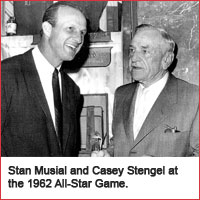
Stengel, the Mets’ 71-year-old manager, managed the Braves when Musial made his big-league debut against them 21 years earlier in 1941.

“He’s the only player left from my last time in the National League,” Stengel said to the Associated Press. “No wonder they keep him around.”

Ashburn, the first batter in Mets regular-season history, flied out to center. Bell got the first Mets hit, a single to center in the second. Gil Hodges hit the first Mets home run, with none on in the fourth.

Larry Jackson pitched a complete game for the Cardinals. Craig lasted three innings and took the loss, his first of 24 in 1962.

Cardinals dominate

A week later, April 18, 1962, the Cardinals played their first game against the Mets at New York and it was another romp. Ken Boyer hit two home runs and scored four times, and Musial was 2-for-4 with two RBI and a run in a 15-5 Cardinals triumph before 4,725 on a Wednesday afternoon at the Polo Grounds. Boxscore

The win improved St. Louis’ record to 5-0. The Mets dropped to 0-6 on their way to a 40-120 season.

The Cardinals won 13 of 18 against the 1962 Mets. Musial hit .468 with four home runs, 15 RBI and 11 walks in 17 games against them. Other Cardinals who excelled against the Mets in 1962: White (.360 batting average, 19 RBI), Boyer (.329, 23 RBI), Flood (.392, 13 RBI), Washburn (4-0 record), Jackson (3-0) and McDaniel (1-0, four saves).

The 1962 Cardinals batted .311 against the Mets, with 30 home runs.

Previously: An interview with former Cardinals pitcher Al Jackson

The Cardinals thought so highly of Gene Freese they offered to trade Ken Boyer for him.

Freese, an infielder, hit 14 home runs as a Pirates rookie in 1955 and batted .283 for them in 1957.

“I like that Freese … He’s my type of player,” Cardinals general manager Frank Lane told The Sporting News. “He’s aggressive and strong.”

In November 1957, Lane agreed to deal Boyer and another player (probably pitcher Willard Schmidt) to the Pirates for Freese and outfielder Frank Thomas, according to The Sporting News, but “Anheuser-Busch brass is understood to have frowned on the proposed deal.”

Soon after, Lane resigned to become general manager of the Cleveland Indians. Bing Devine replaced Lane in St. Louis and Freese appealed to him, too. On June 15, 1958, Devine acquired Freese and utility player Johnny O’Brien from the Pirates for shortstop Dick Schofield and cash.

The Cardinals projected Freese as a player who could back up Don Blasingame at second, Eddie Kasko at short or Boyer at third. In late July 1958, Blasingame was injured and Freese got his first stretch of starts for the Cardinals. After Blasingame returned to the lineup, manager Fred Hutchinson, unhappy with the weak hitting of Kasko and backup Ruben Amaro, installed Freese as the shortstop.

Though he lacked range, Freese provided pop. On Aug. 7, 1958, Freese, batting second, was 3-for-5 with a double and three runs scored in the Cardinals’ 12-1 victory over the Giants at St. Louis. Boxscore

Freese also was part of a power performance against the Dodgers at the Coliseum in Los Angeles. On Aug. 17, 1958, Curt Flood and Freese led off the game with back-to-back home runs to left field off Sandy Koufax. It was only the fifth time a National League team opened a game with consecutive homers. Boxscore Freese slugged three home runs in the four-game series.

Impressed, The Sporting News reported, “Since coming to the Redbirds, the 24-year-old Freese has been a life-saver. He’s filled in competently at both second base and shortstop … Neither the ex-Pirate nor the Cards’ high command has any illusions about his defensive talent. He doesn’t pretend to be a premier shortstop, but Hutchinson reluctantly sacrificed defense to get some hitting.”

Freese hit .257 with six home runs in 62 games for the 1958 Cardinals, but his on-base percentage was a poor .294. He committed eight errors in 28 games at shortstop and four errors in 14 games at second base.

On Sept. 29, a day after the 1958 season ended, the Cardinals traded Freese to the Phillies for infielder Solly Hemus, who became St. Louis’ player-manager, replacing Hutchinson.

Freese became the starting third baseman for the 1959 Phillies, hitting 23 home runs. His best season was 1961. As the third baseman for the National League champion Reds, managed by Hutchinson, Freese posted single-season career highs of 26 home runs and 87 RBI.