Feeds:
Posts
Comments

In a special game that featured the best Latino players in the majors, Cardinals second baseman Julian Javier did as well as anyone on the field.

On Oct. 12, 1963, the last baseball game played at the Polo Grounds in New York was a charity event called the Latin American Major League Players Game.

Part of the proceeds from the game were targeted for the Hispanic-American Baseball Federation, a group committed to developing baseball programs for Spanish-speaking youth in the United States.

Growing market

New York sportscaster Guy LeBow was the director of the Latin American charity game. He hoped to make it an annual event, the Bayonne (N.J.) Times reported.

LeBow was a “schmaltzy, do-everything sportscaster,” according to Phil Mushnick of the New York Post. He called hockey, basketball and baseball games, boxing and wrestling matches, hosted a popular bowling show and was a local news TV sports anchor in New York. As a child, he was bedridden with polio for two years. He walked with a limp the rest of his life. LeBow also played a sportscaster in the Woody Allen film “Radio Days.”

(In LeBow’s online obituary, Mets radio broadcaster Howie Rose left this comment: “I learned a lot from you _ some of it has even been put to good use, and I say that lovingly. You were an original.”)

George Schreier, a former Jersey Observer sports reporter who was hired by LeBow to help promote the Latin American game, told the Bayonne Times, “A new crop of promoters has risen today, one very much interested in the Spanish language market, a tremendous one in the greater (New York) metropolitan area.”

The event organizers put together two teams _ one of Latino American Leaguers and the other of Latino National Leaguers. Each player was paid $175 to participate, according to the Society for American Baseball Research.

Though the game was not sponsored by Major League Baseball, it had the approval of commissioner Ford Frick.

The Polo Grounds, most recently the home of the New York Mets, was awaiting to be demolished and replaced by a housing project. Promoters of the Latin American event touted it as a chance to see the last baseball game played at the venerable ballpark.

Talent galore

Played on a Saturday afternoon, the Latin American game drew 14,235 spectators. They were treated to pregame entertainment from bandleaders Tito Rodriguez and Tito Puente, and singer La Lupe.

The starting lineup for the American League squad: shortstop Luis Aparicio, first baseman Vic Power, right fielder Tony Oliva, left fielder Hector Lopez (also the manager), catcher Joe Azcue, center fielder Roman Mejias, third baseman Felix Mantilla, second baseman Zoilo Versalles and pitcher Pedro Ramos.

(Vic Power “was a favorite with the fans because of his one-handed catches of pop fouls,” the New York Times noted.)

For the National League team: shortstop Leo Cardenas, third baseman Tony Taylor, left fielder Felipe Alou, first baseman Orlando Cepeda, center fielder Tony Gonzalez, right fielder Roberto Clemente (also the manager), second baseman Julian Javier, catcher Cuno Barragan and pitcher Juan Marichal.

Six of the players _ Aparacio, Oliva, Cepeda, Clemente, Marichal and an American League reserve, outfielder Minnie Minoso _ would be elected to the Baseball Hall of Fame. (Minoso, 39, a former Cardinal, “received warm applause” when introduced to the Polo Grounds crowd, the New York Times reported.)

Javier, the only Cardinals player in the game, was coming off a successful 1963 season. He was the National League starting second baseman in the All-Star Game, led the league’s second basemen in putouts, produced 160 hits and scored 82 runs.

Javier was in the mix when the Latin American National Leaguers scored three runs in the fourth against Ramos. With the National Leaguers ahead, 1-0, Cepeda and Gonzalez singled. Then Javier drove in Cepeda with a single. Later in the inning, Gonzalez and Javier scored on a single by Manny Mota, who was batting for Marichal.

Al McBean, who relieved Marichal, provided the most entertaining play of the game. Batting in the sixth, the pitcher from the Virgin Islands ripped a deep drive. “There was a Listerine sign in left field (422 feet from home plate) and that’s where I hit the ball,” McBean told Rory Costello of the Society for American Baseball Research.

As Minnie Minoso chased the ball in left, McBean streaked around the bases. He reached third safely as Minoso threw to shortstop Luis Aparicio. Trying for a home run inside the park, McBean continued toward the plate, but Aparacio’s relay to catcher Joe Azcue was strong and McBean was out by five feet.

The Latino National Leaguers won, 5-2. Javier was 2-for-2 with a RBI, a run scored and a stolen base before he was lifted for a pinch-hitter, Chico Fernandez, in the sixth. (The Polo Grounds often was a tough venue for Javier. During the 1963 season, he batted .194 in 31 at-bats in the Polo Grounds. For his career, Javier was a .200 hitter in 70 at-bats there.)

Others with two hits in the Latin American game were Mota and Gonzalez for the National Leaguers and Tony Oliva for the American League side.

Oliva, 25, a Cuban who was in New York for the first time, recalled to MLB.com, “I was very timid.”

He told Adrian Burgos of La Vida Baseball, “I think very fondly of that game because that was where I actually first met Cepeda, Marichal, Clemente and all the others, and we have become friends, like brothers, since then.”

Cepeda said to MLB.com’s Michael Clair, “I was very happy to all get together. For me to be able to participate and to spend some time together with so many great players like Roberto Clemente, Vic Power, Zoilo Versalles _ that was a great day.”

Gate receipts were between $25,000 and $50,000, according to the Society of American Baseball Research. Boxscore

Despite the goodwill generated, the game never was held again.

As a youth in south St. Louis County, Sonny Siebert was a fan of second baseman Red Schoendienst and the hometown baseball teams, Cardinals and Browns. Years later, Siebert played for Schoendienst when he managed the Cardinals.

A right-hander with the skill to pitch a no-hitter or belt a home run, Siebert was acquired by the Cardinals from the Rangers on Oct. 26, 1973, when he was at the back end of his playing career.

After achieving double-digit win totals in eight of his 10 seasons in the American League, Siebert was up to the challenge of switching to the National League. He pitched a shutout in his Cardinals debut and punctuated his 1974 season with a win in an epic marathon during the September title chase.

At home on the hardwood

Named after his father, a foreman at a lead company, Wilfred Siebert (better known as Sonny) was an infielder for the Bayless High School baseball team in St. Louis and a high jumper for the track squad, but he got the most attention for his basketball abilities. Described by the St. Louis Post-Dispatch in February 1953 as a “sprout who is the pride of the Bayless fans,” Siebert got selected to the South County League all-star basketball team his sophomore season.

When Siebert was 15, he attended a Cardinals tryout camp. “They put me at shortstop,” he said to the Post-Dispatch. “Four balls were hit to me and I fielded all of them perfectly and flipped perfectly underhand to first base. I was quite proud. Red Schoendienst had been my idol and I copied his underhanded flip.”

The Cardinals told him to stay home. “They said I didn’t throw hard enough and I ought to forget about baseball,” Siebert said to the Post-Dispatch.

Experiencing a growth spurt, Siebert was 6-foot-2 when he reported for his junior basketball season in high school. (He eventually grew another inch.) He was a prolific scorer, popping jump shots from all ranges. Siebert topped 1,000 points for his varsity career early in his senior year. On Jan. 14, 1955, his 18th birthday, Siebert scored 43 points against Eureka.

“I don’t think there is a shot in the book that Sonny didn’t make that night,” Bayless coach Clyde Ficklin told the Post-Dispatch. “Jump shots, hook shots, drive-ins, layups, fall-away shots _ you name ’em.”

The Post-Dispatch noted, “Wilfred Siebert is an unobtrusive, retiring sort of high school boy who does average-well in class and seldom makes himself noticed. There is almost nothing out of the ordinary about him except when he puts on a basketball uniform for the Bayless High team. Then Wilfred becomes Sonny Siebert, a running, shooting demon who drives opponents batty.”

A two-time Class B all-state selection, Siebert accepted a basketball scholarship to the University of Missouri in June 1955. As a sophomore in his first varsity season, Siebert averaged 13.4 points a game. His 308 total points broke the Missouri sophomore record held by Norm Stewart (256).

Playing in a conference dominated by Wilt Chamberlain of Kansas and Bob Boozer of Kansas State, Siebert averaged a team-high 16.7 points for Missouri as a junior. He scored 27 in an upset victory against Indiana and his free throw with four seconds left gave Missouri a one-point triumph versus Marquette.

Missouri coach Sparky Stalcup called Siebert the “league’s best shot,” United Press reported. The wire service also observed that Siebert “is troubled by myopia, an eye condition making distant objects blurry.” Siebert was taking “pupil dilation treatment” for his eyes.

Change in plans

Siebert didn’t play baseball at Missouri as a sophomore but he did his junior year. A first baseman, he hit .368 with eight home runs in the regular season. Missouri reached the championship game of the 1958 College World Series before losing to University of Southern California, 8-7, in 12 innings on June 19. Two days later, Siebert, 21, got married.

Receiving interest from professional baseball teams, Siebert decided to skip his senior year at Missouri. The Cleveland Indians brought him to their ballpark for workouts that summer under the supervision of talent evaluators Hoot Evers and Bob Kennedy.

“(Outfielder) Rocky Colavito was there then and he worked with me every day, teaching me how to make the throw from the outfield,” Siebert recalled to The Sporting News. “Evers and Kennedy seemed to like the way I threw the ball, so they decided to make an outfielder out of me.”

Siebert signed with the Indians on July 16, 1958, and received a $48,000 bonus, the Post-Dispatch reported. He was one of three St. Louis athletes who left University of Missouri early for pro baseball deals in 1958. The others, football players Charlie James and Mike Shannon, signed with the Cardinals.

Sent to a Class B farm club in Burlington, N.C., Siebert struggled in the outfield, didn’t hit (.147) and was dropped to Class D Batavia, N.Y. “On the last day of the season, we didn’t have any pitchers left, so I pitched two innings of relief and I did all right,” Siebert told The Sporting News. “I think the batters were afraid to stand in there against me. It was the first time I was ever on the mound.”

Still an outfielder in 1959 with the Class C Minot (N.D.) Mallards, Siebert broke an ankle and was limited to 185 at-bats. After the season, he went to the Indians’ Florida Instructional League team. Asked to pitch batting practice, Siebert impressed coach Spud Chandler, the former Yankees pitcher, who urged him to stick with pitching.

(Siebert then accepted an invitation to try out for the NBA St. Louis Hawks. He participated in their training camp before the 1959-60 season but didn’t make the team.) 

An outfielder at spring training in 1960, Siebert got frustrated when instructors tried to change his batting style. According to The Sporting News, he “was ready to quit,” but then, remembering Chandler’s advice, asked to become a pitcher.

On the rise

Success was not immediate but Siebert persevered. He was 27 when he reached the majors with the 1964 Indians.

In 1965, Siebert had 16 wins and a 2.43 ERA for Cleveland. He struck out 15 in shutting out the Washington Senators. Boxscore

The next year, Siebert won 16 again, including a no-hitter versus the Senators. Boxscore

He got to pitch in St. Louis for the first time as a professional, appearing in the 1966 All-Star Game at Busch Memorial Stadium. Siebert retired all six batters he faced _ Jim Ray Hart, Willie Mays, Roberto Clemente, Hank Aaron, Willie McCovey, Ron Santo. Boxscore

Experienced pro

In April 1969, Siebert was traded to the Red Sox. He had 15 wins for them in 1970 and 16 in 1971. He also hit .266 with six home runs for the 1971 Red Sox. Two of those homers came in a game versus Pat Dobson of the Orioles, who were shut out by Siebert. Boxscore

“Sonny Siebert has the best stuff on the staff,” Red Sox pitcher Bill Lee said to The Sporting News.

In 1973, Siebert had a falling out with Red Sox manager Eddie Kasko, who banished him to the bullpen. The Rangers, managed by Whitey Herzog, acquired Siebert in May 1973 and he became their ace.

In his Rangers debut, Siebert pitched five scoreless innings to beat Catfish Hunter and the Athletics. Boxscore On June 20, Siebert shut out the Twins and ended Rod Carew’s 18-game hitting streak. Boxscore Five days later, he pitched six scoreless innings in a win versus Ken Holtzman and the A’s. Boxscore

Mike Shropshire of the Fort Worth Star-Telegram wrote, “When Sonny Siebert pitches, the Rangers’ games take on a peculiar air of dignity and sophistication. Instead of the usual orgy of runs, it’s strictly a matter of law and order.”

In July, with his ERA at 2.10 for the Rangers, Siebert suffered a shoulder separation and was sidelined for a month. When he returned, he lost five decisions in a row. Herzog was fired in September and replaced by Billy Martin.

Headed for home

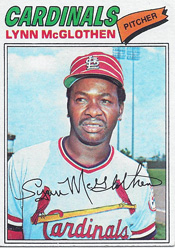
The Cardinals acquired Siebert (for outfielder Tommy Cruz) to join a revamped starting rotation that included two other former Red Sox pitchers, John Curtis and Lynn McGlothen, and holdovers Bob Gibson and Alan Foster.

At 1974 spring training, Siebert, 37, pitched well and Schoendienst declared him the No. 2 starter behind Gibson. “Siebert has been our best pitcher down here,” Schoendienst told the Post-Dispatch. “In fact, he might also be our best hitter.”

Making his National League debut in the Cardinals’ second game of the season against a Pirates lineup with Willie Stargell and Dave Parker, Siebert pitched a four-hit shutout and drove in two runs with a single. Boxscore

In May, Siebert made five starts and had a 1.66 ERA for the month. He pitched consecutive shutouts against the Cubs and Padres. Boxscore and Boxscore

After he won his fourth straight decision on June 5 versus the Giants, giving up one unearned run in 8.2 innings, Siebert had a season record of 6-3 with a 1.95 ERA for the Cardinals. Boxscore

The bubble burst when Siebert went on the disabled list on July 4 because of an inflamed tendon in his right elbow. He returned on July 28, went winless in August and was moved to the bullpen in September.

Siebert’s last win for the Cardinals came in a doozy of a game _ a 25-inning endurance test with the Mets. Siebert, the Cardinals’ seventh pitcher, performed a high-wire act for 2.1 scoreless innings.

Relieving Claude Osteen with two on and two outs in the 23rd, Siebert walked Felix Millan to load the bases, then got Cleon Jones to fly out to right.

In the 24th, the Mets had the bases loaded with two outs, but Siebert got Rusty Staub to ground out.

The Cardinals broke the 3-3 tie in the 25th when Bake McBride scored from first on a wild pickoff throw by pitcher Hank Webb. Siebert gave up a single to Brock Pemberton (his first big-league hit) in the bottom half of the inning but then shut down the Mets. Boxscore

In 28 games, including 20 starts, for the 1974 Cardinals, Siebert was 8-8 with a 3.84 ERA. After the season, he was traded to the Padres.

Siebert, 38, finished his career with the 1975 Athletics, winning four times for a team that finished with the best record in the American League (98-64) and secured its fifth consecutive West Division title.

His career record was 140-114 with 16 saves. Of his 114 hits, 12 were home runs.

Roric Harrison was an intriguing talent with a distinctive name. A right-hander, he possessed power on the mound and at the plate.

After seeing Harrison pitch at spring training in 1973, Phillies ace Steve Carlton told the Philadelphia Daily News, “Just a super, fantastic arm. He could win 20 with that arm just throwing strikes with his fastball.”

Harrison had some special performances, but inconsistent command of his pitches, as well as injuries, hampered him. A pitcher for the Orioles (1972), Braves (1973-75), Indians (1975) and Twins (1978), he had a career mark of 30-35 with 10 saves. He also produced 15 hits _ six were home runs.

During his five seasons in the majors, Harrison earned two wins versus the Cardinals. Both were complete games. He hit a home run in each, including one against Bob Gibson.

Later, Harrison went to spring training with the Cardinals but failed in an attempt to make the club as a reliever.

Top of the morning

Roric Harrison was from Los Angeles but his family roots were in Ireland, which is how he got his name. He told the St. Louis Post-Dispatch in 1973, “I’m Irish and the first rebel king of Ireland was named Roric. My father liked it.”

(The rebel king in the 1500s was Brian O’Rourke, or O’Ruairc in Irish Gaelic. Handsome, proud, defiant, he got into territorial disputes with the English, who arrested and executed him for his rebelliousness.)

Harrison was a Dodgers fan as a youth. He turned 13 a couple of weeks before they clinched the 1959 World Series title against the White Sox at Chicago. At the Los Angeles airport, Harrison hung on a fence to glimpse the players arriving home. “I had tears in my eyes seeing my heroes get off the plane _ Maury Wills, Don Drysdale, Gil Hodges,” he recalled to the Rochester Democrat and Chronicle.

Five years later, when he turned 18, Harrison signed with the Astros. Pitching in their farm system, he threw hard, not accurately. Harrison struck out the first seven batters he faced as a pro, then walked the next five, according to the Akron Beacon Journal. He told the Rochester newspaper, “My fastball was hard to control at times. I was overthrowing.”

In 1969, still in the minors, Harrison tore up his left knee while fielding a bunt and had surgery. (He’d need operations on the knee again in 1971 and 1974.) An American League expansion team, the Seattle Pilots, took a chance on him while he mended. On Aug. 24, 1969, they traded pitcher (and “Ball Four” author) Jim Bouton to the Astros for Harrison and Dooley Womack.

The Pilots moved from Seattle to Milwaukee in 1970 and were renamed the Brewers, but Harrison was not in their immediate plans. He got assigned to the minors for a sixth straight year.

Change of plans

Finally, at spring training with the Brewers in 1971, Harrison had a breakthrough. He pitched well and made the Opening Day roster. Then, the day before the season opener, with the Brewers in need of a left-hander, he got traded to the Orioles for Marcelino Lopez.

“It was the kind of deal you sometimes hate to make because a fine young arm can come back to haunt you,” Brewers general manager Frank Lane told The Sporting News. “Harrison showed a lot of stuff this spring.”

The 1971 Orioles (who would win the American League pennant) were loaded with pitchers, so Harrison was sent again to the minors. He joined a Rochester Red Wings team featuring prospects such as Don Baylor, Bobby Grich and Ron Shelton, who later became director and screenwriter of the 1988 film “Bull Durham.”

Harrison found his groove with Rochester. In June 1971, he pitched a two-hit shutout and slugged a grand slam versus the Toledo Mud Hens. A month later, against Toledo again, he struck out 18, pitched a three-hitter and drove in a run with a triple. Harrison told the Rochester newspaper, “My fastball was really doing its thing. Jumping. Tailing off.”

On Aug. 12, 1971, Harrison pitched a one-hitter against Syracuse. Three days later, he was in the dugout when a foul ball struck him on the right side of the head, damaging an ear drum. “Thank God he turned his head,” Dr. Armand Cincotta told the Rochester Democrat and Chronicle. “If he hadn’t turned his head, the ball would have hit him flush in the face.”

Harrison was treated at a hospital, but two days after the accident he started the first game of a doubleheader versus Syracuse. Despite a ringing sound in his right ear, he pitched a seven-inning one-hitter. “It was a strange feeling,” he told the Rochester newspaper, “because I couldn’t hear the ball hit the catcher’s mitt.”

Harrison finished with a 15-5 record, including five shutouts, and a 2.81 ERA for Rochester in 1971. He struck out 182 in 170 innings. He also hit .273 with four home runs.

At spring training in 1972, Harrison impressed Orioles manager Earl Weaver, who told the Baltimore Evening Sun, “Harrison exceeds my expectations. He throws as hard as anyone we’ve got in this camp except maybe one guy (Jim Palmer).”

With a starting staff of Palmer, Mike Cuellar, Pat Dobson and Dave McNally, Harrison primarily was a reliever with the 1972 Orioles, but, at last, he was in the big leagues for the first time. The rookie led the club in appearances (39) and was second (to Palmer) in ERA (2.30).

When the Orioles made a pitch for Braves slugger Earl Williams after the season, they had to include Harrison (along with Davey Johnson, Pat Dobson and Johnny Oates) to complete the trade. Video

Clashes with Cardinals

After beginning the 1973 season in the bullpen, Harrison became part of the starting rotation for the Braves. His first win for them was on June 10, a 5-2 victory against the Cardinals. His home run against Tom Murphy broke a scoreless tie in the third. Harrison held the Cardinals to one hit (a Ken Reitz triple in the sixth) in eight innings before Danny Frisella relieved in the ninth.

Regarding Harrison, Cardinals manager Red Schoendienst told the Post-Dispatch, “He’s the best pitcher they got.” Boxscore

Two months later, the Cardinals torched Harrison in a seven-run third inning capped by pitcher Rick Wise’s grand slam, but the Braves (with four RBI from Dusty Baker, three from Hank Aaron and three scoreless innings of relief from Phil Niekro) rallied and won, 11-7. Boxscore

Harrison made 38 appearances, including 22 starts, for the 1973 Braves and finished 11-8 with five saves.

Placed in a Braves starting rotation with Phil Niekro, Ron Reed and Carl Morton, Harrison struggled in 1974. He had ERAs of 5.20 in April and 4.41 in May.

A highlight came on June 14, 1974. Matched against Bob Gibson, Harrison hit a two-run homer and limited the Cardinals to one unearned run for the win. Braves manager Eddie Mathews told the Atlanta Journal, “It might have been the best I’ve seen him look since he got here last year.” Boxscore

A month later, Gibson and Harrison were matched again. Gibson needed three strikeouts to become the first National League pitcher with 3,000. He got two. Harrison gave up a three-run home run to Ted Simmons and departed after six innings, but it was Gibson who took the loss. Boxscore

Out of luck

In June 1975, Harrison was traded to the Indians for Blue Moon Odom and Rob Belloir. Ten months later, in April 1976, the Indians sent him to the Cardinals for Harry Parker.

When Harrison, 29, learned the Cardinals would assign him to the minors, he thought about not reporting, but reconsidered after a talk with general manager Bing Devine. “He assured me that I was obtained with the big-league club in mind,” Harrison said to the Tulsa World.

Harrison’s 1976 season got curtailed in June when he had surgery to remove bone chips from his right elbow. “The surgery made me a sort of bionic man,” he told The Sporting News. “It seemed they put in a new arm.”

The Cardinals put him on their big-league winter roster and he went to spring training with them in 1977 as a candidate for a relief role.

The luck of the Irish was with Harrison on St. Patrick’s Day when he pitched three scoreless innings for the win in a spring training exhibition against the White Sox. “My arms feels as good as it did when I was a rookie with the Orioles,” he told The Sporting News.

His other performances, though, were inconsistent. In four Grapefruit League appearances, his ERA was 4.64.

First-year Cardinals manager Vern Rapp opted to keep nine pitchers on the Opening Day roster _ four starters (Bob Forsch, John Denny, Pete Falcone, Eric Rasmussen), a swingman (John D’Acquisto) and four relievers (Al Hrabosky, Clay Carrol and rookies John Urrea and John Sutton).

Released by the Cardinals, Harrison pitched in the farm systems of the Tigers (1977) and Twins (1978). The Twins called him up in June 1978 and he ended his big-league career with them, making nine relief appearances.

After starting the 1973 season in a funk, the Cardinals finished it with a flourish, but the feeling was the same on both ends of the spectrum: frustration.

In September 1973, the Cardinals won their final five games of the season. Highlighted by the return to health of Bob Gibson and the return to form of Rick Wise and Reggie Cleveland, the Cardinals allowed two runs over 45 innings during the season-ending win streak.

The big finish wasn’t enough, though, to earn them a division title. Weighed down by a miserable start (20 losses in their first 25 games) and more slumps in the second half of the season (11 losses in 12 games from Aug. 6 to Aug. 18, and 13 losses in 17 games from Sept. 7 to Sept. 25), the Cardinals ended up 81-81, 1.5 games behind the division champions.

Slipping away

On the morning of Sept. 25, 1973, the Cardinals (76-80) were in third place in the National League East. Ahead of them were the Mets (79-77) and Pirates (78-77). The division champion would advance to the playoffs.

The Cardinals had six games remaining, all at home _ three with the Cubs (75-80) and three with the Phillies (69-87). If they won all six, the Cardinals figured they’d have a chance to finish tied or alone atop the division.

That night, their hopes seemed to evaporate when they collapsed against the Cubs. The Cardinals blew a 2-1 lead with two outs in the ninth and lost, 4-3. A former Cardinal, Jose Cardenal, delivered a two-run double on an 0-and-2 pitch from Diego Segui. Boxscore

The Cardinals’ loss, coupled with the Mets’ win that night versus the Expos, was a crusher. It meant the Cardinals (76-81) trailed the Mets (80-77) by four with five to play. “We had to win this one,” Cardinals manager Red Schoendienst said to the St. Louis Post-Dispatch.

The newspaper’s headline the next day declared: “Cardinals Face Reality: Loss To Cubs Ends Title Dream.”

Though the Cardinals mathematically still had a chance, the odds against them got higher when it was revealed that one of their best hitters, Joe Torre, would sit out the final five games because of an inflamed right shoulder.

Dominant pitching

The Cardinals saw a glimmer of hope the night of Sept. 26, when they beat the Cubs, 1-0, and the Mets lost to the Expos. Those results put the Cardinals (77-81) three behind the Mets (80-78) with four to play.

Rick Wise pitched his fifth shutout of the season for St. Louis. It was his second consecutive win after losing six in a row. The Cubs threatened in the eighth when Jim Hickman, a career .358 hitter in 53 at-bats versus Wise, came up with two on and two outs. Wise struck him out on three pitches, the last “a high, tight fastball with enough mustard on it to daub all the hot dogs in Busch Stadium,” Bob Logan of the Chicago Tribune reported.

The Cardinals got their run when Ted Simmons drove in Lou Brock from third with a single in the first. Boxscore

Brock and Reggie Cleveland were the standouts the next night, Sept. 27, when the Cardinals beat the Cubs, 2-0.

Cleveland, who had lost his last four decisions, pitched a one-hit shutout. He retired the first 16 batters before Ken Rudolph singled with one out in the sixth.

Brock slammed a two-run home run versus Burt Hooton in the bottom of the sixth. It was Brock’s only homer in 73 career at-bats against Hooton. “That was the first changeup I’ve hit out of the park in five years,” Brock told the Chicago Tribune. Boxscore

With the Mets (80-78) idle that night, the Cardinals (78-81) crept to within 2.5 games of first place. While the Cardinals prepared for three at home against the Phillies, the Mets were scheduled to play four versus the Cubs at Chicago.

Wet and wild

The Sept. 28 Friday afternoon doubleheader between the Mets and Cubs at Wrigley Field was rained out. It poured a lot in St. Louis that night, too, but the Cardinals withstood three rain delays totaling nearly two hours and posted their third consecutive shutout, a 3-0 triumph versus the Phillies.

Mike Thompson and Diego Segui combined for the shutout. Thompson, making just his second appearance for the Cardinals, pitched four hitless innings, then was lifted after an 89-minute rain delay. Segui pitched five innings of relief and yielded two hits. He got the last out as a fourth downpour began. Boxscore

The Cardinals’ outlook suddenly brightened. With a 79-81 record, they were two behind the Mets (80-78), who faced consecutive doubleheaders at Wrigley Field to end the season.

He’s back

The Cardinals got a boost from a franchise icon, Bob Gibson. Sidelined since tearing a right knee ligament on Aug. 4 and undergoing surgery, Gibson returned to start the Saturday afternoon Sept. 29 game against the Phillies. His mound opponent: former teammate and fellow future Hall of Famer Steve Carlton.

Gibson, 37, held the Phillies to one run in six innings and got the win. “It’s just like riding a bike,” Gibson told the Philadelphia Inquirer. “You never forget how.”

The Cardinals scored seven times and had 17 hits, including 11 against Carlton, who allowed five runs in six innings. The loss was Carlton’s 20th of the season. Tim McCarver, playing first base for the Cardinals, had two RBI-singles versus his friend Carlton. Boxscore

Meanwhile, at Chicago, the Mets-Cubs doubleheader was rained out for the second straight day. The Cardinals (80-81) had one game left against the Phillies. The Mets (80-78) still had four scheduled with the Cubs.

Wise choice

For their season finale on Sunday Sept. 30, the Cardinals started Alan Foster. The Phillies went with Jim Lonborg, the former Red Sox ace who six years earlier opposed the Cardinals in the 1967 World Series.

Just like he had done in that World Series, Lou Brock set the tone. He led off the first inning with a double versus Lonborg, stole third and scored on Bake McBride’s sacrifice fly.

In the fifth, with the Cardinals ahead, 2-0, the Phillies had two on, one out, when Foster was relieved by Diego Segui. After allowing a run-scoring single, Segui got the final two outs of the inning and the Cardinals still led, 2-1.

After Tommie Agee batted for Segui in the bottom half of the fifth, Cardinals manager Red Schoendienst made a bold move, choosing Rick Wise to pitch. Wise had not pitched in relief all season and had little experience in that role, but it turned out to be a good choice.

Wise worked the final four innings, yielding no runs or hits, and got the win, enabling the Cardinals to complete the season at 81-81. Boxscore

At Chicago, the Mets (81-79) and Cubs split their Sunday doubleheader. Another was scheduled for Monday Oct. 1. If the Cubs swept, the Mets and Cardinals would finish tied atop the division. The Pirates (80-81) still had one more game to play as well, at home versus the Padres, and needed a win to stay in the mix.

Silly season

Before a Monday afternoon gathering of 1,913 at Chicago, the Mets took a 5-0 lead against the Cubs in the first game of the scheduled doubleheader. Tom Seaver started for the Mets but faltered, allowing four runs and 11 hits before Tug McGraw took over in the seventh.

McGraw rescued the Mets with three scoreless innings and they won, 6-4. Boxscore

The victory gave the Mets an 82-79 mark, securing the division title and making the second game of the scheduled doubleheader unnecessary to play.

At Pittsburgh, the Pirates lost to the Padres, finishing 80-82 and leaving the Cardinals alone in second place.

In the best-of-five playoffs, the Mets, with the fourth-best record in the National League, played the team with the best record in baseball, the Reds (99-63), and beat them three times, winning the pennant.

That put them in the World Series, where the team with the second-best record in the American League, the A’s, prevailed, winning four of seven.

Pitching with the poise and skill of a master, the Cardinals’ Michael Wacha capped his rookie season with a nearly unhittable showing.

On Sept. 24, 2013, Wacha held the Nationals hitless until Ryan Zimmerman got a scratch single with two outs in the ninth.

The near no-hitter came in Wacha’s final appearance of the regular season and solidified a spot for him in the Cardinals’ starting rotation for the playoffs, where he gave an encore that was just as impressive.

Helping hand

In the June 2012 amateur draft, Wacha was chosen by the Cardinals in the first round with a pick given them as compensation for the Angels’ signing of free agent Albert Pujols.

A 6-foot-6 right-hander, Wacha was 9-1 with a 2.07 ERA in 16 starts for Texas A&M in 2012. After the Cardinals signed him, he pitched in 11 games in their farm system that summer.

Assigned to Class AAA Memphis in 2013, Wacha was projected to spend most of the season there, but when Cardinals starters Jaime Garcia and Jake Westbrook got injured in May, Wacha, 21, was called up.

In his debut, a start against the Royals on May 30, 2013, Wacha got a hit before he allowed one. He singled to center in his first big-league at-bat against Jeremy Guthrie in the second inning. Wacha retired the first 13 batters he faced before Lorenzo Cain doubled with one out in the fifth.

Mixing a fastball and changeup and throwing strikes, Wacha gave up two hits, no walks and left after seven innings with a 2-1 lead. The Royals rallied for three runs in the ninth against the relievers and won, 4-2. Boxscore

Two weeks later, Wacha got his first Cardinals win, beating the Mets, and then was sent back to Memphis. He returned to the Cardinals in August, pitched mostly in relief, got sent down again that month and was recalled in September.

The Cardinals, who entered September a game behind the first-place Pirates in the National League Central Division, made Wacha a starter for the stretch run.

Washington shutdown

With Wacha, 22, providing a lift, the Cardinals surged in September. They were atop the division, two games ahead with five left to play, when Wacha made his start against the Nationals on a Tuesday night at St. Louis.

The Nationals, managed by Davey Johnson, featured a lineup with Bryce Harper, Jayson Werth and Ryan Zimmerman, but all were overmatched by Wacha. He retired the first 14 batters before Adam LaRoche reached on a Matt Carpenter error. Other than that, the Nationals managed only leadoff walks from Zimmerman in the seventh and LaRoche in the eighth.

“He was amazing, keeping the ball down, mixing it with the changeup,” Cardinals catcher Yadier Molina told the St. Louis Post-Dispatch. “When you throw hard with the sinker he’s got, the movement, the changeup, it was hard for them.”

With the Cardinals ahead, 2-0, Wacha retired the first two batters in the ninth. Zimmerman was up next and he hit a high bouncer toward the mound. Wacha stretched and nicked the ball with his glove. Charging in from his shortstop position, Pete Kozma scooped the ball off the turf with his bare hand.

“I thought there was a real good chance we were going to see an unbelievable finish to an unbelievable game,” Cardinals manager Mike Matheny said to the Post-Dispatch.

With no time to set, Kozma hurried his throw and first baseman Matt Adams had to come off the bag to snare it as Zimmerman streaked across with a single.

Trevor Rosenthal relieved and got the final out, sealing the win. Boxscore and Video

Wacha finished the 2013 regular season with a 4-1 record and 2.78 ERA for the Cardinals. In five September starts, he was 2-1 with a 1.72 ERA.

Right stuff

The 2013 Cardinals (97-65) had the best record in the National League and were matched in the first round of the playoffs against a team with the third-best mark, the Pirates (94-68). During the season, the Pirates won 10 of 19 versus St. Louis.

In the playoffs for the first time in 21 years, the Pirates won two of the first three in the best-of-five series. With the Cardinals needing to win Game 4 at Pittsburgh to avoid elimination, Mike Matheny chose Wacha as the starting pitcher.

Making his first playoff appearance and pitching for the first time since his near no-hitter versus the Nationals, Wacha delivered another masterpiece. He held the Pirates hitless until the eighth, when Pedro Alvarez hit a solo home run.

Wacha went 7.1 innings and departed with a 2-1 lead. Carlos Martinez and Trevor Rosenthal came through in relief, sealing the win. Boxscore

Pirates right fielder Marlon Byrd, who struck out three times against Wacha, told the Pittsburgh Post-Gazette, “I feel like he’s the next coming of (Cardinals ace) Adam Wainwright. He knows how to pitch. He has that swagger.”

Wainwright told the Post-Dispatch, “Michael may be one of the most talented pitchers I’ve seen.”

Given new life by Wacha’s win, the Cardinals took advantage, prevailing in Game 5 and advancing to the next round against the Dodgers.

Top gun

Wacha dominated the Dodgers, winning Game 2 and the pennant-clinching Game 6. In both, he beat Dodgers ace Clayton Kershaw, who received the second of his three Cy Young awards in 2013.

Asked about Wacha, Chris Carpenter, who earned a Cy Young Award with the Cardinals in 2005 and was 3-0 for them in World Series games, said to the Los Angeles Times, “His maturity level is not normal for a kid that’s his age. It’s been a lot of fun to watch him rise to the occasion. Not only rise to the occasion, but wanting to be in the situation. It’s a tough spot to be when you’re 22 years old.”

In the 2013 World Series, Wacha was opposed by the Red Sox, who had his former American Legion teammate, third baseman Will Middlebrooks. They played together on the same team coached by Wacha’s father, Tom, in Texarkana, Texas. “He really didn’t start throwing hard until his senior year in high school,” Middlebrooks recalled to the Associated Press. “He wasn’t like a dominant pitcher.”

Wacha started and won Game 2 of the World Series, but lost Game 6 when the Red Sox clinched the championship.

For the 2013 postseason, Wacha had as many wins (four) for the Cardinals as he did for them in the regular season.

Reflecting on his debut year in the majors, Wacha told the Post-Dispatch in January 2014, “The goal was just try to win a ballgame for this team. It ended up being a pretty special year.”

In seven years with the Cardinals (2013-19), Wacha had a regular-season record of 59-39. Granted free agency after the 2019 season, he signed with the Mets.

Ed Meador was good at duping the St. Louis football Cardinals. He did that at least a couple of times.

A defensive back for the Los Angeles Rams, Meador successfully pulled off a fake field goal attempt versus the Cardinals. He also tricked their quarterback, Jim Hart, into throwing passes to Jackie Smith that got intercepted.

As the old saying goes, “Fool me once, shame on you; fool me twice, shame on me.”

The Cardinals weren’t alone, though, in getting outmaneuvered by Meador. In his 12 seasons with the Rams (1959-70), Meador totaled 46 interceptions (returning five for touchdowns), 22 fumble recoveries and 10 blocked kicks.

Ram tough

As a college player, Meador was a standout running back and defensive back for the Arkansas Tech Wonder Boys. He was taken by the Rams (whose general manager was Pete Rozelle) in the seventh round of the 1959 NFL draft.

Placed with the defensive unit at Rams training camp in 1959, Meador impressed and won a starting cornerback spot as a rookie. “He has all the essentials to become an outstanding defensive back,” Rams head coach Sid Gillman told the Los Angeles Times. “He has speed and tremendous reactions. He has more poise than any rookie I’ve ever encountered.”

Defensive backs coach Jack Faulkner said to the newspaper, “I’ve never coached any first-year man with greater potential.”

After five seasons (1959-63) as a cornerback, Meador was moved to free safety in 1964 and stayed there the rest of his career. Los Angeles Times columnist Jim Murray noted, “As free safety, he goes where the ball does. With eyesight better than normal, and the speed of a startled doe, he is the surest tackler in the NFL.”

Meador said the toughest player to tackle was Chicago Bears running back Gale Sayers. “I’d much rather tackle a big man who’s trying to run over me. They don’t have the lateral movement,” Meador said to the Los Angeles Times. “Sayers is the best runner in football because when you try to get hold of him, he’s suddenly five yards away from you. The trick is to keep your eye on his belt buckle. His shoes may be going one way and his hat may be going the other, but he can’t get too far away from his belt.”

Right move

Because of his sure hands, Meador also was the holder on field goal and extra point attempts.

On Dec. 5, 1965, the Rams led the Cardinals, 20-3, in the fourth quarter when, on fourth down at the St. Louis 11-yard line, they set up for a Bruce Gossett field goal try. Instead, after the ball was snapped and Gossett went into his kicking motion, Meador got up and “scampered around right end with the ball, beating several Cardinals defenders to the corner of the end zone” for a touchdown, the Los Angeles Times reported.

Rams head coach Harland Svare told the newspaper, “We have had that play for three years, but it didn’t work until today. When you’re ahead, you can afford to do things like this.”

The Rams won, 27-3, marking the first time since 1962 versus the Green Bay Packers that the Cardinals failed to score a touchdown in a game. Game stats

Doing the unexpected

In the 1968 season opener, the Rams harassed Cardinals quarterback Jim Hart and won, 24-13. Hart had six passes knocked down, three by defensive end Lamar Lundy, was sacked five times and intercepted three times.

Meador made two of the interceptions. His 20-yard return with the first set up a Rams touchdown. The second prevented a Cardinals field goal attempt. Both picks came on Hart passes to tight end Jackie Smith, who was running hook patterns. “We had him covered inside and out,” Meador told the Los Angeles Times.

The coverage was not what Hart was expecting. Because Rams strong safety Ron Smith was new to the position, head coach George Allen had Meador, the free safety, help out in covering Jackie Smith.

As the Los Angeles Times explained, “Hart was keying on the tight safety (Ron Smith) on each occasion. He did not see Meador on either play. NFL quarterbacks are not in the habit of watching out for free safeties when they throw to the tight safety’s man. Meador skillfully took advantage of this fact to run for the ball the instant Hart unlimbered.”

George Allen said to the St. Louis Post-Dispatch, “He’s the best free safety in pro football.” Game stats

Meador was one of three safeties selected to the NFL’s all-decade team for the 1960s. The other two, Larry Wilson of the Cardinals and Willie Wood of the Packers, were inducted into the Pro Football Hall of Fame.

Meador also was named to the Pro Bowl six times _ 1960 and each year from 1964 to 1968. He played in 159 consecutive games for the Rams before sitting out one because of an injury.

Columnist Sid Ziff wrote, “Watching Meador, you wonder how anybody can be that good all the time. He never has an off night.” Video highlights