Feeds:
Posts
Comments

In a lineup featuring future Hall of Famers Stan Musial, Red Schoendienst and Enos Slaughter, it was Erv Dusak who delivered two of the most important hits for the 1946 Cardinals.
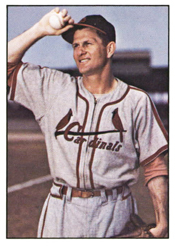
On July 16, 1946, Dusak hit a three-run walkoff home run in the ninth, enabling the Cardinals to complete a four-game sweep of the front-running Dodgers.

Two months later, in the last week of the regular season, Dusak hit another walkoff home run, a solo shot in the 10th inning against the Reds, for a victory that kept the Cardinals in first place.

Power prospect

An outfielder, Dusak was one of three players who made his major-league debut with the Cardinals in September 1941 after being called up from the Rochester farm team. The others were Musial and third baseman Whitey Kurowski.

In his book “Stan Musial: The Man’s Own Story,” Musial said Cardinals executive Branch Rickey didn’t say much to him when he joined the team.

“It was obvious that the player on his mind was Dusak, not Musial, and I can see why,” Musial recalled. “Erv was a strapping right-handed power hitter who ran well, fielded well and threw considerably better than I did.”

Unfortunately for Dusak, pitchers quickly discovered a weakness. “Erv had too much trouble with the breaking ball to last long in the big leagues,” Musial said.

Dusak spent most of 1942 back at Rochester. Following the season, he enlisted in the Army and spent three years (1943-45) in World War II service.

In 1946, the Cardinals opened the season with an outfield of Musial and Slaughter in the corners and Terry Moore in center. Dusak made the team as a reserve.

Swing series

The Dodgers set the early pace in the 1946 National League race, winning eight of their first nine.

When they came to St. Louis for a four-game series in July, the Dodgers (49-28) were 4.5 games ahead of the Cardinals (45-33).

The series began with a doubleheader at Sportsman’s Park on Sunday July 14. The Cardinals won the opener, 5-3. Slaughter drove in four runs, including two on a tie-breaking home run in the eighth, and Ted Wilks pitched four scoreless innings in relief of Johnny Beazley. Boxscore

In the second game, Musial led off the 12th with a walkoff home run against Vic Lombardi, giving the Cardinals a 2-1 triumph. Boxscore

Game 3 of the series was played on Monday night July 15. Schoendienst had three RBI and the Cardinals prevailed, 10-4.

In the third inning, the Dodgers thought their left fielder, Pete Reiser, snared a drive by Slaughter, but umpire Al Barlick ruled Reiser trapped the ball. Dodgers manager Leo Durocher argued and was ejected. Boxscore

The next day, Tuesday July 16, National League president Ford Frick suspended Durocher for five days and fined him $150 for “laying hands on” Barlick during the rhubarb, the New York Daily News reported. Durocher departed St. Louis rather than stick around for that night’s series finale.

Setting the stage

With coach Chuck Dressen as acting manager for Game 4 of the series, the Dodgers took a 4-2 lead into the bottom of the ninth.

“The big crowd, almost silent, appeared to have given up,” the St. Louis Star-Times reported. “Most Brooklyn writers had their stories written.”

Cardinals manager Eddie Dyer told The Sporting News, “It looked like we were goners.”

The Cardinals had the bottom of their order due to face left-hander Joe Hatten.

Hatten got ahead in the count, 1-and-2, to the first batter, Marty Marion, “when the miracle happened,” the St. Louis Post-Dispatch noted.

Hatten grazed Marion on the side of his uniform jersey with a pitch, putting him on first.

Clyde Kluttz, a catcher acquired from the Phillies in May, singled to left, moving Marion to second.

After Dyer sent Dusak to bat for pitcher Howie Pollet, Dressen went to the mound to talk to Hatten. A right-hander was ready in the bullpen, but Dressen stuck with Hatten, a decision some speculated Durocher would not have made.

Fantastic finish

Dusak, batting .229 for the season, was given the bunt sign. After he failed in his first attempt to bunt successfully, he was permitted to swing away. He lashed at Hatten’s second pitch and fouled it off.

Hatten’s next two pitches missed the strike zone, evening the count at 2-and-2. He came back with a fastball and Dusak connected.

“The wallop rang out like a pistol shot,” the St. Louis Globe-Democrat reported.

According to the Star-Times, “There was a terrific crack and everybody knew at once it was all over.”

The ball carried over the left-field wall and landed 10 rows up in the bleachers, turning the two-run deficit into a 5-4 victory and a series sweep. Boxscore

“Frenzied spectators unloosed a thunderous shout and kept it up for many minutes,” the Globe-Democrat reported. “So jubilant were the Cardinals players that they gathered at the plate and almost mobbed Dusak as he scored.”

The New York Daily News noted, “The Dodgers, with their chins sunk against their chests, trudged forlornly off the field, while all around them Redbird fans joined the St. Louis players in whistling, stomping and jumping with joy.”

Dusak was “as happy as a youngster who had just seen Santa Claus for the first time,” the Globe-Democrat declared.

In the locker room, a young bleacher fan showed up with the home run ball and presented it to Dusak, the Star-Times reported.

“He hit one of the most beautiful home runs I ever expect to see,” Dyer told The Sporting News.

Encore performance

By sweeping the series, the Cardinals (49-33) moved within a half-game of the Dodgers (49-32).

“No series played by the Dodgers all season gave them more of a jolt,” Dyer said to The Sporting News.

The Cardinals and Dodgers waged a fierce fight for first place the remainder of the season.

On Sept. 24, the Cardinals (94-55) held a half-game lead over Brooklyn (94-56) heading into a game against the Reds at St. Louis.

The Reds started Johnny Vander Meer, the left-hander who pitched consecutive no-hitters in 1938.

Vander Meer limited the Cardinals to two singles through eight innings and took a 1-0 lead into the ninth, but Musial tied the score with a two-out RBI-single.

In the 10th, Dusak batted with none on. Working the count to 3-and-1, he got a fastball and pulverized it. The ball cleared the wall in left and “landed only a few feet in front of the concession stand at the back of the bleachers,” the Globe-Democrat reported.

Dusak’s second walkoff home run of the season gave the Cardinals a 2-1 victory and put them a game ahead of the Dodgers with four to play. Boxscore

Mobbed again by his teammates, Dusak was carried off the field on the shoulders of Dyer and coach Mike Gonzalez, the Cincinnati Enquirer reported.

Change in plans

More drama followed. The Cardinals lost three of their last four games and the Dodgers won two of four, leaving the clubs tied for first at the end of the regular season. A best-of-three playoff was held and the Cardinals won the first two games, clinching their fourth pennant in five years.

The Cardinals then prevailed in a seven-game World Series versus the Red Sox.

Dusak hit .240 with nine home runs for the 1946 Cardinals. As a pinch-hitter, he was 4-for-10. Three of the hits were home runs.

In 1947, Dusak batted .284 for the Cardinals, but slumped to .209 in 1948. He decided to become a pitcher and returned to the minors in 1949.

Dusak pitched in 14 games for the Cardinals in 1950 and five more in 1951 before he was traded to the Pirates.

The Dodgers got a bit of revenge on May 22, 1951, when Gil Hodges hit a grand slam against Dusak. Boxscore

Dusak’s big-league career statistics: .243 batting average, 24 home runs, 0-3 pitching record, one save, 5.33 ERA.
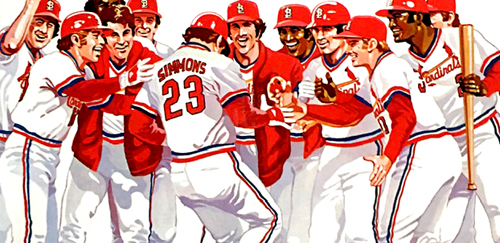
Ted Simmons is part of a special group of players who hit with a rare combination of power and consistent contact.

Simmons is one of 12 players who finished his big-league career with at least 240 home runs and fewer than 700 strikeouts, according to the National Baseball Hall of Fame.

A catcher who spent most of his playing days with the Cardinals before going to the Brewers and Braves, Simmons is the last player to achieve the feat. He’s also the only switch-hitter among the 12.

Simmons will be inducted into the Hall of Fame on Sept. 8, 2021. He is one of nine Hall of Famers among the 12 elite hitters who showed that a slugger doesn’t have to whiff a lot to produce steady power.

In order of most home runs, here are the dandy dozen based on a review of statistics at baseball-reference.com:

_ Stan Musial, 475 home runs, 696 strikeouts: The most Musial struck out in a season was 46 times in 1962 when he was 41. He batted .330 that season with 19 home runs.

In 1948, when Musial batted .376, he had more home runs, a career-high 39, than strikeouts 34.

Musial struck out three times in a major-league game only once. It happened on July 28, 1963, against the Cubs’ Dick Ellsworth when Musial was 42 and in his final season. Boxscore

The pitcher who fanned Musial the most was fellow Hall of Famer Warren Spahn. Though Spahn struck out Musial 30 times, Musial batted .318 against him. The 17 home runs Musial hit versus Spahn are the most he had against any pitcher.

_ Joe DiMaggio, 361 home runs, 369 strikeouts: Remarkably, DiMaggio had more home runs than strikeouts in seven of his 13 seasons with the Yankees.

In 1941, DiMaggio had 30 home runs and 13 strikeouts. During his 56-game hitting streak that year, he whiffed five times.

Like Musial, DiMaggio struck out three times in a big-league game just once. It happened on June 19, 1942, versus the Indians’ Mel Harder. Boxscore

_ Johnny Mize, 359 home runs, 524 strikeouts: When Mize hit 51 home runs for the Giants in 1947, he struck out 42 times. It was one of three times he had more home runs than strikeouts in a season.

The 43 home runs Mize hit for the Cardinals in 1940 were the franchise record for a season until Mark McGwire hit 70 while taking steroids to enhance his performance in 1998. Mize struck out 49 times in 1940. McGwire fanned 155 times in 1998.

_ Yogi Berra, 358 home runs, 414 strikeouts: Though he was known for chasing balls out of the strike zone, Berra six times had more home runs than strikeouts in a season with the Yankees. Perhaps the most impressive was in 1950 when Berra had 28 home runs and 12 strikeouts. He hit .322 with 124 RBI that season.

While with the Mets, Berra struck out three times in a game against the Braves’ Tony Cloninger on May 9, 1965, three days before turning 40. He decided to quit immediately and never played in another game. Boxscore 

_ Rogers Hornsby, 301 home runs, 679 strikeouts: In 1924, when he batted .424 and hit 25 home runs for the Cardinals, Hornsby struck out 32 times in 642 plate appearances.

_ Chuck Klein, 300 home runs, 521 strikeouts: When Klein achieved the Triple Crown with the Phillies in 1933, leading the National League in batting (.368), home runs (28) and RBI (120), he struck out 36 times in 667 plate appearances.

_ Ted Kluszewski, 279 home runs, 365 strikeouts: Wearing a sleeveless Reds jersey that enabled him to bare bulging biceps, Ted Kluszewski looked the part of a slugger, but he was no swing-and-miss hacker. Kluszewski only once struck out three times in a game, on June 17, 1950, versus the Phillies’ Robin Roberts. Boxscore

In 1954, when he led the National League in home runs (49) and RBI (141), Kluszewski fanned 35 times in 659 plate appearances. It was one of five times he had more home runs than strikeouts in a season.

_ Roy Campanella, 260 home runs, 501 strikeouts: The Dodgers’ catcher hit 20 or more home runs seven times but never had more than 61 strikeouts in a season.

_ Goose Goslin, 248 home runs, 585 strikeouts: In 1928, when Goslin was with the Senators, he led the American League in batting at .379, was third in slugging at .614 (trailing only Babe Ruth and Lou Gehrig) and struck out 19 times.

_ Ted Simmons, 248 home runs, 694 strikeouts: As consistent as he was excellent, Simmons had the same number of strikeouts, 35, in each of three consecutive seasons (1974-76) with the Cardinals. In his biggest home run year, 1979, when he hit 26, Simmons fanned 34 times.

in the book “The Ted Simmons Story,” his teammate and friend, Joe Torre, said, “Nobody in the league hits the ball so hard so consistently as Simmons.”

After falling into a slump early in the 1973 season while trying to hit home runs, Simmons said, “I knew now I wasn’t ever going to be a big home run hitter, but if I ever felt I had to have some record to shoot at, some goal to turn me on, all I had to think about was Pete Rose hitting over .300 eight years in a row. That’s a record to brag about. It’s a lot more impressive than Roger Maris’ or Hank Aaron’s home run records.”

_ Vern Stephens, 247 home runs, 685 strikeouts: A shortstop who played 15 years in the American League, Stephens hit 20 or more home runs in a season six times, including in 1944 when he helped the Browns to their only pennant.

_ Wally Berger, 242 home runs, 693 strikeouts: An outfielder who played 11 years in the National League, Berger hit 25 or more home runs for the Braves five times, including 38 as a rookie in 1930.

Kluszewski, Stephens and Berger are the only three of the 12 who haven’t been elected to the Hall of Fame.

Dizzy Dean always could talk a good game, so given the choice of being a coach or a broadcaster, the former Cardinals ace grabbed the microphone.

On July 7, 1941, Dean quit as Cubs coach and signed a three-year deal with Falstaff Brewing to call Cardinals and Browns home games on St. Louis radio station KWK.

“I can make enough in radio in three years to put me on easy street,” Dean told The Sporting News. “There is no future coaching in baseball.”

Desperate measures

Dean made a dazzling debut in the majors with the Cardinals in 1930 and went on to become one of the game’s best and most popular players. He led National League pitchers in strikeouts four times and had 30 wins for the 1934 Cardinals, plus two more in the World Series.

A right-hander, he was 27 when he injured his pitching arm in 1937. A year later, in April 1938, the Cubs sent $185,000 and three players to the Cardinals to acquire Dean.

“When the Cubs purchased Dean, they said they made the move with their eyes wide open,” The Sporting News noted. “They knew his arm was bad, but were confident that proper treatment would take care of everything. It didn’t.”

Dean was 7-1 in 1938 for the National League champion Cubs and 6-4 in 1939, but his arm ached and his availability was limited.

In June 1940, with his ERA for the season at 6.18, Dean, 30, accepted a demotion to the Cubs’ Tulsa farm club.

“Diz is supposed to have made the suggestion,” The Sporting News reported. “He told club officials he wanted to develop a new sidearm delivery.”

The Cubs assigned scout Dutch Ruether, a former big-league pitcher, to work with Dean at Tulsa. “It will be Ruether’s job to keep an eye on Dean’s conduct and assist him in his professed aim to master the sidearm delivery,” The Sporting News reported.

Dean returned to the Cubs in September but “still had the nothing ball,” according to the Chicago Tribune. He was 3-3 with a 5.17 ERA for the 1940 Cubs. All three losses were to the Cardinals.

Different role

Dean, whose top salary as a player was $25,000 in 1935 with the Cardinals, signed with the Cubs for $10,000 in 1941, according to The Sporting News.

Cubs manager Jimmie Wilson, a former catcher who was Dean’s teammate with the Cardinals, endorsed the signing, saying Dean provided the club with “color and pep.” Wilson indicated he’d start Dean against second-division opponents. “Whatever he wins is gravy,” Wilson told The Sporting News.

On April 25, 1941, Dean started against the Pirates, pitched an inning and gave up three runs. Boxscore

“The arm simply went dead and the best doctors in the country couldn’t fix me up,” Dean told the St. Louis Star-Times.

Dean, 31, wrote a letter to Cubs general manager Jim Gallagher, asking to be placed on the voluntary retirement list.

“I have tried everything I know about to get my arm in shape, and this is a step I deeply regret having to take,” Dean wrote. “I sincerely and gratefully appreciate the many kindnesses the club have extended me. I only hope some day, some way, I may be able to repay in part, at least, the debt I owe it.”

On May 14, 1941, the Cubs gave Dean his unconditional release and then signed him to be a coach.

“Dean’s wife had urged him to retire for several weeks before he took the step that made him a coach,” the Chicago Tribune reported.

According to The Sporting News, “Arrangements were made for the remainder of his season’s salary to go into an annuity and a new salary was agreed for the coaching job.”

Follow the money

Dean’s coaching role primarily was to “pitch batting practice and lead cheers in the dugout,” the Chicago Tribune noted.

After a couple of weeks, The Sporting News declared, “Dean is taking his new job as coach as seriously as Diz could be expected to take anything.”

On June 6, 1941, Dean was ejected from a game at Brooklyn for arguing that Dodgers batter Billy Herman interfered with a throw from catcher Clyde McCullough. After being tossed, Dean headed for the clubhouse but returned and had to be chased a second time, The Sporting News reported. League president Ford Frick punished Dean with a $50 fine and five-day suspension. Boxscore

Three weeks later, Cubs first-base coach Charlie Grimm resigned to become manager of a farm team in Milwaukee and Dean replaced him.

Dean was the first-base coach for two weeks before he, too, resigned to accept the offer to become a broadcaster in St. Louis.

According to The Sporting News, Dean would be paid $5,000 to broadcast for the remainder of the 1941 season and $10,000 per season for the next two years.

“I only hope I’m as great an announcer as I was a pitcher,” Dean said to national columnist Walter Winchell.

Meet me in St. Louis

After attending the 1941 All-Star Game in Detroit, Dean boarded a train to St. Louis to begin his broadcasting job. When he arrived at Union Station at 8 a.m. on July 9, he was greeted by a band playing and a welcoming committee of about 300 people, the St. Louis Globe-Democrat reported.

Arriving on the train with Dean was Joe DiMaggio, who played in the All-Star Game and was joining the Yankees in St. Louis for a series with the Browns.

According to the St. Louis Star-Times, “A parade was formed and Dizzy was taken to the Park Plaza hotel for a breakfast reception. DiMaggio joined in the festivities.”

Dean’s first broadcast on KWK was the July 10 game between the Yankees and Browns at Sportsman’s Park. He joined sportscasters Johnny O’Hara and Johnny Neblett in describing the 1-0 Yankees victory. The game was called after five innings because of rain, but DiMaggio got a single in the first, extending his record hitting streak to 49 games. Boxscore

Dean was an immediate hit that summer. The Sporting News credited him with attracting “many new listeners because of his conversational style.”

Some examples of Dean’s style:

_ On the inability of Red Sox pitcher Mickey Harris to throw strikes: “A pitcher can’t pitch that way in the majors, or in the minors either, and parade up to the cashiers window every first and fifteenth.”

_ On Red Sox slugger Ted Williams: “I don’t know if Ted’s got a nickname, but I’m going to give him one: Goose. That’s what he looks like to me _ tall, skinny, loose-jointed.”

_ On batters who complain about an umpire’s strike zone: “It just don’t do you any good to think when you’re up there hitting that the ump has given you a bum call. The ump does his thinking first and that settles it all.”

Dean went on to have a long career in broadcasting, including national telecasts for ABC and CBS.

At his best, Bill White hit for average and distance.

In July 1961, White achieved an unprecedented slugging feat against the Dodgers, then tied a major-league base hit record held by Ty Cobb.

A left-handed batter and first baseman, White did the following:

_ On July 5, he became the first player to hit three home runs over the right-field fence in a game at the Los Angeles Coliseum.

_ From July 17 to July 18, he totaled 14 hits in four games, equaling a record set by Cobb 49 years earlier for most hits in two consecutive doubleheaders.

Tough test

In 1961, White was a National League all-star and Gold Glove Award winner who was among the Cardinals’ leading hitters, but the club wanted him to produce more power. In each of the three previous seasons (1958-60), Ken Boyer was the only Cardinal to hit 20 home runs.

Heading into the game against the Dodgers at the Coliseum, White was hitting .294 with five home runs for the season.

The Coliseum seemed an unlikely place for White to go on a home run binge. The distance from home plate to the fence in right-center was 440 feet and it was 390 feet in straightaway right. Left-handed sluggers, such as the Dodgers’ Duke Snider, found those dimensions daunting.

The Coliseum was friendlier to right-handed pull hitters, with a distance of 251 feet down the line from home plate to the left field fence. Though a screen stretching 42 feet high was erected, routine fly balls reached the seats.

Adding to the degree of difficulty for White was the Dodgers’ choice of a starting pitcher, left-hander Johnny Podres. White hit for a higher average and with more power against right-handers than he did left-handers.

Pulling power

Batting second in the order in the last game managed by Solly Hemus, White grounded out his first time at the plate against Podres.

Leading off the third, White swung at an inside fastball from Podres and pulled it over the fence near the foul line for a home run.

An inning later, facing Roger Craig, White got a hanging changeup and drove it over the wall in right-center for a two-run home run.

The next time up, with two outs and a runner on second in the sixth, White was walked intentionally by Craig.

In the eighth, White led off against rookie Jim Golden and hit a slider into the seats in right-center for his third home run.

According to the St. Louis Post-Dispatch, White was the sixth Cardinals player with three home runs in a game. The others: Frank Shugart (1894), George Harper (1928), George Watkins (1931), Johnny Mize (1938 and 1940) and Stan Musial (1954).

Lee Walls of the 1958 Cubs and Don Demeter of the 1959 Dodgers also hit three home runs in a game at the Coliseum, with all carrying the short distance to left.

“I took extra batting practice last Monday determined to practice getting out in front of the ball,” White said to the Post-Dispatch. “I believe the club expects it of me.”

White had a chance to hit a fourth home run in the game when he faced Golden again in the ninth. He took a rip and lined a double to the base of the wall in right near the foul line.

Asked whether he was trying for a home run, White told the Los Angeles Times, “I wasn’t thinking so much about that as the fact that the first pitch might come pretty close to me. Then, when I did hit the ball, it looked for a second or two like it might hook in there for another homer.”

White’s road roommate, Bob Gibson, also contributed impressively to the 9-1 Cardinals triumph. Gibson pitched a four-hitter and slugged his first home run in the majors. Boxscore

Hot hitting

Two weeks later, with Johnny Keane managing the club, the Cardinals faced consecutive twi-night doubleheaders against the Cubs at St. Louis.

White produced 14 hits in 18 at-bats in the four games, all won by the Cardinals.

When Cobb achieved the mark while playing for the Tigers against the Athletics at Philadelphia in 1912, he was 14-for-19. Cobb had seven hits in 11 at-bats in the doubleheader played July 17 and, after an off day for the teams, he was 7-for-8 in the doubleheader played July 19.

In an eerie bit of serendipity, White’s record-tying performances occurred on almost the same exact July dates as when Cobb achieved the feat. In addition, Cobb died on July 17, 1961, the same day White played the first of the two doubleheaders.

White was 8-for-10 in the July 17 doubleheader against the Cubs.

In the first game, he was 4-for-5, getting three singles against starter Don Cardwell and another single versus Don Elston. Boxscore

White went 4-for-5 again in the second game. He had a double and a single against starter Jim Brewer and two singles versus Barney Schultz. Boxscore

Julian Javier also had eight hits, including seven in succession, for the Cardinals in the doubleheader.

The second game didn’t end until nearly 1 a.m. When White got home, he sat up with an ailing child and didn’t get any sleep, the Associated Press reported.

In the morning, White fulfilled a commitment to instruct youngsters at a baseball clinic at a local park from 10 a.m. to noon. According to the Post-Dispatch, White had lunch after the clinic, went to Busch Stadium and took a 45-minute nap in the trainer’s room before batting practice.

Showing no signs of fatigue, White was 3-for-4 in the opener of the July 18 doubleheader. He had two singles and a home run against starter Glen Hobbie. Boxscore

In the second game, White again was 3-for-4. He had a pair of triples, one against reliever Mel Wright and the other versus Don Elston. The hit that tied Cobb’s record was a double against Bob Anderson that “just escaped Ed Bouchee’s leap at first base,” the Chicago Tribune reported. Boxscore

Asked about tying the record, White told the Post-Dispatch, “It feels good to win two more ballgames.”

For the two doubleheaders, White had nine singles, two doubles, two triples and a home run.

White had a .417 on-base percentage in July 1961 and hit .331 for the month.

He finished the season with these numbers: .286 batting average, 28 doubles, 11 triples, 20 home runs and 90 RBI. Against the Cubs, he had 33 hits in 21 games and batted .371.


A rift between manager Solly Hemus and most of his coaches was a major factor in the Cardinals’ decision to fire him.

On July 6, 1961, Hemus was ousted and replaced by coach Johnny Keane.

Distrust between Hemus and the coaching staff, combined with a losing record, a disgruntled fan base and low team morale, all contributed to the decision to change managers.

Uneasy relationship

Hemus entered the Cardinals’ farm system as an infielder in 1946. As the second baseman for the Houston Buffaloes in 1947 and 1948, his manager was Johnny Keane. Hemus got to the majors with the Cardinals in 1949 and played for them until he was traded to the Phillies in May 1956.

In September 1958, Cardinals owner Gussie Busch decided to fire manager Fred Hutchinson and replace him with Hemus, who was the Phillies’ second baseman. Busch ignored the recommendation of general manager Bing Devine, who wanted Hutchinson to remain manager.

According to the St. Louis Post-Dispatch, Hemus asked for Keane, who was managing in the Cardinals’ farm system, to be on his coaching staff and also approved the choices of coaches Howie Pollet and Harry Walker.

Keane, who was a finalist for the Cardinals’ managing job in November 1950 before Marty Marion was selected, twice had rejected offers to become a Cardinals coach because, “I wanted to go up as a manager,” he told The Sporting News.

On the advice of his friend Bing Devine, who told Keane his lack of big-league experience was preventing him from managing in the majors, Keane reconsidered his stance and accepted the offer to join Hemus’ staff.

In Hemus’ first year as manager, the Cardinals were 71-83 and finished seventh in the eight-team National League. Hemus made racist remarks and lost the respect of players such as Bob Gibson. In his book “Stranger to the Game,” Gibson said, “His treatment of black players was the result of one of the following: Either he disliked us deeply or he genuinely believed the way to motivate us was with insults.”

Hemus arranged for catcher Darrell Johnson to join the staff as player-coach in 1960 and the Cardinals improved to 86-68 and third place. According to the St. Louis Globe-Democrat, Hemus credited Johnson with the development of pitchers Ernie Broglio, a 21-game winner, and rookie Ray Sadecki.

As Hemus gained confidence in Johnson, the relationship with the other coaches ruptured.

“Hemus questioned both the competence and loyalty of the veteran organization men” on the coaching staff, according to the Post-Dispatch.

Only Johnson “passed Solly’s own naive loyalty test,” columnist Bob Broeg wrote.

Hemus wanted to fire Keane after the 1960 season, but Devine blocked the attempt, the Globe-Democrat reported.

Clubhouse turmoil

Expected to contend in 1961, the Cardinals flopped, posting losing records in each of the first three months of the season.

Tension created by the defeats intensified because of the fractured leadership. With Hemus relying on Johnson for advice, “Keane and the other coaches resented the decreased responsibility,” the Post-Dispatch reported.

Keane said Hemus “had not taken advantage of his baseball experience and had bypassed him.”

“I did the only thing I could do then _ my job and no more,” Keane said.

Describing Hemus and Keane as “two fast friends who had become cool associates,” the Post-Dispatch reported Devine sought to bring them together, but couldn’t.

After a 13-1 loss to the Cubs on July 1 dropped the Cardinals’ record to 31-39, Gussie Busch declared he was “terribly discouraged and unhappy” with the team, but said Hemus would finish the season as manager, the Post-Dispatch reported.

Busch told the Globe-Democrat, “I’m a great admirer of Solly,” and added, “I’m quite sure he’ll finish the season.”

Regarding the players, Busch said, “Our boys are not playing hard enough. Something’s going on.”

The next day, July 2, the Cardinals again lost to the Cubs, 10-9. After a day off, they played at home and split a July 4 doubleheader with the last-place Phillies. After winning the opener, the Cardinals blew a 6-0 lead in the second game and lost, 10-6. Boxscore

In what had become a common occurrence, Hemus was booed throughout the doubleheader. Hemus “probably drew more boos than any pilot in the history of the Cardinals,” the Globe-Democrat noted.

Decision time

After the doubleheader, Devine informed Hemus a change might be necessary, the Globe-Democrat reported.

As the team departed for Los Angeles and a series against the Dodgers, Devine stayed behind in St. Louis. He went to Busch and said a change in managers was needed immediately.

“I took the initiative in this thing,” Devine told the Globe-Democrat.

Concerned about the discontent of Cardinals fans, Busch “relented reluctantly” to Devine’s recommendation, according to the Post-Dispatch.

On July 5, while the Cardinals were beating the Dodgers, 9-1, “Devine slipped into town and registered at another hotel,” the Post-Dispatch reported. He met with Hemus and Keane and told them of the change.

At 9 a.m. on July 6, Devine, flanked by Keane and Hemus, held a press conference and made the official announcement.

Keane was signed to manage for the remainder of the 1961 season and for 1962.

Devine also announced that Red Schoendienst and Vern Benson would join Howie Pollet and Harry Walker as coaches on Keane’s staff. Benson had been manager of the Cardinals’ Portland farm team. Schoendienst would be a player-coach.

Darrell Johnson was removed from the coaching staff. He rejected the Cardinals’ offer to be a coach at Portland and instead joined the Phillies as a reserve catcher. “I know I have no future with the Cards,” Johnson told the Globe-Democrat.

Hostile takeover

The Cardinals were 33-41 and in sixth place when Hemus was fired. His overall record with them was 190-192. “We feel a change is called for before an extended losing pattern becomes fixed and established,” Devine said.

Hemus displayed “an obvious coolness” toward Keane at the press conference, the Post-Dispatch noted.

Bob Broeg wrote, “At first, Solly declined to discuss at all his relations with Keane. Then, asked specifically if his silence meant he felt Keane had undermined him, he said, ‘No comment.’ “

Keane had been a player, manager, scout and coach in the Cardinals’ organization since 1930. Regarding the 1961 Cardinals, Keane said, “The important thing is to boost morale. The morale isn’t apparent in the mechanical effort, but some players are down.”

Pointing to his heart, Keane told the Post-Dispatch he believed some players weren’t “feeling the game here.”

Bob Burnes of the Globe-Democrat lauded Keane as “a sound baseball man” and added, “Many of us have thought for years that Keane deserved a shot at the job he now has acquired.”

Under Keane, the 1961 Cardinals were 47-33 and finished fifth at 80-74.

In his book “From Ghetto to Glory,” Gibson said, “If there is any individual who gave me the confidence in my ability to be a major-league pitcher, it was Johnny Keane.”

Keane led the Cardinals to 84 wins in 1962, 93 in 1963 and 93 again in 1964.

The 1964 Cardinals won the National League pennant on the last day of the season and prevailed against the Yankees in a seven-game World Series.

Feeling betrayed by Gussie Busch, who fired Bing Devine during the 1964 season and plotted to have Leo Durocher become manager, Keane quit a day after the World Series clincher and joined the Yankees.

The distance from Clinton, Iowa, to St. Louis is 285 miles, but it took Tom Hilgendorf a decade to complete the trek.

A left-handed pitcher who was born and raised in Clinton, Hilgendorf was 18 when he signed with the Cardinals in 1960. He was 27 when he finally got to pitch for them in the big leagues in 1969.

Hilgendorf’s route to the majors was filled with detours, including illness and a career change, but he persevered.

In six big-league seasons with the Cardinals, Indians and Phillies, Hilgendorf was 19-14 with 14 saves. His most important save occurred off the field while on a road trip with the Indians when he rescued a youth from drowning.

Traveling man

Hilgendorf’s baseball talent was evident early. According to The Sporting News, he pitched for the St. Mary’s High School varsity team when he was 13.

After signing with the Cardinals when he graduated from high school, Hilgendorf began an odyssey through their farm system.

While with Winnipeg in 1961, he played outfield on some days he didn’t pitch. Hilgendorf told the Philadelphia Daily News that farm director Walter Shannon and outfielder Stan Musial scouted him on a Cardinals off-day during the season.

“Musial came to Winnipeg to see me hit,” Hilgendorf said. “He had tagged me as just the kind of hitter he was when he quit pitching in the minors. The next week I was back to pitching. They were overloaded with outfielders and short on arms.”

After the 1965 season, Hilgendorf went to Nicarauga to play winter baseball.

“I was sitting in the dugout and (teammate) Mel Queen said, ‘Hey, your eyes are yellow,’ ” Hilgendorf told the St. Louis Post-Dispatch. “I went and looked in a mirror and he was right. Then I noticed my arms were yellow, too.”

Hilgendorf had hepatitis. He returned to Iowa and said he spent a week in a hospital and four months in bed at home.

The Cardinals put Hilgendorf on the restricted list and he sat out the 1966 season. According to the Post-Dispatch, “he lost 45 pounds and started to think about a different future.”

He informed the Cardinals he wouldn’t play in 1967 either. “I went to work for DuPont’s cellophane plant in Clinton,” Hilgendorf told the Wilmington (Del.) News Journal.

“The hours were great and the money good,” said Hilgendorf, who operated a slicer, “but I couldn’t see myself sitting behind a machine all my life, never seeing the sun until I get off work.”

Hilgendorf returned to the Cardinals’ farm system in 1968. He began the season at Arkansas before moving to Class AAA Tulsa, managed by Warren Spahn

Back with Tulsa in 1969, Hilgendorf didn’t appear prominent in the plans of the Cardinals, whose bullpen ace was another left-hander from Iowa, Joe Hoerner.

“My mother and father would ask me why the Cardinals wouldn’t trade me to some team that would use me, or they’d say, ‘Why don’t you find yourself a nice job?,’ ” Hilgendorf said to the Wilmington News Journal.

Major achievement

In August 1969, Hilgendorf finally got the call from the Cardinals.

With prominent sideburns and a beefy physique, Hilgendorf “looks like a guy who just wheeled an 8-axle semi rig up to a truck stop somewhere on Route 66 and said to Marge the Waitress, ‘How’s tricks, Sweetie? Rustle me up a cheeseburger and black coffee,’ ” Bill Conlin wrote in the Philadelphia Daily News.

Hilgendorf made his major-league debut with an inning of scoreless relief against the Braves. Boxscore

The next month, Hilgendorf earned saves in consecutive games versus the Expos. The second one preserved the first win for Jerry Reuss, who was making his major-league debut. Boxscore

In six appearances covering 6.1 innings for the 1969 Cardinals, Hilgendorf had a 1.42 ERA.

After the 1969 season, the Cardinals dealt Joe Hoerner to the Phillies. Hilgendorf became “the prime candidate” to replace Hoerner as the top left-handed reliever, The Sporting News declared.

Hilgendorf opened the 1970 season with the Cardinals, but it didn’t work out. He was 0-4 with three saves for them and spent part of the season back at Tulsa, pitching for Spahn.

On Dec. 2, 1970, the Cardinals traded Hilgendorf to the Royals for pitcher Ike Brookens.

Fork it over

The Royals assigned Hilgendorf to the minors and left him there. In July 1972, they traded him to the Indians. The deal reunited Hilgendorf, 30, with Spahn, the Indians’ pitching coach.

“He’s got a good arm,” Spahn told The Sporting News. “He throws strikes, keeps the ball low.”

Facing a stretch with multiple doubleheaders, the Indians gave Hilgendorf his first start in the big leagues versus the Brewers. He pitched a six-hitter for his his first major-league win. Boxscore

Hilgendorf was 3-1 with a 2.68 ERA in 19 appearances for the 1972 Indians. In five starts for them, he was 2-1 with a 2.72 ERA.

The next year, Hilgendorf was 5-3 and led the Indians in games pitched (48), ERA (3.14) and saves (six). Hilgendorf credited a forkball, a pitch described by The Sporting News as “a no-spin pitch with a sharp drop,” with helping him get established in the majors.

Big save

Hilgendorf was 4-3 with three saves for the 1974 Indians. The highlight came on July 6 when the Indians were in Anaheim to play the Angels.

Hilgendorf was returning from dinner at 11:20 p.m. when he noticed a boy at the bottom of the motel swimming pool, the Long Beach Independent reported.

According to the newspaper, 13-year-old Jerry Zaradte of San Francisco was playing in the pool when he was overcome with cramps and sank to the bottom. Hilgendorf dived fully clothed into the pool to rescue him.

“I got him up once, but he slipped back,” Hilgendorf told the Long Beach Independent. “The second time, I made it. He’s a lucky kid. Normally, I wouldn’t have passed by the pool, but I decided to take a shortcut because it was getting late.”

Hilgendorf “was credited with saving the life” of the youth, The Sporting News reported.

Philadelphia story

In March 1975, the Indians traded Hilgendorf to the Phillies.

“I’ve been after Hilgendorf for two years,” Phillies general manager Paul Owens told The Sporting News. “He can pitch.”

In joining the Phillies, Hilgendorf crossed paths again with former Cardinals teammate Joe Hoerner. With Tug McGraw sidelined because of a back ailment, Hoerner and Hilgendorf were the left-handers in the Phillies’ bullpen.

Hilgendorf was 7-3 with a 2.14 ERA in 53 appearances for the Phillies. In seven games versus the Cardinals, he was 1-1 with a 1.76 ERA.

The Phillies released Hilgendorf, 34, just before the start of the 1976 season. The Pirates signed him, but he never returned to the majors.

After his playing career, Hilgendorf was a self-employed carpenter in Iowa.