Feeds:
Posts
Comments

Archive for the ‘Hitters’ Category

(Updated April 6, 2026)

Curt Flood, the most consistent hitter on the 1968 Cardinals, helped the team and himself with a perfect performance at the plate in the pennant clincher.
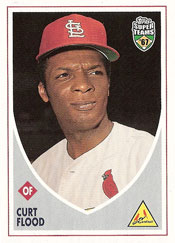
On Sept. 15, 1968, Flood produced five hits in five at-bats, sparking the Cardinals to a 7-4 victory over the Astros at Houston. The win combined with the Giants’ loss to the Reds assured the Cardinals their second consecutive National League pennant and their third in five years.

Flood’s 5-for-5 game also elevated his batting average for the year to .302 and positioned him to become one of the few players to finish the 1968 season with a mark of .300 or better.

Key player

The 1968 Cardinals were a club with four future Hall of Fame players _ Lou Brock, Steve Carlton, Orlando Cepeda and Bob Gibson _ and the reigning single-season home run record holder, Roger Maris, but Flood was an essential part of the team’s success.

Flood in 1968 led all National League center fielders in putouts (384) and assists (11) and he won the sixth of his seven Gold Glove awards. Flood also led the 1968 Cardinals in hits (186), batting average (.301) and on-base percentage (.339) and he ranked No. 1 in the league in singles (160).

Flood was one of six major-league players to achieve a batting mark of .300 or better in 1968. Pete Rose (.335), Matty Alou (.332), Felipe Alou (.317), Alex Johnson (.312) and Flood (.301) did it in the National League and Carl Yastrzemski (.301) was the lone achiever in the American League.

Manager Red Schoendienst usually batted Flood second in the order behind Lou Brock because Flood was able to hit consistently well even though he often took strikes to enable Brock to attempt steals of second base.

In the book “Redbirds Revisited,” Flood said, “Brock made me a better hitter. His ability to rattle the opposition gave me the opportunity to wait on good pitches … I became a more patient hitter up there. I’d take one strike, I’d take two strikes, as I gained confidence at the plate.”

Run generator

Flood went into the three-game series with the Astros determined to cut down on his stride at the plate and the strategy worked. Flood had nine hits in 13 at-bats for the series.

In the Sunday finale, Flood was the ignitor of the Cardinals’ offense.

Flood singled against Don Wilson in the first inning and Brock scored from second on the play. In the third, Flood singled and scored on Maris’ two-run home run, the last of his career, giving the Cardinals a 3-2 lead.

Flood singled and scored on Cepeda’s two-run hit in the fifth, singled and drove in Dal Maxvill from third in the sixth and capped his performance with a fifth single in the eighth.

Brock had three hits, a walk, two runs and a steal, Maris produced three RBI, and Cepeda contributed two hits and two RBI. Carlton struck out nine, went the distance and got the win, though he yielded 11 hits and four walks. Boxscore

Waiting game

With the win, the Cardinals were guaranteed of finishing the regular season in at least a tie for first place atop the 10-team league. The second-place Giants were playing the Reds in San Francisco that afternoon and needed a win to keep their pennant hopes alive.

After beating the Astros, the Cardinals gathered in the visiting team clubhouse, ate fried chicken and baked beans, played cards and monitored radio reports from the Reds-Giants game.

An hour later, when the final out was made in the Reds’ 4-0 triumph over the Giants, the Cardinals were outright champions, holding a 12.5-game lead over the Giants, who had 12 games remaining.

As the Cardinals celebrated with champagne, Cepeda got on top of a table and led the cheers.

“The Cardinals players baptized their newest teammate, 19-year-old catcher Ted Simmons, with champagne and beer after tearing off his undershirt,” the St. Louis Post-Dispatch reported.

Simmons, who joined the Cardinals for weekend games in September while attending college classes at Michigan on weekdays, “shook his head and said, ‘I’ve got to catch a plane to Michigan at 7 o’clock,’ ” the Post-Dispatch reported.

Winning combination

The 1968 pennant was the Cardinals’ 12th. The Sept. 15 date was the earliest they’d clinched a National League championship. “This is the game you wait for from March 1st on,” Flood said to the Associated Press.

Flood credited Gibson, who won 15 consecutive decisions, as the biggest factor in the Cardinals’ successful run to the 1968 pennant. “Gibson having that fantastic streak of his is the most important thing that happened to us this year,” Flood said. “He was winning consistently and pitching complete games, which helped our bullpen.”

The Cardinals finished the season at 97-65, nine wins better than the runner-up Giants at 88-74.

“They’re not selfish as a ballclub,” Schoendienst said. “They’ll give themselves up at bat, move up the runner, or do whatever it takes. It’s just like Flood. He’ll take a strike and give Lou a chance to steal a base. Anytime you get Brock on base, he’s got a chance to score. He’s tough _ and you got Flood hitting behind him.”

Nearly 50 years later, in a 2015 interview with Fox Sports Midwest, Flood’s 1960s Cardinals teammate, catcher Tim McCarver, said Flood was “as good a teammate as any of us had … He was about as conscientious a guy as I ever played with.”

Read Full Post »

(Updated July 26, 2025)

Mark Whiten remains the only Cardinals player to hit four home runs in a game.

On Sept. 7, 1993, in the second game of a doubleheader at Cincinnati, Whiten hit a grand slam, a pair of three-run home runs and a two-run home run, leading the Cardinals to a 15-2 victory over the Reds. Boxscore

“This is the No. 1 achievement I’ve ever witnessed,” Cardinals manager Joe Torre said to the St. Louis Post-Dispatch.

Whiten’s 12 RBI tied the big-league single-game record established by Jim Bottomley of the Cardinals on Sept. 16, 1924, against the Dodgers at Brooklyn. In that game, Bottomley produced six hits _ three singles, a double and two home runs. The home runs were a grand slam and a two-run shot. Boxscore

Whiten was the 12th big-league player to hit four home runs in a game and the first since Bob Horner of the Braves did it on July 6, 1986, against the Expos at Atlanta. Boxscore

Eight major-league players have hit four home runs in a game since Whiten did it, bringing the total number of those who have achieved the feat to 20.

Whiten, Gil Hodges and Josh Hamilton are the only major-league players to hit four home runs in a game and have at least one runner on base for each of the four.

Whiten, a switch-hitter, hit each of his four home runs while batting left-handed against Reds right-handers. Whiten said he hit a fastball on each home run.

“Even though they were fastballs down the middle, you still have to know what to do with them,” Cardinals third baseman Todd Zeile said. “You can’t even do what he did in batting practice.”

Here is a look at each of Whiten’s four home runs, including the calls by KMOX broadcasters Jack Buck and Mike Shannon as published by the Post-Dispatch:

Home run No. 1

In the first inning, Whiten hit a 2-and-0 pitch from rookie starter Larry Luebbers 408 feet to left-center for a grand slam.

Jack Buck on KMOX: “Swing and a long one to left-center. That one won’t be caught. At the wall and goodbye.”

Home run No. 2

In the sixth, Mike Anderson, making his major-league debut, relieved Luebbers and walked the first two batters he faced, Zeile and Gerald Perry. Whiten was the next batter and he drilled the first pitch from Anderson 397 feet to right-center for a three-run home run.

Mike Shannon on KMOX: “Swing and a long one into right field. On the move the right fielder (Tim) Costo can’t get it. Over the wall and seven RBI in the second game for Whiten … Have a big evening and Whiten said, ‘I don’t mind if I do.’ ”

Home run No. 3

In the seventh, Whiten hit a 2-and-1 pitch from Anderson 388 feet to right for another three-run home run.

Jack Buck on KMOX: “Here’s another pitch and another home run by Whiten. He walks down to first base as it is over the fence for a three-run homer.”

Home run No. 4

When Whiten came up in the ninth to face the original Nasty Boy closer, Rob Dibble, the Cardinals had a 13-2 lead, a runner on first and one out.

“Do you think Dibble will come after him?” Jack Buck asked on the air, building the drama for his listeners. “Do you think Dibble will let him swing the bat?”

Dibble’s first two pitches to Whiten were outside the strike zone.

Said Whiten: “I felt he was going to try to pitch around me.”

“”I’m not going to walk him,” Dibble told the Cincinnati Enquirer. “That’s not my style. Put it in play, fine.”

With the count at 2-and-0, Whiten swung at Dibble’s next offering and crushed it 441 feet off the facing of the second-deck seats in right-center for a two-run home run.

Jack Buck on KMOX: “Swing and a long one. Looks like he did it. Four home runs for Mark Whiten. He powdered one over the center field fence … Man, what a blast that was! What a blast this is! … Excuse me while I applaud.”

On Cardinals’ television, Jack’s son, Joe Buck, was doing the play-by-play and his call of Whiten’s fourth home run was: “Into center field. Did he? Yes!”

Said Whiten: “It’s like when Michael Jordan gets in the zone. He’s going to score 50 points. That’s kind of the way I felt.”

Here is a video of all four home runs: Video

Ten years later, Whiten told Gabriel Kiley of Cardinals Gameday Magazine, “I was more excited about the third one because I had never hit more than two in a game in my life. The fourth dinger was icing on the cake.”

Whiten didn’t use his bat model to hit any of the four home runs, Rick Hummel of the Post-Dispatch reported, and “word is he has been using Jose Oquendo’s bat.”

Oquendo hit no home runs for the 1993 Cardinals. “There are plenty of home runs left in that bat,” Torre said.

The next night, in his first at-bat of the game leading off the second against the Reds’ Bobby Ayala, Whiten singled.

“What a bum,” Jack Buck said to listeners in his most endearing wise guy tone. “That’s the best he can do?”

Read Full Post »

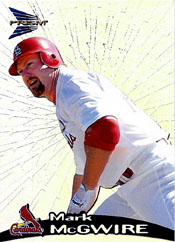
Deep into his tainted pursuit of a home run record, Mark McGwire refused to heed an umpire’s repeated warnings to cease arguing a call and got ejected, prompting a dangerous outburst from some of the St. Louis spectators.

On Aug. 29, 1998, fans at Busch Memorial Stadium threw baseballs, bottles and helmets onto the field when umpire Sam Holbrook tossed McGwire for arguing a called third strike in the first inning of a game between the Braves and Cardinals.
McGwire, well aware he was the reason many had paid to attend the game, could have avoided ejection and protected the umpires from fan backlash if he had acted on any of Holbrook’s three warnings to return to the dugout and stop arguing.

When McGwire continued to rage while standing at home plate, Holbrook, a rookie umpire, banished him from the game.

Crossing a line

A crowd of 47,627 packed into Busch Stadium and thousands more tuned in to a national telecast to watch McGwire, who was in a neck-and-neck race with the Cubs’ Sammy Sosa in a bid to be first to break Roger Maris’ single-season home run mark of 61.

McGwire entered the game with a season total of 54 home runs. He eventually was the first to break Maris’ mark and finished with 70 home runs in what was trumpeted as a feel-good story that brought baseball back from the ill will of the 1994 players’ strike. Years later, McGwire admitted he cheated in pursuit of the record by using banned performance-enhancing drugs to boost his performance.

In retrospect, it’s natural to wonder whether steroids fueled McGwire’s relentless ranting at Holbrook in the game against the Braves.

McGwire, batting third in the Cardinals’ order, came to the plate with two outs in the first inning, worked the count to 3-and-2 and struck out looking against Tom Glavine.

McGwire protested vehemently to Holbrook and used his bat to make a mark in the batter’s box to indicate the pitch was out of the zone. Manager Tony La Russa ran from the dugout to the plate to protect his player. Holbrook warned La Russa to back off, but La Russa ignored him and was ejected. Holbrook asked McGwire to return to the dugout, but McGwire wouldn’t leave.

“The first ejection was La Russa,” Holbrook said to the St. Louis Post-Dispatch. “That could have ended it right there if (McGwire) had walked away.”

Holbrook said to La Russa, “Please get (McGwire) out of here. If you don’t, I’m going to have to eject him.”

La Russa tried but McGwire kept arguing.

“I warned him again,” said Holbrook, who gave McGwire a total of three warnings. “When he continued after that, that’s when I ejected him.”

Cardinals pitching coach Dave Duncan was yelling at Holbrook from the dugout and Holbrook ejected him, too.

“The furthest thing from my mind was to eject Mark McGwire,” Holbrook said. “I bent over backwards not to. I did everything I could to keep him in the game, but at some point I had to draw the line. I tried to walk away a couple of times and he still came back around and continued arguing.”

Said McGwire: “Did I cross the line? Yeah, I probably did. I probably deserved what I got.”

Justice for all

On the national telecast, broadcaster Josh Lewin said, “Do you throw Batman out of Gotham City? That’s what Sam Holbrook just did.”

Post-Dispatch columnist Bernie Miklasz wrote, “The fact that McGwire has a chance to break a home run record is irrelevant. Umpires aren’t supposed to hold players to different standards. They can’t go out of their way to protect McGwire. There should be no special treatment.”

Umpire crew chief Harry Wendelstedt said Holbrook “worked an excellent game” and McGwire “was given ample time to argue.”

“The rules have to stay the same for everybody,” Wendelstedt said.

La Russa, who disagreed with the strike call but not the ejections, said, “I’ve seen umpires get upset, but I watched Sam and he was in control.”

Dumb and dumber

Some of the fans, though, lost control and threw objects onto the field. “It was ugly there for a while,” said Braves outfielder Ryan Klesko.

In the second inning, as the barrage continued, Wendelstedt stopped the game, players scurried into the dugouts and announcements were made over the public-address system and on the scoreboard, informing fans to stop throwing objects onto the field or else a forfeit could be declared.

“For long minutes, the threat of forfeit hung heavy over Busch,” Mark Bradley of the Atlanta Constitution wrote.

Said Wendelstedt: “A forfeit is a very last resort for an umpire … but we don’t want someone to get hurt.”

The St. Louis Police Department called in 15 to 20 extra officers to keep order, the Post-Dispatch reported, and stadium security director Joe Walsh said several fans were ejected.

In addition, about 2,000 spectators departed in the second inning because McGwire no longer was in the game, according to the Atlanta Constitution.

After a 10-minute delay, fans quieted, the game resumed and the Braves went on to win, 4-3. Boxscore

“A national TV audience had to be watching and wondering whether St. Louis really is the best baseball town in America,” the Post-Dispatch opined.

Miklasz described the fan actions as “disgraceful” and added, “If you can’t control yourself, please stay away from Busch Stadium in the future because the rest of us don’t want to be injured as a result of your temporary insanity, your acts of cowardice.”

McGwire said of the fans who threw objects, “That’s wrong … We don’t need that in baseball.”

Miklasz wondered, “Is McGwire Mania officially out of control? … Have we created a monster? Or are we now the monster?”

Read Full Post »

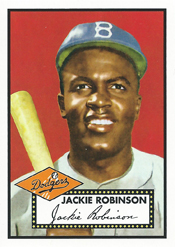
Jackie Robinson hit for the cycle one time in his major-league career and he did it in inverse order against four different Cardinals pitchers.

On Aug. 29, 1948, Robinson produced a home run, triple, double and single for the Dodgers in the first game of a doubleheader at Sportsman’s Park in St. Louis. Robinson also scored three runs, drove in two and had a stolen base, propelling the Dodgers to a 12-7 victory.

In the second game, Robinson had two singles, a sacrifice bunt and a run scored, helping the Dodgers sweep with a 6-4 triumph in 10 innings and lifting them into first place in the National League.

Making a move

The Dodgers won the 1947 National League pennant under manager Burt Shotton, who filled in while Leo Durocher was suspended for association with gamblers. Durocher returned in 1948 and the Dodgers started poorly, losing 19 of their first 31 games. On July 2, they were in last place at 27-35.

On July 16, 1948, Shotton came back to the Dodgers after Durocher departed to manage the Giants. The Dodgers surged and were back in contention entering the doubleheader against the Cardinals.

The first game of the doubleheader matched Dodgers rookie Paul Minner against Cardinals ace Harry Brecheen and attracted 33,826, the biggest crowd of the season at Sportsman’s Park.

Billy Cox opened the game for the Dodgers with a single and Robinson followed with his home run, a line drive over the wall in left. Pee Wee Reese reached on shortstop Marty Marion’s error and Bruce Edwards connected on a two-run home run, giving the Dodgers a 4-0 lead and driving Brecheen out of the game without recording an out.

Until then, Brecheen had yielded three home runs all season.

Extra incentive

Robinson, “spurred by constant boos from the crowd,” according to the New York Daily News, led off the third inning with a triple against Ted Wilks.

In the fourth, Robinson doubled to left against Al Brazle, swiped third and scored on Reese’s line out to center.

Robinson lined out to center in the sixth against Red Munger before he completed the cycle with a single in the eighth off Gerry Staley.

Robinson’s last at-bat of the game in the ninth resulted in a fly out against Jim Hearn.

Described by Bob Broeg of the St. Louis Post-Dispatch as “the nimble Negro star,” Robinson was 4-for-6 in the game.

“He was simply poison to the Cardinals hurlers in the opener,” the Associated Press reported. Boxscore

Pennant push

In the second game, Robinson’s two hits brought his batting average to .300 for the season and the Dodgers’ sweep of St. Louis pulled them into a virtual first-place tie with the Braves. The Dodgers had a 66-51 record and .564 winning percentage and the Braves were 69-54 and .561.

Robinson, in his second Dodgers season after breaking the major league’s segregation practices the year before, finished the 1948 season with a batting mark of .296. He hit .329 in 19 games against the Cardinals in 1948.

After winning 39 of 55 games in their surge from last place to first, the Dodgers eventually faded and finished in third place at 84-70. The Braves won the pennant with a 91-62 record and the Cardinals placed second at 85-69.

Read Full Post »

A reckless, senseless act by Vince Coleman blew up in his face, putting him at risk for a jail sentence and casting him into baseball limbo.

On Aug. 26, 1993, the Mets cut their connection to Coleman, telling him to stay home, after prosecutors charged him with a felony for throwing an explosive device similar to a grenade into a parking lot and injuring three people, including two children.
Though a month remained in the 1993 season and Coleman had another year left on his contract, Mets co-owner Fred Wilpon said Coleman “will not play here again as a Met” regardless of the legal outcome of the case. His stint with them was marred by injuries and controversies until he reached rock bottom with the felony charge.

Follow the money

An outfielder with exceptional speed, Coleman debuted in the major leagues with the Cardinals in 1985, established a big-league single-season rookie record with 110 stolen bases, scored 107 runs and sparked St. Louis to a National League pennant. Coleman was the unanimous choice for the National League Rookie of the Year Award.

Coleman led the league in stolen bases in each of his six seasons with St. Louis, swiping more than 100 three times.

After the 1990 season, when Coleman, 29, became a free agent, the Cardinals offered him a four-year, $10.5 million contract. Coleman rejected it for the Mets’ offer of four years at $11.95 million.

While with the Mets, Coleman had trouble on and off the field. Plagued by damaged hamstrings, he was limited to 72 games and 37 stolen bases in 1991 and 71 games and 24 stolen bases in 1992.

Coleman feuded with manager Jeff Torborg and coach Mike Cubbage and he was suspended for two games after shoving Torborg. In 1992, Coleman was one of three Mets players investigated in a rape allegation until authorities in Port St. Lucie, Fla., determined there wasn’t enough evidence to file charges.

Under attack

On July 24, 1993, Coleman and teammate Bobby Bonilla got into a Jeep driven by Dodgers outfielder Eric Davis after a game at Dodger Stadium. As a prank, Coleman tossed a M-100, described by authorities as a military device having 200 to 300 grains of gunpowder and used to simulate grenades, into the parking lot where a group of people were gathered to seek autographs from players.

The M-100, which packed the equivalent power of a quarter-stick of dynamite, exploded and injured a 2-year-old girl, who suffered second-degree burns to a cheek and damage to an eye and finger; an 11-year-old boy, who had cuts on his shin; and a 33-year-old woman, who complained of vertigo and ringing in her ear, according to the Los Angeles Fire Department.

Salvador Hernandez, who witnessed the incident, told the Los Angeles Times he saw Coleman toss the M-100 and “he definitely meant to throw it at the fans.”

Another witness, Veronica Mayhew, told the New York Daily News the M-100 “started fizzing and everybody thought it was a smoke bomb, but then it just blew up really big and sparks flew everywhere.”

Five days later, Coleman called his actions “inappropriate,” but complained about being portrayed as insensitive and uncaring.

Clear message

Coleman, batting .279 with 38 stolen bases, played his last game for the Mets on July 31, 1993, against the Cardinals at St. Louis. After that, manager Dallas Green, who’d replaced Torborg in May, removed Coleman from the lineup until authorities determined whether to file charges.

On Aug. 3, 1993, the Los Angeles district attorney’s office charged Coleman with one count of unlawful possession of an explosive device. A spokesman said prosecutors opted for a felony charge instead of a misdemeanor because of the strength of the explosive and the injuries. Coleman faced a maximum sentence of three years in jail.

In a prepared statement, Coleman said, “I take full responsibility for a very foolish act for which I am suffering greatly. It was never my intent to hurt anyone.”

At Coleman’s request, the Mets placed him on an unpaid leave of absence.

Meanwhile, public pressure was applied on the Mets to do more to punish Coleman.

_ Steve Serby, New York Daily News: “There really is no point in keeping Vince Coleman around anymore … Coleman is nothing but trouble.”

_ Michael Ventre, Los Angeles Daily News: “Baseball produces a higher percentage of immature knuckleheads than any other sport. Sitting on the throne today as the king of all of them is Coleman … Here’s hoping somebody lowers the boom on Vince.”

_ Bernie Miklasz, St. Louis Post-Dispatch, noting how pitcher Nolan Ryan pummeled Robin Ventura after Ventura charged the mound: “It’s a shame Vince Coleman didn’t charge Ryan … Maybe we ought to have Nolan Ryan clean this game up, administer his brand of frontier justice, and restore baseball’s vanishing morality.”

Three weeks into his leave of absence, the Mets told Coleman he never would be welcomed back to the team.

“I think it would be in Vince Coleman’s best interests and the New York Mets’ best interests that he never wear a New York Mets uniform again,” Wilpon said.

Said Green: “You’ve got to have guys who care about their responsibilities as a professional and care about the organization and care about winning. There were times that wasn’t Vinny’s first goal.”

Plea bargain

Coleman hired Robert Shapiro to be his defense attorney. Shapiro, one of the lawyers who represented O.J. Simpson in his double-murder trial, sought to have the charge against Colman reduced to a misdemeanor.

On Oct. 22, 1993, Coleman entered a plea of innocent to the felony charge in municipal court in Los Angeles. Two weeks later, on Nov. 5, after Shapiro and prosecutors negotiated an agreement, Coleman pleaded guilty to a misdemeanor charge of possession of an explosive device.

A one-year jail term was suspended. Coleman was given three years of probation and assigned 200 hours of community service. He also agreed to make restitution to the three people he injured.

Deputy district attorney Bill Hodgman said he consulted with the victims and their families to determine whether to accept the plea agreement and all agreed he should, the Associated Press reported.

“I’m relieved, very relieved,” Coleman said. “I’m sorry it happened. I’ve suffered dearly.”

On Jan. 5, 1994, the Mets traded Coleman to the Royals for outfielder Kevin McReynolds.

Coleman played four more big-league seasons with four teams, Royals, Mariners, Reds and Tigers, before making an unsuccessful comeback bid with the Cardinals in 1998.

Read Full Post »

(Updated Nov. 26, 2024)

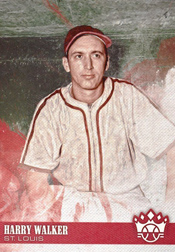
Harry Walker and Vince DiMaggio, members of prominent baseball families, displayed dazzling speed and skills in making plays against one another in a game between the Cardinals and Pirates.

On Aug. 31, 1943, at Pittsburgh, Walker drove a ball past DiMaggio in center field and circled the bases for a two-run inside-the-park home run, lifting the Cardinals to a 4-2 victory.

Walker might have had another inside-the-park home run earlier in the game, but DiMaggio made a sensational catch to deprive him.

All in the family

Harry Walker made his major-league debut with the Cardinals in 1940. After spending parts of three seasons (1940-42) with the Cardinals, he was their starting center fielder in 1943.

Harry was the fourth member of his family to play in the big leagues. His father, Ewart Walker, was a pitcher with the Senators from 1909-12 and his uncle, Ernie Walker, was an outfielder with the Browns from 1913-15. Harry’s brother, Dixie Walker, was the best-known, playing 18 seasons (1931 and 1933-49) in the majors as a hard-hitting outfielder with the Yankees, White Sox, Tigers, Dodgers and Pirates. Dixie’s given name was Fred and he was eight years older than Harry.

Vince DiMaggio was the oldest of three brothers who became outfielders in the big leagues. Vince made his major-league debut with the Braves in 1937. Joe DiMaggio, two years younger than Vince, got to the big leagues first, with the Yankees in 1936, and played 13 seasons in a Hall of Fame career. Dom DiMaggio, five years younger than Vince, played for the Red Sox for 11 years after debuting with them in 1940.

In the book “My Greatest Day in Baseball,” Cardinals pitcher Dizzy Dean said a nightclub owner, Johnny Perkins, bet him he wouldn’t strike out Vince DiMaggio the first time he came up in a game at Boston.

“I did, and when I went back to the bench I made motions to (Perkins) I’d double the bet the next time,” Dean said. “I struck (DiMaggio) out again, and I put everything back on a third bet, and I fanned him three straight times.

“Then Perkins wanted to make it all or nothing, so I took him, and when DiMaggio came up again he lifted a pop foul back of the plate. I thought (Bruce) Ogrodowski was going to catch it, and I ran and hollered, ‘Let it go, let it go.’ He couldn’t get the ball anyway, as it turned out, because it hit the screen, but I’d have bumped him sure as hell if he’d got under it. I wanted to win that bet. I struck DiMaggio out on the next pitch. Four straight times!” Boxscore

Vince was dealt by the Braves to the Yankees on Feb. 4, 1939, and was assigned to their minor-league club at Kansas City. Vince never did join Joe on the Yankees. On Aug. 5, 1939, Vince was acquired by the Reds and, nine months later, in May 1940, the Reds traded him to the Pirates. Vince became the Pirates’ starting center fielder, succeeding Lloyd Waner. In 1941, Vince produced 21 home runs and 100 RBI.

On the run

In the 1943 game at Pittsburgh, the Cardinals had runners on second and third, one out, when Harry Walker faced Pirates starter Bob Klinger in the third inning at Forbes Field. Walker, a left-handed batter, lined a pitch to right-center and Vince DiMaggio gave chase.

“DiMaggio was racing backward at full speed when he glanced back, leaped” and speared the ball on the dead run, the St. Louis Post-Dispatch reported.

The Pittsburgh Press said, “If Vince hadn’t made that final stretch, Walker would have had an inside-the-park homer.”

According to the Post-Dispatch, “DiMaggio made as fine a catch as you’ll ever see on a ballfield.”

Marty Marion tagged and scored from third on the play, giving the Cardinals a 1-0 lead, and Walker was credited with a RBI.

Finding the gap

In the ninth, with the score tied at 2-2, the Cardinals had pitcher Red Munger on second base with two outs and Walker at the plate against Klinger. Walker hit a drive to left-center and DiMaggio again took off in pursuit.

“Vince made a desperate lunge for the ball,” the Post-Dispatch reported, but it landed just beyond his reach and skidded to the wall.

Munger scored easily from second with the go-ahead run and Walker circled the bases for an inside-the-park home run and a 4-2 Cardinals lead. Munger retired the Pirates in order in the bottom half of the inning, sealing the victory for St. Louis. Boxscore

The home run was the second of Walker’s big-league career. A line-drive hitter who sprayed the ball to all fields rather than an upper-cut swinger, Walker hit 10 home runs, including two inside the park, in 11 major-league seasons.

Read Full Post »

« Newer Posts - Older Posts »