Feeds:
Posts
Comments

Archive for the ‘Managers’ Category

(Updated Feb. 27, 2023)

In a union of Hall of Famers, Stan Musial hired Warren Spahn to be a manager in the Cardinals organization.
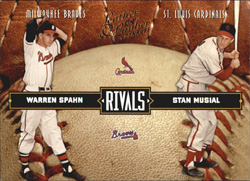
spahn_musialOn Feb. 25, 1967, a month after he was named Cardinals general manager, Musial bypassed Sparky Anderson and selected Spahn to be manager of Class AAA Tulsa.

Anderson had managed the Cardinals’ Class A St. Petersburg club to a league championship in 1966 and reportedly was the top internal candidate for the Tulsa opening.

Spahn, who never had managed, was the recommended choice of Tulsa owner A. Ray Smith.

Though Cardinals executives such as farm director George Silvey had input, Musial, as general manager, had the final decision regarding who to hire as manager for the Cardinals’ top affiliate.

Matchup of marvels

In Spahn, Musial chose the candidate who had been his respected nemesis during their Hall of Fame playing careers.

Spahn, who pitched 21 seasons in the major leagues, primarily with the Braves, is the all-time leader in career wins (363) among left-handers. Musial, who played 22 seasons in the major leagues, all with the Cardinals, is the all-time leader in total bases (6,134) among left-handed batters.

Their matchups spanned the 1940s to 1960s. Musial has a career .318 batting average and .412 on-base percentage against Spahn, according to the Web site retrosheet.org. Musial has more hits (104), doubles (23), triples (6) and walks (50) versus Spahn than any other player. Only Willie Mays (18) hit more home runs against Spahn than Musial (17) did.

In his 1964 book “Stan Musial: The Man’s Own Story,” Musial called Spahn “the best National League pitcher of my era.”

“Spahnie was more than a student of pitching,” Musial said. “He was a scientist.”

Musial concluded, “It was a great challenge to hit against this cunning guy … and I’m proud to have done well.”

Spahn told writer Roger Kahn, “Musial was just the hardest man to fool … I tried to upset Stan’s timing with breaking stuff and changeups. Once Musial started timing fastballs, your infielders’ lives were in jeopardy.”

Pressure on Stan

If not for Bob Howsam’s departure, Musial and Spahn might never have worked together and Anderson might not have left the Cardinals.

On Jan. 22, 1967, Howsam resigned as Cardinals general manager and became executive vice president and general manager of the Reds. Musial, a Cardinals vice president, took on the additional role of general manager.

One of Howsam’s cronies was Tulsa manager Charlie Metro, who was waiting in the wings in case Cardinals manager Red Schoendienst faltered. Metro followed Howsam to the Reds, accepting a job as a scout.

With spring training close to opening, Musial and the Cardinals had to scramble to find a replacement for Metro in Tulsa.

Spahn, 45, was residing on his 2,800-acre cattle ranch in Hartshorne, Okla., about 120 miles from Tulsa. He made it known he wanted to get back into baseball. Smith was thrilled by the possibility of having a baseball icon manage his club, so the Oilers owner went to work on trying to convince Musial to make it happen.

On Feb. 20, 1967, Musial said Smith’s request was under review and he hoped to announce a choice soon, The Sporting News reported.

Musial was pressured to select a candidate from within the Cardinals’ organization, “but we fought a hard fight” for Spahn, Smith told the Associated Press.

Though Anderson was “first choice for the position,” according to The Sporting News, Spahn got the Tulsa job. Anderson was assigned to manage the Cardinals’ Class A club at Modesto, Calif.

Rookie manager

Spahn’s hiring was announced by Smith at a news conference at Tulsa’s prestigious Southern Hills Country Club.

“The Oilers and Tulsa are mighty lucky to get a man of Spahn’s caliber,” Smith said.

Said Spahn: “I’ve always wanted an opportunity to manage. The ranch is great, but it’s more like a plaything. I’d like to manage in Tulsa for 10 years. Naturally, I’m for a major-league job someday, but first I’ve got to earn that.”

Tulsa opened the 1967 season with a roster featuring pitchers Tracy Stallard and Wayne Granger; catchers Pat Corrales and Sonny Ruberto; infielders Elio Chacon, Bobby Dews and Coco Laboy; and outfielder Danny Napoleon.

Other managers in the Pacific Coast League in 1967 included Chuck Tanner of the Seattle Angels, Whitey Lockman of the Tacoma Cubs, Bob Skinner of the San Diego Padres and Mickey Vernon of the Vancouver Mounties.

Under Spahn, Tulsa had a dismal 1967 season (65-79), though he did receive high marks for helping to develop starting pitchers Mike Torrez (10 wins) and Hal Gilson (15 wins). Silvey noted Spahn “must have helped Torrez quite a bit. Mike has added a curve and he’s faster.”

Anderson led Modesto to a 79-61 record and a league championship in 1967. After the season, Anderson joined the Reds as manager of their Class AA Asheville club.

Anderson “was so upset at being bypassed (for the Tulsa job) that he quit the Cardinals organization,” The Sporting News reported.

Two years after leaving the Cardinals, Anderson was named manager of the Reds and went on to build a Hall of Fame career.

Ups and downs

In 1968, Spahn took Tulsa from worst to first. The Oilers finished 95-53 and won the league championship.

Spahn managed Tulsa in 1969 (79-61), 1970 (70-70) and 1971 (64-76) before he was fired by Cardinals general manager Bing Devine.

“Devine said I had been here five years and there were young prospective managers in the organization who needed to move up,” Spahn said.

Though Spahn went on to work as a coach and instructor with other organizations, Tulsa would be the only team he would manage.

Previously: Warren Spahn and his Cardinals connection
 

Read Full Post »

(Updated July 6, 2024)

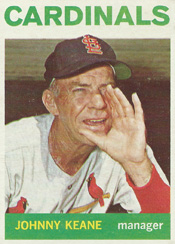
After being fired from his job as Yankees manager in 1966, Johnny Keane was looking forward to rebuilding his career in 1967. The Angels had hired him to be a special assignment scout. Keane hoped that role would position him to become a big-league manager again and provide him the chance to replicate the success he had when he led the 1964 Cardinals to a World Series title.

johnny_keane3The spirit was willing, but the body was not.

On Jan. 6, 1967, Keane, 55, died of a heart attack at his home in Houston.

Code of honor

Keane, a St. Louis native who studied for the priesthood at St. Louis Prep Seminary, abided by a principled personal code of fair play, dignity and loyalty.

In August 1964, Cardinals owner Gussie Busch violated that code by firing Keane’s friends, general manager Bing Devine and business manager Art Routzong, and plotting to replace Keane with Leo Durocher. Unwilling to continue working for Busch, Keane resigned following the Cardinals’ World Series triumph over the Yankees. Five days later, he became Yankees manager, inheriting a club of fading, injury-prone players.

When the Yankees finished with a 77-85 record in 1965 and followed that by losing 16 of their first 20 games in 1966, Keane took the fall.

Some believed the emotional toll of Keane’s departures from the Cardinals and Yankees within a span of 19 months contributed to his death.

In a less romanticized view, St. Louis Post-Dispatch sports editor Bob Broeg, knowing Keane’s resiliency, wrote, “There is a tendency among the poets in the press box to suggest (Keane) died of a broken heart. Possibly, but not probably.”

Career Cardinal

Keane devoted most of his professional career to the Cardinals, working for them in four decades. He joined their farm system as a shortstop in 1930. Five years later, he was struck in the head by a pitch from Sig Jakucki and suffered a fractured skull.

“It happened in Houston,” Keane recalled to the Philadelphia Daily News. “I hit a home run off a pitcher the night before. The next night he came back in relief and he hit me. Crazy pitcher.”

In 1938, Keane became player-manager for the Cardinals’ farm club in Albany, Ga. He spent 21 seasons as a manager in the St. Louis farm system and had winning records in 17 of those years.

Keane was a candidate to become Cardinals manager in 1951, but the job went to Marty Marion. Twice after that, Keane rejected offers to become a Cardinals coach because, “I wanted to go up as a manager,” he told The Sporting News.

In 1959, Keane, on the advice of Devine, reconsidered his stance and made it to the major leagues for the first time as a coach on the staff of Cardinals manager Solly Hemus. Keane replaced Hemus in July 1961 and led the Cardinals to a 47-33 record. The Cardinals also produced winning records in Keane’s three full seasons as their manager: 84-78 in 1962, 93-69 in 1963 and 93-69 again in 1964.

My way

With players such as Mickey Mantle, Roger Maris and Tony Kubek sidelined by injuries, the Yankees under Keane went from champions to also-rans.

Mantle didn’t like Keane’s attempt to instill discipline among the Yankees. In his autobiography, “The Mick,” Mantle called Keane “a drill sergeant” with “silly little high school rules.”

“I kept my distance,” Mantle said. “When we did talk, there were no arguments. More often than not, we had staring contests. Eventually the situation got so bad that if I had been financially set, I would’ve retired at the end of the (1965) season.”

When the Yankees decided Keane no longer should be their manager, they offered to make a deal with him to prevent the move from being announced as a firing. Keane refused to go along with the scheme.

“Yes, that’s what happened,” Keane said to Chuck Fierson of the Oneonta (N.Y.) Star. “The Yanks told me that if I said I was retiring because of my health they would give me a job in the front office. But my health is OK and I don’t want a front office job. Besides that, I didn’t like the idea of making up excuses.”

New York columnist Red Smith wrote, “There is something depressing about a business that makes a gentleman of John Keane’s dignity and integrity a victim of the system.”

Three months later, in July 1966, the Braves fired manager Bobby Bragan. Keane was their choice to replace him, according to columnist Dick Young in The Sporting News, but Keane didn’t want to step in until the season was completed.

“He preferred to start fresh,” Young said.

Billy Hitchcock, a Braves coach, was named interim manager. When Hitchcock led the Braves to a 33-18 mark to finish the season, the interim tag was removed from his title and Keane was out of the picture.

True gentleman

By December 1966, Keane, eager to get back into baseball, was grateful to receive the offer to scout for the Angels.

To prepare for his role, Keane bought a car on Jan. 6, 1967, so that he’d have a reliable vehicle to take him on scouting trips.

After dinner that evening, Keane told his wife he was feeling ill. At 10:30, Keane collapsed and died.

Dr. William Sutton, Keane’s physician, said Keane “had been under treatment for heart trouble and high blood pressure, but had not suffered a previous heart attack,” the Post-Dispatch reported.

Reacting to news of Keane’s death, Ken Boyer, third baseman for the 1964 Cardinals, said Keane was the type of person “you would be proud to have for a brother or father.”

Yankees pitcher Whitey Ford said Keane “was the first person to visit me in the hospital after my operation last season _ and that was after he had been dropped as manager.”

In his book “Whitey and Mickey,” Ford said, “I liked Johnny Keane. He was a great man, a decent man, and I pitched a lot for Keane. He just got there at the wrong time.”

Yankees president Michael Burke noted Keane “won everyone’s respect” and “his own self-respect and quiet sense of personal dignity was never compromised.”

In his book “From Ghetto to Glory,” Cardinals pitcher Bob Gibson called Keane “one of the nicest people I ever met in my life” and said Keane’s death “probably affected me as much as anybody’s I’ve ever known.”

Faithful friends

The funeral for Keane was held in Houston three days after his death. Among the pallbearers were Devine, Routzong and two of Keane’s coaches from his Cardinals staff, Vern Benson and Howie Pollet.

Milt Richman of United Press International wrote that Keane “had more friends than he knew” and Keane and Devine “were almost like brothers.”

Keane was survived by his wife, daughter and two grandsons.

Three months after the funeral, Young reported that, although Keane had been employed by the Angels for only one month, the club honored him by paying his widow the year’s salary Keane would have received as special assignment scout.

Read Full Post »

(Updated Sept. 10, 2022)

In a move made as much for its public relations value as for on-field leadership, the Cardinals, in effect, hired two managers to replace Rogers Hornsby.

bob_ofarrellA week after Sam Breadon created an uproar when he traded Hornsby rather than agree to his contract demands, the Cardinals’ owner attempted to quell the controversy by naming one of the club’s most popular players as manager.
On Dec. 27, 1926, Bob O’Farrell, a Cardinals catcher and recipient of the 1926 National League Most Valuable Player Award, was chosen as Hornsby’s successor. At the same time, Bill McKechnie, former Pirates manager, was hired as Cardinals coach and assistant to O’Farrell.

O’Farrell, 30, had no experience managing. McKechnie, 40, had managed the Pirates for five seasons (1922-1926) and led them to a NL pennant and World Series championship in 1925. The Pirates produced winning records every year under McKechnie and finished no lower than third place. He was fired when the defending champion Pirates placed third, 4.5 games behind the first-place Cardinals, in 1926.

McKechnie had been considered a candidate to replace Hornsby, but Breadon opted instead for a manager who already was well-liked by fans and players.

Like latter-day Cardinals catchers such as Tim McCarver, Ted Simmons and Yadier Molina, O’Farrell was smart, talented and respected.

O’Farrell batted .293 with 30 doubles for the 1926 Cardinals, handled the pitching staff superbly and led NL catchers in putouts. In the 1926 World Series against the Yankees, O’Farrell hit .304 and threw out Babe Ruth attempting to steal, ending Game 7 and sealing the Cardinals’ championship.

Who’s the boss?

Few could have predicted the Cardinals would be seeking a manager in December 1926.

Hornsby, a second baseman who won the NL batting title in six consecutive seasons (1920-25) with the Cardinals, became their player-manager in 1925, replacing Branch Rickey.

After Hornsby, 30, led the Cardinals to their first pennant and World Series crown in 1926, he demanded a three-year contract. Breadon offered a one-year deal. When Hornsby persisted, Breadon traded him to the Giants on Dec. 20, 1926, incurring the wrath of Cardinals fans. The St. Louis Chamber of Commerce was so upset it asked Breadon to withdraw his membership in the group.

In the book “The Glory of Their Times,” O’Farrell said, “Hornsby was a great manager as far as I’m concerned. That (1926) year in St. Louis he was tops. He never bothered any of us. Just let you play your own game.”

Breadon offered O’Farrell a one-year contract to be player-manager. The catcher called Hornsby and sought his approval. Hornsby assured O’Farrell he wouldn’t be disloyal if he accepted the offer. Breadon was relieved when he did.

O’Farrell told author Lawrence Ritter, “I didn’t want to be the manager. I was in the prime of my (playing) career, and managing always takes something away from your playing.”

Likeable leader

In the St. Louis Star-Times, James Gould wrote, “The naming of O’Farrell undoubtedly will be as popular a choice as could be made under the circumstances … None is better liked by his teammates.”

The St. Louis Post-Dispatch called O’Farrell “the only man perhaps who was sure to be received pleasantly by the fans and the players.”

Breadon was “as jubilant as a 2-year-old” when he got both O’Farrell and McKechnie, the Star-Times reported.

“The offer I made to O’Farrell was positively the only one I made to anyone since Hornsby was traded,” Breadon said. “… He is absolutely the only man who could be chosen for the post. But the greatest joy of all was the signing of McKechnie.”

Breadon said McKechnie “ought to help O’Farrell guide the Cards to their second pennant.”

Unfair to O’Farrell

O’Farrell said “I never dreamed” of inheriting a World Series championship team. “I consider Hornsby the greatest manager I ever saw and just as he let the club play its own games I will let the fellows do their own thinking.” O’Farrell said. “You can’t think for 25 men.”

Hornsby, who also had no managing experience when he got the job, said O’Farrell was “a fine choice” and “he ought to make a good manager.”

Noting his proven skill in working with pitchers, The Sporting News suggested O’Farrell “probably knows more about the pitching part … in a day’s workout than Hornsby would learn second hand in a year.”

Set back by injuries and with his focus on managing, O’Farrell was limited to 61 games in 1927. Splitting the catching chores with Frank Snyder and Johnny Schulte, O’Farrell hit .264 with 10 doubles.

As manager, O’Farrell led the 1927 Cardinals to a 92-61 record _ better than the 89-65 mark of the 1926 championship club _ but St. Louis finished in second place, 1.5 games behind the Pirates.

Breadon replaced O’Farrell with McKechnie and gave O’Farrell a pay raise to remain on the team as a catcher in 1928. His tenure, though, was short-lived. In May 1928, O’Farrell was traded to the Giants. McKechnie led the Cardinals to the 1928 pennant.

Read Full Post »

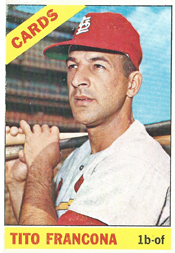
As a utility player with the Cardinals, Tito Francona was thinking about his future. The idea of becoming a manager appealed to him.

tito_franconaIn 1966, Francona said “he had learned a lot on the sidelines that should help him in his hoped for career as a manager,” The Sporting News noted.

Francona, who played 15 seasons in the majors, including two (1965 and 1966) with the Cardinals, never did get to fulfill his dream of becoming a manager. After 1970, his final season as a player, Francona became a Pennsylvania parks and recreation director, according to a biography by the Society for American Baseball Research.

It was Francona’s son, Terry, who would become a manager, winning World Series titles with the Red Sox in 2004 and 2007 and an American League pennant with the Indians in 2016.

Like his father, Terry also was a big-league player, primarily a first baseman and outfielder, who spent 10 years (1981-90) in the majors, mostly with the Expos.

Terry was 5 years old when his father was acquired by the Cardinals from the Indians in a cash transaction on Dec. 15, 1964, two months after St. Louis had won the World Series championship.

Bound for Browns

John Francona was born in Aliquippa, Pa., about 25 miles north of Pittsburgh, in 1933 and was nicknamed Tito _ which, in Italian, means Giant _ by his father.

In 1952, at 18, Francona signed with the St. Louis Browns. “They were at the bottom (of the American League) and I figured I’d have a better chance of moving up fast with them,” Francona told The Sporting News in 1964.

Francona never made it to St. Louis with the Browns. The franchise relocated to Baltimore in 1954 and became the Orioles. Francona made his big-league debut with the 1956 Orioles.

In 1959, Francona had his best big-league season, batting .363 with 145 hits in 122 games for the Indians. In 1961, his lone season as an all-star, Francona batted .301 and had career highs of 178 hits and 85 RBI for the Indians.

A left-handed batter, Francona sprayed the ball to all fields. The Indians, though, were seeking more power from a corner outfielder. After the 1964 season, in which he hit .248 in 111 games, Francona was put on the trading block.

The Indians offered to trade Francona, catcher Johnny Romano and pitcher Gary Bell to the Twins for catcher Earl Battey, pitcher Dick Stigman and outfielder Jimmie Hall, The Sporting News reported, but the proposal was rejected. The Indians also talked with the Cubs about a deal involving Francona and others for outfielder Billy Williams, but that also fell through.

Unable to package Francona in a major trade, the Indians sold his contract to the Cardinals for cash. After nine seasons in the American League, Francona would be playing in the National League for the first time.

Quality move

The Cardinals envisioned Francona, 31, as a pinch-hitter and backup to Mike Shannon in right field and to Bill White at first base. His acquisition generally was seen as a shrewd move by general manager Bob Howsam.

“Tito’s not too old and the St. Louis ballpark was made for good left-handed hitters,” Phillies pitcher Jim Bunning said to The Sporting News.

Phillies first baseman Roy Sievers added, “Tito can do a lot of things well … He can do a good job in the outfield and he’s an excellent backup man for Bill White at first base … The short porch in right field at Busch Stadium will help him a lot.”

Francona batted .259 in 81 games for the 1965 Cardinals, including .265 as a pinch-hitter. On July 9, 1965, with the score tied at 1-1 in the eighth inning at Wrigley Field, Francona smacked a three-run home run against ex-Cardinal Lindy McDaniel, propelling St. Louis to a 7-3 victory versus the Cubs. Boxscore

Used in the same role by the Cardinals in 1966, Francona slumped to .212 in 83 games, including .171 as a pinch-hitter.

Goodbye to good guy

In spring training 1967, Bobby Tolan, 21, beat out Francona, 33, for the role of left-handed pinch-hitter and backup outfielder and first baseman.

On April 10, a day before the Cardinals opened the 1967 regular season, Stan Musial, in one of his first transactions as general manager, sold Francona’s contract to the Phillies.

Noting that the Cardinals received an amount greater than the $20,000 waiver price in the deal, the St. Louis Post-Dispatch reported, “The indication is that the Cardinals felt Francona had to play regularly to be of help with his bat and the Redbirds have several younger ballplayers to move in at first or the outfield.”

In 1969 and 1970, Francona played for an Athletics team that included infielder Tony La Russa and catcher Dave Duncan. In 2004, La Russa was manager and Duncan was pitching coach of a Cardinals team that played in the World Series against manager Terry Francona’s Red Sox.

La Russa told the Post-Dispatch then that he and Tito Francona had roomed together on road trips with the Athletics.

“Some guys treated me like I shouldn’t be there … but not Tito,” said La Russa, who was a light-hitting reserve infielder. “He was just a terrific roommate and a very, very helpful guy.”


Read Full Post »

Concerned about the direction of a franchise that had gone eight consecutive years without qualifying for the postseason, the Cardinals pushed sentiment aside and fired manager Red Schoendienst.

red_schoendienst11On Oct. 5, 1976, general manager Bing Devine informed Schoendienst he was out after 12 seasons as manager.
Schoendienst, who had built a Hall of Fame career as a Cardinals second baseman in the 1940s and 1950s, won two National League pennants (1967 and 1968) and a World Series title (1967) as St. Louis manager.

From 1969 through 1976, though, with a core that included Bob Gibson, Lou Brock, Ted Simmons and Joe Torre, the Cardinals never reached the postseason, even though a division format had expanded the number of teams that qualified.

In 1976, the Cardinals had an abysmal season. Their 72-90 record gave them a .444 winning percentage, their lowest since the .442 mark of the 1955 Cardinals (69-86).

“There are times, regardless of one’s capabilities, when a different perspective is in order,” Cardinals owner Gussie Busch said in explaining the decision to fire Schoendienst.

Devine told Neal Russo of the St. Louis Post-Dispatch he recommended the move to Busch.

“I felt a change in managers was in the best interests of the club,” Devine said. “We wanted a new approach, a new atmosphere.”

Red’s assessment

Schoendienst said he was “absolutely surprised” by the firing.

“I thought I did a good job with the young kids,” Schoendienst said. “I don’t think anyone could have done any better with the club this year. It was great to see some of the kids playing so hard and showing so much potential. That’s why I would have liked to be around another year.”

In the book “Red: A Baseball Life,” Schoendienst said of the firing, “It caught me a little off guard … The organization decided to make changes. It was as simple as that and there really was no argument I could make. I never second-guessed myself. I never regretted any move or decision I made and I was happy with the job I had done.”

Old school

The 1976 Cardinals had an array of players who were 24 or younger, including infielders Keith Hernandez, Garry Templeton and Hector Cruz, outfielder Jerry Mumphrey and pitchers John Denny, Pete Falcone an Eric Rasmussen.

Some critics thought Schoendienst didn’t connect with the younger players.

“What hurt him most was that we’re a young club and maybe Red’s managing is  directed more to a veteran ballclub _ just let ’em go out there and play,” Cardinals pitcher John Curtis said to Dick Kaegel of the Post-Dispatch. “I think you need a stronger approach than that. You need to reinforce things.”

The 1976 Cardinals, though, had the fewest saves (18) in the NL and committed the second-most errors (174), indicating the personnel, not the manager, was the problem.

In an article for The Sporting News, Russo, who covered the team on a daily basis, wrote, “Key injuries, erratic defense, disappointing pitching and the failure of the offensive leaders to produce doomed Red in ’76. There had been criticism of Red as being too easy-going, but the fact remains that his style was preferred by most players and observers.”

Schoendienst told longtime writer Bob Broeg, “I’m not going to kick benches or kick bats. I had meetings with the team and I asked them for 100 percent.”

Replacing Red

Two days after firing Schoendienst, the Cardinals hired Vern Rapp, a minor-league manager and former Cardinals prospect, to replace him.

Said Schoendienst: “I don’t expect to be working for the Cardinals in some other capacity _ at least not now. But maybe I’ll be back in a few years.”

Schoendienst became a coach for the 1977 Oakland Athletics on the staff of manager Jack McKeon.

in 1978, a month into his second season as Cardinals manager, Rapp was fired and replaced by Ken Boyer.

After two seasons with the Athletics, Schoendienst returned to the Cardinals as a coach on Boyer’s staff in 1979.

When Boyer was fired in 1980, Schoendienst served a stint that season as interim manager for the Cardinals. He was on the coaching staff of manager Whitey Herzog when the Cardinals returned to the postseason in 1982 and won the World Series championship.

Schoendienst served on the Cardinals coaching staffs of managers Boyer, Herzog and Torre from 1979-95.

Previously: The pitfalls of Cardinals rookie manager Vern Rapp

Previously: How Red Schoendienst became Cardinals manager

Read Full Post »

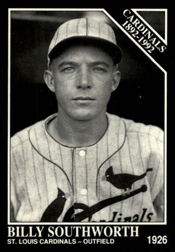
Three months after he was traded by the Giants to the Cardinals, Billy Southworth hit a home run against his former team, providing the winning run in the victory that clinched the first National League pennant for St. Louis.

billy_southworth4It was sweet revenge for Southworth, whose deteriorating relationship with Giants manager John McGraw led to the trade.

On Sept. 24, 1926, Southworth broke a 3-3 tie with a two-run home run in the second inning, carrying the Cardinals to a 6-4 victory over the Giants at the Polo Grounds in New York. The victory gave the Cardinals a three-game lead over the second-place Reds with two remaining.

In a biography of Southworth by author John C. Skipper, Southworth said, “I couldn’t have asked for a better setting, in the Polo Grounds against the Giants who had traded me. That was the timeliest home run I ever hit and to have hit it against the Giants, with McGraw snarling his defiance from the bench, made it doubly thrilling and satisfying.”

Quite a comeback

Southworth, a right fielder, was traded by the Giants to the Cardinals on June 14, 1926. “I was unable to subordinate myself to McGraw’s rigid system,” Southworth explained. “So when he decided, in 1926, that I was, from his viewpoint, hopeless, he traded me with no personal feeling one way or the other.”

Contributing to their pennant push, Southworth hit .317 in 99 games for the 1926 Cardinals.

To pitch the potential pennant clincher against the Giants, Cardinals manager Rogers Hornsby chose 20-game winner Flint Rhem as his starter.

After the Cardinals failed to score in the top of the first against Hugh McQuillan, Bill Terry slugged a three-run home run off Rhem in the bottom half of the inning.

Said Southworth: “Hornsby poured acid on us when we came back to the bench. He told us we hadn’t been taking our full cuts at the ball for several games and to get out there and swing.”

Hornsby’s words woke up the Cardinals.

In the second, Les Bell doubled and, with one out, advanced to third on a wild pitch. Bell scored on Bob O’Farrell’s infield single. The No. 8 batter in the order, Tommy Thevenow, doubled, moving O’Farrell to third.

Rhem was due up next, but Hornsby lifted him for a pinch-hitter, Specs Toporcer.

Toporcer, who hit .391 as a pinch-hitter for the 1926 Cardinals, drilled a two-run double, tying the score at 3-3.

After Taylor Douthit flied out, Southworth batted and hit his home run into the upper deck in right field, giving the Cardinals a 5-3 lead.

Bill Sherdel, who relieved Rhem, held the Giants to one run in eight innings and got the win. Boxscore

Dancing downtown

In downtown St. Louis that Friday afternoon, the game was broadcast over loudspeakers set up for the public.

When Sherdel nailed down the final out, sealing the Cardinals’ victory, it “loosed bedlam in the downtown district,” according to the St. Louis Post-Dispatch.

“Scenes comparable only with the ending of the Great War were enacted in the business section and repeated upon a smaller scale in other centers of the city’s life,” the newspaper reported. “Blizzards of paper enveloped every office building in the downtown area between Twelfth Boulevard and Fourth.”

Wrote the Associated Press: “Traffic at the principal corners was in a hopeless jam. Policemen, trying vainly to keep some semblance of order, were unable to keep the automobiles and street cars moving. Parades formed on Olive Street, Washington Avenue and other principal thoroughfares.”

At the Polo Grounds, the victorious Cardinals “merely smiled as they hurried to the clubhouse, shaking hands and slapping one another on the back” wrote the Associated Press.

That night, reported J. Roy Stockton in the Post-Dispatch, “as the young men sat around the lobby of the Alamac Hotel, accepting congratulations and reading telegrams from friends back home, they appeared suddenly to have knocked 10 years off their age.”

Confident Cards

Contacted by the Associated Press, Cardinals owner Sam Breadon said, “Nothing could possibly have made me happier than the winning of the pennant. When I took charge of the club seven years ago, I did it with the sole hope of winning a championship for St. Louis.”

Asked about the Cardinals being matched against the American League champion Yankees in the 1926 World Series, Hornsby boasted to The Sporting News, “Of course we are going to win the world’s championship. We have the punch and that means we do not fear the Yankees’ pitchers. We have better pitchers of our own, for that matter. Also, a faster fielding team.”

The Cardinals went on to win four of seven games against the Yankees, earning the World Series title.

Previously: How Cardinals got Grover Cleveland Alexander

Read Full Post »

« Newer Posts - Older Posts »